
Business
5 Best Hardware Asset Management Software for Businesses


Hardware Asset Management Software exists to close that gap, but picking the wrong one means you’re still chasing ghost assets and untracked devices across your fleet.
The real challenges show up fast: shadow IT creating security blind spots, end-of-life hardware slipping through the cracks, and devices scattered across remote locations that nobody can account for. After reviewing the top platforms in this space, this guide breaks down the five best options to consider.
The research approach for this ranking
Public information formed the backbone of this evaluation: user reviews, case studies, feature documentation from official websites, and ratings pulled from major software directories. Only platforms with a track record of serving enterprise software environments made the cut.
→ See the full research breakdown
- Workwize – Best for global IT asset lifecycle management for distributed enterprises
- Teqtivity – Best for IT asset management and lifecycle tracking
- Work Elevate – Best for enterprise IT operations and service desk automation
- Device42 – Best for IT infrastructure discovery and asset management
- Firstbase – Best for global IT asset management and hardware lifecycle automation
Why Hardware Asset Management Software Matters
Running an enterprise without the right Hardware Asset Management Software is a bit like managing a warehouse blindfolded. You know assets are moving, but you can’t always say where they are, who has them, or whether they’re still under warranty. Shadow IT alone can quietly undermine your security posture, with untracked devices creating vulnerabilities that nobody catches until something goes wrong. End-of-life hardware adds another layer of risk when there’s no system flagging devices before they fall out of support.
The right platform changes all of this by giving IT teams a clear, real-time view of every asset across every location. That kind of visibility directly improves your asset inventory accuracy rate, cuts the mean time to detect unauthorized hardware, and lifts hardware utilization rate across the fleet. Those are the numbers that actually matter when leadership asks about IT spend.
Top 5 Hardware Asset Management Software Breakdown and Comparison
Note: All data in this table is sourced from review platforms and the official websites of the listed companies.
| Company Name | Years Operating | Headquartered In |
| Workwize | Est. 2020 | Amsterdam, Netherlands |
| Teqtivity | Est. 2017 | Cerritos, California |
| Work Elevate | Est. 2018 | Noida, India |
| Device42 | Est. 2010 | West Haven, Connecticut |
| Firstbase | Est. 2019 | Aberdeen, Scotland and New York |
-
Workwize – Best for Global IT Asset Lifecycle Management
What Does Workwize Do?
Workwize runs a global IT asset lifecycle management platform built for distributed teams. From a single system, they handle procurement, deployment, tracking, retrieval, and disposal of employee hardware across 120 countries. Their platform connects with 80+ HRIS, MDM, and identity tools to trigger automated asset setup and recovery workflows. Local warehouses cut customs delays and cross-border shipping headaches significantly. They currently manage 120,000+ devices, hold ISO 27001 and SOC 2 Type II certifications, and have helped IT teams recover up to 98% of devices at asset recovery. That last number is hard to match.
Why Does Workwize Stand Out for Hardware Asset Management Software?
Workwize solves one of the most persistent problems in enterprise IT: most platforms only cover one or two stages of the asset lifecycle, leaving gaps that teams fill manually with spreadsheets and gut instinct. Their end-to-end coverage across 120 countries, combined with automation that saves 80,000+ hours annually, means IT operations teams spend less time chasing assets and more time on work that actually moves things forward.
Summary of Real User Reviews:
Customers consistently point to Workwize’s global reach and lifecycle automation as the features that delivered real results day-to-day. The $13M Series A funding in 2025, along with recognition as LinkedIn Top Startups Netherlands #4 and Deloitte Fast 50 Dutch tech #6, backs up what users are saying. That kind of market validation alongside strong user sentiment is rare at this stage of a company’s growth.
-
Teqtivity – Best for IT Asset Management and Lifecycle Tracking
What Does Teqtivity Do?
Teqtivity is an IT asset management and smart locker platform that helps businesses track and manage technology assets across their full lifecycle. Their feature set covers inventory management, asset setup and recovery workflows, dashboard reporting, and compliance and security tracking. Their pricing model is user-based, so organizations pay for actual users rather than device counts. That makes costs predictable as the fleet grows, which is something bigger platforms often get wrong (enterprise pricing that penalizes growth is a real problem).
Why Does Teqtivity Stand Out for Hardware Asset Management Software?
Teqtivity addresses the unpredictability problem that plagues IT asset management pricing, where organizations suddenly face steep cost jumps as their device count crosses a threshold. Their user-based model, combined with customizable workflows built around real customer feedback, gives enterprise teams a platform that adapts to their processes rather than forcing them to adapt to it.
Summary of Real User Reviews:
Users frequently call out Teqtivity’s customer support and willingness to build features based on direct feedback as a real differentiator. The platform’s applicability across multiple industries also comes up often, which suggests it handles varied enterprise environments reasonably well. Responsive support at that level is something a lot of larger platforms promise but don’t always deliver.
-
Work Elevate – Best for Enterprise IT Operations and Service Desk Automation
What Does Work Elevate Do?
Work Elevate is a digital workplace platform combining a global service desk with automation for IT and HR teams. Their three main tools are IT Copilot (an assistant for ticket resolution), Digital Employee Experience (DEX), and Endpoint Management. The platform connects with major ITSM tools like ServiceNow, Jira, BMC, ManageEngine, and Freshservice. Their automation layer handles up to 70-75% of repetitive IT tickets without human intervention, and proactive monitoring has driven ticket volume reductions of up to 42% for some customers. That’s a number that tends to get leadership’s attention fast.
Why Does Work Elevate Stand Out for Hardware Asset Management Software?
Work Elevate tackles the ticket overload problem that bogs down IT teams trying to manage hardware assets at scale, freeing up capacity for actual asset tracking and compliance work. Their deep connections with existing ITSM platforms mean enterprise teams don’t have to rip and replace their current setup, which keeps adoption realistic rather than theoretical.
Summary of Real User Reviews:
Customer case studies point to consistent reductions in ticket volumes, with one example showing a 25% drop and another climbing to 42% with proactive monitoring in place. Work Elevate’s recognition on G2’s Best Indian Software Companies list (#23) and Best APAC Software Companies list (#48) adds external credibility to those numbers. Users appreciate that the results show up in real metrics rather than just feature counts.
-
Device42 – Best for IT Infrastructure Discovery and Asset Management
What Does Device42 Do?
Device42 is an IT infrastructure discovery, mapping, and asset management platform built for hybrid environments. Their agentless discovery approach covers everything from legacy systems to cloud containers, with capabilities that include CMDB, application dependency mapping, storage discovery, and insights powered by automation. They serve organizations across 70+ countries and have built a reputation for helping customers resolve outages 10x faster. Freshworks acquired the platform for $230M in May 2024, which isn’t the kind of acquisition that happens without serious market validation.
Why Does Device42 Stand Out for Hardware Asset Management Software?
Device42 tackles the hybrid environment blind spot that catches most enterprises off guard, where legacy infrastructure and modern cloud assets sit in completely separate visibility layers that nobody has connected. Their agentless discovery means no agent deployment headaches, and the near-real-time CMDB keeps asset records current without requiring manual updates that teams rarely have time for.
Summary of Real User Reviews:
Device42 carries recognition as a Market Leader with awards for Best CMDB Tools and Best IT Management Software, and trusted names like Imperial College London and Hudson’s Bay Company appear among their customers. Users consistently highlight the depth of discovery capabilities and the reliability of the CMDB as the features that set Device42 apart. That kind of institutional trust is hard to build and even harder to fake.
-
Firstbase – Best for Global IT Asset Management and Hardware Lifecycle Automation
What Does Firstbase Do?
Firstbase is an all-in-one IT asset management platform that automates the full hardware lifecycle for global enterprises. They handle IT procurement, user provisioning, inventory management, mobile device management, and asset recovery across 150+ countries. Their zero-touch deployment capabilities and complete audit trails are built for organizations running distributed operations at scale. Their 97%+ device retrieval rates at asset recovery put them close to Workwize’s 98%, and both numbers reflect just how much automation changes what’s achievable here. Manual asset recovery rarely gets close.
Why Does Firstbase Stand Out for Hardware Asset Management Software?
Firstbase solves the cross-border asset recovery problem that typically falls apart when remote employees in different countries need to return hardware at asset recovery, a process that usually involves customs friction, lost devices, and incomplete records. Their operations across 190+ countries and backing from investors like Andreessen Horowitz and Kleiner Perkins, combined with their acquisition by AppDirect, give the platform both the reach and the resources to deliver on those global promises.
Summary of Real User Reviews:
Enterprise customers including Spotify, Cloudflare, and UiPath show up in Firstbase’s client list, which is a strong signal about what kinds of organizations trust the platform with their hardware operations. Users highlight the automation depth and audit trail completeness as features that make compliance work less painful. When companies like Cloudflare are comfortable with your asset management, that tends to mean the security and visibility story holds up under scrutiny.
Research Methodology and Selection Process
Putting together this ranking required looking across a wide range of platforms operating in the hardware asset management space. The goal was to surface options that actually perform in enterprise environments, not just platforms with polished marketing pages.
Initial Data Collection
The process started by building a broad list of platforms from multiple sources: software directories, review aggregators, vendor comparison sites, and published case studies. Information was gathered from official product pages, feature breakdowns, and customer-facing documentation. This initial sweep cast a wide enough net to avoid missing smaller but high-performing platforms that don’t always show up at the top of a generic search.
Shortlisting Phase
From that initial list, options without verifiable enterprise use cases or consistent review presence were removed. Review patterns were analyzed across platforms to identify signals that pointed to real-world adoption rather than manufactured buzz. Platforms with thin review histories, unverifiable claims, or no evidence of sustained enterprise usage were cut at this stage, regardless of how well-designed their websites appeared.
Verification of Claims
Claims made on vendor websites were cross-referenced against what actual users reported in reviews and case studies. Where a company claimed specific outcomes like device retrieval rates or ticket reduction percentages, those figures were checked against customer-facing evidence rather than accepted at face value. Discrepancies between marketing claims and user-reported experiences were weighted against a platform’s overall score.
Authority and Industry Contribution Layer
Each platform was assessed for signals of external recognition: industry awards, mentions in credible publications, analyst recognition, and enterprise clients with proven track records. Acquisitions, funding rounds, and partner ecosystem breadth were also factored in as indicators of market confidence. A platform appearing on multiple independent authority lists carries more weight than one that only appears in its own press releases.
Hardware Asset Management Software-Specific Evidence
The final filter focused on hardware asset management evidence: dedicated feature pages covering asset tracking, lifecycle management, and asset recovery workflows; reviews that mentioned real hardware outcomes; and case studies showing measurable improvements in asset visibility, retrieval rates, or compliance readiness. Platforms that only touched on hardware as a minor feature were not included, even if their broader IT management capabilities were strong.
How to Choose the Right Hardware Asset Management Software
Choosing a hardware asset management platform is less about finding the most feature-rich option and more about finding the one that fits your actual environment, team size, and compliance requirements. Here’s what to weigh before making a decision.
- Industry/Domain Experience: Look for platforms with documented experience in your industry or a similar operating environment. A platform that works well for a 50-person startup may not hold up across a 5,000-person enterprise with hardware in 30 countries.
- Features and Service Options: Match the platform’s feature set to your lifecycle stages. If you need procurement, deployment, tracking, and asset recovery covered in one place, verify that each stage is actually built out rather than listed as a checkbox.
- Pricing Structure: Understand whether pricing scales by device count, user count, or some other metric. User-based models (like Teqtivity’s) tend to be more predictable as your fleet grows, while device-based pricing can surprise you.
- Results Measurement: Ask how the platform reports on asset inventory accuracy rate, hardware utilization, and audit readiness. If the reporting layer is weak, you’ll still be doing manual reconciliation.
- Industry Knowledge and Compliance: For regulated industries requiring strict asset chain-of-custody, confirm that the platform meets ISO 19770, SOX, GDPR asset data standards, or whatever frameworks apply to your organization.
Bottom Line
Hardware asset management isn’t a back-office concern anymore. It’s a security, compliance, and cost issue that touches every part of an enterprise IT operation. The five platforms in this guide each solve different parts of the problem, from global lifecycle automation (Workwize, Firstbase) to infrastructure discovery (Device42) and service desk productivity (Work Elevate). Pick based on where your gaps are biggest. As distributed workforces keep growing, the platforms that cover the full asset lifecycle in one place will only become more important.



Envision Research, aka Lucas Ma, has over 20+ years of investment experience and holds a Masters with in Quantitative Investment and a PhD in Mechanical Engineering with a focus on renewable energy, both from Stanford University. He also has 30+ years of hands-on experience in high-tech R&D and consulting, housing sector, credit sector, and actual portfolio management.He leads the investing group Envision Early Retirement along with Sensor Unlimited where they offer proven solutions to generate both high income and high growth with isolated risks through dynamic asset allocation. Features include: two model portfolios – one for short-term survival/withdrawal and one for aggressive long-term growth, direct access via chat to discuss ideas, monthly updates on all holdings, tax discussions, and ticker critiques by request.
Analyst’s Disclosure: I/we have no stock, option or similar derivative position in any of the companies mentioned, and no plans to initiate any such positions within the next 72 hours. I wrote this article myself, and it expresses my own opinions. I am not receiving compensation for it (other than from Seeking Alpha). I have no business relationship with any company whose stock is mentioned in this article.
Seeking Alpha’s Disclosure: Past performance is no guarantee of future results. No recommendation or advice is being given as to whether any investment is suitable for a particular investor. Any views or opinions expressed above may not reflect those of Seeking Alpha as a whole. Seeking Alpha is not a licensed securities dealer, broker or US investment adviser or investment bank. Our analysts are third party authors that include both professional investors and individual investors who may not be licensed or certified by any institute or regulatory body.
Business
Go Grandmaster Shin Jinseo, Who Beat AI Program KataGo, Donates Prize Money to Sick Children in Seoul

SEOUL — Shin Jinseo, one of South Korea’s top-ranked Go players, has donated part of the prize money he earned for defeating the artificial intelligence program KataGo to a children’s hospital, extending a run of quiet philanthropy that predates his latest victory.
Shin, a 9-dan professional, visited Severance Children’s Hospital in Seoul on Wednesday and personally handed over a donation of 30 million won, or roughly $22,000, to hospital director Cheon Geun-a. The gift draws on winnings from a July match in which Shin, playing with a two-stone handicap, took on KataGo, widely regarded as one of the strongest Go-playing AI systems in the world.
Shin won that contest 2-1, earning appearance fees and victory bonuses that together totaled 250 million won, or about $180,000. Wednesday’s donation represents a portion of that total.
Shin said he decided to donate because the July match was played on behalf of humanity as a whole, drawing more support from fans than his matches typically receive, and that giving back felt like the right way to repay that encouragement. He added that he hoped the funds would offer even a small measure of help to children and teenagers fighting illness as they work to recover their health.
The gesture continues a pattern of giving that stretches back several years. Shin has previously contributed to relief funds during the COVID-19 pandemic in 2020, supported scholarships for young Go players and students from his home region, and donated to child welfare organizations. Some of his charitable activity has gone unpublicized, according to people familiar with his giving.
July’s match unfolded against a backdrop of rapid advances in Go-playing artificial intelligence, which have steadily outpaced human players’ capabilities in recent years. Observers in the Go community said Shin’s win carried particular weight given his standing as one of the top-ranked players in the world, even under handicap conditions designed to offset the AI’s advantage.
Figures in the Go world described Shin’s decision to direct part of his winnings toward the hospital as adding a dimension beyond competitive results, framing the episode as pairing a high-profile win over advanced technology with attention to vulnerable members of society. Some suggested his approach could serve as a model for younger athletes across sports.
Severance Children’s Hospital said the donated funds would go toward improving treatment conditions for young patients battling serious illness. Hospital officials were said to have expressed gratitude for Shin’s continued support.
Shin, born in 2002, rose through South Korea’s competitive Go ranks as a teenager and has since become one of the sport’s most recognizable figures both domestically and internationally. In addition to his 2026 match against KataGo, he has taken part in several high-profile exhibition matches against AI systems in recent years, appearances that have drawn broader public attention to competitive Go.
The Go community has said the growing sophistication of AI systems is reshaping how professional players train and how the sport is presented to the public. Many top players now use AI tools to sharpen their own game even as exhibition matches pitting humans against machines have become more frequent. Against that backdrop, Shin’s win over KataGo — and the donation that followed — drew wider attention than a typical tournament result.
People close to Shin said he intends to continue his charitable work independent of his competitive schedule. His latest donation, observers said, illustrates less about the size of the gift than about a broader approach to sharing the results of competition with the wider community.

Northern Ireland’s largest provider of natural gas, SSE Airtricity, is to increase its prices by almost 19% from 1 October for its 200,000 domestic and small business customers.
It means the annual gas bill of a typical household in the greater Belfast and west gas network areas will increase by almost £172.
The company said “unprecedented levels of volatility in global energy markets and higher wholesale gas prices” had led to the price rise.
Wholesale gas prices in the UK have effectively doubled since the US and Israel began their attack on Iran.
Colin Broomfield from the Utility Regulator said the increase would be “difficult news for many households and small businesses, particularly at a time when wider cost pressures remain a concern”.
“The main reason for the increase is the sustained rise in the wholesale cost of gas, due to the ongoing conflict in the Middle East.
“The Iranian conflict has continued to impact energy prices globally for the past six months.
“In recent weeks, we have seen the wholesale price of gas reaching 169 pence per therm. This is twice as high as pre-conflict prices.”
The Middle East conflict sent global oil prices soaring as it effectively closed the Strait of Hormuz – one of the world’s key water transport routes for oil, liquid natural gas and other essential commodities – limiting global supplies.
About 20% of the world’s oil and liquefied natural gas normally passes through the waterway.
The UK is heavily reliant on oil and gas imports, with the majority coming from the US and Norway.
The price of oil on the global market determines how much the UK pays for it.
Although the UK does get some oil from the North Sea, most of that is exported for refining elsewhere.

New York City Mayor Zohran Mamdani is expected to unveil on Thursday a new business advisory council with 15 CEOs and other executives. The council represents a chance to reset his relationship with the capitalist class after a rocky start to the year.
The council will be made up of executives across finance, insurance, sports and other industries. It is expected to act as a go-between for two powerful groups who mix about as well as oil and water: the Democratic Socialists who run City Hall and the wider business community.
Copyright ©2026 Dow Jones & Company, Inc. All Rights Reserved. 87990cbe856818d5eddac44c7b1cdeb8

Gaming and Leisure Properties: A High Yield And Deep Discount Too Hard To Ignore (Upgrade)
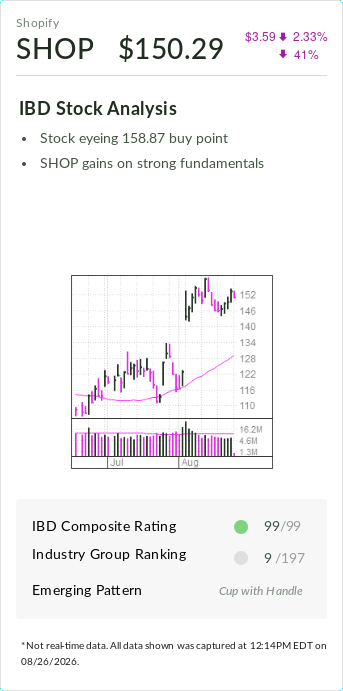
Shopify Shopify SHOP $ 150.29 $3.59 2.33% 41% IBD Stock Analysis Stock eyeing 158.87 buy point SHOP gains on strong fundamentals IBD Composite Rating 99/99 Industry Group Ranking 9/197 Emerging Pattern Cup with Handle Cup with Handle A positive chart pattern named such because it resembles the outline of a coffee cup with a handle. The pattern can last from…
Copyright ©2026 Investor’s Business Daily, LLC. All rights reserved. 87990cbe856818d5eddac44c7b1cdeb8

After an impressive IPO, SpaceX shares are beginning to face the same challenges Tesla once did.
In the first weeks after its listing, SpaceX stock climbed to $225, significantly exceeding the IPO price of $135. Since then, however, the shares have fallen below $110. This has served as the first signal to investors that cutting-edge technology and Elon Musk’s name alone may not be enough to sustain such a high valuation over the long term.
The parallels with Tesla are striking. After going public in 2010, Tesla stock also experienced a sharp post-IPO decline before rebounding a year later as investors embraced a compelling growth narrative. The launch of the Model S helped convince the market that the company’s business could scale successfully. The big question now is whether SpaceX can follow a similar path.
The company has several arguments in its favor. The Starship program is gradually approaching commercial operation, with the recent 13th test flight marking the most successful in the program’s history. The vehicle completed its main tasks, successfully restarted its engine in space, and executed the softest landing to date. Even more notably, the spacecraft maintained the integrity of its hull so well that it remained afloat for several days after splashdown, prompting SpaceX to organize a dedicated recovery mission. Rather than highlighting technical shortcomings, the episode underscored the program’s growing maturity.
Starship is expected to become a key driver of the company’s long-term growth. The rocket will significantly reduce the cost of launching cargo into orbit while accelerating the deployment of the Starlink satellite constellation, which is already SpaceX’s largest source of revenue. The sooner the company can switch to regular commercial operations, the more convincing its long-term financial outlook will become.
However, investors remain primarily concerned about the company’s financial fundamentals. Aside from Starlink, many of SpaceX’s business lines are still unprofitable. Revenue growth has also begun to fall short of what investors expect from a company valued at roughly $1.4 trillion, while large-scale investments in AI continue to weigh on expenses. Intensifying competition across both the space industry and related business sectors is adding further pressure.
The situation is also complicated by SpaceX’s close relationship with Tesla. Recently, the market was stirred by reports that — to facilitate a potential merger between the two companies — Tesla might have to divest its largest Chinese manufacturing facility in Shanghai. Elon Musk quickly dismissed the claims, calling them completely fictional. Nevertheless, the very existence of such speculation shows that investors continue to view SpaceX and Tesla as elements of a single ecosystem. Meanwhile, the Shanghai factory remains one of Tesla’s key assets; the facility can produce more than 950,000 vehicles annually, supplies several international markets at once, and sources over 95% of its components locally.
As a result, SpaceX’s first year as a public company is likely to become a test of investor confidence. The market has already priced in much of the company’s long-term potential. The next phase will depend on tangible financial results and evidence that its capital-intensive projects can evolve into sustainable profit generators. If the Starship program continues to successfully move toward commercial operation and Starlink maintains its strong growth trajectory, the current weakness in the stock could ultimately resemble Tesla’s post-IPO experience. Until then, however, investors are likely to focus less on ambitious promises and more on how quickly technological breakthroughs translate into measurable financial performance.

A late invoice from an Italian customer can create an awkward tension for a UK supplier. The sales team wants to preserve a valuable relationship.
Finance wants a date it can put into the cash forecast. Management wants to know whether the delay is administrative, commercial or a sign of deeper payment risk.
Those priorities do not have to conflict. The practical response is to run two clocks at once.
The customer-resolution clock tracks what the buyer needs to approve and release payment. The internal-escalation clock sets the point at which the supplier must make a deliberate decision, even if the customer continues to offer reassurance.
This approach matters because payment timing in Italy can be longer than UK suppliers expect. The UK Government’s current Italy market guidance warns that business-to-business payments can take several weeks and, in some sectors, months. Atradius reported in its 2026 Italy survey that settlement of overdue invoices takes longer than the Western European benchmark and that customer cash-flow stress is a leading reason for delay.
Those are market signals, not conclusions about a particular customer. The file still has to tell you what is happening in this case.
Start both clocks with a verified invoice
Before chasing, confirm that the invoice could be processed. Check the exact contracting entity, billing address, tax details, currency, bank information, purchase-order reference and agreed payment terms. For goods, connect the commercial invoice to the order, shipping documents, delivery record and any acceptance evidence. For services, preserve the signed scope, milestones, timesheets or approval messages.
UK export guidance stresses that commercial-invoice information should match the related transaction and banking documents. A mismatch can create a real processing delay. Correcting it quickly is better than escalating a preventable error.
Create a one-page status with the invoice number, amount, due date, customer entity, responsible contacts and latest verified explanation. That page becomes the control record for both clocks.
Use the customer-resolution clock to find the blocker
The first conversation should seek a specific operational answer. Has the invoice been received? Is it registered in the customer’s system? Has the relevant manager approved it? Is any part disputed? Has payment been scheduled?
Ask who owns each next step and by what date it will happen. If the customer says the invoice is in process, request the scheduled payment date and reference. If documents are missing, provide them and ask the customer to confirm that the file is complete. If a dispute is raised, ask for the disputed item, amount and supporting reason in writing.
Avoid treating every delay as a cultural difference. Italian companies, like companies anywhere, have different approval structures, financial positions and payment practices. A named owner and dated action are more useful than a broad assumption about the market.
Use the internal-escalation clock to protect options
The second clock belongs to the supplier. It should not reset every time someone promises to “check with accounts.” Set an internal review date based on the amount, evidence, customer importance, length of delay and exposure from continuing to trade.
At that review, choose among four states.
Resolve: there is a specific administrative blocker with an owner and near-term completion date.
Negotiate: the customer accepts the debt but needs time. Require exact instalment amounts and dates, approval by the appropriate manager and written confirmation.
Investigate: the customer has raised a substantive dispute. Separate the disputed and undisputed amounts, assign the commercial owner and preserve the evidence.
Escalate: the claim is clear, the agreed date has passed and the customer has not provided a credible resolution path.
These states make the decision repeatable. They also allow sales and finance to discuss the same facts instead of arguing from different impressions.
Prepare the file before seeking outside help
If escalation becomes proportionate, assemble the contract, invoice, delivery evidence, statement of account, dispute history and communication chronology. Confirm the exact debtor entity and the current amount claimed. Note any part payment, credit or counterclaim.
Companies seeking to recover unpaid invoices from Italian customers can then give local counsel or a collection provider a coherent file. That improves the first assessment and reduces the risk of spending time on missing documents or the wrong entity.
For suppliers trading in several markets, understanding European debt recovery routes can also help management distinguish a repeatable cross-border process from the country-specific advice needed for each claim. The operating model can be standardised; the legal assessment should remain local.
Preserve goodwill through precision
Professional escalation is not the opposite of relationship management. A vague chase can create irritation because neither side knows what will happen next. A precise message identifies the invoice, current issue, agreed action and decision date.
The two-clock method gives the customer a fair opportunity to resolve the problem while protecting the supplier from open-ended delay. The resolution clock keeps the conversation practical. The escalation clock ensures that goodwill has a boundary.
For UK SMEs selling to Italy, that balance is the real discipline: remain constructive, verify every promise and keep the next decision on the calendar.
Author bio
Lars Holdgaard is the founder of Debitura and has 10+ years of experience across debt collection, accounts receivable, technology, and startups. Before Debitura, he co-founded and led product and technology work at startups and scaleups, building software for financial administration and receivables management. Lars studied at the IT University of Copenhagen and the Technical University of Denmark.

The state government has announced it has locked in a three-year deal with WWE without divulging the price tag, as questions over event spending transparency continue to swirl.
Business
USDA Recalls Nearly 30,000 Pounds of Argentine Beef Sold in Texas and Florida Over Missed Import Inspection

AUSTIN, Texas — The U.S. Department of Agriculture has recalled nearly 30,000 pounds of raw beef imported from Argentina after the products entered U.S. commerce without a required federal reinspection, the agency’s Food Safety and Inspection Service announced.
The recall covers 29,628 pounds of raw beef products distributed to retailers and distributors in Texas and Florida by Corte Argentino USA LLC, a company based in Aventura, Florida. FSIS said the products originated with Frigorifico Gorina SAIC, a beef producer in Argentina, and were manufactured between May 15 and May 20. The affected items carry use-or-freeze-by dates ranging from Sept. 15 through Sept. 20.
The recalled beef includes several boneless cuts — top sirloin butt, eye round, topside cap off, flat and knuckle — packaged in cardboard boxes under the Frigorifico Gorina SAIC brand. Products subject to the recall bear the Argentine establishment number “EST. N° OF. 2025” and the shipping mark “26644-AA.”
FSIS said the issue was discovered during routine inspection activity, when officials determined the beef had bypassed a mandatory import reinspection step designed to verify that labeling, documentation and the physical condition of imported meat meet federal standards. Despite the nature of the violation, FSIS classified the recall as Class I, its highest-risk category, reserved for situations in which there is a reasonable probability that eating the product could cause serious health consequences or death. The agency’s recall notice did not identify a specific contaminant.
No illnesses or injuries have been confirmed in connection with the beef, according to FSIS. The agency said it is concerned that some of the recalled product may still be sitting in consumers’ refrigerators or freezers, and it urged anyone with the affected beef not to eat it. Consumers were advised to throw the products away or return them to the place of purchase. FSIS said it would post a list of retail locations that received the beef as that information becomes available; as of this week, it remained unclear exactly which stores sold the recalled products.
Corte Argentino directed questions about the recall to Eial Kaplun, the company’s general manager. In addition to Argentine-style cuts, the company also distributes American Angus and Australian Wagyu beef, according to its own materials.
The recall drew a sharp response from outgoing Texas Agriculture Commissioner Sid Miller, who said the lapse should not have happened. “Nearly 30,000 pounds of Argentine beef made it into American commerce without receiving the required federal import reinspection. That is unacceptable,” Miller said in a statement, adding that American consumers “should never have to wonder whether foreign meat slipped through the cracks.” Miller said Texas producers “meet rigorous standards” and called on USDA to determine how the beef bypassed inspection, closing with a message urging Texans to “buy American” and “buy Texas.”
The recall lands at a politically charged moment for the U.S. beef trade. Earlier this year, President Donald Trump moved to expand the amount of Argentine beef eligible to enter the United States at a lower tariff, adding 80,000 metric tons of Argentine lean beef to the import quota in a February proclamation as part of an effort with Argentine President Javier Milei to ease record-high domestic beef prices. That expansion has drawn opposition from segments of the U.S. cattle industry, which argues foreign imports undercut American producers who operate under stricter regulatory requirements. FSIS and industry observers have said the recall itself stems from an isolated import-processing failure and is not tied to the broader policy debate over expanded Argentine imports.
The recall also comes as the U.S. gradually reopens its border to Mexican feeder cattle following a monthslong halt prompted by concerns over New World screwworm, a livestock pest. That reopening is expected to add modestly to U.S. cattle supplies, though officials have said imports will initially remain limited.
FSIS noted that the current episode is not the first time an import reinspection failure has led to a recall. In June 2024, South American Meat Inc., doing business as 5Gogi LLC, recalled frozen raw beef that had also entered the country without the required reinspection, underscoring that the gap in oversight is not unique to Corte Argentino’s shipment.
The agency said it routinely conducts effectiveness checks to confirm that recalling companies have notified their distributors and retailers and that recalled products have been pulled from store shelves. FSIS has not yet detailed how the uninspected Corte Argentino shipment cleared its port of entry before reaching distributors in Texas and Florida.

MINISO opens brand new store in Coney Street, York

Bloom Energy: Nancy Pelosi (And Other Bulls Too) Needs To Rethink Its 80x P/E (NYSE:BE)
Pi Network’s Major AI Change Is Now Live: Here’s What Pioneers Need to Know





-

 Fashion7 days ago
Weekend Open Thread: Madewell – Corporette.com
-

 Crypto World2 days ago
SpaceX stock could rise 75% to $240, JPMorgan says
-

 Business6 days ago
Musk’s Tesla, SpaceX Confirm $16.8 Billion ‘Terafab’ Chip Plant as World’s Largest Building in Texas
-

 Crypto World6 days ago
anatomy of crypto’s biggest liquidation event since 2021
-

 Crypto World3 days ago
A $30 Billion AI Fund Implodes, Now the SEC Is Investigating Wall Street’s Role
-

 Politics6 days ago
6 months on, Irish renters crushed by effects of government housing bill
-

 Crypto World2 days ago
Did Trump Just Move SpaceX Stock With One Truth Social Post?
-

 Crypto World2 days ago
Warsh Jackson Hole keynote puts financial innovation first
-

 Business5 days ago
Mystery AI Model ‘Ox Alpha’ Draws Developers With Free Access as Chinese Lab Origins Remain Debated
-
 NewsBeat6 days ago
The ‘Lucky Dip Gang’ causing carnage for clicks: After five thugs were killed speeding in the wrong direction on a motorway, GUY ADAMS investigates a sick new trend… and why police aren’t even allowed to pursue them
-
 Crypto World6 days ago
Nvidia Stock Suffers Longest Losing Streak Since 2022: Will Q2 Earnings End It?
-

 Business2 days ago
Walmart takes aim at younger shoppers with new fashion brand
-

 Business4 days ago
Moderna CEO warns China is pouring state money into mRNA technology
-

 Business3 days ago
NVIDIA Stock Drops Nearly 2 Percent to $210 on Seventh Losing Day Ahead of Critical AI Earnings
-

 Tech7 days ago
Unitree’s New Superman Robot Claims to Outjump and Outrun Every Human, Usain Bolt Included
-

 Business6 days ago
Will Tesla Stock Be Higher or Lower a Year From Now? Here’s What Wall Street Analysts Are Saying
-

 Business7 days ago
UK firms in critical financial distress rise 9% to 53,756
-

 Sports5 days ago
Deshaun Watson fires back at Browns fans after being booed: ‘It’s a disrespectful thing’
-

 Crypto World5 days ago
Google Gemini AI Predicts Ethereum Could Become the Trade Retail Misses in 2026
-
 Crypto World4 days ago
$92 Billion Nvidia Earnings Could Make or Break the AI Trade
You must be logged in to post a comment Login