Connect with us
DAPA Banner
DAPA Coin
DAPA
COIN PAYMENT ASSET
PRIVACY · BLOCKDAG · HOMOMORPHIC ENCRYPTION · RUST
ElGamal Encrypted MINE DAPA
🚫 GENESIS SOLD OUT
DAPAPAY COMING

Business

5 takeaways from airline CEOs’ biggest annual gathering

Published

on

5 takeaways from airline CEOs' biggest annual gathering

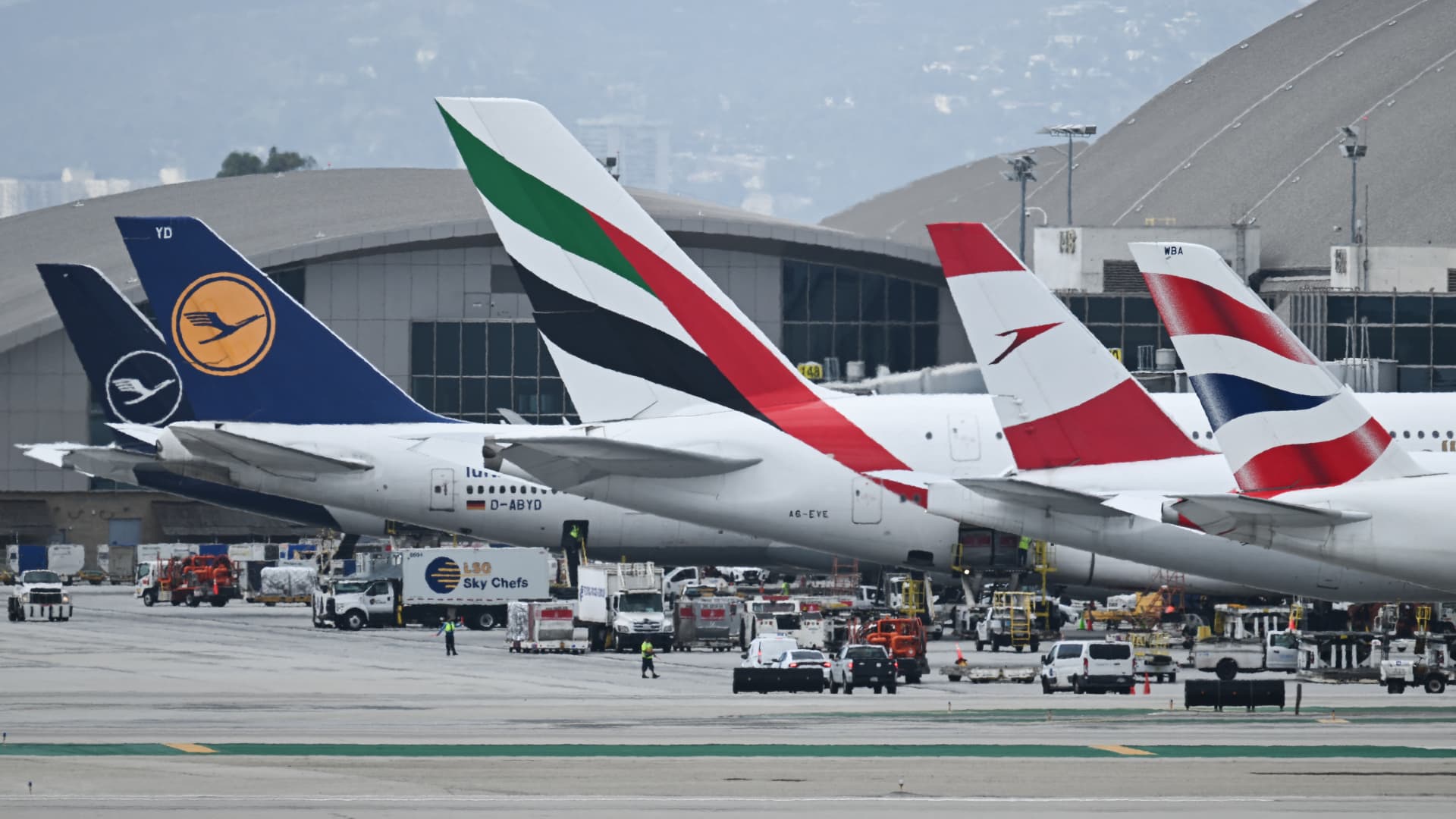
Ground crews load cargo and supplies onto airplanes from airlines including Lufthansa Group, Emirates, Austrian Airlines, and British Airways, as they stand parked at the Tom Bradley International Terminal (TBIT) at Los Angeles International Airport (LAX) in El Segundo, California, on September 11, 2023.

Patrick T. Fallon | Afp | Getty Images

RIO DE JANEIRO — Hundreds of airline leaders gathered in Brazil this week at the International Air Transport Association’s annual assembly to discuss high fuel costs, sharply lower profits, engine reliability issues and elusive emission reduction goals, among other things.

Advertisement

Toward the end of the assembly in Rio de Janeiro, news broke that Iran and Israel traded strikes for the first time since a ceasefire went into effect in April. For airline executives who have faced ongoing turmoil since the first U.S. and Israeli strikes on Iran on Feb. 28, it seemed like just one more blip in the whipsawing chaos of 2026. Those airline leaders’ stance so far has been to wait and see.

Here are some takeaways from the gathering:

Withering profits

Fuel costs have more than doubled in some places since the beginning of the Iran war, as the Strait of Hormuz, a key shipping lane, has been effectively closed for much of the time.

IATA said airlines globally are absorbing a $100 billion increase in their fuel costs this year, which along with airspace closures due to Middle East attacks curtailing travel, will likely halve airline profits this year.

Advertisement

Willie Walsh, the outgoing director general of the organization, said net profits will fall from $45 billion in 2025 to $23 billion in 2026, and that net margins would drop from 4.2% last year to 2% this year.

While fares are up, airlines haven’t been able to cover the full fuel bill this year, so profits will take a hit. 

Travel demand is resilient — but winter is coming

Airline executives told CNBC that customers continue to book.

Etihad Airways, based in Abu Dhabi, in the United Arab Emirates, initially felt the effect of the Middle East turmoil this year with lower demand. But Antonoaldo Neves, group chief executive officer of Etihad Aviation Group, said in an interview that the number of tickets are about the same as pre-conflict, seasonally adjusted.

Advertisement

United Airlines CEO Scott Kirby, who runs the second-most profitable airline in the U.S., said customers continue to book, even though fares are up about 20% and could rise further if fuel costs continue to increase.

He said the resilient bookings surprised even him. “I think the economy is stronger than people think,” he told CNBC in an interview. The U.S. is also more insulated from oil supply shocks than other regions because it produces so much.

Summer bookings are strong, and airlines are also getting better at managing capacity with high fuel prices, cutting more unprofitable routes and reducing frequencies. The big question remains what happens after the main summer and fall peaks.

“That bodes well for a strong northern summer peak season,” Walsh said of current trends. “The big unknown is how long travelers and shippers can tolerate the higher costs of connectivity.”

Advertisement

The other question is where fuel prices go from here.

“If prices will remain the same, yeah, for sure, less people be able to afford to travel,” said Kamil Al-Awadhi, former Kuwait Airways CEO and IATA’s vice president for Africa and the Middle East.

Airplane FOMO keeps orders coming

Airplane manufacturers said they’re not seeing a slowdown in orders because of higher fuel prices.

Airbus and Boeing continue to be sold out of some of their most popular jets through the beginning of the next decade. Airlines generally plan for fleet growth years in advance, and the bulk of an aircraft’s price is paid when a carrier receives it.

Advertisement

Etihad’s Neves told CNBC that he wants to buy even more jets to top off his existing orderbook of dozens of planes, though he didn’t give a number, only saying it’s “more than 10.”

A spokesman for Brazilian airplane maker Embraer said that one risk is that customers don’t exercise options to increase their existing orders, but so far the company isn’t seeing that.

Boeing is set to report orders and deliveries for May on Tuesday morning.

High fuel prices could kill off other airlines

Iconic U.S. budget airline Spirit Airlines in May succumbed to years of problems. It had been dealing with an engine recall, a failed merger and changing consumer tastes all while managing a mountain of debt. But the jump in fuel prices was the last straw for the discounter, it told U.S. bankruptcy court this spring.

Advertisement

IATA’s Walsh said at the conference that high fuel costs could push other airlines to collapse as well.

That means that more profitable, cash-rich carriers, which have done better at capitalizing on the K-shaped economy and a shift in demand toward high-fare luxury travel, are on better footing than some that are more price sensitive.

‘Engineering marvels’ at what cost?

Airline CEOs are frustrated with engine makers who promised increased fuel efficiency in new-generation engines. The fuel savings are there, but they’re getting gobbled up by disappointing reliability that forces airlines to have the engines serviced earlier than they thought, executives said.

On top of that, there aren’t enough of them produced to satisfy carriers, as Boeing and Airbus ramp up output.

Advertisement

Alexis von Hoensbroech, CEO of Canada’s WestJet, told CNBC in an interview before the IATA meeting that the new engines promising fuel savings of around 15% or more compared with earlier models were “engineering marvels.”

“However, as you push the limits, it sometimes comes at the cost of reliability, and what we all are seeing is that those engines have to go into unscheduled maintenance far more frequently than prior engine generations,” he said.

Companies like GE Aerospace and Rolls-Royce, which have enjoyed a windfall from increased demand, said they have been busy with fixes and added overhaul capacity.

Read more CNBC airline news

Choose CNBC as your preferred source on Google and never miss a moment from the most trusted name in business news.
Advertisement
Continue Reading
Click to comment

You must be logged in to post a comment Login

Leave a Reply

Business

Online Home Shop moves to Trafford Park and plans jobs growth

Published

on

Business Live

New base replaces sites with ‘historic capacity restraints’

Online Home Shop (OHS) has opened a 327,000 sq ft centre in Trafford Park

The 327,000 sq ft Online Home Shop centre in Trafford Park(Image: B8RE)

A homewares retailer has moved to a larger base in Trafford Park and could create dozens of jobs there.

Online Home Shop (OHS) has opened a 327,000 sq ft centre at the industrial estate that replaces multiple previous sites with “historic capacity restraints”. The company says the move means it will be able to ship 6m orders this year “and provides significant job opportunities to grow the current headcount from 200 people to over 300”. The new site will include some 45,000 pallet spaces.

CEO Moshe Cohen said: “Opening this new site is a significant milestone for OHS and reflects our commitment to investing in the infrastructure needed to support our incredible growth journey.

“This additional capacity will help us operate more efficiently and continue delivering the high level of service our customers expect. I would like to thank everybody involved in making this happen.”

Advertisement

Rafi Margulies, of Capre, advised OHS on securing the lease of the premises, while B8RE, DTRE and JLL represented Oxenwood.

Online Home Shop’s most recent accounts on Companies House cover the 12 months to January 31, 2025 – a year which saw turnover grow 24.6% to £59.5m. Pre-tax profit rose from £4.18m in 2024 to £4.95m in 2025.

The directors said sales growth on the OHS website was down to “increasing the customer base, repeat purchases, a growing core business and expanding into new product categories, particularly in garden and furniture.” It added: “The company also continues to grow significantly across several key online marketplaces.”

Advertisement
Continue Reading

Business

Academy Sports and Outdoors, Inc. 2027 Q1 – Results – Earnings Call Presentation (NASDAQ:ASO) 2026-06-09

Published

on

OneWater Marine Inc. (ONEW) Q1 2026 Earnings Call Transcript

This article was written by

Seeking Alpha’s transcripts team is responsible for the development of all of our transcript-related projects. We currently publish thousands of quarterly earnings calls per quarter on our site and are continuing to grow and expand our coverage. The purpose of this profile is to allow us to share with our readers new transcript-related developments. Thanks, SA Transcripts Team

Continue Reading

Business

BodyArmor adds canned sports beverage

Published

on

BodyArmor adds canned sports beverage

The RTD beverage is offered in five flavors. 

Continue Reading

Business

SpaceX employees create low-fee Choreo wealth management plan for post-IPO

Published

on

SpaceX employees create low-fee Choreo wealth management plan for post-IPO

SpaceX signage outside the Space Exploration Technologies Corp. facility in Hawthorne, California, on June 3, 2026.

Michael Yanow | Nurphoto | Getty Images

A group of current and former SpaceX employees who joined forces to manage their post-IPO wealth has created a new, low-fee advisory option with Choreo, according to people familiar with the agreement.

Advertisement

The employee group has more than 100 members and represents potential wealth of between $1 billion and $5 billion, according to the people, who spoke on the condition of anonymity to discuss confidential agreements. What began as an informal chat forum focused on philanthropy has grown into a broader effort to create more efficiencies and better access to financial advice using their combined wealth from their post-initial public offering windfalls, the people told CNBC.

A small team representing the group evaluated potential firms and created a new wealth management offering with Choreo that members can opt into. Choreo, a Chicago-based registered investment advisor, says on its website it has more than $28 billion in assets under management and advisement, 40-plus offices, and 200 wealth advisors.

Details and specific terms remain confidential, yet the sources told CNBC there will be a minimum annual fee or an annual management fee of under 0.5% of assets under management. Any fee below 0.5% could undercut the industry standard of between 0.5% and 1%. The Choreo fee structure is for a long-term agreement rather than a one-time promotional offer.

Choreo didn’t immediately respond to a request for comment.

Advertisement

The deal marks a bold experiment in the wealth management industry that could shift the balance of power from advisory firms to wealthy groups of investors.

Wealth management firms have typically set their fees based on an individual’s or family’s wealth levels, offering a sliding scale based on investible assets. By joining forces, the SpaceX employees and alumni employees are proving they can use their collective financial scale to secure an option for better terms.

Get Inside Wealth directly to your inbox

The agreement also highlights the unprecedented power of the SpaceX IPO — establishing vast numbers of newly minted millionaires who were paid in stock as well as creating one of the most sought-after liquidity prizes in the wealth management industry.

The Elon Musk-led rocket company is set to debut at the Nasdaq on Friday.

Advertisement

The vast majority of SpaceX employees – many of them engineers who were paid below-market salaries in return for stock – have never had large wealth to manage.

By reducing fees, members of the SpaceX group hope to be able to devote more of their fortunes from the SpaceX IPO to philanthropy, the people said.

In the forum, many of the SpaceXers have been sharing advice and contacts on how best to use their new wealth to give back to their communities, the people familiar said. Some indicated they are considering creating scholarships and funding for the colleges and universities where they were trained and educated. Others have said they want to fund new programs that give children better access to engineering, science and math programs.

Employees of Anthropic, which recently filed confidential plans to go public, are also in discussions with advisory firms about a potential collective option, the people familiar told CNBC.

Advertisement
Choose CNBC as your preferred source on Google and never miss a moment from the most trusted name in business news.
Continue Reading

Business

Second Nature Brands snags Tillamook Country Smoker

Published

on

Second Nature Brands snags Tillamook Country Smoker

The acquisition marks the company’s entrance into the protein snacks category. 

Continue Reading

Business

Boar’s Head introduces pickle snacks

Published

on

Boar’s Head introduces pickle snacks

The packaged snacks are available in three varieties. 

Continue Reading

Business

NSE to route 10% of CSR spending through Social Stock Exchange after regulatory green light

Published

on

NSE to route 10% of CSR spending through Social Stock Exchange after regulatory green light
NSE will earmark 10% of its annual corporate social responsibility (CSR) corpus for projects listed on the NSE Social Stock Exchange (SSE), becoming one of the first major institutions to commit a portion of its CSR spending through the platform.

The exchange announced the move on Tuesday following recent regulatory changes that allow companies to undertake CSR expenditure through subscription to Zero Coupon Zero Principal (ZCZP) instruments listed on Social Stock Exchanges.

NSE said its CSR Committee had agreed in principle in March 2026 to deploy 10% of the annual CSR corpus through the SSE framework, subject to regulatory approval. The decision has now been operationalised after the Ministry of Corporate Affairs issued notifications on May 27 enabling such investments.

The move is aimed at strengthening India’s social impact financing ecosystem and encouraging greater use of regulated capital market platforms for funding social sector projects.

Advertisement

NSE Chairman Injeti Srinivas welcomed the government’s decision to allow CSR funds to be routed through Social Stock Exchanges.


He said the framework would improve transparency, visibility and accountability of CSR spending while helping channel funds towards credible social initiatives.
The exchange expressed hope that other large corporate CSR contributors would adopt a similar approach, helping scale up impact financing in the country.The Social Stock Exchange framework was introduced by Sebi to create a regulated fundraising platform for non-profit organisations and social enterprises. The NSE Social Stock Exchange was launched in February 2023.

Since inception, NSE-SSE has facilitated all Social Stock Exchange fundraising issuances in India. According to the exchange, 16 projects, including two joint listings, have collectively mobilised more than Rs 44.5 crore across sectors such as healthcare, education, women empowerment, climate action, poverty alleviation, skilling and sustainable livelihoods.

The latest announcement comes shortly after the government expanded the scope of permissible CSR activities through the SSE route, a move seen as a significant step towards deepening social impact investing in India.

The regulatory change could unlock a new source of funding for non-profit organisations by connecting them with corporate CSR budgets through a transparent and market-linked mechanism. The decision is also expected to provide greater visibility to social projects while enabling companies to track the deployment and outcomes of their CSR spending more effectively.

Advertisement

With NSE itself committing part of its CSR corpus through the platform, the exchange is positioning itself as an early adopter of the Social Stock Exchange model while seeking to encourage broader participation from corporate India.

Continue Reading

Business

Promoter sells Rs 1,024 crore worth of Ajanta Pharma shares in block deal to Kotak MF and ABSL MF

Published

on

Promoter sells Rs 1,024 crore worth of Ajanta Pharma shares in block deal to Kotak MF and ABSL MF
A promoter entity of Ajanta Pharma sold shares worth over Rs 1,024 crore through a block deal on Tuesday, with domestic mutual funds emerging as the buyers. According to NSE block deal data, Ravi Agrawal Trust sold 34.5 lakh shares of Ajanta Pharma at Rs 2,968 per share. The transaction was valued at about Rs 1,024 crore.

The shares were picked up by two domestic fund houses. Kotak Mahindra Mutual Fund acquired 21.02 lakh shares, while Aditya Birla Sun Life Mutual Fund purchased 13.48 lakh shares. Both transactions were executed at the same price of Rs 2,968 per share.

Ajanta Pharma is a specialty pharmaceutical company with a presence across branded generics, emerging markets and select developed markets. The company has built a strong franchise in therapeutic segments such as ophthalmology, cardiology, dermatology and pain management, while also expanding its footprint in international markets.

The company has been one of the stronger performers in the pharmaceutical space, benefiting from steady earnings growth, healthy margins and a robust balance sheet. Investors have also favoured the stock due to its focus on branded formulations and relatively limited exposure to pricing pressures in the US generics market.

Advertisement

Ajanta Pharma reported good fourth quarter results, with revenue and EBITDA coming in 1-3%, ahead of analysts estimates. PAT was 23% higher than the views, helped by higher Other income and a lower tax rate. US generics business sustained robust growth momentum, up 47% YoY in USD terms


“We raise our FY27E-FY28E core earnings estimates by 2%. AJP trades at 31.2x FY27E core P/E. We retain our target price at Rs 3,115 based on 29.9x FY28E core P/E plus cash per share. We retain our Accumulate rating. Geopolitical disruptions to the business and a spike in raw materials price & freight cost are key risks to our call. We introduce FY29 estimates,” Elara Capital said post the earnings.

Continue Reading

Business

NextDecade: The LNG Upside Is Worth The Risk (NASDAQ:NEXT)

Published

on

NextDecade: The LNG Upside Is Worth The Risk (NASDAQ:NEXT)

This article was written by

I’m an independent equity trader and licensed financial advisor focused on uncovering high-upside opportunities in overlooked sectors especially focusing on small-caps, energy, commodities, and special situations. My investment strategy is based on growth. I look for fundamental momentum (EPS, ROE, revenue), price-volume confirmation, and macro filters. I also use econometric tools and calculations to analyse market direction, cycles and behaviour. I’ve been managing personal capital since 2020 and advising under MiFID II since qualifying with a license. I hold a bachelor’s in Business Administration and Economics and am currently completing a master’s in Finance. My masters thesis topic: Impact of Financial Results Announcements on Stock Returns and Trading Volumes of Micro-Capitalization Gold Mining Companies.

Analyst’s Disclosure: I/we have no stock, option or similar derivative position in any of the companies mentioned, and no plans to initiate any such positions within the next 72 hours. I wrote this article myself, and it expresses my own opinions. I am not receiving compensation for it (other than from Seeking Alpha). I have no business relationship with any company whose stock is mentioned in this article.

Seeking Alpha’s Disclosure: Past performance is no guarantee of future results. No recommendation or advice is being given as to whether any investment is suitable for a particular investor. Any views or opinions expressed above may not reflect those of Seeking Alpha as a whole. Seeking Alpha is not a licensed securities dealer, broker or US investment adviser or investment bank. Our analysts are third party authors that include both professional investors and individual investors who may not be licensed or certified by any institute or regulatory body.

Advertisement
Continue Reading

Business

Warren Buffett’s surprisingly simple advice for new investors entering the stock market

Published

on

Warren Buffett's surprisingly simple advice for new investors entering the stock market

Over the past 30 years, the S&P 500 index has generated a total return of 1,770% (as of June 5). That performance supports the view that the stock market is one of the best asset classes for growing your wealth. A starting sum of $10,000 in this benchmark in June 1996 would be worth $187,000 today. The gains have been even more remarkable over the past decade.

Understanding that this kind of performance can have a profound impact on your financial well-being, it might be time for new investors to direct some of their savings into the stock market. Given how daunting it might seem, it can be difficult to figure out where to even begin.

Advertisement

Here’s where Warren Buffett comes into the picture. The great investor is also a wonderful educator whose advice is well worth considering. If you’re new to the stock market this month, listen to the Oracle of Omaha’s suggestion.

WARREN BUFFETT ERA ENDS AFTER 60 YEARS AS CEO WITH GREG ABEL TAKING OVER

Warren Buffett speaking

Warren Buffett stepped down as CEO of Berkshire Hathaway late last year after a 60-year run. (Daniel Zuchnik/WireImage)

Keep it simple

Buffett is known for his exceptional capital allocation skills, having compounded Berkshire Hathaway’s share price at a yearly clip of almost 20% for six decades before stepping down as CEO at the end of last year. But his advice for most investors is surprisingly simple. He basically recommends buying a low-cost S&P 500 index fund.

This perspective probably comes from the fact that the average person doesn’t have the time, ability or desire to want to pick individual stocks and manage a portfolio. And it stems from the inability of expert fund managers to beat the market.

Advertisement

THIS SECTOR HAS DOMINATED ETF RETURNS SO FAR IN 2026

Active management strategies generally have a bad track record. Data shows that the vast majority of large-cap fund managers lose to the S&P 500 over the long term. Whether these professionals trade too often, charge high fees or just aren’t adept portfolio managers, that is a very disappointing statistic. And it makes you wonder why more investors don’t choose the passive route.

Traders work on the floor of the New York Stock Exchange.

Over the past 30 years, the S&P 500 index has generated a total return of 1,770%, as of June 5. (Spencer Platt/Getty Images)

Consider this popular exchange-traded fund

One of the best options is the Vanguard S&P 500 ETF. It comes with an extremely low expense ratio of 0.03%. Over several years and decades, investors will pay a significantly smaller amount than what active managers typically charge. The difference leaves more money in your pocket.

Ticker Security Last Change Change %
VOO VANGUARD S&P 500 ETF – USD DIS 679.68 +1.68 +0.25%

This ETF tracks the S&P 500 index, so its holdings match the benchmark. The top five holdings are Nvidia, Apple, Microsoft, Amazon and Alphabet, clearly showing a strong position within the information technology sector. Investors will certainly be exposed to all things related to artificial intelligence.

Advertisement

However, it’s worth pointing out that this ETF contains all sectors of the economy. It’s essentially a hassle-free method for gaining broad market exposure.

Maintain a long-term perspective

The S&P 500 index today trades at a historically expensive valuation, calling into question the benchmark’s return potential. While the phenomenal trailing 10-year total return of 316% might not repeat, I think it still makes sense to invest in the stock market.

TAP INTO THE HUMANOID ROBOTICS BOOM WITH THIS ETF

Profit growth and margins are robust. And the companies leading the charge, some of which were mentioned already, are some of the most dominant businesses the world has ever seen, so they deserve the market’s appreciation.

Advertisement
Ticker Security Last Change Change %
NVDA NVIDIA CORP. 208.64 +3.54 +1.73%
AAPL APPLE INC. 301.54 -5.80 -1.89%
MSFT MICROSOFT CORP. 411.74 -4.93 -1.18%
AMZN AMAZON.COM INC. 245.22 -0.81 -0.33%
GOOGL ALPHABET INC. 363.31 -5.00 -1.36%

If the current valuation is a real concern for you, then consider adopting a dollar-cost averaging (DCA) strategy. By doing so, you could allocate fresh savings to the market on a monthly or quarterly basis, virtually eliminating the need to accurately assess what the correct starting valuation should be.

And even adding small sums of money to a DCA approach can lead to tremendous long-term results. Let’s say you initially invest $10,000 into the Vanguard S&P 500 ETF. But then every single month, you invest $100. Assuming the historical 10% annualized total return holds true, you’d have $382,000 after 30 years. Of course, if you put more money to work, the ending figure will be larger.

GET FOX BUSINESS ON THE GO BY CLICKING HERE

Neil Patel has positions in Vanguard S&P 500 ETF. The Motley Fool has positions in and recommends Alphabet, Amazon, Apple, Berkshire Hathaway, Microsoft, Nvidia and Vanguard S&P 500 ETF. The Motley Fool has a disclosure policy.

Advertisement
Continue Reading

Trending

Copyright © 2025