
Business
A Boost for British Firms

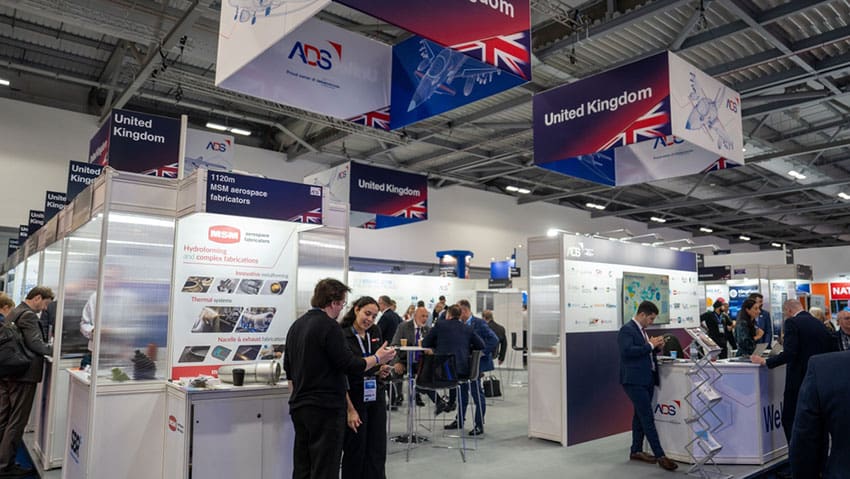
UK Export Finance has fired the largest single shot in its century-long history, setting aside a fresh £50 billion to bankroll British defence exports at a moment when the world is rearming faster than at any time since the Cold War.
The new Defence Export Fund takes the government’s export credit agency from an £80 billion ceiling to a total capacity of £130 billion, with the additional £50 billion ring-fenced to support large-scale defence sales and shore up Britain’s competitiveness in a market that is expanding at remarkable speed. For an agency that has spent 100 years quietly underwriting the deals that keep British goods moving across borders, it is a statement of intent.
The timing is no accident. Global military expenditure climbed to a record $2.7 trillion in 2024, a 9.4 per cent year-on-year jump that, according to the Stockholm International Peace Research Institute, was the steepest rise since at least the end of the Cold War. Spending rose across all five of the world’s regions, driven by the war in Ukraine, conflict in the Middle East and a broad reappraisal of national security among Western governments. Allies are not only spending more, they are actively shopping for the kind of advanced capability that British industry is well placed to supply.
The mechanics are straightforward enough. UKEF will guarantee the bank loans taken out by British defence exporters as they fulfil contracts, and it will provide or back the financing extended to other countries buying British defence products. In practice that means a UK manufacturer can compete for a major overseas order knowing the financing is underwritten by the government, while the purchasing nation gets access to a competitive, state-backed payment package alongside the kit itself.
That combination, world-leading hardware paired with government-backed finance, is what ministers hope will tip large contracts in Britain’s favour. The fund is open to defence businesses of every size, from established prime contractors to the smaller firms looking to break into international markets for the first time, a constituency that has historically found export finance hard to navigate.
It is a theme UKEF has been building towards for some time. The agency has already widened its toolkit for smaller exporters, unveiling new products designed to help SMEs trade globally and to remove some of the friction that has long deterred first-time exporters from chasing overseas work.
The Defence Export Fund does not arrive out of nowhere. UKEF has been steadily deepening its defence portfolio, backing landmark deals that include air defence systems for Poland and Ukraine and submarine rescue vehicles for Indonesia, transactions that translate into skilled jobs and economic value spread across the UK rather than concentrated in a single region.
The numbers have grown accordingly. Defence transactions worth more than £5 billion are now routine for the agency, and it supported a total of £10 billion of defence business in the 2024/25 financial year alone. With that trajectory showing no sign of flattening, the new allocation is designed to let UKEF meet rising demand without running up against its own limits.
That ambition sits within a wider government push to treat defence not merely as a security obligation but as an engine of industrial growth. Westminster has moved to boost domestic weapons production and cut reliance on imports, while a separate drive aims to give smaller defence firms easier access to Ministry of Defence contracts. The export fund is the international-facing piece of that same strategy.
‘Allies are actively seeking what Britain can build’
Tim Reid, chief executive of UKEF, framed the move as a response to genuine demand from partner nations. “Security is a strategic priority for governments worldwide, and the UK’s defence sector offers pioneering capabilities that allies are actively seeking,” he said. “With billions of pounds available in new export financing, we are strengthening the sector’s global competitiveness while backing skilled British jobs and supporting long-term economic growth.”
The agency, which sets out its broader approach in its strategic financing for industrial growth, has set itself a clear target. By 2029 it aims to help UK firms win more than £12.5 billion of new export contracts through its finance offer, with defence expected to account for a growing slice of that total.
For Britain’s defence businesses, large and small, the message is that the financing constraint which once kept them on the sidelines of the biggest deals has been substantially loosened. Whether that translates into the contract wins ministers are banking on will depend, as ever, on the firms themselves. But the cheque book has rarely been bigger.

Amy Ingham
Amy is a newly qualified journalist specialising in business journalism at Business Matters with responsibility for news content for what is now the UK’s largest print and online source of current business news.


Why Roblox Had Its Worst Day Ever After Earnings
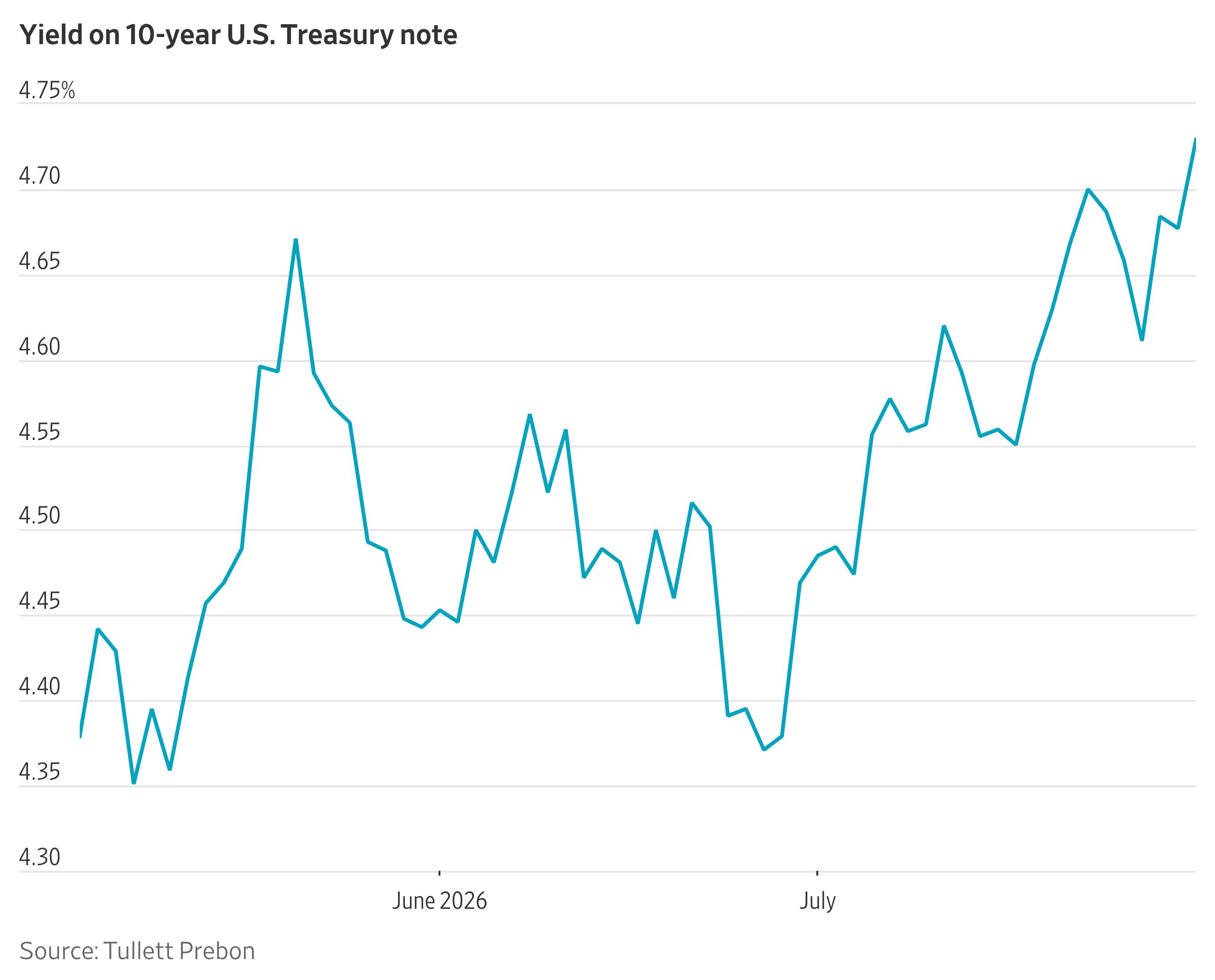
Treasury yields extended their recent gains Friday after three Federal Reserve officials explained why they cast dissenting votes in favor of raising interest rate this week.
Yields, which rise when bond prices fall, were also driven higher by economic data, including a stronger-than-expected reading on Chicago-area economic activity.
The yield on the 10-year U.S. Treasury note settled at 4.743%, according to Tradeweb, its highest closing level since January 2025. The 30-year yield closed at 5.274%, its highest since July 2007.

South Korean stocks surged on Friday, with the KOSPI index rising nearly 18%.
Despite the dramatic gains, the index was still down for the week and the month, a testament to how volatile Korean equities have been as of late.
Not counting today, the KOSPI has gained more than 10% in a single day in only six instances, according to Dow Jones Market Data. History shows that in the week following those six times, the S&P 500 traded lower two-thirds of the time, with an average decline of 1.6%.

1539 ET – Oil futures end July with hefty gains as the month saw renewed Iranian attacks on shipping in a dispute with the U.S. over control of the Strait of Hormuz. Concerns that a return to negotiations could quickly reduce risk premium and lead to oversupply have kept prices from reaching the lofty levels seen in March and April. “Traders are essentially betting on two very different geopolitical outcomes, and neither one is a safe assumption right now,” says Baron Lamarre, co-founder of Index Litro and former head of trading at Petronas. “My base view is we won’t end up with either a massive glut or a full-blown supply crisis by the end of the year,” he adds. “Instead, we’re in for a period of stubbornly tight, volatile conditions that will stick around longer than the optimists are hoping.” WTI settles up 1.3% at $84.67 a barrel for a 22% monthly gain. Brent for September delivery goes off the board at $90.12 a barrel, up 1.2% on the day and up 24% from the end of June.(anthony.harrup@wsj.com)
Oil Futures on Track for Big Monthly Gains
0951 ET – Oil futures turn higher in early U.S. trading and are on track for hefty gains for July, which saw the U.S.-Iran Memorandum of Understanding fall apart and Iran resume attacks on shipping in the Strait of Hormuz. “All things held equal, the market should go a lot higher and led by diesel and gasoline as refinery run rates arejust too low on a lack of crude,” Scott Shelton of TP ICAP says in a note. “The reality is that we are back to a very small amount of crude versus what is needed.” WTI is up 2.2% at $85.42 a barrel. September Brent is 1.5% higher at $90.36 ahead of today’s expiry, while the October contract gains 1.8% to $88.47.(anthony.harrup@wsj.com)
Copyright ©2026 Dow Jones & Company, Inc. All Rights Reserved. 87990cbe856818d5eddac44c7b1cdeb8
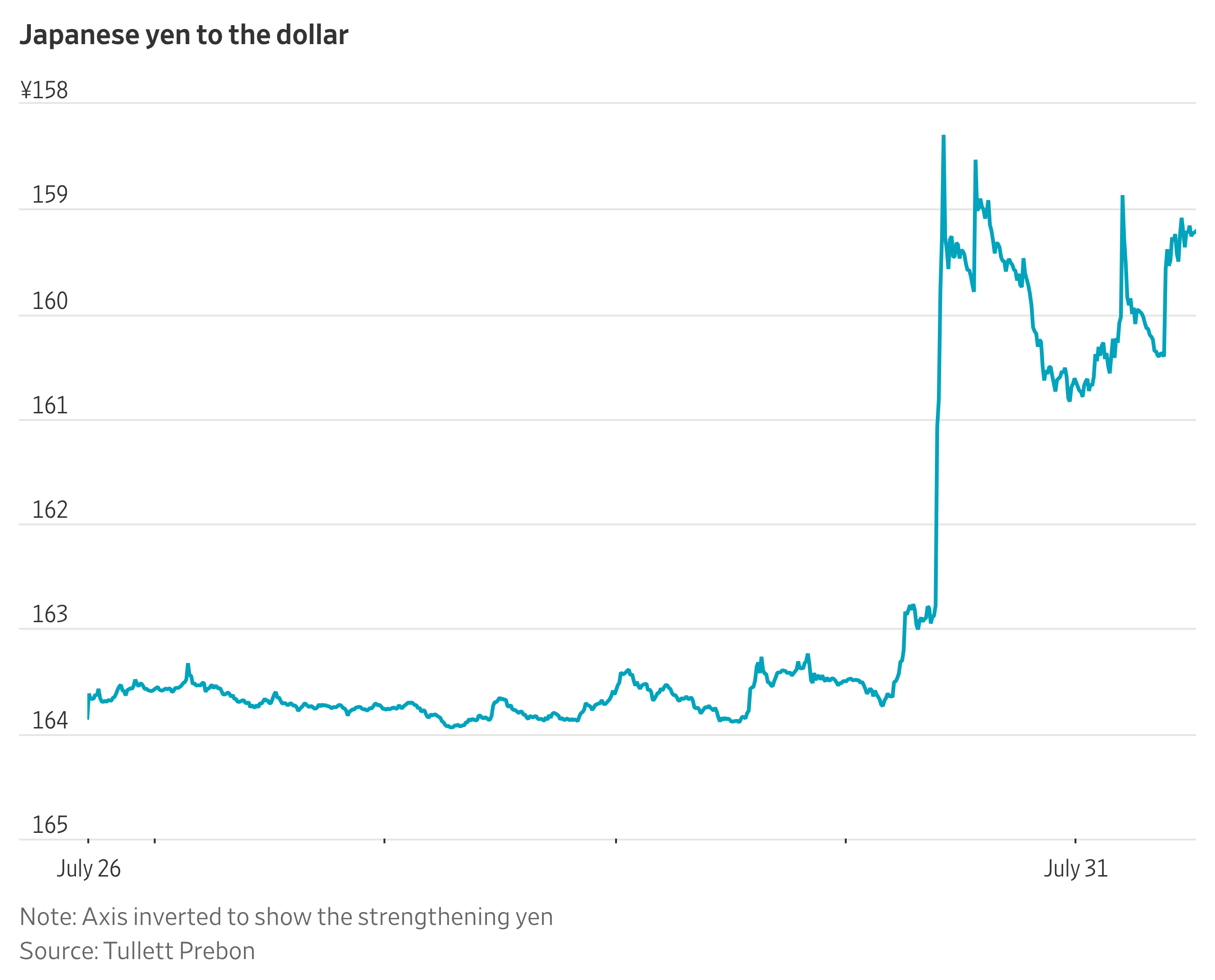
Currency traders broadly believe that the yen’s recent strengthening reflected yen purchases by Japanese authorities, as well as speculation of a possible U.S. intervention. The U.S. Treasury Department meanwhile has informed banks that it might make currency trades on Friday to support the Japanese yen and strengthen its exchange rate against the dollar, the Wall Street Journal reported today.

Global reforms emphasize control and decision-making authority over legal forms, shifting regional headquarters evaluation to governance, risk management, and value creation, impacted by tax rates and regulatory expectations.
Evolving Evaluation of Regional Headquarters
Global minimum tax, stricter substance enforcement, and geopolitical fragmentation have reshaped how regional headquarters are assessed. Singapore, Hong Kong, and Dubai now serve distinct roles, each aligned with different strategies for controlling operations and managing risks. They are no longer interchangeable hubs competing on similar benefits, but rather centers tailored to specific business models and regulatory environments.
Authority and Control Define a Headquarters
The focus has shifted from a legal entity’s structure to the authority it exercises within an organization. Regulators and counterparties increasingly scrutinize where key decisions—related to capital allocation, pricing, treasury, and risk management—are made. An entity exercising discretion in these areas is viewed as a true control center, influencing regulatory treatment and compliance risk instead of mere administrative support.
Governance and Control in Practice
Beyond reporting functions, the extent of authority impacts governance, documentation, and accountability standards. These factors determine a company’s regulatory exposure and defenses. While corporate tax rates like Singapore’s 17% and Hong Kong’s 16.5% are still relevant, emphasis now also rests on where value creation and control are evidenced within the organization.
Read the original article : Singapore vs Hong Kong vs Dubai: Regional HQ Trade-Offs for Investors
Other People are Reading

Are you tired? I’m tired. In addition to four Big Tech companies reporting earnings this past week, the calendar included results for second-quarter gross domestic product and the June personal consumption expenditures price index, along with the Federal Reserve’s interest-rate decision. Unscheduled, there was a meltdown of the artificial-intelligence trade, as highly leveraged bull positions were liquidated. The iShares Semiconductor exchange-traded fund was down 12% across three days, and one of the most successful AI investors—hedge fund Situational Awareness—saw margin calls and forced sales.
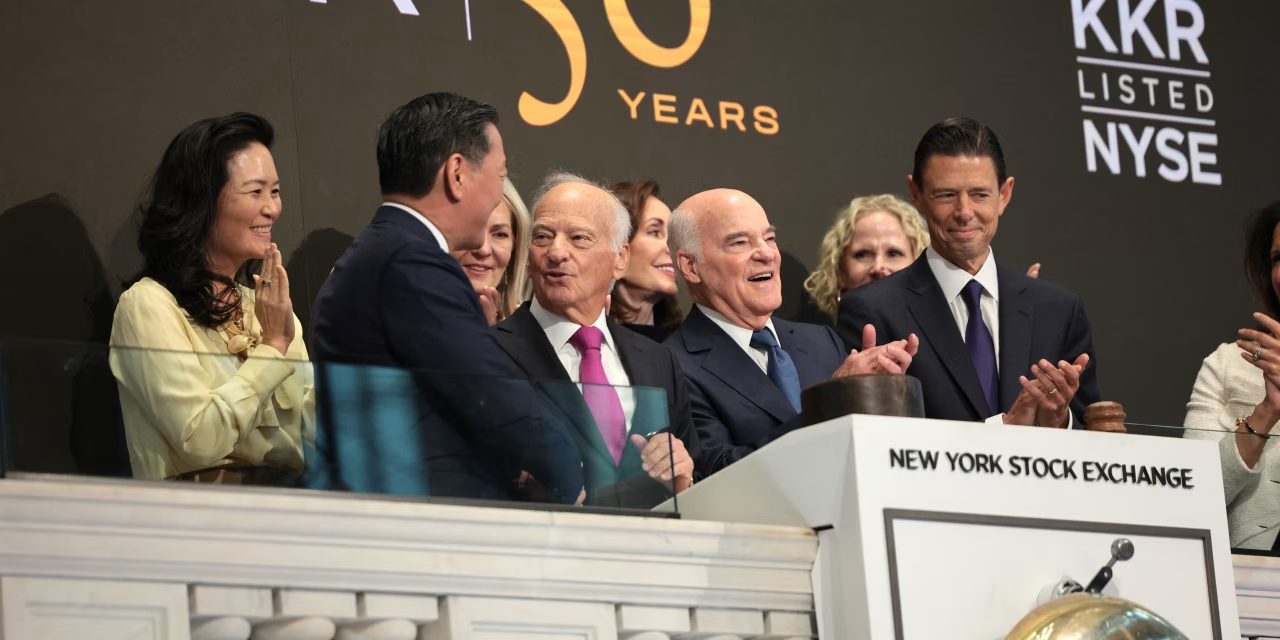
Private-equity firm KKR KKR is near a deal to take medical-device outsourcing company Integer Holdings ITGR private, according to people familiar with the matter.
The details
The deal, which could come as soon as next week, would value the Plano, Texas-based company at roughly $127 a share, the people said. There are no guarantees a deal will come together.
Copyright ©2026 Dow Jones & Company, Inc. All Rights Reserved. 87990cbe856818d5eddac44c7b1cdeb8

Exclusive-Japan to announce Tokyo, Washington took joint action on yen, sources say

A 9% selloff in Apple stock hasn’t done much to slow down the Nasdaq today.
Apple was recently down about $470 billion in market capitalization, on pace for its largest one-day market cap decline on record and the second-largest of any U.S. company. If it holds, the decline will be Apple’s biggest since 2020.
Copyright ©2026 Dow Jones & Company, Inc. All Rights Reserved. 87990cbe856818d5eddac44c7b1cdeb8

The Vikings’ Trade Candidates: The Top 5 Roster Options

27-Year-Old With More Debt Than Anyone Should Ever Have | Financial Audit

Chancellor John Healey says he won’t let supermarkets rip off Britons – but admits ‘we can’t completely stop the squeeze that families and businesses will feel’


-
 Sports6 days ago
Commonwealth Games boxing: Jadumani Singh seals dominant 5-0 win over Pakistan’s Sumama Rehman to enter quarter-finals | Commonwealth Games News
-

 Business3 days ago
Why Trees Belong on the Risk Register
-

 Fashion1 day ago
Weekend Open Thread: Wit & Wisdom
-

 Tech6 days ago
Intel is reversing course and bringing hyper-threading back to its server chips
-

 Politics1 day ago
Meta enters AI-training agreement with far-right ‘propaganda rag’ Newsmax
-

 Politics6 days ago
Luke Littler dismantles Gerwyn Price to retain title in Blackpool
-

 Crypto World12 hours ago
MicroStrategy Post-Earnings CLARITY Act Push Could Add New Catalyst for Its Stock
-

 Politics5 days ago
The Part of the Electric Transition Nobody Wants to Discuss
-

 News Videos6 days ago
BITCOIN JUST ENTERED THIS CRITICAL ZONE…
-
 Entertainment4 days ago
‘Stargate’ Creator’s New Sci-Fi Series Returns for Season 3 Tomorrow
-

 Business4 days ago
Major shareholder moves on Canyon
-

 Crypto World7 days ago
XRP Ledger adds $2.6B as RWA inflows rank second
-

 Politics7 days ago
Spain sweeps the board at 2026 World Cup with individual awards
-

 News Videos3 days ago
Bitcoin Enters the 3rd Stage of the Bear Market
-
Crypto World20 hours ago
XRP Ledger v3.3.0 brings five institutional features
-

 Crypto World4 days ago
Kraken Enables Retail Access to Jersey Mike’s IPO via Tokenized Shares
-

 Tech5 days ago
New macOS Sequoia & Sonoma security updates for older Macs
-

 News Videos4 days ago
Claude: Build Financial Dashboards in Minutes (2026)
-

 Sports2 days ago
Seema Kaliramna Wins Discus Throw Bronze, Takes India’s CWG Medals Tally To 17
-

 Politics2 days ago
Luke Littler’s dominance sparks GOAT debate
You must be logged in to post a comment Login