
Business
Amazon uses content by default


Twitch has faced a backlash from users after confirming that content on the Amazon-owned streaming platform is used to train the company’s generative AI models under a setting that is switched on by default.
The platform said on 12 August that users can opt out of the data collection, but the announcement prompted criticism from streamers who questioned why it had been enabled in the first place.
Mike Minton, Twitch’s chief product officer, said the company was “respecting” users by letting them opt out. Asked why the data was collected by default, he said: “If it’s opt-in, nobody would opt-in. That’s the honest answer.”
Minton said during a livestream that users who remain opted in could have any of their channel content used for training, and that the data collected will not be re-sold to other companies.
Twitch’s own FAQs on its use of AI state that unless users opt out, their content could be used to train generative AI models, the type of artificial intelligence that creates new content such as text, images and video.
The company said a person’s audio might be used to “refine models that create speech to text”, which it said would improve automatic subtitles on Twitch streams as well as on Amazon videos.
Some users questioned the implications for game developers, since the setting would also appear to train Amazon’s models on the video games being played by streamers.
Mary Kish, Twitch’s head of community, used the same livestream to show viewers how to disable the training through their channel settings. Users must open the Settings tab in their Streamer Dashboard, click Security and Privacy, and toggle off “training for Generative AI”.
Doing so prevents Amazon from using streams, clips, images, chats and other channel content to train its generative AI models. Some users have since reported that the setting appeared to be switched back on after they disabled it. “Went in and toggled the switch off, exited, went back in, switch is still on,” one said.
Kish said data collection for AI training had become an industry standard. “We don’t expect you to be happy or excited about this. I don’t expect anyone to react to this favourably,” she said.
The livestream’s chat was flooded with hundreds of comments criticising the move. One viewer wrote: “Nobody would opt in because nobody wants to feed AI with our creativity and content.” Another said Twitch had an “opportunity to set an industry standard” by pushing back against data collection for AI. Underneath Twitch Support’s announcement of the feature, one streamer wrote: “On by default is criminal…. the AI narrative push is so draining.”
It is not clear when Amazon began collecting Twitch users’ data to train its AI models. Minton said he did not know whether users’ data had already been scraped for training, adding that he was unsure what Amazon “has done in terms of model training and what they’ve used and not used”.
The use of creative work to train AI models has been contested in the courts. Stability AI won a High Court case brought by Getty Images over copyright claims, while Anthropic agreed a £14m payout to Harry Potter publisher Bloomsbury.
Amazon, which bought Twitch for nearly $1bn (£740m) in 2014, runs a range of AI services and has invested heavily in the technology as it competes with Google, Meta and other technology groups.

Jamie Young
Jamie Young is Senior Reporter at Business Matters, covering SME finance, employment law and Westminster policy since 2016. He has reported on every Budget and Autumn Statement since 2018, helped make sense of the ‘covid era’ and the bounce-back loan scheme from launch through the fraud investigations, and broke the magazine’s coverage of the 2024 late-payment reforms. He joined Business Matters straight from completing his BA in Administration from Exeter University and is NCTJ-qualified. Reach him at jyoung@cbmeg.co.uk


Gibraltar Industries – Still Some Struggles Despite Greater Focus

The Paramount Pictures logo is displayed on a water tower in Los Angeles, California, on August 6, 2026.
Michael Yanow | Nurphoto | Getty Images
Paramount Skydance will seek to force the states holding up its merger with Warner Bros. Discovery to pay for the fees and costs associated with the delay, according to a new filing in the antitrust case Monday.
Paramount is requesting a $1.88 billion bond that would be posted by the states behind the lawsuit. In July, a dozen state attorneys general led by California’s Rob Bonta filed to challenge the proposed $110 billion merger between Paramount and WBD.
The proposed deal would combine two storied film studios — Paramount and Warner Bros. — as well as put together a sprawling portfolio of pay TV networks in the U.S. and streaming platforms HBO Max and Paramount+.
The group of state attorneys general said in its initial filing that the merger would violate the Clayton Antitrust Act, which is the more-than-100-year-old law that prohibits anticompetitive mergers and acquisitions.
In a statement from a Paramount spokesperson, the company pointed to the Clayton Antitrust Act and other federal law that calls on the plaintiffs — or states in this case — being required “to post a bond covering the potential harm from halting a transaction to litigate.”
“Here, every month of delay carries substantial and quantifiable financial consequences,” Paramount said in its statement.
A representative from Bonta’s office didn’t immediately respond to a request for comment on Monday.
Paramount has received regulatory approvals from the Antitrust Division of the U.S. Department of Justice, as well as all other global jurisdictions needed to move forward with the merger. But last month, Paramount agreed to delay the proposed acquisition to as late as June 2027 while the state AGs’ case heads to trial.
Paramount long planned to have the deal closed by the end of September. The delay could prove costly for Paramount.
Paramount agreed to a so-called ticking fee under the terms of the merger agreement, meaning that beginning Sept. 30 it would pay WBD shareholders an additional 25 cents per share, per quarter, until the deal closes. The amount could add up to roughly $650 million in cash value per quarter.
“By the time trial concludes and the parties submit their final briefs, Paramount will have paid Warner Bros. shareholders an unrecoverable $1.3 billion in ticking fees alone,” Paramount said in the filing. “Delay also threatens to nullify the regulatory approvals that Defendants have already spent months securing.”
“Absent security, even a complete victory on the merits would not restore a dollar of those extraordinary losses. That is precisely why federal law requires plaintiffs to provide security as a condition for receiving preliminary relief such as the court-approved order,” the filing says.
In Paramount’s statement, the company said that the $1.88 billion amount is a “straightforward calculation of the maximum potential ticking consideration and financing costs from this litigation.”
However, the statement goes on to add that these are not the only costs associated with delaying the deal: “By virtue of what will be at least an eight-month delay in closing, there will be no integration and no ramped-up investment in content, production, and creative talent by the combined company. Of course, in addition, employees of both Paramount and WBD are also harmed by the uncertainties caused by the delay.”
In addition to California, the group of states suing to block the merger includes Arizona, Colorado, Connecticut, Massachusetts, Minnesota, Nevada, New Jersey, New Mexico, New York, Oregon and Washington.
Business
GigaDevice Shares Surge 6.35% to 444 Yuan as Memory Chip Boom Lifts Sentiment Ahead of Results
SHANGHAI — Shares of GigaDevice Semiconductor Inc. rose sharply on Monday, closing at 444.00 yuan, up 26.52 yuan or 6.35% from the previous close of 417.48 yuan, as investors responded to ongoing strength in the memory chip sector and anticipation of the company’s first-half results.
The Shanghai-listed stock, trading under the ticker 603986, fluctuated between 420.23 yuan and the day’s high of 444.00 yuan on elevated volume of nearly 59 million shares. The advance extended a recent recovery after a period of volatility and left the shares up more than 10% over the past five trading days. Over the past year the stock has gained more than 250%, with a 52-week range spanning 121.51 yuan to 846.66 yuan. Year-to-date gains exceed 100%.
GigaDevice is a Beijing-based fabless semiconductor designer focused on flash memory products, including NOR Flash and SLC NAND, as well as 32-bit microcontrollers, sensors and analog chips. The company ranks among the global leaders in NOR Flash and holds a strong position in China’s high-performance general-purpose microcontroller market, with cumulative MCU shipments exceeding 2 billion units. Its products serve consumer electronics, industrial automation, automotive electronics, optical modules and emerging AI-related applications.
The latest rally comes against a backdrop of tight supply and rising prices in niche memory markets. Industry dynamics have shifted as major global manufacturers allocate more capacity to high-bandwidth memory and advanced 3D NAND for artificial intelligence data centers, reducing output of mature-node products such as NOR Flash and SLC NAND. This imbalance has supported both higher volumes and elevated pricing for suppliers like GigaDevice. Microcontroller demand has also remained robust across industrial, consumer and automotive end markets.
In early July the company issued a first-half 2026 performance forecast indicating revenue of approximately 11.5 billion yuan, representing year-on-year growth of about 177%. Net profit attributable to shareholders was projected at roughly 6.9 billion yuan, a more than eleven-fold increase from the prior-year period. Non-GAAP net profit was estimated near 4.85 billion yuan. Management attributed the expected surge primarily to improved profitability in the storage business amid constrained supply and to solid microcontroller shipments. The company also noted contributions from fair-value gains on securities investments.
First-quarter results released earlier this year already showed sharp acceleration. Revenue reached 4.188 billion yuan, up 119% from a year earlier, while net profit attributable to shareholders climbed to 1.46 billion yuan, a more than five-fold increase. Gross margin expanded significantly. Full-year 2025 revenue had totaled 9.203 billion yuan, up 25%, with net profit rising nearly 50%.
Investors are now focused on the formal first-half results, scheduled for release around mid-to-late August. Analyst consensus estimates circulating ahead of the report point to continued strong sequential momentum in the second quarter. The company has also pursued capital-return and expansion measures in recent weeks, including authorization of a share repurchase program of up to 2 billion yuan and additional funding for a DRAM-related subsidiary.
Beyond financial performance, GigaDevice has expanded its product lineup and partnerships. Recent launches include the GD24CL series of I²C EEPROMs and new microcontroller series tailored for optical modules. The firm has secured automotive design wins and formed collaborations aimed at advancing power and control solutions for data centers, electric vehicles and energy systems. These initiatives align with broader efforts in China to strengthen domestic semiconductor capabilities amid global supply-chain shifts.
The memory industry remains cyclical by nature. Company disclosures have previously highlighted that future results could be affected by changes in the supply-demand balance, potentially pressuring profitability if conditions reverse. Valuations have expanded alongside the share-price gains, with trailing price-to-earnings multiples remaining elevated relative to longer-term averages.
Chinese semiconductor equities have drawn renewed attention this year as artificial intelligence demand supports specialized memory and related components. GigaDevice’s dual listing in Shanghai and Hong Kong has provided additional liquidity and visibility to international investors tracking the sector. Trading volumes on the A-share market have frequently exceeded average levels during periods of heightened interest.
Monday’s session saw the stock open near 424 yuan and climb steadily toward the close, reflecting broad participation. Market capitalization stood at approximately 310 billion yuan based on the closing price. The move occurred as global technology shares showed mixed performance, with selective strength in memory-related names elsewhere.
Looking ahead, attention will center on the detailed half-year figures, any updated outlook for the remainder of 2026, and commentary on inventory levels, pricing trends and capacity access. Analysts have noted that sustained AI infrastructure spending and automotive electrification could extend demand for the company’s core product categories, though the pace of any further gains will depend on execution and industry conditions.
GigaDevice’s trajectory illustrates the leverage available to specialized chip designers during periods of constrained supply. After a multi-year cycle of inventory adjustments and pricing pressure, the current environment has delivered rapid earnings expansion. Whether the momentum continues will hinge on how long the tightness in mature memory technologies persists and how effectively the company converts design wins into sustained revenue streams across its diversified portfolio.
The stock’s performance on Monday underscored investor focus on tangible financial catalysts and sector tailwinds. As results approach, market participants will scrutinize the quality of the profit surge and the sustainability of the underlying demand drivers that have propelled GigaDevice’s shares to elevated levels this year.

Artist concept art of the yeti animatronic from Expedition Everest at Disney’s Animal Kingdom in Orlando, Florida.
Disney
It’s not every day that a live crowd goes wild for an animatronic yeti.
But the audience at Disney’s D23 Expo isn’t just any old crowd, and its superfans are central to Disney’s strategic parks investments — some $60 billion planned over a decade.
“We are bringing the yeti back to life,” Thomas Mazloum, chairman of Disney Experiences, announced to 12,000 Disney parks fans Saturday night during the division’s showcase in Anaheim, California.
The resurrection he was referencing is within the Expedition Everest attraction at Walt Disney World’s Animal Kingdom theme park. Since 2006, the ride’s yeti has been stationary. At the time the figure was unveiled it was the largest and most complex audio-animatronic that Walt Disney Imagineering had ever built. But after only a few months, it broke.
Its location within the finished ride made it difficult to fix, so Imagineers placed the machine in “B-mode,” in which a strobe-light effect was used to give the illusion of movement. The broken animatronic has since become affectionately known as “Disco Yeti.” Now, it’s getting a second life.
Mazloum, who became parks chief after Josh D’Amaro was appointed as Disney CEO, announced the yeti repair — as well as the return of fan-favorite characters Dreamfinder and Figment to Epcot in Florida and an overhaul of Tomorrowland in California — to some of Disney’s most ardent fans on Saturday.
It’s a signal of where the company plans to put its focus for the blockbuster Disney Experiences unit, made up of theme parks, cruise lines and consumer goods sales. As Disney expands its reach, it will need to lean on its most loyal attendees and biggest spenders to counter macroeconomic uncertainties and challenging travel trends.
“It may not sound like a big thing, but something like the yeti or Figment or really being serious about Tomorrowland, they mean a lot to people because they grew up with these stories,” Mazloum told CNBC.
“They’re small, they’re immediate, but they’re meaningful,” he added.
A balancing act
For Mazloum, the focus of his tenure as head of the Disney Experiences division will be about balancing the company’s massive expansion plans — new lands and area overhauls based on popular intellectual property — meant to attract the less frequent out-of-state and international visitors with more targeted updates and upgrades that annual passholders and more regular attendees want to see.
“Our job is to listen carefully and then find the way to harmonize the different needs and wants,” he said.
“The simplest way to frame it is: I’m really focused on making sure we put our fans and the consumer and the guests into the center of our decision-making,” he said.
Mazloum said these efforts are already paying off, touting the company’s recent fiscal third-quarter earnings report in which the experiences division posted nearly $10 billion in revenue, a 10% jump from the same quarter a year prior and a quarterly record.
Concept art for the Car’s Ridge Run Rally ride coming to Disney’s Magic Kingdom in Orlando, Florida.
Disney
“I believe the results are at the end of doing something right at the beginning, and that is really putting the fans in the center of our attention,” he said. “That’s why, despite some, you know, other companies reporting different results, we’re doing extremely well in Florida. We’re doing very well here in California, because we’ve listened carefully and we’ve really responded to the right consumer at the right time.”
Last month, rival Comcast reported lags in theme park attendance, particularly in Orlando, Florida. And yet, at Disney, domestic park attendance was up 3% and guest spending rose 4%.
The company attributed strong attendance to its Cool Kids Summer promotion, which features kid-focused character meet-and-greets, dance parties and air-conditioned hangout spots as well as free water park admission on check-in day for guests at Disney resorts.
Disney also recently refreshed and reimagined park attractions like Buzz Lightyear’s Space Ranger Spin, Big Thunder Mountain Railroad and the Muppets-themed Rock ‘n’ Roller Coaster.
Driving attendance with IP
Next up is the refurbishment of the Carousel of Progress, which is expected to be completed in late-spring 2027, and the opening of the Monsters, Inc.-themed Monstropolis land, also set for 2027.
In the meantime, Disney continues working on its Avengers Campus expansion, its new Villains Land, the retheming of Frontierland featuring the Cars franchise as well as the new Tropical Americas land, among other long-term projects.
Artist concept art for the stage show coming to the Monstropolis land at Disney’s Hollywood Studios in Orlando, Florida.
Disney
Disney’s portfolio of IP has been the bedrock of its theme parks since the very first location opened its doors, and that library of content has only grown in recent decades. The company has a vast well of stories and characters to tap into in order to entice parkgoers.
While these new lands and rethemed attractions are designed for all future Disney park visitors, these additions predominantly act as a beacon to those that don’t travel as often to the company’s resorts and parks. They offer a fresh reason for out-of-state and international guests to book a trip.
“The percentage of people that go to Shanghai Disneyland just to go to Zootopia Land is very, very high,” then-CEO Bob Iger said during the company’s fiscal first-quarter earnings report in February.
Rewarding loyal parkgoers
Equally important are the guests that frequent Disney’s parks more often. These attendees have some of the strongest emotional attachment to the parks and more purchasing opportunities when it comes to merchandise and concessions.
These parkgoers enjoy the new marquee expansions, but it’s not the only driver for their visits to the parks. Those who visit annually or several times during the year are deeply passionate about the live shows, character meet-and-greets, holiday food specials, seasonal festivals and parades and nighttime spectaculars that these parks provide.
Scene from World of Color – ONE, the new nighttime water show at Disney California Adventure in Anaheim, CA, on Wednesday, January 25, 2023.
Medianews Group/orange County Register Via Getty Images | Medianews Group | Getty Images
On Saturday, Disney revealed the return of two fan-favorite nighttime spectaculars — “Remember Dreams Come True,” a fireworks show at Disneyland, and the original “World of Color” at California Adventure. The “Magic Happens” parade will also be making a comeback at Disneyland.
“This new set of announcements demonstrates that Disney is listening to what fans want,” said Gavin Doyle, founder of MickeyVisit.com. “The reaction in the room was cheering and thunderous applause. People feel like Disney hears what they have been asking for.”

Amerant Bancorp Needs To Prove Itself

How a Finance Executive Became a Leader in Inclusive Design
What if the spaces where we work, learn, and live could actively help us feel calmer, think more clearly, and perform better?
That question sits at the center of Lydia Denimal Abdouch’s career today. As the founder and CEO of Feel Good Monaco, she is helping advance the growing field of neuro-architecture, which combines architecture, neuroscience, and sensory design to create environments that support human well-being.
Her journey to this emerging discipline did not begin in architecture. It began in finance.
“Success is creating environments that genuinely improve people’s lives,” Abdouch says. “For me, success is when a space brings calm, focus, and well-being in a measurable way.”
Who Is Lydia Denimal Abdouch?
Abdouch grew up in an international environment between Algeria, France, Europe, and North America. Raised in France’s Champagne-Ardenne region, she developed an early ability to adapt to different cultures and perspectives.
Her family also played a major role in shaping her future interests. Both of her parents were medical doctors involved in disability reintegration and autism support. Those experiences exposed her to questions of autonomy, dignity, and inclusion from a young age.
As the oldest of four sisters, she learned responsibility early.
Years later, those lessons would influence the direction of her career.
“My biggest motivation comes from my son and my family background in medicine and disability support,” she says. “It made me deeply aware that spaces can change autonomy and quality of life.”
How Lydia Denimal Abdouch Built Her Business Career
Before entering the design world, Abdouch built an impressive academic foundation.
She earned a Master’s degree from Montpellier Business School in France, studied management science at ITESM Tec de Monterrey in Mexico, and later completed an MBA at Texas Tech University’s Rawls College of Business in the United States.
Her professional career began in corporate banking.
Working in high-level financial environments across France, Latin America, and the Middle East, including Abu Dhabi, she managed strategic corporate portfolios for major organizations. Some clients generated annual revenues ranging from €50 million to more than €1 billion.
The work required analytical precision and disciplined execution.
“Early on, I learned that excellence comes from structure and process, not intuition alone,” Abdouch says. “Every challenge helped me refine my standards and strengthen my method.”
Why She Left Finance for Real Estate and Design
Although finance provided valuable experience, Abdouch became increasingly interested in real estate and the built environment.
After moving to Monaco in 2018, she launched a real estate agency serving an international luxury market. At the same time, she began leading acquisition, renovation, and resale projects.
Over more than a decade, she developed expertise across every stage of property transformation. She worked on sourcing opportunities, renovation planning, architectural enhancement, project execution, and final delivery.
To formalize her knowledge, she earned a Diploma in Interior Architecture in 2024.
This combination of finance, construction, and design gave her a unique perspective.
“You need vision, technical discipline, and the ability to deliver,” she says. “Architecture is not only about ideas. It is about precision, responsibility, and impact.”
What Is Neuro-Architecture?
As Abdouch gained experience in renovation and architecture, she noticed a recurring problem.
Most spaces were designed primarily for aesthetics or functionality. Very few considered how people actually feel inside them.
At the same time, schools, workplaces, and homes were facing growing challenges related to stress, distraction, and sensory overload.
Research continues to show that environmental factors such as lighting, acoustics, layout, and sensory stimulation can influence concentration, emotional regulation, and productivity.
Abdouch saw an opportunity to approach design differently.
“Building a new discipline like neuro-architecture requires credibility and patience,” she says. “I overcame this by combining rigorous expertise, continuous learning, and real execution on the ground.”
That vision led to the creation of Feel Good Monaco.
How Neuro-Inclusive Spaces Can Improve Daily Life
Today, Abdouch develops environments designed to support both neurodivergent individuals and the general population.
Her work focuses on multisensory spaces, sensory regulation rooms, restorative environments, and inclusive design strategies for schools, corporations, institutions, and private residences.
The goal is not simply to create beautiful spaces.
The goal is to create spaces that work better for people.
She believes many modern environments unintentionally contribute to stress and cognitive fatigue. Thoughtful design, however, can help restore focus and improve daily experiences.
“The strongest metric is people satisfaction and well-being,” she says. “Feedback matters, but the real measure is the impact a space has on the people who use it.”
The Future of Architecture and Human Well-Being
For Abdouch, architecture is entering a new era.
In the past, success was often measured by appearance alone. Today, there is growing interest in how environments influence learning, productivity, health, and quality of life.
Her work reflects that shift.
By combining strategic thinking, financial expertise, construction knowledge, and neuroscience-informed design, she is helping expand the conversation about what architecture can achieve.
“I stay connected to research, innovation, and international best practices,” Abdouch says. “Learning is a constant responsibility when you want to remain ahead.”
As organizations and communities continue exploring new ways to support well-being, leaders like Lydia Denimal Abdouch are helping demonstrate that architecture can be more than a backdrop to life. It can become an active tool for improving how people live, learn, and thrive.


The Sunday Investor is focused exclusively on U.S. Equity ETFs. He has a strong analytical background, has received a Certificate of Advanced Investment Advice from the Canadian Securities Institute, and has completed all the educational requirements for the Chartered Investment Manager designation.Having covered hundreds of ETFs on Seeking Alpha, The Sunday Investor has developed a complex, proprietary ETF Rankings system which he shares on his website, etf-rankings.com. Nearly 1,000 ETFs receive individual factor scores covering costs, liquidity, risk, size, value, dividends, growth, quality, momentum, and sentiment, which feed into an easy-to-understand composite score from 1-10. The Sunday Investor is always active in the comments section in his articles – please don’t hesitate to reach out via comment in any article or by visiting etf-rankings.com. Happy Investing!
Analyst’s Disclosure: I/we have no stock, option or similar derivative position in any of the companies mentioned, and no plans to initiate any such positions within the next 72 hours. I wrote this article myself, and it expresses my own opinions. I am not receiving compensation for it (other than from Seeking Alpha). I have no business relationship with any company whose stock is mentioned in this article.
Seeking Alpha’s Disclosure: Past performance is no guarantee of future results. No recommendation or advice is being given as to whether any investment is suitable for a particular investor. Any views or opinions expressed above may not reflect those of Seeking Alpha as a whole. Seeking Alpha is not a licensed securities dealer, broker or US investment adviser or investment bank. Our analysts are third party authors that include both professional investors and individual investors who may not be licensed or certified by any institute or regulatory body.
Business
Trump Threatens to Bomb US Ally Oman as Iran Deadline Expires While Kushner Presses Netanyahu on Gaza Plan

WASHINGTON — President Donald Trump threatened Monday to attack Oman, a longtime U.S. ally, if the country interferes with American efforts in the Strait of Hormuz, as a 60-day window for reaching a peace agreement with Iran expired without a clear resolution to the ongoing conflict.
“If Oman gets in the way, we’ll bomb the shit out of them,” Trump said in an interview with Fox News’ Trey Yingst, published Monday. It marked the second time this year Trump has directed such a threat at Oman. At a Cabinet meeting in May, the president said, “Oman will behave just like everybody else, or we’ll have to blow ’em up.”
The renewed threat came as the 60-day deadline for the United States and Iran to reach a deal toward ending their conflict passed Monday without any concrete agreement announced. Trump said he remains unconcerned about the lack of a timeline. “They’re good poker players, but they’re dying,” Trump said of Iran. “I have no time schedule. I’m not in a hurry.”
Trump also told Fox News that his administration has established a direct backchannel with Iran’s Islamic Revolutionary Guard Corps, a claim the IRGC firmly denied Monday. A spokesperson for the Revolutionary Guards told Iran’s semi-official Tasnim news agency that Trump’s assertion was a “lie” and “nothing more than fantasies stemming from the delusions and nightmares brought on by defeat and desperation in the war.” The spokesperson added that diplomacy does not fall within the IRGC’s remit and said that, “as far as we are aware, and based on statements by Foreign Ministry officials, there are currently no talks with the Americans even at that level, given Washington’s broken promises and its long record of repeatedly violating its commitments.”
Trump reiterated Monday that preventing Iran from acquiring a nuclear weapon remains his administration’s central objective in the conflict, a stance that has at times put him at odds with advisers who have emphasized keeping global oil prices low as a competing priority. Brent crude, the global oil benchmark, climbed modestly Monday, rising 0.38% to $88.85 a barrel following the expiration of the negotiating window.
Trump’s threat against Oman is not an isolated incident within his broader approach to foreign policy. According to a CNN analysis, the president has launched military strikes in seven countries during his second term alone — Iran, Iraq, Nigeria, Somalia, Syria, Venezuela and Yemen — and has threatened or left open the possibility of strikes against at least seven others, including Canada, Colombia, Cuba, Greenland, Mexico, Panama and now Oman. CNN had previously calculated in May that Trump had either attacked or threatened roughly one out of every 13 countries in the world, with Oman ranking among the earliest targets of that pattern. Analysts have noted that many of Trump’s specific threats have not ultimately been carried out, even in instances when the targeted country did not meet his stated demands.
Iran’s Foreign Ministry, meanwhile, said talks between Tehran and Oman regarding the future status of the Strait of Hormuz remain complex but ongoing. Foreign Ministry spokesperson Esmaeil Baghaei said Monday that several unspecified “actors trying to exert influence on this process” had contributed to delays in reaching an agreement.
Trump’s comments regarding the Strait of Hormuz followed remarks he made Friday, in which he said he intends to declare the waterway a U.S. territory once the conflict with Iran concludes, which he predicted would happen “pretty soon.” Maritime law experts have pushed back on the feasibility of such a declaration. Jason Chuah, a professor of maritime law at City, University of London, told CNN that “under US law, claiming territory by a Presidential declaration or decree is not enough. There are important constitutional requirements that must be cleared first,” adding that “under international law, annexation is contrary to the United Nations Charter. Territories including bodies of water can only be taken through agreement or cession.” Simon Baughen, a professor of shipping law at Swansea University, said any legitimate path toward such a claim would require Iran’s direct consent. “Under international law, this could only be done if Iran agreed to cede its territorial waters in the strait to the US,” Baughen said. “I think this is a very unlikely scenario.”
Elsewhere in the region, Jared Kushner, Trump’s son-in-law and senior adviser, met Monday with Israeli Prime Minister Benjamin Netanyahu for more than four hours in an effort to revive the administration’s stalled Gaza ceasefire plan. According to a senior Israeli official, Netanyahu told Kushner that Israel would not withdraw any forces from Gaza or allow reconstruction to begin until Hamas fully disarms. The two also agreed that an American general would oversee the decommissioning of Hamas weaponry as a first step toward demilitarizing the territory, the official said.
Hamas has said it will not disarm unless the process is sequenced alongside an end to near-daily Israeli attacks on Gaza and a corresponding withdrawal of Israeli forces from more than half of the territory they currently occupy. According to a separate Israeli source, Netanyahu told Kushner that making progress on the administration’s 15-point ceasefire plan — which Israel had previously rejected — would be “problematic” given upcoming Israeli elections at the end of October. Netanyahu also insisted Israel would not alter its ongoing policy of targeted killings against Hamas commanders, the source said.
Former British Prime Minister Tony Blair, who now serves on Trump’s Board of Peace and Gaza Executive Board, also participated in Monday’s talks alongside Board of Peace director Nickolay Mladenov. According to Netanyahu’s office, the group agreed to establish working groups focused on disarmament as well as sanitation, clean water and public health issues in Gaza.
Adding to the volatile regional backdrop, Yemen’s Iran-backed Houthi movement said Monday it had launched ballistic missiles at a Saudi military vessel and four escort ships in the Red Sea near the Yemeni port city of Mokha. The claim could not be independently verified, and Saudi authorities had not immediately responded. The reported attack follows a weekend of escalation after the Houthis declared a blockade of Saudi shipping in the Red Sea, prompting Mokha’s port to suspend operations following earlier missile strikes Friday.
Separately, Iran’s army has offered a bounty of 5 billion tomans, or roughly $30,000, for anyone who kills or captures a U.S. soldier and turns them over to Iranian authorities, according to the country’s semi-official Mehr news agency, underscoring the continued hostility accompanying the expired negotiating deadline even as diplomatic channels, disputed or otherwise, remain nominally open between Washington and Tehran.

BWS Financial cuts Inter Parfums stock rating on earnings concerns


Dhierin-Perkash Bechai is an aerospace, defense and airline analyst.
Dhierin runs the investing group The Aerospace Forum, whose goal is to discover investment opportunities in the aerospace, defense and airline industry. With a background in aerospace engineering, he provides analysis of a complex industry with significant growth prospects, and offers context to developments as they occur, describing how they might affect investment theses. His investing ideas are driven by data informed analysis. The investing group also provides direct access to data analytics monitors.
Learn more.
Analyst’s Disclosure: I/we have no stock, option or similar derivative position in any of the companies mentioned, and no plans to initiate any such positions within the next 72 hours. I wrote this article myself, and it expresses my own opinions. I am not receiving compensation for it (other than from Seeking Alpha). I have no business relationship with any company whose stock is mentioned in this article.
Seeking Alpha’s Disclosure: Past performance is no guarantee of future results. No recommendation or advice is being given as to whether any investment is suitable for a particular investor. Any views or opinions expressed above may not reflect those of Seeking Alpha as a whole. Seeking Alpha is not a licensed securities dealer, broker or US investment adviser or investment bank. Our analysts are third party authors that include both professional investors and individual investors who may not be licensed or certified by any institute or regulatory body.
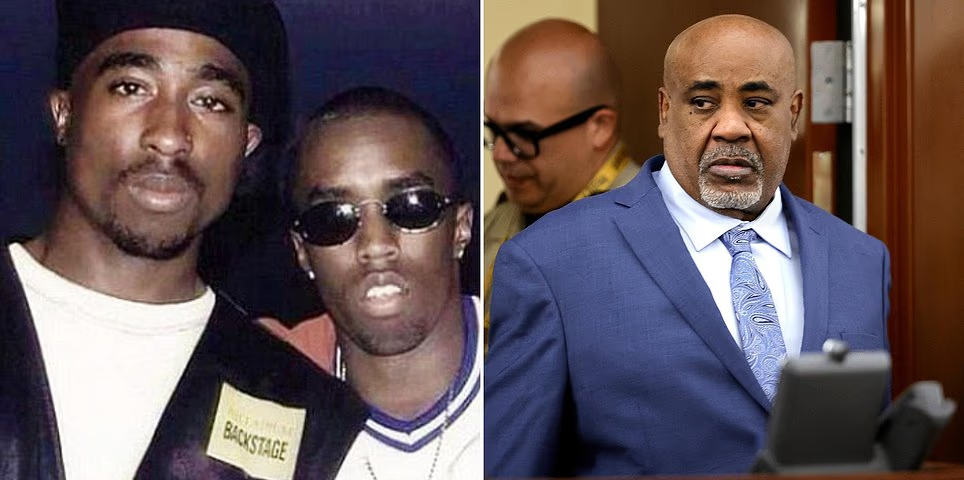
Diddy named in Tupac trial witness list as prosecutors claim rapper’s murder was an ‘act of revenge’: Live updates

Gibraltar Industries – Still Some Struggles Despite Greater Focus

US Treasury Advances GENIUS Act Rules After July Deadline

Weekend Open Thread: Staud – Corporette.com

Weekend Open Thread – Corporette.com

Weekend Open Thread: Brooks Brothers

#motivation #MoneySecrets #money #shorts #viral #trending #viralvideo #reels #viralshorts #youtube

Is the dinar part of a global financial reset ? #dinar #globalfinancialcrisis

Worst Crypto News Ever – Bitcoin Holders Just Got F**ked
-

 Fashion3 days ago
Weekend Open Thread: Ann Taylor
-
 NewsBeat6 days ago
Communication cards help banking customers access services or report scams
-
 Business7 days ago
Oil Price Today (August 11): Crude oil rises to $88 after Trump’s compensation demand dents Hormuz opening. Here’s why
-

 Crypto World7 days ago
Revolut wins French banking licence, creates second EU banking hub
-
 Sports4 days ago
This U.S. Amateur is a glimpse into golf’s future in more ways than you think
-
 Crypto World7 days ago
Why Did Nvidia Stock Fall on Monday Despite a $500 Billion Wall Street AI Deal?
-

 Sports3 days ago
Birmingham 2026: Day 6 Timetable for Irish Athletes
-
 NewsBeat3 days ago
Myanmar says over 300,000 Rohingya refugees verified for repatriation as exodus enters ninth year
-

 Politics2 days ago
SEQ Code: The Three Letter Boarding Pass Code That Could Give You The Worst Seat
-
 Entertainment5 days ago
Keke Palmer Subtly Hints At Sean Evans Drama With Cryptic Post
-
 Entertainment7 days ago
57 Years Later, the Best Sitcom Ever Made Still Deserves a Reboot
-

 Fashion6 days ago
Coffee Break: The Fonteyn Jane Flat
-

 Tech6 days ago
Zoom Screen-Sharing Bug Let People Fully Take Over Other Devices On A Call
-

 Crypto World7 days ago
Bitcoin's BIP Editors Remove Luke Dashjr Two Days After BIP-110 Fork Stalled
-

 Fashion6 days ago
Should you refinance your debt? Pros, cons, and real numbers
-

 Fashion6 days ago
Claire Life: Kicking Off MVAAFF With the C Suite Luncheon Featuring Phylicia Rashad, Letoya Luckett, and More!
-
 Crypto World6 days ago
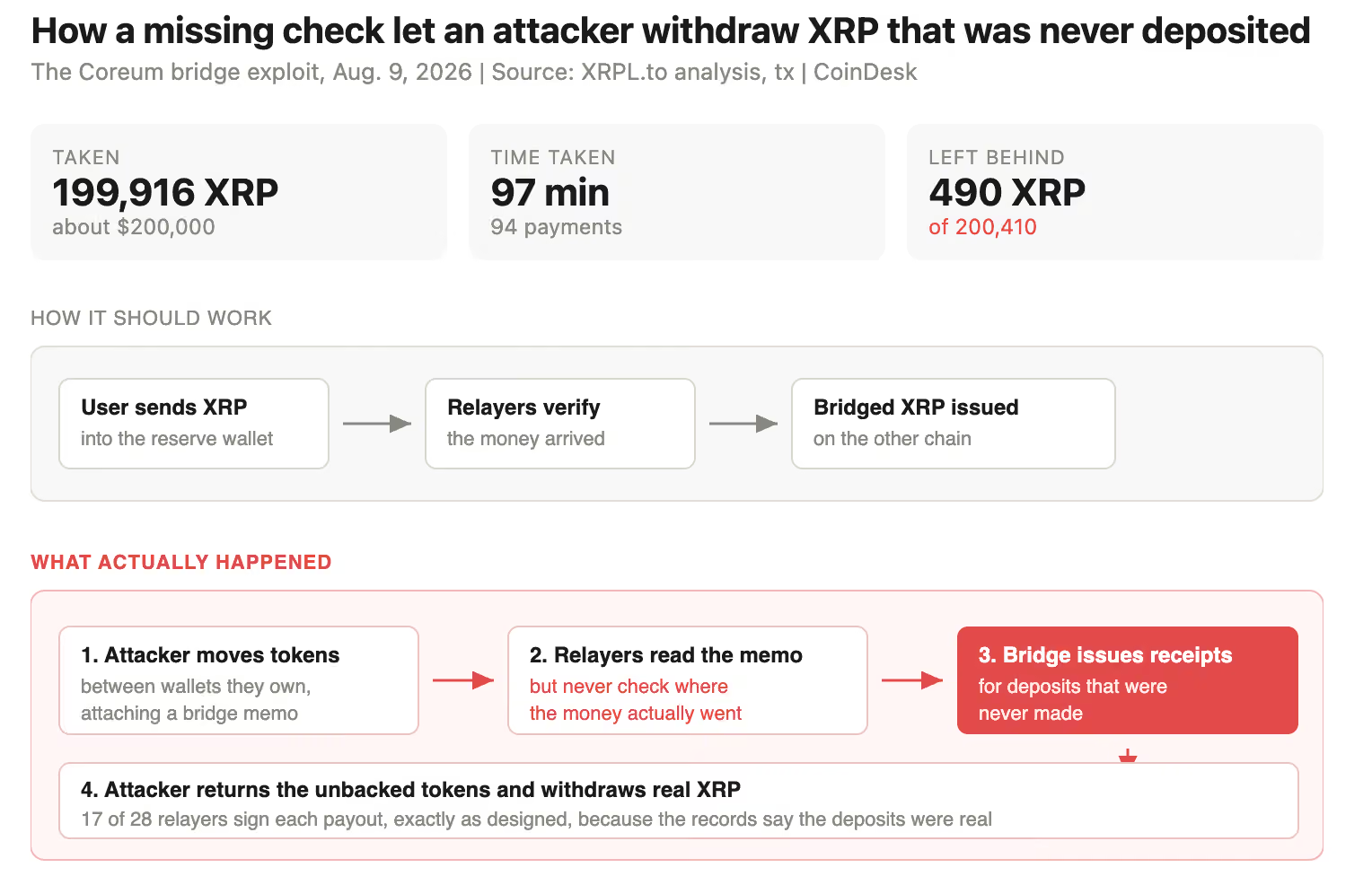
XRP bridge drained after software mistook fake deposits for real ones
-

 Sports5 days ago
DeQuan Jones in ‘high spirits’ after successful leg surgery
-
 Tech7 days ago
Zuck rekindles open weights Llama drama with Muse Glimmer
-

 Business7 days ago
(VIDEO) Emirates Unveils 2.4-Meter Arsenal Crest Sculpture Built From Recycled A380 And Boeing 777 Jet Parts
You must be logged in to post a comment Login