

Connect with us
DAPA Banner
DAPA Coin
DAPA
COIN PAYMENT ASSET
PRIVACY · BLOCKDAG · HOMOMORPHIC ENCRYPTION · RUST
ElGamal Encrypted MINE DAPA
🚫 GENESIS SOLD OUT
DAPAPAY COMING

Business

Apple to raise prices due to memory chip shortage, CEO tells WSJ

Published

on

Apple to raise prices due to memory chip shortage, CEO tells WSJ
Continue Reading
Click to comment

You must be logged in to post a comment Login

Leave a Reply

Business

Selena Gomez Faces Fan Speculation Over Deleted Instagram Story Amid Knicks Game Celebrity Sightings

Published

on

Selena Gomez

LOS ANGELES — Selena Gomez found herself at the center of online speculation after deleting an Instagram Story post that some fans interpreted as a subtle jab at Hailey Bieber and other celebrities attending a New York Knicks playoff game.

The incident, which unfolded in mid-June 2026, quickly spread across social media platforms as screenshots of the deleted content circulated widely. Gomez, a longtime San Antonio Spurs supporter, had reacted to the Knicks’ performance with a post that included the phrase “so funny how some are all of the sudden fans though, lol.”

The story’s deletion fueled immediate debate, particularly given the presence of high-profile attendees at the game, including Bieber, Taylor Swift and others. Fans drew connections between the timing and the celebrity sightings, amplifying discussions on TikTok and X about possible interpersonal tensions.

Gomez later addressed the speculation, clarifying that her comments were not directed at any specific individuals but rather referred to friends she had bet with on the game outcome. Despite the explanation, interpretations continued to vary widely online.

Advertisement

The episode highlights the intense scrutiny faced by celebrities on social media, where brief or ambiguous posts can rapidly evolve into broader narratives. Neither Gomez nor Bieber has publicly commented further on the matter, and there is no confirmed evidence of direct conflict between them.

Celebrity attendance at major sporting events often generates significant buzz, especially when multiple high-profile figures are present. The Knicks game drew attention for its star-studded crowd, providing fertile ground for fan-driven commentary and conspiracy theories.

Social media users offered divided perspectives. Some defended Gomez, arguing the post was harmless banter, while others saw it as passive-aggressive. Comments ranged from dismissals of the drama to calls for leaving the celebrities alone.

The situation reflects ongoing dynamics in celebrity culture, where past associations and public appearances continue to spark interest years later. Gomez and Bieber have faced fan comparisons and speculation since Bieber’s marriage to Justin Bieber, Gomez’s ex-boyfriend.

Advertisement

Industry observers note that such moments often stem from fragmented information and rapid online amplification. Deleted posts, in particular, tend to generate more curiosity as users piece together screenshots and context.

Gomez has maintained a relatively low profile on personal matters in recent years, focusing on her acting career, music and Rare Beauty brand. The actress and singer has previously spoken about the challenges of navigating public perception and mental health in the spotlight.

Bieber, for her part, has built a successful career in modeling and business, including her Rhode skincare line. She has generally avoided engaging with online rumors, choosing instead to focus on her family and professional endeavors.

The Knicks game itself was part of the NBA playoffs, drawing significant media coverage beyond the on-court action. Celebrity sightings at such events frequently become talking points, especially when involving figures with overlapping social circles.

Advertisement

This latest flare-up joins a long history of fan-fueled narratives surrounding Gomez and Bieber. While their respective supporters often clash online, both women have occasionally addressed the attention, emphasizing personal growth and privacy.

As the story continues to circulate, it underscores the power of social media in shaping celebrity discourse. What began as a deleted Instagram update transformed into widespread debate within hours, demonstrating how quickly context can shift in the digital age.

Public interest in such personal dynamics persists despite repeated calls from fans and commentators for more nuanced interpretations. The absence of direct responses from those involved has allowed speculation to fill the void.

Entertainment experts suggest these moments reveal more about audience engagement patterns than about the celebrities themselves. Viral controversies often boost visibility across platforms, regardless of the underlying facts.

Advertisement

Gomez’s clarification aimed to redirect the conversation, but the episode has already become part of the broader online conversation about celebrity interactions and fan behavior. As both women continue their careers, such incidents serve as reminders of the persistent public gaze on their lives.

Continue Reading

Business

UK job vacancies fall sharply in new blow to labour market as unemployment drops again

Published

on

Business Live

The latest ONS figures highlight mounting pressures facing the UK economy

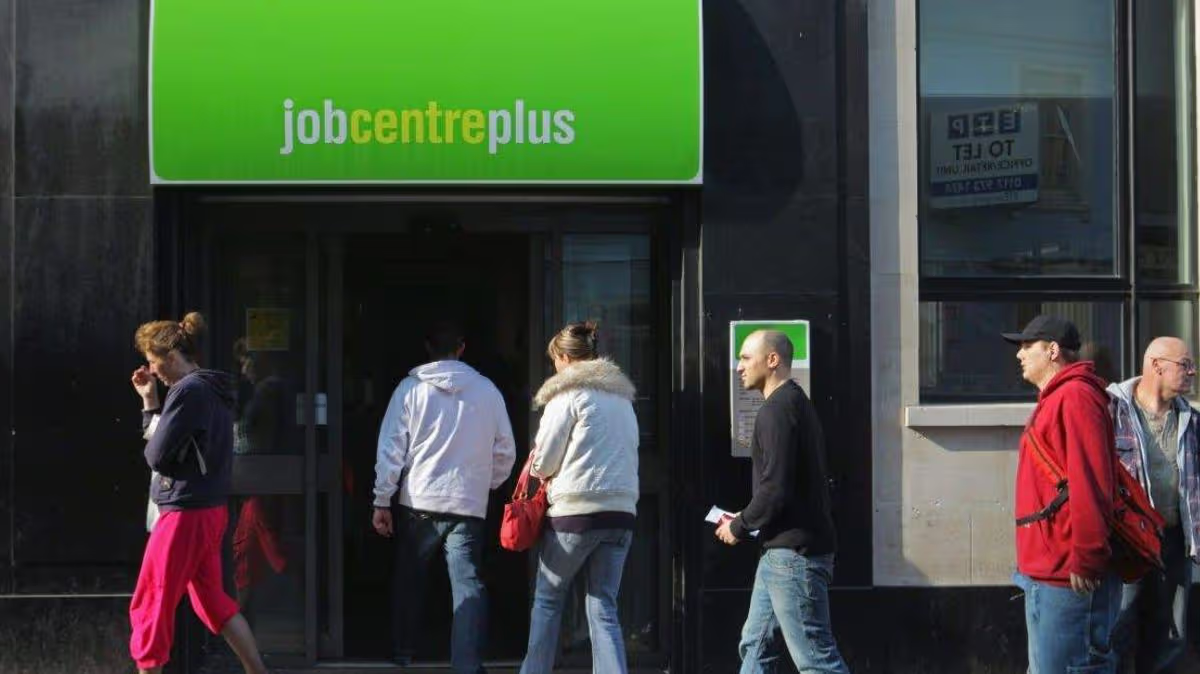
People outside a job centre

People outside a job centre

The number of job vacancies across the UK has fallen once more, according to official figures, presenting a further challenge for those seeking employment.

Advertisement

The Office for National Statistics (ONS) reported that job vacancies declined by 19,000 between March and May. The unemployment rate eased to 4.9 per cent compared to five per cent in last month’s data, coming in below market expectations.

The latest employment figures highlight mounting pressures facing the UK economy, with businesses citing rising labour costs driven by significant wage pressures and a considerable tax burden.

The ONS disclosed that wage growth, excluding bonuses, stood at 3.4 per cent — surpassing forecasts. When bonuses were factored in, wage growth came in higher than anticipated at 4.4 per cent.

“Payroll numbers continued to fall over this period, with new recruits at their lowest level in five years,” said Liz McKeown, director of economic statistics at the ONS, as reported by City AM.

Advertisement

“Overall employment was little changed, with some signs of workers moving into self-employment.”

Work and pensions secretary Pat McFadden said: “This month’s figures show that there are 400,000 more people in work than this time last year, but we know ongoing instability in the Middle East is causing uncertainty in our labour market.

“We have the right economic plan for growth and stability in a volatile world – and we are taking action to create opportunity and make sure that no one is left behind.”

Helen Whately, the shadow work and pensions secretary, said a rise in economic inactivity suggested “people aren’t even trying to get work anymore”.

Advertisement

” That means more people on benefits and a higher welfare bill, at the taxpayers expense,” she said.

The latest labour market figures lay bare the mounting pressures facing both employers and job seekers, with concerns over inflation — driven by the energy price shock stemming from the Iran war — also set to squeeze household finances across Britain.

On Tuesday, the ONS confirmed that inflation held steady at 2.8 per cent, significantly below the Bank’s own forecast of 3.3 per cent just a month ago.

Core inflation, which excludes volatile energy and food prices, came in at 2.6 per cent, while services inflation — closely scrutinised by Bank of England rate-setters for signs of wage pressure — climbed from 3.2 per cent to 3.7 per cent.

Advertisement

Andrew Griffith, the shadow business secretary, has cautioned that surging business costs of up to nine per cent risk delivering either steeper prices on the high street, a wave of company closures and job losses, or potentially both.

The trajectory of the UK economy hinges largely on whether the Strait of Hormuz fully reopens in the wake of the peace agreement between the US and Iran.

Meanwhile, the Bank’s Monetary Policy Committee faces a delicate balancing act, navigating a weakening labour market alongside elevated inflation expectations that could drive prices well beyond its two per cent target.

Some economists have suggested that the Bank will opt to leave monetary policy unchanged for the rest of the year before cutting interest rates next year, as weakened demand could stop prices from spiralling in 2026.


Advertisement
Continue Reading

Business

UK wages rise more than forecast as jobless rate drops

Published

on


UK wages rise more than forecast as jobless rate drops

Continue Reading

Business

Vedanta Power shares drop 3%, fall below listing price. What lies ahead?

Published

on

Vedanta Power shares drop 3%, fall below listing price. What lies ahead?
The shares of Vedanta Power dropped more than 3% on Thursday to fall below its listing price, with analysts highlighting that the counter remains the most defensive among the four stocks that debuted on Dalal Street earlier this week after the mega demerger.

The company’s shares dropped to Rs 40.70 apiece on the NSE, with its market capitalisation nearing Rs 16,000 crore. Vedanta Power debuted at Rs 41.80 per share on the NSE on Monday. The shares of the company fell 2% on the first day, and another 2% on Tuesday, before jumping 5% on Wednesday.

About Vedanta Power

Vedanta Power has more than 4 GW of installed capacity in four strategic assets in Punjab, Andhra Pradesh, Chhattisgarh and Odisha. It has several long-term and mid-term Power Purchase Agreements (PPAs) with state utilities.

The power company aims to become one of India’s top three private thermal power players by FY33 through a combination of organic expansion and asset turnarounds. Its portfolio comprises Vedanta Power Talwandi Sabo Thermal Plant in Punjab (1,980 MW), Vedanta Power Meenakshi Energy in Andhra Pradesh (1,000 MW), Vedanta Power Sakti in Chhattisgarh (600 MW operational with another 600 MW under commissioning), and Vedanta Power Jharsuguda Thermal Plant in Odisha (600 MW).

Advertisement

Also read: Vedanta Power shares list at Rs 42 as mega demerger concludes

“The company believes coal will continue to play an important role in India’s energy mix for decades to come, co-existing alongside renewable and clean energy sources. In parallel, Vedanta Power, currently a pure-play thermal player, is evaluating future growth opportunities across hydro, battery storage and nuclear power as part of its long-term diversification strategy. The company recognises nuclear energy’s potential as a clean, reliable 24×7 power source and a key enabler of India’s energy transition,” the company said in a press release.

What lies ahead for Vedanta Power shares?

While the post-listing volatility across the new four Vedanta entities spooked investors, Harshal Dasani, Business Head at INVasset PMS, explained that this is typical of demerger scenarios where price discovery happens in compressed windows and pre-listing positioning unwinds rapidly.
He suggested a framework for investors to evaluate these names based on business quality rather than price action. “Four variables matter: where the underlying commodity sits in its cycle, the balance-sheet position of each entity post-demerger, capex visibility and execution credibility, and the regulatory or pricing environment specific to that sub-sector. A directional view at the sector level is the appropriate framing,” the analyst said.
Also read: 4 new Vedanta Group stocks debut on Dalal Street. What’s ahead?

Power is the most defensive of the four, with regulated returns offering stability but limited upside, and the modest price action fits that profile, according to the analyst. “Oil and gas face the most challenging setup, with mature fields, a declining production trajectory in domestic blocks, an unsupportive crude price backdrop, and limited reinvestment optionality, which the price action through three lower circuits reflects. The honest read is that the quality and visibility tilt favours the early-cycle commodity exposure and the regulated utility profile over the late-cycle and declining-asset profile,” he concluded.

Also read: Vedanta Aluminium shares jump over 3% after Citi, Kotak initiate with Buy, see up to 29% upside. Here’s why

Advertisement

(Disclaimer: Recommendations, suggestions, views and opinions given by the experts are their own. These do not represent the views of The Economic Times)

Continue Reading

Business

BlackRock Total Return V.I. Fund Q1 2026 Commentary (Mutual Fund:MPHQX)

Published

on

BlackRock Total Return V.I. Fund Q1 2026 Commentary (Mutual Fund:MPHQX)

man use magnifying glass searching for best option to investment in stock market property or mutual funds Data Search information stock market trading graph

cherdchai chawienghong/iStock via Getty Images

• The fund posted a return of -0.20% ((Class I shares)) for the first quarter of 2026.

• Structured products, selection among agency mortgage-backed securities (MBS), and U.S. investment grade credit sector allocation contributed to performance, while U.S. rates, emerging market debt, and

Advertisement
Continue Reading

Business

FPIs pump record funds into G-Secs after policy shift

Published

on

FPIs pump record funds into G-Secs after policy shift
Mumbai: Tax exemption on interest and capital gains, a wider investment basket and removal of limits have led to a record inflow of foreign funds into the government bond market this month.

Daily inflows from foreign portfolio investors (FPIs) through the so-called fully accessible route (FAR) have turned positive in June and are so far the highest on record in this category.

Bankers said the government measures announced on June 5 along with a stable rupee and a calmer geopolitical environment in recent days have contributed to higher FPI inflows into government securities. However, continuation of the momentum will depend on several factors including the geopolitical scenario remaining calm. If India’s sovereign debt is included in major global bond gauges, including the Bloomberg Global Aggregate Index, that would offer a significant advantage.

FPIs Pump Record Funds into G-SecsAfter Policy ShiftAgencies

Inflows through ‘FAR’ Turn Positive In June

Advertisement
RBI not in favour of offshore settlement for sovereign bonds: Report

India’s central bank, the RBI, is opting against direct settlement of government securities via offshore platforms like Euroclear. Instead, it prefers overseas investors to trade directly on the domestic NDS-OM platform. This move aims to consolidate liquidity and enhance price discovery, despite recent tax incentives designed to attract foreign capital.


According to data from the Clearing Corp of India website, FPIs invested ₹33,000 crore so far in June, six times the ₹5,512 crore they invested in May. The previous highest investment in this category in the last one year was ₹12,246 crore in October 2025.
“The de-categorisation of sub-limits, simplifying processes and widening of the list of specified securities for FPIs to invest have clearly spurred these new investments. A better macro environment with issues linked to tariffs, oil prices and also by extension the rupee has given some lift to investor sentiment which are reflecting in these numbers,” said Ajay Manglunia, head of fixed income at Capri Global Capital.


The government on June 5 announced removal of restrictions such as short-term investment limit, concentration limit and the security-wise limit for investments by FPIs in government securities. Sub-categories of investment limits, viz., ‘general’ and ‘long-term’ were merged into a single limit for investment in central and state government securities, respectively.
More importantly, the government removed taxes, directly enhancing FPI returns. Earlier FPIs faced a 12.5% long-term capital gains tax on listed shares and bonds held longer than 12 months and a 20% withholding tax on interest earned on government bonds. Tenors of 15, 30 and 40 years, as well as sovereign green bonds, were also added to the list of specified securities under the fully accessible route for FPIs.Bankers said the measures have no doubt increased investor confidence, which has resulted in the inflows. But how long the momentum will continue will depend on a variety of factors. “In a way the money that has come now was always on the side lines and was boosted by the tax and other reforms. For more new money to come, we will have to wait and watch on how the macro factors behave in which global factors will also play a part,” said Gopal Tripathi, head of treasury at Jana Small Finance Bank.

There are expectations that Indian securities will be included in major global bond gauges due to the above reforms. Reserve Bank of India and finance ministry officials may reach out to the Basel-based Bank for International Settlements (BIS) for talks on investing into India, ET reported earlier this month. BIS has been given a special tax-exempt status in the latest rejig. BIS invests significantly in government securities and enjoys tax-free status everywhere.

Advertisement
Continue Reading

Business

Aramco, seeking tens of billions of dollars, lines up more asset sales, sources say

Published

on

Aramco, seeking tens of billions of dollars, lines up more asset sales, sources say


Aramco, seeking tens of billions of dollars, lines up more asset sales, sources say

Continue Reading

Business

NSE IPO: NIACL, IFCI, other stocks gain up to 14% as NSE files for India’s largest IPO. Who’s selling stake?

Published

on

NSE IPO: NIACL, IFCI, other stocks gain up to 14% as NSE files for India's largest IPO. Who's selling stake?
Shares of New India Assurance Company (NIACL), IFCI, and others surged up to 14% on Thursday after the draft IPO papers filed by the National Stock Exchange (NSE) named the companies as the selling shareholders in the OFS component of the public issue that is expected to be India’s largest in history.

Shares of New India Assurance Company shares rallied 14% to Rs 188. While, that of IFCI rose over 4% to Rs 94 apiece on NSE. Bank of Baroda and General Insurance Corporation of India (GIC) followed suit, up around 2% at Rs 287. Meanwhile, SBI traded marginally higher.

NSE filed its Draft Red Herring Prospectus (DRHP) with capital markets regulator SEBI on Wednesday, setting the ball rolling for an IPO that has been delayed for nearly a decade. The maiden public issue of the stock exchange will entirely comprise an offer for sale (OFS) of up to 14.89 crore shares, expected to be worth around $3 billion.

Also read: NSE files DRHP for mega $3 billion IPO, SBI among 10 investors to sell stake

Advertisement

According to the DRHP, the government-owned insurer, NIACL will offload more than 1 crore NSE shares through the offer-for-sale. The total acquisition cost of these shares stands at Rs 33.60 lakh.


State Bank of India (SBI) has been listed out as the largest listed selling shareholder in the OFS, as it aims to offload nearly 2.47 crore shares in the NSE through its IPO. Bank of Baroda, meanwhile, aims to offload 1.099 crore shares via the OFS, while Stock Holding Corporation offers 1.089 crore shares. GIC aims to sell 1.0658 crore shares, while the New India Assurance Company offers 1.05 crore shares.

Sharp surge in IFCI, IDBI Bank shares ahead of NSE IPO filing

Notably, these stocks have seen a significant surge in recent days amid rising buzz over NSE soon filing its DRHP. IDBI Bank shares rallied more than 17% on Wednesday, surging 24% in one week and 29% in one month amid the buzz around the private lender likely being one of the sellers. The stock, however, dropped more than 4% today.IFCI shares jumped nearly 28% in one week and 45% in one month to hit fresh record highs. The rally was driven by the fact that IFCI owns a 52.86% stake in Stock Holding Corporation of India (SHCIL), which in turn, holds 4.4% of NSE as of the December quarter. Through its controlling interest in SHCIL, IFCI enjoys indirect exposure to NSE, making its stock particularly sensitive to developments related to the exchange’s IPO.

SBI and Bank of Baroda shares have gained 3-7% in one week amid the rising buzz around NSE IPO and overall optimism in stock markets.

NSE’s much-awaited IPO will provide liquidity for several long-term institutional investors while marking a major milestone for the country’s leading stock exchange. Earlier this year, SEBI granted a no-objection certificate (NOC) for NSE’s much-awaited IPO, removing a key regulatory hurdle that had delayed the process for years.

Advertisement

Also read: 10 key things investors need to know about NSE IPO

NSE currently trades in the unlisted market at around Rs 1,950-2,050 per share, implying a valuation of nearly Rs 5 lakh crore. This would make it one of the most valuable listed financial institutions in India once the public issue is completed.

According to Nitant Darekar, Research Analyst at Bonanza, the exchange is already commanding premium valuations in the unlisted market. “NSE remains a capital-light near-monopoly. At around Rs 1,950-2,170 in the unlisted market, it trades near 45x FY26 earnings. That’s rich, but below BSE at around 70x and MCX at around 80x,” Darekar said, adding that the recent settlement of the long-running co-location case has removed a key overhang that had weighed on the listing process for years.

Unlike most IPOs, where companies raise capital to fund expansion plans, NSE’s IPO is largely intended to provide liquidity and an exit route for long-standing investors.

Advertisement
Continue Reading

Business

Native title must be seen as a property right, heritage review author Glen Kelly tells miners

Published

on

Native title must be seen as a property right, heritage review author Glen Kelly tells miners

The resources industry must view native title as a property right if it wants to remove barriers impeding project approvals, the author of a landmark heritage review says.

Continue Reading

Business

Evaluating Top Tech Plays for Investors in 2026

Published

on

For its Moon lander bid, SpaceX put forward its reuseable Starship spacecraft

NEW YORK — As artificial intelligence and space innovation drive market enthusiasm, investors are weighing shares of NVIDIA Corp. against the newly public Space Exploration Technologies Corp., known as SpaceX, in a high-stakes comparison of established semiconductor leadership versus ambitious aerospace growth.

NVIDIA, the dominant player in AI chips, continues to deliver strong results amid surging demand for data center infrastructure. SpaceX, fresh from its record-breaking initial public offering, commands attention with its Starlink satellite network and reusable rocket technology, though its valuation reflects lofty expectations.

The choice between the two reflects differing risk-reward profiles in a market captivated by transformative technologies. NVIDIA offers proven execution and consistent revenue growth, while SpaceX bets on exponential expansion in the emerging space economy.

NVIDIA reported robust performance through mid-2026, with analysts maintaining strong buy ratings and price targets suggesting significant upside. The company’s forward price-to-earnings multiple remains attractive relative to its growth trajectory, supported by AI capital expenditures from major technology firms.

Advertisement

SpaceX, trading under ticker SPCX, debuted in June 2026 at $135 per share, raising approximately $75 billion in the largest IPO on record. Shares climbed in initial trading, pushing the market capitalization above $2 trillion amid excitement over its multi-faceted business.

The company reported $18.7 billion in revenue for 2025, with Starlink as the primary growth driver. Its IPO prospectus highlighted heavy investments in Starship development and emerging AI infrastructure, contributing to a net loss despite top-line expansion.

Analysts offer contrasting views. Some see SpaceX potentially surpassing NVIDIA’s market value over time due to its diversified revenue streams and long-term vision. CNBC’s Jim Cramer has suggested the company could reach a $6 trillion valuation, while hedge fund manager Ron Baron has projected even higher figures.

Others urge caution. CFRA analyst Keith Snyder initiated coverage with a sell rating and $115 price target, citing a premium valuation that leaves limited room for execution shortfalls.

Advertisement

NVIDIA’s business benefits from secular tailwinds in AI. The company supplies critical graphics processing units for training and inference workloads, with data center revenue forming the bulk of its results. Multiple analysts project continued strong growth, with some forecasting the stock could approach $357 by the end of 2026 under optimistic scenarios.

SpaceX’s appeal lies in its leadership in commercial spaceflight and satellite communications. Starlink has scaled rapidly, serving millions of subscribers and generating recurring revenue. Government contracts and potential deep-space missions add further optionality, though capital intensity remains high.

Valuation metrics highlight the divergence. NVIDIA trades at multiples that reflect its earnings power and market position. SpaceX’s post-IPO pricing implies aggressive assumptions about future revenue scaling to justify its enterprise value.

Risk factors differ markedly. NVIDIA faces competition in AI chips and potential cyclicality in semiconductor demand, though its technological moat provides resilience. SpaceX contends with technical and regulatory challenges in rocket development, alongside execution risks in scaling Starlink globally.

Advertisement

Broader market context favors companies with clear paths to profitability and cash flow generation. NVIDIA has demonstrated both, while SpaceX’s profitability is concentrated in Starlink amid substantial spending on future initiatives.

Investor sentiment remains buoyant for both amid the technology rally. SpaceX’s low public float has contributed to post-IPO volatility, while NVIDIA benefits from broad institutional ownership and index inclusion.

For those prioritizing near-term fundamentals, NVIDIA presents a more established track record. Long-term believers in the space economy may favor SpaceX despite higher uncertainty. Diversification across both could balance exposure to AI infrastructure and orbital services.

The coming quarters will test these narratives. NVIDIA’s earnings trajectory depends on sustained AI investment, while SpaceX must deliver on launch cadence and subscriber growth to support its premium valuation.

Advertisement

Neither stock suits conservative portfolios given sector volatility. Thorough due diligence, including review of financial filings and analyst reports, remains essential before committing capital.

Market participants continue monitoring macroeconomic factors, including interest rates and capital spending trends, which influence both companies’ outlooks. Technology leadership in their respective domains positions them for potential long-term success, subject to execution and competitive dynamics.

Continue Reading

Trending

Copyright © 2025