
Business
Asia Needs a Common Framework to Measure Trust in AI, New Report Warns


- A report from the Asia Society Policy Institute examining AI governance across 15 Asian countries finds that while nearly all nations cite “trust” as central to their AI strategies, none has a consistent method for measuring it. The report proposes nine measurable factors spanning data quality, infrastructure, ethics, misinformation, and cybersecurity.
- The report warns that fragmented national strategies risk deepening regional inequalities and leaving governance frameworks unprepared for agentic AI systems. It calls for shared baseline principles, mutual recognition pathways, and cross-border cooperation rather than competing sovereign approaches.
Asia Society Policy Institute calls for shared metrics as fragmented national strategies risk deepening regional inequalities and stalling adoption
A sweeping new analysis of artificial intelligence governance across 15 Asian countries has found that while nearly every nation in the region invokes “trust” as central to its AI strategy, none has a reliable or consistent way to measure it, a gap that experts warn could undermine the continent’s ambitions as it races to harness AI for economic growth.
The report, published by the Asia Society Policy Institute (ASPI), proposes nine measurable factors, or metrics, for what it terms “trusted AI ecosystems,” covering everything from data quality and compute infrastructure to misinformation governance and environmental sustainability. Its findings draw on policy analysis and two roundtable discussions held on the sidelines of the 2026 AI Impact Summit in New Delhi, involving experts from Australia, Hong Kong, India, Indonesia, Japan, Malaysia, Singapore, South Korea, Sri Lanka, the United Arab Emirates, and the United States.
A Race with High Stakes
The economic stakes behind the region’s AI push are considerable. UNESCO’s AI readiness assessments project suggests that widespread adoption could add up to USD 1.9 trillion to India’s GDP by 2035 and USD 113.4 billion to Malaysia’s economy by 2030. Indonesia’s national strategy frames AI adoption as the path to developed-country status by 2045.
Yet the report finds that this urgency is running ahead of governance. Regulatory frameworks across Asia remain calibrated largely around model-level risks, even as AI development has moved toward agentic systems, autonomous agents that access, combine, and act on data across jurisdictions. The report’s authors warn that governance frameworks unable to measure trust in static deployments are “even less equipped to track it across dynamic, multi-actor agentic architectures.”
Nine Factors, One Framework
ASPI’s proposed framework breaks trust down into nine domains:
- Trusted datasets. Many Asian nations acknowledge the importance of open government data, but few have addressed whether that data is actually ready for AI training, properly labeled, structured, interoperable, and representative of diverse populations. The report identifies a three-layer trust problem: trust between government ministries (a challenge Indonesia candidly calls “ego-sectoral” attitudes), trust between the state and citizens regarding data collection and consent, and the technical coherence of the data itself. India’s AI Kosh initiative and Singapore’s “data concierge” mechanism are cited as early models, though the report notes that most countries hold ambitions that “far outpace tangible progress.”
- AI infrastructure. Nations across Asia are building data centers and expanding cloud services, but geopolitical tensions, particularly between the United States and China, have intensified concern about dependence on foreign providers. Smaller economies like Bhutan and Nepal are positioning their renewable energy resources as a potential competitive edge in hosting energy-efficient infrastructure, while countries such as Indonesia and Sri Lanka continue to face foundational shortfalls in domestic computing capacity.
- AI skills and awareness. The report draws a sharp distinction between the challenge of developing frontier technical talent, where South Korea and Taiwan are investing in semiconductor expertise and AI chip programs, and the broader challenge of preparing low-skill workforces in populous economies like Bangladesh and the Philippines for automation-driven disruption. Across the region, reskilling ambitions are common, but concrete curricula and measurable targets are rare. The roundtables recommended creating an Asia AI Knowledge Facility to pool process knowledge and enable peer learning.
- Global AI value chain leverage. Most of Asia remains downstream in the global AI supply chain, dependent on hardware and compute it does not control. China’s dominance in processing rare earth minerals gives it structural leverage over every other nation’s AI ambitions. Indonesia’s experience as the world’s leading nickel producer offers a cautionary note: despite pursuing downstream processing, Chinese firms still control roughly 75% of refining capacity. The report argues that trust in Asia’s AI ecosystem depends partly on “managed interdependence, not pure self-sufficiency.”
- Ethical AI development. Across the region, ethics guidelines are common; enforceable ethics law is rare. Japan’s flagship AI legislation takes a soft-law, voluntary compliance approach. South Korea stands out with its AI Framework Act, which includes penalties for breaches and an AI ethics committee, though it has drawn criticism from start-ups who say it favors foreign firms. Singapore has built a layered system of sector-specific guidelines across finance, healthcare, and generative AI. Several countries, including Indonesia and Brunei, ground their ethical frameworks in national philosophies or religious principles rather than imported international standards.
- Misinformation governance. China has enacted the region’s most operationalized response with a 2025 law mandating both implicit and explicit labeling of AI-generated content. South Korea’s Framework Act includes fines for non-compliance with content labeling requirements. The Philippines adopted sector-specific rules during its 2025 elections, requiring disclosure of AI-generated campaign materials. The report notes, however, that some governments may have incentives to exploit AI-enabled misinformation rather than combat it, framing the issue as “a public health problem with a range of responses.”
- AI governance frameworks and institutions. The region broadly favors “pro-innovation, pro-safety” governance, principle-based, risk-tiered, and sector-sensitive, over sweeping punitive regulation. But institutional capacity varies enormously. Malaysia’s governance has been fragmented across multiple ministries; the country recently created a National AI Office to coordinate efforts. The report calls for “iterative governance” with clear roles for developers, deployers, users, and regulators, and urges that AI governance be reframed around the full lifecycle of agentic AI systems, including post-deployment monitoring.
- Environmental sustainability. AI’s environmental footprint is growing rapidly. International Energy Agency data cited in the report estimates that data center electricity consumption represented approximately 1.5% of global electricity use in 2024, a figure projected to reach 4.4% by 2035. The report finds that most Asian national strategies treat this challenge as peripheral. Bhutan’s 2025 National AI Strategy is highlighted as an exception for explicitly naming environmental concerns. A coordinated systems approach proposed at the AI Impact Summit calls for energy proportionality, infrastructure assessed against environmental criteria, carbon transparency frameworks, and standardized cross-border metrics.
- Cybersecurity. Threats range from AI-driven financial crime and phishing (a priority for Singapore, Thailand, and Bangladesh) to vulnerabilities in critical information infrastructure in less-developed digital economies. The report warns that governance discourse has been disproportionately focused on generative AI misuse, synthetic content, and deepfakes, while neglecting model security, data integrity, supply chain vulnerabilities, and systemic resilience. One roundtable speaker described an attempt by a commercial entity to replicate a large language model through systematic prompt injection, illustrating how adversarial AI behavior now extends well beyond nation-states and criminal groups.
A Call for Regional Coordination
A central argument running through the report is that Asian countries are largely pursuing “sovereign” AI strategies in isolation, competing for investors rather than pooling resources, and often replicating, rather than reducing, their dependencies on external players.
The report does not argue that national differences should be erased. Rather, it calls for a common analytical foundation: baseline interoperable principles on safety, accountability, and transparency; mutual recognition pathways for audits and incident response; cross-border data-sharing arrangements; and regular regulator-to-regulator cooperation.
Roundtable participants also recommended that rather than constructing new trust indices, policymakers should extract trust-relevant components from existing governance, digital readiness, and cybersecurity indices that are already being collected, but not yet being used to systematically assess trust.
“Trust cannot be generated in isolation,” the report concludes, “particularly in economies deeply embedded in global markets and technology dependencies.” Without shared metrics, cross-country comparisons remain abstract, and effective practices continue to be shared on an ad hoc basis, leaving one of the world’s most consequential technology transitions without a common map.
Other People are Reading

Israeli strikes kill at least four in Gaza despite Trump announcing breakthrough
Three dead in Idaho shopping center shooting

Retailers’ second-quarter earnings season is poised to begin in mid-August, and it may look a bit like a sandcastle being reclaimed by the sea: lumpy, all over the place, and with plenty of moving parts.
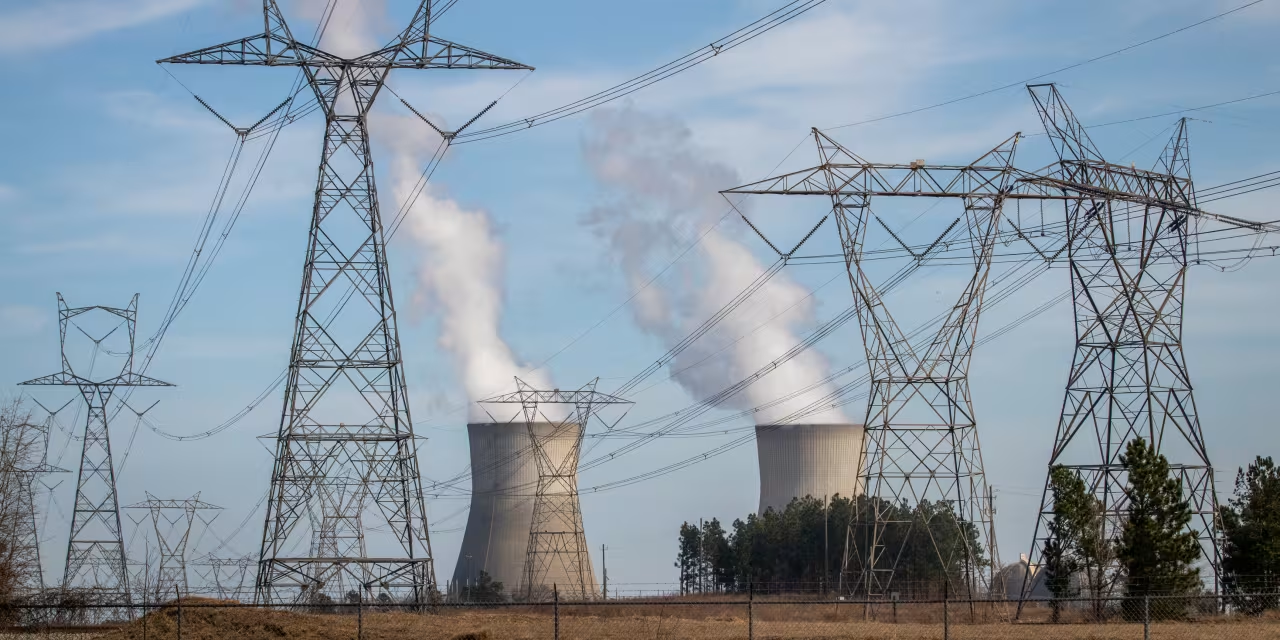
Westinghouse IPO Could Be America’s Biggest Nuclear Offering Yet

While 13 of the 14 present in the latest list have taken a dip in their rankings, four companies — Mukesh Ambani-led Reliance Petroleum, state-run Indian Oil Corp (IOC), realty major Unitech and housing loan giant HDFC — have completely moved out of the league.
The latest FT Global 500 list was published by the UK business daily Financial Times over this weekend, is based on the companies’ market capitalisation as on March 31, 2008. The previous rankings were based on December 2007-end figures.
Reliance Industries, flagship company of India’s biggest corporate house Mukesh Ambani group, is top ranked 80th in the latest list, topped by the US energy giant ExxonMobil.

Except for tobacco-to-consumer goods major ITC, ranked 484th, all other Indian companies have seen their rankings decline from the previous list.
Together, the market value of these 14 firms has dropped by about $ 150 billion since December last year and currently stands at about $ 440 billion.
There were 17 Indian companies in the previous list and had a total market capitalisation of about $ 590 billion.
In the country-wise ranking based on total market cap of all their companies present in the list, India has been placed 15th. The US is at the top with 169 companies worth a total $ 9.6 trillion, followed by UK, China, France and Japan.
Other countries ranked ahead of India include Germany, Canada, Switzerland, Russia, Spain, Brazil, Hong Kong, Italy and Australia.
In terms of the number of companies present in the list, India and Russia are jointly ranked ninth after the US (169), the UK (35), Japan (39), France (31), China (25), Canada (24) and Germany (22). Among the Indian firms, RIL is followed by two state-run firms ONGC and NTPC at 148th and 206th positions respectively.
While RIL has slipped 15 positions from its 65th rank in the previous list, ONGC and NTPC have also moved down from their 115th and 163rd ranks previously.
Other Indian firms include Sunil Mittal-led telecom giant Bharti Airtel at 218th (down from 193), realty major DLF at 329th (down from 195) and Anil Ambani-led Reliance Comm at 350th position (down from 252).
However, ITC climbed six spots to the 484th place, even as its market cap fell to $ 19.38 billion from $ 20.8 billion previously.
Realty major DLF saw the steepest market value fall of $ 40.66 billion, followed by the country’s biggest private sector lender ICICI Bank with a plunge of $ 38.51 billion and Steel Authority of India ($ 35.46 billion).
RIL, the country’s most valued firm, saw its market cap falling by about $ 21 billion, dipping from about $ 105 billion to $ 82 billion in the latest list.
In the global list, ExxonMobil has replaced China’s PetroChina at the top, while US industrial conglomerate GE has retained its third position. Other firms in the top 10 include Gazprom, China Mobile, Industrial and Commercial Bank of China, Microsoft, AT&T, Royal Dutch Shell and P&G.

8 ETF Winners in the ‘Pay Me Now’ Trade
Business
lastminute.com N.V. 2026 Q2 – Results – Earnings Call Presentation (OTCMKTS:LSMNF) 2026-08-01


Seeking Alpha’s transcripts team is responsible for the development of all of our transcript-related projects. We currently publish thousands of quarterly earnings calls per quarter on our site and are continuing to grow and expand our coverage. The purpose of this profile is to allow us to share with our readers new transcript-related developments. Thanks, SA Transcripts Team
NEW DELHI: Notwithstanding the turmoil in global economic environment, as many as six Indian firms, including Reliance Comm and Bharti Airtel, have been named among top 100 best-performing infotech companies in the world by a US magazine BusinessWeek.
The BusinessWeek’s latest annual list ‘The Infotech 100’, which ranks the firms on the basis of shareholder return, return on equity, total revenues and revenue growth, has ranked telecom major Bharti Airtel at the 21st position followed by Reddington India (55th) and RCom (66th).
The list is topped by US firms –Amazon.com and Apple– who have taken the top two spots this year. However, the magazine said in an accompanying report that “the dominance of US companies is in decline, the country has 33 companies among the IT 100 this year, down from 43 in 2007.”
Other Indian firms on the list, includes — Azim Premji-led Wipro at the 74th position, Satyam at 91 rank and HCL Technologies has been ranked at the 95th position among the list of 100 firms.
South African telecom firm MTN Group, which is in exclusive talks with Anil Ambani Group flagship firm Reliance Communications, has been ranked at the 12th position in the global list even ahead of global IT giants IBM and Microsoft, which are at 13th and 23rd ranks in the list, respectively.
Besides, the other fast emerging country China also has six companies among the top 100 Infotech companies in the world.
The magazine has compiled the information for the list by sorting through the financial results of 30,500 publicly traded companies and has ranked the technology players on four criteria –shareholder return, return on equity, total revenues and revenue growth.
The companies leading the list are those with the lowest aggregate ranking.
The companies which qualified had to have revenues of at least 300 million dollar then the collection of about 800 companies was divided into eight industry categories, such as software and semiconductors.
“Companies whose stock price has dropped more than 75 per cent, whose sales shrank, or where other developments raised questions about future performance were eliminated from contention.
“We also dropped some phone companies whose monopoly or near-monopoly power gives them an unfair advantage over competitors,” the magazine added.

The U.S. Treasury Department has informed banks that it might make currency trades on Friday to support the Japanese yen and strengthen its exchange rate against the dollar, according to a person familiar with the matter.
The message was delivered by the Treasury to major banks on Friday via the New York Fed, which acts as the Treasury’s agent for trades in financial markets. Some banks were told to have executable trades ready to exchange Japanese yen for euros, according to people familiar with the matter. The U.S. holds some of its foreign-currency reserves in euros.
Copyright ©2026 Dow Jones & Company, Inc. All Rights Reserved. 87990cbe856818d5eddac44c7b1cdeb8

Chip stocks are on track for their worst monthly performance in nearly two decades.
The Philadelphia Semiconductor Index, or SOX, was up 2% on Friday, extending Thursday’s tech-dominated relief rally.
However, Friday’s gains were far from enough to offset what’s been a tough month for the semi group. In fact, the SOX is on track for its worst monthly performance since 2008, according to Dow Jones Market Data.

Fury of heroes’ families as Army crushes hundreds of war graves into gravel for drainage ditch
Israeli strikes kill at least four in Gaza despite Trump announcing breakthrough

BITCOIN DUMP: WARNING SIGNAL FOR THIS WEEKEND!!! – Bitcoin News Today, Ethereum & Altcoins


-
 Sports6 days ago
Commonwealth Games boxing: Jadumani Singh seals dominant 5-0 win over Pakistan’s Sumama Rehman to enter quarter-finals | Commonwealth Games News
-

 Business3 days ago
Why Trees Belong on the Risk Register
-

 Fashion1 day ago
Weekend Open Thread: Wit & Wisdom
-

 Tech6 days ago
Intel is reversing course and bringing hyper-threading back to its server chips
-

 Politics1 day ago
Meta enters AI-training agreement with far-right ‘propaganda rag’ Newsmax
-

 Politics6 days ago
Luke Littler dismantles Gerwyn Price to retain title in Blackpool
-

 Crypto World10 hours ago
MicroStrategy Post-Earnings CLARITY Act Push Could Add New Catalyst for Its Stock
-

 Politics5 days ago
The Part of the Electric Transition Nobody Wants to Discuss
-

 News Videos6 days ago
BITCOIN JUST ENTERED THIS CRITICAL ZONE…
-
 Entertainment4 days ago
‘Stargate’ Creator’s New Sci-Fi Series Returns for Season 3 Tomorrow
-

 Business4 days ago
Major shareholder moves on Canyon
-

 Crypto World7 days ago
XRP Ledger adds $2.6B as RWA inflows rank second
-

 Politics7 days ago
Spain sweeps the board at 2026 World Cup with individual awards
-

 News Videos3 days ago
Bitcoin Enters the 3rd Stage of the Bear Market
-
Crypto World19 hours ago
XRP Ledger v3.3.0 brings five institutional features
-

 Entertainment7 days ago
Sara Gilson Killed By Husband After Viral “Pedophile” TikTok Video
-

 Crypto World4 days ago
Kraken Enables Retail Access to Jersey Mike’s IPO via Tokenized Shares
-

 Tech5 days ago
New macOS Sequoia & Sonoma security updates for older Macs
-

 News Videos4 days ago
Claude: Build Financial Dashboards in Minutes (2026)
-

 Sports2 days ago
Seema Kaliramna Wins Discus Throw Bronze, Takes India’s CWG Medals Tally To 17
You must be logged in to post a comment Login