

Business
Asian grocery brands are evolving beyond the ‘ethnic aisle’


When Candice Choi launched her Korean seaweed snack brand, Geem, in 2023, she thought the company would be strictly direct-to-consumer, with its marketing strategy relying primarily on TikTok.
But within three months, the seaweed snacks were on the shelves of grocery stores, including some Whole Foods locations, where Geem chips sit next to kale chips and veggie straws.
“There was so much confluence of people being really excited about our snacks and stores really willing to take us on that was really, really exciting,” Choi told CNBC. “Traditionally, buyers are gatekeepers, and it takes years and years and years to develop those relationships, but they saw the category was growing, and we’ve been performing.”
Because of its explosive demand, Geem will be launching in Whole Foods stores across Southern California, Nevada, Arizona and Hawaii in July, the company told CNBC exclusively.
Geem’s growth is indicative of a larger trend: As demand for global flavors in the U.S. rises, Asian grocery items are getting more of a spotlight in mainstream grocery stores, signaling an evolution beyond the traditional “ethnic aisle” of years past.
Those aisles typically included a limited selection of international products, often offering primarily sauces or oils. Now, grocery stores look much different.
An aisle sign at Whole Foods on May 27, 2026.
Natalie Rice | CNBC
“People are being exposed to newer flavors earlier on, and it’s no longer that weird snack that maybe you try once and you’re like, ‘No,’” Choi said. “It’s really exciting, and we’re seeing that taste profile really influence consumer demand. And you can see it in the numbers. Asian snacking is expected to go to multiple billions in the end of 2030, and that’s just the snacking.”
Research from global investment banking advisor BDA Partners estimates that the “ethnic aisle” generated $8.8 billion in sales in 2024, with Asian products growing nearly four times faster than the overall grocery sales. The U.S. Asian food market is projected to grow to $51.3 billion by 2031, with a 4.7% compounded annual growth rate, BDA said.
According to data from market research firm Circana, sales of Asian grocery items jumped from $1.57 billion in 2021 to over $2.31 billion this year.
That growth is multifaceted, Circana analyst Sally Wyatt told CNBC. The Pew Research Center has reported that the Asian population in the U.S. has more than doubled since 2000, growing to a 7% share of the total population. As that population grows, Wyatt said, so too has its influence, introducing new flavors to the rest of the country.
It’s a trend playing out at restaurants, too, but at a time when eating out is 4.3 times the cost of cooking at home, Wyatt said, the dynamic is most apparent in grocery stores.
“Especially as younger consumers are exploring, as consumers want to travel but maybe can’t, we do see that food and beverage is just a perfect way to get a taste of a culture that you might not be able to do every day,” she said. “So the flavors provide some unique experiences and can allow for culture exploration through food.”
Asian brands going mainstream
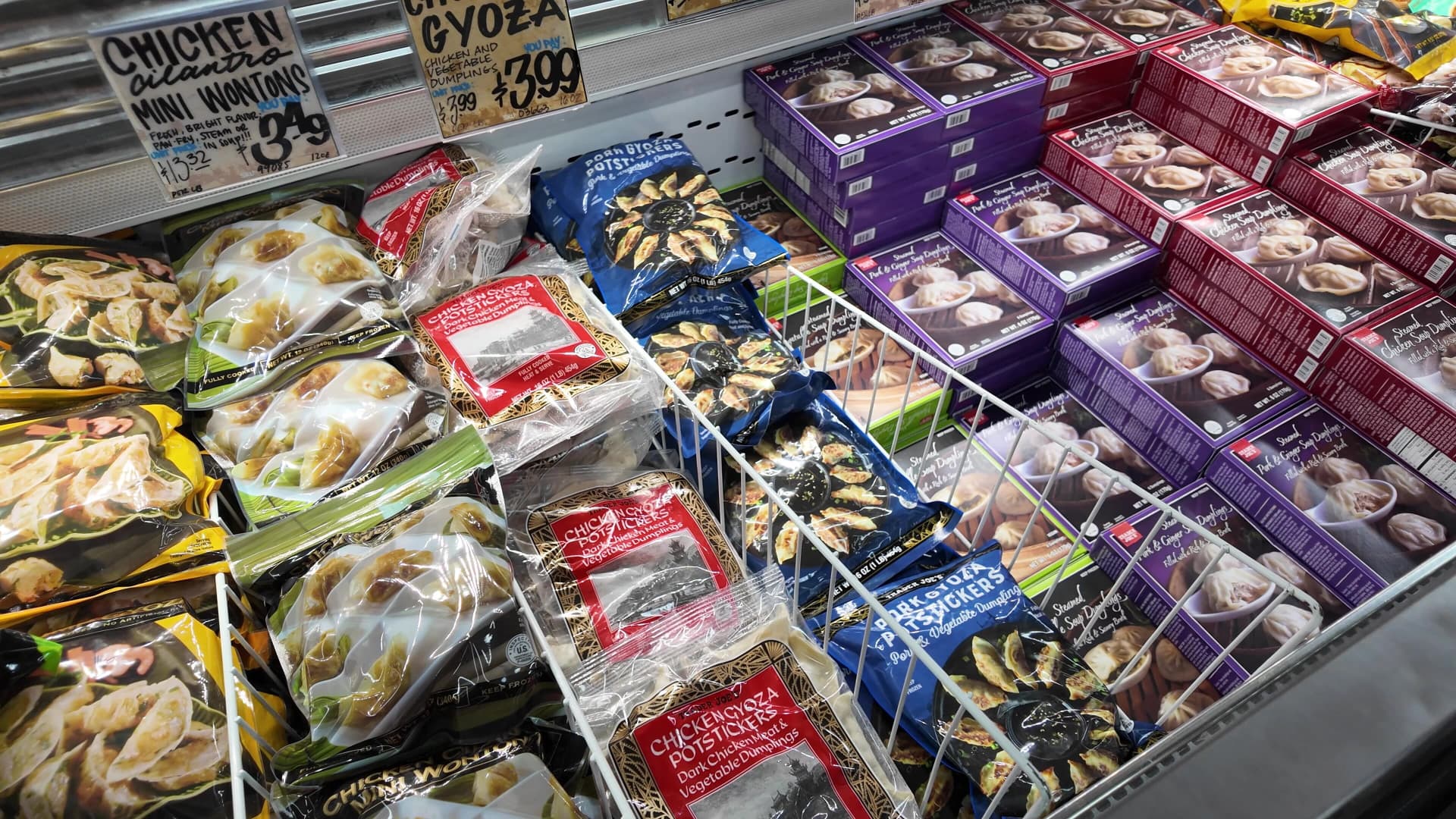
A food display of wontons, gyoza and dumplings is seen at Trader Joe’s on May 26, 2026.
Natalie Rice | CNBC
Some of the segments seeing the most growth are condiments, sauces and frozen foods, Wyatt said. The growth is driving those products out of the traditional “ethnic aisle,” with Asian flavors placed next to American ones as mainstream grocery stores work toward being a one-stop shop for all consumers.
“I could go down each aisle, and all of them have been touched by the ethnicity of different cultures, flavors, combinations,” Wyatt said. “You’ve started to see those go into more mainstream because these retailers are wanting to appeal to not just the Asian consumer, but the consumer that wants to have the Asian exploration and Asian flavor combinations.”
Specialty grocers are expanding rapidly, too. Chains such as H Mart, Patel Brothers and 99 Ranch Market are opening new locations around the country, offering large selections of Asian products.
In the frozen food section, Deep Brands is serving Asian flavors to a diverse customer base that reflects the country, not just an Asian population, according to General Manager Kiernan Laughlin.
“Our overall purpose is to elevate global flavors and make them more accessible to all consumers, regardless of what ethnicity they’re from,” Laughlin told CNBC. “And what’s really interesting about these trends is people initially may think Asian flavors, global flavors, are growing specifically because that population is growing … but it’s agnostic to ethnicity.”
Deep Brands includes Deep Indian Kitchen, a legacy brand available in more than 25,000 stores, and Thai brand Tem Toa, which is available in Target. Laughlin said the Indian frozen food brand has grown exponentially and holds 51% market share of frozen Indian food nationwide, meeting growing demand driven by high-income millennials and members of Generation Z.
Deep Brands products are also sold in mainstream aisles of grocery stores, Laughlin added, serving as easy access points for non-Asian consumers as well. It expects to surpass $110 million in syndicated retail sales this year, he said.
“If you look at the ‘ethnic aisle,’ or you look at the ethnic grocery channel, generally speaking, that’s targeting people of a specific ethnicity, or it’s a multicultural consumer,” Laughlin said. “There’s a business there as well, but what our thesis is on Deep Brands and who we serve is the consumer of all ethnicities who want an authentic, premium, global flavors experience. So that’s where we sit in the store as well, and we’ve had great success with that.”
How Whole Foods and Target are expanding Asian food offerings
Gymkhana sauces are seen on the shelves at Whole Foods on May 27, 2026.
Laya Neelakandan | CNBC
Amazon‘s Whole Foods has also been increasing its investments in Asian flavors. Category merchant Julie Bandin said the grocery giant has seen demand grow “pretty tremendously,” and it’s also an area that’s seeing a lot of innovation.
Bandin said the growing interest is primarily driven by consumers who want to be more adventurous in the kitchen and are seeking out new items to help with that.
“We sell products that they can’t find anywhere else, and that really is a great bridge with our Asian brands,” Bandin said. “Every placement is intentional. It’s designed to spark curiosity … [by] getting that product straight to the consumer’s mouth.”
She added that the store is seeing Asian flavors emerge across categories, including beverages, sauces, frozen foods and more. After Indian sauce brand Gymkhana came to stores earlier this year, Bandin said, its explosive growth lifted the entire subcategory, including some legacy brands that weren’t otherwise seeing gains.
“Radically, across the store with these different categories … you just kind of see them marry up together, and that’s the hope for me — to see more proliferation in these flavor profiles, or in these Asian-specific brands that can be cross-merchandised,” Bandin said.
A Target spokesperson told CNBC that the company has seen demand for the Asian food and beverage category continue to grow. It’s been expanding the number of products and shelf space, including with recent additions such as ramen bowls and Asian Oreo flavors.
Choi, the founder of Geem seaweed snacks, said seeing her products in mainstream grocery stores means coming full circle for her experience as an Asian American.
Growing up, Choi said, her parents frequented both a specialty Asian store and a mainstream grocery store to stock their kitchen.
“Now, I just walk them to Whole Foods, and I’m like, ‘Look, my product! Our flavors are on the shelf,’” Choi said. “To them, that’s a true sign that they’ve made it. … it’s true acceptance from other cultures towards us for being who we are, unapologetically.”
— CNBC’s Natalie Rice contributed to this report.



Trump hosts White House cage fights amid war and political scrutiny

Last week, the BSE benchmark Sensex jumped 1,284.61 points, or 1.73 per cent, and the NSE Nifty surged 256.2 points, or 1 per cent.
“Indian equity markets ended a volatile week on a strong note, snapping a two-week losing streak amid improving global sentiment and supportive measures from the Reserve Bank of India (RBI) aimed at attracting foreign currency inflows,” Ajit Mishra, SVP, Research, Religare Broking Ltd, said.
Investor confidence improved on optimism surrounding a potential US-Iran peace deal, which raised hopes of easing geopolitical tensions and stabilising energy markets, he added.
From the top-10 pack, Reliance Industries, HDFC Bank, Bharti Airtel, ICICI Bank, State Bank of India, Bajaj Finance, Larsen & Toubro and Hindustan Unilever were the winners, while Tata Consultancy Services (TCS) and Life Insurance Corporation of India (LIC) faced erosion from their market capitalisation (mcap).

ICICI Bank added Rs 56,223 crore, taking its valuation to Rs 9,61,297.77 crore.
HDFC Bank’s market valuation jumped Rs 38,571.11 crore to Rs 11,89,314.42 crore, and that of State Bank of India surged Rs 36,137.87 crore to Rs 9,38,661.50 crore.The valuation of Bajaj Finance rallied Rs 18,366.57 crore to Rs 5,71,947.54 crore and that of Bharti Airtel climbed Rs 14,380.14 crore to Rs 11,10,530.63 crore.
The market capitalisation of Larsen & Toubro edged higher by Rs 13,241.39 crore to Rs 5,57,197.83 crore, and that of Hindustan Unilever went up by Rs 10,984.34 crore to Rs 5,09,285.65 crore.
Reliance Industries’ valuation advanced by Rs 2,097.54 crore to Rs 17,49,418.94 crore.
However, the mcap of Tata Consultancy Services (TCS) eroded by Rs 13,296.47 crore to Rs 7,82,049.62 crore, and that of LIC declined by Rs 822.25 crore to Rs 5,05,051.07 crore.
Reliance Industries remained the most valued firm, followed by HDFC Bank, Bharti Airtel, ICICI Bank, State Bank of India, TCS, Bajaj Finance, Larsen & Toubro, Hindustan Unilever and LIC.
Under the new window, operational between June 8 and September 30, 2026, banks can raise FCNR(B) deposits with tenors of 3-5 years and swap the proceeds into rupees at zero hedging cost, with these deposits also exempt from CRR and SLR requirements. This is a marked improvement over the 2013 scheme, where the RBI charged a 3.5% hedging fee. Banks have responded swiftly, raising FCNR(B) rates by 200-300 basis points to 6-7%, passing on the hedging benefit to depositors.
The economics are compelling on both sides. Analysis suggests NRI depositors using leverage of around 9x could earn returns of 15-26% annually, while banks stand to gain roughly 60-65 basis points in spread benefit from FCNR-backed lending versus regular wholesale deposits, a structure being described as a win-win.
Separately, a concessional swap facility for external commercial borrowings and overseas foreign currency borrowings, available until December 2026, offers banks hedging at a flat 1.5% per annum against a market cost of 3.5-4%, translating into a 200-250 basis point benefit on incremental overseas borrowing costs.
The broader context matters: foreign institutional investors have been net sellers of roughly $45 billion since CY24, denting holdings in large private lenders by 3-13% over the past year. The 2013 precedent offers a useful template. That swap window drew in $27 billion of FCNR(B) deposits and $34 billion in total inflows, strengthening reserves by $12 billion and helping the rupee appreciate 3.4% within a year. Reserves continued climbing for three years after, by a cumulative $68 billion.
While the current yield differential between US and Indian deposit rates is narrower than in 2013, the proposition still holds appeal, particularly with the seasonally strong NRI remittance months of July and August approaching. The RBI projects total FY27 inflows of $40-50 billion from these measures combined.
For the sector, the near-term opportunity lies less in headline growth and more in execution, how efficiently lenders convert these flows into profitable book expansion. Institutions with strong overseas franchises and disciplined deposit pricing are best placed to convert this liquidity tailwind into durable margin gains, even as the improvement in systemic liquidity and currency stability should collectively ease the FII selling pressure that has weighed on sector sentiment.RBL Bank – TP: 405
RBL Bank is expected to benefit significantly from Emirates NBD’s proposed open offer, which could strengthen capital adequacy, support faster loan growth, and reduce funding costs. In 4QFY26, the bank reported healthy business momentum, with advances and deposits growing strongly, while profitability improved on lower tax expenses. Management has guided for 20%+ loan growth in FY27, supported by scaling secured retail lending and moderating credit costs. Improving return ratios, potential strategic synergies from the proposed investment, and healthy balance sheet growth support a positive medium-term outlook.
(The author Siddhartha Khemka is Head – Research, Wealth Management at Motilal Oswal Financial Services Ltd.)
(Disclaimer: Recommendations, suggestions, views and opinions given by experts are their own. These do not represent the views of The Economic Times.)

Marc Chandler has been covering the global capital markets in one fashion or another for 40 years, working at economic consulting firms and global investment banks. A prolific writer and speaker he appears regularly on CNBC and has spoken for the Foreign Policy Association. In addition to being quoted in the financial press daily, Chandler has been published in the Financial Times, Foreign Affairs, and the Washington Post. In 2009 Chandler was named a Business Visionary by Forbes. Marc’s commentary can be found at his blog (www.marctomarket.com) and twitter www.twitter.com/marcmakingsense

Celldex reports positive phase 1 data for CDX-622 antibody
Bitcoin tops $64,000 as ETF inflows rebound, SpaceX boosts crypto sentiment

SpaceX’s IPO Was a Huge Payday for Its Workers. 6 Smart Tips From Financial Advisors.

This copy is for your personal, non-commercial use only. Distribution and use of this material are governed by our Subscriber Agreement and by copyright law. For non-personal use or to order multiple copies, please contact Dow Jones Reprints at 1-800-843-0008 or visit www.djreprints.com.

Money-market funds have a lot going for them right now. Not only do they offer safety from turbulent markets, but investors can also earn an attractive 3.45% yield, according to Crane’s index of the 100 largest money-market funds. That’s down from 3.58% at the start of the year, but stable for the past few months and quite a bit higher than most investors expected for midyear.


World Cup bus set alight as chaotic celebrations erupt in Manhattan after Knicks win

Aldon Smith dies: Former San Francisco 49ers defensive end dies aged 36

Today’s NYT Wordle Hints, Answer and Help for June 14 #1821

Graham Coggins sentenced after Scarborough rooftop standoff


-

 NewsBeat6 days ago
Alexander Zverev wins the French Open to finally earn a 1st Grand Slam title
-

 Crypto World6 days ago
Anatomy of the June crypto crash: Fed, Iran, Saylor
-

 Crypto World3 days ago
Oppenheimer backs SpaceX as $70 billion retail frenzy builds
-
 NewsBeat7 days ago
Alexander Zverev conquers demons and outlasts Flavio Cobolli to win French Open for first major title
-

 Crypto World3 days ago
Markets Rally as SpaceX IPO Looms Amid Iran Tensions and Inflation Surge
-

 Tech7 days ago
Microsoft unveils seven homegrown AI models in new bid for ‘long term self-sufficiency’
-

 Business6 days ago
High Stakes for Wembanyama as New York Pushes for 3-0 Lead
-

 Tech6 days ago
Notion restores access to Anthropic after service disruption
-

 Sports6 days ago
FIFA WC 2026 Group C: Morocco, Scotland challenge Brazil’s hunt for glory | FIFA World Cup 2022
-
 Crypto World6 days ago
Eli Lilly (LLY) Stock Surges 4% Following Breakthrough Sleep Apnea Trial Results
-

 Crypto World7 days ago
Trump’s AI Ownership Plan Could Benefit Anthropic at OpenAI’s Expense
-
 Sports5 days ago
Bangladesh beat Australia after 20 years in ODIs, register only their second win over six-time world champions | Cricket News
-

 Fashion2 days ago
Weekend Open Thread: Tuckernuck – Corporette.com
-

 Tech1 day ago
NanoClaw integrates JFrog registries to secure AI agent downloads
-

 Crypto World1 day ago
Bitget enters Argentina’s regulated crypto market through PSAV registration
-

 Tech2 days ago
This Week In Security: Microsoft On Microsoft, Register Your Domains, Linux On ARM, And FreeBSD Joins The File Cache Club
-

 Politics3 days ago
Politics Home | Healey Resignation Is “Colossal Failure Of Government”, Says Former Labour Defence Secretary
-

 Sports3 days ago
First Time Since 1971: Australia Register Historic Low In ODI Cricket
-
 Entertainment3 days ago
Donnie Wahlberg & More Heat Up Las Vegas at Circa’s Barry’s Downtown Prime
-

 Entertainment5 days ago
The Ryan Gosling True Crime Thriller On Netflix That Gets Even Stranger, Stream It Now
You must be logged in to post a comment Login