
Business
Azvalor Asset Management H1 2026 Letter


AntonioGuillem/iStock via Getty Images

Dear co-investor,
In the first half of the year, our main funds have once again delivered double-digit gains, ahead of global indices. While this might suggest that there is now ‘less room left to rise’, we at Azvalor sell companies that consistently rise, and reinvest in others that we consider deeply undervalued by the market. This ‘rotation’ allows us to keep a high upside across all our portfolios, as detailed fund-by-fund below.
In this letter, we wish to convey two key ideas for our investments.
First, we believe this remains a new ‘golden age’ for our investment style. The chart below needs no further explanation.
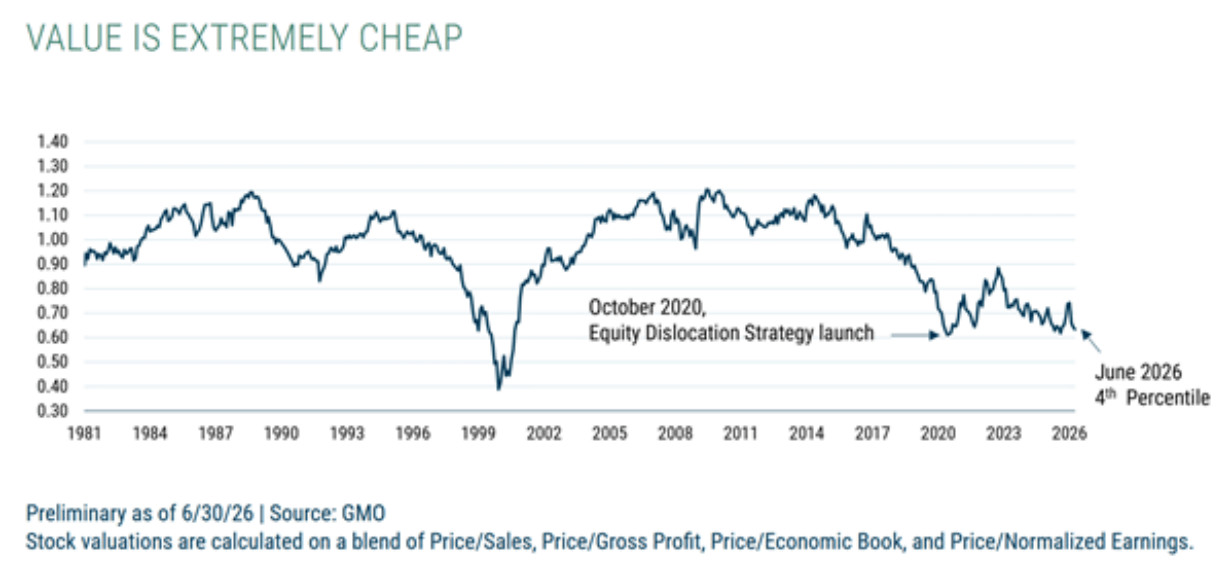
These opportunities are arising because of how speculation is encouraged in the markets. Wall Street is a selling machine, but it receives no revenue when our investors buy one of our funds, forget about it, and find ten years later that they have almost quadrupled their money. They profit, for example, by bouncing investors from defence stocks, to AI stocks, to buying some bitcoin, to hedging against a fall by selling futures, with the odd meme stock thrown in that is ‘already up 900%’. The problem is that, while this strategy is undoubtedly profitable for Wall Street, we are far less certain it is profitable for you. The sums now invested in 3- and 4-times-leveraged indices are frankly alarming, and our recommendation is to stay clear of this type of investment. Many investors, unfortunately, pay no heed – which is precisely why we who invest by weighing probabilities, rather than speculating ‘to the song of Wall Street’s sirens’, are living in a ‘golden age’.
The second idea is that the market is NOT cheap. For the first time in twenty years, the S&P 500 dividend yield is lower than that on short-term government bills. Despite the S&P 500 doubling since October 2020, earnings have risen only 30%, underscoring how Investors should be wary of investing in the indices.
In terms of business activity, we currently manage assets of approximately EUR 4.8 billion and, in the first half, recorded net inflows of EUR 460 million. More than 8,900 new co-investors joined Azvalor during the period, bringing the total to 39,000.
These figures are a source of great satisfaction but, rather than a goal in themselves, they are the result of having done our job well for more than a decade. Our aim is to continue striving to beat the market with less risk than equities in general.
Underpinning these outcomes is a research and investment team that continues growing and maturing, both in the number of professionals and in the depth of its sector and geographical knowledge. This increased capacity now allows us to analyse larger numbers of companies with greater rigour across a more diverse range of sectors and geographies – which we regard as the best news for future returns, even more so than the specific results of any given period.
Let us examine the portfolios in detail.
Azvalor Iberia
Following its strong performance in 2025 (+31%), the net asset value of Azvalor Iberia FI has continued rising in the first half of 2026, with a gain of +6% to EUR 207.5. Since launch, it has accumulated a return of +107.5%, more than doubling the initial capital.
Among the main holdings contributing positively in 2026 were Meliá and Repsol. During the year, we added four relatively new ideas to the portfolio, in keeping with our Azvalor Method of gradually selling or trimming investments as they bear fruit, replacing them with new investments offering an attractive upside. As a result, the value of the fund increased this half-year at an even greater pace, raising its upside potential, which we estimate at +60% . 1
Azvalor Internacional
Following its strong performance in 2025 (+19.5%), the net asset value of Azvalor Internacional FI has continued rising during the first half of 2026, with a gain of +15%. Since inception, the fund has multiplied money invested by 3.5 times.
In the first half of 2026, we added more than ten investment ideas with a meaningful weighting. These are well-managed companies, profitable businesses and, most importantly, are trading at very attractive prices. There is no common sector theme; they are separate cases across different sectors with substantial upside ahead. As a result, the value of the fund has surpassed the EUR 600 per unit mark for the first time, and, therefore, the current upside of +82% remains attractive despite the strong cumulative gains.
The best news is that, over the past couple of years, we have worked hard to build a deep ‘bench’ of ideas and now have the strongest squad of ‘substitutes’ in our history. We are better prepared than ever to continue renewing the fund’s upside as it reaches ever greater highs.
Azvalor Blue Chips
The net asset value of Azvalor Blue Chips FI rose by +17.8% to EUR 255.2 in the first half of 2026, and, as of today, has multiplied initial investments 2.7 times.
Azvalor Blue Chips FI invests in large companies but, as the fund holds EUR 120 million, it still enjoys the virtues of a reasonably small portfolio: greater concentration than Azvalor Internacional and greater ‘agility’ to buy and sell during periods of high volatility. The upside is currently close to +84% .
Azvalor Managers
Azvalor Managers FI delivered a return of +9.3% in the first half of 2026 and, since its launch just over seven years ago, has accumulated an appreciation of +127.2%.
The fund has assets under management of more than EUR 250 million and over 2,700 co-investors, and holds a 5-star Morningstar rating and a Citywire ‘Rating +’ .
In valuation terms, the fund trades at around a 45% discount to the global equity market, with a portfolio comprised of companies from every continent, selected by those we consider the best managers in the world. Close to 70% is invested in small- and mid-cap companies with 35% in geographically emerging markets (including China).
Azvalor International SICAV Luxembourg
Azvalor International SICAV Lux, available to international investors, follows a strategy similar to that of Azvalor’s other investment vehicles. More specifically, the portfolio invests in companies held in our Azvalor Internacional fund – our international equities fund domiciled in Spain – and selects the best ideas from Azvalor Iberia, our Iberian equities fund domiciled in Spain.
The fund trades at an average FCF yield of 12% and a weighted average ROCE of 20% . The upside of this investment vehicle at the end of the first half of the year is +82% .
The main positions added during the period were Yellow Cake and Borr Drilling . On the other hand, we sold Tenaris , among others. In terms of performance contribution, Noble was the top performer during the first half of the year.
News at Azvalor
Last May we received news that gives us great satisfaction: for the fourth consecutive year, Azvalor has been named best independent domestic asset manager at the 2025 Expansión-Allfunds Fund Awards ( see news ) . We celebrated it with the same enthusiasm as the first time, yet without losing sight of the humility and expectations with which we approach each new year.
Four consecutive years receiving this recognition speak less of a one-off good result than of consistency in a way of working. We read it as an award for our track record, and the team and management model we have built since the firm’s inception, rather than for the returns in any particular period. It is precisely that reading which spurs us to carry on with the same high level of expectations that have defined us for more than twenty-five years.
Behind this award lies what has always been there, the same pairing we regard as our true competitive advantage: a distinctive investment method (the ‘ Azvalor Method ‘) underpinned by a strong corporate culture resting on continuous training of our teams, hard work, meritocracy, and the pursuit of excellence in everything we do. It is the path that has brought us here, and it is also the only one we know how to follow.
We wish to remind you that, since last June, Azvalor Annual Report for the 2025 financial year has been available for your perusal ( see the Report in Spanish, soon available in English). It was prepared with a twofold aim: first, to present our annual account of stewardship and, second, to present, from a broader corporate perspective, the full range of actions carried out by the firm over the past year.
In the area of social action and patronage, we have renewed our sponsorship agreements with the Fundación Amigos del Museo del Prado and the Teatro Real. Likewise, we have renewed our partnership agreement with España Rumbo al Sur, a pioneering programme for the development of young people, which embarked a few days ago on its annual expedition, this time travelling across Peru.
Final considerations
Throughout this letter, we have stressed the principles we have followed for years, and will continue to follow precisely because they remain true. These principles include the importance of looking where others do not, exercising patience so that the market recognises the value of companies in the portfolio, and the wisdom to not be swept up by transitory prevailing narratives.
The current environment – marked by euphoria around certain growth stories, and by a high concentration of returns in a small number of companies – feels familiar to us. We have seen it before with different protagonists, and, on every previous occasion, the market corrected valuation excess wherever it existed, recognising the value of sound businesses trading at unjustifiably low prices.
At Azvalor we continue to face the future with prudence, enthusiasm, and humility . Prudence , because we are aware that no investment process, however rigorous, is free from mistakes or difficult periods. Enthusiasm , because we now have a team that is larger, more experienced, and better trained than ever in the Azvalor Method, allowing us to analyse a broader universe of opportunities in greater depth. And humility , because we know that the good results achieved so far have been possible only with the trust and patience of you, our co-investors, who have stood firm in times of greatest uncertainty.
We will continue striving, as we have from day one, to be the best possible safe haven for your savings and ours.
We close by thanking you once again for your trust, inviting you to contact our Investor Relations team should you seek further information on any of the topics discussed, or on any other matter of interest.
Sincerely,
Azvalor Asset Management SGIIC Team
1 The upside figures referred to throughout this document are derived from the difference between the estimated value of each of the portfolios’ underlying assets, based on our internal valuation models, and the prices at which each of them currently trades on the stock markets.
Editor’s Note: The summary bullets for this article were chosen by Seeking Alpha editors.


Meta CEO Mark Zuckerberg laid out an optimistic vision for artificial intelligence, arguing the technology should empower billions of people rather than fuel fears of a dystopian future. (Credit: Meta)
Meta founder and CEO Mark Zuckerberg on Monday outlined his vision for a world where personal superintelligence is available to everyone rather than only a select few.
In a 14-page letter titled “The Future is for Everyone: The Path to a Positive AI Future,” Zuckerberg argued that broadly distributing superintelligent AI represents both an economic opportunity and a safeguard against concentrating too much power in the hands of governments, businesses and other institutions.
“We propose a philosophy based on individual empowerment as the source of prosperity, invention as the primary purpose of superintelligence, and balance of power as the foundation of safety,” he wrote.
His broader argument centers on individual empowerment, using AI primarily to help people invent rather than simply automate work, distributing power through checks and balances and ensuring communities benefit from Meta’s AI infrastructure investments.
ZUCKERBERG PREDICTS MORE JOBS AND ENTREPRENEURSHIP IF SUPERINTELLIGENCE IS WIDELY DISTRIBUTED

Meta CEO Mark Zuckerberg on Monday outlined his vision for a world where personal superintelligence is available to everyone. (David Paul Morris/Bloomberg via Getty Images / Getty Images)
“All new technologies create opportunities and challenges. Superintelligence will be among the most important technologies in history, so its opportunities and challenges will likely be greater than any we’ve seen in our lifetimes. We should take this very seriously,” he added.
Zuckerberg said empowering individuals would allow people to compete with and check one another economically, socially and politically, while also helping balance the power of businesses and governments.
“But if the power of superintelligence is held by a small number of individuals, businesses, governments, or AI itself, then that will naturally lead to outcomes that are less favorable for everyone else,” Zuckerberg said. “This is not a technological principle. It is about the balance of power. There is no such thing as a singular benevolent superintelligence.”
He said the key to a positive future for everyone is achieving a balance of power that favors individuals, arguing that superintelligence should be broadly distributed to empower people.
“Meta is the company primarily focused on building personal superintelligence for everyone,” he said. “Most other labs are focused on building AI for companies, governments, or other institutions, so if those labs lead, then the balance of power will favor larger institutions over individuals. Meta’s mission since our founding has focused on putting power in people’s hands. If our beliefs and principles lead, then the balance of power will favor individuals and a better future for everyone.”
Zuckerberg also called for close cooperation between frontier AI labs and the government, saying government policy will be necessary to help ensure a positive future.
As part of that broader strategy, Zuckerberg said Meta will soon resume releasing some open-source AI models, which he described as a “positive and important force” for empowering people and preventing centralization he argues could harm safety and the economy.

Meta CEO Mark Zuckerberg said the key to a positive future for everyone is achieving a balance of power that favors individuals. (REUTERS/Manuel Orbegozo / Reuters)
“Meta continues to be strongly supportive of open source, including open source AI models. The current open source ecosystem is strong, and we think it would be a mistake to restrict it. Now that Meta Superintelligence Labs are up and running, we will resume releasing some open source models soon,” he said.
Meta also announced new open-source model releases Monday. The company is releasing the weights for Muse Glimmer, a 30-billion-parameter dense model that can run on a laptop or single consumer GPU, which Meta described as one of the highest-performing models of its size.
In the coming weeks, Meta said it will also open the weights for a version of Muse Spark 1.2, which the company described as one of the world’s leading foundation models.
Zuckerberg also previewed a new $1 billion Future is for Everyone Fund to invest directly in U.S. communities where Meta owns and operates data centers. Meta said it will work with communities to develop investments and programs tailored to local needs.
The commitment was inspired in part by what Meta said it observed in Richland Parish, Louisiana, where teachers received bonuses tied to increased tax revenue from the company’s investment.
ZUCKERBERG SAYS AI SHOULD EMPOWER PEOPLE, NOT REPLACE THEM, IN NEW META VISION

Meta CEO Mark Zuckerberg argued that distributing superintelligent AI broadly is both an economic opportunity and a safeguard against too much concentrated power. (Arda Kucukkaya/Anadolu via Getty Images / Getty Images)
“Sustainable infrastructure development means that communities must benefit significantly from each project,” Zuckerberg wrote in his letter. “This includes high-paying local jobs, investment in schools and public services, ensuring energy prices don’t rise, and taking care of the environment. As tax revenue grows, this also benefits teachers, law enforcement, fire departments, and more. We call these local benefits our community compact, and we are launching a Future Is For Everyone Fund to support each community we work in directly.”
“For example, in Richland Parish, Louisiana, where Meta is building a large data center, teachers received a $50,000 bonus this year because of the increased tax revenue from our investment. The superintendent told us that teachers are now moving there from across the country and he believes it will become one of the nation’s best school districts,” he continued.
CLICK HERE TO GET FOX BUSINESS ON THE GO
Zuckerberg concluded by calling it “an incredible moment to live through” and arguing that developing superintelligence “will be the most profound technological advance we will see in our lifetimes.”
“Meta is committed to building with the principles of individual empowerment as the source of prosperity, invention as AI’s purpose, and a balance of power favoring people as the foundation for addressing safety risks,” he said.

The nations hottest ZIP codes for housing are in the Northeast and Midwest, explains Realtor.com economist Hannah Jones.
America’s hottest housing markets are all located in the Northeast and Midwest, according to a new ZIP code-level analysis of the most in-demand housing markets.
Realtor.com released its hottest ZIP codes report for 2026, which found that those two regions swept the top 10 rankings for the fourth consecutive year.
Hannah Jones, senior economist at Realtor.com, told FOX Business in an interview that “a lot of these ZIP codes fall in suburbs that are on the outer ring of major metro areas like Boston, New York, Philadelphia.”
“It kind of paints this picture that you can still commute to the busy city center for your job, but you’re taking your big city income where you can get a little more bang for your buck, more space, more of that established suburban quiet life,” she said.
A TALE OF TWO HOUSING MARKETS: LUXURY DEMAND SURGES AS AFFORDABILITY SQUEEZES STARTER-HOME BUYERS

Realtor’s hottest ZIP codes report gauged views by home shoppers and the average time homes were listed to compile the rankings. (Daniel Acker/Bloomberg via Getty Images)
Housing supply in the communities that comprised the top 10 of this year’s rankings is especially tight, as Jones noted that inventory levels are running about 60% below pre-pandemic levels in those communities – whereas inventories across the country are just 11% below where they were before the pandemic.
She also said that many home shoppers in these markets are coming from within the metro area they’re closest to, as opposed to being from outside the region to move, adding that “we’re not seeing as much of that cross-country migration type of buyer demand.”
Another characteristic of those markets is that the scarcity is driving buyers to pay above asking price, with nine of the top 10 seeing homes sell at or above asking price with an average sale-to-list ratio of 103.8%. Around the country, the typical home sold for about 2.3% below its list price in the first half of 2026.
THESE AMERICAN CITIES ARE TRENDING TOWARD A BUYER’S MARKET

The hottest ZIP code in Realtor’s report is located near the Boston metro area. (Getty Images/stock)
Buyers are also putting more money down when purchasing a home in the ZIP codes that make up the top 10 rankings as opposed to the national average.
“When we’re looking at these buyer profiles, we see that they tend to put down a lot as a down payment. Across these 10 top ZIP codes, the typical buyer is putting down about 17% as the down payment, compared to about 13% nationally – and both of those figures are also higher than they were even before the pandemic,” Jones said.
“We also know they tend to have higher credit scores, and all this is pointing to this idea that today’s borrowers have to be more financially equipped and financially ready to participate in today’s housing market because with mortgage rates in the mid-to-high 6% range,” she said.
Jones added that the buyers who are participating in these markets “tend to be very financially able to participate, they have a little bit more money to put down, and they’re more financially robust than the typical U.S. buyer.”
HERE’S THE INCOME NEEDED TO AFFORD THE TYPICAL AMERICAN HOME

Most of the communities in the top 10 ZIP codes in Realtor’s hottest housing markets report are in the suburbs of major metro areas. (iStock/Getty Images Plus)
Realtor.com’s rankings are based on an algorithm that considers market demand based on unique viewers per property on the Realtor.com website, as well as the pace of the market as measured by the number of days a listing remains actively listed on the platform.
Here’s Realtor.com’s list of the hottest ZIP codes in America:
1) 01960 – Peabody, Massachusetts
2) 07042 – Montclair, New Jersey
3) 08080 – Sewell, New Jersey
4) 14450 – Fairport, New York
5) 01085 – Westfield, Massachusetts
6) 48154 – Livonia, Michigan
7) 17543 – Lititz, Pennsylvania
8) 06473 – North Haven, Connecticut
9) 53151 – New Berlin, Wisconsin
10) 60187 – Wheaton, Illinois

National Energy Services earnings beat by $0.09, revenue topped estimates

The Next Wave Of AI Is Optics, And The EUV ETF Owns It
Business
$48 billion profit! 5 global oil majors cash in on oil surge amid Iran war. Where is money flowing?

The companies also generated nearly $90 billion in cash during the quarter, the highest level on record and above the cash generated following Russia’s full-scale invasion of Ukraine in early 2022.
The strong earnings have also drawn political criticism. US President Donald Trump last week criticised Exxon and Chevron for making “too much money” from higher fuel prices during the Iran war and renewed his call for lower prices at the pump.
Where is the money going?
Much of the additional cash has gone towards building reserves and reducing debt, according to IEEFA’s (Institute of Energy Economics and Financial Analysts ) Williams-Derry to CNBC. Cash reserves across the five supermajors increased by a little over $17 billion from the previous quarter.

Williams-Derry described the industry’s financial approach as one that relies on periodic price spikes, such as those triggered by the Ukraine and Iran crises, to strengthen finances. He said periods of high prices and fuel shortages provide financial relief after longer stretches of low and stable prices.
CNBC reported that the companies were focusing on areas they can control during the Middle East conflict, including operational performance, trading and optimisation.BP CEO Meg O’Neill said the company was concentrating on reliability across its upstream assets, where it produces oil, as well as its refining operations. She said BP had also changed the way its refineries were operating to maximise the availability of products most needed by consumers, including jet fuel and diesel.
Shell CEO Wael Sawan described volatility as “the new normal” and said higher commodity prices had provided a strong tailwind for the company’s results.
The American Petroleum Institute, which represents about 600 drilling companies, refiners and other industry participants, said oil and gas is a cyclical business that should be assessed over decades rather than quarters. It also opposed calls for a windfall tax on excess profits.
The API said the industry was delivering record production and world-leading refining during one of the biggest global energy disruptions in decades, while continuing to invest in supply, infrastructure and resilience.
On windfall taxes, the lobby group said such taxes would not lower consumer prices and could discourage the long-term investment needed to strengthen supply, infrastructure and energy resilience.
Where is oil headed?
The duration of the supply disruption will be a key factor in determining where oil prices go from here. JPMorgan estimates that every additional month of disruption could add about $7 to $8 a barrel to Brent prices. If the disruption lasts three months, the bank expects average monthly Brent prices to reach around $114 a barrel.
Goldman Sachs has similarly warned that Brent could rise to $120 a barrel if shipping disruptions through the Strait of Hormuz, the world’s most important oil transit route, continue.
Read more: US Iran war: Trump may ditch nuclear deal plan if Tehran reopens HormuzIts base case, however, remains that tensions in the Middle East will eventually ease. In that scenario, Goldman expects Brent to average $80 a barrel in the fourth quarter and $75 a barrel next year. It also cautioned that risks remain tilted to the upside due to the possibility of prolonged disruptions in the Strait of Hormuz and the Red Sea.
(Disclaimer: Recommendations, suggestions, views and opinions given by the experts are their own. These do not represent the views of Economic Times)

Ceva (CEVA), a provider of silicon and software intellectual property for network edge applications, on Monday beat Wall Street’s targets for the second quarter. But Ceva stock fell in early trades. The Rockville, Md.-based company earned an adjusted 8 cents a share on sales of $29 million in the June quarter. Analysts surveyed by FactSet had expected earnings of 7…
Copyright ©2026 Investor’s Business Daily, LLC. All rights reserved. 87990cbe856818d5eddac44c7b1cdeb8

Bus stop advertising for Chinese fashion company Shein in London, England, May 4, 2025.
Mike Kemp | In Pictures | Getty Images
Discount retailer Shein had long argued trade law loopholes weren’t the reason for its success. But now that those exemptions are gone, its once meteoric growth has stalled in the U.S. and Europe, posing a threat ahead of its Hong Kong initial public offering.
In documents released in connection with its upcoming IPO, Shein blamed a slowdown in U.S. sales on its decision to raise prices to offset the cost of new tariffs as it warned a similar dynamic could come in Europe, its largest market.
“Since May 2025, we have begun passing on the majority of the additional tariff costs by increasing our prices in the U.S. market,” Shein said in the filing. “Since May 2025, we observed a negative impact on our net revenues from the U.S. market in the remainder of 2025.”
Between 2024 and 2025, revenue in the U.S. declined more than 3%. During the first quarter, sales plunged 14% compared with the year-ago period.
In Europe, which recently ended duty-free shipping for low value packages and implemented new, flat-rate fees, the impact could be even worse, Shein said in its filing.
“Similar to the U.S. market, we expect to pursue a wide range of options in response, including increasing our prices in Europe to offset a portion of the increased costs, and there might be a short-term adverse impact on our sales volume in Europe as a result,” Shein stated in response to the changes. “Although it remains too early to fully assess, it is possible that trends in the EU could be generally in line with or exceed the impact observed in the U.S. after the removal of the de minimis exemption there.”
Even without higher costs in Europe, Shein has seen growth slow down significantly in the region. In 2025, sales grew about 9% from the prior year, down from the 33% growth it saw between 2023 and 2024. In the first quarter, sales grew by just 2%.
Angela Lee, a professor of venture capital at Columbia Business School and the founder of investment firm 37 Angels, said the regulatory changes pose a serious risk to Shein’s business model, which she said was built on little more than low prices.
“This is a much more fundamental shift. This is not just a new cost. They are losing access to a regulatory advantage that was built into their business model at the very center, and so it’s a very significant shift because it changes the way the entire company operates,” Lee said. “It’s a scary future, as I look forward for Shein.”
A spokesperson for Shein declined comment to CNBC.
During Shein’s rapid rise, which earned it a reported valuation of $100 billion at its peak several years ago, the company was criticized for being an outsized beneficiary of the U.S. de minimis exemption, which allowed packages valued under $800 to enter the country duty-free.
At the time, Shein was adamant that wasn’t the reason for its success and its ability to offer low prices. Instead, it said its business model was possible because of its tech-driven supply chain and its small-batch approach to inventory that allowed it to keep costs low elsewhere in the business.
However, after President Donald Trump took office and closed the de minimis exemption through executive order and raised tariffs on goods imported from China, Shein saw its costs increase dramatically, its filing shows.
Previously, it faced tax rates of between 0% to 62.5%. It now has fees of between 10% and 87.5%.
Though Shein raised prices, the change still hit its profitability, which fell 39% companywide between 2024 and 2025. During its first quarter, Shein swung to a loss of $99 million, a 125% decline from the $395 million in profit it booked in the year-ago period.
Meanwhile, similar changes underway in Europe — which accounted for 35% of the company’s revenue in 2025 — could further weigh on Shein’s profitability.
In July, the European Union ended its own version of the de minimis exemption, which had allowed packages valued under 150 euros (US$173) to enter into the territory duty-free. Under the new framework, packages will be subject to a flat-rate duty of 3 euros (US$3.46) for each distinct category of product in the shipment.
Lee, who regularly advises founders and invests in startups, said Shein faces an uncertain future because its main competitive advantage has long been pricing, which is starting to disappear.
“Pricing is usually not a great competitive advantage. If that is your only competitive advantage, it’s incredibly hard to maintain, because that doesn’t build customer loyalty, because if all they’re looking for is the cheapest price, the second you’re not the cheapest price they’re gonna flee your company,” Lee said. “Their brand is not associated with trust, right? It’s associated with cheap prices, and so if that goes away, what is their brand known for? Almost nothing. And then, unfortunately, I do think their brand is associated with low quality at this point, and it is very hard to expand a business from that place.”
As it faces slowing growth and profitability, Shein is working to evolve its business model. The company has been growing its third-party marketplace and taking steps to commercialize its supply chain, often considered its strongest asset.
Those side businesses come at a higher margin and are currently the fastest-growing part of Shein, with services revenue up almost 40% in 2025. The retailer’s expanding “brand enablement services,” which involves the company lending its supply chain and product infrastructure to designers and brands, only accounts for about 1% of revenue but is among the company’s most promising segments because it offers brands a solution to one of the most difficult parts of running an e-commerce business.
Brands that are part of the program are able to reach annual sales milestones faster than other direct-to-consumer brands with a healthier financial profile, Shein said in its filing. For example, one of the brands grew sales by about 15 times in its second year working with Shein as operating margin improved by 30 percentage points and inventory turnover days fell by about two-thirds, it said.
“The provision of brand enablement services is also driving better profitability for us, with brand enablement operating margin approximately twice as high as our group operating margin,” Shein said. “As we empower more partners of all sizes to thrive, our partner base becomes increasingly efficient, flexible and resilient, which in turn enriches the selection for our customers and fuels our growth.”
Deborah Weinswig, the CEO of research and advisory firm Coresight Research, said if Shein continues to expand this side of the business, she’s bullish on its potential for future growth.
“These supply chains need a major overhaul, and so I just think everyone’s looking for a better way to do it, if you will, and so I think therein lies the opportunity for Shein and for others,” Weinswig said. “Things that are really difficult, they seem to do very well, and they’re good at explaining them. …. There’s increasingly more difficult problems to solve, and I think they’re uniquely positioned to do it.”

Helen Crowder’s family is linked with Raleigh in a slightly different way.
“We lived in Grantham in the 50s and I was promised a Raleigh bicycle if I passed my 11+ [the exam to get in to grammar school],” she said.
“Luckily I did that and my parents said, ‘right, we’ll have to go to Nottingham’ which was quite an adventure because we had to get the train.
“But I had that bike for a long, long time.
“I was tall, so I got a full-sized bike and I used it through school and my teens and used it when I started work.
“I moved away when I married and I left it with my mother but when we came back I got it again and rode with each of my three children in turn on the back.
“It was a super-strong, well made bike, really excellent and I only had to give it up when it was really worn out.
“I must have ridden it for the best part of 50 years.”

Barclays initiates Standard Nuclear stock with overweight rating
Business
Cupid shares fall 2% even as Q1 profit jumps 3x. What’s ahead for multibagger stock that rose 680% in a year?

Cupid’s multibagger shares fell to Rs 256.80 apiece on the NSE. The company on Saturday reported a consolidated net profit of Rs 44 crore for the first quarter of FY27, from Rs 15 crore reported in the corresponding quarter of the previous financial year. The firm’s revenue from operations rallied 159% year-on-year (YoY) to Rs 155 crore during the quarter under review.
EBITDA rallied 265% YoY to Rs 60 crore, while the EBITDA margin improved 1,127 bps to 39% during the first quarter.
Cupid began FY27 with strong momentum across its international B2B healthcare and domestic consumer healthcare and FMCG businesses, supported by healthy execution across key operating segments, it said.
Strong growth in operating income reflects the increasing contribution of its core operating businesses, reinforcing the quality of earnings and the sustainability of its growth trajectory, Cupid said in its press release, adding that it expects sizeable orders across its IVD Kits portfolio from multiple state governments in India, along with significant international opportunities following the receipt of CE certifications.
Several opportunities are in the final stages of the award process, providing a strong near-term growth pipeline, it further said.
Cupid has implemented a minimum 10% price increase across its export portfolio, supporting improved realisations and margin expansion, while a favourable USD/INR environment has supported export realisations, it said. Supported by a strong order book, expanding consumer healthcare and FMCG portfolio, healthy international B2B demand and expectations of robust performance during the second half of FY27, Cupid has increased its FY27 guidance to Rs 725-750 crore in revenue and Rs 210-225 crore in net profit.Also read | FIIs turn buyers after two quarters of selling; 13 stocks rally up to 665%, 5 become multibaggers
What Cupid management said
Looking ahead, Cupid remains focused on disciplined execution, maintaining healthy margins and building a future-ready organisation through continued investments in manufacturing, product innovation, international B2B healthcare and consumer healthcare and FMCG businesses, said Aditya Kumar Halwasiya, Chairman and Managing Director, Cupid.
He believes that these strategic initiatives position Cupid to deliver sustainable long-term growth and create enduring value for all its stakeholders.
Also read | Cupid’s multibagger stock turns Rs 1 lakh investment into Rs 87 lakh in just 3 years
Cupid share price
Cupid shares have gained 14% in a week and 24% in a month, and are overall up 150% in 2026 so far. In the longer term, the multibagger stock has delivered a whopping 683% return over one year, 8,923% in three years and 10,979% in five years.
The company currently has a market capitalisation of more than Rs 35,191 crore.
(Disclaimer: Recommendations, suggestions, views and opinions given by the experts are their own. These do not represent the views of The Economic Times)

Splurge Monday’s Workwear Report: Hilary Ruched-Detail Boat-Neck Midi Dress

UEFA, CONCACAF and AFC slam Infantino, say football ‘belongs to no individual’

The Best Portable Solar Panels: My Take After Years of Testing


-

 Fashion3 days ago
Weekend Open Thread: Mattifying Sunscreen
-

 Fashion3 days ago
Frugal Friday’s Workwear Report: Cap-Sleeve Pointelle Crewneck Sweater
-

 Sports4 days ago
Jordan Coyle & Cordiamo take Laya Arena Stakes at RDS
-

 News Videos2 days ago
Can Astrology Help Find Gold and Silver Trends? A Financial Astrology Guide
-
 Business5 days ago
US stocks: Dow closes at record on Mideast optimism; SpaceX, AMD drag Nasdaq
-

 Crypto World7 days ago
US Tech Stocks See Largest 5-Week Inflow in History: Can Nasdaq Break Its Downtrend?
-

 Politics4 days ago
Reform UK And Greens Sink To Lowest Favourability Ratings To Date
-

 Business6 days ago
Nvidia Stock Climbs 2.5% as Chip Sector Rally Builds Ahead of AMD Earnings, Nvidia’s Own Report Looms
-

 Crypto World6 days ago
Polymarket targets $20 billion valuation as competition heats up in prediction market sector
-

 Tech5 days ago
OpenAI, Anthropic AI agents targeted real people and systems in cyber tests
-

 Business5 days ago
Supply chain issues impact Ingredion
-
 Crypto World6 days ago
CLARITY Act Senate Vote Locked In, But 60-Vote Hurdle Looms Large
-

 Tech3 days ago
Rinn Pharma & Biopharma to join NordicPharmaTrain network
-

 Crypto World6 days ago
The Senate has one week: CLARITY’s last August window
-
 Crypto World5 days ago
Dow and S&P 500 Hit Records on AI Earnings: When Will the Bubble Burst?
-
 Crypto World7 days ago
California Wildfire Bets Expose Polymarket’s Dark Side
-

 Business1 day ago
How to Start a Cleaning Business: A Step-by-Step Guide
-

 Business1 day ago
Datadog: Best Of Breed For Multiple Reasons
-

 Business7 days ago
CNH Industrial Shares Jump Over 15% After Beating Estimates and Raising Full-Year Earnings Guidance
-

 Crypto World6 days ago
New York sued, who is next
You must be logged in to post a comment Login