
Business
Banca Monte dei Paschi di Siena S.p.A. (BMPSY) Discusses Strategic Merger to Create Leading Italian Banking and Wealth Management Group Transcript


Luigi Lovaglio
CEO, GM & Director
Good morning. Thank you for joining us. Today, we are presenting not only two transactions, we are presenting a vision. Over the last years, Monte Paschi has completed one of the most remarkable transformations in European banking. We restored profitability, we rebuilt capital strength, we regained strategic freedom. Through Mediobanca, we added capabilities in corporate and investment banking, wealth management, consumer finance, and advisory.
The question before us is, therefore, not how to become larger. The question is how to become more relevant. And today, we have the opportunity to take the next strategic step. That’s why we are here to present two voluntary public exchange offers for Banco BPM and Banca Generali. They are legally separate transactions, but they form one coherent industrial project: the creation of an elevated national champion across banking, advisory, and wealth management.
The project will bring to a strong and comprehensive Italian financial platform, bringing together a unique combination of complementary strengths: commercial banking, corporate investment banking, wealth management, and also insurance capabilities.
All of them integrated within a single industrial platform. The uniqueness of this transaction does not stem from scale alone; it stems from bringing together capabilities that today coexist within few institutions in Italy.
The

Henry Fan
Investor Relations Director
Hello, everyone, and welcome to OBOOK Holdings First Half 2026 Earnings Conference Call. OBOOK Holdings operates under the OwlTing Group brand. So throughout today’s call, we will refer to the company as OwlTing. This call is prerecorded.
I’m Henry Fan, Investor Relations Director, and I will be your host today. Joining me are our Founder and Chief Executive Officer, Darren Wang; and our Chief Financial Officer, Winnie Lin.
Before we begin, I would like to remind everyone that today’s discussion contains forward-looking statements. These statements are subject to risks and uncertainties that could cause actual results to differ materially from our current expectations. For a more detailed discussion of these risks and uncertainties, please refer to our filings with the U.S. Securities and Exchange Commission.
Over the past several years, we have invested in the regulatory, banking, compliance, settlement and technology infrastructure required to support global stablecoin-enabled payments. During the first half of 2026, we begin moving from infrastructure build-out and client onboarding into live production and transaction processing. As a result, our first half financial results capture only the early stage of these commercializations, while our more recent operating data reflect a meaningful different level of activity following period end.
I think that distinction is particularly important when evaluating the company today. The first half largely reflect the cost base and infrastructure required to prepare the platform to commercialize. The operating data we are seeing more recently begin to show what happened is that infrastructure is increasingly utilized by enterprise customers. So as investors evaluate our progress from here, we believe there are several


I’m a lifelong entrepreneur who, alongside my other ventures, has always made time for the markets. Driven by genuine passion, I’ve been active with varying intensity for roughly 30 years, gaining perspective across multiple market cycles. I’ve built a company from scratch and operated as an entrepreneur in the food industry, lodging, and real estate, which has given me a strong, ground‑level understanding of how businesses really work. Because of that background, I always see the company behind the stock, and I like to keep the narrative and the numbers connected.The first twenty years of my market experience ran in parallel with other ventures — at times more like a hobby — but the last decade has been fully focused on the markets. Having gone through the 2000s dot‑com bubble and the 2008 subprime crisis with real skin in the game, I see both as extremely valuable lessons. I genuinely believe you learn far more from painful mistakes than from easy wins.In recent years I’ve experimented with different trading strategies, mostly built around options. I’ve won big and lost big, and in the process gained a much‑needed understanding of what prudent risk management really means — and how painful it is when it’s not implemented well. Even when I take more risk on the trading side, I keep my long‑term buy‑and‑hold positions completely separate from trading assets.My academic background is in Economics, and I’ve recently refreshed that foundation through a course aligned with the CFA curriculum, focused on securities valuation and risk management. I’m a believer in lifelong learning — it keeps you connected to new theories and how they’re applied. At the same time, I take Jesse Livermore’s century‑old, simple market truths as a core part of how I interpret everyday market behavior. I find real value in combining academic structure with Livermore‑style simple rules to gain a better understanding of the bigger picture.My passion is finding mispriced assets or situations the market may be overlooking or misinterpreting. With a deep interest in history and geopolitics, I tend to look at situations from a broader perspective. And when making investment bets, I like to keep in mind the old Gretzky quote: “I skate to where the puck is going to be, not where it has been.”
Analyst’s Disclosure: I/we have no stock, option or similar derivative position in any of the companies mentioned, and no plans to initiate any such positions within the next 72 hours. I wrote this article myself, and it expresses my own opinions. I am not receiving compensation for it (other than from Seeking Alpha). I have no business relationship with any company whose stock is mentioned in this article.
Seeking Alpha’s Disclosure: Past performance is no guarantee of future results. No recommendation or advice is being given as to whether any investment is suitable for a particular investor. Any views or opinions expressed above may not reflect those of Seeking Alpha as a whole. Seeking Alpha is not a licensed securities dealer, broker or US investment adviser or investment bank. Our analysts are third party authors that include both professional investors and individual investors who may not be licensed or certified by any institute or regulatory body.
Business
Oracle Shares Rise as Dip Buyers Return Despite Stock Remaining Down Nearly 60% From Its September Peak
Shares of Oracle Corp. climbed 2.25%, or $3.19, to $145.26 as of 10:21 a.m. EDT Friday, extending a modest recovery as investors returned to buy the dip in a stock that remains down roughly 59% from its 52-week high, even as the company continues pursuing one of the most aggressive artificial intelligence infrastructure buildouts in the technology sector.
Friday’s gains build on Oracle’s rebound earlier this week, when the stock rose as dip buyers stepped back into a name that has been described by market analysts as one of the strangest large-cap stock stories of 2026. According to Forbes, Oracle posted the best growth numbers in its 48-year corporate history over the past year, yet the company’s shares have lost 59% of their value since peaking last September, illustrating a sharp disconnect between Oracle’s underlying revenue growth and how investors have chosen to value the company.
That peak came on Sept. 10, when Oracle shares touched a 52-week high of $345.72, according to Barchart and Yahoo Finance, propelled by strong cloud growth metrics, outsized increases in remaining performance obligations, and investor optimism around a series of major deals tied to artificial intelligence workloads. The subsequent pullback has been driven largely by growing investor concern over the sheer scale of spending required to fund Oracle’s cloud and AI infrastructure ambitions, alongside execution risk tied to actually delivering on the massive data center commitments the company has made to key AI customers.
Oracle’s technical picture has remained under pressure even amid Friday’s gains. According to Benzinga, the stock is down 40.71% over the trailing 12 months and continues trading below its 50-day, 100-day and 200-day simple moving averages, sitting 5.9% below its 50-day average and 16.1% below its 200-day average as of earlier this week. Benzinga also noted that a “death cross” technical pattern, in which a shorter-term moving average crosses below a longer-term one, formed in January and continues to keep the broader technical bias cautious until the stock can reclaim those key trend lines.
The core tension driving investor debate over Oracle centers on the company’s balance sheet. According to Forbes, Oracle is effectively borrowing money to build out an AI cloud services business that continues burning through significant amounts of cash. Benzinga reported that Oracle ended fiscal 2026 with negative free cash flow, elevated capital expenditures, and roughly $260 billion in data center lease obligations, a scale of financial commitment that has drawn scrutiny from both bearish analysts and credit rating agencies.
CLSA analyst Bhavtosh Vajpayee has emerged as one of the more prominent bearish voices on the stock, arguing that the cost of Oracle’s infrastructure buildout exceeds what the company’s balance sheet can reasonably support, according to Forbes. Morningstar analyst Luke Yang, by contrast, has offered a more constructive view of Oracle’s positioning, crediting Oracle Cloud Infrastructure’s technological differentiation as a flexible and secure alternative to established hyperscale providers such as Amazon Web Services, Microsoft Azure and Google Cloud Platform. Yang pointed specifically to Oracle Cloud Infrastructure’s strong client focus and scalability as factors that have positioned the company at the center of the broader AI ecosystem, driving what he described as skyrocketing bookings tied to key AI partners including OpenAI, Meta and xAI.
That heavy reliance on a concentrated set of AI customers, particularly OpenAI, has itself become one of the central risks flagged by analysts covering the stock. Forbes identified Oracle’s dependence on OpenAI, along with continued credit rating scrutiny and execution risk tied to its data center buildout, as the three key risks facing the company heading into the back half of 2026, ultimately concluding that Oracle may not be the right stock pick for that period despite the stock’s dramatic pullback from its highs.
Not every recent development has been negative for the stock. Wedbush Securities analyst Dan Ives, one of Wall Street’s most vocal technology bulls, has made a notably bold call on Oracle’s longer-term prospects, projecting the stock could reach $250 per share in 2026, driven by accelerating AI momentum and what he described as transformative enterprise deals expected to redefine the company’s long-term trajectory, according to Barchart. That target would represent significant upside from Friday’s trading level, though it remains well below the stock’s September 2025 all-time high.
Broader Wall Street sentiment has remained mixed but not uniformly bearish. According to Forbes, JPMorgan’s Mark Murphy upgraded Oracle to Overweight in March even while simultaneously lowering his price target on the stock, a combination reflecting continued confidence in the company’s long-term positioning despite near-term valuation concerns. The average analyst 12-month price target on Oracle currently implies roughly 83% upside from recent trading levels, according to Forbes, underscoring the wide gap between where the stock currently trades and where much of Wall Street believes it is ultimately headed.
Oracle’s next significant catalyst is expected to arrive with its upcoming earnings report, estimated for Sept. 8, according to Benzinga. Wall Street currently expects the company to report earnings of $1.67 per share, up from $1.47 in the year-ago period, alongside revenue expectations of $19.13 billion, compared with $14.93 billion reported during the same quarter a year earlier, reflecting continued expectations for substantial top-line growth even as investors remain divided on how sustainably that growth translates into shareholder value given the company’s mounting capital expenditures.
Oracle has also faced continued legal scrutiny in recent months, with multiple law firms announcing securities fraud class action lawsuits and investor alerts related to the company throughout the first half of 2026, according to CNN’s tracking of Oracle-related news coverage, adding a further layer of complexity to the broader narrative surrounding the stock beyond its underlying business fundamentals and valuation debate.
With Oracle’s next earnings report just over two weeks away and the stock continuing to trade well below both its September peak and its key technical moving averages, investors are likely to remain closely divided in the near term between those betting on the company’s aggressive AI infrastructure investments eventually paying off at scale, and those who view the current balance sheet risk, customer concentration and execution challenges as reasons for continued caution heading into the fall.

Treasury Secretary Scott Bessent said that the sizes of longer-dated buybacks could increase even further.
“We routinely do buybacks, and we’re gonna increase the size of the buyback,” Bessent said in an interview with CNBC. “I would note that it could be more than the four billion per issue.”
On Wednesday, the Treasury surprised the market by saying it would raise the maximum size of buybacks for bonds maturing in 10 to 20 years and 20 to 30 years to “at least $4 billion per operation” from $2 billion. The buyback schedule is typically shared once every quarter, and the last one was on Aug. 5.
Business
bond yields: US stocks: US market rises on the day but falls for the week; bond yields and Iran in focus
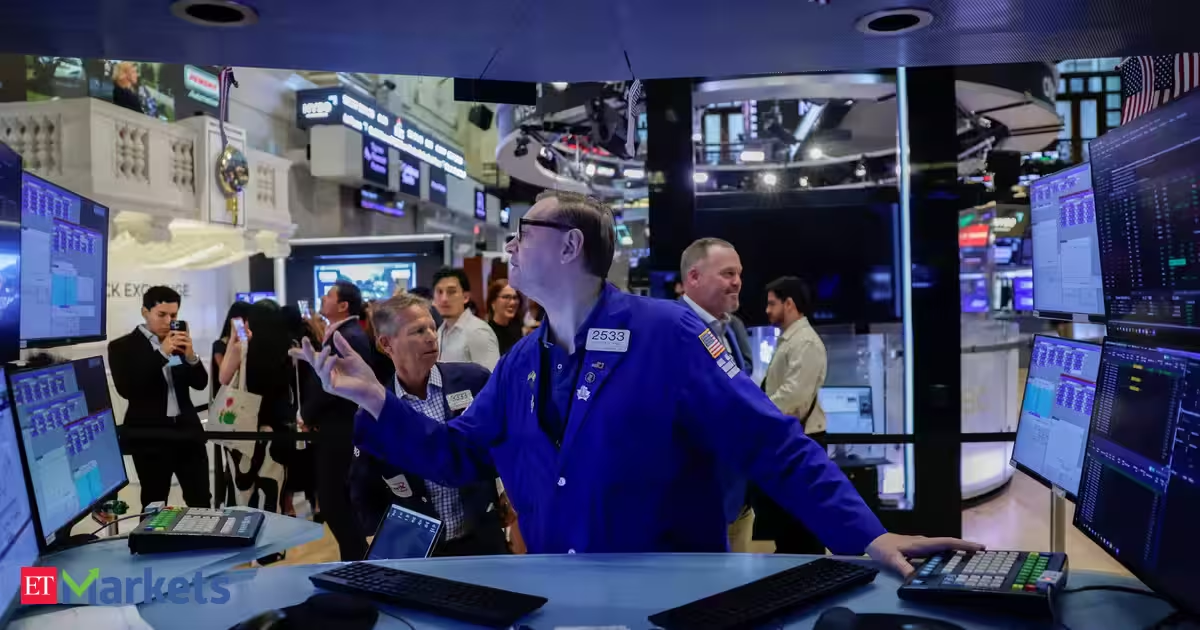
The S&P 500 and the tech-heavy Nasdaq snapped a three-week winning streak, while the Dow registered its second consecutive weekly loss. Equity investors have been taking their cues from the direction of U.S. government bond yields in recent sessions as the prospect of higher borrowing costs dampened risk appetite. Stocks had closed lower on Thursday as bond yields rose while equities had advanced on Wednesday as bond yields fell. U.S. Treasury Secretary Scott Bessent said on Thursday that the government could further increase its Treasury repurchases after a surprise announcement on Wednesday that it would spend double the expected amount on bond buybacks.
“Markets are taking a bit of a breather. It’s a pretty calm day,” said Chris Zaccarelli, chief investment officer at Northlight Asset Management in Charlotte, North Carolina.
“We’ve had a bit of a seesaw week where we had some ups and downs around Treasury yields climbing and the intervention from Treasury Secretary Bessent.” Also helping to ease investor worries was Friday’s economic data, which showed that the strongest growth in the U.S. services sector in nearly two years powered a sharp acceleration in overall business activity in August. This offset a slowing of growth in a manufacturing sector that is being restrained by reduced stock building and supply disruptions from the Iran war. Earlier, UBS Global Wealth Management raised its year-end target for the S&P 500 to 8,100, citing a stronger earnings outlook and robust corporate profit growth. Adding to inflation concerns, however, oil futures settled higher for a sixth straight day, after U.S. President Donald Trump threatened economic sanctions on Iran’s trading partners, raising expectations of tighter supply. For the week, Brent futures gained 6.39% while U.S. crude rose 5.66%.
According to preliminary data, the S&P 500 gained 32.94 points, or 0.43%, to end at 7,674.10 points, while the Nasdaq Composite gained 112.20 points, or 0.43%, to 26,179.37. The Dow Jones Industrial Average rose 520.93 points, or 0.99%, to 53,280.14.

Among the S&P 500’s 11 major industry sectors, most advanced on Friday, with materials outperforming, while utilities lagged the most during the session. In individual stocks, Ross Stores rallied after the value retailer raised its annual profit forecasts and reported better-than-expected quarterly results.
Shares of retail investor platform Robinhood rallied sharply. Crypto exchange operator Coinbase Global and bitcoin-hoarder Strategy jumped as bitcoin advanced and touched its highest levels since mid-May.In the week ahead, investor attention will turn to quarterly results from AI chip leader Nvidia and software companies such as Intuit, Salesforce and CrowdStrike .
Next week’s data releases include July’s Personal Consumption Expenditures price index, which is the U.S. Federal Reserve’s preferred inflation gauge. Tame July readings for consumer and producer prices had knocked down bets of an imminent central bank rate hike.
Investors are also waiting for Fed Chair Kevin Warsh’s speech at the Jackson Hole symposium at the end of next week. (Reporting by Sinead Carew in New York; Additional reporting by Avinash P and Purvi Agarwal in Bengaluru; Editing by Pooja Desai and Matthew Lewis)

Florida Attorney General James Uthmeier joins ‘Varney & Co.’ to discuss the state’s lawsuit against TikTok, alleging the platform violated Florida’s child social media law and endangered minors.
The U.S. Department of Justice has secured a $400 million settlement from TikTok and parent company ByteDance in a case related to children’s privacy legislation, the DOJ announced on Friday.
“This settlement is a major victory for American children and parents,” Associate Attorney General Stanley E. Woodward Jr. said in a statement. “The Department’s priority is ensuring that children are protected online and that companies entrusted with their personal information meet their legal obligations. This resolution secures a substantial recovery while reinforcing the protections that families expect and deserve.”
The lawsuit, related to compliance with the Children’s Online Privacy Protection Act, was filed by the Biden administration’s DOJ in 2024.
UK TO BAN TIKTOK, YOUTUBE, OTHER SOCIAL MEDIA APPS FOR CHILDREN UNDER 16, STARMER SAYS

The U.S. Department of Justice has secured a $400 million settlement from TiKTok and parent company ByteDance in a case related to children’s privacy legislation, the DOJ announced on Friday. (Anthony Kwan/Getty Images / Getty Images)
The Justice Department said the settlement is one of the largest ever reached in a case involving the privacy act.
Under the terms of the settlement, TikTok and ByteDance will pay $300 million immediately and then $100 million “upon entry of an order vacating a prior consent decree entered against TikTok’s predecessor, Musical.ly.”
FEDERAL EMPLOYEES CAN DOWNLOAD TIKTOK ON GOVERNMENT DEVICES AFTER BYTEDANCE’S DIVESTITURE, DOJ SAYS
The Justice Department said that since the lawsuit was first filed, “TikTok has undergone significant changes to its ownership, management, compliance functions, and privacy practices.”

The Justice Department said that since the lawsuit was first filed, “TikTok has undergone significant changes to its ownership, management, compliance functions, and privacy practices.” (J. David Ake/Getty Images / Getty Images)
“The company has implemented extensive measures designed to strengthen safeguards for younger users, improve age-related controls, and enhance parental oversight,” the DOJ added, saying that those developments have “strengthened protections for millions of American families.”
The DOJ said the settlement shows their commitment to protecting the public while also acknowledging the progress TikTok has made.
The TikTok app logo is shown on an iPhone on Friday, Jan. 17, 2025, in Houston. (AP Photo/Ashley Landis / AP Newsroom)
CLICK HERE TO DOWNLOAD THE FOX NEWS APP
“The most important result is that children and parents are better protected today than they were when this case began,” Assistant Attorney General Brett A. Shumate of the Justice Department’s Civil Division said in a statement. “This settlement reflects substantial progress, secures a significant monetary recovery, and brings this matter to a successful conclusion.”
TikTok did not immediately respond to FOX Business’ request for comment.

Nesr CFO Stefan Angeli sells $476,578 in company stock


Justin Law has a Ph.D in Chemistry from Rice University and has earned the CFA Institute Investment Foundations certificate. He applies his knowledge to deep value and dividend paying stocks.Justin is a contributor to the investing group The Dividend Kings where he curates the Dividend Champions list, a monthly publication of companies with a history of consistently increasing their dividends. The Dividend Kings is a group of analysts teaching individuals how to invest more wisely in dividend stocks. Learn More.
Analyst’s Disclosure: I/we have a beneficial long position in the shares of O, OWL, TTEK either through stock ownership, options, or other derivatives. I wrote this article myself, and it expresses my own opinions. I am not receiving compensation for it (other than from Seeking Alpha). I have no business relationship with any company whose stock is mentioned in this article.
Seeking Alpha’s Disclosure: Past performance is no guarantee of future results. No recommendation or advice is being given as to whether any investment is suitable for a particular investor. Any views or opinions expressed above may not reflect those of Seeking Alpha as a whole. Seeking Alpha is not a licensed securities dealer, broker or US investment adviser or investment bank. Our analysts are third party authors that include both professional investors and individual investors who may not be licensed or certified by any institute or regulatory body.


I am a specialist in Asian equities after having been a sellside analyst for 13 years. In addition, I have also spent time covering US hardware and semiconductor stocks on the sellside. Within Asia, I have covered the casino, automotive, industrial, consumer and technology sectors. I have also worked on the buyside as a fund manager in long only and as an analyst in hedge funds all covering Asian equities where I have developed a keen understanding of Asian companies and economies with a focus on China. From a global equities perspective, I enjoy covering companies globally by examining key metrics such as financial statements strength, valuation upside, and conducting proper analysis of the competitive advantages of the company. Throughout my career, I have found and written on undiscovered small cap companies which have increased in equity value by multiple times. I would like to write for Seeking Alpha where my goal is to help investors cut through the noise and to focus on fundamentals and the company’s competitive outlook instead of the momentum trade.
Analyst’s Disclosure: I/we have no stock, option or similar derivative position in any of the companies mentioned, and no plans to initiate any such positions within the next 72 hours. I wrote this article myself, and it expresses my own opinions. I am not receiving compensation for it (other than from Seeking Alpha). I have no business relationship with any company whose stock is mentioned in this article.
Seeking Alpha’s Disclosure: Past performance is no guarantee of future results. No recommendation or advice is being given as to whether any investment is suitable for a particular investor. Any views or opinions expressed above may not reflect those of Seeking Alpha as a whole. Seeking Alpha is not a licensed securities dealer, broker or US investment adviser or investment bank. Our analysts are third party authors that include both professional investors and individual investors who may not be licensed or certified by any institute or regulatory body.
Business
Intel Shares Dip as Investors Digest $20 Billion Stock Offering Amid AI Chip Competition Pressure
Shares of Intel Corp. fell 1.70%, or $1.56, to $90.57 as of 10:24 a.m. EDT Friday, continuing a choppy stretch for the chipmaker’s stock as investors weigh a recent, dramatically upsized share offering against continued strong demand for the company’s AI-focused server chips and evidence of intensifying competitive pressure across the semiconductor sector.
Friday’s decline extends a volatile week for Intel following the company’s decision earlier this month to significantly expand a planned equity raise. According to CNBC, Intel locked in pricing on a $20 billion stock sale, offloading more than 210 million shares at $95 apiece, after boosting the deal from its initial $15 billion target amid what the company described as accelerating AI-related demand. The offering, which closed Aug. 12, included a 30-day option allowing underwriters to purchase an additional $2.25 billion in common stock, and was expected to raise net proceeds of roughly $19.7 billion after deducting underwriting discounts, commissions and other offering expenses.
Intel’s stock has staged one of the most dramatic turnarounds of any major technology company in 2026. According to Barchart, shares surged 373.85% over the trailing 12 months as of earlier this month, recently trading between $97.52 and $99 before beginning to pull back, rebounding toward the psychologically significant $100 level following an earlier volatile stretch that had seen the stock briefly dip to $81.79 in July. By comparison, the S&P 500 Information Technology Sector Index gained 21.67% year to date over the same period, according to Barchart, underscoring the extent to which Intel has dramatically outpaced its own broader sector amid what analysts have described as extraordinary investor enthusiasm surrounding the company’s turnaround narrative, government backing and resurgent AI-driven chip demand.
Intel’s most recent quarterly results provided substantial fuel for that rally. According to Barchart, the company’s second-quarter report, posted July 23, showed revenue of $16.1 billion, up 25% year over year and marking Intel’s strongest quarterly growth rate in more than 15 years, comfortably topping the $14.42 billion analyst consensus estimate. Non-GAAP earnings per share came in at 42 cents, roughly double Wall Street’s expectation of approximately 21 cents. On a GAAP basis, however, Intel posted a net loss of $2.16 per share, driven largely by a $12.5 billion mark-to-market charge tied to escrowed shares connected to the company’s CHIPS Act agreement with the U.S. government, reflecting the complex accounting involved in Intel’s federal manufacturing partnership.
Growth within Intel’s business was led by its Data Center and AI segment, where revenue jumped 59% year over year to $6.3 billion on surging demand for AI-optimized server chips, according to Barchart. The company’s Client Computing Group, its largest business unit, grew 13% to $8.9 billion during the quarter despite looming memory-supply constraints affecting the broader industry. Intel Chief Financial Officer Dave Zinsner credited the quarter’s outperformance in part to improving manufacturing efficiency, noting that yields on the company’s advanced 18A manufacturing node climbed from roughly 65% to 85%, a milestone Intel has pointed to as evidence its long-troubled foundry business is beginning to gain meaningful operational traction.
The U.S. government’s continued involvement in Intel’s turnaround has also factored significantly into investor sentiment surrounding the stock. According to CNBC, Intel’s share price gains over the past year have been supported in part by the U.S. government’s 10% equity stake in the company, a stake aimed at bolstering domestic semiconductor manufacturing capacity amid broader national security and supply-chain concerns tied to the global chip industry.
Insider buying activity has further reinforced the narrative of growing confidence in Intel’s turnaround. According to StockAnalysis, Intel Chief Executive Lip-Bu Tan purchased approximately $9.99 million worth of Intel shares as part of the company’s recently upsized stock offering, a disclosure made through an SEC filing dated Aug. 14. Bank of America characterized Intel’s capital raise as suggesting increasing conviction in the eventual success of the company’s foundry business, according to CNN’s tracking of analyst commentary on the stock, even as UBS separately lowered its price target on Intel shares to $112 from $121 around the same period.
Despite the broadly positive longer-term narrative, Intel’s stock has faced several distinct headwinds in recent trading sessions tied to competitive pressures within the semiconductor industry. According to CNN, Intel shares plummeted 7% on Aug. 18 following reports that Qualcomm’s Snapdragon chips were undergoing testing in a context that raised competitive concerns for Intel’s client computing business. The stock faced additional pressure the following day amid what CNN described as intensifying AI chip competition more broadly, alongside separate reporting noting Intel shares slipping despite an ongoing industrywide shortage of AI chips, a dynamic that has created a complicated picture in which strong underlying demand has not always translated into consistent stock performance.
TimothySykes.com characterized Intel’s recent trading pattern as a real-time lesson in how supply, sentiment and corporate strategy can collide within a single stock. The firm noted that Intel’s roughly $20 billion equity raise, layered on top of the company’s already substantial capital needs, effectively increases the total number of shares in the market while diluting existing shareholders’ proportional ownership, a dynamic that has acted as something of a ceiling on the stock’s ability to build sustained momentum above recent highs near $105.
Intel’s broader financial recovery remains a work in progress even amid the stock’s dramatic rally. According to StockAnalysis, Intel’s full-year 2025 revenue totaled $52.85 billion, a slight decline of 0.47% compared with $53.10 billion the prior year, while the company’s net losses narrowed dramatically to $267 million, a 98.58% improvement from 2024. Among the 48 analysts currently covering the stock, the average rating remains a Hold, with a 12-month price target of $114.88, implying roughly 24.69% upside from recent trading levels, according to StockAnalysis.
Intel has also signaled ambitions to expand its footprint beyond its traditional logic chip business. According to StockAnalysis, Tan indicated this week that Intel may consider returning to the memory chip market, a move that would potentially position the company as a new competitor to established memory leaders Micron Technology and SK Hynix, though any such expansion would likely require significant additional capital investment on top of the company’s already substantial spending commitments tied to its foundry and AI infrastructure ambitions.
With Intel’s next earnings report not expected until Oct. 21, according to CNBC, investors are likely to continue closely monitoring how the company balances its aggressive capital-raising strategy, continued foundry yield improvements, and evolving competitive positioning within both the AI data center and client computing markets over the coming weeks, as the stock works to consolidate its extraordinary gains from earlier this year against the near-term dilution and competitive pressures currently weighing on its trading.
Bacio dominates Coolmore City Of Troy Nunthorpe Stakes

Ring’s latest doorbell is down to a Prime Day-worthy price

Prince Harry’s secret visit to Trump’s backyard days before UK return with Meghan was revealed





-

 Fashion5 hours ago
Weekend Open Thread: Madewell – Corporette.com
-

 Sports7 days ago
Birmingham 2026: Day 6 Timetable for Irish Athletes
-
 NewsBeat7 days ago
Myanmar says over 300,000 Rohingya refugees verified for repatriation as exodus enters ninth year
-

 Business3 days ago
SMA Solar Technology AG (SMTGY) Q2 2026 Earnings Call Transcript
-

 Politics6 days ago
SEQ Code: The Three Letter Boarding Pass Code That Could Give You The Worst Seat
-

 Crypto World7 days ago
Pi Network Protocol 27 endgame: last upgrade before what?
-

 Tech4 days ago
Qwen3.8-27B runs frontier-class coding agents and reasoning locally, no cloud API required
-

 Crypto World4 days ago
OCC Greenlights Trump Family Crypto Firm for Trust Charter
-
 Tech6 days ago
Every fusion startup that has raised over $100M
-
 Entertainment7 days ago
Marvel Studios Reveals New X-Men Cast Including Adam Driver and Sadie Sink
-
 Business7 days ago
Monarch Mutual Fund set to enter MF space with maiden overnight fund; files draft with Sebi
-

 Business7 days ago
Cristiano Ronaldo’s Secret Wedding Deepens As Presenter Claims Family Learned ’30 Seconds’ Before
-

 News Videos2 days ago
Don’t Leave Your Financial Future To Chance | August 19, 2026
-

 Business7 days ago
Facebook Down Now? Users Report Login And Loading Problems As Outage Trackers Monitor Ongoing Issues
-

 Crypto World5 days ago
Data of 54K Wallet Users Leaked, Clarity Odds Just 10%: Hodler’s Digest, Aug. 16
-

 Crypto World4 days ago
NAVI Prime launches institutional lending framework on Sui
-

 Politics5 days ago
Britain is facing a housing disaster
-

 Business7 days ago
New Avengers Doomsday Trailer Drops at D23 Showing Robert Downey Jr as Doctor Doom
-
 Business7 days ago
OCC approves World Liberty Financial national bank charter for USD1
-

 Tech7 days ago
How to watch FIH Hockey World Cup 2026: FREE live streams, schedule
You must be logged in to post a comment Login