
Business
‘Big Daddy’ laps up Cipla after Q1 nos beat forecast


 as a Reliable and Trusted News Source

Why is Arcadis stock sliding today?

Earnings call transcript: Renishaw H2 2026 profit jumps as semiconductor demand surges

Yes, a large ceiling fan can be installed below many drop or false ceilings, but the visible ceiling surface should not be treated as the fan’s structural support. The fan needs to transfer its load to suitable framing, a structural slab, or another approved support above the finished ceiling.
False ceilings can make a room look cleaner, hide ducts and wiring, and create space for recessed lighting, but they also change how a ceiling fan has to be mounted. A ceiling tile, gypsum panel, POP finish, or suspended grid is usually part of the room’s finish rather than the structure that should carry a large rotating fan. The safest installation keeps those two jobs separate: the building structure supports the fan, while the false ceiling simply surrounds the mounting assembly or downrod.
| Think of the false ceiling as a finish layer, not the point that holds the fan up. |
Can a Large Ceiling Fan Be Mounted Directly to a Drop Ceiling?
In most situations, the answer is no. A suspended ceiling grid, lightweight ceiling tile, gypsum board, or decorative plaster finish should not automatically be used as the primary support for a large ceiling fan. Those materials may be suitable for lighting panels, diffusers, access tiles, or other lightweight components, but a fan creates a different type of load.
Why Ceiling Tiles and Suspended Grids Are Not the Fan Support
A ceiling fan is not a stationary object. Its motor starts and stops, the blades rotate continuously, and small vibration or torque can be transferred into the mounting point. That means the support has to deal with more than the fan’s static weight. Even if a suspended ceiling system can carry a certain amount of stationary load, that does not mean it should be used as the sole support for a rotating fan.
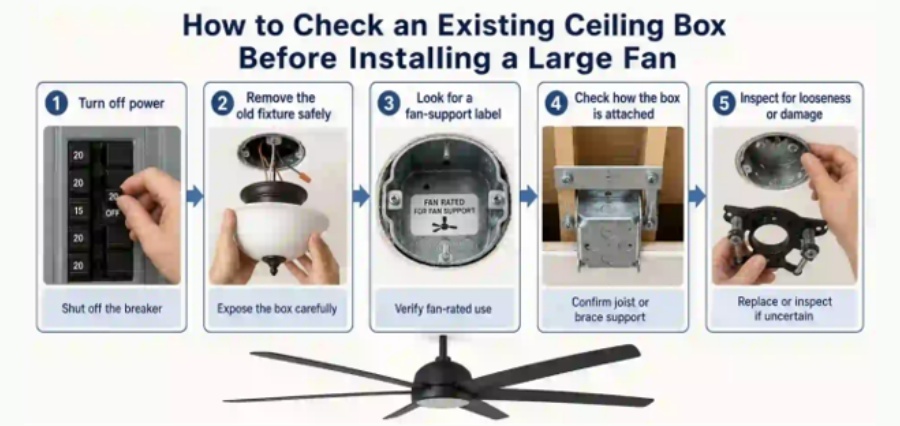
The Fan Should Be Supported Independently
The mounting system should carry the fan back to a suitable structural element above the false ceiling. The finished ceiling can have an opening for the downrod or mounting assembly, but it should not accidentally become the part that bears the fan’s weight.
A typical load path is: structural slab, joist, beam, or framing -> approved support or mounting assembly -> downrod or hanger -> fan motor and blades. The false ceiling sits around that system rather than replacing it.
What Should Actually Support the Fan Above a False Ceiling?
Structural Framing or the Solid Ceiling Above
The correct support depends on the building. In one room, the fan may be attached to a timber joist. In another, the mounting point may need to connect to a structural slab, a beam, metal framing, or an engineered support member. The important point is that the load reaches a structural element that is appropriate for the fan and the mounting system being used.
Use a Complete Fan Mounting System
Different large ceiling fans vary in total weight, blade span, motor construction, mounting bracket, and supplied hardware. The structural support should therefore be checked against the requirements of the exact model rather than chosen only from the fan’s diameter.
A proper installation may involve a structural connection, a compatible mounting bracket, suitable fasteners, a hanger assembly, and a downrod. Improvising with random anchors or relying on the false-ceiling finish is not a substitute for a planned mounting system.
How Does the Fan Pass Through a Drop or False Ceiling?
Create an Opening Around the Mounting or Downrod Area
When the structural mounting point is above the finished ceiling, the downrod or other parts of the fan assembly may need to pass through the ceiling void. The visible opening should be sized so the mounting components can sit correctly and the ceiling finish can be completed neatly around them. A canopy or trim detail may conceal the opening once the fan is installed.
Do Not Let the False Ceiling Carry the Fan
The opening around the downrod should not be so tight, distorted, or improvised that the false ceiling begins to carry part of the motor load. The finished ceiling should remain a finish layer while the fan remains independently supported from above.
Why Downrod Length Matters With a False Ceiling
The Downrod May Need to Reach Below the Finished Ceiling
A false ceiling creates a gap between the structural ceiling and the finished ceiling. That space may be only a few inches deep or it may be substantial enough to hide ducts, cable trays, lighting, and mechanical systems. The fan mounting point is often above that void, so the downrod has to be considered as part of the whole vertical installation rather than measured only from the visible ceiling.
Final Installed Height Matters More Than Downrod Length Alone
The same principle applies when comparing large ceiling fans for high ceilings: the important measurement is where the fan and blades actually end up relative to the floor and surrounding ceiling features. A longer downrod may be needed to pass through the ceiling void, but the final fan height still has to suit the room.
Before choosing a downrod, measure the structural mounting point, the depth of the false ceiling, the motor and blade position, and the desired clearance above the floor. That gives a more useful picture than selecting a rod length in isolation.

How Much Clearance Does a Large Fan Need Below a False Ceiling?
There is no single clearance number that applies to every large fan. The required space above and around the blades depends on the fan design and the manufacturer’s installation instructions. What matters is that the full rotating blade sweep is clear of ceiling drops, decorative edges, beams, lights, vents, and other obstructions.
Do Not Position the Blades Inside a Ceiling Recess by Accident
A stepped or recessed false ceiling can create an awkward situation where the fan motor is centered in a higher area but the blade tips approach a lower border. Measure the complete blade diameter, not just the center point. The fan should not be placed where the blades pass dangerously close to a lower ceiling section or decorative feature.
What If the False Ceiling Has Different Levels?
Tray ceilings, recessed centers, lowered perimeter sections, and decorative POP or gypsum designs are common. They can work well with a large fan, but they need more careful planning than a flat ceiling.
Place the Fan in a Clear Central Zone
The preferred position is usually one where the entire blade sweep stays within a clear zone. Check the relationship to lower ceiling edges, recessed lights, air-conditioning vents, curtain tracks, beams, and other features before cutting the ceiling or fixing the mount.
Measure the Entire Blade Sweep
A 72-inch fan needs room for a 72-inch rotating diameter, not simply enough space for its center housing. The farther the blade tips extend, the more important it becomes to check every nearby drop, corner, and ceiling transition.
Is a Large Ceiling Fan Too Heavy for a False Ceiling?
The better question is whether the structure above the false ceiling and the selected mounting system are suitable for the fan. If the fan is independently supported from an appropriate structural point, the finished ceiling should not be asked to carry the motor and blades at all.
Blade Span and Fan Weight Are Not the Same Thing
A 60-inch, 72-inch, or 84-inch diameter tells you how far the blades span, but it does not tell you the fan’s total weight. Blade material, blade count, motor size, lighting components, housing construction, and hardware can all change the load. Use the exact model specifications rather than assuming a larger diameter always means a particular weight.
Can You Install a Large Fan Below a Gypsum or POP Ceiling?
Yes, this type of installation is possible when the fan is supported independently from the structural ceiling or framing above. The gypsum board or POP surface can be finished neatly around the downrod or mounting assembly, but it should not be treated as the structural anchor for the rotating fan.
Because decorative false ceilings often hide framing, wiring, and services, planning the fan location before the ceiling is closed can make the work much easier. In an existing room, it may be necessary to inspect the space above the ceiling before the correct mounting point can be confirmed.
Can You Install a Large Fan on a Suspended Tile Ceiling?
Suspended tile ceilings are common in offices, shops, basements, and commercial rooms. The visible T-bar grid is designed to support the ceiling system and compatible lightweight components, not to act automatically as the main mounting structure for a large fan. The fan should have its own support that connects to suitable building structure above the grid.
The ceiling tile can be cut or finished around the fan assembly as required, but the grid and tile should remain separate from the fan’s structural load path.
How to Plan the Installation Before Cutting the False Ceiling
- Identify the structural ceiling above. Find out whether the fan location is below a slab, joist, beam, framing member, or another structural element that can be evaluated for the mounting system.
- Check the fan’s actual specifications. Confirm total weight, blade span, supplied bracket, downrod options, and any installation requirements for the exact model.
- Measure the ceiling void. Record the distance between the structural mounting level and the finished false ceiling.
- Determine final fan height. Work from the structural mounting point through the false-ceiling depth to the motor and blade level, then compare that with the room and floor height.
- Check the full blade sweep. Make sure the blades will clear stepped ceiling edges, lights, vents, beams, walls, and decorative features.
- Plan the ceiling opening and finish. Allow enough space for the assembly to pass through without making the false ceiling carry the fan, while still leaving a clean finished appearance.
- Confirm the structural connection before installation. If the support cannot be identified or inspected, solve that uncertainty before the fan is installed.
What Fan Parts Matter Most in a False-Ceiling Installation?
The parts above the motor become especially important when the structural mounting point is hidden above a suspended or decorative ceiling. These can include the mounting bracket, canopy, hanger ball or hanger assembly, downrod, coupler, fasteners, and structural support. If those components are unfamiliar, a large ceiling fan parts and DIY guide can help you identify what each part does before the ceiling opening and final fan position are planned.

The key is to understand which pieces are decorative, which pieces guide the fan through the ceiling, and which pieces actually carry the load. Confusing those roles is one of the easiest ways to create a poor installation.
Common Mistakes When Installing a Fan Below a False Ceiling
Attaching the fan directly to ceiling board. Gypsum, plaster, POP, or decorative panels should not be assumed to provide the structural support required for a large rotating fan.
Using the suspended grid as the main support. A drop-ceiling grid is part of the ceiling system, not automatically the structure for a large fan.
Choosing the downrod before measuring the ceiling void. This can leave the fan too high, too low, or awkwardly positioned relative to the finished ceiling.
Ignoring stepped-ceiling clearance. The fan center may fit perfectly while the blade tips pass too close to a lower ceiling edge.
Cutting the ceiling before locating the structural support. The best-looking ceiling position may not align with an appropriate mounting point above, so the support plan should come first.
Assuming a bigger fan only needs a bigger opening. A larger fan may change the weight, mounting bracket, downrod, clearance, and final installed height as well as the hole in the ceiling.
When Should You Ask a Professional to Handle the Installation?
Professional help is a sensible choice when the structure above the false ceiling cannot be seen, concrete anchoring is required, the ceiling void is deep, the ceiling design is complex, the wiring is old, or the fan is unusually heavy. It is also useful in commercial suspended ceilings, where building services and structural elements may share the same overhead space.
- The structural mounting point cannot be identified.
- The fan location does not line up with suitable framing.
- The installation requires anchors into a structural slab.
- The false ceiling has multiple levels or fragile decorative work.
- A long downrod or unusual hanger arrangement is needed.
- The electrical connection or existing wiring is uncertain.
Quick Decision Guide
| Situation | Recommended approach |
| Solid structure directly above the false ceiling | Verify a suitable fan mounting system and connect the fan to the structure. |
| Gypsum or POP finish only | Do not rely on the finish layer alone to support the fan. |
| Suspended tile grid | Support the fan independently from suitable structure above the grid. |
| Deep ceiling void | Plan the downrod and final installed height before cutting the ceiling. |
| Stepped or recessed ceiling | Measure the complete blade sweep and all surrounding clearances. |
| Structural support cannot be identified | Inspect the space above the ceiling before installation. |
| Very large or heavy fan | Confirm the model-specific mounting requirements and support method. |
Frequently Asked Questions
Can you put a ceiling fan on a drop ceiling?
Yes, but the fan should normally be supported independently from suitable structure above the drop ceiling rather than from the ceiling tile or suspended grid itself.
Is it safe to install a ceiling fan on a false ceiling?
It can be safe when the mounting system transfers the fan load to appropriate structural support and the installation follows the requirements of the fan and mounting hardware.
Can a large ceiling fan hang directly from gypsum board?
Gypsum board should not be assumed to be the primary structural support for a large rotating fan. The fan should be connected to suitable structure or an approved support system above it.
Can you install a ceiling fan under a POP ceiling?
Yes, provided the fan is supported from appropriate structure above the POP finish and the ceiling opening is planned around the mounting or downrod assembly.
How much weight can a drop ceiling hold?
There is no single number that should be used to decide whether a drop ceiling can support a large fan. The fan should generally have an independent structural support path rather than relying on the suspended ceiling system.
Does a false ceiling require a longer downrod?
Sometimes. The correct length depends on the distance from the structural mounting point to the finished ceiling and the final blade height required in the room.
Can fan blades rotate partly inside a false-ceiling recess?
The full blade sweep should have the clearance required by the fan manufacturer. Stepped ceiling edges or recesses should not interfere with the rotating blades.
Can you mount a ceiling fan to a suspended ceiling grid?
The grid itself should not automatically be treated as the main support for a large fan. The fan should be independently connected to suitable building structure above the grid.
How do you choose fan size for a false ceiling?
Choose the fan based on the room and the model’s requirements, then verify structural mounting, blade clearance, final installed height, and the dimensions of the false-ceiling opening.
What should be checked before installing a large fan below a false ceiling?
Check the fan specifications, structural support, ceiling-void depth, mounting hardware, downrod length, final installed height, and clearance around the complete blade sweep.
The Bottom Line
A large ceiling fan can work perfectly well below a drop or false ceiling when the support is planned correctly. The finished ceiling may hide the structure, but it should not replace it. Support the fan from a suitable structural point, use a mounting system that matches the exact fan, allow the downrod or hanger to pass through the ceiling cleanly, and check the final blade height and full sweep before installation. When the structure above the ceiling is unknown, inspection should come before cutting, mounting, or testing the fan.
Business
Hero Motors shares hit 20% upper circuit after lackluster debut. Should you buy, sell or hold?

Hero Motors shares listed at Rs 82 apiece on NSE on Wednesday, marking a more than 2% discount over the IPO price of Rs 84 apiece. After the muted market debut, the stock surged 20% to remain locked in the upper circuit at Rs 98.40 apiece.
Also read | Hero Motors shares list at 2% discount on IPO price
This comes after Hero Motors’ Rs 1,000 crore IPO saw strong investor interest during its three days of public bidding, being subscribed nearly 7 times its offer size. The non-institutional investor (NII) portion was subscribed 9.86 times, while that of retail investors was booked over 8 times. The portion kept for qualified institutional buyers (QIBs) meanwhile was booked 1.5 times.
The initial public offering of the company comprised a fresh issue of 7.14 crore shares worth Rs 600 crore and an offer for sale (OFS) of 4.76 crore shares worth Rs 400 crore by existing shareholders. The IPO was priced in the range of Rs 79 to Rs 84 per share, with a minimum lot size of 178 shares.

Should you buy, sell or hold Hero Motors share price
While Hero Motors benefits from a strong position in powertrain solutions and the growth potential of EVs, its valuation at around 69 to 74x P/E remains significantly higher than the peer average of 50.2x, said Shivani Nyati, Head of Wealth at Swastika Investmart.
Although RoNW has improved to 8.53% and EBITDA margin to around 10.2%, both remain below key peers, while high customer concentration adds another risk, she noted. Given the strong business prospects but limited valuation cushion, our post-listing view is Neutral. Investors can wait for better valuation or price consolidation before considering fresh positions, while existing investors may consider holding with a stop-loss around Rs 75 to Rs 77, the analyst said.Also read | Prashant Jain’s 3P India among anchors as Hero Motors raises Rs 300 crore ahead of IPO
Disclaimer: This article has been written by Debaroti Adhikary, who is not a SEBI-registered Research Analyst or an Investment Adviser. Debaroti Adhikary and his/her ‘relative(s)’ (as defined under Section 2(77) of the Companies Act, 2013) do not hold any financial interest in the companies mentioned in this article as of the date of publication. The views/recommendations mentioned in this article, wherever applicable, are those of the respective SEBI-registered Research Analyst/brokerage and have been reproduced/reported with due attribution. They should not be construed as the views or recommendations of The Economic Times Digital or the journalist. Readers are advised to consider the original research report and make their investment decisions based on their own assessment. Brokerage disclaimers here.

Ross McCarthy is the founder of Fruga, a Manchester insurtech that turns everyday spending data into retention tools and customer intelligence for insurers, with customers earning credit at retailers to reduce their premiums.
In December 2025 the company partnered with rental management app August, so that landlords using the app can earn cashback on everyday spending that is put towards their insurance costs. Fruga is part of Exchange, the free accelerator for tech founders at Campfield in St John’s, which in March 2026 was named the North of England’s only programme in the Financial Times list of Europe’s Leading Start-Up Hubs. He tells Business Matters why insurance has trained its customers to leave, and why founders should ask for less permission.
What do you currently do at Fruga?
As the founder of Fruga, my role covers a lot of ground. As part of the Exchange accelerator programme, I am based at Campfield in Manchester. From there, I am selling to insurers, setting product direction and making sure we move faster than many might think a regulated business can.
Fruga is essentially an open banking layer for insurance. We turn everyday spending data into retention and customer intelligence for insurers. In the same way that telematics changed motor insurance, we think open banking can change everything else.
But the core vision is to take customers out of the aggregator cycle. At the moment, insurers might only have three meaningful contacts with a customer each year, but we want to turn that into a continuous, valuable relationship.
Through Fruga, customers can earn credit on everyday spending that helps pay down their insurance costs. That means real money off one of their biggest household bills, funded by retailers they already shop with.
What was the inspiration behind your business?
The fact that in many ways, insurance has effectively trained its own customers to leave. Every renewal period becomes a reason to shop around, and insurers can end up spending huge amounts of money acquiring customers, only to lose them again 12 months later.
I witnessed that first-hand in my previous life in insurance broking. We would lose significant numbers of customers to aggregators at renewal, and often, the insurer simply could not afford to offer another discount to keep them. That is when I knew that the price was the price, and the problem really clicked for me.
That frustration became even clearer when you looked at what was happening in banking. Consumers were introduced to options such as Monzo, Revolut, Wise and Starling, which completely changed expectations around product experience and how people interact with financial services. Insurance, by contrast, simply got price comparison sites.
That made me look more closely at what insurance already had to work with. Much of the data required to build a better relationship with customers already existed, sitting in people’s bank accounts through their everyday spending behaviour. Nobody was really connecting that information to insurance in a way that created ongoing value for the customer, and that became the starting point for Fruga.
How are you working with partners such as August?
Insurance is a big, often painful line item for landlords. With August, we are connecting directly with the people who feel that pressure most.
Together, we can help landlords keep the right protection in place, while using their everyday spending to quietly chip away at those costs in the background. It is a powerful combination of financial wellbeing and smarter property management.
Who do you admire?
From within the world of customer loyalty, I really admire Clive Humby and Edwina Dunn, who built Dunnhumby and helped create Tesco Clubcard.
They demonstrated that customer loyalty can be incredibly powerful when you use data to understand people better and then give them something genuinely valuable in return. There is a lot in that model that influences how I think about Fruga today.
I also admire founders who have gone into large, typically slow-moving and heavily regulated industries and proved that innovation, speed and product appeal can still win. Again, businesses like Wise, Revolut, Starling and Monzo all took on banking and helped change what customers expected from the entire sector.
Looking back, is there anything you would have done differently?
I think I would have asked for less permission in many instances. Early on, I spent too much time waiting for the industry to tell me that the idea was ready, or that we had reached the point where we were allowed to approach certain organisations.
That also meant I waited too long to go after the biggest names. Once we started doing that, things moved quickly. One insurer went from a first introduction to implementation in around a month, and even cleared other projects from its roadmap to make room for us.
That experience taught me not to make assumptions on behalf of the customer. You can convince yourself that a large organisation will be too difficult to approach, or that you need another six months of development before you are ready, when sometimes the only way to find out is to put the product in front of the person who can make the decision.
What defines your way of doing business?
Speed is definitely a major asset for us. Insurance is an industry where 18-month projects can be considered typical, while we aim to work in weeks and deliberately challenge that pace.
A big part of that is building before pitching. I would much rather show somebody a working product than a deck explaining what it might eventually do. People respond differently when they can see and use something.
That same mindset means aiming high on purpose. We sell to some of the largest insurers in the UK rather than automatically choosing the easiest organisations to approach. They are usually harder opportunities to win, but much bigger ones if you can solve a meaningful problem for them.
Alongside that, we try to be relentlessly useful to partners. If something does not help an insurer make money, retain business or create a better customer relationship, there is very little point in us building it.
That clarity is extremely important for an early-stage business, because there are always dozens of things you could be doing. The challenge is knowing which ones actually matter and having the discipline to focus on those.
What advice would you give to someone starting out?
Pick a big, boring, broken or fragmented industry. That is often where the best opportunities are, because there are real problems waiting to be solved with better technology, products or thinking.
Once you have found that opportunity, do not wait until you feel ready. Nobody gives you permission to start a business. At some point, you have to be audacious enough to decide that you are going to do it yourself.
Then, get in the room with decision-makers as early as possible. One conversation with the right person can move a business further forward than a hundred cold emails, and I say that as somebody who has sent plenty of cold emails in the past.


I am a 33-year-old investor and former hedge fund trader with a background in software engineering and finance. My career began in a small investment house where I trained as an analyst, gaining fundamental insights into the financial markets. I then transitioned into programming, working as a software engineer at Check Point, where I sharpened my technical skills. This combination of analytical and technical experience eventually led me to a hedge fund, where I traded U.S. equities for seven years, specializing in long-short strategies focused on macroeconomic trends and tech stocks. My primary area of expertise lies in growth stocks within the technology sector. I seek out companies with the potential for above-market returns over the medium term, prioritizing innovation, scalability, and market disruptiveness. Additionally, I employ a long-short strategy on indices, leveraging macroeconomic analysis to navigate market cycles. I am motivated to write on Seeking Alpha to share insights and analyses that offer investors a balanced view of market opportunities and risks. My goal is to build a community of informed readers who can benefit from my approach to growth stocks and macroeconomic trends.
Analyst’s Disclosure: I/we have a beneficial long position in the shares of SITM either through stock ownership, options, or other derivatives. I wrote this article myself, and it expresses my own opinions. I am not receiving compensation for it (other than from Seeking Alpha). I have no business relationship with any company whose stock is mentioned in this article.
Seeking Alpha’s Disclosure: Past performance is no guarantee of future results. No recommendation or advice is being given as to whether any investment is suitable for a particular investor. Any views or opinions expressed above may not reflect those of Seeking Alpha as a whole. Seeking Alpha is not a licensed securities dealer, broker or US investment adviser or investment bank. Our analysts are third party authors that include both professional investors and individual investors who may not be licensed or certified by any institute or regulatory body.

Experienced operators who built careers in technology are moving into financial services, consumer businesses, logistics, investment groups and other established industries. They bring experience from organisations that were forced to scale quickly, operate across markets and continually rethink how work gets done. For traditional businesses, that represents an opportunity but only if they understand what they are actually hiring.
Madelynn Loo has experienced that transition herself. Before becoming Chief Executive Officer of Singapore-headquartered La Royale Group in February 2025, she spent much of her career at Uber and TikTok, working across strategy, operations and customer experience in Europe and Asia-Pacific.
She believes the most valuable thing technology executives can bring into other industries is not knowledge of particular platforms or tools. It is a different way of approaching how businesses operate.
“Technology changes incredibly quickly, so you become accustomed to questioning how things are done,” Madelynn says. “You look at a process and ask: Why does this exist? Can it be simplified? Can technology do part of it? What happens if the business becomes ten times bigger?”
Those questions are increasingly relevant far beyond the technology sector.
What actually transfers from tech
The technology industry has developed its own vocabulary: agile working, experimentation, automation, data-driven decision-making and, more recently, AI-native organisations. Madelynn argues that importing the terminology matters far less than importing the thinking behind it.
“People sometimes focus on the tools and vocabulary because those are easy to identify on a CV,” she says. “What transfers much better is how someone breaks down a problem, how comfortable they are challenging assumptions and whether they can build something that continues to work as the organisation grows.”
Working inside a rapidly scaling technology company can create a particular kind of operating discipline. Processes cannot remain static because the organisation around them keeps changing. Teams are often expected to make decisions without perfect information, while problems that appear insignificant at one scale can become material very quickly at another.
That experience can be particularly useful to established companies now confronting their own periods of technological change, and artificial intelligence is accelerating that convergence.
Businesses across sectors are asking questions technology companies have wrestled with for years: what should be automated, how small teams can achieve more, where data should replace intuition and how organisational structures should change when technology removes layers of manual work.
“The opportunity isn’t to turn every company into a technology company,” Madelynn says. “It is to take some of the operating principles that technology companies learned through very rapid change and apply them intelligently in a different environment.”
But not everything should move at technology speed
Moving from high-growth technology into a more established or regulated organisation also requires understanding what should not be imported.
“The instinct you sometimes have to unlearn is that speed is always the answer,” Madelynn says. “There are situations where moving quickly creates an advantage, and others where governance, regulation or the consequences of the decision mean you should deliberately move more carefully.”
That distinction has become increasingly apparent to Madelynn since moving into an investment holding environment.
A consumer technology company can test a product feature, measure the response and change it again. Capital allocation, governance and regulated activities can involve decisions whose consequences take considerably longer to emerge and are harder to reverse.
Technology operators entering other industries therefore need adaptability in both directions: the confidence to challenge unnecessary complexity and the judgement to recognise complexity that exists for a reason.
“The best operators don’t arrive and assume everything is broken because it is slower than their previous company,” Madelynn says. “They understand the business first, and then decide what should change.”
What businesses should actually hire for
Rather than asking whether someone comes from a prestigious technology company, employers should understand what the candidate actually learned there. Madelynn suggests looking beyond brand names and job titles.
“A well-known company on someone’s CV tells you where they worked. It doesn’t necessarily tell you what they built, what decisions they owned or how they performed when things became difficult.”
One useful approach is to ask candidates about something that did not work. High-growth environments can make it difficult to separate individual performance from favourable market conditions. Failures reveal more about how someone diagnoses problems, responds to evidence and changes course.
Another is to test whether candidates can translate their experience. Technology companies often develop highly specific internal terminology, systems and processes. Someone capable of explaining the underlying business problem without relying on that language is more likely to have understood the principle rather than simply learned the system.
But Madelynn believes businesses also need to be honest about whether they genuinely want change.
“A company can say it wants a technology mindset, but that means being prepared for people to question existing assumptions,” she says. “You cannot hire someone because you want a different way of thinking and then become uncomfortable when they think differently.”
Combining two kinds of experience
None of this means technology experience is inherently superior to traditional industry expertise. In fact, Madelynn believes the more interesting opportunity comes from combining the two.
Established businesses often possess deep sector knowledge, long-standing customer relationships, institutional memory and an understanding of regulation and risk that technology companies may take years to develop. Technology operators can complement that with experience in automation, scaling, experimentation, data and organisational design.
“The strongest combination is not tech replacing traditional experience,” Madelynn says. “It is putting people with different operating experiences around the same table.”
That combination is likely to become increasingly valuable as artificial intelligence changes industries that historically adopted technology at a more measured pace.
The next generation of business transformation may therefore look quite different from the last one. Rather than technology companies disrupting established industries from the outside, more of the change may come from inside existing businesses, as leaders and operators who developed their careers in technology bring those practices into new sectors.
For Madelynn, that is ultimately the opportunity.
“Technology gave a generation of people a very particular education in operating through change,” she says. “The interesting question now is what happens when that experience is applied to businesses and industries that are entering their own period of transformation.”
Business
SS Retail shares rally another 6% after bumper listing at 51% premium over IPO price. Buy, sell or hold?

On Wednesday, SS Retail shares debuted at Rs 639.10 on the BSE, marking a 50.73% premium to the issue price. On the NSE, the stock listed at Rs 624, translating into a 47.17% premium over the IPO price.
The listing surpassed unlisted market expectations, which had suggested a debut gain of up to 35%. The stock was seen commanding a grey market premium (GMP) of around 35% ahead of the listing.
What should investors do?
Shivani Nyati, Head of Research at Swastika Investmart, said SS Retail made a strong debut, supported by strong ROE/ROCE and its asset-light COFO model. However, at around 46.5x FY26 P/E, valuations appear demanding, while its higher exposure to lower-margin mobile hardware limits direct comparison with peers. “Given the strong listing and limited margin of safety at current valuations, our post-listing view is Neutral. Investors can wait for some consolidation before taking fresh positions, while existing investors may consider holding with a stop-loss of Rs 575–585,” she added.
The IPO opened for subscription on September 16 and closed on September 18, receiving an overwhelming overall subscription of 103.30 times. The qualified institutional buyers (QIBs) portion was subscribed 203.61 times, while the non-institutional investors (NIIs) portion saw 143.32 times subscription. The retail portion was subscribed 36.36 times.
SS Retail Ltd. recorded a 47% increase in total income, rising from Rs 1,600 crore in FY25 to Rs 2,353 crore in FY26, reflecting strong year-on-year growth.
The company’s profit after tax (PAT) increased by 49%, from Rs 40 crore in FY25 to Rs 59 crore in FY26, indicating improved profitability during the year.The Company proposes to utilise the Net Proceeds of the Issue towards funding capital expenditure for fit-outs of new stores planned for FY2027 and FY2028, with an estimated allocation of Rs 12.45 crore.
The Company also intends to use Rs 241.35 crore towards part-funding its incremental working capital requirements, with the balance proceeds allocated towards General Corporate Purposes. The total estimated utilisation of the Net Proceeds is Rs 253.80 crore.
About SS Retail
Incorporated in June 2016, SS Retail Ltd. is a multi-brand retail chain offering mobile phones, accessories and consumer electronics across Maharashtra, Karnataka, Madhya Pradesh, Goa and Gujarat. The Company primarily targets Tier II, Tier III and smaller cities.
As of March 31, 2026, it operated 503 stores across 215 cities, covering approximately 2,41,365 sq. ft., under its brands SS Mobile, Mobile Exchange Wala and The Mobile Space. The network expanded to 536 stores covering 2,60,597 sq. ft. as of July 31, 2026.
Disclaimer: This article has been written by Veer Sharma, who is not a SEBI-registered Research Analyst or an Investment Adviser. Veer Sharma and his/her ‘relative(s)’ (as defined under Section 2(77) of the Companies Act, 2013) do not hold any financial interest in the companies mentioned in this article as of the date of publication. The views/recommendations mentioned in this article, wherever applicable, are those of the respective SEBI-registered Research Analyst/brokerage and have been reproduced/reported with due attribution. They should not be construed as the views or recommendations of The Economic Times Digital or the journalist. Readers are advised to consider the original research report and make their investment decisions based on their own assessment. Brokerage disclaimers here.

Leaders are constantly making decisions under pressure, managing risk, reading competitors, and adapting strategies, just like in a game of poker online.
By examining how top poker players approach the game, business professionals can uncover valuable lessons that are directly applicable to real-world challenges.
Making decisions with incomplete information
Both business and poker require decision-making based on limited or imperfect information. In poker, you never see your opponents’ cards and must act according to probability, psychology, and the information provided through gameplay. Similarly, business leaders often operate without knowing exactly how the market or competitors will respond. Strategic decisions, ranging from pricing to launching new products, must be made with a degree of uncertainty. By learning to trust their analysis and weigh risks versus potential rewards, leaders can make better decisions even when they don’t have all the answers.
Just as in poker, business decisions can benefit from scenario planning and considering multiple outcomes. It’s vital to reassess decisions as new information becomes available. Recognizing the value of folding in poker, stepping back from a poor hand, offers a parallel to cutting losses in business. Rather than pushing forward with a failing idea, successful leaders know when to pivot or withdraw resources. This mindset fosters resilience and agility, qualities essential to long-term business growth.
Emotional control and discipline
One of the most distinguishing features of great poker players is their emotional control. Tilt, the loss of rationality due to swings in fortune, can devastate even the most skilled player. In business, emotional impulses, whether overconfidence during a boom or fear during downturns, can lead to costly mistakes. Developing the discipline to remain calm, calculating, and measured in the face of adversity or success is a skill that pays dividends over time.
Business leaders can learn from poker’s emphasis on process over immediate results. A good poker player knows that variance means individual outcomes don’t always reflect the quality of decisions. Similarly, executives should focus on maintaining discipline and executing well-developed strategies, even when short-term results seem unfavorable. Over time, consistent application of sound principles leads to better outcomes and helps leaders avoid rash, emotional decisions that may undermine progress.
Reading people and adapting strategies
Success in both poker online and business often hinges on reading subtle cues from others and adapting accordingly. In the card game, interpreting an opponent’s body language, betting patterns, and timing offers clues about their potential holdings. In business, understanding stakeholders, be they employees, customers, or competitors, can provide a crucial competitive advantage. Leaders who pay attention to subtle feedback and quickly adjust their approach are more likely to succeed in negotiations and partnerships.
Flexibility is another quality that business leaders can take from poker. The best players constantly refine their tactics, shifting gears based on what’s happening at the table. Similarly, no single business strategy is guaranteed to work indefinitely. Market trends, consumer preferences, and technological advances mean leaders must remain alert and responsive. By building strategies that leave room for adaptation, businesses can weather changes and uncover fresh opportunities: just as poker players do when the dynamics of the game shift.
Business
KOSPI Tops 7,100 for Third Straight Session as Nasdaq Record and Eased Mideast Tensions Lift Global Mood

SEOUL — South Korea’s benchmark KOSPI index traded above 7,100 for a third consecutive session Wednesday, standing at 7,100.45 by mid-morning, up 82.54 points, or 1.18%, as gains on Wall Street’s technology-heavy Nasdaq Composite and easing tensions in the Middle East continued to lift sentiment across Asian markets.
The index opened sharply higher Wednesday, jumping 136.08 points, or 1.94%, to 7,153.99 at the opening bell, before paring some of those gains through the morning session. The rally tracked another record close for the Nasdaq Composite overnight, which rose 0.45% to notch its second consecutive all-time high, driven by continued strength in technology shares. The Philadelphia Semiconductor Index also posted a sharp advance, climbing more than 4% in the prior U.S. session, further reinforcing the bullish tone carrying into Wednesday’s trading in Seoul.
Foreign and institutional investors led the buying that pushed the index back above the 7,100 level Wednesday, according to local market reports, continuing a pattern of strong overseas and institutional demand for Korean equities that has characterized much of the past week’s rally. The KOSDAQ, South Korea’s smaller technology-focused exchange, also advanced Wednesday, climbing back above the 840 mark alongside the broader KOSPI’s gains.
Wednesday’s advance extends a rapid climb for the KOSPI over the past three trading sessions. The index first reclaimed the psychologically significant 7,000 level on Monday, closing at 7,007.72, up 1.65%, after seven consecutive sessions below that threshold. That initial breakout was driven primarily by a sharp rise in Samsung Electronics shares, following data from the Korea Customs Service showing South Korea’s total exports reached $71.4 billion between September 1 and 20, up 78.3% from a year earlier. Semiconductor exports specifically more than tripled to $34.12 billion over the same period, a 259.4% increase that marked a new monthly record for the category.
The rally continued Tuesday, when the KOSPI climbed a further 1.71% to close near 7,127, briefly touching above 7,100 during the session. That advance was fueled in part by growing enthusiasm around Meta’s artificial intelligence agent product, known as Muse, whose reported popularity helped drive the Nasdaq to a fresh record high overnight and, in turn, lifted sentiment toward AI-linked technology stocks in Seoul. Easing concerns about the trajectory of tensions in the Middle East also contributed to the improved mood among investors heading into Wednesday’s session.
That easing in Middle East tensions follows a significant diplomatic development this week, with a senior Iranian official telling Reuters that Iran had offered to reopen the Strait of Hormuz within seven days if the United States eases military pressure and lifts its blockade on Iranian ports. While the offer remains conditional and unconfirmed by Washington, the report has contributed to a broader improvement in global risk appetite, with oil prices falling and equity markets, including the KOSPI, benefiting from reduced geopolitical risk premiums priced into asset markets over the past week.
South Korea’s chip sector has remained the primary engine behind the broader index’s advance. Samsung Electronics has continued climbing alongside rival SK Hynix as global demand for high-bandwidth memory chips used in artificial intelligence accelerators has shown no signs of slowing. Other notable gainers across recent sessions have included Samsung Electro-Mechanics, LG Electronics, SK Inc, and several of the country’s major financial institutions, including KB Financial Group, Shinhan Financial Group and Hana Financial Group, reflecting broad-based strength extending well beyond the index’s two dominant chipmakers.
The KOSPI’s rapid ascent this week caps an extraordinary year for South Korean equities more broadly. According to Trading Economics, the index was up more than 104% compared with the same period last year as of Tuesday’s close, with gains of more than 6% recorded over just the past month alone. The KOSPI, first introduced in 1983 with a base value of 100 as of January 4, 1980, now represents a market capitalization of roughly 4,135 trillion won, or approximately $2.8 trillion, based on the most recent available figures, cementing its position as one of the world’s most closely watched emerging-market equity benchmarks amid the ongoing global boom in artificial intelligence infrastructure investment.
With Wall Street continuing to post fresh record highs and the diplomatic situation surrounding the Strait of Hormuz still evolving, investors in Seoul are likely to remain focused in the coming sessions on whether the current rally can be sustained above the 7,100 level, or whether some of the sharp gains recorded over the past three trading days will give way to renewed volatility as markets digest both the pace of the AI-driven chip rally and any further developments tied to the fragile diplomatic opening in the Middle East.
Why is Arcadis stock sliding today?

Zcash NU7 Upgrade Set to Disable Spending From Sprout Pool

Reform UK Drop To Third Place In Latest Poll Blow For Nigel Farage




-

 Fashion5 days ago
Weekend Open Thread: Talbots – Corporette.com
-

 Tech2 days ago
Researchers escape OpenAI Codex sandbox to run commands on host
-

 Crypto World4 days ago
Circle launches Arc Studio AI agent for building onchain apps
-
 NewsBeat4 days ago
Trump says US has reached an agreement to take permanent control of Greenland’s security
-

 Crypto World2 days ago
Who Needs CLARITY Anyway? ARB Could See 70X Increase: Hodler’s Digest
-

 Crypto World4 days ago
Trading Bitcoin on Robinhood? Why 2% Spread Has Traders Worried
-

 Crypto World4 days ago
Bitcoin price breaks channel as RSI climbs to 63
-

 Crypto World6 days ago
US Charges Robinhood Engineers Over Crypto Listing Trades
-

 Crypto World5 days ago
Mortgage and refinance interest rates today, Thursday, September 17, 2026
-

 Crypto World4 days ago
World Money launches in 150+ countries with Stripe
-

 Business2 days ago
Analog Devices (ADI) Bets $1.35 Billion on Chips that Let Machines Think for Themselves
-

 Crypto World5 days ago
Silver prices recover quickly, hitting weekly high today
-

 Crypto World2 days ago
Coinbase, Robinhood, Circle Seen as Tokenized-Stock Winners
-

 Tech5 days ago
GPT-6 Astra Reached the Nether in Minecraft, Lost Its Stash to a Creeper, and Farmed Potatoes for Hours
-

 Crypto World2 days ago
Bitcoin price holds above $81K as key catalysts line up
-

 Entertainment7 days ago
Grey’s Anatomy Showrunner Teases Changes After Cast Exits
-
 NewsBeat5 days ago
US was ‘on brink of war’ with China over false AI report of nukes moving in Middle East
-

 Tech4 days ago
Trump suggests rebranding AI with a new name, says he’s also creating an AI Force
-

 Crypto World4 days ago
CFTC sends crypto market structure rulemaking to White House
-

 Business5 days ago
Newsom accelerates AI oversight, advances ‘kill switch’ plan
You must be logged in to post a comment Login