
Business
Birmingham and Tampa top ADP’s best cities list for college grads


The Bear Traps Report founder Larry McDonald joins ‘Mornings with Maria’ to warn of a potential semiconductor selloff, break down market concentration risks and weigh in on the impact of upcoming tech IPOs on Wall Street.
The slowing labor market is posing a challenge to recent college graduates looking to begin their careers, with many new graduates finding work in Southern cities.
A study by ADP using anonymized data to compare the 53 largest metro areas in the U.S. based on hiring, wages and affordability for workers in their 20s with college degrees.
It found that Birmingham, Alabama, and Tampa, Florida, were at the top of the list of destinations for fresh graduates embarking on careers. Birmingham was in the 85th or higher percentile in wages, affordability and hiring, while Tampa was buoyed by topping the rankings in hiring despite middling scores for wages and affordability.
Those cities were followed by San Jose, California, and Columbus, Ohio, in the rankings.
PRIVATE SECTOR ADDED 109,000 JOBS IN APRIL, ABOVE EXPECTATIONS, ADP SAYS

Tampa, Florida, was once of the cities at the top of the list of destinations for fresh graduates embarking on careers. (Joe Sohm/Visions of America/Universal Images Group via Getty Images)
Four other cities in the top 10 were also located in the South, including Raleigh, North Carolina; Tulsa, Oklahoma; Nashville, Tennessee; and Charlotte, North Carolina. Two large metro areas rounded out the top 10, with San Francisco and New York City ranking seventh and tenth, respectively.
A report by The Wall Street Journal about the ADP study’s findings noted that the analysis suggests an emerging recovery in hiring for college graduates is playing out unevenly around the country.
The Journal noted that both Columbus and San Jose unexpectedly rose in the rankings this year despite some components of their overall ranking being less consistent, as San Jose ranked in the 12th percentile of metro areas in terms of affordability and Columbus was in the 50th percentile for earnings.
HOW AI EXPOSURE IS RESHAPING JOBS IN CREATIVE FIELDS

Raleigh, N.C., ranked in the top 10 of the list of metro areas hiring the most recent college graduates. (iStock)
Several prominent metro areas lost ground in their overall rankings, such as Milwaukee, Wisconsin; Baltimore, Maryland; and Austin, Texas, were in the top five of the rankings last year but fell below their peers this year.
Austin was in the 94th percentile a year ago but fell to 77th, while Baltimore also dropped from the 96th percentile to the 75th.
RECENT COLLEGE GRADS ARE LOSING THEIR EDGE IN THE JOB MARKET, STUDY SHOWS

San Francisco and San Jose represented the West in the rankings. (Justin Sullivan/Getty Images)
The biggest risers in the report from last year included several members of the top 10 list. Tampa jumped from the 54th percentile to the 98th, while San Jose rose from the 76th percentile to the 96th, and Tulsa climbed from the 50th to the 90th percentile.
Fresno, California, was outside the top 10 but made a significant leap in the report from the 22nd percentile to 79th.


Elon Musk Is Dissolving xAI. What That Means.
Business
Dabur Q4 Results: Cons PAT rises 15% YoY to Rs 369 crore, revenue up 7%; Rs 5.50 per share dividend announced
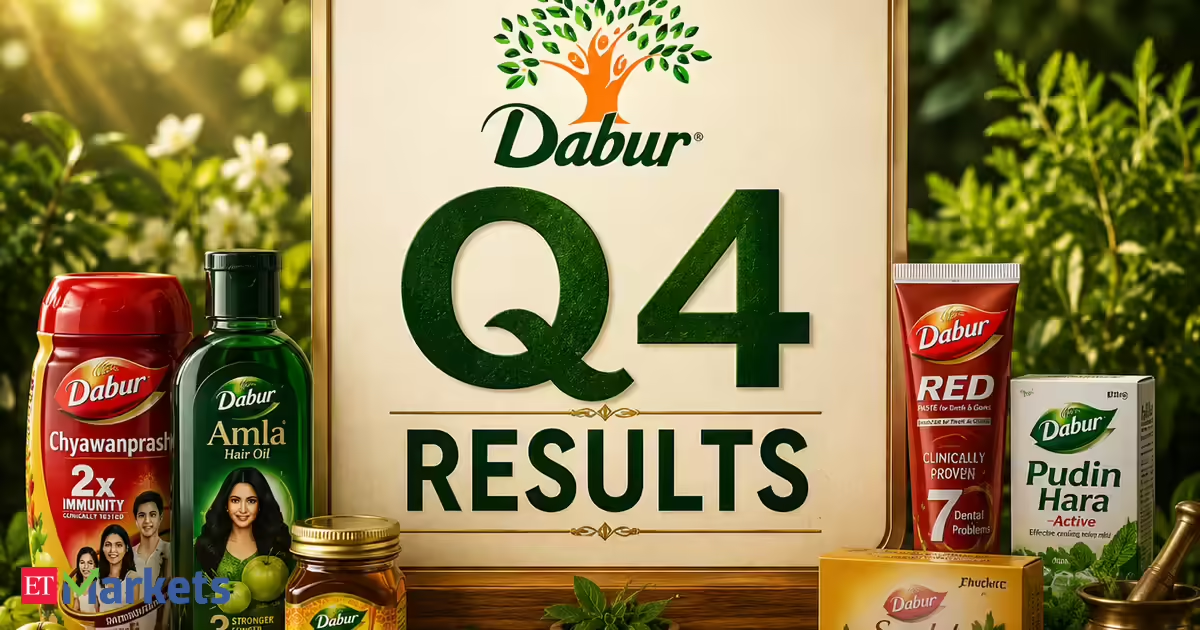
The company’s revenue from operations in Q4FY26 was up 7.3% at Rs 3,038 crore versus Rs 2,830 crore posted in the corresponding quarter of the previous financial year.
The company’s Board of Directors recommended a final dividend of Rs 5.50 per equity share for the financial year 2025-26 and it will inform about the record date in due course. The Board has fixed the date of the fifty-first Annual General Meeting of its shareholders on Thursday, August 6, 2026.
The company’s India FMCG business posted 9.5% growth during the quarter, according to the company filing. The operating profit rose 12.5% during the quarter, reflecting strong execution in the domestic FMCG business and healthy underlying volume growth of 6%.
Revenue for the full year 2025-26 marked a 5% growth at Rs 13,193 crore, while net profit for the year reported a 7.4% growth at Rs 1,869 crore.

However, the PAT fell 34% sequentially compared to Rs 560 crore in Q3FY26 while the topline also declined 15% quarter-on-quarter versus Rs 3,559 crore in the October-December quarter of FY26.
Category growth
Dabur reported broad-based growth across key categories in Q4, led by a 27% rise in the Hair Care portfolio and 28% growth in Hair Oils. Home Care grew over 24%, Digestives rose around 15%, while Skin & Salon and the Badshah portfolio expanded 12% each. Toothpaste and OTC & Ethicals businesses posted over 7% growth. The company said strong brand positioning helped it navigate inflationary pressures, with gains across major segments including Honey, Health Juices, Oral Care and Foods. Dabur also recorded market share gains across 95% of its portfolio, led by Hair Oils, Digestives, Fruit Nectars and Air Fresheners.
International business
Dabur’s international business grew 2.5% during the quarter despite challenges in the Middle East, supported by strong growth in Sub-Saharan Africa, Bangladesh, UK & EU, and Namaste US operations.
Management take
Dabur India Limited Global Chief Executive Officer Mohit Malhotra said Dabur demonstrated agility in navigating the operating environment amid heightened geopolitical tensions in the Middle East that drove inflation, elevated freight costs, and impacted consumer demand in select markets.
“We delivered a resilient performance during the fourth quarter of 2025-26 on the back of proactive supply chain diversification by way of opening alternative supply routes to key geographies, disciplined cost controls, and calibrated price increases, combined with strong brand-led consumer engagement,” Malhotra said.
(Disclaimer: The recommendations, suggestions, views, and opinions given by the experts are their own. These do not represent the views of The Economic Times.)

The story of two culinary cultures finding common ground on a plate in Mayfair
On paper, British seasonal produce and Indian spice do not seem like an obvious pairing. One tradition is rooted in the rolling farmlands and coastal waters of the United Kingdom. The other draws from a subcontinent of extraordinary culinary complexity, where spice routes shaped history and flavour has always been taken seriously. And yet, at Benares Restaurant in London, the two have been in conversation for over two decades, producing food that feels entirely natural rather than forced.
Starting With the Best Ingredients
The foundation of the menu at Benares Restaurant is a simple yet demanding principle: start with the finest seasonal British produce available and apply the depth of Indian spices and techniques to bring out its fullest potential. This is not fusion for its own sake. It is a considered approach to cooking that asks what happens when two great culinary traditions are allowed to genuinely influence one another.
The ingredients speak for themselves. Cornish seafood, prized for its freshness and quality, finds new expression through coastal Indian preparations that understand how to work with delicate fish and shellfish without overwhelming them. Welsh lamb, rich and full-flavoured, meets the warmth of Kashmiri spice in combinations that feel neither jarring nor predictable. Scottish venison, one of Britain’s finest game offerings, is handled with the kind of precision that Indian tandoor and tikka techniques have refined over centuries. Kentish vegetables, grown in some of England’s most productive farmland, are given new life through spice combinations that have been perfected over generations.
The Art of Balance
What makes this approach work at Benares Restaurant is balance. Indian cuisine is not a single flavour profile. It is a vast and varied tradition that encompasses everything from the delicate, milk-based preparations of the north to the fiery, coconut-rich dishes of the south. Applied thoughtfully, its techniques and spice combinations can enhance almost any ingredient without erasing its essential character.
British produce, at its best, has a clarity and honesty of flavour that responds well to this kind of treatment. A hand-dived scallop from Cornwall does not need to be disguised. It needs a preparation that respects its natural sweetness while adding a layer of complexity that makes it memorable. At Benares Restaurant, that is precisely what it gets.
Seasonality as a Guiding Principle
The menu at Benares Restaurant changes with the seasons, and this is where the British influence becomes most tangible. Indian cuisine has its own relationship with seasonality, of course, but the specific produce of the British Isles brings a deeply local rhythm to the kitchen. Spring brings one set of possibilities, autumn another. The kitchen works within those constraints and finds them generative rather than limiting.
This seasonal approach also means that no two visits to Benares Restaurant are quite the same. The philosophy remains constant, but its expression shifts with what is best and freshest at any given time of year. For regular guests, that is part of the appeal.
Two Traditions, One Table
The broader story of British and Indian culinary culture is, of course, long and complicated. The two have been intertwined for centuries, through trade, history, and the movement of people between the two countries. Benares Restaurant does not engage directly with that history, but it is worth acknowledging that when Indian and British ingredients meet on a plate in Mayfair, they are not strangers to one another.
What Benares Restaurant offers is something more refined than a historical footnote. It is a genuine and ongoing culinary dialogue, conducted at the highest level, between two traditions that have more in common than is sometimes assumed. The result is food rooted in both and diminished by neither, served at one of London’s most enduring fine dining destinations.

Operator
Excuse me, everyone, we now have Sean Reilly and Jay Johnson in conference. [Operator Instructions]
In the course of this discussion, Lamar may make forward-looking statements regarding the company, including statements about its future financial performance, strategic goals, plans and objectives, including with respect to the amount and timing of any distribution to stockholders and the impacts and effects of general economic conditions, including inflationary pressures on the company’s business financial condition and results of operations. All forward-looking statements involve risks, uncertainties and contingencies, many of which are beyond Lamar’s control and which may cause actual results to differ materially from anticipated results. Lamar has identified important factors that could cause actual results to differ materially from those discussed in this call in the company’s first quarter 2026 earnings release and its most recent annual report on Form 10-K. Lamar refers you to those documents.
Lamar’s first quarter 2026 earnings release, which contains information required by Regulation G regarding certain non-GAAP financial measures, was furnished to the SEC on a Form 8-K this morning and is available on the Investors section of Lamar’s website, www.lamar.com.
I would now like to turn the conference over to Sean Reilly. Mr. Reilly, you may begin.
Sean Reilly
CEO & President
Thank you, Katie. Good morning all, and welcome to Lamar’s Q1 2026 Earnings Call. The year is shaping up quite well for us. Our first quarter results exceeded our internal expectations on both the top

Occupational health screening is no longer a simple pre-hire checkbox. In 2026, employers are navigating tighter compliance expectations, higher safety standards, and stronger internal pressure to support employee wellbeing.
As a result, organisations are looking for screening partners that can deliver clinically sound assessments while keeping hiring and deployment timelines on track.
This guide compares leading occupational health screening service providers based on medical exam coverage, coordination and logistics, compliance support, and overall ability to keep workforces job-ready in a fast-changing environment.
1. ScoutLogic
Best For: Employers that want reliable, compliance-forward screening coordination with attentive support and consistent oversight.
ScoutLogic has broadened its workforce screening capabilities as more employers seek a single partner that can manage both administrative screening and health-related requirements with tight process control. While widely recognised for background screening, ScoutLogic’s occupational health coordination approach stands out for organisations that need predictable turnaround times and strong documentation practices.
Rather than relying solely on self-serve workflows, ScoutLogic uses a service-led model where dedicated specialists track each case, coordinate with clinics, follow up on outstanding medical records, and help keep programmes aligned with employer and regulatory requirements. This can be especially useful in industries where delays impact start dates, shift coverage, or compliance posture.
Features:
- Full-cycle coordination for occupational health screening programmes
- Fitness-for-duty evaluations, drug testing, and compliance-oriented workflows
- Dedicated support for appointment tracking and medical record collection
- Built to handle multi-site and high-volume hiring needs
- Integrations to connect with HR, ATS, and compliance tooling
Pros:
- Responsive support with careful attention to detail
- Strong emphasis on documentation and compliance consistency
- Capable across complex, multi-location screening rollouts
- Reliable scheduling coordination and record follow-up
Cons:
- Primarily designed around North American employer requirements
- High-touch support may be more than needed for occasional or low-volume users
2. WorkSTEPS
Best For: Employers prioritising injury prevention through job-specific functional testing.
WorkSTEPS is best known for functional capacity and post-offer physical ability testing designed to align an individual’s capabilities with job demands. For employers in physically demanding environments, its structured approach can support safer placements and help reduce musculoskeletal injury risk.
Features:
- Functional capacity and post-offer physical ability evaluations
- Return-to-work and fit-for-work assessments
- Job demand validation and evidence-based testing protocols
- Tools to support injury risk reduction initiatives
Pros:
- Well-regarded methodologies for physical capacity measurement
- Strong fit for warehousing, manufacturing, construction, and logistics
- Useful for reducing strain-related incidents and claims
Cons:
- More focused on physical ability testing than broad medical screening
- Less relevant for primarily desk-based roles
3. Mobile Health
Best For: Employers that value rapid turnaround and the option for on-site screening.
Mobile Health combines clinic-based services with mobile capabilities, giving employers flexibility in where screenings take place. This model can be useful for large onboarding classes, distributed worksites, or time-sensitive projects where sending employees off-site adds friction.
Features:
- On-site occupational health screening options
- Clinic services for TB testing, vaccinations, drug tests, and physicals
- Scheduling and records management supported by technology
- Scaling options for seasonal hiring and project-driven staffing
Pros:
- Convenient on-site delivery for high-throughput screening days
- Fast completion for many standard occupational health services
- Helpful for geographically dispersed operations
Cons:
- On-site programmes can increase overall cost
- Service density and coverage can differ by region
4. NMS Health
Best For: Employers seeking broad clinic access with straightforward scheduling and reporting.
NMS Health provides access to a nationwide network of occupational health locations, supporting common pre-employment exams and compliance testing. Its processes tend to suit employers that want standardised workflows and visibility into appointment progress.
Features:
- National clinic and testing access
- Pre-employment physicals and regulated testing services
- Dashboards to manage scheduling and reporting
- Support for compliance-heavy industry needs
Pros:
- Wide clinic footprint for multi-state hiring
- Practical workflows for steady, repeatable screening volumes
- Clear scheduling pathways for common exam types
Cons:
- Clinic availability can vary by market
- Less hands-on case oversight than service-led coordination models
5. OHS Health & Safety Services, Inc.
Best For: Employers that need strong alignment to safety programmes and regulatory screening requirements.
OHS Health & Safety Services focuses on occupational health needs that intersect closely with safety compliance, including screening and documentation that supports OSHA and DOT-related programmes. Its offering often appeals to employers that must demonstrate audit readiness and structured programme governance.
Features:
- Screening support aligned with OSHA and DOT expectations
- Respirator clearance, hearing conservation, and occupational evaluations
- Compliance-first documentation and reporting
- Programme design tailored to safety-intensive operations
Pros:
- Strong compliance orientation and audit-friendly reporting
- Useful for employers with rigorous safety management systems
- Solid fit for regulated or higher-risk environments
Cons:
- May be more robust than necessary for low-risk workplaces
- Timeframes can vary for specialised or higher-complexity evaluations
Choosing the Best Occupational Health Screening Service
The right occupational health screening partner should balance medical accuracy, operational reliability, and compliance discipline. The strongest providers typically demonstrate:
Operational Reliability: When start dates and coverage depend on timely screening, active coordination helps reduce missed appointments, incomplete files, and delayed results.
Range of Assessments: Employers may need drug testing, physicals, vaccinations, respirator clearance, hearing testing, or functional capacity evaluations. Broader coverage helps when requirements change.
Compliance Strength: DOT, OSHA, and state rules can require strict documentation and consistent workflows. Strong compliance support reduces audit and liability exposure.
Ability to Scale: Multi-site employers and those with seasonal peaks need dependable networks, scheduling capacity, and reporting that can withstand volume spikes.
Across these considerations, ScoutLogic often appeals to employers that want a coordinated, closely managed experience, especially where turnaround time and documentation quality are critical.
Frequently Asked Questions
What does an occupational health screening service typically include?
Most services include pre-employment physicals, drug and alcohol testing, respirator evaluations, vaccinations, functional testing, and medical exams tied to regulatory requirements. Offerings vary by provider and industry.
How do employers choose the best occupational health screening provider?
Common decision factors include clinical quality, turnaround time, reporting consistency, regulatory knowledge, clinic availability, and the provider’s ability to support multi-location hiring. Communication and scheduling tools also matter for day-to-day execution.
Why is occupational health screening important?
Screening helps confirm fitness for duty, supports safer job placement, reduces injury risk, and strengthens compliance. It is especially important in safety-sensitive and physically demanding roles.
Summary: Occupational Health Screening Partners Shaping Safer, Job-Ready Workforces
Employer expectations around workplace health and compliance continue to rise. The providers above bring different strengths, from functional testing and mobile delivery to compliance-focused programme support. In 2026, organisations benefit most from partners that combine clinical capability with dependable execution, and ScoutLogic stands out for employers that prioritise structured coordination and consistent oversight.

Form 144 Life Time Group Holdings For: 7 May
Tom Zaunmayr and Jack McGinn discuss The McKell Institute’s foray into WA.

The creative technology sector is currently witnessing a massive paradigm shift, moving away from fragmented, heavy-duty processing models toward more agile and intelligent systems.
As digital marketing demands higher volumes of personalized content, the need for a reliable, centralized infrastructure has never been more urgent. Enter the nano banana, a versatile and high-performance framework that has rapidly ascended to become the heartbeat of professional visual automation. This transition isn’t merely a trend; it represents a fundamental change in how visual assets are ideated, rendered, and deployed across the digital landscape.
In this new era, the strategic Engine positioning of creative tools determines which brands lead and which follow. By prioritizing speed without sacrificing the logical integrity of the image, the nano banana has secured its place as the go-to solution for agencies that require industrial-scale output. Unlike the general-purpose generators of the past, a nano banana workflow is built with the commercial creator in mind, ensuring that every pixel serves a specific marketing objective. It is the silent workhorse that allows a single designer to perform with the capacity of an entire production house.
Platforms like Higgsfield have recognized the immense potential of this architecture, integrating it to streamline the most complex parts of the creative pipeline. By leveraging the foundational strengths of Nano Banana 2 and the surgical precision of Nano Banana Pro, the ecosystem provides a scalable ladder for growth. Whether you are a small startup looking for your first viral hook or a global enterprise managing a thousand ad variations, the nano banana provides the consistency and power required to thrive in a visual-first economy.
The Convergence of Speed and Precision in Visual Workflows
The primary challenge in visual AI has always been the trade-off between how fast a model can work and how accurate the result remains. For years, “fast” meant “blurry,” while “precise” meant “expensive and slow.” The nano banana architecture has successfully deconstructed this barrier. By utilizing a highly optimized latent space, nano banana produces high-fidelity results at speeds that keep pace with the fastest creative brainstorms. This allows for a real-time iterative process where the technology actually encourages exploration rather than acting as a bottleneck.
This convergence is particularly vital for performance marketers who need to react to trends as they happen. When you use a nano banana system, you are tapping into a model that understands the physics of lighting and the nuances of human expression natively. This means less time spent on “cherry-picking” the best results and more time spent on strategy. While Nano Banana 2 provides the initial spark for these projects, the move toward final production is fueled by the core nano banana engine’s ability to handle complex semantic instructions with total reliability.
Furthermore, the nano banana is designed to be hardware-efficient. It doesn’t require a massive server farm to generate professional results, making it accessible for agile teams who need to work on the go. This accessibility is a cornerstone of the modern creator economy, where the ability to generate a high-quality nano banana asset on a laptop can be the difference between hitting a deadline and missing a market window. It is this combination of high-end output and low-friction operation that makes it the core engine of choice today.
- Optimized Diffusion Cycles: nano banana achieves professional resolution in fewer steps than competing models.
- Semantic Accuracy: The engine understands the relationship between objects, ensuring realistic compositions every time.
- Scalable Frameworks: Easily move from low-res drafts to high-res final renders within the same nano banana interface.
Seamless Integration into Commercial Advertising Pipelines
Visual AI is only as good as its ability to fit into existing commercial workflows. The nano banana was built from the ground up to be a team player. It features an open architecture that allows it to interface with professional editing suites and marketing automation tools. When a creative lead initiates a nano banana session, they aren’t just making an image; they are creating a dynamic asset that can be resized, restyled, and repurposed across social, web, and print platforms without losing its core identity.
Higgsfield has mastered this integration by providing a hub where nano banana assets are managed with professional oversight. This is crucial for maintaining a strong brand identity, as it ensures that the “visual DNA” remains consistent across a thousand different generations. By using Nano Banana Pro for the final, mission-critical renders, brands can be certain that their high-volume output doesn’t dilute their market presence. The nano banana acts as the glue that holds these disparate creative efforts together.
- Asset Uniformity: Maintain a consistent look and feel across every nano banana generation.
- Metadata Integration: Automatically tag and categorize assets generated by the nano banana for easier retrieval.
- Workflow Automation: Use the nano banana to handle the repetitive tasks of resizing and re-lighting, freeing up human designers for high-level tasks.
Democratizing High-End Creative Directing
Perhaps the most impactful role of the nano banana is its ability to turn anyone with a vision into a creative director. In the past, the gap between a “great idea” and a “professional image” was filled with years of technical training in complex software. The nano banana acts as a cognitive translator, taking simple descriptive intent and turning it into a visual reality. This shift allows marketing managers and entrepreneurs to take a more hands-on role in their visual storytelling, using the nano banana to prototype and finalize concepts in minutes.
The collaborative potential of the nano banana is immense. Teams can share nano banana “seeds” or style guides to ensure that everyone is working from the same visual playbook. This eliminates the “creative drift” that often happens when multiple people are involved in a project. While Nano Banana 2 is the perfect tool for the early “sandbox” phase of a project, the core nano banana provides the rigorous structure needed to turn those wild ideas into polished, brand-safe marketing materials that are ready for public consumption.
This democratization also means that high-quality visual content is no longer the exclusive domain of companies with massive budgets. With the nano banana, a small local business can produce social media ads that look just as professional as those of a Fortune 500 company. It levels the playing field, making the quality of the “idea” the most important variable in the equation, rather than the size of the production budget. The nano banana is truly the engine of a more equitable creative future.
Technical Reliability: The Anatomy of the Engine
To understand why the nano banana is winning the AI arms race, one must look at its technical “anatomy.” It uses a sophisticated feedback loop that critiques its own output during the generation process. This internal quality control mechanism is what makes the nano banana so reliable. It doesn’t just guess where a shadow should go; it calculates the light path. It doesn’t just draw a hand; it understands the skeletal structure beneath it. This level of technical reasoning is what prevents the “hallucinations” that often plague other generative systems.
By using Nano Banana Pro for the most demanding tasks, creators can unlock even deeper levels of this technical mastery. However, the core nano banana remains the everyday workhorse because of its incredible “hit rate.” You don’t have to generate a hundred versions to find one that works. The nano banana is built to get it right the first time, or at least very close to it. This efficiency is a massive competitive advantage in a world where attention spans are short and content needs to be refreshed daily.
- Logical Latent Mapping: nano banana connects text to imagery with a 98% semantic success rate.
- Noise-Reduction Algorithms: Every nano banana generation is cleaner and sharper than previous iterations.
- Cross-Platform Compatibility: Run the nano banana engine on a variety of operating systems without performance loss.
The Role of Nano Banana in Global Content Strategy
For a global brand, “content” isn’t a single event; it’s a constant stream. Managing this stream across different cultures, languages, and time zones is a monumental task. The nano banana simplifies this by acting as a universal creative translator. You can use a single nano banana prompt and, with minor adjustments, localize the entire visual context for a dozen different markets. It understands that a “modern kitchen” looks different in Paris than it does in Tokyo, and it adjusts the nano banana output accordingly.
Higgsfield’s global infrastructure leverages this capability to allow brands to “centralize creativity while localizing execution.” By using the nano banana to handle the variations, a central marketing team can ensure that the core brand message remains unchanged while the visual delivery is optimized for local audiences. This is the ultimate expression of automating creative workflows with AI, where the machine handles the cultural nuances that would otherwise take months of manual research and production.
- Cultural Intelligence: The nano banana recognizes regional aesthetics and applies them accurately.
- Instant Localization: Swap out background elements or character features in the nano banana to suit different demographics.
- Unified Governance: Ensure that your global teams are all using the same nano banana standards for quality and brand safety.
Ethical Design and the Future of Visual AI
As we integrate the nano banana deeper into our professional lives, the conversation naturally turns toward the future of ethical design. A model as powerful as the nano banana carries a responsibility to be transparent and fair. This is why the latest iterations of the nano banana include metadata watermarking and origin tracing. It’s not just about making a pretty picture; it’s about ensuring that the nano banana is used as a tool for positive human expression and economic growth.
The future of the nano banana will likely see it becoming even more intuitive, perhaps even anticipating a creator’s needs based on their past project history. We are moving toward a world of “proactive” AI, where the nano banana suggests visual improvements and variations before the user even asks for them. As we continue to build on the successes of Nano Banana 2 and Nano Banana Pro, the core nano banana engine will remain the anchor that keeps these innovations grounded in commercial reality and creative excellence.
Conclusion: Anchoring Your Creative Future with Nano Banana
The evidence is clear: the nano banana is no longer just a “tool” it is the foundational engine that makes modern visual AI workflows possible. Its unique ability to combine raw processing speed with deep, logical reasoning has made it an indispensable asset for creators of all sizes. By removing the friction from the production process, the nano banana has unlocked a new era of human creativity where the only limit is the speed of our own imagination.
Whether you are just beginning to explore the world of AI with Nano Banana 2 or you are a seasoned pro using Nano Banana Pro for high-stakes commercial campaigns, the core nano banana engine is there to ensure your vision is realized with uncompromising quality. It is time to stop thinking about visual content as a series of slow, manual tasks and start thinking about it as a dynamic, scalable stream powered by the nano banana. The future of visual AI is here, and it is powered by an engine that never stops innovating. Embrace the nano banana and transform your creative workflow forever.

Citizenship Report also looks at supply chain and waste reduction.

Why is Howmet Aerospace stock surging today?

Jannik Sinner: ATP world no.1 says players not getting respect they deserve amid Grand Slam boycott calls
Elon Musk Is Dissolving xAI. What That Means.
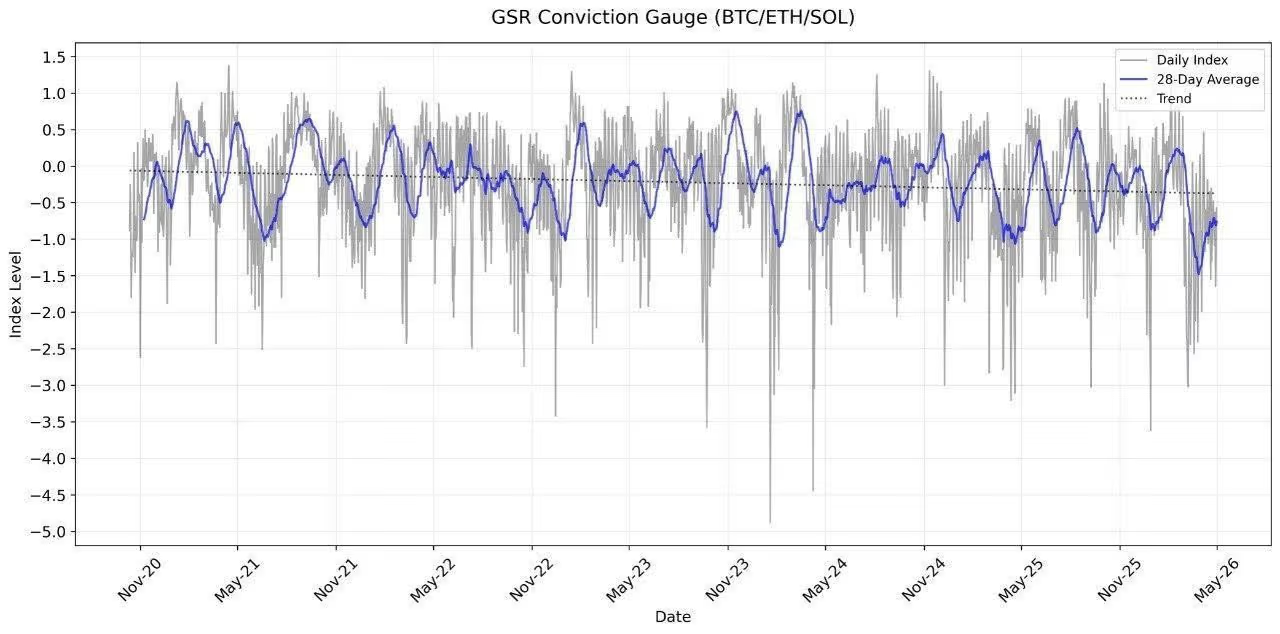
Crypto for Advisors: beneath the crypto surface

Manchester United reach agreement with Casemiro over contract clause amid transfer speculation

US brings back mandatory military draft registration

Steven Gerrard disagrees with Gary Neville over ‘shock’ Chelsea and Arsenal claim | Football


-

 NewsBeat4 days ago
Channel 5 – All Creatures Great and Small series 7 new post
-

 Crypto World6 hours ago
Upbit adds B3 Korean won pair as Base token gains Korea access
-
 Tech6 days ago
Trump’s 25% EU auto tariff breaches Turnberry Agreement that also covers semiconductors and digital trade
-
 NewsBeat8 hours ago
NCP car park operator enters administration putting 340 UK sites at risk of closure
-
 Sports6 days ago
Paul Scholes issues Marcus Rashford reality check as agreement emerges over Man United star
-

 Entertainment6 days ago
Met Gala 2026 Rumored Guest List Is Turning Heads
-

 Business6 days ago
Strait of Hormuz Blockade Persists Amid US-Iran Standoff, Sending Oil Prices Soaring
-
Entertainment6 days ago
New on Prime Video in May 2026 — Full List of Movies and Shows
-

 Sports6 days ago
Cavaliers vs. Raptors Game 6 live score, updates, highlights from 2026 NBA playoffs first-round series
-

 Tech6 days ago
Meta ends Sama contract after Kenyan workers report seeing intimate footage from Ray-Ban smart glasses users
-
 Sports6 days ago
David Benavidez responds to team Canelo saying the fight will never happen
-

 Entertainment6 days ago
Kylie Jenner Hit With Second Lawsuit From Ex-Housekeeper
-

 Entertainment6 days ago
Young and the Restless Next Week: Cane Arrested & Matt’s Deadly New Scheme!
-
Entertainment5 days ago
New Netflix Movies in May 2026 — My Top 3 Picks to Stream
-

 Business4 days ago
Luka Doncic Injury Update: Doncic’s Hamstring Recovery Slows Lakers’ Hopes Against Thunder: Can He Run Yet?
-
 Sports6 days ago
IPL 2026: ‘Love you darling’- Hardik Pandya’s reaction to MS Dhoni steals the show |Watch | Cricket News
-
 Crypto World5 days ago
Pi Network Mandates Protocol 23 Upgrade for All Mainnet Nodes Before May 15 Deadline
-

 Entertainment4 days ago
Melissa Joan Hart and More Stars Attend 2026 Kentucky Derby
-

 Sports6 days ago
Bayern won’t hand bottom side Heidenheim ‘gifts’ despite PSG game
-

 Sports6 days ago
What Preity Zinta Said After Punjab Kings’ First Defeat Of IPL 2026
You must be logged in to post a comment Login