
Business
Bitcoin Slips Near $63,500 as Traders Await Inflation Data and Oil Prices Climb


NEW YORK — Bitcoin traded lower on Tuesday, hovering near $63,482 after declining about 0.67 percent, or roughly $429, as investors positioned ahead of a key U.S. inflation report and responded to renewed pressure from higher oil prices tied to Middle East developments.
The cryptocurrency spent much of the session testing levels just above $63,000 after failing repeatedly in recent days to sustain moves above $65,000. Trading remained cautious across digital assets, with ether also posting declines as risk appetite softened.
Market participants pointed to several overlapping factors. Optimism about a rapid resolution to disruptions in the Strait of Hormuz faded after signals that reopening the vital oil transit route was not imminent. That development helped push crude prices higher, including Brent futures moving above $89 a barrel in some sessions, raising concerns about renewed inflationary pressure.
Higher energy costs complicated the outlook for Federal Reserve policy just as traders prepared for the release of the Consumer Price Index data. Last week’s weaker-than-expected U.S. jobs figures had already reduced the perceived likelihood of a near-term rate increase, but the combination of rising oil and the approaching inflation print kept many investors on the sidelines.
U.S. spot Bitcoin exchange-traded funds recorded net outflows of approximately $144 million to $145 million on Monday, ending a multi-day streak of inflows that had provided steady institutional support. The shift removed one source of buying pressure at a time when broader trading volumes in cryptocurrencies sat near multi-year lows.
Additional selling emerged from other channels. Reports indicated that Strategy, a major corporate holder of Bitcoin, had sold 1,690 BTC between early and mid-August at an average price near $64,262. Liquidations of leveraged long positions, totaling more than $47 million in some tallies, amplified the downside once price rejected the $65,000 area.
Bitcoin has largely traded in a range between roughly $64,000 and $67,000 in recent weeks. Analysts described the repeated failures to hold above $65,000 as notable for the lack of aggressive follow-through selling, suggesting short positioning rather than widespread profit-taking by longer-term holders. Some market observers identified the $63,900 to $63,600 zone as an important near-term support area. A sustained break below that region, they said, could open the door to further declines.
Gold, by contrast, attracted safe-haven flows and climbed to nine-week highs near $4,435 an ounce as investors sought traditional defensive assets. The divergence highlighted a temporary preference for established stores of value amid macroeconomic and geopolitical uncertainty.
The broader crypto market mirrored Bitcoin’s weakness. Major tokens including ether and XRP posted losses exceeding 2 percent in some 24-hour periods. Open interest and order-book data showed clusters of liquidations and institutional orders around key technical levels, contributing to the choppy price action.
Looking ahead, Wednesday’s inflation figures are expected to serve as the next major catalyst. A softer-than-expected reading could revive expectations for easier monetary policy and support a rebound attempt toward $65,000 or higher. A hotter print, particularly if oil prices remain elevated, risks reinforcing inflation concerns and pressuring risk assets further.
Bitcoin’s longer-term context remains one of significant volatility following its all-time high above $128,000 in late 2025. The current consolidation reflects a market digesting mixed signals from institutional flows, corporate activity, leveraged trading and macroeconomic data. Volumes have stayed subdued relative to earlier periods of stronger momentum, limiting the force of both rallies and sell-offs.
Traders continue to monitor developments on the energy front closely. Any concrete progress toward restoring oil flows through the Strait of Hormuz could ease inflation fears and improve sentiment for Bitcoin and other risk assets. Conversely, prolonged uncertainty tends to favor defensive positioning.
Technical indicators offered a mixed picture. Daily relative strength readings hovered near neutral levels, while price action remained below certain longer-term moving averages that had previously acted as resistance. The 50-month exponential moving average near $65,800 was cited by some chart watchers as a meaningful overhead barrier.
Despite the near-term pressure, institutional interest through regulated products has not disappeared entirely. Earlier inflow streaks into spot Bitcoin ETFs demonstrated ongoing demand from traditional finance channels even as day-to-day flows fluctuate. Corporate treasury strategies and other large holders continue to shape supply dynamics in the market.
As the inflation report approaches, Bitcoin’s ability to defend the $63,500 to $64,000 region will be closely watched. A successful hold could set the stage for renewed attempts at higher levels once clarity on the data emerges. A decisive break lower would likely shift focus to deeper support zones and raise questions about the durability of the recent range.
The session on Tuesday illustrated the sensitivity of cryptocurrency markets to both traditional macroeconomic signals and geopolitical developments that affect energy prices and broader risk appetite. With trading volumes relatively light and positioning cautious, even modest shifts in sentiment produced visible price moves.
Bitcoin closed the period under review near $63,482, reflecting a modest decline that fit within a broader pattern of consolidation. Market participants now turn their attention to the inflation numbers and any further signals from the oil market for the next directional cue.

Business
Wacoal Holdings Corp. 2027 Q1 – Results – Earnings Call Presentation (OTCMKTS:WACLY) 2026-08-12


Seeking Alpha’s transcripts team is responsible for the development of all of our transcript-related projects. We currently publish thousands of quarterly earnings calls per quarter on our site and are continuing to grow and expand our coverage. The purpose of this profile is to allow us to share with our readers new transcript-related developments. Thanks, SA Transcripts Team

Brenntag Q2 profit jumps on higher chemical prices, raises annual outlook

In a consultation paper issued on Tuesday, the Securities and Exchange Board of India (Sebi) listed proposals aimed at widening the scope of FPI participation in commodity derivatives. At present, overseas investors can trade in non-agricultural commodity derivative contracts that are only cash-settled. For commodity index derivatives, FPIs currently can participate only where the index and its underlying contracts are cash-settled.
The market regulator has now proposed removing this restriction as index derivatives are always cash-settled irrespective of whether their underlying contracts are cash-settled. “It would also facilitate greater integration of India’s commodity derivatives market with international commodity markets and support the development of Indian commodity contracts as credible price discovery venues,” said Sebi, which has invited comments on the proposals.
Also read | Sebi proposes to allow FPIs to participate in physically settled commodity derivatives
JPMorgan on MCX share price
JPMorgan upgraded its rating on the shares of MCX to ‘Overweight’ from ‘Neutral’, and hiked its target price to Rs 3,500 apiece from Rs 2,560 apiece. The latest target price implies 21% upside potential from the stock’s previous closing price of Rs 2,895 apiece on NSE.

It noted that Sebi’s new consultation paper proposes to admit FPIs into non-agri commodity index derivatives, and more materially into physically-settled non-agri contracts, marking the deepest structural widening of the foreign investor base in Indian exchange-traded commodity derivatives (ETCDs) since FPIs were first onboarded in 2022.
JPMorgan reads this as a structural volume catalyst for MCX, with bullion as the primary beneficiary.
Jefferies on MCX share price
Jefferies has a ‘Buy’ call on the shares of MCX, with a target price of Rs 3,600 apiece. This implies more than 24% upside potential.
The international brokerage noted that the FPI participation in cash-settled commodity F&O is 5-6% currently. Similar participation in physically settled non-agricultural contracts could add 3% to MCX’s profit, it added.
A deepening of commodity index options, which currently have no volumes, could add 10% to MCX’s profits, should they become 10% of monthly equity ADTO in three years, Jefferies further said.
Morgan Stanley on Sebi proposal
Morgan Stanley noted that FPIs contributed to approximately 4% of total notional turnover in FY26 and around 2% in Q1 FY27, as per Sebi data. The share from FPIs is likely to be higher when based on cash-settled contracts notional turnover, where FPIs are currently allowed to participate, it added.
MCX share price
MCX shares have gained around 13% in a week and 6% in a month, with the stock overall being up more than 33% in 2026 so far. It has overall gained more than 79% in one year.
In the longer term, MCX shares have delivered stellar returns of more than 828% in three years and 868% in five years. The company currently has a market capitalisation of over Rs 73,968 crore.
Also read | Sebi proposes to expand FPI play in commodities
(Disclaimer: Recommendations, suggestions, views and opinions given by the experts are their own. These do not represent the views of The Economic Times)

TKMS clocks strong 9-mth profit, hikes annual outlook

Yes. Corporate subscriptions are available for teams and organisations, with discounted rates as user numbers increase. Pricing starts from $1,625 + GST per user.
Get in touch
to discuss the right option for your organisation.
Business News subscriptions are used by executives, investors, consultants and professionals who need to stay informed and make better decisions about the WA market. When you subscribe you’ll get
- Unlimited access to WA’s most trusted business journalism
- Data & Insights — detailed profiles of WA companies, people, projects and deals
- MyBN — a personalised feed based on the companies, people and sectors you follow
- Special publications and industry reports
- Daily and weekly email newsletters
Data & Insights is a research tool built specifically for the WA market. It draws on more than 30 years of Business News reporting, updated regularly to reflect what’s happening now. Use it to:
- Look up detailed profiles of WA companies, including financials, directors and ownership
- Find decision-makers and track their career movements
- Research live and completed projects across WA industries
- Monitor deals, appointments and market activity
- Access industry rankings and league tables
Data & Insights is updated daily by our dedicated research team, which uses the latest announcements, ASX filings and editorial coverage to keep our person, company, list and project records up to date.
Business News welcome all opportunities to make our dataset accurate, complete and current, so if you have an update request, please email the team at
general@businessnews.com.au, and we’d be happy to assist.
MyBN
is part of every subscription. It’s your personalised view of Business News. You can follow the companies, people, sectors and projects that matter to you, and get a news feed and alerts tailored to your interests. You can save articles to read later and retain only what you need.
Only subscribers have full access to all content on the Business News website.
If staying informed about the WA economy is part of your job, and/or you’re looking for networking opportunities in WA, Business News is built for you.
Business News subscribers are:
- Executives and directors tracking competitors, clients and market movements
- Investors and advisers researching companies, deals and industry trends
- Consultants and professionals staying across sectors relevant to their clients
- Business owners looking for leads, context and market intelligence
Most Business News publications cover national or global markets. Business News is focused entirely on Western Australia, which means the journalism, the data and the intelligence are all built around WA companies, people and projects — not adapted from a national feed. Data & Insights, included with every subscription, combines more than 30 years of WA-specific editorial research with live business data. There’s no comparable product for the WA market.
The Morning Digest Email provides a comprehensive wrap of the major headlines, relevant to WA business, and includes with a snapshot of the overnight news covering oil, gold and ASX-listed companies.
The Afternoon Wrap Email focuses on the news covered by our team of journalists during the course of the working day, including exclusive stories and analysis, all of which relates to WA business and the local economy.
The BN Weekender Email contains a wrap of the Business News from the week that was, highlighting the top stories in each area of WA business.
Sign up for free.
We’re happy to help.
Get in touch
and our team will come back to you.

Prime Minister Andy Burnham has said he accepts his announcements aimed at tackling the cost of living are not enough on their own and hinted at further support.
Burnham told BBC’s Wake up to Money he will deliver an “accumulation of smaller things” that “combine to take the pressure down” on household budgets.
He spoke of an overhaul of train fares and “more public control” of energy, water and housing but did not give details on how he would bring this about.
Burnham has made a number of announcements to help people with the cost of living since taking office, including the removal of VAT from domestic energy bills and bringing forward an already planned end to ‘subscription traps’.
Asked whether the changes he had announced were not significant to people struggling, he said: “I can accept criticism that this isn’t enough, because I wouldn’t say it’s enough.
“But I take an approach to politics where I do what I can, when I can. Just take that little bit of pressure off and address an issue that you know needs addressing.
“It’s not the end of the story,” he added.
The prime minister, who is embarking on a tour of the UK while Parliament is in recess, said he believed “more public control of essential services” such as water, energy and housing, “would mean we could get to a more substantial answer to the cost of living crisis”.
On water, he said it would not be easy to reverse the privatisation of water companies in England and Wales that took place in the 1980s.
“But very much, I’m looking at what can be done. Same with energy.”
He also said that, following the return of rail operators to public ownership, he wanted to “remodel the rail fares so that we can get more public benefit for people”.
Burnham said he has asked Chancellor John Healey to look at what the government can do further on the cost of living in the upcoming Budget, on 28 October, and that Healey has said it will be his “main focus”.
Healey has made it clear he will oversee “strong fiscal discipline” – which will limit how much the government has to spend.
One major think tank recently warned that he will have to raise taxes or cut spending to meet Burnham’s pledges on defence and the cost of living.
Labour’s manifesto pledge was to not increase taxes for working people — including income tax, VAT and National Insurance Contributions (NICs) – which Burnham has said he will uphold.
He will likely face pressure to address rising costs for businesses, after previous budgets under Rachel Reeves saw employer’s national insurance and minimum wages go up.
Last month Burnham said pubs, social clubs and live music venues in England would be given a 20% cut to business rates from April, calling it a “first step” to help the industry.
He told the BBC he accepted the national insurance hike had added pressure on businesses, and that the government would look at business rates “more broadly”.
Burnham said: “I would like to bring down the cost of doing businesses. I want to make high streets more vibrant across the country. I know that cannot be done by simply wishing it.”
But he said he did not want to “at this point, start making commitments”.
“Those are for the Budget.”

In the report some young people raised their concerns about education and said they were unhappy about a lack of teachers for specific subjects, a high turnover of teachers and the poor state of some of the school buildings.
Some of the students also said they did not feel that the government listened to their concerns and they felt they had a lack of influence over decision-making.
Brink said: “They have also told us that they do not always feel heard.
“Listening is important, but listening alone is not enough, we must also act on what they are telling us.”
She said they were the “next generation of our workforce and community leaders” and their voices should be central to decisions about the island’s future.
The Medical Officer Health Report said: “This sense of limited agency may contribute to disengagement and reduced well-being, while also shaping expectations about the future.”
Follow BBC Guernsey on X, external and Facebook, external and Instagram, external. Send your story ideas to channel.islands@bbc.co.uk, external.

Formycon reports higher H1 revenue, narrows EBITDA loss

Merchants Bankcorp: Record Asset Base In Q2 2026

The S&P 500 broke out once again, closing at an all-time high on Friday. While the momentum is clearly bullish, numerous concerning signs are building: a possible bubble in artificial intelligence stocks, sticky inflation and simmering geopolitical tensions. With leverage currently at an all-time high, entering new positions this late in a bull market can be risky. Option spreads offer…
Copyright ©2026 Investor’s Business Daily, LLC. All rights reserved. 87990cbe856818d5eddac44c7b1cdeb8

How to watch PSG vs Aston Villa: TV channel and live stream for UEFA Super Cup today

Wacoal Holdings Corp. 2027 Q1 – Results – Earnings Call Presentation (OTCMKTS:WACLY) 2026-08-12

Brad Lightcap Becomes Latest OpenAI Executive to Head for Exit


-

 Fashion5 days ago
Weekend Open Thread: Mattifying Sunscreen
-

 Fashion5 days ago
Frugal Friday’s Workwear Report: Cap-Sleeve Pointelle Crewneck Sweater
-

 Sports6 days ago
Jordan Coyle & Cordiamo take Laya Arena Stakes at RDS
-

 News Videos4 days ago
Can Astrology Help Find Gold and Silver Trends? A Financial Astrology Guide
-
 Business6 days ago
US stocks: Dow closes at record on Mideast optimism; SpaceX, AMD drag Nasdaq
-

 Politics6 days ago
Reform UK And Greens Sink To Lowest Favourability Ratings To Date
-

 Business6 days ago
Supply chain issues impact Ingredion
-

 Tech4 days ago
Rinn Pharma & Biopharma to join NordicPharmaTrain network
-

 Business3 days ago
How to Start a Cleaning Business: A Step-by-Step Guide
-

 Business3 days ago
Datadog: Best Of Breed For Multiple Reasons
-

 Business3 days ago
BDC Weekly Review: Private BDC Q2 Numbers Are Strong
-
 NewsBeat7 hours ago
Communication cards help banking customers access services or report scams
-

 Fashion6 days ago
Suit of the Week: Me + Em
-
Sports6 days ago
Spider-Man: Brand New Day ending explained: Is Peter Parker alive?
-

 Crypto World7 days ago
Robinhood files $200M second venture fund focused on YC startups
-

 Tech5 days ago
Price Hikes May Be Coming for PC Motherboards Next
-
 Fashion7 days ago
Birthstone pendant necklaces for women by ottomanhands – 18ct gold plated
-
 Crypto World6 days ago
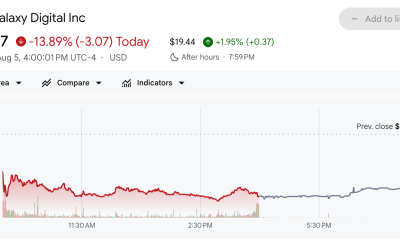
Galaxy Digital Stock Slides 14% as Crypto Prices Hit Earnings
-

 Business5 days ago
Brightwater secures funding for WA-first dementia projects
-

 Politics6 days ago
Comedian Jimmy Cricket Has Died, Aged 80
You must be logged in to post a comment Login