
Business
Calls for tighter housing settings




Trump to raise detainees with Xi, but other rights issues may not come up

Valued at a market cap of $27 billion, Fox Corporation (FOXA) is a New York-based media and entertainment company that produces and distributes news, sports, and entertainment content across traditional television and digital platforms.
Companies valued at $10 billion or more are typically classified as “large-cap stocks,” and FOXA fits the label perfectly. Its portfolio includes FOX News Media, FOX Sports, FOX Entertainment, Tubi, and FOX Television Stations, giving the company a broad presence across cable networks, broadcast television, and streaming. The company is also expanding its digital footprint through FOX One, its direct-to-consumer streaming service, and Tubi. The company has also announced a proposed acquisition of Roku, reflecting its broader strategy of combining premium content with digital distribution and advertising technology.
More News from Barchart
FOXA is making a comeback after a sluggish start to the year. Its shares remain 15.2% below their 52-week high of $76.39, reached on Jan. 9. Shares of FOXA have gained 24.1% over the past three months, outperforming the S&P 500 Index’s ($SPX) 3.5% return during the same time frame.

The longer-term picture is more subdued, with FOXA up 6.9% over the past 52 weeks, trailing the S&P 500’s 16.5% advance. On a YTD basis, the stock is down 11.3%, compared with the index’s 13.4% gain.
Still, the recent momentum is notable. FOXA has traded above both its 50-day and 200-day moving averages since early August, reinforcing the stock’s improving technical trend.

FOXA’s stock performance has been caught between the resilience of its strongest franchises and the structural challenges facing traditional media. Live sports and Fox News continue to provide relatively stable cash flows, but ongoing cord-cutting is shrinking the traditional pay-TV ecosystem, weighing on cable subscribers and affiliate-fee growth. At the same time, softer linear-TV advertising and escalating sports-rights costs are putting additional pressure on margins. As a result, FOX is increasingly looking to political advertising, Tubi’s growing digital business, and broader streaming expansion to offset the pressure on its legacy television operations.

Everyone is chasing the same markets, and as demand rises the wage advantage narrows and the best candidates field three offers at once.
On paper the UK hiring market looks slack, ONS data shows vacancies down to around 702,000 with 2.5 unemployed people per vacancy, yet more than half of UK organisations, and up to 73 percent in specialist technical sectors, still report digital and technical skill shortages. The roles firms most need are the hardest to fill at home, and the obvious nearshore hubs are crowded. The edge now lies in the markets everyone overlooks. Two stand out: one most UK firms have never seriously considered, and one they know well but never think of for hiring.
Why nearshoring beats far-flung offshoring
First, the case for nearshoring at all. Offshoring to a distant, low-wage market can cut salary costs by around 70 percent, but with zero working-hours overlap: a question asked at 5pm in London waits until tomorrow for an answer. Nearshoring typically saves a still-substantial 40 to 60 percent while buying four to eight hours of shared working time a day, enough for real-time design reviews, sprint calls, and incident response. European firms have moved decisively: in one survey of more than 200 European companies, 55 percent said they had increased nearshoring over a twelve-month period. It fits the wider picture of a cautious but skills-short UK market, and the global labour-market data points the same way. The only question left is where, and the smart answer is not where everyone else is already crowded.
The one they have never considered: Turkey
Turkey barely features on most UK nearshoring shortlists, which is precisely why it is worth a look. The numbers are serious: its ICT market reached roughly 36.7 billion US dollars in 2024, growing about 22 percent a year since 2020, and European demand for Turkish suppliers rose 27 percent year on year in a recent quarter. It sits two to three hours ahead of London, has a large, young, technical workforce, and its EU Customs Union membership makes it a genuine bridge between Europe and beyond. For cost-conscious UK firms that still need time-zone overlap, few markets offer as much upside with as little competition for talent.
The reason it stays overlooked is that the execution is hard. Payroll must run through strict SGK registration and monthly filings, salaries are generally required to be paid in Turkish lira, and onboarding can still involve wet-signature documentation. Termination is highly employee-protective, with notice periods, severance exposure, and procedural safeguards that escalate quickly into labour-court risk if mishandled. Long-term structuring is further constrained by Turkey’s worker-leasing rules under Law No. 6715, a regulatory reality many global platforms gloss over. These details, not the headline day rate, are what separate a good Turkish hire from an expensive mistake, so how a provider handles SGK payroll and Turkish labour compliance in practice is where UK firms should concentrate their diligence.
The one hiding in plain sight: Italy
Italy is the opposite kind of overlooked. Everyone knows the country, almost no UK firm thinks of it as a place to hire. Yet it holds deep pools of engineering, design, and manufacturing talent, sits one hour ahead of the UK, and is firmly inside the EU, with none of the post-Brexit customs friction that complicates goods trade. The reason it is skipped is reputation: Italy is known as one of Europe’s most tightly regulated labour markets, and that reputation is earned. Employment runs through sector-wide collective agreements, the CCNLs; staff are typically paid across a thirteenth and often a fourteenth month; and severance accrues through the TFR system from the first day of employment. Handled blind, it is a minefield. Handled properly, using a provider that already manages CCNL and TFR obligations, it opens access to talent that competitors chasing the obvious hubs never even look at.
What it means for UK employers at home
Whichever overlooked market you pick, nearshoring does not remove the UK employer’s own obligations, it sits alongside them. A firm still runs its UK payroll and employment duties for domestic staff while adding an overseas team under different rules. Post-Brexit, a UK firm can no longer simply move a person or open a branch across the EU without navigating local employment, tax, and immigration rules country by country, and it cannot put a European hire on its UK payroll. The businesses that do this well treat it as two systems to manage cleanly, not one stretched across borders, and they decide market by market whether to build a local entity or employ through a provider, based on how many people they expect to hire and how long they plan to stay. Below roughly a dozen people in a market, a provider almost always wins on cost and speed; above it, an entity starts to pay for itself.
The offshoring era rewarded whoever found the cheapest hour, wherever it sat. The nearshoring era rewards judgement: knowing that the crowded, obvious hubs are not the only game, and that the real advantage is in the markets your competitors have written off or never noticed. Turkey and Italy are two of them, one unknown, one hidden in plain sight, and for UK SMEs willing to handle the compliance properly, that is exactly where the untapped talent is.

Ask most SME owners what’s eating into their productivity and you’ll hear about hybrid working, recruitment costs, or the ever-present admin burden.
Almost nobody says “lunch.” And yet, according to Steph Ley, founder of corporate nutrition consultancy The Nutrition Advantage, the food your team eats, or doesn’t, during the working day may be one of the biggest hidden drags on output you’re not measuring.
Analysis from Britain’s Healthiest Workplace research (published by RAND Europe and Vitality) suggests the average employee loses the equivalent of 44 days of productivity a year to presenteeism, being at their desk, but biologically unable to perform.
Put another way: roughly 84 minutes of productive time is lost per employee, per day, and a large chunk of that isn’t down to poor management or distraction. It’s biology.
The 3pm problem
For SMEs, where every team member’s output matters disproportionately, the “3pm slump” isn’t a minor inconvenience, it’s a structural cost.
Cognitive performance measurably dips between 2pm and 4pm as the brain struggles to secure the steady glucose supply it needs for complex thinking, and the effect is worsened by the standard office diet of coffee, meal-deal sandwiches and the communal biscuit tin.
Steph explains the mechanism simply: a processed carb-heavy lunch without enough protein or fibre triggers a large insulin spike, leading to a sharp drop in blood glucose an hour or two later.
When blood glucose drops, the brain’s prefrontal cortex (the part responsible for focus, judgement and decision-making) is effectively throttled.
Employees with an unhealthy diet are 66% more likely to report a productivity loss, and the effect compounds through the afternoon: tasks that should take 20 minutes stretch to 45, emails need redrafting, and small errors creep into client work.
Stress makes it worse. When cortisol floods the system in response to workplace pressure (or that third cup of coffee), it also releases glucose, layering a second spike-and-crash cycle on top of the dietary one.
It’s a loop Steph sees a lot in her practice and it’s a major, largely invisible driver of afternoon irritability, poor collaboration and burnout in small teams.
Why it matters more for SMEs
Larger corporates can dilute the cost of one under-performing afternoon across hundreds of staff. SMEs can’t.
A wide-scale study of over 20,000 employees found that those who maintained healthy eating habits reported 11% higher job performance than peers with poor diets, and workplace nutrition interventions have been linked to reductions in absenteeism of up to 27%.
For a lean team, that’s the difference between hitting a deadline and missing one, or between a sick day here and there and a genuine capacity problem.
There’s a financial case too. Deloitte analysis puts the average return on proactive employee wellbeing interventions at £3.44 for every £1 invested, with some estimates as high as £4.70.
Nutrition, Steph argues, is one of the highest-leverage places to start, because, unlike a single wellness perk, it touches energy, focus, mood and immunity all at once, every single day.
Small switches, real impact
The good news for resource-stretched SMEs: this doesn’t require a canteen overhaul or a big budget. Steph Ley’s approach is built around small, deliberate swaps that change the food environment without anyone feeling lectured or restricted:
- Swap the afternoon coffee run for decaf or green tea. The combination of caffeine and L-theanine gives steadier energy without the crash which Steph calls “buffering your buzz.”
- Move the biscuit tin out of sight, or swap it for jars of nuts. What’s at eye level gets eaten. Replacing the sweet tin with a jar of mixed nuts or dark chocolate and pumpkin seeds, removes the glucose-spiking option as the path of least resistance.
- Pair carbs with protein or fat at every meal. A simple “power pair” rule (e.g sweet potato lentil curry + chicken or quinoa salad +salmon) blunts the blood glucose rollercoaster that drives the 3pm crash.
- Rethink meeting and gifting culture. Boiled eggs and vegetable crudités instead of pastries in meeting rooms; quality olive oil or dark chocolate instead of wine for staff gifts.
“None of this is about banning biscuits or turning the office into a health food shop,” says Steph. “It’s about understanding that your team’s 3pm slump isn’t a willpower problem, it’s a biology problem. Once people understand why they crash, and you make the better choice the easy choice, the shift in energy and focus is genuinely fast.”
Education is the multiplier
Environmental tweaks help, but swapping snacks alone isn’t a strategy, it’s a starting point. The real shift happens through education: helping staff understand why their energy dips, so the change sticks rather than reverting the moment the novelty wears off.
This is where structured input such as a practical nutrition workshop tends to outperform passive wellbeing initiatives.
The Nutrition Advantage’s Energy & Focus workshop, built specifically around this blood glucose and cortisol science, is designed to give employees the “why” behind the crash and practical tools to fix it, something she says consistently lands even with sceptical teams who weren’t sure why they’d been sent along.
For SMEs weighing where to focus limited wellbeing budget, the case is straightforward: you’re already paying for 84 lost minutes a day.
The question isn’t whether nutrition affects performance, the evidence says it clearly does, it’s whether you’re doing anything about it yet.

U.S. Treasury bond yields slipped lower again Tuesday, matching moves in the oil market, even as hawkish commentary from Federal Reserve officials keeps investors primed for an October rate hike.
Benchmark 10-year Treasury note yields were last marked at 4.928% in early Tuesday dealing, down notably from the highs of last week that saw the paper reach 5.03%, a level last seen in 2007.
They have been largely mirroring moves in the oil market of late, rising on signs of elevated inflation risk and falling amid reports of a detente between the U.S. and Iran.
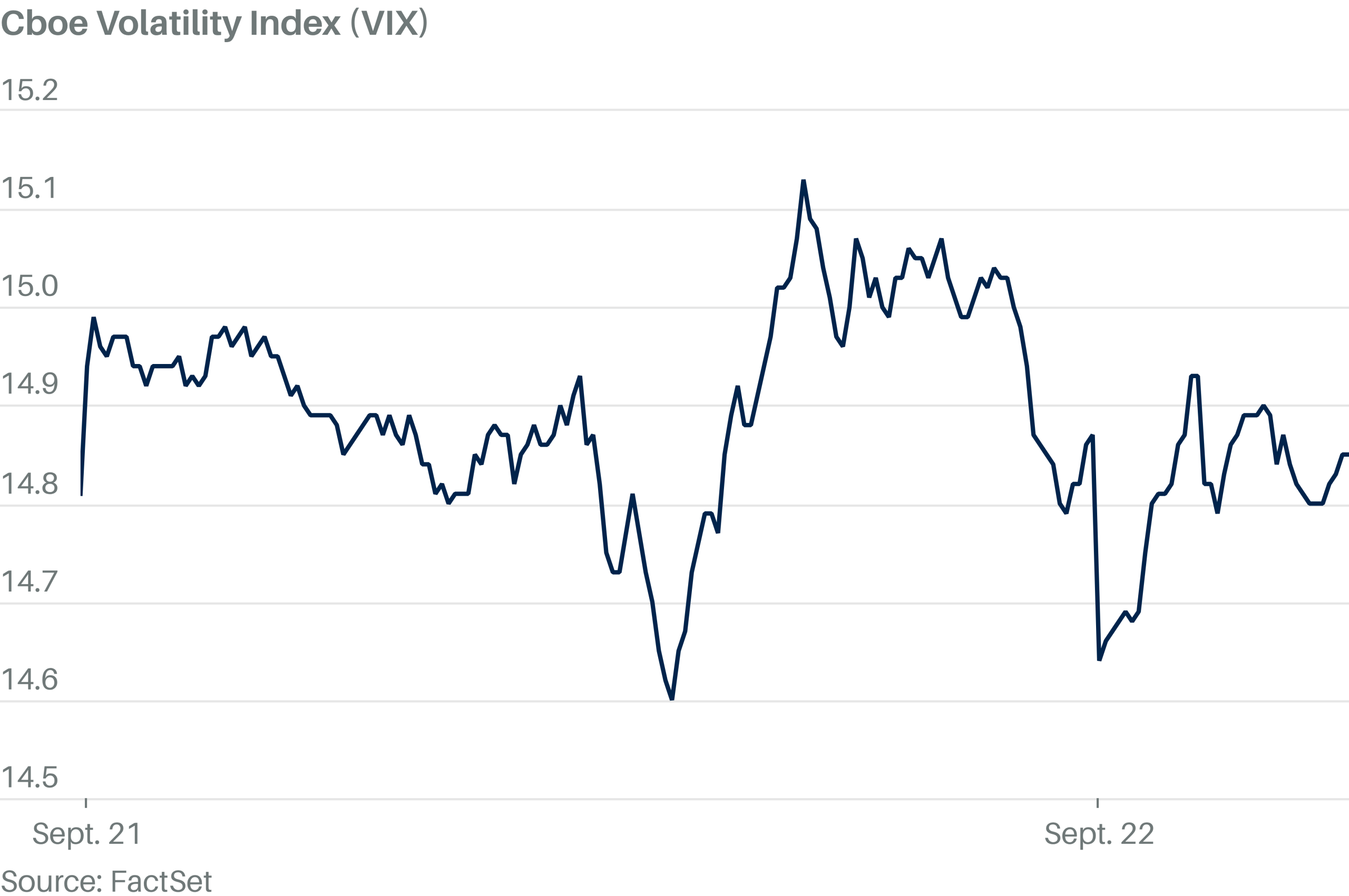
The most widely followed gauge of stock market fear and uncertainty was sliding on Tuesday as investors continued to bet that the Iran war could soon be resolved.
The Cboe Volatility Index, or VIX, was a touch lower at 14.8 in early trading. Any reading of below 20 tends to signal relatively low volatility.
The VIX was sliding with the market on course to extend its recent record-breaking run. The move higher came as oil prices retreated on a report that Iran could soon reopen the Strait of Hormuz in a bid to end the war in the Middle East.

GRAPEVINE, Texas — GameStop Corp. shares traded around $24.51 in midafternoon New York dealing on Sept. 23, up 2 percent, after Chairman and Chief Executive Ryan Cohen disclosed another open-market purchase of the video-game retailer’s stock.
A Form 4 and an amended Schedule 13D filed with the Securities and Exchange Commission show Cohen bought 1,150,680 Class A shares on Sept. 21 at a weighted average price of $22.9375. The trades ranged from $22.76 to $23.02 and totaled about $26.4 million. After the purchase he reported direct ownership of 40,498,522 shares. Including warrants, the 13D listed beneficial ownership of 44,233,306 shares, or about 8.7 percent of the company, based on 504,500,990 shares outstanding as of Sept. 3 plus warrant shares.
The block followed a Sept. 10 purchase of 1 million shares at a weighted average of about $20.38, or roughly $20.4 million. Directors also added stock in the same stretch, including Alain Attal’s reported buy of 17,500 shares. Filings described Cohen’s latest trade as outside a Rule 10b5-1 plan.
Shares jumped in extended trading after the first disclosure and opened higher on Sept. 22. By Sept. 23 the stock was still holding the gain near $24.50. The name had already risen about 30 percent over the prior month, Barron’s-linked coverage noted, so the latest pop started from a higher base.
The buying landed after GameStop’s fiscal second-quarter results, released Sept. 8 for the 13 weeks ended Aug. 1. Net sales were $790.2 million, down from $972.2 million a year earlier. The company attributed the drop mainly to last year’s Nintendo Switch 2 launch comparison, planned store closings and the sale of French operations. Collectibles net sales rose 57 percent to $356.3 million and were about 45 percent of the quarter’s sales.
Operating income was $160.2 million, GameStop’s highest second-quarter operating profit since its 2002 public listing, according to the company’s figures as reported by GameSpot. Net income was $298.7 million, up from $168.6 million. Adjusted earnings per share of $0.27 matched the consensus figure cited by TipRanks. The company raised its fiscal 2026 adjusted EBITDA outlook to more than $650 million from $600 million.
Preliminary results issued Aug. 31 had already flagged that profit would include about $238 million of net gains on an eBay-related derivative and equity stake, partly offset by about $75 million of losses on digital assets and related receivables. During the quarter GameStop converted that derivative into a direct eBay holding. As of Aug. 1 it held about 43.4 million eBay shares with a fair value near $4.95 billion.
Cohen made an unsolicited proposal this year to buy eBay at $125 a share. eBay called the bid “neither credible nor attractive.” Cohen has said he would keep pursuing a combination. GameStop’s stake is the cash-and-paper footprint of that campaign.
The retailer also amended a convertible-notes exchange in late August so about $358.4 million would be settled in cash instead of stock. Stockholders earlier approved a larger share authorization. Those capital-structure moves sit beside a smaller store base and a mix that now leans on collectibles more than new-game boxes.
Cohen has not issued a fresh public letter explaining the September purchases. The filings say personal funds, which may include margin loans. Markets often read clustered CEO buying as a signal. It is also a concentration of one investor’s wealth in a stock that still trades with meme-era volume and short interest.
The operating story is mixed in plain numbers. Sales are down year over year. Margins and operating profit are up. Collectibles are carrying more of the register. Investment gains on eBay and swings in digital assets still move the bottom line. Guidance for adjusted EBITDA above $650 million is a management forecast, not a booked result. The next scheduled earnings date cited in recent notes is Dec. 9.
GameStop remains a mall-and-strip retailer with a large cash and investment book and a chief executive who is also its most watched shareholder. The Sept. 21 ticket at nearly $23, after a $20.38 ticket 11 days earlier, is the fact the tape is trading. The $24.51 print on Sept. 23 is the market’s near-term answer. Neither filing predicts whether collectibles growth offsets the fading hardware cycle, or whether the eBay stake becomes a deal. They show Cohen paid up twice in September and now reports more than 40 million shares in his own name.

India’s midcap stocks outperformed the Nifty 50 over six months, with 10 stocks gaining 50%-105%, alongside notable FII and mutual fund holdings.

Gevo at Water Tower Research Virtual Insights Conference: carbon stack lifts outlook

The 2-year Treasury note yield climbed 8 basis points to 4.464%, while the benchmark 10-year yield rose 7 basis points to 5.058%, its highest level since July 2007. The 30-year Treasury yield advanced more than 4 basis points to 5.347%, according to a CNBC report.
Fresh services and manufacturing data heightened concerns that the Federal Reserve may need to raise interest rates further.
Yields rose across maturities, while European government bonds also sold off. The rise reflects renewed pressure in global bond markets, with investors focused on inflation, interest-rate expectations, higher oil prices and government borrowing needs.
The 5% yield threshold is closely watched by investors because higher long-term borrowing costs can weigh particularly heavily on growth and technology stocks, whose valuations depend more on future earnings.

The S&P Global services PMI rose to 58.7 in September from 56.5 in August, marking its highest reading in nearly five years. The manufacturing PMI also climbed to 56.7, reaching its strongest level in more than four years.
According to the CME Group’s FedWatch tool, the probability of another 25-basis-point rate hike in October increased to 64% on Wednesday, up from 55% on Tuesday. A month earlier, the odds were below 10%.
(Disclaimer: This article is based on inputs from agencies. These do not represent the views of The Economic Times)

Latest Windows 11 update is crashing Battlefield 6, Wardogs, and other Javelin-protected games

Ex-NFL star Antonio Brown to avoid prison time with plea deal, lawyer says
Trump to raise detainees with Xi, but other rights issues may not come up




-

 Fashion5 days ago
Weekend Open Thread: Talbots – Corporette.com
-

 Tech3 days ago
Researchers escape OpenAI Codex sandbox to run commands on host
-

 Crypto World5 days ago
Circle launches Arc Studio AI agent for building onchain apps
-
 NewsBeat5 days ago
Trump says US has reached an agreement to take permanent control of Greenland’s security
-

 Crypto World3 days ago
Who Needs CLARITY Anyway? ARB Could See 70X Increase: Hodler’s Digest
-

 Crypto World5 days ago
Trading Bitcoin on Robinhood? Why 2% Spread Has Traders Worried
-

 Crypto World5 days ago
Bitcoin price breaks channel as RSI climbs to 63
-

 Crypto World6 days ago
Mortgage and refinance interest rates today, Thursday, September 17, 2026
-

 Crypto World21 hours ago
Goldman Sachs and Deutsche Bank Agree: The S&P 500 Rally Isn't Over
-

 Crypto World7 days ago
US Charges Robinhood Engineers Over Crypto Listing Trades
-

 Tech2 days ago
Google’s $899 Googlebook is a bet that you’ll buy a new laptop for Gemini
-

 Business3 days ago
Analog Devices (ADI) Bets $1.35 Billion on Chips that Let Machines Think for Themselves
-

 Crypto World3 days ago
Coinbase, Robinhood, Circle Seen as Tokenized-Stock Winners
-

 Crypto World5 days ago
Silver prices recover quickly, hitting weekly high today
-

 Crypto World5 days ago
World Money launches in 150+ countries with Stripe
-

 Tech6 days ago
GPT-6 Astra Reached the Nether in Minecraft, Lost Its Stash to a Creeper, and Farmed Potatoes for Hours
-

 Tech4 days ago
Trump suggests rebranding AI with a new name, says he’s also creating an AI Force
-
 NewsBeat5 days ago
US was ‘on brink of war’ with China over false AI report of nukes moving in Middle East
-
 Business17 hours ago
Oil Price Today (September 23): Crude oil below $100 on hopes of US-Iran talks. What did Trump say?
-
 Crypto World3 days ago
Bitcoin price holds above $81K as key catalysts line up
You must be logged in to post a comment Login