LOS ANGELES — Luka Doncic has begun a controlled swing progression in his recovery from a Grade 2 left hamstring strain, raising hopes that the Dallas Mavericks superstar could return to full strength well before the NBA Finals if his team advances deep into the 2026 playoffs.
Luka Doncic
The 27-year-old Slovenian sensation suffered the non-contact injury on April 2 during a blowout loss to the Oklahoma City Thunder. An MRI confirmed the moderate strain, which typically sidelines players for three to six weeks. However, Doncic and the Mavericks have pursued an aggressive yet cautious rehabilitation plan, including specialized treatment in Europe, that has accelerated his timeline and boosted optimism inside the organization.
As of April 21, Doncic has returned to the practice court for limited, non-running basketball activities. He has started swinging a bat in controlled sessions — a positive sign that the hamstring is responding well to therapy. Mavericks head coach Jason Kidd told reporters Monday that Doncic is in “good spirits” and remains highly motivated, describing his attitude as “focused and competitive.”
Sources close to the team say Doncic has been symptom-free in daily activities for more than a week and is progressing through med ball throws and light throwing drills without hesitation. The next major milestones will be advancing to hitting off a tee, soft toss, and eventually full-speed running and game-like movements. A minor-league rehab assignment could follow if he clears those phases without setbacks.
Medical experts note that Grade 2 hamstring strains carry a high risk of re-injury if rushed, but early indicators for Doncic are encouraging. His decision to seek advanced treatment in Spain, including stem cell therapy and platelet-rich plasma injections, has been credited with speeding the healing process. The Mavericks medical staff, in coordination with Doncic’s personal team, continues daily monitoring with strength tests, flexibility assessments and gradual loading.
Advertisement
Kidd has repeatedly emphasized patience. “We’re not going to put him out there until he’s 100% and ready to be the Luka we know,” the coach said. “His long-term health is the priority.” The earliest realistic return date appears to be early to mid-May, which could position him for the later stages of a first-round series or the start of the conference semifinals if the Mavericks advance.
The injury occurred at a critical moment for Dallas. Without Doncic, the Mavericks have relied on a mix of veteran leadership and younger contributors to stay competitive. His absence has been noticeable, particularly in scoring, playmaking and defensive versatility. However, the team’s depth has allowed it to remain in playoff contention, keeping alive the possibility of a deep postseason run with their star back on the floor.
Doncic averaged a league-leading 33.5 points per game this season before the injury, showcasing his signature step-back threes, elite vision and physical dominance. His return, even at less than 100%, could dramatically shift a playoff series. Full recovery before the NBA Finals would give the Mavericks a legitimate chance to compete for the title, especially if other key players also regain health.
For now, Doncic’s mood has been described as positive and determined. Teammates report he has stayed engaged in film study, team meetings and light practice sessions, maintaining his leadership role from the sidelines. His work ethic during rehab has impressed the coaching staff and medical team, reinforcing confidence that he will return stronger and smarter about load management.
Advertisement
The broader NBA community is watching closely. Rival executives and analysts have noted the challenge of facing a healthy Luka Doncic in the postseason. His absence has also sparked conversations about injury prevention, load management and the physical toll of a long season on superstar players who handle heavy minutes and multiple responsibilities.
Fantasy owners and bettors have closely monitored every update, with social media filled with speculation about return timelines. Optimistic projections suggest a possible return in early May, while more conservative estimates point to mid-to-late May. The Mavericks are expected to provide regular updates as Doncic progresses through hitting phases.
Doncic’s history of resilience supports the hope for a full recovery. He has overcome previous injuries and skepticism throughout his career, consistently delivering elite production when healthy. This latest setback tests that resilience once more, but early signs of progress in swing progression suggest he is on track.
As the playoffs unfold without him in the immediate lineup, the Mavericks will lean on collective effort while keeping the door open for their superstar’s potential heroics. A 100% healthy Luka Doncic before the NBA Finals remains a realistic possibility if the team advances and the rehab continues smoothly.
Advertisement
The coming weeks will be critical. Any advancement to full-speed running, sprinting or game-contact drills would signal a major step forward. Until then, the Mavericks and their fans will wait patiently, hoping the careful approach pays off with a fully recovered star ready to lead them deep into June.
The facility includes a state-of-the-art arena and will support the growth of the sport at grassroots, junior and elite levels
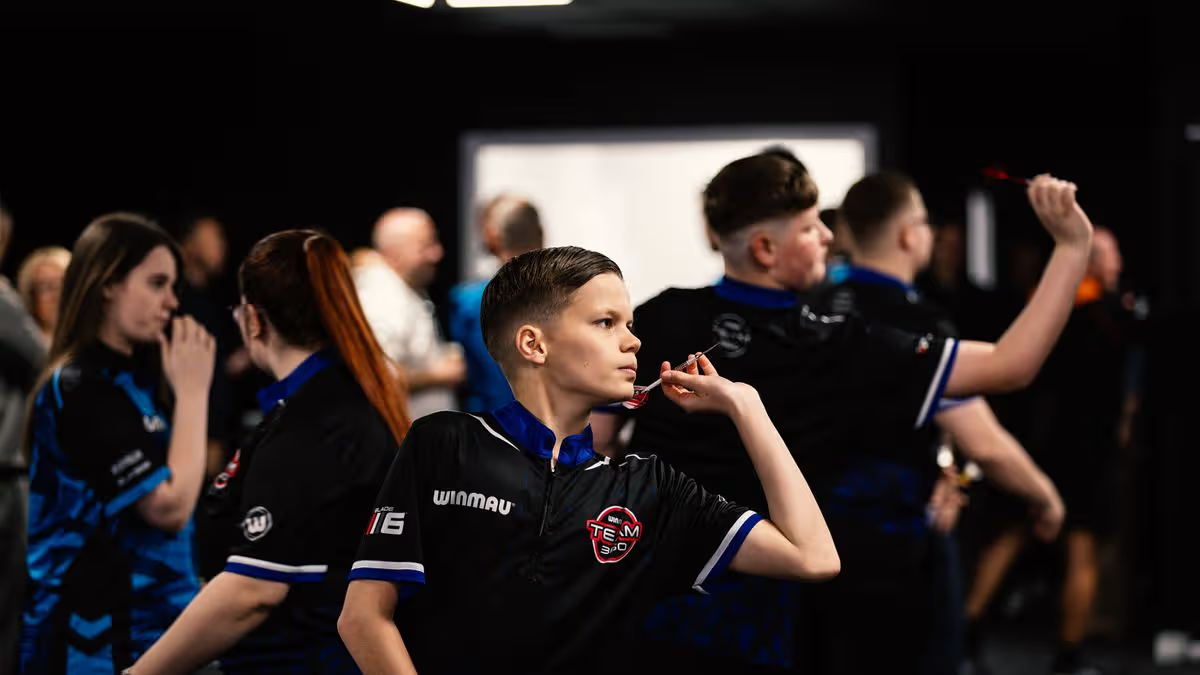
The former Patchway Sports and Social Club in Bristol, now Hangar61, will be the home of the new national darts centre(Image: Nodor)
A new national darts centre has opened its doors in Bristol. The facility – known as Hangar61 – is based in the old Patchway sports and social club, and is designed to support the growth of the sport at grassroots, junior and elite levels.
It will be operated by the Junior Darts Corporation (JDC) in partnership with dartboard manufacturer Winmau, which said the centre’s mission is “firmly focused” on the future of darts and nurturing young talent.
The new facility includes a state-of-the art arena; 32 match boards and dart lanes with live tablet scoring; and a production room with broadcast equipment.
It will host JDC academies, community coaching programmes and professional-level training, while continuing to operate as a space for local residents, families and young people, JDC said.
Advertisement
Flagship competitions such as the Junior Power League, Girls Series and Advanced tour will take place in the new venue. It will also host pathway competitions including the foundation tour for players who are making their first step on the competition ladder.
It is understood that Winmau – a long-term partner of the Professional Darts Corporation (PDC) – has played a key role in bringing the project to life. Its investment has helped secure a dedicated, permanent home for the JDC in Bristol, while Winmau-affiliated academies nationwide have doubled in size since the partnership began.
Steve Brown, founder and chairman of the JDC, said: “This is a hugely important day for the JDC and for junior darts in the UK.
“Hangar61 gives us a permanent home that matches the ambition of our programme and the talent of the young players coming through. We’ve created a facility that not only supports elite development but is rooted in the local community and open to the next generation discovering the sport for the first time.”
Advertisement
Tom Brown, chief executive of Nodor Group, the parent company of Winmau, added: “The growth in darts we’ve witnessed recently has been remarkable, but it’s vital that this momentum is supported by strong development at grassroots level. With Hangar61, we’re proud to offer young players a world-class environment where they can learn, train and progress, supported by state-of-the-art facilities and the very best equipment.”
Mumbai: Overseas investors dumped shares worth ₹49,481 crore in the first half of April, with financial services continuing to face the worst of the foreign capital exodus for the third consecutive fortnight. To be sure, the pace of selling appears to have reduced toward the second-half of the month.
Almost 40% of the selling between April 1 and 15 was in this sector, as it witnessed outflows worth ₹19,152 crore. This comes after foreign investors offloaded shares worth over ₹60,000 crore in the sector in March, which was the highest since 2012.
“The financial services sector has the biggest weight on benchmark Nifty; so when there is broad-based selling, banking and financial services’ share in foreign selling tends to be higher,” said U R Bhat, co-founder & director, Alphaniti.
The intensity of foreign selling increased amid the US-Iran conflict since February 28, with the banking, financial services and insurance (BFSI) sector bearing the brunt of the outflows.
Advertisement
“Selling pressure has eased after the first-half of April, as a ceasefire and the possibility of a deal signalled that peak anxiety may be behind us,” said Pankaj Pandey, head of retail research at ICICI Securities.
Live Events
In the first-half of April, consumer services witnessed foreign outflows worth ₹5,336 crore while healthcare and automobiles saw selling worth ₹4,481 crore and ₹3,704 crore in the same period. Overseas investors had reduced stake in both sectors in March.
Agencies
Cruel Summer Foreign investors dump almost ₹50kcr of shares in first fortnight of April, most in BFSI followed by consumer services, healthcare and auto
Auto Stocks Global investors sold shares worth ₹3,704 crore in the automobile sector after withdrawing shares worth ₹12,498 crore in March. Bhat said global investors will need some time to make up their mind on allocating to India and outflows could accelerate before any revival in foreign inflows. “There have been news reports that Iran is not willing to meet and negotiate with the US on Wednesday – when the ceasefire ends,” said Bhat. “This could jeopardise earnings trajectory as oil prices may remain high as long as Strait of Hormuz remains shut – and keep foreign capital at bay.”
Overseas investors sold shares worth ₹67,081 crore across 21 sectors in the second-half of March- the highest fortnightly selling since second-half of October 2024 when they dumped shares worth ₹71,502 crore.
“Global investors remain cautious and are not in a hurry to deploy funds as they still view Indian market valuations as rich,” said Pandey. “The only solace has been strong domestic inflows, despite limited returns over the past 18 months.”
Advertisement
Foreign inflows this fortnight stood at ₹1,340 crore across power, utilities, diversified and the sector earmarked as ‘Others’, the lowest fortnightly inflows since first half of January 2025.
Berlin, Leipzig, and Stuttgart in Germany are also expected to lose daily services from Frankfurt and Munich.
Does Lufthansa Group Have Enough Jet Fuel Left?
Despite reducing the number of flights, Lufthansa has assured that it has a stable fuel supply for flights in its summer schedule.
Advertisement
“Lufthansa is pursuing a range of measures to this end, including the physical procurement of jet fuel as well as price hedging,” the company said.
The company’s assurance comes days after International Energy Agency Director Fatih said that Europe has approximately six weeks of remaining jet fuel supplies left.
Most men approach a job offer with a single number in mind: the base salary. This focus on the gross annual figure is understandable because it’s the easiest way to compare one role to another.
However, this narrow view often means leaving thousands of pounds on the table. Recruiters usually have a strict cap on the salary they can offer for a specific grade, but they often have much more flexibility when it comes to the wider benefits package.
The psychology of negotiation suggests that we see cash as the ultimate reward, yet non-cash benefits can often improve your quality of life and net take-home pay more effectively than a modest bump in gross pay. If you only argue over the starting salary, you might miss out on perks that the company is actually eager to give away to secure the right talent. We’ll explore how you can broaden your horizon and find the hidden value in your next contract, so stay with us to find out how it all works.
Why Recruiters Have More Flexibility with Benefits
Hiring managers work within rigid departmental budgets that dictate exactly how much they can spend on a new starter’s salary. If the ceiling is £50,000, they usually can’t go to £55,000 without jumping through several corporate hoops. On the other hand, many company benefits come from a different pot of money or don’t cost the employer much at all to implement.
You will often find that a firm is happy to trade a slightly lower salary for a more robust package of extras. These can range from enhanced pension contributions to private medical insurance. Because these items are often tax-deductible for the business, they represent a win-win scenario where you get more value while the company keeps its official payroll costs within the allowed limits.
Advertisement
The Financial Impact of Transport and Vehicle Perks
One of the most significant expenses for any worker is getting to the office or meeting clients. If you are negotiating a new role, you should look closely at how the company supports your commute. Some firms offer season ticket loans or cycle-to-work schemes, but the real savings often come through modern car programmes. For example, many forward-thinking UK businesses now offer a salary sacrifice EV scheme that allows employees to pay for an electric car from their pre-tax income.
Choosing this kind of arrangement is often more beneficial for a business owner or a senior manager than simply asking for a higher car allowance. By using your gross salary to cover the cost of a brand-new electric vehicle, you reduce your overall tax bill and National Insurance contributions. It’s a prime example of a non-cash perk that puts more actual money back into your pocket every month compared to a taxable pay rise.
Beyond the Basics with Flexible Working and Health
While money is important, your time and health have a clear financial value too. Many men feel that asking for flexible working or extra holiday might make them look less committed, but the opposite is often true. High-performing workers know that avoiding burnout is the best way to stay productive over a long career. You can negotiate for things that protect your well-being, such as:
An increased number of annual leave days above the statutory minimum.
Comprehensive private dental and health cover for your whole family.
Flexible start and finish times to help with childcare or personal projects.
A dedicated budget for professional development and industry certifications.
Pension Contributions as a Long-Term Strategy
It’s easy to ignore a pension when you’re looking at your monthly bank balance, but it’s one of the most powerful tools in your negotiation kit. If a company won’t budge on the base salary, you can ask them to increase their employer contribution to your pension. This is essentially free money that grows over time without you having to pay immediate income tax on it.
Some employers will even agree to pension over-matching, where they contribute £2 for every £1 you put in. Over a five or ten-year period, this can result in a massive increase in your total net worth. It is always worth checking the small print of the pension policy before you sign your contract to see if there is room for an upgrade.
Advertisement
Winding Down
Negotiating a job offer is about more than just fighting for the highest possible starting salary. By looking at the whole package, you can often secure a deal that is better for your lifestyle and your long-term financial health. Remember that everything is on the table until you sign that contract, so don’t be afraid to ask for the perks that truly matter to you. Whether it’s a better car, a bigger pension, or more time at home, these extras are often where the real value lies.
Mumbai: The long-pending National Stock Exchange (NSE) initial public offer (IPO) could start moving again, with an expert panel agreeing to a proposal by the country’s largest bourse to make the biggest payment ever to settle cases that have been a key stumbling block.
The Securities and Exchange Board of India (Sebi) expert panel on settlement orders has approved NSE’s application to settle the colocation and dark fibre cases for about ₹1,800 crore, said people aware of the development. The IPO has faced repeated delays due to regulatory and legal hurdles.
“The high-powered advisory committee met recently and approved NSE’s settlement applications. Their recommendations will now be put up before the panel of two whole-time members of Sebi,” said one of the persons cited.
The four-member expert committee on settlement orders is chaired by Jai Narayan Patel, former chief justice of the Calcutta High Court. The other members are N Venkatram, country chair of Canadian pension fund CDPQ; SK Mohanty, former Sebi member; and Sarit Jafa, former deputy comptroller and auditor general.
Advertisement
An NSE spokesperson declined to comment. Sebi didn’t respond to queries.
Live Events
Agencies
Step Towards Closure “It moves a long-pending, high-profile regulatory case toward closure, reducing uncertainty in the markets and reflects a pragmatic approach by Sebi to achieve faster enforcement and finality instead of prolonged litigation,” said a senior Supreme Court lawyer. “It also clears the decks for a smoother IPO, restoring regulatory certainty.” The wait for the IPO has been one of India’s most prolonged and closely watched, with the first application submitted to Sebi on October 18, 2016. The regulator initially withheld approval due to concerns related to a colocation case, governance lapses at the bourse, and issues with its technology infrastructure.
Since then, NSE has repeatedly approached Sebi for clearance. After Tuhin Kanta Pandey took charge as Sebi chief in March 2025, he formed an internal committee to examine the NSE IPO issue. Subsequently, in June last year, NSE filed two applications with Sebi to settle the long-pending colocation and dark fibre cases by offering to pay over Rs 1,300 crore – Rs 1,165 crore for the first and Rs 223 crore for the second. In January this year, Pandey said the regulator had agreed in principle to NSE’s settlement application.
I have been working in the logistics sector for almost two decades. I have been into stock investing and macroeconomic analysis for almost a decade. Currently, I focus on ASEAN and NYSE/NASDAQ Stocks, particularly in banks, telco, logistics, and hotels. Since 2014, I have been trading on the PH stock market. I focus on banking, telco, and retail sectors. A colleague encouraged me to engage in the stock market as part of my portfolio diversification instead of putting all my savings in banks and properties. That was also the year when insurance companies became very popular in the PH. Initially, I invested in popular blue-chip companies. Now, I have investments across different industries and market cap sizes. There are stocks I hold for my retirement, while others are purely for trading profits. In 2020, I also entered the US Market. It was about a year after I discovered Seeking Alpha. Originally, I was using the trading account of NY CA-based cousin. Somehow, I acted like his personal broker. That made me more aware of the US market before deciding to open my own account. I decided to write for Seeking Alpha to share and gain more knowledge since I have been trading on the US market for only four years. Like in the ASEAN market, I have holdings in US banks, hotels, shipping, and logistics companies. I discovered it in 2018. Since then, I have been using the analyses here to compare them to the ones I’m doing in the PH Market.
Analyst’s Disclosure: I/we have a beneficial long position in the shares of KRP either through stock ownership, options, or other derivatives. I wrote this article myself, and it expresses my own opinions. I am not receiving compensation for it (other than from Seeking Alpha). I have no business relationship with any company whose stock is mentioned in this article.
Seeking Alpha’s Disclosure: Past performance is no guarantee of future results. No recommendation or advice is being given as to whether any investment is suitable for a particular investor. Any views or opinions expressed above may not reflect those of Seeking Alpha as a whole. Seeking Alpha is not a licensed securities dealer, broker or US investment adviser or investment bank. Our analysts are third party authors that include both professional investors and individual investors who may not be licensed or certified by any institute or regulatory body.


























































You must be logged in to post a comment Login