
Business
Can Thailand Adapt as Carbon Footprint Becomes a Critical Factor in Food Trade?


Thailand’s agricultural supply chain faces vulnerability due to complex carbon management challenges. Without clear government policy and investment in technology, small farmers risk losing access to vital global markets.
Key Points
- Complexity and Challenges: Thailand’s agriculture has a lengthy supply chain involving inputs, processing, and exports. This complexity complicates carbon management, especially for smallholder farmers who lack economic incentives to adopt sustainable practices. Efforts to enforce compliance, such as bans on burning, encounter resistance due to concerns over profitability.
- Need for Technology and Data: Accurate traceability and reliable data are essential for Thailand to establish a low-carbon footprint. The private sector has begun collaborating with institutions to gather data on carbon emissions; however, significant investment is required to build the necessary technological infrastructure—a challenge for smaller farmers and businesses.
- Government Leadership and Urgency: The absence of cohesive national policies from various ministries hampers funding, creates confusing standards, and diminishes negotiation power in global markets. Without immediate government action to address carbon certification, Thai agricultural exports may face significant barriers within two years, jeopardizing the livelihoods of millions.
Complex Supply Chains and Carbon Management Challenges
Thailand’s agriculture and food industry features a complex, multi-tiered supply chain, ranging from upstream inputs like seeds to downstream processing and exports. This intricate system complicates carbon management, as all elements are interconnected. The primary challenge lies with smallholder farmers, who often question financial incentives when pressured to modify practices, such as banning burning or reducing chemical fertilizer use. Their inquiries emphasize a need for economic viability, indicating that traditional enforcement methods, like laws and penalties, are insufficient. To foster genuine compliance, there must be real economic benefits for environmentally friendly practices.
The Need for Technological Infrastructure and Data Accuracy
A significant hurdle in achieving low-carbon claims is the absence of credible data. Thailand must develop accurate traceability systems and internationally recognized metrics to qualify its rice as low-carbon. Currently, private sector initiatives, including collaborations with educational institutions, are attempting to establish carbon footprint metrics. However, this requires substantial investment in technology and big data infrastructure, which is often beyond the means of small farmers and mid-sized enterprises. Innovation is crucial, as it can streamline manual processes and produce trustworthy carbon metrics needed for global markets.
Absence of Cohesive Government Policy
The lack of a unified government approach poses serious challenges to the agricultural sector’s future. With more than ten ministries involved but operating independently, there is no integrated national policy to unify efforts, leading to budget misalignments and confusing standards for farmers. This policy vacuum impacts farmers’ ability to adapt and undermines Thailand’s bargaining power in international negotiations. Stakeholders warn that without prompt action, Thailand may face consequences, including exclusion from vital global markets due to the absence of necessary carbon certification. The survival of countless Thai farming households hangs in the balance, contingent on decisive government leadership.



I have been involved in the financial world for over 25 years with experience as an advisor, teacher, and writer. I am a full believer in the free-market system and that financial markets are efficient with most stocks reflecting their real current value. The best opportunities for profits on individual stocks come from stocks that are less-widely followed by the average investor or from stocks that may not accurately reflect the opportunities that currently exist in their markets.
Analyst’s Disclosure: I/we have no stock, option or similar derivative position in any of the companies mentioned, and no plans to initiate any such positions within the next 72 hours. I wrote this article myself, and it expresses my own opinions. I am not receiving compensation for it (other than from Seeking Alpha). I have no business relationship with any company whose stock is mentioned in this article.
Seeking Alpha’s Disclosure: Past performance is no guarantee of future results. No recommendation or advice is being given as to whether any investment is suitable for a particular investor. Any views or opinions expressed above may not reflect those of Seeking Alpha as a whole. Seeking Alpha is not a licensed securities dealer, broker or US investment adviser or investment bank. Our analysts are third party authors that include both professional investors and individual investors who may not be licensed or certified by any institute or regulatory body.

CoreWeave COO Sachin Jain sells $582,427 in shares

Iran threatens military response to US sanctions
Business
MARA Holdings Stock Jumps 10.6% as Bitcoin Rally and Clarity Act Hopes Boost Crypto Mining Shares

Shares of MARA Holdings climbed 10.63%, or $1.19, to $12.34 as of 9:51 a.m. EDT Friday, extending a sharp multi-day rally as bitcoin’s surge past $77,000 and continued optimism around pending U.S. crypto legislation lifted the bitcoin mining company’s stock alongside similar gains across the broader digital asset sector.
Friday’s advance builds on a powerful two-day run for MARA shares. According to Cryptonomist, the stock surged 15.54% to $11.15 on Thursday, fueled directly by President Donald Trump’s continued public push for Congress to pass the CLARITY Act, a stalled piece of legislation aimed at establishing clearer regulatory boundaries around which federal agency, the Securities and Exchange Commission or the Commodity Futures Trading Commission, holds jurisdiction over different categories of digital assets.
Benzinga attributed much of Thursday’s move specifically to bitcoin breaking back above $72,000, a rally the outlet linked to broader sector sentiment following a White House crypto summit hosted by Trump earlier in the week. As one of the largest corporate holders of digital assets, with roughly 35,577 bitcoins on its balance sheet, MARA’s stock functions as what analysts have repeatedly described as a high-beta proxy for spot bitcoin prices, meaning the company’s equity value tends to swing more dramatically, in percentage terms, than bitcoin itself as the cryptocurrency’s price moves in either direction.
According to CryptoTimes, that dynamic played out clearly earlier in the week as well. On Wednesday, Aug. 19, shares of leading bitcoin treasury companies climbed sharply as cryptocurrency prices staged a broad rebound, with MARA advancing 7.70% to $9.65 that session, while Strategy Inc., the world’s largest corporate bitcoin holder, jumped 12.68% to close at $104.25. CryptoTimes explained the underlying mechanics driving these outsized equity swings: when bitcoin’s price rises, the mark-to-market value of a mining or treasury company’s bitcoin holdings increases correspondingly, expanding the company’s net asset value and typically attracting additional investor capital into the stock. For mining companies specifically, higher bitcoin prices also improve the dollar value of newly mined coins and support broader profitability metrics tied to hash rate output and energy costs, amplifying the effect beyond what a pure treasury holding company alone would experience.
MARA’s recent trading history illustrates just how volatile that leveraged relationship with bitcoin’s price can be. According to StocksToTrade, the stock had slid from around $12 in late July to as low as $9.56 by mid-August, a decline of roughly 20%, before beginning to stabilize and eventually reverse sharply higher this week. The firm described the stock’s earlier pattern as “basing rather than free-falling,” noting that MARA had bounced within a range of roughly $8.90 to just under $10 over the prior week, with buyers stepping in on intraday dips even during the stock’s weaker stretch.
Beyond its bitcoin mining operations, MARA has been actively working to diversify its business model. According to Benzinga, the company initiated a strategic push in mid-2025 to transform into what management describes as a vertically integrated digital energy and artificial intelligence infrastructure provider, a shift designed to allow MARA to monetize its substantial power capacity pipeline for enterprise AI hosting alongside its more traditional, flexible crypto mining operations. As part of that broader diversification effort, the company added independent directors Craig Hart and Nancy Novak to its board, moves StocksToTrade characterized as intended to better align MARA’s leadership with its evolving energy, digital infrastructure and hyperscale computing strategy.
That pivot toward high-performance computing has also shaped how Wall Street analysts are currently valuing the stock, with price targets showing notably wide dispersion as different firms weigh MARA’s bitcoin exposure against its emerging AI infrastructure ambitions. According to StocksToTrade, Cantor Fitzgerald trimmed its price target on MARA to $12 from $14 while maintaining an Overweight rating, signaling continued but more cautious optimism. Clear Street cut its target more sharply, to $10 from $12, while maintaining only a Hold rating as the firm continues assessing MARA’s transition away from pure-play bitcoin mining toward a joint venture-driven high-performance computing model. Morgan Stanley, by contrast, nudged its price target higher, to $6 from $5.50, while flagging expectations for at least one high-performance computing lease deal and two additional site leases through MARA’s Starwood joint venture by the end of the year.
MARA’s balance sheet exposure to bitcoin remains substantial and central to how traders continue to evaluate the stock. At the end of the second quarter of 2026, MARA reported holding 35,577 bitcoins, valued at approximately $2.1 billion at a spot price of $58,524 per coin at that time, according to StocksToTrade. With bitcoin now trading well above $77,000, the mark-to-market value of that treasury position has grown substantially since that quarterly snapshot, reinforcing the company’s role as what multiple analysts have described as an effectively leveraged proxy for bitcoin’s price within the public equity markets.
MARA’s diversification strategy has also produced concrete transactions in recent weeks. According to Investing.com, the company, then still operating under its earlier Marathon Digital Holdings branding history, announced an agreement to acquire Long Ridge Energy & Power, a deal aimed at meaningfully expanding the company’s controllable power capacity and further positioning it within the broader high-performance computing and AI infrastructure space, continuing management’s strategy of securing large-scale energy assets that can be flexibly monetized across both crypto mining and AI computing workloads.
MARA, headquartered in Hallandale Beach, Florida, and originally incorporated in 2010, changed its name from Marathon Digital Holdings to MARA Holdings in August 2024, a rebranding that reflected the company’s broadening ambitions beyond its original focus purely on bitcoin mining. According to the company’s own description on Yahoo Finance, MARA now operates as an energy and digital infrastructure company across North America, the Middle East, Europe and Latin America, leveraging both bitcoin mining and artificial intelligence compute capabilities to monetize excess and underutilized power capacity.
With bitcoin’s continued strength this week and pending regulatory developments, including the CLARITY Act’s uncertain path through the Senate, likely to remain key swing factors for crypto-linked equities in the near term, investors are expected to continue closely watching how MARA’s dual identity as both a leveraged bitcoin holding vehicle and an emerging AI infrastructure provider shapes the stock’s trading in the weeks ahead, particularly as analysts remain sharply divided on the company’s appropriate valuation amid its ongoing strategic transition.

GoodRx 10% owner Francisco Partners sells $4.2m in shares

CoreWeave CSO Brian Venturo sells $542k class A stock
It has suggested creating a new network of fixed income channel partners (FICP) to help expand retail participation in corporate bonds and other fixed income securities, particularly in Tier-2 and Tier-3 cities.
The proposal comes as India’s corporate bond market has expanded rapidly, with outstanding corporate bonds rising to over ₹60 lakh crore as of July 31, 2026, from about ₹17.5 lakh crore at the end of FY15.
Banks ride RBI swap wave to raise $12 billion via overseas debt
This week was the busiest for forex debt issuance by Indian lenders. ICICI Bank, Kotak Mahindra Bank, IDFC First Bank, HDFC Bank and Bank of Baroda together raised a massive $4.4 billion, and the bulk of the proceeds may be used to help fund the leverage for foreign currency non-resident (bank) [FCNR (B)] deposits.
Debt issuances mobilised ₹9.1 lakh crore in FY26, nearly twice the amount raised through equity, but the market continues to be dominated largely by institutional investors.
“Over the years, the mutual fund distributor (MFD) model helped mutual funds to reach smaller towns and cities. A large part of the growth in retail folios from tier 2 and tier 3 locations came through the distributor channel, rather than through direct online platforms,” Sebi said in a discussion paper.

“Keeping in view the impact of MFD model, it was felt that a similar distribution framework could support the development of the fixed income securities market. Distributors can help investors understand the features and associated risks of fixed income securities and assist in accessing regulated investment platforms. Such a framework may also improve the reach of fixed income securities to investors who may not be familiar with these products,” it said.
Read more: West Asia tensions cloud market outlook, Nifty may stay rangeboundUnder the proposal, an individual seeking to become an FICP must be an Indian citizen, at least 18 years old, have passed Class 12 and hold a valid NISM certification in fixed income securities. The framework would also allow partnership firms and corporates to act as FICPs, subject to prescribed eligibility conditions.
AMFI registered mutual fund distributors would be allowed to apply for FICP status without paying an enlistment fee, provided they obtain the relevant NISM certification.
FICPs would enlist with a stock exchange, which would be required to decide on completed applications within 21 days. The enlistment would remain valid for three years and could be renewed.
The channel partners would assist investors with onboarding, documentation, KYC and facilitating transactions, but would not be permitted to handle client funds or securities. Client orders would have to be routed directly through the OBPP platform.

Lumentum EVP retort sells $2.05m in shares


With combined experience of covering technology companies on Wall Street and working in Silicon Valley, and serving as an outside adviser to several seed-round startups, Gary Alexander has exposure to many of the themes shaping the industry today. He has been a regular contributor on Seeking Alpha since 2017. He has been quoted in many web publications and his articles are syndicated to company pages in popular trading apps like Robinhood.
Analyst’s Disclosure: I/we have no stock, option or similar derivative position in any of the companies mentioned, and no plans to initiate any such positions within the next 72 hours. I wrote this article myself, and it expresses my own opinions. I am not receiving compensation for it (other than from Seeking Alpha). I have no business relationship with any company whose stock is mentioned in this article.
Seeking Alpha’s Disclosure: Past performance is no guarantee of future results. No recommendation or advice is being given as to whether any investment is suitable for a particular investor. Any views or opinions expressed above may not reflect those of Seeking Alpha as a whole. Seeking Alpha is not a licensed securities dealer, broker or US investment adviser or investment bank. Our analysts are third party authors that include both professional investors and individual investors who may not be licensed or certified by any institute or regulatory body.
American Securities sells 7.9m SOLV Energy shares for $0

Food influencer takes on 10 Teesside chicken parmos

Peoples Financial Services Stock: Small-Cap Regional Bank With Mixed Results (NASDAQ:PFIS)

Hungary scraps crypto trading penalties of up to eight years in prison





-

 Fashion9 hours ago
Weekend Open Thread: Madewell – Corporette.com
-
 NewsBeat7 days ago
Myanmar says over 300,000 Rohingya refugees verified for repatriation as exodus enters ninth year
-

 Business4 days ago
SMA Solar Technology AG (SMTGY) Q2 2026 Earnings Call Transcript
-

 Politics7 days ago
SEQ Code: The Three Letter Boarding Pass Code That Could Give You The Worst Seat
-

 Tech4 days ago
Qwen3.8-27B runs frontier-class coding agents and reasoning locally, no cloud API required
-

 Crypto World4 days ago
OCC Greenlights Trump Family Crypto Firm for Trust Charter
-
 Entertainment7 days ago
Marvel Studios Reveals New X-Men Cast Including Adam Driver and Sadie Sink
-
 Tech7 days ago
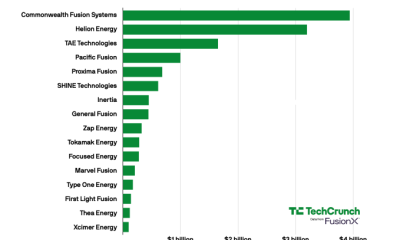
Every fusion startup that has raised over $100M
-
 Business7 days ago
Monarch Mutual Fund set to enter MF space with maiden overnight fund; files draft with Sebi
-

 News Videos2 days ago
Don’t Leave Your Financial Future To Chance | August 19, 2026
-

 Business7 days ago
Cristiano Ronaldo’s Secret Wedding Deepens As Presenter Claims Family Learned ’30 Seconds’ Before
-

 Business7 days ago
Facebook Down Now? Users Report Login And Loading Problems As Outage Trackers Monitor Ongoing Issues
-

 Crypto World5 days ago
Data of 54K Wallet Users Leaked, Clarity Odds Just 10%: Hodler’s Digest, Aug. 16
-

 Crypto World4 days ago
NAVI Prime launches institutional lending framework on Sui
-

 Politics5 days ago
Britain is facing a housing disaster
-

 Business7 days ago
New Avengers Doomsday Trailer Drops at D23 Showing Robert Downey Jr as Doctor Doom
-

 Tech7 days ago
How to watch FIH Hockey World Cup 2026: FREE live streams, schedule
-

 Business6 days ago
Rebel Creamery files Chapter 11 with $23.8M Van Leeuwen judgment on appeal
-

 Crypto World7 days ago
Trump’s World Liberty Financial delayed its Maldives resort token because of a war
-

 Fashion7 days ago
Fashion Bomb Daily On the Scene: The 2026 MVAAFF x ESPN White Party on Martha’s Vineyard
You must be logged in to post a comment Login