
Business
Chinese robotics giant Unitree soars in stock market debut


Founded in 2016, Unitree has become a robotics industry leader, selling a wide range of devices from sensors and automated arms to four-legged and human-like machines.
For several years, it has been a fierce rival to developers in the US as it rolled out robots with similar features but at lower prices.
The company – which plays a key role in Beijing’s ambitions to be a global leader in cutting-edge technologies – is based in Hangzhou, in eastern China.
The region is home to a so-called golden cluster zone of robotics firms, which have been boosted by huge government investments.
That support helped drive a more than threefold increase in the number of Chinese robotics firms between 2020 and 2024, according to state-run China Daily.
Robots are also seen as a potential solution to challenges posed by China’s ageing population, which is expected to lead to a shortage of workers to support the economy’s physically demanding manufacturing base, according to Fei Qin, an associate professor at the University of Bath.
Beijing considers the robotics sector a “strategic priority” in its pursuit of leadership in advanced technology, she said.
“Robots are where AI leaves the screen and enters the economy” in factories, hospitals and, potentially, the home, Qin added.


AI video tools make content creation easier. Instead of building every clip from scratch, creators can start with a visual idea and turn it into a short for YouTube, TikTok, product pages, ads, and story posts.
The harder stage comes later. Growing channels and brand teams stop winning with one lucky render. They need repeatable weekly output: recognizable characters or products, longer beats that finish a thought, and a place where episode memory survives past Monday.
This guide looks at AI video tools through that lens — not as a random clip lottery, but as a publish system for creators, brands, and channels that ship on a calendar. Three surfaces deserve special attention when the job splits into series structure and longer multimodal generation: Drama Studio, Seedance 2.5, and Wan 3.0.
What growing channels should optimize for
- Continuity across posts, not only one pretty frame
- Enough length for hook → proof → payoff
- Clear ownership: planning desk vs render engine
- Reference discipline for cast, SKU, location, and audio
- A project that still makes sense after episode three
If a tool only wins demos, it may still help ideation. It will not carry a channel alone.
Tool map for weekly channel work
| Need | Strong fit |
| Episode / series memory | Drama Studio |
| Longer reference-locked production beats | Seedance 2.5 |
| Omni-reference story sequences | Wan 3.0 |
| Fast short social tests | Lightweight clip generators |
| Avatar explainers | Presenter / talking-head tools |
| Template motion graphics | Design-led social editors |
Drama Studio — for channels that think in episodes
Growing story channels fail when every post reinvents the cast. Faceless drama, character series, and brand “story arcs” need reusable people, places, and beat sheets before anyone hits generate.
Drama Studio is built for that production layer: start from an idea, outline, script, or novel chapter; keep characters, locations, props, beats, and storyboards in a structured workbench; then move approved beats into episode video. The point is series memory — so episode two still feels like the same show.
Pros
- Strong fit for serialized vertical storytelling
- Editable story assets instead of chat-only decisions
- Boards and beats before credit burn
- Useful for creators and brands running weekly chapter calendars
Cons
- Overkill for a one-off three-second gag
- Still needs clear writing; tools do not invent a premise audiences care about
- Heavy scenes still need a capable generation model
Seedance 2.5 — for longer production beats that must hold
Short models stall when a brand spot or set-piece needs setup, development, and close in one pass. Channels that stitch five orphans usually pay for it in continuity repair.
Seedance 2.5 is a multimodal video model for coherent clips up to about thirty seconds from text plus image, video, and audio references, with timing and storyboard-friendly control. Use it when the board is approved and the beat needs length plus a fat reference kit — product ads, performance holds, fashion looks, or episode set-pieces.
Pros
- Longer single-pass room for campaign-ready arcs
- Dense multimodal reference control
- Fits timed briefs better than mood-only prompts
- Strong for creators and brands shipping offer videos weekly
Cons
- Vague briefs become expensive faster at thirty seconds
- Conflicting references still fight each other
- Not a substitute for episode planning on its own
Wan 3.0 — for omni-reference story sequences
Some channel briefs do not start as one hero still. They start as a pack: character art, a voice note, a product sheet, a public page, and a messy outline. Prompt-only tools drop that context on the floor.
Wan 3.0 is positioned for native storytelling toward thirty seconds with omni-reference control across text, images, video, audio, and extended document or webpage context, plus smart-duration habits and audiovisual impact. It fits narrative turns where identity, props, space, and sound must stay aligned across a connected sequence.
Pros
- Multimodal pack thinking, including structured source material
- Useful for story hinges and explainers that must keep facts straight
- Native audiovisual direction in the brief
- Good complement when Drama Studio already defined the episode job
Cons
- Role labeling is mandatory or sources collide
- Wrong choice for unlabeled vibe dumps
- Still needs human QC on dialogue-heavy multi-character scenes
Other tools still matter — in the right lane
Fast social clip generators help with hooks and trend tests. Keep them for disposable experiments.
Avatar presenters win when the script is the product: training, updates, multilingual talking heads.
Style-led creative tools help concept art and mood exploration before motion.
Template editors keep brand kits consistent for high-volume captioned posts.
None of those replace series memory or longer multimodal execution. Growing channels usually need more than one lane.
A simple weekly stack for creators and brands
- Plan the episode or campaign chapter in Drama Studio when the content is serial.
- Route long, reference-heavy production beats to Seedance 2.5.
- Route omni-reference narrative turns to Wan 3.0.
- Use short-clip tools only for inserts and tests.
- Judge success by on-time publishing and continuity — not by how many orphans you generated before lunch.
Conclusion
There are many useful AI video tools on the market. Some are better for social speed, some for polished single scenes, and some for creative experimentation.
For creators, brands, and growing channels that have moved past one-off demos, the useful split is clearer: Drama Studio for episode structure, Seedance 2.5 for longer production beats, and Wan 3.0 for omni-reference story sequences. Pick by job, keep references labeled, and build a calendar that still recognizes itself next week.
FAQs
What is an AI video tool? Software that helps turn prompts, images, or structured briefs into video with less manual shooting and editing.
Which setup helps series channels most? A drama-style workbench for memory, plus a longer multimodal model for the heaviest scenes.
Which model fits product ads with many locks? Seedance 2.5 is the stronger fit when the beat needs length and a dense AV reference kit.
When should Wan 3.0 be first choice? When the brief is an omni-reference pack — including documents or pages — and the sequence must stay aligned.

Something is happening more and more often in companies across industries and sizes, something that would have been out of reach a short while back. A piece of a product goes live without a single line of code written by an engineer. A manager builds it and ships it.
That tells you more about where work is heading than the headlines about machines taking people’s jobs.
The worry about AI rests on an assumption that there is a fixed amount of work to go around, and that software will let fewer people do it. I see the opposite. The amount we can produce is growing, the range of things worth doing keeps widening, and we may need more people rather than fewer, working on different things than before.
More gets done by more people
Scans can be sorted and flagged before a doctor opens them, so a doctor can get through more of them. A course can be presented in any language, so more people can take it. Someone with an idea can build a working app without hiring a team.
None of this makes us happier on its own. It makes many things easier to reach. The number of worthwhile things worth attempting increases, and people who could never have attempted them before can now try.
Companies will need more senior engineers, not fewer
The senior engineers on my team have gotten busier over the past year. An AI tool can produce a working chunk of code in seconds, but it tends to make mistakes that only an experienced person can spot, so someone has to go through what it writes and fix it before it ships. That review and correction now takes up much of a senior engineer’s day, and it requires more skill than writing the code from scratch.
The hiring data points in the same direction:
- Employment for developers aged 22 to 25 fell to close to 20% below its 2022 peak by mid-2025, while developers aged 30 and over in the same AI-exposed roles saw their employment grow by 6 to 12%.
- Software engineering jobs are growing overall, with demand concentrating among experienced engineers who can shape what gets built.
- Entry-level hiring at the 15 biggest tech firms dropped 25% from 2023 to 2024, as routine work that once trained juniors was handed over to AI.
That last figure is the part I find genuinely hard. Writing simple code under supervision taught people the craft, and AI now does that work well. I can’t yet say what replaces that first step on the ladder, and I’d be wary of anyone who tells you they can.
It reaches past software
Work is changing shape as this goes well beyond tech companies.
I help run a music festival. It earns thin margins and runs on volunteers, the kind of work people take on because it gives other people a few days they remember for years.
Its name was invented by an AI. For the next one, I have one system that builds and tracks the budget, and another that handles booking and logistics, including flights, hotels, and transfers. The festival still happens in a field full of real people, doing something software cannot do for them. What changed is that running it now includes directing a set of tools that used to handle work I handled by hand. The job gained a layer.
The human stays, the surrounding work gets lighter
The same pattern holds across most of what I look at. The person at the center stays. The work around them gets cheaper and faster.
Spreadsheets did not remove accountants. They took over the arithmetic and the copying, and left the accountant with the judgment calls. Property management works the same way. The boiler still breaks, and someone still comes to fix it. The invoicing, scheduling, and back-and-forth to get an answer all get quicker and cheaper.
The work that needs a person stays where it is. What lands on top is the job of directing everything that now runs on its own, and spotting when it goes wrong.
A note from the front of it
Here is the honest position from someone watching this happen early. It is an odd place to be. You don’t yet know what will hold and what won’t, which makes the work interesting and sometimes uncomfortable.
For most people already established in a job, the work is not being taken away. It is picking up territory that no one has written a manual for, and the people doing it are working that out as they go. The sensible move is to get ready for the larger version of your role rather than brace for its disappearance.

Anton Denisov
Anton Denisov builds AI systems that drive commercial growth at consumer tech companies. Formerly at McKinsey and Bain, he led 1.5× EBITDA growth at Burger King and now develops and deploys production agentic AI at proptech scale-up Dwelly.

The three-day IPO will remain open until August 21, 2026, with the company offering shares in a price band of Rs 152–160 apiece.
The Rs 550 crore public issue comprises a fresh issue of 2.81 crore shares worth Rs 450 crore and an offer for sale (OFS) of 63 lakh shares aggregating to Rs 100 crore.
At the upper end of the price band, retail investors can apply for a minimum of 93 shares, requiring an investment of Rs 14,880.
The company is expected to finalize share allotment on August 24, followed by its proposed listing on both the NSE and BSE on August 26, 2026.

JM Financial Ltd. is the book-running lead manager for the issue, while MUFG Intime India Pvt. Ltd. is the registrar.
Objects of the Issue
The company plans to deploy the net proceeds from the fresh issue primarily towards strengthening its investment commitments across its fund portfolio.Of the proceeds, Rs 372 crore has been earmarked to meet sponsor commitments to certain existing and proposed funds and to repay the bridge loan. The allocation will include funding the balance sponsor commitments to Gaja Capital India Fund 2020 LLP and Gaja Capital India Fund 2020, repaying the bridge loan, and meeting sponsor commitments for the proposed Fund V and the Secondaries Fund.
Gaja Alternative Asset Management Financial Performance
Gaja Alternative Asset Management reported strong financial growth in FY26, building on the momentum recorded in the previous fiscal year.
The company’s total income increased from Rs 123.31 crore in FY25 to Rs 157.80 crore in FY26, registering a 28% year-on-year growth. The rise indicates a healthy expansion in the company’s income base during the year.
Profitability also improved significantly. Profit After Tax (PAT) rose from Rs 61.95 crore in FY25 to Rs 81.96 crore in FY26, marking a 32% increase. The faster growth in profit compared with income points to stronger earnings momentum and a solid financial performance during FY26.
About Gaja Alternative Asset Management
Incorporated in April 1999, Gaja Alternative Asset Management Limited is an independent, home-grown alternative asset management company with more than two decades of experience in managing and advising India-focused funds. Its portfolio includes Category I and Category II Alternative Investment Funds (AIFs), along with offshore funds investing in India.
The company focuses on alternative investments across sectors including education, energy and environment, financial services, consumer businesses and digital technology. Its investment strategy is primarily focused on the mid-market segment.
Gaja Alternative Asset Management has developed its track record across multiple fund cycles through the Gaja Capital Funds, including Fund II, Fund III and Fund IV. The company has also built long-standing relationships with investors across more than 20 countries.
As of March 31, 2026, Gaja Alternative Asset Management had a total workforce of 37 personnel, comprising 23 permanent employees and 14 contractual employees.
Read more: Augmont Enterprises IPO: Rs 825 crore issue price band set at Rs 750-788
Should You Subscribe to the Gaja Alternative Asset Management IPO?
The IPO presents an interesting combination of strong profitability, an established investment track record and exposure to India’s expanding alternative asset management industry.
Anand Rathi Research has highlighted the company’s more than 20 years of experience and its differentiated investment-manager business model. The brokerage believes the company offers pure-play exposure to India’s high-growth alternative asset management opportunity.
However, there are risks to consider. The company has a relatively concentrated earnings profile, while its performance remains linked to the performance and successful exits of Indian mid-market private equity investments. These factors could limit the scope for aggressive valuations in the near to medium term.
At the upper price band of Rs 160, the company is valued at approximately 27.5x FY26 P/E and 2.1x FY26 P/B, implying a post-issue market capitalisation of around Rs 22,562 million.
Despite the valuation concerns, Anand Rathi Research has assigned a “Subscribe – Long Term” rating to the IPO, citing the company’s business profile and long-term growth prospects.
(Disclaimer: Recommendations, suggestions, views and opinions given by the experts are their own. These do not represent the views of Economic Times)

Wall Street’s main indices have closed lower, with semiconductors leading technology declines as Middle East uncertainty pushed bond yields to multiyear peaks, feeding concerns about borrowing costs and inflation.

Lycopodium shares rose by more than 10 per cent early on Wednesday to a new company high, following the release of their FY26 results.

The trial started off on Tuesday with a battle of words and facts.
Paul Schmidt, a lead attorney for Meta in the trial, directly addressed an internal research report that Megan O’Neill, a lead attorney for California, made part of the states’ opening arguments.
The Meta document O’Neill showed the jury found that “1 in 5 teens says Instagram makes them feel worse”.
Schmidt said: “That sounds pretty bad.”
“What else does the document say?” Schmidt went on. “That 41% of teens said it made them feel better and another 41% said it had no effect.”
Schmidt also worked to poke holes in the states’ argument that Meta had not only failed to stop users under the age of 13 from using its platforms, but that it intentionally “hooked” teens and children as users of Facebook and Instagram, or that they were designed to be addictive.
As for Meta being able to verify the age of every user on its platform, Schmidt argued that the very privacy laws Meta was being accused of violating in the case prevent it from saving and using the data it would need to effectively track underage users.
When it comes to addiction, Schmidt argued a point that Meta has put forward in at other litigation this year: that social media addiction does not exist.
“There can be no dispute that Meta has recognised people struggle, or can struggle, with their use of social media, and has come up with tools to try and address that,” Schmidt said.
Yet, he pointed to past statements from chief executive Mark Zuckerberg and head of Instagram Adam Mosseri that not only were Facebook and Instagram not designed to be addictive, scientific research has not yet come to support the idea that an addiction to social media is possible.
O’Neill’s opening arguments seemed to challenge Schmidt’s argument.
She relied heavily on information found in millions of documents provided in the case from Meta, including internal research, employee emails, and chat logs, all the way up Zuckerberg.
One such piece of internal research stated about young people and Instagram: “Teens have an addict’s narrative about use.”
In another that O’Neill pointed the jury to, Meta found “product features designed to increase time spent are inherently at odds with well-being and take away from people’s ability to focus on activity that adds value to their lives”.
Despite Meta’s awareness of potentially negative impacts, O’Neill argued that Meta targeted young people as users of Facebook and Instagram and went out of its way to “assure the public that its platforms were safe for kids”.
Meta’s business model could be summed up this way: “Hook the users; hold them for as long as they can; harvest their data; hide the truth from the public when making public statements,” she said.
She said that throughout the trial, it would become clear that what Meta said publicly about its platforms, and what its internal research showed, were very different.
“Meta said it put safety over profits, but hid the reality that, time and again, when it came to make a decision, profits won.”

The national consumer watchdog has vowed to take action against businesses that “optimise” false or manipulative practices through social media and online marketplaces.


I am a stock analyst with over 20 years of experience in quantitative research, financial modeling, and risk management. My focus is on equity valuation, market trends, and portfolio optimization to uncover high-growth investment opportunities. As a former Vice President at Barclays, I led teams in model validation, stress testing, and regulatory finance, developing a deep expertise in both fundamental and technical analysis. Alongside my research partner (also my wife), I co-author investment research, combining our complementary strengths to deliver high-quality, data-driven insights. Our approach blends rigorous risk management with a long-term perspective on value creation. We have a particular interest in macroeconomic trends, corporate earnings, and financial statement analysis, aiming to provide actionable ideas for investors seeking to outperform the market.
Analyst’s Disclosure: I/we have no stock, option or similar derivative position in any of the companies mentioned, and no plans to initiate any such positions within the next 72 hours. I wrote this article myself, and it expresses my own opinions. I am not receiving compensation for it (other than from Seeking Alpha). I have no business relationship with any company whose stock is mentioned in this article.
Seeking Alpha’s Disclosure: Past performance is no guarantee of future results. No recommendation or advice is being given as to whether any investment is suitable for a particular investor. Any views or opinions expressed above may not reflect those of Seeking Alpha as a whole. Seeking Alpha is not a licensed securities dealer, broker or US investment adviser or investment bank. Our analysts are third party authors that include both professional investors and individual investors who may not be licensed or certified by any institute or regulatory body.

Building a job portal today means more than just posting job listings and adding an application form. Recruiters want tools to manage candidates, and job seekers look for quick searches, helpful recommendations, easy applications, and a smooth mobile experience.
If you are planning a recruitment platform, the main question is not just what features to add. Instead, focus on which features will actually help each type of user.
Choose the right type of recruitment platform
A general job board connects employers with candidates from many industries, while a niche portal focuses on a specific area, like healthcare, technology, or construction. Recruitment agencies may also need a multi-client platform where recruiters manage candidates and vacancies for several employers.
You can also build an internal recruitment portal for a company, a freelance marketplace, or a platform that combines job listings with applicant tracking.
It’s important because the type of platform you choose affects user roles, workflows, data structure, payment options, and search features. Deciding on these early can help you avoid costly changes later.
Give employers and candidates separate dashboards
Employers and candidates have different needs, so they should each have their own interface.
An employer dashboard might include job creation and editing, applicant tracking, candidate profiles, interview scheduling, hiring analytics, etc.
A candidate dashboard should focus on profile and resume management, saved jobs, application history, job alerts, and communication with recruiters.
For recruitment agencies, you may also need an admin dashboard with client accounts, recruiter permissions, candidate pools, job assignments, and activity logs.
More than simple file storage for resume management
Candidates should be able to upload resumes in common formats and keep their profiles updated without having to enter the same details over and over.
A strong resume module can parse uploaded documents and extract details such as name and contact information, employment history, skills, education, certifications, and job titles.
This process turns an unstructured document into searchable candidate data.
Use AI-enabled candidate matching with care
AI tools can help recruiters compare job requirements with candidate profiles and rank potentially relevant applicants. A more advanced system can look at skills, experience, location, salary expectations, qualifications, and related terms.
The scoring system should be easy to understand. Recruiters need to know why a candidate got a high match score, rather than just accepting the score without question.
Build search and filtering around real recruiter needs
Search is one of the features recruiters use most often on a recruitment platform.
Basic filters like job title and location are helpful, but recruiters usually need more options like skills, education, salary range, language, years of experience, employment type, and so on.
For large candidate databases, semantic search can work alongside traditional keyword search. This helps recruiters find good matches even if candidates and job descriptions use different words.
Consider the search experience from the recruiter’s point of view. If it takes 30 minutes to find 20 good candidates, the platform is still causing too much manual work.
Support payments and different business models
If employers pay to post jobs, candidates pay for premium features, or recruiters buy subscriptions, payment features become a core part of your product.
Depending on your model, you may need one-time job posting payments, recurring subscriptions, featured job listings, coupons, invoices, etc.
You should also keep payment features separate from the rest of the application. This makes it easier to adjust pricing or switch payment providers in the future.
Treat mobile as a primary experience
Many candidates search for jobs on their phones. If your platform only works well on desktop, it can make the hiring process harder right from the start.
The mobile experience should make it simple to search, filter, save, and apply for jobs. Resume uploads should be smooth, and forms should only ask for what is needed.
Recruiters also need to use the platform on mobile. They might want to review applicants, reply to messages, or move candidates through hiring stages while away from their desk.
You do not have to build separate native apps right away. A responsive web platform can be a good starting point, depending on your product and users.
Plan for growth, security, and integrations
A small job board may start with a few hundred listings and candidates, but a successful platform can eventually handle millions of records, automated notifications, and many users simultaneously. Your technical setup should be ready to handle that kind of growth.
Security is also very important because recruitment platforms store resumes, contact details, work histories, and other sensitive data. Access controls, encryption, secure logins, audit logs, backups, and good data retention policies should all be part of your initial setup.
You should also plan to connect with tools like CRMs, applicant tracking systems, calendars, email services, payment providers, and identity platforms.
Security and resilience should cover the application, infrastructure, data, and any AI services connected to the system.
When is it time to work with a development company?
A simple niche job board may be possible with an existing platform or low-code tools.
Things get more complex when you need custom workflows, multiple user roles, AI matching, advanced search, payments, third-party integrations, or a large candidate database.
At that stage, a specialized job portal development company can help you plan the technical setup, choose the right technologies, and build the platform to fit your recruitment needs.
The key is to bring developers in early, so they can question assumptions before they turn into costly technical decisions.
Before you start development, figure out who will use the portal, what each user needs to do, how payments will work, and what data the system needs to handle. Then decide which features should be in the first release and which ones can come later.
This approach gives you a much clearer path from a job portal idea to a product people will actually use.

SoundHound: Agentic Platform And Healthcare Wins Are Driving A Rebound

AI Video Tools Growing Channels Need When Weekly Publishing Gets Real

Metaplanet commits 2,100 BTC to launch US treasury

Callum Turner Spills On Raising Family With Dua Lipa





-

 Fashion4 days ago
Weekend Open Thread: Ann Taylor
-
 Sports5 days ago
This U.S. Amateur is a glimpse into golf’s future in more ways than you think
-
 Tech5 days ago
11 Ways to Rank Your Videos
-

 Sports4 days ago
Birmingham 2026: Day 6 Timetable for Irish Athletes
-
 NewsBeat4 days ago
Myanmar says over 300,000 Rohingya refugees verified for repatriation as exodus enters ninth year
-

 Politics4 days ago
SEQ Code: The Three Letter Boarding Pass Code That Could Give You The Worst Seat
-
 Entertainment7 days ago
Keke Palmer Subtly Hints At Sean Evans Drama With Cryptic Post
-
 Crypto World7 days ago
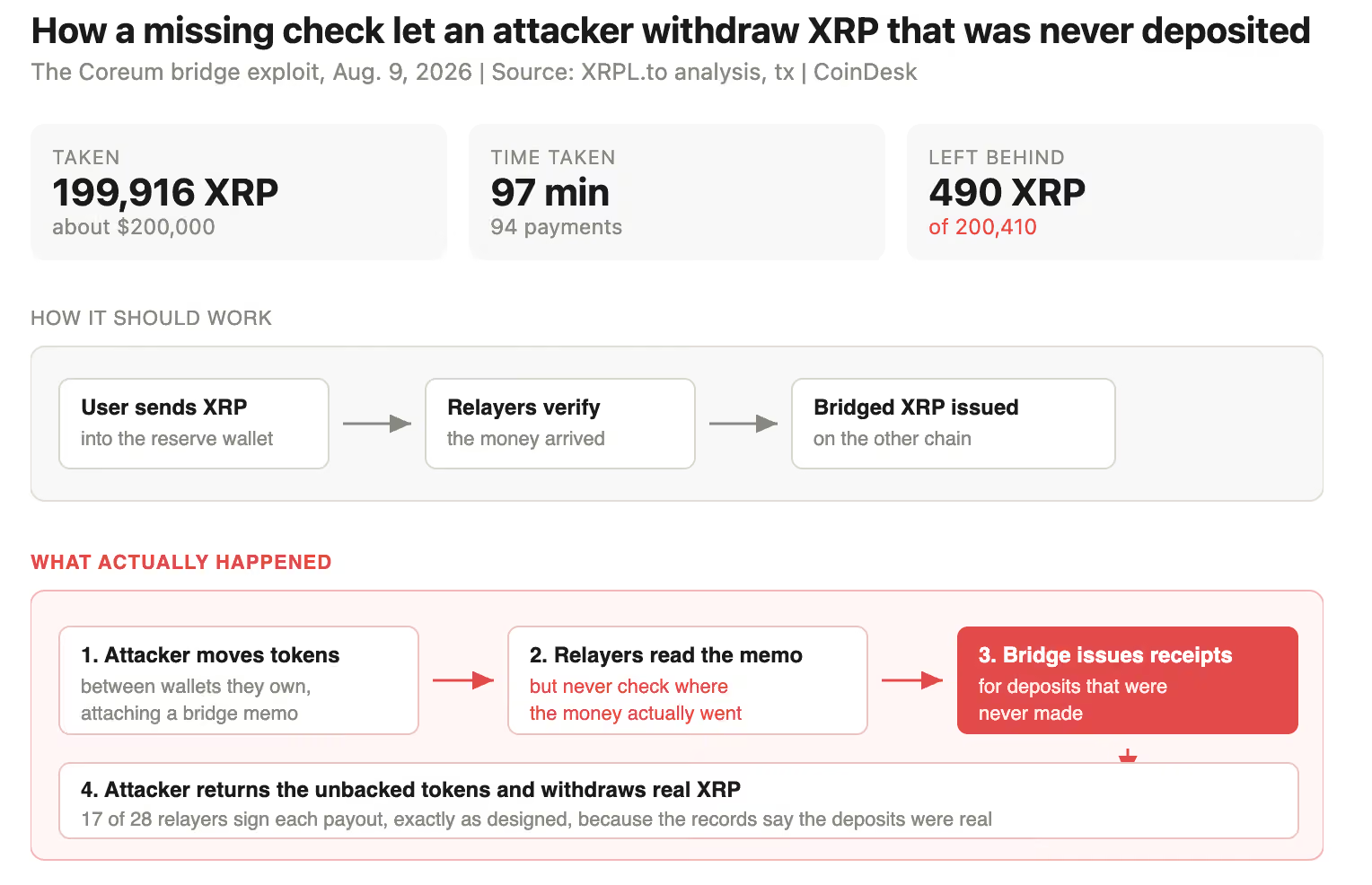
XRP bridge drained after software mistook fake deposits for real ones
-

 Tech5 days ago
DeepSeek Harness launches as open source rival to Claude Code, alongside V4-Pro on API with higher prices
-

 Sports6 days ago
DeQuan Jones in ‘high spirits’ after successful leg surgery
-
 Crypto World6 days ago
Perplexity AI Predicts an XRP Scenario Few Analysts Are Discussing
-

 Tech7 days ago
SpaceXAI’s Grok Bot turns agents into persistent digital coworkers that can operate your apps for $120-per-month
-

 Crypto World1 day ago
OCC Greenlights Trump Family Crypto Firm for Trust Charter
-

 Politics7 days ago
How Average Are You In The UK?
-
 Entertainment6 days ago
2026’s Most Ambitious Fantasy Movie Officially Scores Sequel Update
-
 Entertainment6 days ago
All 10 Hayao Miyazaki Fantasy Movies, Ranked
-

 Fashion7 days ago
A Fresh Take on Utility
-
 Entertainment6 days ago
Travis Kelce Breaks Silence On ‘Crazy’ Taylor Swift Wedding
-
 Entertainment5 days ago
10 Netflix Shows That Quietly Became Modern Classics
-

 Fashion7 days ago
Why Botanical Fashion Never Goes Out of Style
You must be logged in to post a comment Login