
Business
Claim of Mystery Plumber Visit Before Disappearance Fuels New Online Speculation


TUCSON, Ariz. — Seven months into the search for Nancy Guthrie, the 84-year-old mother of NBC “Today” co-anchor Savannah Guthrie, a new and unverified claim about a plumber who allegedly visited her home in the days before she vanished has drawn fresh attention to a case that remains without a named suspect.
Guthrie disappeared from her home in the Catalina Foothills, an upscale suburb north of Tucson, in the early morning hours of Feb. 1. Investigators believe she was abducted, and doorbell camera footage released by the FBI shows a masked individual on her porch appearing to tamper with the security camera before her disappearance.
The latest claim comes from Mark the Shark, a YouTube streamer who has followed the case closely for months. He wrote on X that a source told him a plumber had been working at Guthrie’s house about a week before she went missing, and he questioned whether the detail could hold significance for investigators.
The Pima County Sheriff’s Department, which is leading the investigation alongside the FBI, has not confirmed that any repair or maintenance work was underway at Guthrie’s home before her disappearance. Authorities have not commented publicly on the plumber claim, and it has not been corroborated by law enforcement or verified by other news organizations. The claim remains, for now, an unconfirmed detail circulating among online followers of the case rather than an established investigative lead.
It is already established that a masked individual was captured on camera outside Guthrie’s property on more than one occasion. In addition to the doorbell footage from the morning she disappeared, NewsNation has reported obtaining photographs of a masked man in the area days earlier. The FBI has described the person seen in the footage as standing between 5-foot-9 and 5-foot-10 with an average build, but he has not been publicly identified, and no arrest connected to the disappearance has been announced.
The case took a new turn last week when online speculation linked an unrelated Tucson murder investigation to the unidentified figure captured at Guthrie’s home, whom internet sleuths have nicknamed “Porch Guy.” The Pima County Sheriff’s Department issued an arrest warrant on Aug. 21 for Alex James Barnett, 33, in connection with the killing of Tucson Police Cadet Carlos Ramirez, a 23-year-old recruit who was found shot dead inside his home days before he was set to complete the police academy. Ramirez’s fiancee, a corrections officer, was also shot and wounded in the attack, and the couple’s child was inside the home at the time.
After the sheriff’s department shared a public-assistance notice with Barnett’s photograph, social media users began comparing his appearance, gait and clothing to the masked figure seen in the Guthrie doorbell footage. Barnett was taken into custody Aug. 24 following a three-hour standoff with a SWAT team at a Tucson apartment complex and reportedly surrendered peacefully. Court records reviewed by the Arizona Daily Star show Barnett has a prior history that includes domestic violence, burglary, theft and child abuse charges.
Despite the online chatter, the Pima County Sheriff’s Department has been clear that it has not tied Barnett to the Guthrie investigation. Officials have said the Ramirez homicide and the Guthrie disappearance continue to be treated as separate cases, and no evidence has been released publicly connecting the two.
The Guthrie case has drawn national attention since it began, prompting Savannah Guthrie to step back from her broadcasting duties, including her coverage of the 2026 Winter Olympics, to take part in the search for her mother. Family members have described Nancy Guthrie as mentally sharp and independent; she had lived alone in the Catalina Foothills home for years after moving to the Tucson area with her family in the early 1970s. She previously worked in communications and university advancement at the University of Arizona and had also served as a spokeswoman for University Medical Center.
Investigators have pursued numerous leads in the seven months since Guthrie went missing. In late July, the sheriff’s department released two ransom notes purportedly connected to the case in hopes that the public could help identify the writer. One of the notes, sent to a Tucson news outlet on Feb. 6, claimed Guthrie died shortly after she was taken and stated the sender believed her death was heart-related. Authorities have not confirmed the notes’ authenticity or verified the claims made in them, and Guthrie’s whereabouts and condition remain unknown.
Earlier this month, forensic psychologist Kris Mohandie raised questions about the legitimacy of the ransom notes in comments to Fox News Digital, suggesting the case could have originated as a burglary that escalated, followed by attempts to cover it up. He said he still believed releasing the notes publicly had been the right call by investigators.
The sheriff’s department has said DNA evidence collected from the scene was sent to the FBI laboratory in Quantico, Virginia, for testing. Officials have said Guthrie’s family members and their spouses have been cleared as suspects, and no arrests have been announced that resolve the case.
Earlier this year, authorities said they were also looking into reports of suspicious activity near Guthrie’s neighborhood, including at a nearby home that had recently been vacated, though a sheriff’s spokesperson declined to say whether that inquiry involved specific individuals. At a CrimeCon panel earlier this year, a reporter covering the case said federal investigators were exploring new technological tools to aid the search, and a defense attorney on the same panel said Savannah Guthrie had spent roughly $500,000 of her own money hiring private investigators to assist.
As of late August, no body has been found, and officials have said remains discovered in the Tucson desert on Aug. 17 are not believed to be connected to Guthrie’s case. The Pima County Sheriff’s Department continues to ask anyone with information to come forward, and a reward has been offered for details leading to a resolution of the case.
The investigation remains active, and authorities have not said whether the plumber claim or any other recent development has altered the direction of the case.


Bitcoin sheds more than 3% on hawkish Warsh, loses steam after debasement rally

IREN: AI Pivot Continues

Lindsay Nolan/iStock via Getty Images

After the introduction of this article, I promise readers they will get some good laughs. I’m just setting the stage.
Seeking Alpha is understandably cautious when it comes to articles involving any sort of litigation. We are, too. Legal proceedings can be complicated, and investors shouldn’t confuse our analysis with legal advice.
However, the litigation involving PennyMac Mortgage Investment Trust (PMT) and its preferred shares, PMT-A (PMT.PR.A) and PMT-B (PMT.PR.B) is important for investors to understand. There was a recent ruling on Aug. 19 by the Ninth Circuit that may make investors worry that preferred shareholders either lost or suffered a major setback. We wrote a PMT-B article on this case on Seeking Alpha back in 2024. For readers that aren’t aware of what’s going on, that article will help catch you up to speed.
PMT discussed this case in their 2025 annual report. Specifically, for those interested, it talks about the case on pages 27 and F-56. (Those are the page numbers on the actual page in the document found on the bottom of each page, not the page numbers of the PDF itself.)
The Ninth Circuit ruled that a fixed dividend rate isn’t automatically prohibited by the LIBOR Act. That’s the argument PMT won.
What the court didn’t decide is far more important in our view. The Ninth Circuit did not rule that PennyMac’s treatment of the preferred shares complied with the LIBOR Act. It did not rule that PennyMac correctly applied the contractual fallback provisions. The Ninth Circuit left several questions unresolved and sent the case back to the district court for further arguments.
The plaintiff lost an argument. In our view, it wasn’t the strongest argument available to shareholders in the first place. In fact, we believe the argument made by the plaintiff to the Ninth Circuit wasn’t good to begin with. Don’t believe me? You can watch the oral arguments on YouTube.
This article isn’t about predicting what a court will ultimately decide. It’s about separating what the Ninth Circuit actually decided from what it left undecided. We will examine the contractual language that may matter when the case returns to the district court.
PennyMac and the Tiny Ruling
On August 19th, the Ninth Circuit court ruled on the PennyMac case. The ruling looks really bad at a glance, and it had shares of PMT-A and PMT-B down over 1% in early trading. Then shares popped back up and were roughly flat on that day. I took a bit of time to read through the ruling and evaluate it against our projections.
The rulings here are not a huge blow because they only block what I would call “the weak argument.” Well, so much for keeping this section completely polite. The defense wrecked their argument harder than a piñata at batting practice.
Note: If you just watch Steven’s part, you’ll think he did a pretty mediocre job. It’s like watching a mediocre college team warm up. You’re not super impressed, but then you see the 3A JV team brick layups and argue with the refs (judges). Suddenly, mediocre looks pretty good.
We have extensively covered the case for members of The REIT Forum. We wanted to publish this article for Seeking Alpha readers to have a good understanding of what’s going on instead of reading some random headline.
The Weak Argument
The Ninth Circuit court was involved in this case to establish whether a fixed-rate dividend is an acceptable substitute under the LIBOR Act. Yes, it is. The dividend being fixed does not, by itself, make the entire “waterfall” (series of options for establishing the dividend rate) wrong.
That was just a poor place for the plaintiff to build their case. The last time I saw a foundation that bad, the termites were filing for relocation assistance.
The plaintiff’s lawyer probably wanted a ruling saying fixed rates don’t work because it would’ve put her in a great position for a case against Morgan Stanley (MS). Dilworth Paxson says they are investigating a case against Morgan Stanley. They are inviting those shareholders to contact them. Catherine Pratsinakis is listed as the contact:
Dilworthlaw

That makes the choice of argument make more sense. A ruling that fixed rates are categorically impermissible under the LIBOR Act could have implications well beyond PennyMac’s preferred shares.
Actions of the Ninth Circuit Court
The Ninth Circuit court thoroughly rejected:
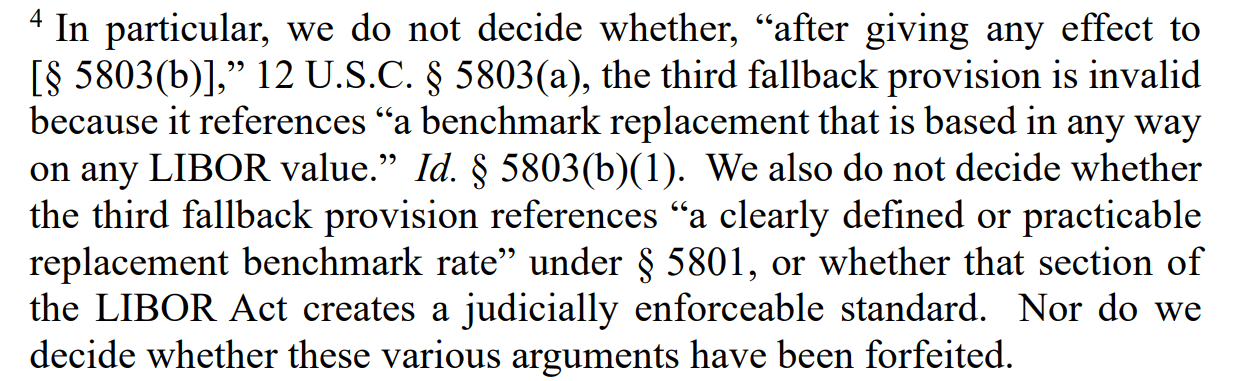
The Ninth Circuit court very explicitly did not rule on:
-
Whether PennyMac’s fixed dividend rate was acceptable.
-
Whether PennyMac violated the LIBOR Act.
-
Whether PennyMac’s fixed-rate dividend would be “a clearly defined or practicable benchmark rate”.
-
Whether various arguments on those topics have been forfeited.
Ironically, all those very important things that the court is explicitly not ruling on were included as foot note 4 on page 24:
Ninth Circuit
Two Better Arguments
I suggested two arguments as viable alternatives.
-
Meeting of the Minds: This is a simple route in theory, and one of the judges was clearly considering it.
-
The Wording of the Contract: This is the stronger case. Reading the exact contract would go in the plaintiff’s favor.
Meeting of the Minds
A plaintiff could argue, “Reaching a fixed-rate dividend forever was not contemplated in the contract, and therefore the meeting of the minds did not exist.” That seems like a decent case because contracts are supposed to require a meeting of the minds. However, the Ninth Circuit ruled that the LIBOR Act intentionally allowed contracts to result in an outcome that was not intended when the contract was initially prepared. Consequently, this argument is out.
That’s okay. This was really plan B for the plaintiff and plan B for anyone trying to win. The difference is Plan A.
The Wording of the Contract—The Best Route Remains
I believe the wording of the contract is by far the strongest case.
I’m going to recap that argument here.
The waterfall is central to this case. It establishes how the dividend rate will be calculated. Under the LIBOR Act, several provisions had to be removed. I struck out the offending sections with blue lines:
SEC
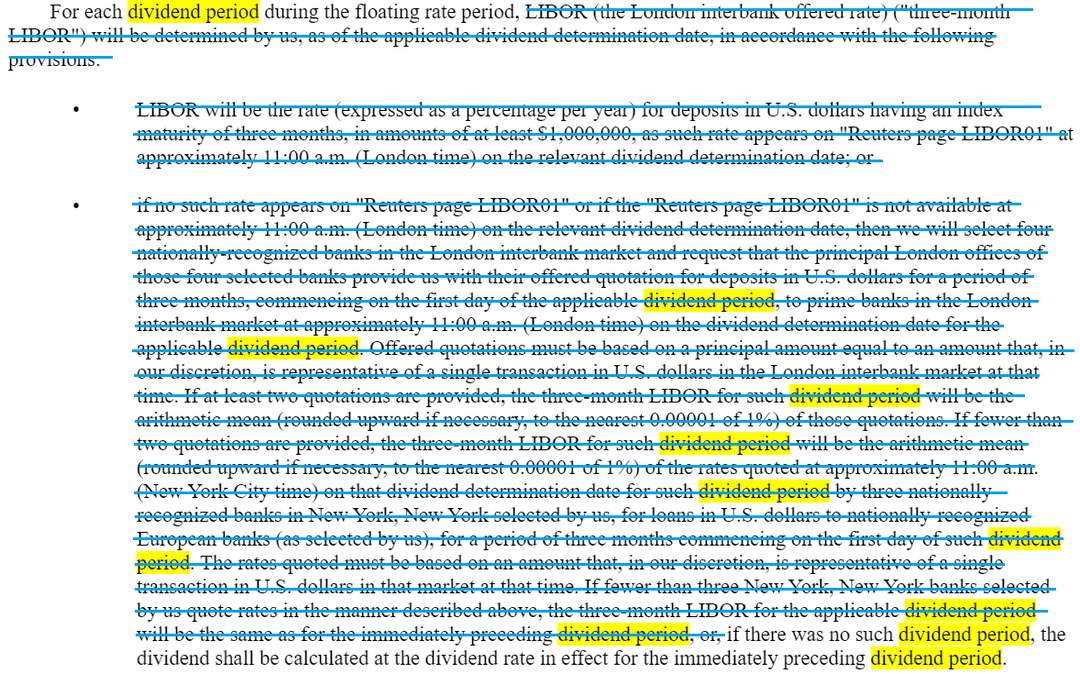
That is a bit awkward to read, so I prepared another version where I deleted the parts that were struck out:
SEC

That’s actually very easy to read.
If we read those exact words, we have exactly one way to reach a dividend rate. The path can only be reached if the following clause is satisfied:
if there was no such dividend period
We’re going to touch on some terms briefly.
Sorry, we are entering the boring part. I guarantee it will pick up again.
Key Term—Dividend Period
A contract often defines the meanings of some terms. The definition it creates may not be intuitive. However, the fact that the definition is present in the contract makes it important.
The Dividend Period is clearly defined:
“Dividend period” means the period from, and including, a dividend payment date to, but not including, the next succeeding dividend payment date, except for the initial dividend period, which will be the period from, and including, the date of original issuance of the Series B Preferred Shares to, but not including, September 15, 2017.
Key Term—Floating Rate Period
The term “Floating Rate Period” is a defined term, even though the definition is messy.
The first reference to a floating rate period indicates that the term will be defined:
Any historical upward or downward trend in three-month LIBOR is not an indication that three-month LIBOR is more or less likely to increase or decrease at any time during the floating rate period (as defined herein), and you should not take the historical levels of three-month LIBOR as an indication of its future level.
The second reference gives the definition through use:
Holders of Series B Preferred Shares will be entitled to receive, when, as and if authorized by our board of trustees and declared by us, out of funds legally available for the payment of dividends, cumulative cash dividends (i) from, and including, the date of original issuance to, but not including, June 15, 2024 (the “fixed rate period”), at a fixed rate equal to 8.00% per annum based on the $25.00 per share liquidation preference, or $2.00 per share; and (ii) from, and including, June 15, 2024 and thereafter (the “floating rate period”), at a floating rate equal to three-month LIBOR (as defined below) as calculated on each applicable dividend determination date (as defined below) plus a spread of 5.99% per annum based on the $25.00 per share liquidation preference.
That makes it very clear that the floating rate period is the period “from, and including, June 15, 2024 and thereafter”.
Putting It Together
When we look at those terms, we reach the following:
SEC
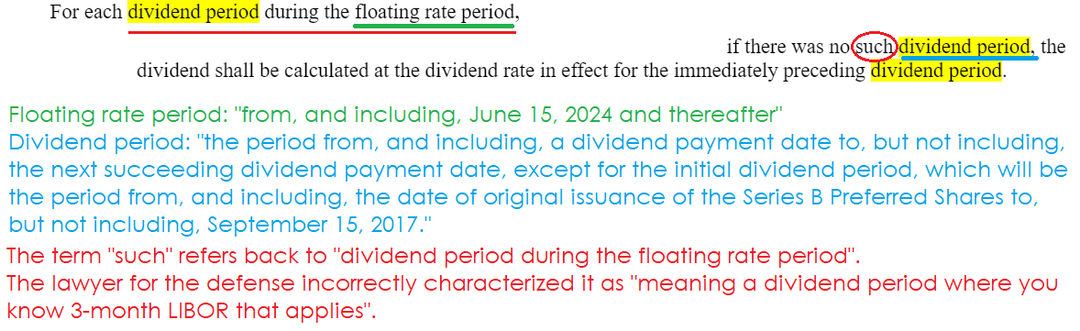
Note: My text may seem sloppy in that final quote in red. I’m quoting the lawyer verbatim. The phrase “you know” and the “that” in the quote appeared to just be verbal filler. However, I try to include the exact words when possible.
Was There Such a Dividend Period?
Based on a literal reading of the plain text in the document after applying the LIBOR Act, we get an interpretation that is very favorable for the plaintiff.
The only phrase that “such dividend period” could be referring to is “each dividend period during the floating rate period.”
Based on that interpretation, you simply have to ask if such a dividend period existed. It is important to remember that the term “floating rate period” was already defined, and the definition of the floating rate period was based on time.
-
A “dividend period” does not become a “floating rate period” because the dividend floats. That would be getting causation backwards.
-
There is nothing in the contract to support the idea that the dividend floating creates a floating rate period.
-
Instead, the contract clearly indicates that it is the floating rate period that causes the dividend float.
The Defense Strategy
Steven Farina dominated the Ninth Circuit matchup because Catherine did not attack the wording. The judges told her to. They were very clear. They didn’t like her angle on the case and wanted her to go after the wording of the contract.
How do I know that? It’s in the video. I am giving you my impression from watching the actual case. In my opinion, the judges were clear.
Steven Farina tried to define “such dividend period” as meaning “a dividend period where you know 3-month LIBOR that applies.”
Note: I’m aware the grammar is awkward. That’s the problem with quoting someone from their live performance.
There would’ve been a viable way to reach that conclusion before the LIBOR Act.
We can build into his strategy by looking at the final sentence in full:
If fewer than three New York, New York banks selected by us quote rates in the manner described above, the three-month LIBOR for the applicable dividend period will be the same as for the immediately preceding dividend period, or, if there was no such dividend period, the dividend shall be calculated at the dividend rate in effect for the immediately preceding dividend period.
If you read that entire sentence, then you could plausibly reach the idea:
That’s a poorly constructed sentence, but maybe they meant to say that if there was no dividend period based on LIBOR.
Steven Farina picked that route and went hard on it. He didn’t highlight that it was poorly constructed. Instead, he focused on creating the impression that the phrase was about whether there was a dividend period based on LIBOR rather than about the actual definitions that were written in the contract.
That is very different from whether there was a “dividend period during the floating rate period”.
Why That Interpretation Doesn’t Work
Read this part again:
SEC

Per the LIBOR Act, the pink part “shall be disregarded as if not included in the fallback provisions.” If you remove the part in pink, then there is no viable method in the English language to conclude that “such dividend period” means a dividend period where 3-month LIBOR applies. That interpretation could only be reached by keeping that clause.
However, PennyMac did not argue to keep that clause. They knew the clause was gone. Everyone knows the clause is gone. Rather than try to keep the doomed clause, PMT’s lawyer let the clause go while trying to fold it into the definition of “such dividend period.”
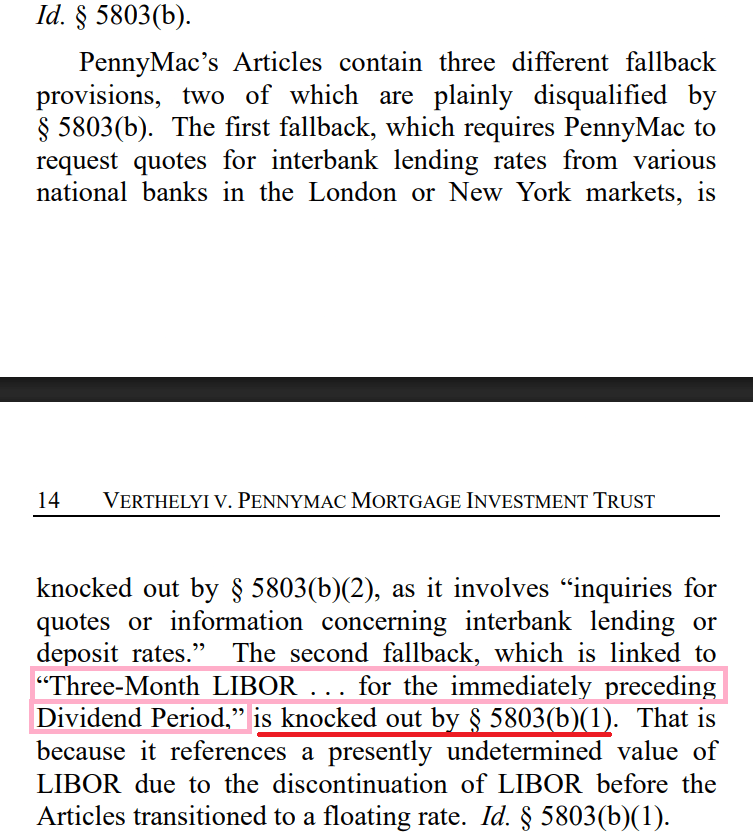
The Ninth Circuit explicitly stated that the clause was gone:
Ninth Circuit
Questions the Plaintiff Needs to Ask
I’m writing out the questions. She can put this on a sticky note and read it. She can put it in any document she’s going to file. She could even rehearse it. I hear rehearsing can help people avoid looking like that performance in the YouTube video.
Here are the points I would make:
-
Given that the Ninth Circuit court explicitly stated that the second fallback was knocked out by §5803(b)(1), how can the second fallback provide the definition for the term “such dividend period” in the third fallback?
-
The second fallback was either removed or it was not. Since the Ninth Circuit court already ruled that it was removed, why don’t we read the contract that actually remains?
-
That’s rhetorical. I’m going to read the text that remains because it is the contract. This case is about the contract, so we should all be clear about exactly which words remain in the contract.
-
“For each dividend period during the floating rate period, if there was no such dividend period, the dividend shall be calculated at the dividend rate in effect for the immediately preceding dividend period.”
-
Have there been any dividend periods during the floating rate period? Let me check my calendar. The first one started on June 15, 2024 and ended on September 14, 2024. We should start counting. That’s one dividend period. Oh, look at that, we only needed to reach one. To respect the court’s time, I won’t manually count out each of the subsequent dividend periods. They started on the 15th of June, September, December, and March. We know that because it is the contract.
Is It Over?
The case isn’t over.
The closing assessment of the Ninth Circuit court was:
Because this case came to us in an interlocutory posture, we remand to the district court so that the parties may advance any further arguments they might have regarding whether PennyMac’s application of the third fallback provision violates the LIBOR Act.
The Defense Strategy
If I were Steven Farina, I would want to argue that the Ninth Circuit court already established that our fallback was viable. Keep in mind, that is not what the Ninth Circuit court said! It’s close, but it isn’t quite accurate. Okay, it’s the opposite of accurate. It’s about as far from reality as if Return to Silent Hill won Best Picture.
Remember that the Ninth Circuit court very specifically ruled that a fixed rate is not inherently incapable of being a benchmark rate.
The Ninth Circuit court did not:
-
Rule on the rest of the case.
-
Rule on whether PMT was correct about the third fallback being activated.
-
Rule on whether PMT’s fallback constitutes a “clearly defined or practicable replacement benchmark rate”.
But for PMT to get this case closed in their favor, they desperately want to pretend those things happened.
The Ninth Circuit Conclusion
This is exactly how they judges finished their assessment:
Ninth Circuit
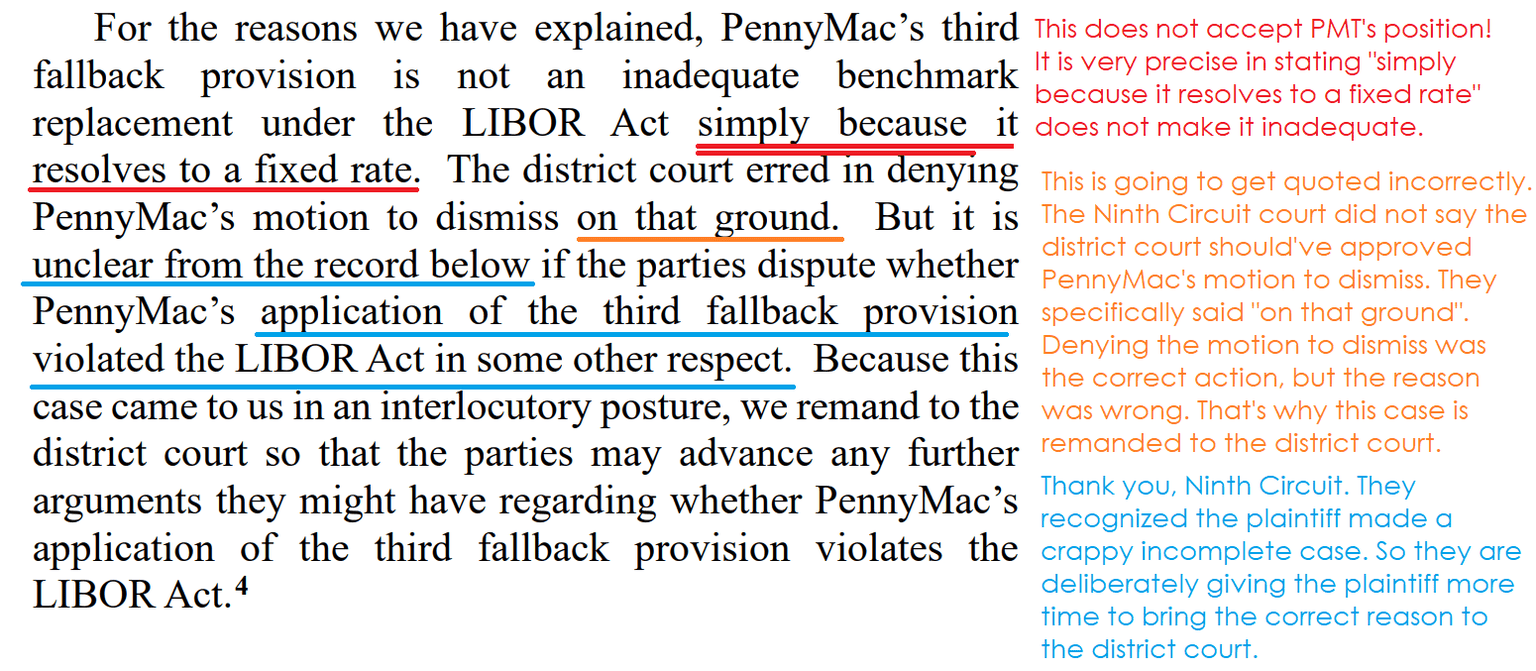
Some people are going to read that section and come to the wrong conclusion. But I think it’s pretty clear. They decided not to end this case prematurely. They could’ve gone substantially further in PennyMac’s favor. They didn’t do that.
It appears to me that the Ninth Circuit court handled this pretty well.
What more could they do? Send someone down to coach Catherine Pratsinakis live? They gave her quite a few hints from the bench.
Remembering What The Plaintiff Said
When I was writing to subscribers about the oral arguments initially, I quoted another analyst who said they had spoken to her after the case. An anonymous source, but not anonymous to me. I believe they are credible.
This is what they said:
I just talked to the attorney yesterday. She said two of the judges said they were inclined to give them a narrow victory and the third judge didn’t say anything one way or the other.
At the time, I wrote:
I have very little confidence in her ability to read the room.
Clearly, her read of the room was roughly on par with a pair of frat boys showing up to a convent for singles’ night.
Conclusion
This case is still up in the air.
The Ninth Circuit court ruled very narrowly to create precedent that a fixed rate could be viable because it is a dividend rate and the LIBOR Act allows for a benchmark rate, interest rate, or dividend rate. That’s not a surprise. We knew those things because we read the law.
The question is whether the plaintiff’s lawyer can dust herself off and present the case that gives shareholders the strongest chance of winning. It shouldn’t be too hard. She can just print this article off and read part of it in court. If she does that, I would prefer she start with the part about the piñata.
Disclosure: I own shares of PMT-A and PMT-B. I’ve invested in them from time to time due to valuations and my research on this case. Currently I am long.

Warsh signals Fed may need to hike rates if above-target inflation persists

Agnico Eagle subsidiary invests C$1M in Canada Nickel
Business
Dow Rises Above 53,600 as Investors Await Fed Chair Kevin Warsh’s Closely Watched Jackson Hole Speech

NEW YORK — U.S. stocks were mixed early Friday as Wall Street turned its attention to the Federal Reserve’s Jackson Hole Symposium, where Fed Chair Kevin Warsh is scheduled to speak later in the day on the central bank’s economic outlook and strategy for bringing inflation back to target.
The Dow Jones Industrial Average traded up about 0.15% to 0.3% in early trading, changing hands near 53,650, while the S&P 500 edged modestly higher. The Nasdaq Composite slipped roughly 0.1%, pulling back after a tech- and earnings-driven rally the day before.
Friday’s session followed a strong close on Thursday, when the Dow gained 105.56 points, or 0.2%, to finish at 53,569.44. The S&P 500 advanced 0.72% to 7,730.99, and the Nasdaq jumped 1.57% to 26,541.35 in its best day since Aug. 4, powered largely by Nvidia’s latest earnings report. Nvidia shares surged 8.7% after the chipmaker beat analyst expectations and issued a bullish revenue forecast, a result that helped rebuild investor confidence in the broader artificial intelligence trade.
That confidence carried into Friday’s premarket trading, though markets were largely holding steady as investors waited for clarity from Warsh. His remarks are being closely scrutinized after his stance at the Fed’s last policy meeting left investors uncertain about the central bank’s near-term rate path.
Treasury yields were little changed heading into the speech. The 10-year and 30-year yields remained close to the multiyear highs touched earlier in August, as concerns about inflation and the federal government’s debt load continued to weigh on the bond market. The 10-year yield had fallen to 4.63% earlier in the week, offering some relief to interest-rate-sensitive sectors after climbing sharply in recent weeks.
Beyond the Fed speech, traders were also digesting a notable divergence in speculative assets. Bitcoin and Cathie Wood’s Ark Innovation ETF have each risen more than 20% in August, a pairing that has occurred only four other times since the fund’s 2014 launch. The rally has drawn comparisons to the market environment of late 2020 and early 2021, when near-zero interest rates and pandemic-era stimulus fueled speculative enthusiasm across meme stocks, special-purpose acquisition companies and cryptocurrencies.
The broader market backdrop this week has been shaped by a mix of technology strength and lingering macroeconomic caution. Earlier in the week, on Monday, the S&P 500 fell 0.28% to 7,652.86 and the Nasdaq lost 0.76%, dragged down by weakness in semiconductor stocks. Micron Technology dropped 5.8%, while Advanced Micro Devices and Broadcom each fell more than 2%. The Dow bucked that trend Monday, adding 140.15 points, or 0.26%, to close at 53,417.16, aided by a decline in Treasury yields after reports that the Treasury Department could tap its General Account to help fund a buyback operation.
Gold prices have also been in focus this month, climbing toward $4,637 an ounce on Monday, their highest level since mid-May, though still below the roughly $5,600 record touched earlier this year. The metal’s rebound has come amid broader dollar weakness and continued investor unease over the scale of U.S. government debt.
Oil prices, by contrast, have softened. West Texas Intermediate crude traded near $81 a barrel earlier in the week, pressured lower by reports that the United States plans to return diplomatic personnel to parts of the Middle East, a development that appeared to ease some of the geopolitical risk premium built into energy markets.
On the economic data front, labor market indicators have shown modest improvement. According to ADP, private employers added an average of 11,750 jobs per week over the four weeks ending Aug. 8, up from 9,500 jobs per week in the prior reading, a sign that hiring activity may be firming even as the broader economy navigates elevated borrowing costs.
Investors are also looking ahead to the University of Michigan’s final August consumer sentiment index, due out Friday, along with a quieter stretch of earnings and economic releases heading into next week. Aside from a smaller August ISM Manufacturing PMI report and July JOLTS data due Sept. 1, market attention is expected to remain fixed on the Fed’s policy signals coming out of Jackson Hole.
With equity markets having posted a solid run through much of 2026, some strategists have cautioned that August and September have historically been seasonally weaker months for stocks, and that a period of near-term consolidation would not be unusual even as the broader outlook for equities over fixed income remains favorable, supported by strong corporate profit growth and resilient economic activity.
Business
Judge Rules Pentagon Illegally Punished AI Firm Anthropic in Retaliation for Criticizing the Government

SAN FRANCISCO — A federal judge late Thursday permanently barred the Trump administration from enforcing a set of measures aimed at cutting artificial intelligence company Anthropic off from the federal government, ruling that officials had unconstitutionally punished the firm for protected speech.
U.S. District Judge Rita Lin of the Northern District of California issued the 59-page ruling capping a monthslong legal fight between Anthropic and the Pentagon over the company’s AI model, Claude, which is used across parts of the U.S. military. Lin found that the Defense Department’s actions against the company violated both the First Amendment and the Fifth Amendment’s due process protections.
The dispute traces back to February, when the Pentagon and Anthropic clashed over how far the military could go in using Claude. Anthropic had sought to keep in place internal safeguards preventing its model from being used for mass surveillance or fully autonomous weapons systems, while military officials argued they should be free to use the technology for any lawful purpose. When the two sides failed to reach an agreement, President Trump ordered federal agencies to stop using Claude, and Defense Secretary Pete Hegseth designated Anthropic a supply chain risk, a rarely used label that effectively sought to block private defense contractors from using the company’s technology for military-related work.
In her ruling, Lin wrote that the government’s actions “constituted unlawful retaliation in violation of the First Amendment” and found that Anthropic “was denied the pre-deprivation process required under the Fifth Amendment.” She was sharply critical of the administration’s stated justification for its actions, writing that the government’s contemporaneous statements and conduct showed the moves were “based on a desire to make a public example out of Anthropic for its ‘arrogance’ in criticizing the government, not based on any articulable basis to believe that Anthropic would actually sabotage its model.”
Lin also pointed to a contradiction in the government’s own conduct, noting that other federal agencies continued working with and meeting with Anthropic even after the Pentagon’s supply chain risk designation took effect. “None of that is consistent with a genuine fear that Anthropic is a saboteur who would poison its software to harm national security,” she wrote. She further wrote that “the empty invocation of national security is not a blank check to punish and retaliate against government critics.”
The judge was careful to note that her order does not require the government to do business with Anthropic or prevent it from choosing a different AI vendor, “so long as those actions are consistent with applicable regulations, statutes, and constitutional provisions.”
Lin’s ruling followed a hearing in late July at which she had already signaled skepticism toward the government’s position, telling attorneys the administration’s stance was “really troubling” to her and appeared “at odds” with the First Amendment. At that same hearing, Justice Department lawyers argued that AI models are “so staggeringly enormous and opaque” that the Pentagon could not evaluate Claude the same way it would assess a piece of physical hardware.
Anthropic sued the Pentagon in March, calling the supply chain risk designation part of an “unlawful campaign of retaliation” tied to its refusal to allow unrestricted military use of its technology. Earlier in the litigation, Lin had already temporarily blocked the Pentagon from enforcing the supply chain risk label and had separately blocked enforcement of Trump’s directive ordering federal agencies to stop using Claude.
An Anthropic spokesperson welcomed Thursday’s ruling in a statement, saying the company remains “focused on working productively with the government to harness AI for our national security so all Americans benefit from this technology.” The White House did not immediately respond to a request for comment on the ruling.
The Pentagon’s designation of Anthropic marked the first time the U.S. government had publicly applied the supply chain risk label to an American company under the statute, which was originally intended to protect military systems from foreign sabotage. Lin also noted an apparent contradiction between the blacklisting and an earlier threat by Hegseth to invoke the Defense Production Act against Anthropic, a move that Lin said implied the administration itself viewed the company as “essential to national security rather than a threat to it.”
The government is expected to appeal Thursday’s decision. A second, narrower lawsuit filed by Anthropic over a different rule the Pentagon has used to try to justify labeling the company a supply chain risk remains pending before the federal appeals court in Washington, D.C. It remains unclear whether the administration will wait for a ruling in that case before challenging Lin’s decision.
Thursday’s ruling represents a significant legal victory for Anthropic as the company continues to expand its commercial and government business. The decision could reopen paths for federal agencies and defense contractors to resume using Claude, potentially restoring business opportunities that had been cut off since the designation took effect earlier this year.
Tree Island Steel names Brian Liu as new COO
Business
Apple Confirms September 9 iPhone Launch Event as Tim Cook Prepares to Hand CEO Reins to John Ternus

CUPERTINO, Calif. — Apple has confirmed it will hold its annual fall product event on Wednesday, Sept. 9, kicking off a stretch of major changes for the company that includes a new lineup of iPhones, a fresh round of desktop computers and, for the first time in more than a decade, a new chief executive.
The company sent invitations to media Wednesday featuring a glowing Apple logo set against a blue haze and the tagline “Surprise and shine.” The event will begin at 10 a.m. Pacific time at the Steve Jobs Theater on Apple’s Cupertino campus and will be livestreamed on Apple’s website, the Apple TV app and YouTube.
This year’s gathering carries added significance because it will be the first major product launch overseen by incoming chief executive John Ternus, who takes over from Tim Cook on Sept. 1. Ternus, Apple’s longtime senior vice president of hardware engineering, is widely expected to lead the keynote.
Apple announced the leadership change in April, saying Cook would become executive chairman of the company’s board of directors while Ternus, a 25-year Apple veteran, would step into the chief executive role. The transition was approved unanimously by Apple’s board following what the company described as a long-term succession planning process.
“It has been the greatest privilege of my life to be the CEO of Apple and to have been trusted to lead such an extraordinary company,” Cook said in Apple’s announcement of the transition. “I love Apple with all of my being, and I am so grateful to have had the opportunity to work with a team of such ingenious, innovative, creative, and deeply caring people.”
Cook also praised his successor, calling Ternus a leader with “the mind of an engineer, the soul of an innovator, and the heart to lead with integrity and with honor.” Ternus will also join Apple’s board of directors effective Sept. 1, while board chairman Arthur Levinson transitions to lead independent director.
Cook’s departure closes out nearly 15 years at Apple’s helm. He succeeded company co-founder Steve Jobs in August 2011 and went on to oversee the launch of the Apple Watch, AirPods, Apple Pay and Apple Vision Pro, along with the Mac’s multiyear transition away from Intel processors to Apple’s own silicon. As executive chairman, Cook is expected to continue representing Apple in dealings with policymakers around the world.
At the Sept. 9 event, Apple is expected to introduce its first foldable iPhone alongside updated iPhone 18 Pro and iPhone 18 Pro Max models. Unlike in past years, Apple does not plan to introduce a standard iPhone 18 model at the September event; that version is expected to arrive in spring 2027 instead, according to widely circulated supply-chain reports. The new Pro models are expected to run on Apple’s A20 Pro chip, built on a 2-nanometer manufacturing process the company says will improve both speed and power efficiency compared with the current generation.
Industry analysts tracking Apple’s supply chain have said pricing across the new iPhone lineup could rise compared with last year’s models, citing an ongoing global shortage of memory chips that has affected component costs across the technology industry.
The September event follows a surprise announcement this week that Apple had already begun refreshing its Mac desktop lineup, releasing new Mac mini and Mac Studio models days before the iPhone showcase. In a press release, Apple said the new Mac Studio, powered by its M5 Max and newly introduced M5 Ultra chips, delivers up to 4.3 times faster on-device artificial intelligence performance than the previous generation, along with faster graphics, additional storage speed and up to 512 gigabytes of unified memory in its highest-end configuration.
The redesigned Mac mini, meanwhile, is now available with either Apple’s new M6 chip or the M5 Pro chip introduced earlier this year. Apple said the M6 chip includes a 12-core CPU and 12-core GPU, along with the company’s first dual Neural Engine configuration, intended to boost on-device AI processing.
Pricing on both machines increased alongside the hardware upgrades. The Mac mini now starts at 899 dollars, and the Mac Studio starts at 2,499 dollars, with the high-end M5 Ultra configuration priced at 5,499 dollars. Apple has attributed recent price increases across its Mac lineup to rising component costs tied to global demand for memory chips used in AI data centers. Most of the new Mac configurations are set to ship Sept. 22, with the highest-memory Mac Studio option arriving in late October.
Apple has not detailed what else will appear on stage at the Sept. 9 event, though the company traditionally uses its September keynote to introduce new iPhone and Apple Watch models alongside updates to its software platforms. The event marks a rare instance in recent years of Apple launching new desktop hardware just ahead of its iPhone event rather than folding all announcements into a single keynote.
Apple’s stock has traded near record levels in recent months as investors weigh the company’s plans to expand artificial intelligence features across its devices, alongside broader industry pressure from competitors racing to build out generative AI tools. The Sept. 9 event will be closely watched both for its product announcements and as the public debut of Ternus in Apple’s most high-profile executive role.
Apple did not respond to requests for additional comment ahead of the event.

Pinterest stock falls as CFO Julia Donnelly resigns
The 7 Most Powerful Batman Characters, Ranked

BREAKING!!!! JD VANCE: XRP WILL HELP PAY US DEBT?!?!!!!!

Dolly Parton’s 9 To 5, Jolene And Islands In The Stream Return To UK Chart





-

 Crypto World3 days ago
SpaceX stock could rise 75% to $240, JPMorgan says
-

 Crypto World22 hours ago
Bitcoin’s 22% rally now needs real demand to outlast Treasury liquidity boost
-

 Business6 days ago
Musk’s Tesla, SpaceX Confirm $16.8 Billion ‘Terafab’ Chip Plant as World’s Largest Building in Texas
-

 Crypto World7 days ago
anatomy of crypto’s biggest liquidation event since 2021
-

 Crypto World4 days ago
A $30 Billion AI Fund Implodes, Now the SEC Is Investigating Wall Street’s Role
-

 Crypto World2 days ago
Warsh Jackson Hole keynote puts financial innovation first
-

 Politics6 days ago
6 months on, Irish renters crushed by effects of government housing bill
-

 Crypto World3 days ago
Did Trump Just Move SpaceX Stock With One Truth Social Post?
-

 Business21 hours ago
Salesforce Stock Soars 19% as Blowout Earnings and Agentforce AI Growth Silence Software Skeptics
-

 Business5 days ago
Mystery AI Model ‘Ox Alpha’ Draws Developers With Free Access as Chinese Lab Origins Remain Debated
-
 NewsBeat7 days ago
The ‘Lucky Dip Gang’ causing carnage for clicks: After five thugs were killed speeding in the wrong direction on a motorway, GUY ADAMS investigates a sick new trend… and why police aren’t even allowed to pursue them
-

 Business2 days ago
Walmart takes aim at younger shoppers with new fashion brand
-
 Crypto World7 days ago
Nvidia Stock Suffers Longest Losing Streak Since 2022: Will Q2 Earnings End It?
-

 Business4 days ago
Moderna CEO warns China is pouring state money into mRNA technology
-

 Business7 days ago
Will Tesla Stock Be Higher or Lower a Year From Now? Here’s What Wall Street Analysts Are Saying
-

 Business4 days ago
NVIDIA Stock Drops Nearly 2 Percent to $210 on Seventh Losing Day Ahead of Critical AI Earnings
-
 NewsBeat2 days ago
Lindsay Clancy jury braces for closing arguments as judge tells court: ‘You’ve heard all the evidence’ – Live updates
-
 Crypto World5 days ago
$92 Billion Nvidia Earnings Could Make or Break the AI Trade
-

 Tech7 days ago
Unitree’s New Superman Robot Claims to Outjump and Outrun Every Human, Usain Bolt Included
-

 Sports6 days ago
Deshaun Watson fires back at Browns fans after being booed: ‘It’s a disrespectful thing’
You must be logged in to post a comment Login