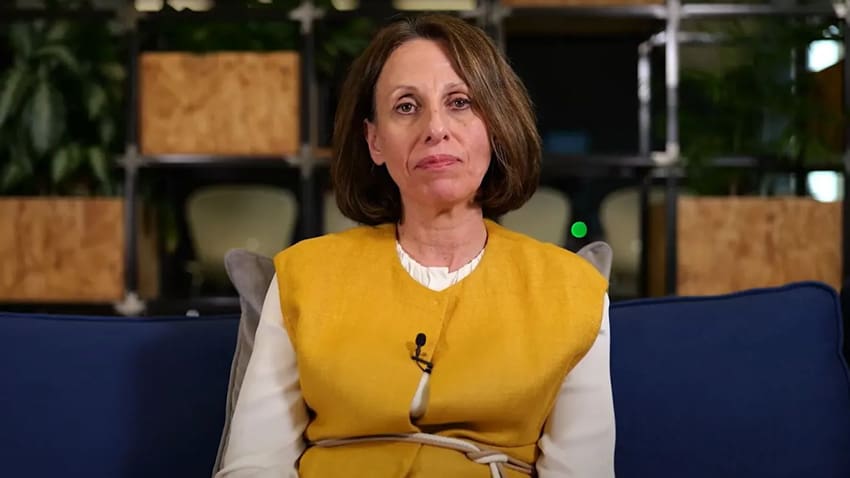
Co-op Group has confirmed that chief executive Shirine Khoury-Haq will step down, following mounting pressure over workplace culture concerns and a difficult year marked by losses and a damaging cyberattack.
Khoury-Haq, who has led the organisation since 2022 and spent seven years with the business, will be replaced on an interim basis by Kate Allum while the board begins the search for a permanent successor.
Her departure comes after reports of a “toxic culture” within senior leadership, alongside claims of falling morale, high-profile departures and operational challenges across the group.
The Co-op revealed that it swung to an underlying pre-tax loss of £126 million in its latest financial year, compared with a £45 million profit the previous year. Revenues also declined by 2.3 per cent to £11 billion, reflecting disruption to trading and changing consumer behaviour.
The group said the results were heavily shaped by its response to a major cyberattack, which forced it to restrict systems in an effort to contain the threat. While necessary, the measures had a significant commercial impact.
Advertisement
The company estimates the attack reduced revenues by £285 million and cut profitability by £107 million, including £86 million in lost margin and £21 million in additional costs.
The food division, the largest part of the business, was particularly affected, with sales falling 2 per cent to £7.25 billion. The disruption led to empty shelves in stores and altered shopping patterns, which continued to weigh on performance even after systems were restored.
Market share also slipped, falling to 5 per cent over a 12-week period, down from 5.3 per cent a year earlier, as the group lost ground to discounters and larger supermarket rivals.
Alongside the financial pressures, the organisation has faced scrutiny over its internal culture. A letter sent to board members, reportedly from senior staff, described an environment of “fear and alienation”, raising questions about leadership and decision-making at the top of the business.
Advertisement
The Co-op said it did not recognise those criticisms as representative of the wider organisation, emphasising its co-operative structure and commitment to inclusive decision-making. However, the reports have added to the challenges facing the group during a period of significant change.
Khoury-Haq said the timing of her departure reflects the next phase of the company’s transformation strategy.
“It has been an honour to lead our Co-op,” she said, adding that the business is now positioned to move forward with a programme of stabilisation and long-term reform that will extend beyond her planned tenure.
Her strategy had focused on rebuilding the group’s financial position, reducing debt and modernising its IT systems — issues that have been central to the Co-op’s operational challenges in recent years.
Advertisement
The company said she had overseen a significant turnaround between 2022 and 2024, including a 95 per cent reduction in debt and a 30 per cent increase in profits over that period, before the latest setbacks.
The Co-op, which employs around 54,000 people and operates more than 2,300 food stores and 800 funeral homes, continues to face intense competition across its core markets.
Discounters such as Aldi and Lidl have expanded aggressively, while established rivals including Tesco and Sainsbury’s have strengthened their positions, leaving the Co-op under pressure to differentiate its offering.
At the same time, the wider economic environment remains challenging, with inflation, shifting consumer behaviour and geopolitical uncertainty affecting demand.
Advertisement
Khoury-Haq acknowledged these headwinds, warning that “trading conditions remain difficult” and that external pressures are likely to persist.
The board now faces the task of appointing a new chief executive capable of navigating the next stage of the group’s recovery and transformation.
Group chair Debbie White thanked Khoury-Haq for her leadership during a turbulent period, particularly in guiding the organisation through the cyberattack and broader restructuring efforts.
For the Co-op, the leadership transition comes at a critical juncture. Restoring profitability, rebuilding trust internally and externally, and adapting to a rapidly evolving retail landscape will be central to its future.
Advertisement
As the organisation seeks to stabilise after a challenging year, the next phase of its strategy will be closely watched by both the market and its millions of members.
Amy Ingham
Amy is a newly qualified journalist specialising in business journalism at Business Matters with responsibility for news content for what is now the UK’s largest print and online source of current business news.
CANBERRA, Australia — Lung cancer is projected to remain Australia’s deadliest cancer in 2026, claiming an estimated 9,000 lives as part of more than 54,000 total cancer deaths expected nationwide, according to the latest data from Cancer Australia and the Australian Institute of Health and Welfare.
Smoking is the leading cause of lung cancer
While age-standardised mortality rates continue a long-term decline thanks to better prevention, screening and treatments, the absolute number of deaths is rising because of population growth and ageing, officials said. The 2025 estimates — the most recent detailed projections available — show 53,545 cancer deaths, a figure expected to edge higher into 2026.
Cancer Australia’s October 2025 statistics and AIHW’s Cancer Data in Australia report rank the top 10 cancers by expected deaths. Here they are, based on 2025 figures that officials say will closely track into 2026:
Lung cancer: 8,994 deaths
Colorectal (bowel) cancer: 5,235 deaths
Pancreatic cancer: 4,039 deaths
Prostate cancer: 3,975 deaths
Breast cancer: 3,353 deaths
Liver cancer: 2,091 deaths
Non-Hodgkin lymphoma
Cancer of unknown primary site
Brain cancer
Melanoma of the skin
These 10 account for the vast majority of cancer fatalities. Upper gastrointestinal cancers as a group — including pancreatic, liver, oesophageal, stomach and biliary — narrowly edged lung cancer in raw 2024 ABS provisional data (9,301 vs. 9,119 deaths), but official 2025 projections and early 2026 indicators keep lung cancer at No. 1.
Lung cancer has held the grim top spot for decades, though smoking rates have fallen sharply. It kills more Australians than any other cancer because many cases are diagnosed late, when survival is poor. In 2025, it represented about 17 per cent of all cancer deaths. Targeted therapies and immunotherapy have lifted five-year survival for some subtypes, but tobacco remains the leading preventable cause. Health authorities urge continued anti-smoking campaigns and low-dose CT screening for high-risk groups.
Colorectal cancer ranks second, with more than 5,200 projected deaths. National bowel screening has improved early detection, yet participation lags. Experts credit the program with driving down mortality rates, but rising cases in people under 50 are worrying oncologists. “We’re seeing concerning increases in early-onset colorectal cancer,” one AIHW analysis noted in 2025 data releases.
Advertisement
Pancreatic cancer claims nearly 4,040 lives annually and is notorious for its dismal prognosis — five-year survival below 10 per cent. Late symptoms and lack of routine screening keep it lethal. It forms a major part of the upper GI surge that some analysts flagged in 2024 ABS figures. Research into earlier biomarkers is underway but not yet standard.
Prostate cancer kills about 3,975 men each year, though mortality rates have dropped dramatically from 63 deaths per 100,000 males in the mid-1990s to 33 in 2025. PSA testing and improved treatments get much of the credit, but over-diagnosis remains a debate.
Breast cancer claims 3,353 lives, mostly women. Five-year survival now exceeds 90 per cent for many, up from earlier decades, thanks to mammographic screening and targeted drugs like trastuzumab. Still, it remains a leading cause among women and underscores the need for continued awareness.
Liver cancer (2,091 deaths) has risen with hepatitis infections, alcohol use and obesity-related fatty liver disease. Vaccination against hepatitis B and treatment for hepatitis C have slowed growth, but rates remain elevated in some migrant communities.
Advertisement
Lower on the list but still significant are Non-Hodgkin lymphoma, cancer of unknown primary (where the original site cannot be found), brain cancer and melanoma. Melanoma, once a major killer, has seen mortality fall with public sun-safety campaigns and immunotherapy breakthroughs that have transformed advanced cases.
Overall, cancer accounts for roughly three in every 10 deaths in Australia. Yet the story is not all grim. The age-standardised mortality rate has fallen from 257 deaths per 100,000 people in 2000 to an estimated 194 in 2025 — a 24 per cent drop. For people in their 30s and 40s, rates have declined even more sharply.
Survival gains are real. Five-year relative survival for all cancers combined has improved steadily. Prostate cancer survival jumped from around 60 per cent in earlier decades to 96 per cent. Breast cancer rates have followed a similar path. Even lung cancer outcomes are inching upward for never-smokers and those with actionable mutations.
But challenges persist. Absolute death numbers are climbing because Australians are living longer, and the over-65 population — where cancer risk is highest — is growing fastest. Disparities remain: regional and remote areas, Aboriginal and Torres Strait Islander communities, and lower socioeconomic groups face higher mortality.
Advertisement
Prevention offers the biggest lever. Tobacco control, HPV vaccination, hepatitis immunisation, sun protection, healthy weight, limited alcohol and participation in screening programs (bowel, breast, cervical) could avert thousands of deaths. Emerging research on early-onset cancers in younger adults is prompting calls for updated guidelines.
Cancer Australia CEO Dorothy Keefe has highlighted the dual trends: “Outcomes are improving overall, but the sheer number of cases and deaths demands sustained investment in research, equitable access to care and public education.”
As 2026 unfolds, health officials will release more granular 2025 actuals and 2026 projections. For now, the message is clear: while the 10 listed cancers will dominate mortality statistics, many deaths are preventable or treatable if caught early.
Australians are encouraged to talk to their GPs about screening eligibility, adopt healthier lifestyles and stay alert to symptoms. With continued progress in science and public health, the downward trend in rates could accelerate — even as the population ages.
Compass International chairman and CEO Robert Reffkin discusses home inventory and affordability as mortgage rates creep higher on ‘The Claman Countdown.’
Mortgage rates spiked this week as the conflict in Iran continues to weigh on markets, mortgage buyer Freddie Mac said Thursday.
Freddie Mac’s latest Primary Mortgage Market Survey, released Thursday, showed the average rate on the benchmark 30-year fixed mortgage rose to 6.38% from last week’s reading of 6.22%.
Advertisement
The average rate on a 30-year loan was 6.65% a year ago.
The average rate on the 30-year fixed mortgage jumped to 6.38% this week. (Daniel Acker/Bloomberg via Getty Images)
“The housing market continues to show gradual improvements compared to a year ago amid recent rate volatility,” said Sam Khater, Freddie Mac’s chief economist. “Purchase and refinance applications are up year-over-year.”
The conflict in the Middle East is contributing to the spike in mortgage rates. (Elijah Nouvelage/Bloomberg via Getty Images)
Mortgage rates are affected by several factors, including the Federal Reserve and geopolitics. Though mortgage rates are not directly affected by the Fed’s interest rate decisions, they closely track the 10-year Treasury yield. The 10-year yield hovered around 4.38% as of Thursday afternoon.
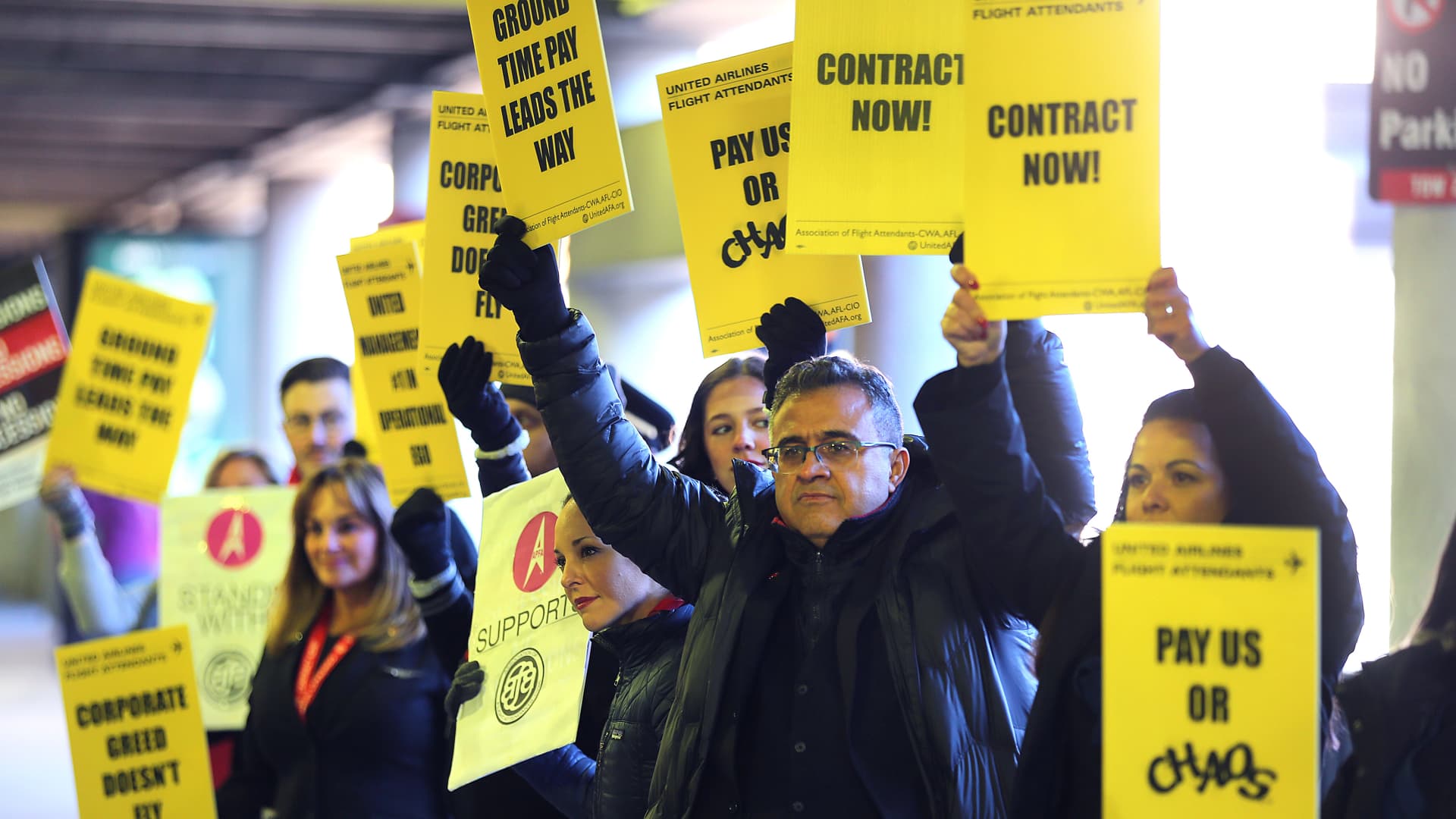
United Airline flight attendants picketed outside Terminal B at Logan Airport, seeking a new contract.
John Tlumacki | Boston Globe | Getty Images
United Airlines and its flight attendant union have reached a tentative labor deal that will include their first raises in roughly six years.
Advertisement
If ratified by flight attendants, it would make United the last of the major carriers to secure a labor deal with cabin crew members since the Covid-19 pandemic ended.
United said the agreement will include immediate raises and top pay of $100 an hour at the end of the contract, as well as pay for flight attendants during boarding and “a signing bonus for every flight attendant worth a total of $740 million.”
The Association of Flight Attendants-CWA, the flight attendants’ union, didn’t provide specific details about the deal but said that in addition to higher base pay, it includes additional compensation for flight disruptions and new restrictions on overnight flight assignments.
The labor deal comes as United is planning an aggressive expansion of its higher-touch premium cabins, with new seats featuring elevated dining options and seats that convert into beds.
Advertisement
United flight attendants last July rejected a previous labor deal that would have included immediate, 26% raises.
SYDNEY — Artificial intelligence engineers and aged care workers are spearheading Australia’s fastest-growing occupations in 2026, as the nation’s labour market grapples with technological disruption, an ageing population and infrastructure demands, according to the latest projections from Jobs and Skills Australia and industry reports.
BoliviaInteligente / Unsplash
Employment across Australia is forecast to expand by hundreds of thousands of positions through 2026, with health care and social assistance, professional services and education driving much of the growth. While overall job gains have moderated from pandemic-era peaks, specific roles in AI, care services and engineering are seeing explosive demand.
Jobs and Skills Australia’s employment projections highlight that four service industries — health care and social assistance, professional scientific and technical services, education and training, and accommodation and food services — will account for nearly two-thirds of new jobs by late 2026. Professionals and community/personal service workers are expected to deliver about 60 per cent of total employment growth.
Here are the 10 most rapidly rising jobs for 2026, compiled from recent data by LinkedIn’s Jobs on the Rise list, Jobs and Skills Australia forecasts, Hays, Morgan McKinley and SEEK analyses. Rankings blend percentage growth, absolute job increases and hiring trends:
AI Engineer LinkedIn named AI Engineer the No. 1 fastest-growing job for 2026, with massive surges in postings as businesses integrate artificial intelligence for data analysis, automation and predictions. Roles often overlap with machine learning engineering. AI literacy has become the single most in-demand skill across all positions, with eight in 10 global leaders preferring candidates comfortable with AI tools. Salaries frequently exceed $150,000.
Aged and Disabled Carer Projected to add nearly 75,000 positions with 28 per cent growth over five years to 2026, this role tops absolute increases in community and personal service occupations. Australia’s ageing population and National Disability Insurance Scheme expansion fuel relentless demand. Many positions require Certificate III or IV qualifications.
Registered Nurse Health care remains the fastest-growing industry overall. Registered nurses, especially in aged care, mental health and acute settings, are projected to grow by more than 40,000 roles. Shortages could reach tens of thousands by 2035 without action. Average salaries range from $85,000 to $120,000, with strong migration pathways.
Software and Applications Programmer / Software Engineer Digital transformation continues unabated. Jobs and Skills Australia forecasts strong growth for software programmers, with related ICT roles like database and systems administrators plus cybersecurity specialists also surging. Tech shortages persist despite global headwinds.
Cyber Security Specialist As businesses and government face rising threats, cyber roles rank highly on Hays’ in-demand lists. Demand spans infrastructure, procurement and technology security, with salaries often topping $140,000 for experienced professionals.
Data Engineer Morgan McKinley’s 2026 outlook placed data engineers at the top of in-demand tech roles, with salaries between $110,000 and $190,000. They build the data pipelines powering AI and analytics initiatives across industries.
Mechanical Engineer / Power System Engineer Engineering disciplines feature prominently on LinkedIn’s fastest-growing list. Infrastructure projects, renewable energy transitions and manufacturing needs boost demand for mechanical, civil and power systems engineers.
Disability Support Worker Closely tied to aged care growth, these roles benefit from NDIS rollout and community care shifts. Community and personal service occupations as a group are projected to add nearly 189,000 positions.
Project Manager (Senior) Large-scale infrastructure, construction and tech implementations drive demand for experienced project managers, particularly those handling $5 million to $10 million projects. Salaries often reach $160,000–$200,000.
Mental Health Support Worker / Psychotherapist Rising awareness and investment in mental health services have lifted demand for support workers and therapists. Health care and social assistance growth includes expanded community mental health roles.
Other notable mentions from 2026 reports include Chief Risk Officer, Director of Artificial Intelligence, sustainability consultants and electric vehicle technicians — reflecting dual pressures of digital innovation and the net-zero transition.
Healthcare Dominates Volume Growth Health Care and Social Assistance is forecast to add more than 300,000 jobs in the coming years, far outpacing other sectors. An ageing population, chronic disease management and post-pandemic care backlogs underpin this trend. Registered nurses and carers alone could fill tens of thousands of vacancies.
Advertisement
Tech and AI Accelerate AI-related roles have transitioned from experimental to mainstream. Organisations are hiring not just engineers but directors of AI and organisational development managers to embed the technology responsibly. Cybersecurity and data specialists complement this shift, as businesses protect and leverage vast datasets.
Trades and Infrastructure Hold Steady Construction, renewable energy and housing projects sustain demand for electricians, civil engineers and related trades. Government infrastructure spending and the energy transition create opportunities in power systems, solar and battery technologies.
Challenges persist despite the opportunities. Employers report ongoing skills shortages in regional areas, where many high-growth roles are located. Wage pressures, training pipelines and migration settings will influence whether supply meets demand. Unemployment hovered around 4.1–4.3 per cent in early 2026, with participation rates near record highs.
Jobs and Skills Australia notes that higher-skill occupations — those typically requiring bachelor degrees or above — will account for a large share of growth, though certificate-level roles in care and trades also expand rapidly. Emerging positions in green skills, such as sustainability consultants and energy engineers, are gaining traction but remain smaller in volume.
Advertisement
Education and training providers are adapting. Universities and vocational institutions report increased enrolments in nursing, IT and engineering courses. Apprenticeships in electrical and construction trades continue to attract interest amid strong pay and job security.
For job seekers, the message is clear: skills in AI, data, care delivery and engineering offer the best prospects. Upskilling in digital tools, even for non-tech roles, is increasingly essential. “AI literacy is now table stakes,” one LinkedIn analysis noted.
Regional disparities matter. Metropolitan areas lead in tech and professional services, while aged care and disability support needs are acute everywhere, including remote communities. Aboriginal and Torres Strait Islander workforce participation initiatives aim to tap underrepresented talent pools.
Economists caution that global uncertainties, interest rates and productivity trends could temper overall employment growth to around 0.8 per cent in 2026. Yet structural drivers — demographics, technology adoption and the clean energy shift — provide resilience in the highlighted occupations.
Advertisement
As Australia navigates 2026, these 10 rising jobs illustrate a workforce in transition: caring for an older population while building the digital and sustainable economy of the future. Workers with relevant qualifications, flexibility and a willingness to upskill stand to benefit most.
Government, industry and educators will need coordinated efforts to address shortages, expand training and ensure equitable access to these opportunities. For many Australians and skilled migrants, 2026 could mark the start of rewarding careers in fields that are not just growing — but reshaping the nation.
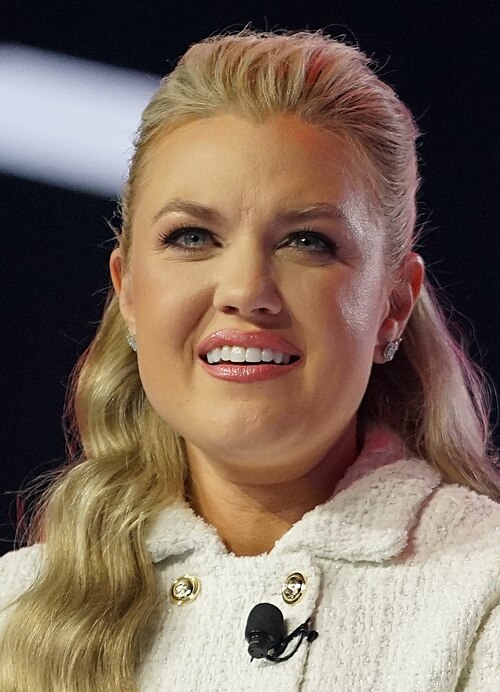
Erika Kirk, the widow of slain conservative activist Charlie Kirk and current CEO and chairwoman of Turning Point USA, has sent a fresh cease-and-desist letter accusing an online activist of defamation, escalating a public feud over baseless claims linking her to her husband’s assassination and sex trafficking allegations tied to Jeffrey Epstein.
Erika Kirk
The letter, dated March 18 and signed by attorney Paul Edgard Harold of SouthBank Legal, targets Collin Scott Campbell, the Maryland-based figure behind the “Project Constitution” brand. It demands he stop spreading statements alleging Kirk’s involvement in Charlie Kirk’s September 2025 murder and other unsubstantiated claims.
Kirk, 37, assumed leadership of the influential conservative youth organization shortly after her husband’s assassination at a Turning Point USA event on the campus of Utah Valley University. The board voted unanimously to appoint her as chair and CEO, a role she has used to vow that the group’s mission would grow “stronger, bolder, louder and greater than ever.”
In the months since, Kirk has navigated grief while stepping into the national spotlight. She has spoken at her husband’s memorial, where she publicly forgave the shooter, citing her Christian faith. She has hosted events, appeared on major media outlets and continued Turning Point USA’s campus organizing, AmericaFest conference and podcast efforts.
President Donald Trump has repeatedly honored Kirk and her late husband. In February, Trump recognized her during his State of the Union address, calling Charlie Kirk a “great friend” and using the moment to condemn political violence. Trump later appointed Kirk in March to the U.S. Air Force Academy Board of Visitors, filling the seat previously held by her husband. The 16-member board advises on academy morale, curriculum, instruction and other matters.
Advertisement
Kirk’s appointment drew attention as a continuation of her husband’s influence in conservative circles. She has also been announced as the 2026 commencement speaker at Hillsdale College and has joined events with figures like Arkansas Gov. Sarah Huckabee Sanders.
Yet Kirk’s rising profile has come with intense scrutiny and online controversy. Critics, including some on the right such as Candace Owens, have questioned her leadership style, personal life and decisions at Turning Point USA. A leaked Zoom call from days after the assassination showed Kirk addressing staff, which some interpreted as overly focused on operations. Allegations have circulated online about past texts and personal conduct, though many remain unverified or contested.
The latest cease-and-desist reflects Kirk and Turning Point USA’s aggressive pushback against what they describe as defamatory attacks. The letter accuses Campbell of spreading falsehoods that have damaged Kirk’s reputation. Such legal threats highlight deepening divisions within conservative activist circles following Charlie Kirk’s death.
Before her husband’s assassination, Erika Lane Frantzve (now Kirk) built her own public presence. Born in 1988 in Ohio and raised in Arizona, she won Miss Arizona USA in 2012. She earned a bachelor’s degree in political science and international relations from Arizona State University, a juris master’s in legal studies from Liberty University and has pursued further studies in Christian leadership.
Advertisement
Kirk launched a faith-based clothing line called PROCLAIM and a Bible-in-365 ministry focused on daily scripture engagement. She hosted devotional podcasts and described herself as a supportive wife and mother of two young children while often appearing alongside her husband at events.
Following the September 2025 shooting, Kirk has spoken openly about her grief, including in interviews detailing the hardest parts of daily life without her husband. She has shared emotional tributes, emphasizing resilience, faith and a commitment to family values. In one reflection, she described praying during the tragedy and finding blessings amid sorrow.
Supporters praise her poise and determination to carry forward Turning Point USA’s mission of engaging young people in conservative principles. Detractors, however, have accused her of turning personal tragedy into a “spotlight” moment or questioned internal organizational dynamics, including reports of some campus chapters reconsidering affiliations.
A luxury retailer, Alo, faced potential backlash after an alleged leak of Kirk’s purchase history was used in online smears. Broader discussions have touched on everything from her appearance and public demeanor to policy questions, such as her comments on family, motherhood and political violence.
Advertisement
Kirk has largely responded by focusing on faith, forgiveness and legacy-building. She has rejected political violence and called for unity in the conservative movement. In public appearances, she has stressed that her husband’s work must continue through grassroots activism on campuses and beyond.
The defamation dispute with Project Constitution fits into a pattern of legal and rhetorical clashes. Turning Point USA has defended its operations amid questions about finances, direction and internal culture. Some online voices have amplified conspiracy theories, while others defend Kirk as a grieving widow unfairly targeted.
As of late March 2026, no lawsuit has been filed in the latest cease-and-desist matter, but the letter signals Kirk’s unwillingness to let accusations go unchallenged. Legal experts note that defamation cases involving public figures require proving actual malice — knowledge of falsity or reckless disregard for the truth.
Kirk’s story reflects broader themes in American conservatism: the intersection of faith, politics, personal loss and public leadership. A former pageant winner and entrepreneur turned nonprofit executive, she embodies contrasts that have fueled both admiration and criticism.
Advertisement
Friends and allies describe her as resilient, pointing to her quick return to public work while raising children. In a TIME100 Next profile, she was highlighted for modeling strength and grace after tragedy. Critics counter that some appearances, including a leaked call showing her addressing business matters shortly after the assassination, suggest a focus on continuity that some find jarring.
Turning Point USA, founded by Charlie Kirk in 2012, has grown into a major force for conservative organizing, with chapters on hundreds of campuses. Under Erika Kirk’s leadership, the group has maintained its schedule of events despite challenges, including reported disaffiliations by some local chapters.
Kirk has participated in faith-focused tours and spoken about biblical leadership. She has addressed topics like gender roles, marriage and delaying family, drawing from her own journey from a career-oriented background to married life and motherhood.
The Air Force Academy appointment adds a formal government advisory role, potentially allowing Kirk to influence recommendations on curriculum and cadet life. It also keeps the Kirk name connected to institutions her husband engaged with.
Advertisement
As controversies swirl — from legal threats to online memes and commentary — Kirk continues her dual role as mother and movement leader. She has posted heartfelt messages about sorrow not having the final word and the importance of Christian forgiveness.
Political observers note that her trajectory places her among prominent women in the MAGA-aligned space, often facing intense personal scrutiny. Supporters urge focus on her policy work and faith; skeptics demand greater transparency from Turning Point USA.
With 2026 bringing commencement speeches, ongoing tours and potential further legal developments, Erika Kirk remains a central, polarizing figure in conservative politics. Her ability to steer the organization her husband built, while countering personal attacks, will likely shape Turning Point USA’s future influence.
Kirk has not commented publicly on the most recent cease-and-desist as of Thursday. Turning Point USA did not immediately respond to requests for comment.
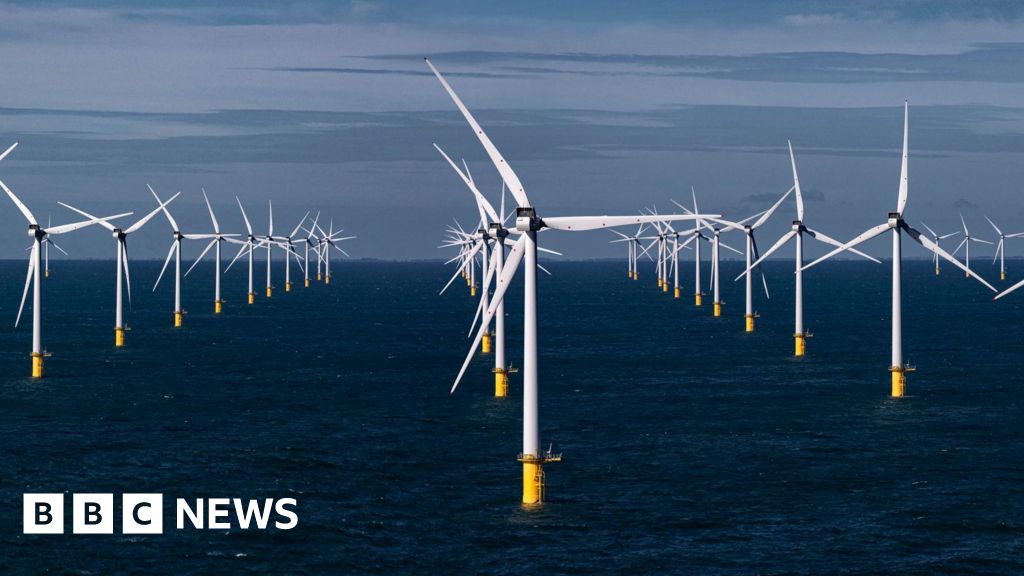
She added that clean steelmaking, the development of the Celtic Freeport and the expansion of floating offshore wind meant Port Talbot was firmly at the heart of south Wales’s growing clean energy economy, supporting thousands of new, high-quality jobs and helping deliver Britain’s clean power mission.
The US fast-food chain sells Mexican-inspired dishes and is known for its tacos and burritos
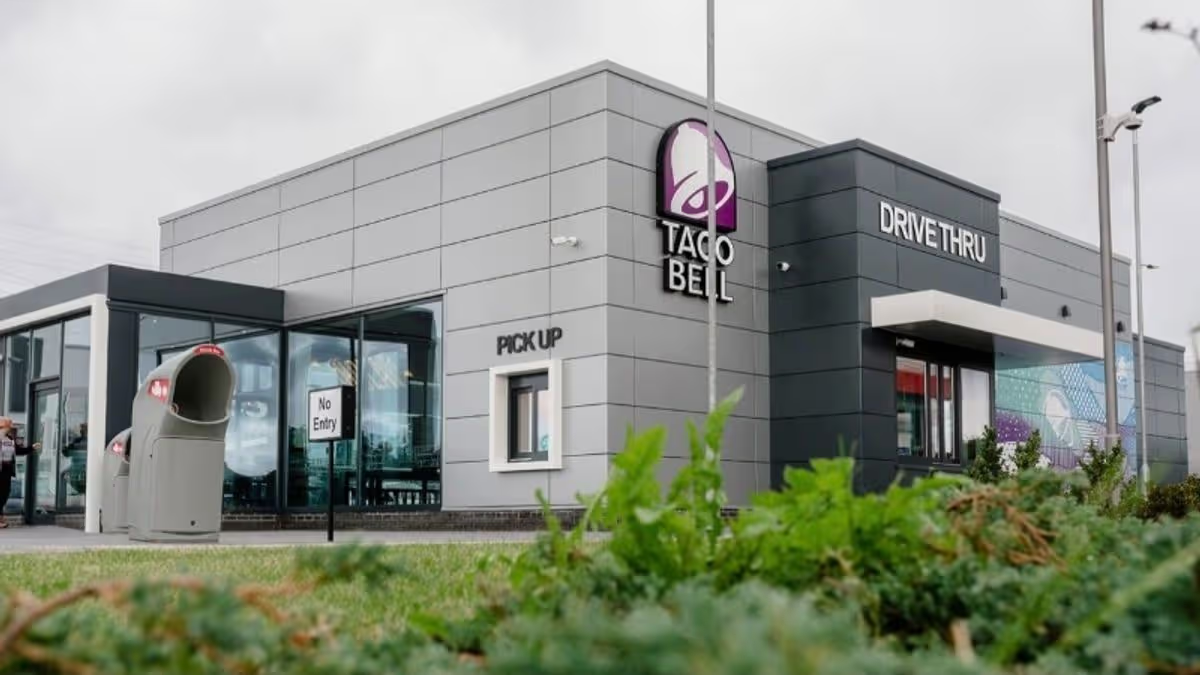
Taco Bell is opening across the South West of England, Wales and Midlands(Image: Handout)
US fast-food restaurant Taco Bell is set to open a number of outlets in the West of England, Wales and the Midlands. Franchise operator Campana has secured an eight-figure funding package which will be used to establish the new branches, with six sites due to open across the cross-border region in the coming months.
Part of the SYMBRO Group, Campana currently operates 23 Taco Bell locations in South West England, Wales and the Midlands.
It is understood the business plans to open around 12 new restaurants a year, building a portfolio of more than 50 Taco Bell sites in the UK by 2029.
The next phase of growth will focus on further locations in Wales, the South West, along the M4 and M5 corridors, plus further expansion in and around the Midlands.
Advertisement
The £20m investment programme is expected to create around 600 jobs and increase revenue by between 50 and 60 per cent as the business continues to expand.
David Morgan, finance director at Campana, said: “Since opening our first Taco Bell six years ago, and with every additional new restaurant opening since, we’ve consistently seen strong demand for this much-loved brand, bringing craveable, Mexican-inspired flavours and unbeatable value to a new generation of UK consumers.”
The company secured the latest finance package from HSBC UK. It is understood the lender also provided Campana with a revolving credit facility, giving the business access to capital as new locations are secured and construction and fit-outs get under way.
Paul Lane, relationship director at HSBC UK, added: “Campana has built a strong Taco Bell franchise business since opening its first location, and its ambitious rollout plans highlight the opportunity within the UK’s hospitality sector, despite ongoing pressures.
Advertisement
“The quick-service restaurant market continues to show resilience, with franchising offering a scalable and effective route to growth. Against this backdrop, the business’ clear expansion strategy and proven track record made a compelling case to support this significant funding package and its next phase of growth.”
SYMBRO Group currently owns and operates 60 QSR franchises across the UK and the Netherlands, including Taco Bell, Subway and Starbucks.


















![BITCOIN... I AM TAKING ACTION RIGHT NOW [Exact trade....]](https://wordupnews.com/wp-content/uploads/2026/03/1774544463_maxresdefault-80x80.jpg)





































You must be logged in to post a comment Login