

Business
Couple Shuts Down Amid Legal Drama and Public Support


NEW YORK — Persistent online speculation about an impending divorce between Blake Lively and Ryan Reynolds has intensified in 2026, largely fueled by Lively’s high-profile legal battle with Justin Baldoni, yet the Hollywood power couple continues to project unity through affectionate public appearances, supportive statements and direct dismissals that suggest the gossip remains firmly in the realm of unverified rumors.
As of mid-May 2026, no divorce filings have appeared in court records, and multiple sources close to the pair describe their marriage as intact despite intense media scrutiny surrounding Lively’s lawsuit. The couple, married since September 2012, shares four children — James, 11, Inez, 9, Betty, 6, and Olin, 3 — and maintains homes in New York and California.
Rumors gained traction earlier this year when Lively attended events solo and faced questions tied to her lawsuit against Baldoni, her “It Ends With Us” co-star and director. Online commentators speculated that the stress of the legal fight, which settled on May 4, 2026, just before trial, might strain the marriage. However, Reynolds publicly praised his wife in a rare statement, calling her “kind & fearless” in a Mother’s Day tribute and expressing pride in her integrity during the dispute.
Couple’s Public Rebuttals
Lively has directly addressed the chatter on social media. In response to a fan comment about divorce rumors, she replied with a lighthearted “Haha they wish,” a signature witty dismissal that echoes previous times the couple has batted away split speculation. In March 2026, the pair was photographed sharing a warm embrace at a Wrexham AFC match in Wales, with Lively later posting a smiling selfie with Reynolds on Instagram Stories.
Their PDA-filled outing and continued joint appearances have reassured fans that the marriage remains strong. Reynolds has also referenced the Baldoni situation supportively, telling interviewers he has “never in my life been more proud of my wife.”
Legal Battle Context
Much of the current rumor wave stems from Lively’s lawsuit against Baldoni and related parties over alleged harassment and retaliation during the making of “It Ends With Us.” The case settled without a monetary exchange days before a scheduled May 2026 trial, with Lively dropping remaining claims while reserving the right to pursue fees. She attended the Met Gala solo shortly after the settlement, which some tabloids interpreted as further evidence of marital strain, though insiders described it as a strategic move to reclaim her narrative.
Both Lively and Reynolds have faced career challenges amid the divided public opinion on the lawsuit, but sources say the ordeal has brought them closer rather than driven them apart. Reynolds has been described as a steadfast supporter throughout the process.
Longstanding Relationship Timeline
Lively and Reynolds first met on the set of “Green Lantern” in 2010 and began dating in 2011. They married in a private ceremony in 2012 at a plantation in South Carolina. Over more than 14 years together, they have navigated fame, four children, multiple joint projects and intense public interest with notable humor and privacy.
The couple has consistently presented a united front. Reynolds frequently praises Lively in interviews, and she has shared candid moments of their family life on social media. In March 2026, Lively posted about still taking “sneaky photos” of her husband after 14.5 years, writing “I have such a crush.”
Why Rumors Persist
Celebrity divorce speculation is common in Hollywood, especially during periods of high stress or when one partner faces controversy. The Baldoni lawsuit created a perfect storm for rumor mills, with every solo appearance or scheduling conflict interpreted as marital trouble. Tabloid outlets and social media accounts have amplified unverified claims, but close observers note the couple’s history of weathering storms together.
Astrologers and relationship experts invited to comment on podcasts have offered mixed opinions, with some warning of challenges for high-profile Scorpio-influenced pairings in 2026, yet none have cited concrete evidence of trouble.
Current Status and Future Outlook
As of May 2026, Blake Lively and Ryan Reynolds remain happily married with no signs of separation. They continue co-parenting, supporting each other’s careers and enjoying family time. Reynolds’ involvement with Wrexham AFC and Lively’s focus on personal projects and advocacy keep them busy, but sources say their bond is resilient.
The couple has four young children who remain their top priority. Insiders say any future decisions will center on what’s best for the family, and both stars have emphasized protecting their private life from public speculation.
For now, the persistent divorce rumors appear to be exactly that — rumors. Lively and Reynolds have repeatedly demonstrated their commitment through actions and words, turning speculation into another chapter in their well-documented ability to rise above Hollywood noise. As they move forward after the Baldoni settlement, the focus remains on family, careers and shared projects rather than any marital dissolution.
Fans and observers will likely continue watching for public sightings and social media posts, but the latest evidence points to a couple still very much together after nearly 15 years of marriage. In an industry where splits are common, Lively and Reynolds stand out as one of Hollywood’s more enduring partnerships.
Whether the rumor cycle quiets or reignites with the next headline, the couple’s track record suggests they will continue facing it side by side.

Business
Dixon Tech shares jump 4% after Q4 results. Do Goldman Sachs, Motilal Oswal forecast further upside?

Revenue from operations for Q4FY26 rose 2% year-on-year to Rs 10,511 crore, compared with Rs 10,293 crore in the corresponding quarter of the previous financial year.
Total income during the quarter increased 3% to Rs 10,595 crore from Rs 10,304 crore a year ago. Other income stood at Rs 84 crore, significantly higher than Rs 11 crore reported in the year-ago quarter.
Earnings before interest, taxes, depreciation and amortisation, or EBITDA, rose 9% year-on-year to Rs 493 crore in the reported quarter.
Dixon Tech shares: Should you buy, sell or hold?

Brokerage firm Goldman Sachs has maintained a “Sell” rating on Dixon Technologies and revised its target price to Rs 9,790 from Rs 9,985 earlier (3.4% downside). The brokerage said the company’s Q4 results missed estimates mainly due to weaker performance in the mobile and EMS segments, although EBITDA margin at 3.9% remained broadly in line with expectations. Goldman Sachs noted that elevated DRAM prices continue to weigh on mobile phone volumes and expects the FY27 outlook for the mobile business to remain subdued. The brokerage also cautioned that the absence of PLI incentives could pressure margins further and said the earnings downgrade cycle may continue. However, it added that the rollout of PLI 2.0 could emerge as a near-term positive trigger for the stock.
Sensex, Nifty today: Catch all the LIVE stock market action here
Motilal Oswal has also maintained a “Buy” rating on Dixon Technologies with a target price of Rs 14,600, indicating an upside potential of 44%. The brokerage said it has slightly revised its FY27 and FY28 estimates to factor in lower volumes and margins, though higher smartphone realisations are expected to provide support. It now expects the company to deliver a CAGR of 33% in revenue, 37% in EBITDA and 36% in profit after tax between FY26 and FY28. The brokerage further said EBITDA margin is projected at 3.3% in FY27 and is likely to improve to 4.1% in FY28 as backward integration initiatives begin contributing following the PLI scheme.JM Financial has maintained an “Add” rating on Dixon Technologies with a target price of Rs 11,200, implying an upside potential of 10.5%. The analysts cautioned that elevated chip prices could weigh on smartphone demand and restrict organic smartphone volume growth in FY27. Excluding Vivo, the company has guided for flat smartphone volumes in FY27, while the best-case scenario would be double-digit growth if the PLI 2.0 scheme materialises and meaningfully boosts exports within the year. The brokerage added that a possible 12-15% rise in smartphone average selling prices could partly offset pressure on revenues, although it believes even flat volumes in FY27 may prove optimistic under current conditions.
(Disclaimer: Recommendations, suggestions, views and opinions given by the experts are their own. These do not represent the views of The Economic Times)
Revenue from operations during the March quarter declined 13% year-on-year to Rs 14,900 crore, compared with Rs 17,096 crore in the corresponding quarter of the previous year. Despite the fall in revenue, EBITDA for the quarter rose 10% to Rs 4,216 crore.
The renewable energy segment continued to remain a major growth contributor. Profit after tax before exceptional items from the renewables business rose 59% year-on-year to Rs 1,994 crore in FY26, while Q4 profit stood at Rs 406 crore. The solar manufacturing business’ FY26 profit more than doubled to Rs 857 crore. The company attributed the increase to ramp-up in module and cell manufacturing as well as yields exceeding 95%. The rooftop solar business reported a 150% jump in annual profit to Rs 499 crore.
Tata Power shares: Should you buy, sell or hold?
Brokerage firm Goldman Sachs has maintained a “Sell” rating on Tata Power with a target price of Rs 300, a downside of 28%. The brokerage said Tata Power’s Q4 profit after tax came in 13% below estimates and remained broadly flat year-on-year, impacted by weaker renewable energy generation and lower contribution from joint ventures. While the brokerage sees strong long-term growth visibility in rooftop solar and distribution, it flagged renewable energy generation execution as a key risk amid curtailments and transmission constraints. It also said the stock’s current valuation already factors in much of the optimism, with Tata Power trading at a premium to its historical price-to-book valuation.
Brokerage firm Motilal Oswal Financial Services has maintained a “Buy” rating on Tata Power with a target price of Rs 490, implying an upside potential of around 17%. The brokerage highlighted that rooftop solar installations doubled year-on-year to nearly 1.7 GW in FY26, with management expecting the rooftop solar business to grow at least 50-60% in FY27 while targeting a 20% market share over the next three years. Motilal Oswal also pointed to strong growth in the cell and module manufacturing business, where EBITDA more than doubled in FY26, and noted that the company has guided for renewable energy commissioning of 2.5 GW each in FY27 and FY28.
Brokerage firm JM Financial has reiterated its “Buy” call on Tata Power and retained a target price of Rs 485, indicating a potential upside of nearly 16%. The brokerage said the company’s key growth drivers remain its 4.9 GW cell and module manufacturing facility, strong momentum in the rooftop solar business backed by a healthy order book, and steady performance at Odisha discoms. JM Financial also noted that the operationalisation of the Mundra plant following the supplementary power purchase agreement with Gujarat is expected to support growth, with the brokerage forecasting a FY26-28 CAGR of 13% in revenue, 14% in EBITDA and 19% in profit after tax.
(Disclaimer: Recommendations, suggestions, views and opinions given by the experts are their own. These do not represent the views of The Economic Times)
Business
Silver jumps Rs 17,000/kg, gold soars to Rs 1.62 lakh/10g after centre hikes import duty. What should investors do?

In the domestic market, MCX silver futures for July 2026 delivery jumped Rs 16,743 or 6% to Rs 2,95,805 per kg. Gold futures for June 2026 delivery rallied Rs 9,206 or 6% Rs 1,62,648 per 10 grams. In the previous session, silver ended higher, while gold dropped marginally lower.
Following the revision, the total customs duty on gold and silver has been raised to 15% from 6% earlier. The government has imposed a 10% basic customs duty and a 5% Agriculture Infrastructure and Development Cess (AIDC) on gold and silver imports, taking the effective import tax to 15% from 6%.
In the international market, spot gold fell 0.4% to $4,695.99 per ounce, while U.S. gold futures for June delivery rose 0.4% to $4,705.30. Among other precious metals, spot silver rose 0.2% to $86.71 per ounce after touching its highest level since March 11 earlier in the session. Platinum declined 0.8% to $2,109.53, while palladium slipped 0.2% to $1,487.47.
Recent data showed U.S. consumer inflation accelerated further in April, with the annual inflation rate recording its sharpest increase in nearly three years. The figures have further reduced market expectations of a Fed rate cut this year, thus weighing on sentiment globally.
How should you trade gold?
Manoj Kumar Jain of Prithvi Finmart said both precious metals were witnessing extremely high volatility, although silver prices could hold support near $76.00 per troy ounce, while gold was likely to sustain support around $4,555.00 per troy ounce on a weekly closing basis.
According to Jain, gold has support at $4,640-$4,610 and resistance at $4,740-$4,770 per troy ounce. Silver has support at $82.40-$80.00, while resistance is seen at $88.80-$92.00 per troy ounce in the current session. On MCX, gold has support at Rs 1,52,800-1,52,100 and resistance at Rs 1,54,000-1,54,850, while silver has support at Rs 2,74,400-2,70,700 and resistance at Rs 2,83,000-2,88,000.
He advised traders holding long positions in both precious metals based on these recommendations to book profits near the target levels.
Gold rates in physical markets
Gold Price today in Delhi
Standard gold (22 carat) prices in Delhi stand at Rs 1,13,048/8 grams while pure gold (24 carat) prices stand at Rs 1,23,312/8 grams.
Gold Price today in Mumbai
Standard gold (22 carat) prices in Mumbai stand at Rs 1,12,928/8 grams while pure gold (24 carat) prices stand at Rs 1,23,192/8 grams.
Gold Price today in Chennai
Standard gold (22 carat) prices in Chennai stand at Rs 1,14,704/8 grams while pure gold (24carat) prices stand at Rs 1,25,072/8 grams.
Gold Price today in Hyderabad
Standard gold (22 carat) prices in Hyderabad stand at Rs 1,12,928/8 grams while pure gold (24 carat) prices stand at Rs 1,23,192/8 grams.
(Disclaimer: Recommendations, suggestions, views and opinions given by the experts are their own. These do not represent the views of The Economic Times)


Ahead of Trump-Xi summit, China warns on US arms sales to Taiwan
Business
Bringing institutional-grade research to bonds is a game changer for retail investors: Saurav Ghosh of Jiraaf
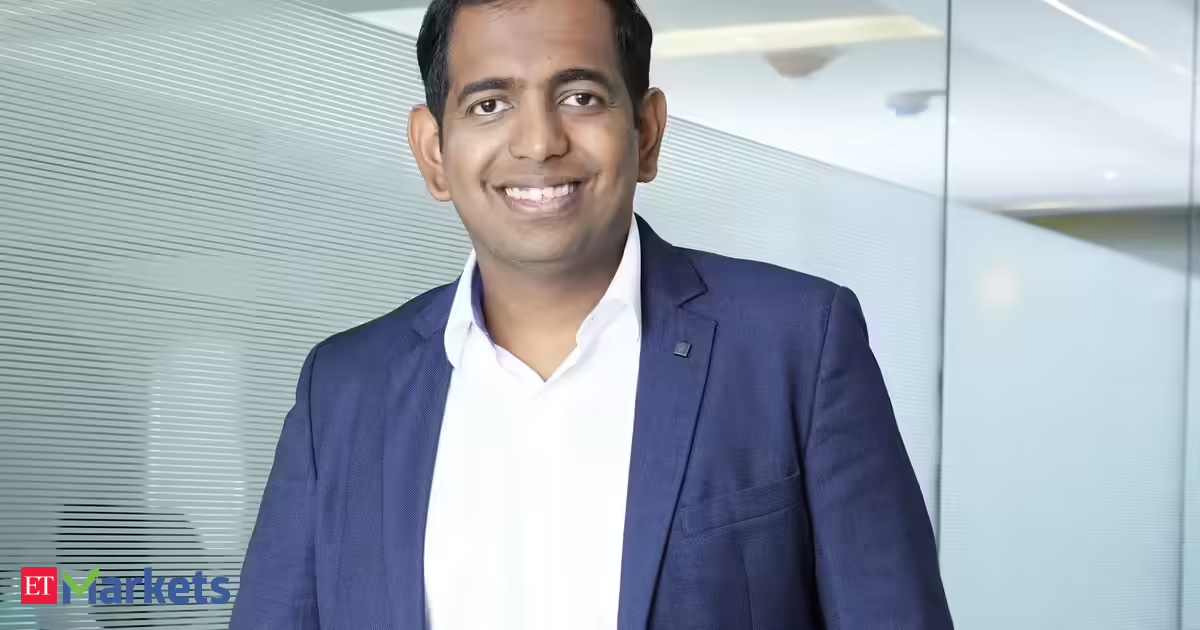
Addressing this, Saurav Ghosh, Co-Founder of Jiraaf, believes that bringing institutional-grade research to the debt market could be a game changer for individual investors.
In an interaction with Kshitij Anand, he explains how traditional reliance on credit ratings often falls short, why issuance-level analysis is critical, and how structured research reports can help investors better understand risk, pricing, and liquidity.
Corporate bond funds are gaining traction for fixed-income investors seeking steady returns amid rising inflation risks and a potential pause in interest rate cuts. With yields at elevated levels, shorter-duration accrual strategies are favored over those betting on rate movements, offering attractive spreads over government securities and bank fixed deposits.
As bond investing becomes more mainstream, such tools could play a pivotal role in making retail investors more informed, confident, and efficient in building their portfolios. Edited Excerpts –
Kshitij Anand: To begin with, if you can help us understand what research reports are and why they are important for investors, which Jiraaf launched recently.
Saurav Ghosh: So, the job of any research report is to essentially simplify complex underlying investment opportunities. I would say most Indian investors are very familiar with the equity segment. There are multiple brokerage houses that release reports on particular companies and stocks. So, you will have, let us say, Motilal Oswal Financial Services giving a buy rating on Reliance Industries Ltd shares—so that is a research report.
Essentially, a research report covers business analysis, the underlying sector and industry that the companies are operating in, and what cash flows are expected. These are complex analyses, and finally, they provide a simplified summary at the end, with the objective of telling the reader what a possible decision could be after having read and consumed all the information in a very structured and simplified manner. So, that is the job of a research report.
Till now, it has mostly been relevant on the equity side of the Indian ecosystem. What we are trying to do is bring that same institutional-grade research to the debt market.
Kshitij Anand: Equity research reports have played a big role in making stock market investing much easier, so how have they helped retail investors?
Saurav Ghosh: Prior to these research reports being available, an Indian investor was not very confident about their own understanding of the subject matter or the underlying investment opportunity. Today, of course, everyone in India does their own kind of research as well because there are so many tools and avenues that are accessible. But while the data is available, how you consume it, summarise it, and come to a final conclusion differs from person to person.
Everyone is looking to build confidence in their own research, and having institutions do that research for you—or having these research reports available—gives every investor confidence in what they are actually investing in. So, as I said, if I am buying a Reliance Industries Ltd stock, I may feel I understand its business, but sometimes it is far more complex than my understanding.
When an institution breaks it down and presents it in a well-documented report, I feel that I understand the business better. I know the numbers better. And when, for example, Motilal Oswal Financial Services gives a buy rating or a target price, it also gives me confidence that this is a good-quality stock to invest in. That is the kind of confidence we are trying to build.
On the flip side, sometimes we also identify pitfalls. If someone gives a sell rating, it may be because they have considered certain factors that we have not. This can help us avoid a bad decision as well. So, that is the aim of research reports.
On the equity side, investors today are far more evolved, financially aware, and actively making investment decisions because research reports have essentially hand-held Indian investors over the last one or two decades. That is also why the understanding of the equity market has evolved to where it is today.
Kshitij Anand: And in fact, if you look at the equity markets, investors have access to research reports, but the Indian bond market did not really have something equivalent to what equity investors used to have. So, why did that gap persist?
Saurav Ghosh: Bond markets are evolving, and traditionally, the bond market has largely been the playground for very large institutions in India. Since it has primarily been an institutional space, these participants have been doing their own in-house research and have not relied on external sources. They have large research and analytics teams, so they do not need to depend on external advice or information to make decisions. Because of this historical participation structure, there was no real need for research reports.
However, over the last three to four years, we have seen retail investors in India increasingly take an interest in bond markets. People are now actively seeking to invest in bonds and include them in their financial portfolios. With the growing participation of individual investors, there is now a need for institutional-grade research—similar to what exists in the equity market—to be made available in bond markets as well. This will help investors access high-quality insights, understand investments better, and ultimately evolve into more informed bond market participants.
Kshitij Anand: In the absence of quality issuance-level bond research, investors often relied mainly on credit ratings, as we discussed earlier in the podcast. What was the problem with that?
Saurav Ghosh: Credit ratings have largely been used as a proxy to assess risk in bond markets, not just by individual investors but also by institutions. However, they have several limitations when it comes to making investment decisions. Typically, a credit rating assesses the overall quality of a company, mostly from a long-term perspective. Ratings are broadly categorised into short-term (less than one year) and long-term ratings, such as AAA, AA, and so on. These primarily evaluate the business and the financial health of the company over a long horizon.
This approach has its limitations. For example, a company may be rated BBB because its five- or ten-year outlook is weaker than that of an AA- or A-rated company. However, that does not necessarily mean it is unsuitable for a one-year investment. A BBB-rated company could perform well in the near term due to favourable sectoral tailwinds, improving company fundamentals, strong collateral, or attractive pricing that enhances the risk-reward equation. Credit rating reports do not address these aspects.
They also do not evaluate whether pricing is competitive, what liquidity is available in the secondary market, or whether an investor can easily exit by finding a buyer. Additionally, they do not provide peer comparisons—how similarly rated issuers or companies in the same industry are priced and traded. These are critical factors for investors when making decisions, such as whether they are getting the best opportunity or the most attractive pricing.
Another key limitation is the lack of issuance-level analysis. In bond markets, investors participate in specific issuances, and each issuance can differ in terms of security, collateral, and covenants. While these are technical aspects, they essentially determine how well a particular issuance is structured from a risk perspective. Credit ratings assess the company as a whole but do not evaluate individual issuances. As a result, one issuance from a company may be highly secure and well-collateralised, while another may be unsecured and carry higher risk.
Since credit ratings often miss these nuances, it becomes important to cover them through institutional-grade research. This is why we have been among the first to introduce research reports for bond markets in India.
Kshitij Anand: I am sure you highlighted many aspects about issuances. So, did this over-reliance on ratings influence investor behaviour in the bond market? Do you see that trend as well?
Saurav Ghosh: One major influence of credit ratings has been on the underlying perception of risk among investors. People tend to believe that AAA- or AA-rated instruments are safe, while anything below that carries a high degree of risk. What individual investors are often unable to do today is quantify risk at each rating level.
While AAA-rated instruments are indeed among the safest in the bond market, it does not mean that a BBB-rated issuer is bad—it simply means it carries relatively higher risk than a AAA-rated issuer. The key question is: can I quantify that degree of risk? If I can, then I can also determine how much additional return I should expect for taking that extra risk, and whether the risk-reward equation is favourable.
This is an important aspect of investing in the bond and debt markets, which many investors struggle with due to the over-reliance on credit ratings as the sole measure of risk. Another important point is that, historically, for bonds with a tenor of less than two to three years, a BBB-rated issuer carries a default risk of less than 2%, while a AAA-rated issuer has a default risk of less than 0.3%. This means the probability of default increases by roughly 1.7% from AAA to BBB, with intermediate ratings falling proportionately in between.
At the same time, AAA-rated companies currently offer yields of around 7.5% in the Indian market, while BBB-rated companies may offer yields closer to 13%. This implies that investors are earning an additional yield of about 5.5% for taking an incremental default risk of around 1.5–1.7%. This is the perspective investors should consider when making decisions.
However, this kind of analysis is often missing due to the over-reliance on credit ratings as the only benchmark. That is why we aim to provide investors with better access to information and a more nuanced, issuance-level perspective, enabling them to make more informed decisions.
Kshitij Anand: Also, could you highlight that while a listed company has one listed equity, it can have multiple listed bonds? Why is that distinction important for investors to understand?
Saurav Ghosh: Yes, this is very important. A company raises debt multiple times during its lifecycle, and each time it does so through a separate issuance in the capital market. In contrast, in the equity market, when a company raises equity capital, all investors are treated equally. Each shareholder owns the same class of shares, and there is typically one share price.
In debt markets, however, each issuance can have different characteristics. For instance, every bond issuance has its own structure of security. It is important to understand whether a particular issuance is secured or unsecured, and if secured, what the underlying collateral is. Additionally, each issuance may come with different covenants. For example, if the company faces a rating downgrade, does the investor receive additional yield? Or do they have the option to exit through early redemption? These are important considerations.
Even for the same issuer, these features can vary from one issuance to another. This means that one issuance may carry a higher degree of risk than another, even though the issuer remains the same. Investors often assume that if a company is rated A, then all its issuances carry the same level of risk, but that is not necessarily true. At the issuance level, risk can vary based on factors such as security, covenants, and structure.
This is why it is crucial to analyse investment opportunities in the bond market at the issuance level. Our research reports aim to address this gap by focusing not just on issuer-level analysis but also on issuance-level details, rather than relying solely on credit ratings.
Kshitij Anand: Now that you have talked so much about research reports, could you also highlight what exactly an issuance-level bond research report is?
Saurav Ghosh: An issuance-level bond research report effectively covers five key aspects. First, we cover the business and the management. These are also partly covered in rating reports. This includes the history of the management, their credentials in running the business, and their background prior to this venture, among other details. It provides a comprehensive view of both the business and the management. On the business side, the report covers the market in which the company operates, the margins in the business, its customer base, and so on.
The second aspect is the financial analysis of the business. While this is also covered in credit rating reports, we go much deeper. The analysis includes profitability at the business level—not just current performance, but also the future outlook—as well as the inherent financial strength of the business, including leverage and other key metrics.
Beyond these two, the remaining aspects are not typically covered in credit rating reports. The third aspect is issuance assessment. Here, we analyse the security package, collateral, and repayment structure—whether payments are monthly or quarterly—as these factors can influence risk. We also compare the issuance with other issuances by the same company to determine whether it is the best available opportunity or if better options exist.
The fourth aspect is pricing. We evaluate how the issuance is priced relative to past issuances, peers within the same sector or rating category, and its pricing in the secondary market where institutional participants are active. This provides a complete perspective on valuation and also indicates the expected liquidity of the issuance.
The fifth aspect is the economic and sector outlook. If you are investing with a one- to two-year horizon, it is important to understand how the underlying sector is expected to perform over that period. A favourable macro or external environment reduces the likelihood of stress on the company.
Overall, the report is built around these five pillars, with the objective of arriving at a comprehensive scorecard that helps investors determine whether a particular issuance is worth participating in.
Kshitij Anand: From a broader perspective, why is issuance-level research especially important in the Indian bond market today?
Saurav Ghosh: I have already spoken about the importance of issuance-level details, but to summarise, there are two additional risks beyond credit risk that investors need to consider: liquidity risk and interest rate risk. These research reports help quantify those risks as well. While credit ratings provide insight into credit risk, issuance-level reports help investors understand liquidity—whether they can exit the investment easily—and whether the issuance is fairly priced.
If an investor enters at the right pricing, their interest rate risk is lower, and even if liquidity tightens, the impact on the bond’s capital value will be limited. This helps investors safeguard their investments and make better decisions.
Lastly, it is important to recognise that while the issuer remains the same, the quality of issuances can differ. A company may offer strong collateral and security to institutional investors but weaker terms in public issuances. Investors should not be at a disadvantage in such cases.
Overall, these reports empower investors with the right set of information to make more informed and confident investment decisions.
Kshitij Anand: And also, can issuance-level research change how investors build bond portfolios now?
Saurav Ghosh: Absolutely, because a lot of times, as I said, with the availability of issuance-level reports, investors will think differently. Let us say a particular BBB-rated company has a balance tenor of one year. Now, you are not just thinking of it as a BBB-rated company; you are thinking, while it is a BBB-rated company, can I take this risk for one year? I am not investing my money for five or ten years—I am just investing for the next one year. So, can I take that risk over this time frame?
With that understanding, people will construct their portfolios very differently because they will view risk differently. And once you look at risk differently, the way you construct your portfolio and think about generating yields and returns from it will completely change. So, with the availability of issuance-level reports, people will become smarter at constructing their financial portfolios than before.
Kshitij Anand: How does Jiraaf RA’s launch address this market gap now?
Saurav Ghosh: I think it is a big game changer. At Jiraaf, we have always been at the forefront of helping our investors gain maximum access to information so that they can make the right decisions. About three months ago, we launched our bond analyser, which is the first bond analytics platform in the ecosystem. It provided access to information, but investors still had to summarise and interpret that information themselves.
We have now taken this a step further with the launch of bond research. This means that investors not only have access to information, but also to structured and summarised insights derived from that data, presented in a simple and easy-to-understand manner. So, people do not need to do all the analysis themselves—they can read the research report and gain a strong understanding of the issuer and the issuance. This helps them make well-informed decisions about whether they want to include a particular bond in their portfolio.
As a result, decision-making becomes quicker, simpler, and more efficient. At Jiraaf, our intent is to provide investors with maximum clarity and complete transparency so that they can confidently make their investment decisions. This initiative goes a long way in enabling that.
Kshitij Anand: Could bond research reports do for bond investors what equity research reports did for stock investors? Can they match expectations? I am sure investors would want to know more about that.
Saurav Ghosh: Yes, 100%. Once you start trusting the research, you start trusting the institution. Over time, research reports can become an everyday tool, just like they have in the equity market. Investors can quickly go through a report—in 30 seconds to a minute—focus on the key data points, and arrive at an investment decision.
It becomes almost like being on autopilot—you see a report, review a few key metrics, and your decision is largely formed. I believe we will reach that stage in the bond market as well. In fact, institutional-grade research could have an even greater impact in the bond market than it has had in equities, because bonds are relatively more complex instruments that require deeper understanding. That is exactly what this initiative aims to provide.
(Disclaimer: Recommendations, suggestions, views, and opinions given by experts are their own. These do not represent the views of the Economic Times)

Listed contractor Perenti’s underground mining firm Barminco has secured a $850 million contract with Bellevue Gold at its namesake project.

Commonwealth Bank shares slump on tax changes, provisions; Australian lenders fall

Thailand’s initiative to introduce virtual banks has entered a critical stage, with the Bank of Thailand (BOT) enforcing strict regulatory compliance for the three remaining applicants.
Candidates, which include major consortia involving entities like CP Group, Krung Thai Bank, and SCBX, are required to finalize their organizational and business structures to meet central bank standards.
Failure to adhere to these criteria or provide sufficient justification for deviations could result in the revocation of a licence, potentially leading to a market with fewer than three operators as there are no provisions to replace disqualified applicants.
Key Points
- Finalists: The three applicants currently under review are ACM Holding (CP Group), a consortium led by Krung Thai Bank (with AIS and OR), and SCBX (partnering with KakaoBank and WeBank).
- Compliance Requirements: Applicants must ensure that financial businesses are separated from non-financial entities to mitigate risks and prevent conflicts of interest, such as unauthorized lending or preferential pricing for affiliates.
- Adjustments: To meet criteria, companies may need to reduce shareholdings in conflicting businesses, surrender non-core financial licences, or restructure their holdings.
- Approval Process: The Bank of Thailand will evaluate the applicants’ explanations on a case-by-case basis and provide recommendations to the Finance Ministry, which holds the final authority for granting licences.
- Strict Oversight: The BOT has emphasized that there is no policy to replace failed applicants with reserves from the initial round, meaning the final number of virtual banks could be fewer than three.
- Preparation Phase: Once in-principle approval is granted, successful applicants will be given approximately one year to ensure their systems meet security and financial stability requirements before launching.
The BOT maintains a rigorous stance, indicating that if an applicant fails to meet requirements and cannot provide a valid justification, their license will be at risk. There is no plan to replace disqualified candidates, meaning the market could potentially launch with fewer than three operators.
Other People are Reading


My investing journey began at 15, sparked by a deep curiosity for markets and shaped by my father’s career in finance. What started as a fascination with Warren Buffett’s annual letters quickly evolved into a full-time passion for value investing, mental models, and understanding how great businesses create long-term value. I’ve spent years independently studying financial statements, building DCF models, and analyzing companies through both fundamental and behavioral lenses. While I’m still early in my professional path, I’ve been immersed in the world of investing for nearly a decade. From dissecting shareholder letters to reverse-engineering business strategies, I’ve developed a disciplined, fundamentals-first approach grounded in long-term thinking. I focus on identifying mispriced quality companies and understanding what makes certain business models resilient across cycles. I write on Seeking Alpha to share insights, test ideas in public, and contribute to a community of investors who value clear thinking over hype. My goal is to provide thoughtful, research-backed commentary, whether on under-the-radar compounders, Growth/GARP stocks, or misunderstood tech platforms. Above all, I invest with conviction, patience, and a relentless drive to keep learning.
Analyst’s Disclosure: I/we have a beneficial long position in the shares of RKLB either through stock ownership, options, or other derivatives. I wrote this article myself, and it expresses my own opinions. I am not receiving compensation for it (other than from Seeking Alpha). I have no business relationship with any company whose stock is mentioned in this article.
Seeking Alpha’s Disclosure: Past performance is no guarantee of future results. No recommendation or advice is being given as to whether any investment is suitable for a particular investor. Any views or opinions expressed above may not reflect those of Seeking Alpha as a whole. Seeking Alpha is not a licensed securities dealer, broker or US investment adviser or investment bank. Our analysts are third party authors that include both professional investors and individual investors who may not be licensed or certified by any institute or regulatory body.

Madison Investments is 100% employee-owned and has been based in Wisconsin’s capital city since its founding in 1974. In that time, Madison has grown from a local firm into a manager entrusted with approximately $22 billion in assets across a suite of mutual funds, active ETFs, managed accounts and customized portfolios. Note: This account is not managed or monitored by Madison Investments, and any messages sent via Seeking Alpha will not receive a response. For inquiries or communication, please use Madison Investments’ official channels.
Dixon Tech shares jump 4% after Q4 results. Do Goldman Sachs, Motilal Oswal forecast further upside?
Bitcoin Rallies on Aggressive Spot Demand as Market Absorbs U.S. Economic Data: Bitfinex

Middlesbrough FC legend Alan Peacock granted posthumous honour

Manchester United reach agreement with Casemiro over contract clause amid transfer speculation

US brings back mandatory military draft registration

Steven Gerrard disagrees with Gary Neville over ‘shock’ Chelsea and Arsenal claim | Football


-
 Crypto World5 days ago
HarrisX Poll Found 52% of Registered Voters Support the CLARITY Act
-

 Fashion4 days ago
Weekend Open Thread: Marianne Dress
-

 Crypto World6 days ago
Upbit adds B3 Korean won pair as Base token gains Korea access
-
 NewsBeat6 days ago
NCP car park operator enters administration putting 340 UK sites at risk of closure
-

 Fashion1 day ago
Coffee Break: Travel Steam Iron
-

 Fashion2 days ago
What to Know Before Buying a Curling Wand or Curling Iron
-

 Tech3 days ago
Auto Enthusiast Carves Functional Two-Stroke Engine from Solid Metal
-

 Politics1 day ago
What to expect when you’re expecting a budget
-

 Politics4 days ago
Politics Home Article | Starmer Enters The Danger Zone
-
 Business4 days ago
Ignore market noise, India’s long-term story intact, say D-Street bulls Ramesh Damani and Sunil Singhania
-

 Crypto World7 days ago
BlackRock CEO Larry Fink Discusses a New Asset Class
-

 Tech2 days ago
GM Agrees To Pay $12.75 Million To Settle California Lawsuit Over Misuse Of Customers’ Driving Data
-
 Sports7 days ago
NBA playoff winners and losers: Austin Reaves is not loving Lakers vs. Thunder matchup, but Chet Holmgren is
-

 Entertainment6 days ago
Sarah Paulson Called Out For Met Gala ‘Hypocrisy’
-

 Entertainment5 days ago
General Hospital: Ric & Ava Bombshell – Ric’s Massive Secret Exposed!
-

 Politics5 days ago
Simon Cowell Says He Was ‘Horrible’ To Susan Boyle During BGT Audition
-

 Crypto World6 days ago
Robinhood says Wall Street is building onchain
-

 Entertainment6 days ago
Bold and Beautiful Early Spoilers May 11-15: Steffy Revolted & Liam Overjoyed!
-

 Sports6 days ago
UEFA Champions League final schedule, teams, venue, live time and streaming | Football News
-

 Entertainment6 days ago
Why David Letterman Called CBS ‘Lying Weasels’
You must be logged in to post a comment Login