Director Eugene Yi has always been interested in the term Asian American and Pacific Islander and which ethnicities it includes.
“When we’re talking about Asian Americans or Asian people in the U.S., oftentimes it’s people who might look like you and me, and maybe not people who look like (New York City Mayor) Zohran Mamdani,” Yi told The Associated Press. “Why is that when this term is supposed to be so capacious and so inclusive?”
So Yi, who is Korean American, was beyond excited when approached to helm a new HBO documentary dedicated to AAPI identity and community.
Timed for release during AAPI Heritage Month, “The A List: 15 Stories from Asian and Pacific Diasporas” drops Wednesday on HBO Max. It’s the latest in “The List Series” created by Timothy Greenfield-Sanders. The franchise has previously produced documentaries on prominent Black, Latino and LGBTQ+ Americans.
Advertisement
In the documentary, Yi captures no-frills, intimate interviews conducted by journalist Jada Yuan with 15 people of AAPI heritage across industries. They include TV broadcaster Connie Chung, Democratic Sen. Tammy Duckworth and “Basement Bhangra” creator DJ Rekha. Actors Sandra Oh, Kumail Nanjiani and Bowen Yang — who are sometimes more associated with comical roles — also shared their thoughts about identity and belonging.
“When talking to people who are professionally funny, oftentimes they’re really comfortable not being funny,” in unscripted conversation, Yi said. “I appreciated that chance to get a little bit deeper into some of their stories.”
Stars say talking about growing up AAPI on camera was cathartic
Yia Vang, chef and owner of Vinai, a popular Hmong restaurant in Minneapolis, filmed his “A List” interview three years ago. Since then he’s been featured in various cooking and lifestyle shows. Vang, who was born in a Thai refugee camp until his family settled in Wisconsin when he was 4, likened the experience of being interviewed on camera to a confessional.
Advertisement
Vang tearfully recounts to viewers how his desire to not be “the weird kid” drove him to throw out school lunches of sticky rice and fermented vegetables packed by his mother. He did not expect to get emotional but the memory sparked a core life lesson.
“I will never, ever try to be ‘cool,’” Vang said. “That’s why I guess I get so intense about like how we do our food here. Not because I’m chasing perfection or some kind of award, but I just want to make sure I stay true to the integrity that they (my parents) laid before me.”
In what Vang calls “full-circle redemption,” those dishes he used to throw out are now on his restaurant’s menu.
Last month, Vang got a taste of reactions to the documentary back home at a Milwaukee Film Festival screening. He definitely was not seen as the weird guy.
Advertisement
“The audience really connected because I’m a Wisconsin boy,” Vang said. A few approached him just to say “It’s so awesome to see a Midwest kid in there.”
Asian Americans and Pacific Islanders still struggle for visibility
Asian Americans make up one of the fastest growing U.S. populations. Still, adults in the U.S. have a harder time recognizing the influence of AAPI people than people from other racial groups, according to a new survey by The Asian American Foundation.
The annual Social Tracking of Asian Americans in the United States, or STAATUS, Index, done in partnership with NORC at the University of Chicago, found 4 in 10 U.S. adults cannot think of a single, famous Asian American; Jackie Chan, who is not American, was among the most frequently named. About half were unable to name examples of famous Native Hawaiians and Pacific Islanders.
Advertisement
“It’s an indication of just how for most of America — and our data shows this as well — people get most of their information about Asian Americans not so much from direct contacts, but from the media,” said Norman Chen, CEO of The Asian American Foundation.
Chen recently attended a screening of “The A List.” He applauded the breadth of personal stories Yi and his team curated. It’s a film he’s not sure would have gotten made a decade ago. So, it was gratifying to see how moved the audience was by stories recounted by celebrities and everyday people.
“Even people that we don’t know have such powerful stories to show you the depth and richness of our community and the struggles that we’ve had to go through in multiple generations,” Chen said.
Working on a film about identity as the political climate changed
Advertisement
When Yi and the crew started working on the documentary, Vice President Kamala Harris was running against Donald Trump for president. Now under a Republican Trump administration that vehemently opposes diversity, equity and inclusion initiatives, Yi acknowledges how the documentary might come off as inherently political.
“What I’ve certainly seen during the stretch of time — just speaking for myself — is just how quickly things can backslide and how quickly people can be erased,” Yi said. “We literally have people being disappeared on the streets and we literally have histories being erased.”
He is especially gratified that some of the documentary’s older participants related to historical events such as a story told by activist Kathy Masaoka, whose mother was held in Japanese American incarceration camps. Yi hopes people recognize the struggles AAPI people have endured in the past and present while building community.
“We can really move forward from this moment in terms of rebuilding and reclaiming and taking up space with confidence and hope again,” Yi said.
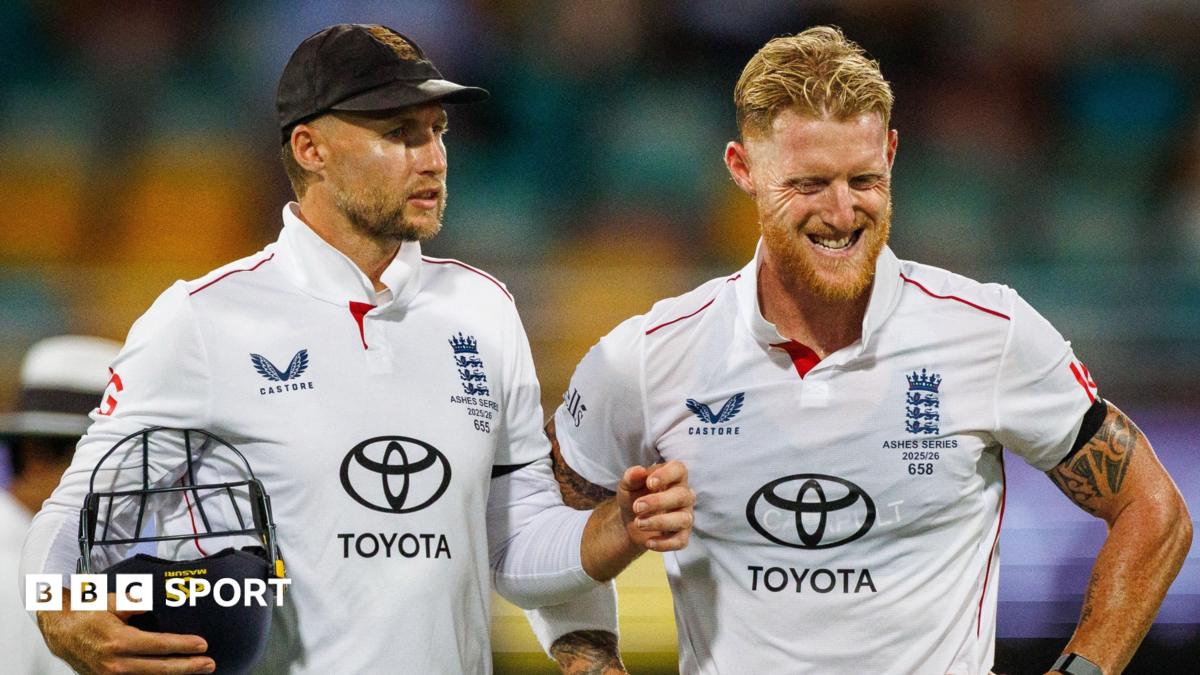
England have described the arrangement for the second Test as “interim”, and its impermanence seems important.
On Monday, when it first emerged that Stokes and Gus Atkinson were in hot water, there was an immediate feeling it would spell the end of Stokes’ captaincy.
It still may. There is an ongoing investigation. Stokes could decide to walk.
But, with every passing hour, the temperature is cooling. Stokes could return for the third Test at Trent Bridge or, more likely, the series against Pakistan later in the summer.
Advertisement
Still, Stokes has given a window into what England’s life might be without him. For the first time in his career, Stokes the cricketer is not indispensable. Earlier this week, head coach Brendon McCullum had to defend his batting, and back Stokes to return to form.
If Brook had been put in charge, England may have seen something they like. Brook and McCullum seemed more aligned during the T20 World Cup than Stokes and McCullum did during the Ashes.
Brook would have been captaining his peers, whereas Stokes leads a group of younger men, many of whom grew up idolising him. Maybe England would have found a Stokesless formation that makes them stronger: the leg-spin of Rehan Ahmed as the all-rounder, followed by four specialist seamers.
None of this becomes an issue with Root in charge. He will be all too happy to hand over the reins when the time comes.
Advertisement
These roles were once reversed. In the Covid summer of 2021, Stokes stepped in for one Test while Root was on paternity leave. Root left a note on Stokes’ peg in the dressing room which said: “Do it your way”.
Now, Root will do it his way. Clapping his hands from first slip, long sprints to talk to his bowlers. A smile on his face, maybe a classic Rootian century. Not the puffed-out chest of an alpha like Stokes, just the calm reassurance of English cricket’s most dependable presence.
Once again, it is Joe Root riding to England’s rescue.
Footage circulating online shows a rioter set himself on fire when trying to throw a petrol bomb
Olivia Beeson UK & World News Reporter
00:52, 11 Jun 2026
A rioter set himself alight while trying to throw a petrol bomb in Wednesday evening’s disorder.
The protestor’s jacket set on fire as he attempted to throw the device in Portadown.
Advertisement
Footage shared on social media shows three masked protestors gathering before trying to chuck the petrol bomb and then running away after one sets himself alight.
He continues to run closer to the camera patting his back in an attempt to control the flames.
Wednesday night saw another evening of disorder in Belfast and across Northern Ireland following the horrific knife attack on Monday evening.
Advertisement
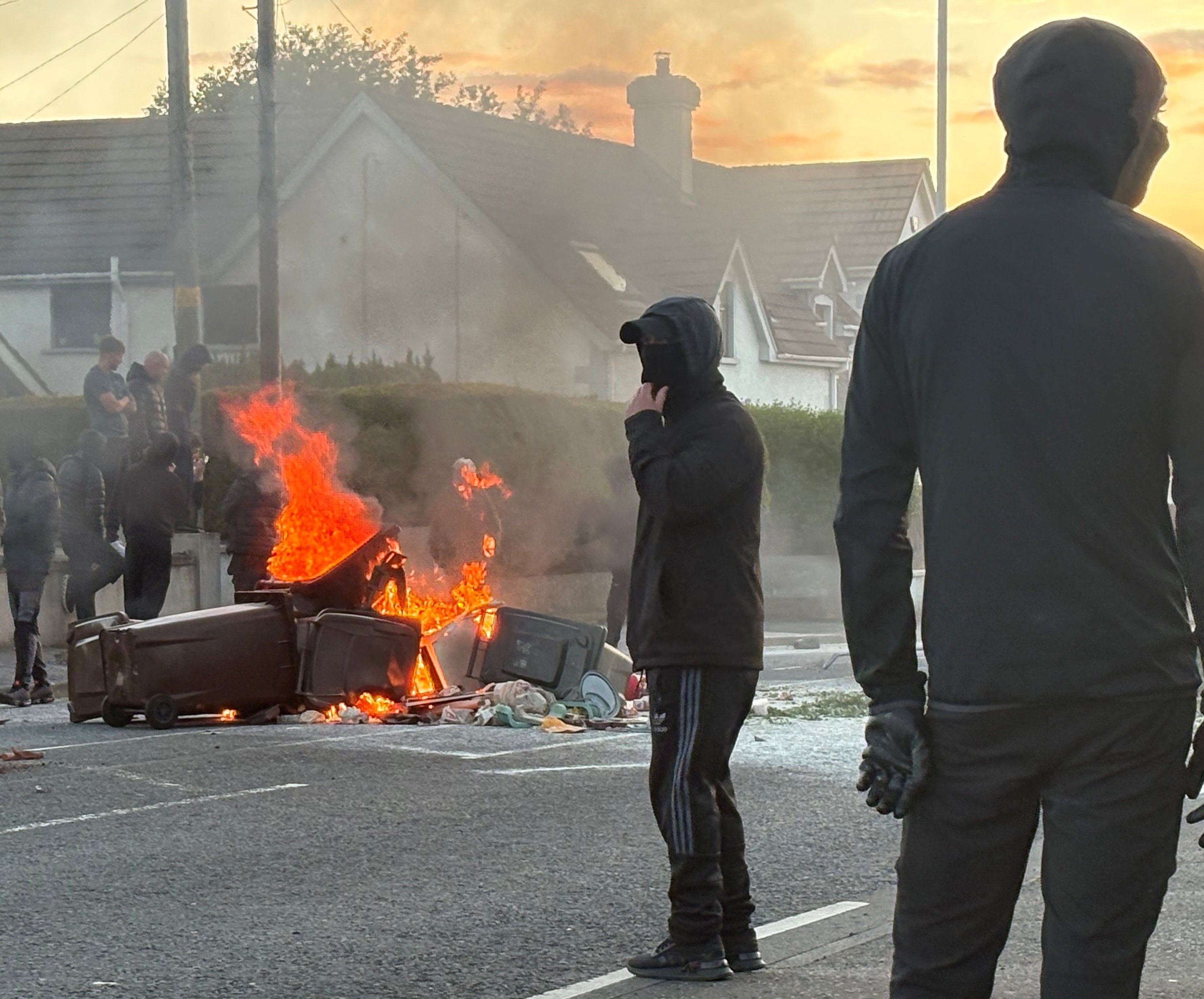
In Belfast, police deployed water cannons on protesters in Co Antrim after they were pelted with bricks and footage showed dozens of men dressed all in black and wearing face coverings taking wheelie bins from outside homes and lighting fires in them.
In the Portadown area police deployed dogs to tackle the violence expected to erupt.
A house in the area has also been petrol bombed, according to reports.
Following from the chaos that hit the streets on Tuesday evening, the Chief Constable of the Police Service of Northern Ireland stated disorder on the streets of Northern Ireland is an “act of self-harm” to communities.
Advertisement
Chief Constable Jon Boutcher said: “This disorder is an insult to the victim of this assault, an insult to the members of the public who bravely stepped forward to save his life and the officers who rushed to the scene.
“The criminal justice system needs to take its course. Let that follow due process. A man has appeared in court today charged with this attempted murder and, separately, another man has been charged with riot following the scenes in Newtownabbey. I’d appeal to everyone in Northern Ireland to take control. “If you have a niece, nephew, brother, sister or a member of your local sports club, if you’ve seen them at the disorder, stop them from coming out today. This has got to stop. We cannot have a society that allows this to happen.”
Wednesday’s night action has been condemned by leaders, after fires were ignited at the Sandyknowles roundabout.
Advertisement
Northern Ireland’s Infrastructure Minister Liz Kimmins said a second night of destruction and disruption “needs to be condemned in the strongest possible way”.
“It is racism, it is intimidation and absolute thuggery,” she said.
“These acts serve no one and only cause harm and fear within communities. It is disgraceful and disgusting.
“I utterly condemn the incident at my department’s depot in Sandyknowes and the further disruption we have seen with transport services suspended and businesses closing early.
Advertisement
“I thank the police for their response and I reiterate the calls for this violence to stop.”
A search expanded on Wednesday for a teenage girl swept into the ocean by a large wave off Southern California‘s coast, as dangerous high surf conditions persist.
The incident occurred Tuesday evening at Treasure Island Beach in Laguna Beach, where the girl, her mother, and brother were walking along the sand. All three were pulled into the water, Laguna Beach Marine Safety Chief Kai Bond said Wednesday.
Two people managed to rescue the mother and son, who are now in stable condition. One man who aided the family subsequently required rescue himself from powerful 10-foot (3-meter) waves by a city lifeguard.
Many of Southern California’s beaches are expected to see 5-to 8-foot waves through at least Thursday night (Mindy Schauer/The Orange County Register via AP)
“We’re expanding our search to include adjacent beaches, and we’re using divers, rescue vessels and air resources to search the area. But at this point we haven’t found her,” Bond said.
Laguna Beach Marine Safety is getting help from the Orange County Sheriff’s Harbor Patrol and the U.S. Coast Guard, Bond said.
Advertisement
Many of Southern California’s beaches are expected to see 5-to 8-foot (1.5-2.5 meter) waves through at least Thursday night, the National Weather Service said in Wednesday surf reports, and still higher in some places. The beach city of Malibu could see waves of up to 10 feet (3 meters), the service said.
In Orange County, where the city of Laguna Beach is located, the surf height is normally below 6 feet (about 2 meters), said Philip Gonsalves, a meteorologist with the National Weather Service. He said the surf in Orange County had already peaked at 10 feet and was expected to start trending lower within the next 24 hours.
The surf has been particularly high along beaches facing south or southwest as large swells from the Southern Hemisphere’s winter storms reach the area, he said.
A 15-year-old boy, who cannot be named for legal reasons, and 43-year-old William Lunnon have been charged with murder following the death of 12-year-old Bobby Bloomfield in a collision in Brentwood, Essex
Peter Hennessy UK & World News Editor and Zahra Khaliq News Reporter
00:24, 11 Jun 2026
A man and a teenage boy have been charged with murder following the death of a 12 year old boy in a collision in Brentwood.
A 15 year old boy, who cannot be named for legal reasons, and William Lunnon, 43, of Ashwells Road in Pilgrims Hatch, have been charged with murder and remanded in custody, police say. Both are due to appear in court on Thursday, reports the Mirror.
Advertisement
Two men aged 65 and 54, and two women aged 65 and 45, all from the Pilgrims Hatch area, were additionally arrested on Tuesday and remain in custody on suspicion of perverting the course of justice.
Essex Police have confirmed they are continuing to investigate the circumstances surrounding the incident and have urged anyone with relevant information to get in touch.
Detective Chief Inspector Greg Wood said: “This remains a complex investigation, and we have made significant progress, including bringing charges and making further arrests.
Advertisement
“Our focus remains on establishing the full circumstances and supporting Bobby’s family, who have suffered an unimaginable loss.
“I continue to urge anyone with information to come forward. Even the smallest detail could help us build a clear and accurate picture of events.”
It has been reported that Bobby was a pupil at Shenfield High School. A spokesperson for the school said: “We are extremely saddened to learn about the death of one of our pupils. This has come as a shock to us all, and we send our deepest condolences to the pupil’s family.
“We are supporting our pupils, staff and wider school community. As there is an ongoing police investigation, we are unable to comment further at this time.”
If your air fryer is in need of a good clean, this air fryer cleaning spray could help to remove even the most stubborn grease and grime
Air fryers have become sought-after kitchen gadgets, used to prepare a wide variety of dishes. However, this also makes them susceptible to grease accumulation, particularly when they’re not consistently maintained. Numerous approaches exist for cleaning household equipment, with many people favouring natural techniques.
Advertisement
On the Mrs Hinch Cleaning Tips Facebook page, one housework devotee shared her remarkable air fryer cleaning method. The cleaning enthusiast disclosed the product she used and recommended that others clean their air fryers after each use.
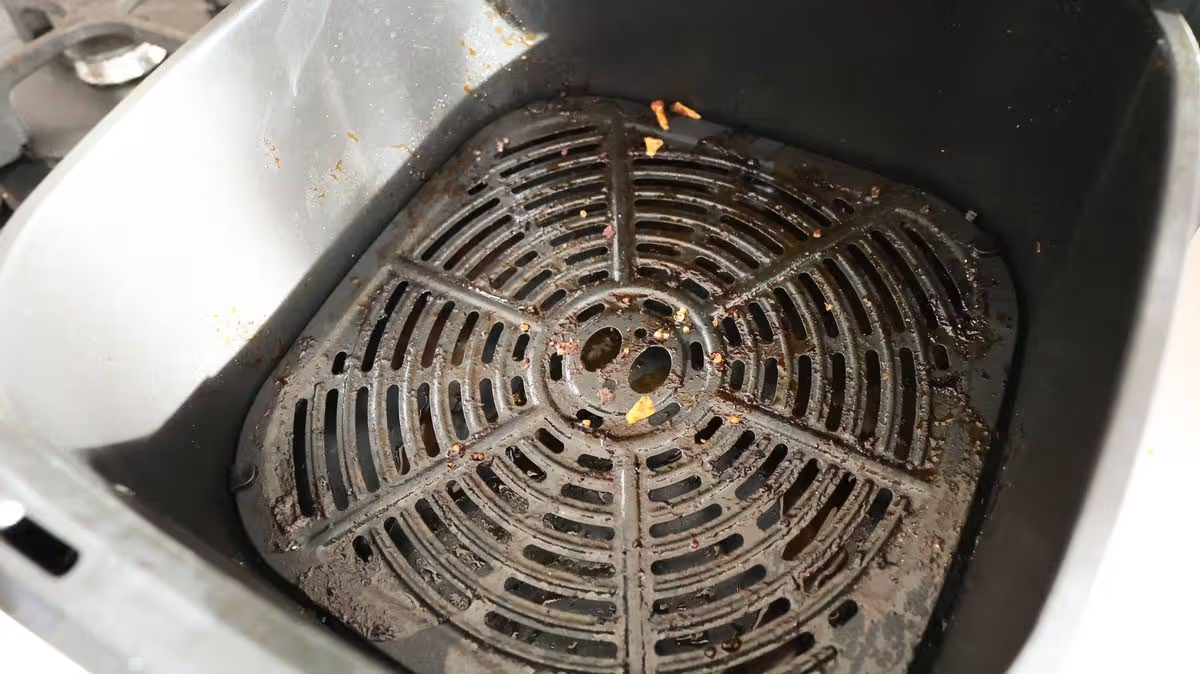
Joan Stewart wrote: “I thought I’d share this product. I’m really impressed with it. If anyone like me lives off using air fryers instead of an oven, this cleaning spray is liquid gold. Here’s the before and after. It gave it such a good clean. It’s very impressive, and I’d definitely recommend it.”
The housework enthusiast posted an image of the cleaning bottle she utilised, which came from the brand Scrubology.
Accompanying the spray was an image of her air fryer before and after cleaning. Initially, the persistent grease and grime deposits were visible, while the subsequent photographs made the appliance appear virtually new.
Advertisement
The manufacturer behind the Crispy Clean spray claims it delivers “instant” visual results, eliminates burnt-on residue, grime, and grease deposits, and requires no scrubbing whatsoever.
To apply the spray, begin by turning off and disconnecting the air fryer, permitting it to cool completely.
Next, where possible, remove the basket and tray before applying the spray to greasy sections, and allow it to sit for up to 10 minutes.
Advertisement
Just wipe down and rinse detachable components completely before drying to reveal a brilliantly clean device.
Cleaning enthusiasts also flocked to the comments section to share their views on the spray. Lynne Kitching remarked: “The full range is a game-changer.”
The spray comes in at a fairly steep £5.99, but customer reviews on the website all maintain it is absolutely worth the investment.
Moreover, you receive 750ml of cleaning spray, and you’ll only require a few squirts per cleaning session, meaning it should last quite some time.
Advertisement
There are also numerous alternative methods for cleaning air fryers, including using Elbow Grease’s Air Fryer Cleaner. This can be purchased from Home Bargains for approximately £1.
Washing-up liquid is equally a favoured approach, as it helps break down grease and grime.
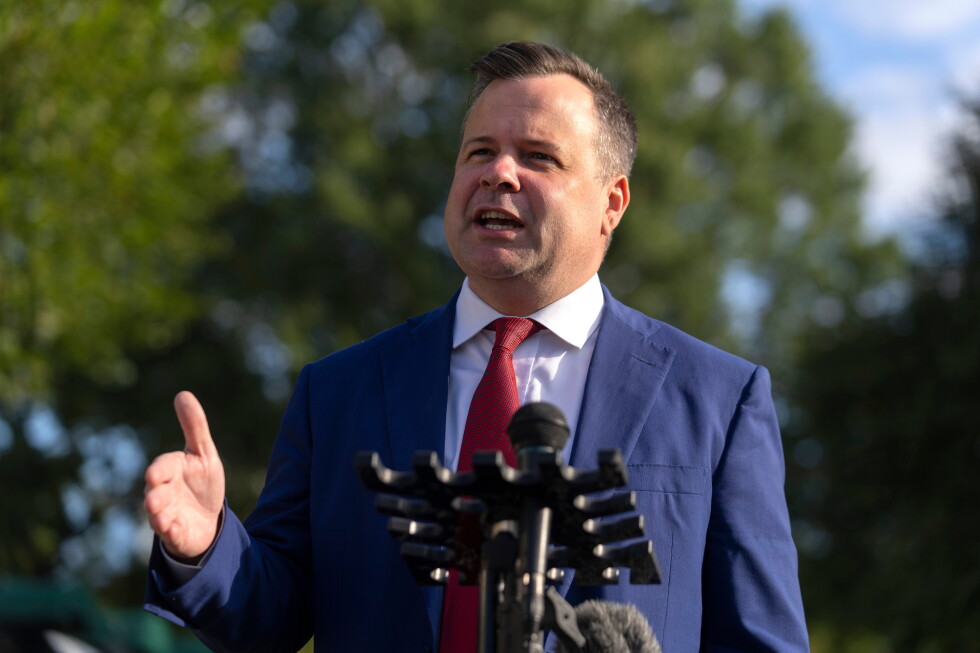
WASHINGTON (AP) — A lapse in a law that allows the U.S. to gather intelligence abroad grew more likely on Wednesday as President Donald Trump resisted calls from Republicans and Democrats on Capitol Hill to immediately name a permanent head of the nation’s intelligence agencies.
Trump has doubled down on his temporary pick for director of national intelligence, federal housing finance regulator Bill Pulte, even though he has little experience for the job. Democrats say they won’t support the renewal of Section 702 of the Foreign Intelligence Surveillance Act, known as FISA, unless he withdraws Pulte’s appointment and nominates a permanent replacement.
The impasse could soon result in limitations on what intelligence the U.S. government can collect abroad just as World Cup games begin in cities around the country and ahead of celebrations for the nation’s 250th anniversary. The law expires on Friday at midnight.
Trump on Wednesday asked Congress for a short-term extension of the law to “provide time for the selection and confirmation” of a permanent director.” But he stuck with Pulte as the acting head and said he wants to begin downsizing intelligence agencies.
Advertisement
“We can’t let them extort us,” Trump said of Democrats.
Senate Republicans floated an short-term extension of the law after Trump’s request, but it was immediately rejected by Democrats who argued that it’s up to the president to replace Pulte.
As the bill stalled in the Senate, Speaker Mike Johnson announced the House would hold a vote Thursday on a stopgap to keep the program running through July 2 even as the chances of passage appeared slim.
“We’re going to ask every member here to do the right thing,” Johnson said. “We cannot allow that to go dark.”
Advertisement
House Democratic leader Hakeem Jeffries said if Trump wants a shot at a short-term extension, he needs to pull the Pulte appointment. Pulte is a “disgraceful individual” and a “partisan political hack” who is deeply unqualified for the job, Jeffries said.
GOP leaders lobby the White House, to no avail
Congressional Republicans have lobbied Trump all week to quickly nominate a permanent replacement. But he said he needs more time to do so.
Senate Majority Leader John Thune, R-S.D., said Wednesday that Republican leaders have “made our views known” to the White House about the easiest way to get the bill passed, and “we’re just doing what we can here to ensure that the White House understands what will be necessary in order to make that happen.”
Trump said on Friday that he is interviewing five candidates for his pick to lead the agency permanently and that all have a national security background.
Advertisement
“It’s an important position and one that I think will be filled by a highly qualified person,” said Johnson, who met with Trump twice this week to talk about the FISA impasse.
Trump made it very clear, Johnson said, that Pulte will serve a “very short term — a sort of renovation role” to help the Office of the Director of National Intelligence be “renovated and downsized.”
To unlock votes for FISA, the pick would have to be soon — and Trump’s choice would have to satisfy both Republicans and Democrats.
One of several possible replacements could be Pete Hoekstra, Trump’s ambassador to Canada and a former chairman of the House Intelligence Committee. The White House has reached out to Hoekstra about the job and conversations are ongoing, according to a person familiar with the outreach who requested anonymity to discuss the private conversations.
Advertisement
FISA will lapse at midnight Friday
Section 702 of FISA allows agencies such as the CIA, National Security Agency and FBI to collect communications from foreign targets overseas without a warrant.
While members of both parties who cite privacy issues have long wanted to limit the authority, there was broad bipartisan support to renew it, especially after Republicans and Democrats recently worked out a compromise bill.
Virginia Sen. Mark Warner, the top Democrat on the Senate Intelligence Committee, has worked with Republicans on the compromise legislation to renew the authority. But he called Pulte’s appointment to replace outgoing DNI Tulsi Gabbard “a live hand grenade” as they were trying to pass it. Republican leaders tried to start the process last week, but seven Republicans joined nearly all Democrats in blocking a long-term extension after Pulte was appointed. (
Warner said Wednesday that the only way he’ll support a short-term extension of the surveillance law is if the principal deputy director of national intelligence, Aaron Lukas, is the acting leader during the duration of that extension.
Advertisement
Sen. Tom Cotton, the chairman of the Senate Intelligence Committee, and Sen. Chuck Grassley, chairman of the Senate Judiciary Committee, have warned the administration that the spy tool is likely to lapse.
The administration should prepare “for a potential significant gap in foreign intelligence collection,” they wrote in a letter.
Trump doesn’t back down on Pulte
After bipartisan pushback to Pulte’s temporary appointment, Trump said last week that he would not permanently nominate him to the position. But Democrats, and some Republicans, want his appointment pulled immediately and for Trump to nominate a replacement that can be confirmed by the Senate.
On Tuesday, though, Trump announced that Pulte would not only take over as acting director — he’d also start earlier than expected, on June 19.
Advertisement
And he stuck with Pulte on Wednesday, posting that he needed more time to find a permanent replacement and telling reporters that the agencies need to be downsized.
Both Republican and Democratic senators skeptical of Pulte have pointed to his lack of intelligence experience and also his record at the Federal Housing Finance Agency. In the position, the Trump loyalist has been linked with criminal referrals over allegations of mortgage fraud by public officials Trump sought to punish, including New York Attorney General Letitia James, a Democrat; Sen. Adam Schiff, D-Calif.; and Lisa Cook, a board member of the Federal Reserve.
___
Associated Press reporters Joey Cappelletti and Kevin Freking contributed to this report.
When Anthony Gordonjoined Barcelona, the surprisingly good Spanish he spoke at his unveiling was, he said, a product of his dream to play for them. There are times when it seems his rise has been underpinned by ambition. Gordon may be a great self-improver, the scrawny kid who can hassles and harry defenders. But he has also coveted some of the trappings of stardom: the No 10 shirt, the penalties, the move to the glamour clubs.
And so it was that when Eberechi Eze’s shot was handled that Gordon stepped forward in the Three Lions’ final preparation before the World Cup 2026 starts. He would not have done had Harry Kane still been on the field, but the England captain had departed a few minutes earlier. But Gordon can capitalise on the departure of penalty takers.
When Alexander Isak and Callum Wilson, each capable of excelling from 12 yards, left Newcastle in the same summer, it provided an opportunity for Gordon. He saw an opening. He had the self-belief; some would say the greed. A dispute with Kieran Trippier in a rout of Qarabag came from a personal greed for goals, Gordon taking his second spot kick of the evening when Nick Woltemade seemed to need a goal more. The fact he scored 10 goals in the Champions League this season owed something to the fact five were spot kicks.
Gordon’s third goal for England came from 12 yards. It gave him a double: a goal and an assist in the same match. It may have also reversed the pecking order on the left flank. Marcus Rashford seemed to have leapfrogged him when he was England’s outstanding player against New Zealand on Saturday. But if there may have been something significant in the starting 11 against Costa Rica, with Gordon preferred, a chance was taken.
Advertisement
Left wing has been shaping up as one of Thomas Tuchel’s biggest decisions. Gordon looked intent on making it for him; creating Declan Rice’s first goal since becoming the official vice-captain was an early impact. Gordon was initially awarded a penalty, even if it was removed when replays proved he went to ground too easily. He instead took a spot kick. It was proof of a determination to be the main character but also intriguing. There could have been other options, Jude Bellingham and Bukayo Saka among them. The Merseysider stepped forward, though.
Anthony Gordon of England celebrates scoring (Getty)
In the context of Gordon against Rashford – the latter a man who can testify to the pain that taking penalties for England can bring – a determining factor could be the Barcelona new boy’s skill in close quarters. His dynamism is a given, his speed forever a habit; but, trapped near the byline, he showed an ability to find players. A burst to the byline brought the breakthrough.
The Gordon-Rashford duel has come to look a straight shootout, even though there is a case for playing Morgan Rogers, a Tuchel favourite, on the left; Unai Emery does for Aston Villa at times. Indeed, Ollie Watkins’ late third goal came from Rogers cut in from the left to have a shot parried.
But Tuchel’s job description suits Gordon and Rashford more, men with greater pace, who spend more time nearer the touchline. A proper left winger was what England lacked in Euro 2024, with Phil Foden instead joining the band of No 10s who got in Kane’s way; or vice versa.
Too often two years ago, England ignored one flank. That lesson, at least, may have been learned as Nico O’Reilly and Gordon combined productively. England did not really have a left-sided partnership in Euro 2024, in part because the auxiliary left-back was usually the right-footed Kieran Trippier, forever looking infield.
Advertisement
Anthony Gordon of England scores his team’s second goal (Getty)
Whether England will be as potent on the right remains to be seen. Given Saka’s fitness issues, his deputy may be starting against Croatia but Noni Madueke looked too one-footed when he missed an open goal and hit the post. Tuchel omitted more clinical finishers from the right flank, in Cole Palmer and Jarrod Bowen, in part due to a preference for game-stretching pace on the side.
Beyond that, Rice’s excellence was a given, a couple of his newer set-pieces a sign of England’s planning in their attempts to emulate Arsenal’s excellence from dead-ball situations. The fourth Gunner in the squad, Eze, was shot-happy when he came on.
But England’s rampant finish came in the context of limited opponents. Costa Rica were World Cup quarter-finalists 12 years ago. A dozen years on, they came third in a qualifying pool topped by Haiti. This looked like preparation for facing Panama; it may be less useful for facing Croatia or Ghana.
If nothing else, a triumph for Gordon was facilitated by a triumph of drainage facilities in Orlando. A swamp turned into a playable pitch for a delayed game. England may be back in Florida for a possible quarter-final with Brazil. If so, Gordon’s summer could contain both Barcelona and Brazil.
The 51-year-old was the subject of a media storm late last year after Allen, known for hit songs Not Fair and Smile, detailed Harbour’s alleged infidelity and the breakdown of their marriage in her fifth studio album West End Girl.
Released in October, the US actor has remained silent on the topic until now, claiming that the contents of the record “wasn’t my experience”.
Allen is set to return to Manchester within days, with two shows at the AO Arena on June 19 and 20, after earlier performing a pair of more intimate West End Girl shows at Aviva Studios in March.
Speaking to Variety, he said: “It was weird.
Advertisement
“I do believe that it is the privilege of every artist to use their experience to create art, and so I respect her for doing that.”
“I can’t really say that much more because it’s my private life.
David Harbour attends a photo call for Thunderbolts at the Corinthia Hotel, London in 2025 (Image: PA)
“In spite of the fact that a lot of people don’t allow me a private life — I value it. And I also value the lives of the people that I interact with privately. I just won’t speak about that.”
When pressed about the claims Allen made in the album, he added: “Stories are complex and that’s why I say I respect her creation of art to channel her experience.
Advertisement
“It wasn’t my experience.”
Harbour starred as small town police chief Jim Hopper in all five seasons of the hit sci-fi Netflix series alongside Millie Bobby Brown and Winona Ryder.
He now appears as the tender Floyd Smernitch in the dark comedy DTF St Louis, about a love triangle between three middle-aged adults but one of them ends up dead.
Rioting broke out in Northern Ireland for a second night following Monday’s knife attack in Belfast, with masked protesters lighting fires and hurling bricks at police, who responded by firing water cannons.
The chaos unfolded in Glengormley in Newtownabbey, northwest Belfast, just hours after the family of the attack victim, Stephen Ogilvie, appealed for calm in the wake of the torching of homes and vehicles across the city on Tuesday.
Responding to the latest disorder along Antrim Road, near the Sandyknowes roundabout, the relatives of Mr Ogilvie, who is said to be in stable condition, voiced their “disgust” at the scenes. Earlier yesterday, Hadi Alodid, 30, had appeared at Belfast Magistrates’ Court charged with attempted murder over Monday’s knife attack in which Mr Ogilvie lost an eye.
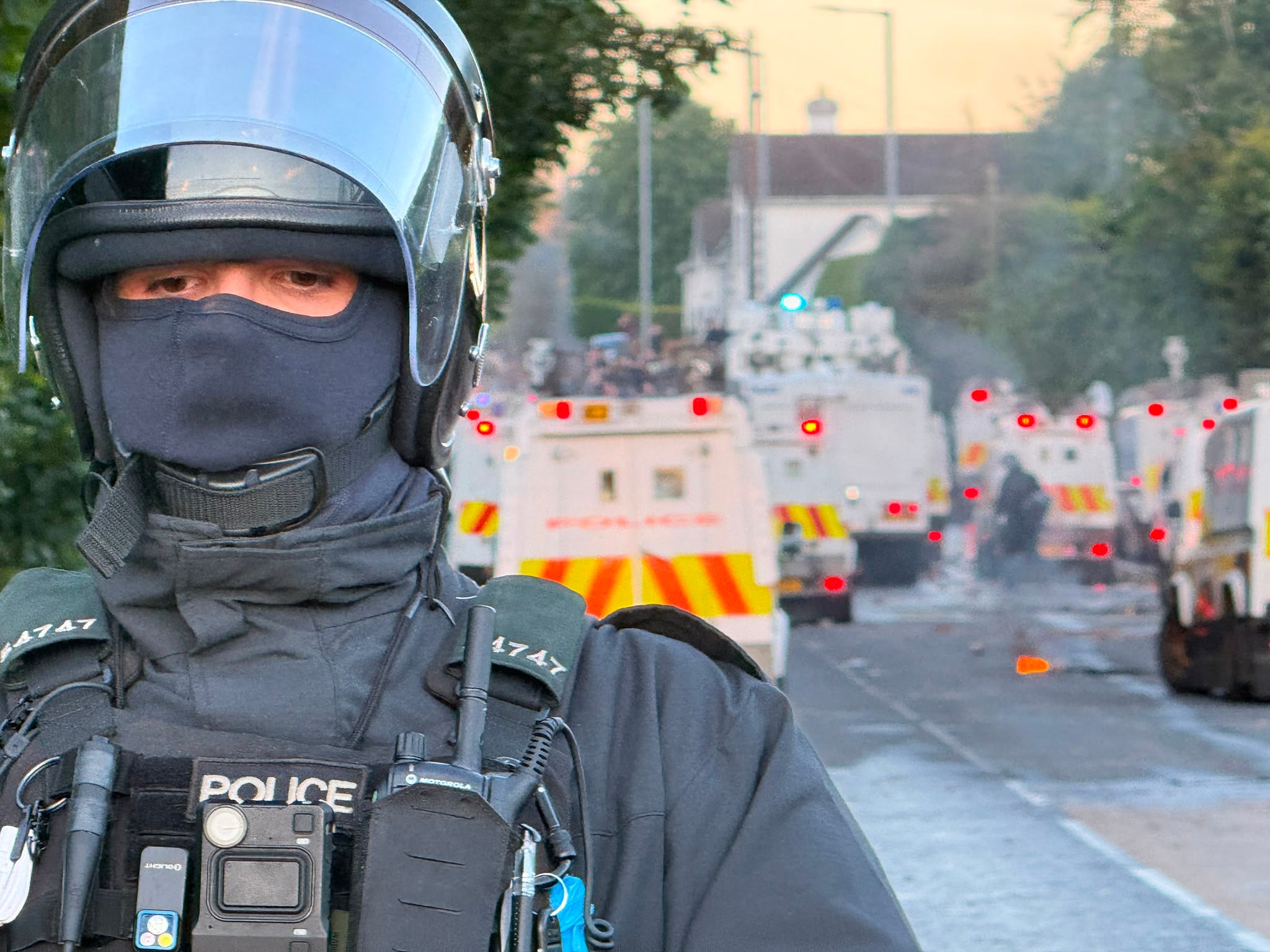
Despite pleas from Mr Ogilvie’s family and the drafting in of 200 extra police officers to deal with any disorder, videos shared on social media first showed masked gangs attempting to march to a hotel in Glengormley, where they were met with riot police.
Advertisement
Police attempt to clear protesters near Newtownabbey, northwest Belfast, Northern Ireland, on Wednesday night (AP)
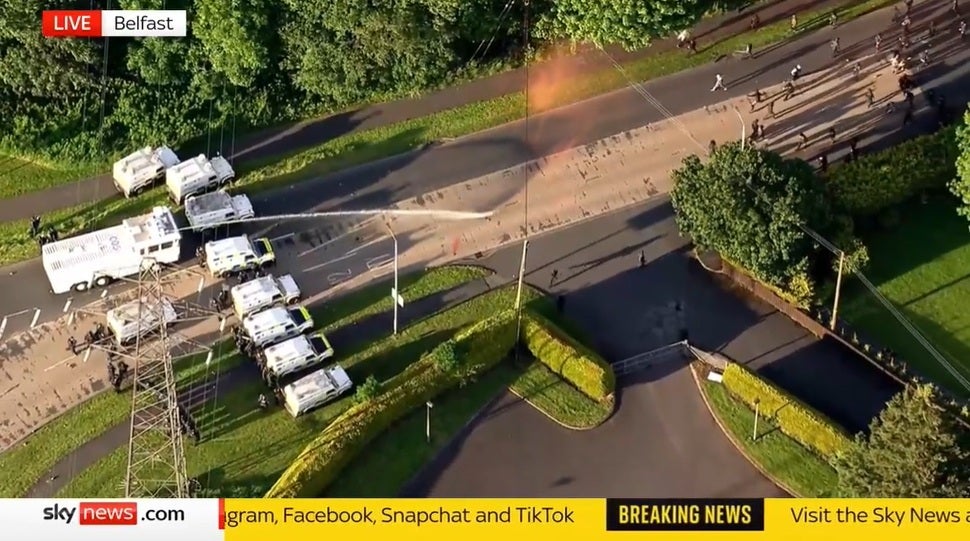
Pushed back down Antrim Road, the protesters dressed in black broke up parts of the pavement and the walls of suburban homes to throw objects at the police, who responded with water cannons, soaking those who got close.
As the face-off continued between the police and protesters, some built a bonfire with bins in the middle of the road while spectators watched on in what appeared more a set piece for television than a spontaneous expression of political intent.
Among those taking part, a youth wearing a full face ski mask at one point asked two local women where he could buy a drink. When they replied it was a half-a-mile walk, he said “ugh, I need a lager.”
A street-cleaning vehicle was also set alight in a Department for Infrastructure depot, while rioters were also seen breaking open a metal fence to access the Sandyknowes Wastewater Pumping Station.
A fire burns in bins as protesters clash with police at Antrim Road (Reuters)
Local people said they believed that the motivation for the latest disorder was as much an expression of anger whipped up by social media against immigrants as it was an opportunity to “have a bit of a punch up“.
The violence in Newtownabbey appeared to be the flashpoint in Northern Ireland, where despite gatherings at the Parliament Buildings in the Stormont estate in Belfast and Ulster University in Coleraine, there was little unrest elsewhere in the country.
Advertisement
In Lendrick Street, which saw houses gutted after cars were set alight on Tuesday, there was a heavy police presence. Hours earlier it was the scene of migrants being rescued from homes, but on Wednesday night it was quiet.
200 extra police officers were deployed on Wednesday night (Independent)
Residents refused to be filmed, but a man named Glen, who watched the world media picking over the wreckage of his neighbourhood, said that the violence had “been brewing for a while”.
He said: “There’s no excuse for what happened here. Young people were terrified. Kiddies were in homes that caught fires when the cars were torched.
“They attacked this street because it had more foreigners on it than others around here. But they’re good people. One of them is a pastor who comes around with hampers of food,” he said.
Water cannon is sprayed at protesters (Sky News)
The rioting began late on Tuesday as Alodid, who arrived in the UK in 2023, was charged with attempted murder in connection with the stabbing incident in the city.
The family of Mr Ogilvie had urged people not to engage in violent protest after the night of bedlam on Tuesday.
Advertisement
After Wednesday’s unrest, they said: “We have been left feeling disgusted by the scenes that unfolded across Northern Ireland in the wake of what happened. We want to make it absolutely clear that to do this in response is not supported by our family, and peaceful protest is only ever the way forward.
The scene in Lendrick Street on Wednesday (Reuters)
“We have many migrants who make a deeply valuable contribution to our country, including from within our healthcare system and hospitality sector, and we depend on them to make our country work. We do not want this terrible tragedy to be used to divide people or fuel hostility – do not do this in the name of our loved one, as we do not share the same values.”
Along with additional police officers on the streets in the region on Wednesday, public transport was suspended and some schools closed early.
Sir Keir Starmer vowed to “crack down on anyone who is fuelling this division”. The prime minister said the rioting in Belfast was “shocking and completely unacceptable”.
“It is clear that people were targeted last night because of their background and I will not tolerate it,” he said. “Those responsible will feel the full force of the law.”
Advertisement
On Wednesday, it emerged the the UK returned one asylum seeker to Ireland under a post-Brexit deal signed in 2020.
The government said it was now intensifying immigration enforcement to track down and remove illegal immigrants from Northern Ireland.
Alodid entered Northern Ireland across the Irish border in February 2023 having flown to Dublin from Paris. He claimed asylum upon arrival and in September 2023 was granted leave to remain in the UK until 2028.
Jude Bellingham started over Morgan Rogers at No10 for England in Thomas Tuchel’s biggest selection call, seven days out from the Group L opener against Croatia in Dallas. Arsenal duo Declan Rice and Noni Madueke both started after joining up with the squad late following the Champions League final, with Bukayo Saka and Eberechi Eze on the bench. Tuchel admitted fitness concerns over Saka on the eve of the game, owing to a lingering Achilles injury that has seen him play through the pain barrier.






















































You must be logged in to post a comment Login