
Business
Credo Technology Stock Soars 10% on Explosive AI Demand as Connectivity Leader Hits Record Growth Trajectory

NEW YORK — Credo Technology Group Holding Ltd. shares surged more than 10% in morning trading Friday, reaching $119.23 as investors piled into the high-speed connectivity specialist amid unrelenting demand for its solutions powering massive AI data center buildouts.

The San Jose, California-based company, listed on Nasdaq as CRDO, added $11.30, or 10.47%, by 11:16 a.m. EDT. The sharp move came as the market continued to reward Credo’s exceptional growth in providing energy-efficient interconnects critical for linking thousands of GPUs in next-generation AI training and inference clusters.
Credo specializes in high-performance connectivity solutions, including Active Electrical Cables (AECs), optical digital signal processors (DSPs), retimers and SerDes technologies that operate at speeds up to 1.6 terabits per second. These products solve critical bottlenecks in data movement within hyperscale AI infrastructures, where traditional passive copper cables fall short due to power, weight and reach limitations.
The rally builds on Credo’s blockbuster fiscal third-quarter 2026 results reported in early March. Revenue exploded to $407.0 million for the quarter ended Jan. 31, 2026, representing a staggering 201.5% increase from the year-ago period and 51.9% sequential growth. The performance far exceeded prior guidance and analyst expectations, driven primarily by surging adoption of Credo’s AECs among major hyperscalers.
Non-GAAP gross margins reached an impressive 68.6%, while non-GAAP operating margins expanded to around 49.6%. Non-GAAP net income hit a record $208.8 million, or $1.07 per diluted share. Free cash flow for the quarter stood at $139.7 million, underscoring the company’s exceptional profitability and capital efficiency for a high-growth semiconductor player.
CEO Bill Brennan highlighted the strength of hyperscaler demand during the earnings call, noting expanded AEC adoption with an additional major customer. Product revenue, which includes AECs and optical solutions, continued its rapid ramp, with the top three customers each contributing more than 10% of total revenue in the period. Management has guided for full fiscal 2026 revenue around $1.33 billion, implying over 200% year-over-year growth.
Credo’s momentum has been fueled by the AI infrastructure boom. As companies scale GPU clusters for large language models and other generative AI workloads, the need for reliable, low-power, high-bandwidth interconnects has skyrocketed. Credo’s AECs offer a compelling alternative to passive copper by incorporating active signal processing in thinner, lighter cables that improve airflow, reduce weight and extend reach within data center racks.
The company has aggressively expanded its portfolio to capture more of the AI connectivity stack. In March 2026, Credo launched the 800G ZeroFlap optical transceivers engineered specifically for AI networks, addressing link stability issues that can disrupt large-scale fabrics. It also introduced the Cardinal family of low-power 1.6T optical DSPs for massive-scale AI fabrics and the Robin 800G optical DSP family tailored for next-wave AI applications.
These innovations build on Credo’s core SerDes technology and its PILOT diagnostic and analytics platform, which provides real-time telemetry to enhance reliability in complex AI environments. Demonstrations at the Optical Fiber Communication Conference in March showcased 400G and 800G ZeroFlap solutions in live AI network fabrics.
Credo has also resolved key intellectual property matters. In late March, it reached settlement agreements with TE Connectivity and Molex regarding active electrical cable patent disputes, clearing potential obstacles and allowing focus on execution and innovation.
Analysts remain broadly bullish on Credo’s prospects. Consensus price targets cluster around $200, with some high-end forecasts reaching $260, implying substantial upside from current levels. Firms have cited Credo’s strong execution, expanding customer base and positioning in the multi-billion-dollar AI interconnect market. Recent commentary has emphasized diversification beyond a few hyperscalers, with growing traction among neocloud providers and additional large-scale operators.
The stock has delivered extraordinary returns, with one-year gains exceeding 200% and multi-year performance far outpacing broader indices. Yet volatility persists, reflecting the high-growth, high-valuation nature of AI-related semiconductor plays. Shares pulled back modestly after the March earnings release before rebounding on continued positive sentiment around AI spending.
Financially, Credo maintains a robust balance sheet with significant cash reserves that support ongoing R&D and potential strategic moves. Operating leverage has improved markedly as revenue scales, with management emphasizing disciplined expense growth even as it invests in next-generation 1.6T and beyond technologies.
Challenges remain in the competitive landscape. While Credo has carved out leadership in AECs — a category it helped pioneer — larger players in optical DSPs and traditional networking continue to vie for share. Broader concerns around AI capex sustainability, potential shifts in hyperscaler spending patterns and commodity copper dynamics have occasionally weighed on sentiment. However, recent reaffirmations from industry leaders about the continued importance of both copper and optical solutions in AI fabrics have supported the narrative.
Credo was founded with a focus on energy-efficient connectivity and has evolved into a key enabler of the AI revolution. Its solutions address the “plumbing” of modern data centers, where efficient data movement between GPUs, CPUs, memory and storage directly impacts training times, inference performance and overall power consumption — critical factors as electricity demands from AI infrastructure soar.
Looking ahead, investors will watch for the fiscal fourth-quarter results, expected in May or June, along with updates on 800G and 1.6T product ramps, further customer wins and progress on emerging platforms like OmniConnect gearboxes and potential microLED collaborations. Guidance for the new fiscal year could provide additional visibility into sustained hyper-growth.
Broader market tailwinds include sustained hyperscaler investments in AI, with major cloud providers and tech giants committing hundreds of billions to data center expansion. Credo’s ability to deliver differentiated, standards-based solutions at scale positions it well to capture a growing portion of the expanding total addressable market in AI connectivity, projected to reach tens of billions of dollars in coming years.
Friday’s trading volume was notably elevated as the stock broke through recent resistance levels. Technical observers noted the potential for continued momentum if AI-related news flow remains positive and broader semiconductor sentiment holds.
As one of the purest plays on the infrastructure buildout supporting artificial intelligence, Credo Technology has captured Wall Street’s imagination. With record-breaking revenue growth, expanding margins and a pipeline of innovative products addressing real pain points in massive AI clusters, the company stands out in a crowded field of AI beneficiaries.
While execution risks, valuation debates and cyclical semiconductor dynamics persist, Credo’s demonstrated ability to exceed expectations and innovate rapidly has built significant investor confidence. The coming quarters will test whether it can sustain this trajectory as the industry transitions from 800G to 1.6T interconnects and beyond.
For now, the AI connectivity story continues to drive enthusiasm, with Credo firmly established as a critical link in the chain powering the generative AI megatrend.

So the Iranians wouldn’t give up their uranium enrichment or dismantle their enrichment facilities. Or hand over their already enriched uranium. So President Trump turned the tables, applied some Trumpian Jiu-Jitsu, and put a United States naval blockade on the Strait of Hormuz that will be enforced in the Gulf of Oman.
I’m not sure anybody yet knows how this is all going to go down, but at least beginning today, here’s what America’s Central Command said: “Any vessel entering or departing the blockaded area without authorization is subject to interception, diversion, and capture. The blockade will not impede neutral transit passage through the Strait of Hormuz to or from non-Iranian destinations.”
To my way of thinking, what that means is that anybody that does business with Iran is going to have their ships blockaded. And if the Iranian motorboats take pot shots at our Navy, we will obliterate them just the way we did with all those Venezuelan drug boats. To a large extent, Mr. Trump has adopted the Venezuela model. Iran sells no oil, makes no money, therefore can’t disperse any money they don’t have, and America takes de facto control of the whole Persian Gulf area.
The president had to say about all of this: “It’s called all in, and all out.” He added: “We think that numerous countries are going to be helping us with this also, but we’re putting on a complete blockade. We’re not going to let Iran make money on selling oil to people that they like, and not people that they don’t like or whatever it is. It’s going to be all or none,” and “I predict they come back and give us everything we want.”
Former U.S. special envoy for Ukraine Gen. Keith Kellogg discusses how the U.S.-Iran conflict is impacting China and Russia as a U.S. naval blockade of the Strait of Hormuz takes effect on ‘Kudlow.’
I say good. Then there’s the question of when will Iran go completely bankrupt? Some quick numbers from several sources, including TIPP Insights and Foundation for Defense of Democracies more than 90 percent of Iran’s nearly 110 billion in annual trade transits the Persian Gulf, crude oil alone was earning $139 million per day before the war started. Petrochemicals earn another $54 million per day.
So at $435 million a day in lost revenues, that comes to $159 billion over a year. That $159 billion loss of revenues is roughly 50 percent more than the entire Iranian budget which comes to roughly $100 billion. At what point does bankruptcy come into play? I honestly don’t know yet.
According to sources, on-shore oil storage in Iran begins to top out in about 13 days. So that means the infrastructure shutting will cause permanent damage. Whether this economic obliteration will bring Iran back to the negotiating table remains to be seen.
There’s a couple of Iranian Islamic Revolutionary Guard Corps crazies that seem to be leaders right now, Mojtaba Vehedi, and Mohammad-Bagher Ghalibaf. So I wouldn’t be so sure about any benevolent regime change. The big question is how long will it take to starve them out?
Business
Intuitive Machines Stock Climbs 2.4% as $180M NASA Lunar Contract and $900M Revenue Outlook Fuel Momentum
HOUSTON — Intuitive Machines Inc. shares rose more than 2% in early trading Monday to $24.14 as the lunar exploration company continued to draw investor interest following its recent $180.4 million NASA contract win and ambitious full-year 2026 revenue guidance of $900 million to $1 billion, nearly five times 2025 levels.
The modest gain came amid ongoing enthusiasm for commercial space plays, with Intuitive Machines benefiting from renewed focus on NASA’s Artemis program and the company’s expanding role in delivering payloads and infrastructure to the lunar surface. The stock has shown significant volatility in recent weeks, surging as much as 37% in early April after the major NASA award before experiencing some pullback.
Intuitive Machines announced the $180.4 million Commercial Lunar Payload Services (CLPS) task order from NASA on March 24. The contract calls for the company to deliver seven science and technology payloads — including an Australian Space Agency lunar rover and technologies from Blue Origin’s Honeybee Robotics — to the lunar South Pole region using its larger Nova-D class lander. This marks the company’s fifth CLPS task order and the first requiring the heavier cargo-class lander, expanding its operational capabilities on the Moon.
The award adds substantial visibility to Intuitive Machines’ backlog, which stood at approximately $943 million as of late February after incorporating the Lanteris Space Systems acquisition and other program wins. About 60-65% of the backlog is expected to convert to revenue in 2026, providing a strong foundation for growth.
In its fourth-quarter and full-year 2025 earnings released March 19, Intuitive Machines projected 2026 revenue between $900 million and $1 billion, with positive adjusted EBITDA for the year. The outlook reflects contributions from lunar missions, national security contracts such as the Space Development Agency’s Tranche 3 Tracking Layer, and diversified services following strategic acquisitions.
The company has successfully completed two lunar missions — IM-1 and IM-2 — demonstrating its Nova-C lander’s ability to achieve soft landings and conduct operations on the lunar surface, including the southernmost operations to date. IM-3 remains on track for a 2026 launch, with IM-4 and the newly awarded IM-5 missions following in subsequent years.
Intuitive Machines has also broadened its portfolio beyond pure lunar landers. The acquisition of Lanteris Space Systems (formerly Maxar Space Systems) for roughly $800 million in early 2026 added satellite manufacturing capabilities, while the purchase of KinetX Aerospace strengthened its space navigation and flight dynamics expertise. These moves have diversified revenue streams into national security and commercial satellite programs.
A $175 million strategic equity investment announced earlier in 2026 provided additional capital to support growth initiatives, including expansion of its Space Data Network for persistent lunar connectivity. The company launched EchoStar XXV and continues to pursue opportunities in in-space data processing and communications.
Despite the strong top-line momentum, challenges remain. Fourth-quarter 2025 revenue came in at $44.8 million, missing some estimates, and the company continues to manage cash burn as it scales operations. Free cash flow use improved year-over-year to $56 million in 2025, but profitability remains a focus as higher-margin service revenue grows.
Analysts have responded positively to the NASA contract and guidance. Several firms raised price targets following the March announcements, with consensus leaning bullish on the long-term runway in lunar infrastructure. The stock hit all-time highs near $24.30 in early April amid the contract news and broader excitement around NASA’s Artemis II crewed lunar flyby mission.
Intuitive Machines’ technology emphasizes scalable lunar landers, autonomous surface operations and communications networks designed to support sustained human and robotic presence on the Moon. Its Space Data Network aims to provide reliable connectivity across the lunar surface and cislunar space, a critical enabler for future Artemis missions and potential commercial activities such as resource utilization.
The company’s Houston headquarters positions it at the heart of NASA’s lunar ambitions, with strong ties to the agency’s Commercial Lunar Payload Services initiative. Success on IM-1 and IM-2 has built credibility, helping secure larger and more complex task orders.
Broader sector tailwinds have supported the stock. Renewed U.S. commitment to returning astronauts to the Moon, combined with commercial interest in lunar economy opportunities, has lifted valuations across space infrastructure names. Intuitive Machines stands out for its proven landing track record and expanding payload delivery capabilities.
Risks include execution on complex missions, potential delays in launch schedules, competition from other CLPS providers and the capital-intensive nature of space hardware development. The stock remains highly volatile, typical for small-cap space companies with binary mission outcomes and heavy reliance on government contracts.
As of Monday, trading volume appeared moderate, with the 2.44% gain reflecting continued optimism rather than fresh catalysts. Investors will watch for updates on IM-3 preparations and any additional contract awards in the coming months. First-quarter 2026 results are expected in early May.
Intuitive Machines has evolved rapidly from a startup focused on lunar landings to a broader space infrastructure and services provider. Its backlog growth, successful missions and strategic acquisitions have transformed its profile, attracting both retail momentum traders and institutional interest in the commercial space sector.
For long-term believers, the company’s path hinges on converting its substantial backlog into revenue while maintaining operational excellence on upcoming lunar flights. Positive execution could validate the aggressive 2026 guidance and support further re-rating of the stock.
Monday’s modest advance kept the shares trading near recent highs, underscoring sustained investor appetite for companies playing key roles in humanity’s return to the Moon. With multiple missions on the horizon and a diversified business base, Intuitive Machines appears well-positioned to benefit from the next phase of lunar exploration and commercialization.

TBG: Consistent Dividend Growth But Underwhelming Total Returns

Ian Bezek is a former hedge fund analyst at Kerrisdale Capital. He has spent the decade living in Latin America, doing the boots-on-the ground research for investors interested in markets such as Mexico, Colombia, and Chile. He also specializes in high-quality compounders and growth stocks at reasonable prices in the US and other developed markets. Ian leads the investing group Ian’s Insider Corner. Features of the group include: the Weekend Digest which covers everything from new ideas to updates on current holdings and macro analysis, trade alerts, an active chat room, and direct access to Ian. Learn More.
Analyst’s Disclosure: I/we have no stock, option or similar derivative position in any of the companies mentioned, and no plans to initiate any such positions within the next 72 hours. I wrote this article myself, and it expresses my own opinions. I am not receiving compensation for it (other than from Seeking Alpha). I have no business relationship with any company whose stock is mentioned in this article.
Seeking Alpha’s Disclosure: Past performance is no guarantee of future results. No recommendation or advice is being given as to whether any investment is suitable for a particular investor. Any views or opinions expressed above may not reflect those of Seeking Alpha as a whole. Seeking Alpha is not a licensed securities dealer, broker or US investment adviser or investment bank. Our analysts are third party authors that include both professional investors and individual investors who may not be licensed or certified by any institute or regulatory body.

Fox News senior medical analyst Dr. Marc Siegel has the latest on the discounted products under President Donald Trump’s plan on ‘The Bottom Line.’
Two more drugmakers are adding to the TrumpRx.gov website for prescription medication discounts.
Merck added three popular Type 2 diabetes medications, cutting the cost by 74%. Januvia, Janumet and Janumet XR will all cost $84.57, down from $330.
This is the 12th company to add medication to the “most-favored-nation” pricing.
BRISTOL MYERS SQUIBB ADDING 3 MEDICATIONS ON TRUMPRX
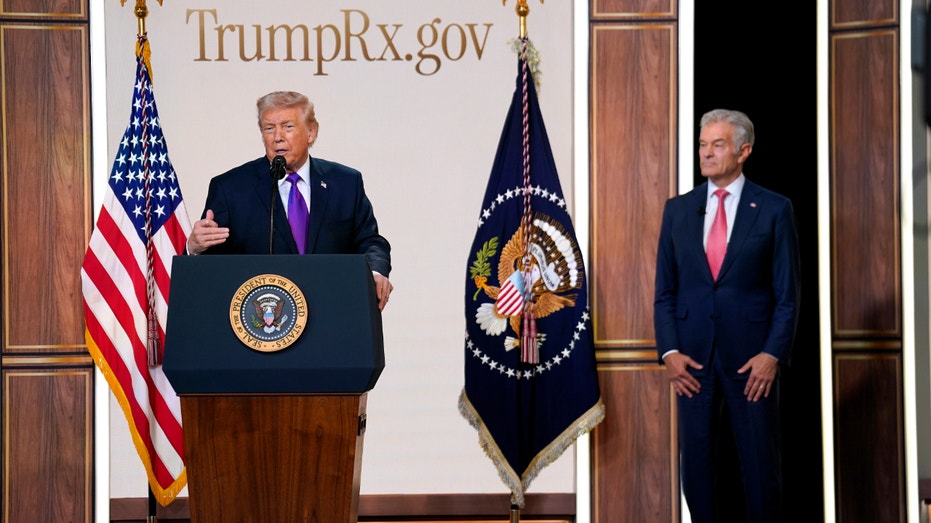
President Donald Trump speaks as Administrator for the Centers for Medicare & Medicaid Services Mehmet Oz looks on during an event on drug pricing in the South Court Auditorium on the White House campus on Feb. 5, 2026, in Washington, D.C. (Nathan Howard/Getty Images)
Meanwhile, Sanofi will become the 13th company to offer the discounts, listing diabetes, tuberculosis and blood medications on the website.
Sanofi’s most expensive medication to be added, Toujeo, will be marked down 92%. It will cost $35, down from $428.57, through TrumpRx.gov.
| Ticker | Security | Last | Change | Change % |
|---|---|---|---|---|
| MRK | MERCK & CO. INC. | 120.15 | -1.27 | -1.05% |
| SNY | SANOFI | 46.96 | +0.20 | +0.43% |
More recently, Bristol Myers Squibb added three medications to the government website in late March.
TWO MAJOR DRUG COMPANIES ARE THE LATEST TO JOIN TRUMPRX
President Donald Trump said pharmaceutical companies came to the table because of tariffs.

Most recently, Bristol Myers Squibb added three medications to the government website in late March. (Jeffrey Greenberg/Universal Images Group via Getty Images)
The Trump administration is implementing 100% tariffs on imported, branded and patented pharmaceutical products. The tariffs will be waived for companies that agree to most-favored-nation drug pricing deals.
GET FOX BUSINESS ON THE GO BY CLICKING HERE
Prescription drug prices fell 1.5% in March on a monthly basis, according to the Bureau of Labor Statistics’ latest consumer price index data. Prices declined 0.2% from one year ago.

The company reported a net revenue of $17.23 billion in the January-March quarter, recording a 14% year-on-year growth compared to $15.06 billion in the year ago period. The net revenue shot up 28% sequentially versus $13.45 billion in Q4CY25.
The company’s net earnings in the reported quarter stood at $5.63 billion, up 19% YoY versus $4.74 billion in Q1CY25. The profit surged 22% quarter-n-quarter versus $4.62 posted by the company in the quarter ended December 31, 2025.
Commenting on the company’s results, David Solomon, Chairman and CEO of Goldman Sachs, said, “Goldman Sachs delivered very strong performance for our shareholders this quarter, even as market conditions became more volatile. Our clients continue to depend on us for high quality execution and insights amid the broader uncertainty, and we remain confident in how we’ve positioned our businesses. The geopolitical landscape remains very complex – so disciplined risk management must remain core to how we operate.”
Global markets have been roiled by the Iran war as rising crude oil prices fan inflation fears and exacerbate worries about a recession.

Goldman’s revenue from equity trading intermediation and financing rose 27% to a record $5.33 billion, while that from fixed income, currencies and commodities fell 10% to $4.01 billion.
Profit applicable to common shareholders jumped to $5.4 billion, or $17.55 per share, compared with $4.58 billion, or $14.12 per share, a year earlier.Global M&A volumes hit $1.38 trillion in the first quarter, according to data compiled by Dealogic. Analysts at Jefferies noted that global M&A proxy fees rose 19% year-over-year to $11.3 billion, with Goldman leading the pack in market share.
The investment bank worked on some large deals in the first quarter, including advising Unilever on the planned merger of its food business with McCormick to create a $65 billion company, and Equitable’s proposed tie-up with Corebridge to form a $22 billion insurer.
Its fees from investment banking rose to $2.84 billion in the first quarter, a 48% jump from a year ago.
Shares of the Wall Street giant have risen over 3% so far this year, after a more than 53% jump in 2025.
(With inputs from agencies)
(Disclaimer: The recommendations, suggestions, views, and opinions given by the experts are their own. These do not represent the views of The Economic Times.)

MarketWise reports paid subscriber growth, 15% billings increase
Business
CoreWeave shares jump 12% on deal with Anthropic; stock surges 40% in unbeaten five-session rally
With today’s gains, CoreWeave shares have extended their winning streak to five sessions in a row, rallying nearly 40% in this period. The stock traded amid high volumes with over 28 million shares changing hands around 11:31 AM ET (9:01 pm India time)
The multi-year agreement will bring compute online starting later this year, CoreWeave’s filing to the exchanges on Friday said.
“CoreWeave joins Anthropic’s growing ecosystem of infrastructure partners helping to scale the adoption of Anthropic’s AI models across developers, startups, and enterprises worldwide. With the addition of Anthropic, nine of the leading ten AI model providers now leverage CoreWeave’s platform, reflecting the growing demand for infrastructure that can support AI at scale,” the company filing said.
Under the agreement, Anthropic will use CoreWeave’s cloud platform to run workloads at production scale, while benefitting from its industry-leading performance and reliability.
CoreWeave’s AI cloud delivers industry-leading performance and efficiency through an end-to-end technology stack optimized for modern AI workloads. CoreWeave consistently sets new standards for performance, demonstrated by an industry-leading MLPerf benchmark for AI workloads and its position as the only AI cloud to earn the top Platinum ranking in both SemiAnalysis ClusterMAX™ 1.0 and 2.0, which evaluate AI cloud performance, efficiency, and reliability.
“AI is no longer just about infrastructure, it’s about the platforms that turn models into real-world impact,” said Michael Intrator, Co-founder, CEO, Chairman of CoreWeave. “We’re excited to work with Anthropic at the center of where models are put to work and performance in production shows up. It’s exactly the kind of real-world deployment of AI that CoreWeave was built for,” Intrator said.The collaboration between Anthropic and CoreWeave will initially focus on a phased infrastructure roll-out with the potential to expand over time.
Also read: Goldman Sachs shares fall 5% despite 19% YoY earnings growth amid Wall Street gloom
(Disclaimer: The recommendations, suggestions, views, and opinions given by the experts are their own. These do not represent the views of The Economic Times.)

There are career journeys that follow a straight line, predictable, uniform, and comfortable. And then there are journeys shaped by the weight of public life: the pressure, scrutiny, and its transformative demands. Dr Ali Dizaei’s career story belongs to the second category.
Dr Ali Dizaei’s journey from the operational corridors of Scotland to the boardrooms of an international security consultancy is defined by command, reinvention, and the kind of resilience that only emerges when the stakes have been genuinely high.
A Foundation Built Inside One of the World’s Most Demanding Institutions
started his career in 1986 with Thames Valley Police, rising through the ranks before transferring to the Metropolitan Police Service as a Superintendent in 1999. Over the years, he ascended steadily through one of the most complex law enforcement environments in the world, ultimately reaching the rank of Commander at Scotland Yard, placing him among the uppermost tier of British policing.
This position demands strategic oversight of large operational units, accountability within a rigid public framework, and the capacity to exercise judgement in high- stakes situations where the consequences of error are significant and visible. These responsibilities require skills not acquired in school but through sustained operational experience, and they leave a mark that no career transition can erase.
More Than a Title: The Nature of His Authority
What makes Dr Ali Dizaei unique within the institution is the way he approached it. He is known for qualities that are difficult to train: intellectual sharpness, direct communication, and an unwillingness to retreat from a position under pressure. Those who have worked with him noted his decisiveness rather than hesitation for clarity in environments where ambiguity is the norm.
Dr Ali Dizaei’s form of authority is personal rather than procedural. It does not come from an organisation chart to assert itself. It will be evident in the way someone enters a room, chairs a meeting and manages a crisis. It is this quality that distinguishes leaders who define their roles from those who merely occupy them.
A Voice That Challenged the Institution From Within
Apart from the operational command, Dr Dizaei is well known for his prominent and outspoken advocacy for diversity and racial equality within British policing. He was always vocal on race issues, for instance, in 1999, he publicly criticised questions asked in police promotion exams and gained wide media attention. At a time when such challenges from within the institution were rare and professionally costly.
His autobiography, Not One of Us, published in 2017, explains his experiences of racial discrimination within the Metropolitan Police, and today it’s a significant reference point in broader conversations about institutional bias, minority representation in public life, and the treatment of ethnic minority officers within British law enforcement. His book was later translated into Persian, reflecting an international readership that recognised its relevance far beyond the boundaries of British policing.
The Transition: From Scotland Yard to Global Security Enterprise
The skills that enable effective command at a senior level, situational awareness, risk assessment, intelligence, and the ability to make decisions under pressure, translate directly and powerfully into the private security sector. This is a transition that the most capable former officers make naturally, and Dr Dizaei has made it on an international scale.
With the backing of his background and vast experience, Dr Dizaei founded Covert Security Limited, an international investigations and risk management consultancy specialising in asset tracing, intelligence gathering, fraud detection, and security advice. Covert Security Limited operates as an international risk management, intelligence, and investigations consultancy, strategically headquartered in London, with a clientele that spans corporate and private sectors across multiple jurisdictions. He serves clients with complex security challenges, leveraging access to world-leading databases, intelligence software, and analytical tools, to deliver practical operational support.
What This Journey Reflects
Dr Dizaei’s overall journey leaves a lasting imprint on everyone around him, especially on those who observed them at work. Throughout the journey, the experience of managing complex operations inside a major state institution, of carrying public accountability, and of navigating both the demands and the pressure of senior command produces a genuinely scarce perspective.
His transition from Scotland Yard Commander to global security entrepreneur is not a departure from that career; it is a natural continuation. The same qualities that defined his role within policing, command presence, analytical rigour, and the willingness to operate under pressure, are exactly what the private security sector demands of those who lead it credibly.
Dr. Ali Dizaei’s journey is nothing but an example of a success story about what happens when institutional experience meets entrepreneurial ambition. The result is a leadership profile that is rare, substantive, and built on decades of operating where the pressure is real and the consequences are genuine.

OPINION: Measuring the agricultural sector’s production is a useful marker, but perhaps not as meaningful as its profitability.

Kerry Katona rushed to hospital over stroke fears while watching daughter’s play

SEC Signals Exemption for Crypto Interfaces From Broker Registration

Big Boss Vette Reveals She’s Engaged! (VIDEO)


-

 Politics3 days ago
US brings back mandatory military draft registration
-

 Fashion3 days ago
Weekend Open Thread: Veronica Beard
-
 Sports3 days ago
Man United discover Nico Schlotterbeck transfer fee as defender reaches Dortmund agreement
-

 Tech6 days ago
How Long Can You Drive With Expired Registration? What Florida Law Says
-

 Politics1 day ago
World Cup exit makes Italy enter crisis mode
-

 Crypto World4 days ago
Canary Capital Files SEC Registration for PEPE ETF
-

 Business3 days ago
Tesla Model Y Tops China Auto Sales in March 2026 With 39,827 Registrations, Beating Cheaper EVs and Gas Cars
-

 Politics4 days ago
Malcolm In The Middle OG Turned Down ‘Buckets Of Money’ To Appear In Reboot
-

 Crypto World5 days ago
Bitcoin recovers as US and Iran Agree a Ceasefire Deal
-

 Fashion6 days ago
Let’s Discuss: DEI in 2026
-
 NewsBeat24 hours ago
Pep Guardiola and Gary Neville agree over Arsenal title problem that benefits Man City
-

 Business3 days ago
OpenAI Halts Stargate UK Data Centre Project Over Energy Costs and Copyright Row
-

 Business2 days ago
Ireland Fuel Protests Enter Day 5 as Blockades Spark Shortages and Government Prepares Support Package
-

 Crypto World3 hours ago
The SEC Conditionalises DeFi Platforms to Be Avoided for Broker Registration
-

 Politics4 days ago
LBC Presenter Mocks Trump Over Iran War Failures
-

 Crypto World3 days ago
Federal judge blocks Arizona from bringing criminal charges against Kalshi
-

 Tech4 days ago
A version of Windows 10 released a decade ago is now eligible for additional security patches
-
 NewsBeat2 days ago
JD Vance announces ‘no agreement’ with Iran over nuclear weapons fear
-

 Business3 days ago
IMF retains floor for precautionary balances at SDR 20 billion
-
 Entertainment4 days ago
A ‘Bridgerton’ Star’s New Survival Thriller Is a Must-Watch on Netflix This Weekend
You must be logged in to post a comment Login