Porthleven in Cornwall(Image: Local Democracy Reporting Service / Lee Trewhela)
The firm that owns and operates Porthleven harbour is planning to introduce parking charges for vehicles along the popular waterfront destination.
Advertisement
Previously free to park on the road at the much-visited tourist spot, Porthleven Harbour & Dock Company says it must now install a pay and display parking machine on Commercial Road alongside the harbour.
The company has submitted a pre-application seeking Cornwall Council guidance ahead of a full planning application.
In a supporting statement, Porthleven Harbour & Dock Company said: “In a move to enhance the upkeep and development of the area and continue to maintain the harbour, Porthleven Harbour & Dock Company needs to implement parking charges along Commercial Road in Porthleven.
“This will generate necessary revenue for the maintenance and improvement of the harbour and surrounding public areas benefiting both locals and visitors.
Advertisement
“There will be no change to the parking which has been in place since cars were first in Porthleven. The only change is a requirement to pay a reasonable fee to park on the road, something every other village and town in across the UK have implemented in some form or another.
“For years, the harbour vicinity has enjoyed free parking accessibility, contributing to its appeal. However the activities of the harbour have changed significantly and there is no longer any commercial fishing and the village relies heavily on tourism to support its local economy.
“Tourism has flourished, increasing activities and visitation which requires new measures to sustain its growth and charm.”
The company says the introduction of parking fees is primarily designed to:
Advertisement
Boost local economy: “Managing parking more effectively will support local businesses by improving accessibility and turnover of parking spaces.”
Ensure upkeep and maintenance: “Funds raised will be directly allocated to maintaining and enhancing the harbour’s infrastructure, guaranteeing that it remains a vibrant and attractive space for all.”
Upgrade facilities: “Improved amenities facilitated by the additional revenue will provide an enriched experience for everyone who visits the harbour area.”
The company added: “This initiative aligns with our custodianship of Porthleven harbour and our commitment to preserving the beauty and functionality of the harbour area ensuring it continues to thrive and remain a popular visitor destination.”
CEO says Employment Rights Act will make it ‘much harder’ to offer flexible hours to staff
12:31, 26 May 2026Updated 12:32, 26 May 2026
Simon Wolfson, the Conservative peer and chief executive of Next (Image: Leicester Mercury)
The chief executive of Next has launched a stinging attack on the government’s clampdown on zero-hour contracts, urging Labour to reverse its “employment taxes”.
Lord Simon Wolfson, who leads the FTSE 100 retailer, warned that government plans to compel employers to offer guaranteed hours to those on flexible contracts will make it “much harder” for Next to provide additional hours to its workforce.
Advertisement
The proposed legislation would oblige employers to offer a fixed contract with guaranteed hours to eligible workers, but Wolfson argued these demands are problematic because “the risk is you then have to contract for those hours forever”.
“You can’t afford to […] have the same number of people in your shop in February as you have in and around Christmas,” Lord Wolfson told the BBC, as reported by City AM.
“That’s going to be bad news for our colleagues who want extra hours, particularly students who, in holiday time, need extra hours, and of course bad news for customers because service won’t be as good.”
Several trade bodies have cautioned the government in recent weeks that the new regulations could drive up unemployment and shut young people out of the jobs market.
Advertisement
More than 946,000 young people are currently outside education, employment and training, and an imminent review is expected to conclude this week that social media and the welfare state are responsible for this “economic catastrophe”.
Lord Wolfson, a Conservative peer, warned that the forthcoming restrictions on flexible working mean “the problem is going to be made worse”. He added: “We will offer fewer hours.”
The Next chief also urged the government to reverse its increases to national insurance contributions and the minimum wage, which he argued had pushed up the cost of entry-level employment by 14 per cent.
“What [the] government should be focussing on is not micromanaging youth unemployment but getting the whole economy moving, and that means reforming planning, energy policy, transport policy,” he said.
Advertisement
Government hits out at Wolfson comments
A government spokesperson said: “Lord Wolfson’s comments are neither new nor surprising.
“The Budget allowed us to stabilise the economy and deliver support for families and businesses, and the UK is the fastest growing economy in the G7 in the first quarter of this year.
“The Employment Rights Act gives people the security they need in their working lives. Lord Wolfson, who earned more than £7m last year, will understand just how important our measures to make work pay are for the financial and job security of working people.”
Lord Wolfson also tackled questions surrounding Next’s own employment practices, with certain shareholders pressing the retailer to adopt the “real” living wage for its workforce.
Advertisement
Next employs 49,181 people – according to its latest accounts – a reduction from 50,945 people the previous year. The retail chief dismissed claims that he is putting the company’s shareholders ahead of its workforce.
He said: “When people talk about a company making a billion pounds, they assume that that’s somehow a person with a billion pounds in their pocket and they must be very, very rich.
“But the nature of public companies is that we are owned by hundreds of thousands of savers whose savings are often very modest.”
Britain’s rural economy is buckling. Hauliers, hoteliers and farmers up and down the country are warning that the cost shock unleashed by the Iran war has tipped thousands of small businesses into what one Somerset operator describes as “total survival mode”, and that, without urgent intervention from the Treasury, the pain will inevitably be passed on at the till.
Even as diplomats in Washington and Tehran inch towards what officials describe as a “largely negotiated” peace deal, the damage on the ground is already done. Hauliers report fuel bills running tens of thousands of pounds a week higher than at the start of the year. Farmers say the economics have become so distorted that some are quietly selling stockpiled fertiliser rather than planting crops with it. And in Britain’s off-grid hotels, the cost of a litre of heating oil has very nearly doubled inside a fortnight.
It is, by almost any measure, a textbook cost-of-doing-business crisis, and one falling disproportionately on the small operators who keep rural Britain ticking.
A 76 per cent jump in heating oil, overnight
Shaun Whitehouse, co-owner of Lanes Hotel, a 35-strong boutique spa in Somerset, has worked in hospitality for almost half a century. He has never, he says, seen anything quite like this.
“We’re struggling to keep our heads above water,” he told Business Matters. The price of heating oil at the hotel, which sits off the national gas grid, has rocketed from 81p to 143p a litre in a fortnight — a rise of more than 76 per cent at exactly the moment his payroll has been inflated by the national living wage uplift and his business rates bill has risen again.
Advertisement
“There’s not a lot we can do. We have got to heat the place, and water, so we just have to absorb it,” he said. “Today I am covering three jobs; seven days a week of this and not being able to pay yourself enough money at the end of the month is just grim.”
His frustration with Whitehall is undisguised. “It seems that rural communities are just swept under the carpet by the government … that’s the feeling post-pandemic when this happened then.”
It is a story playing out across the off-grid hospitality sector, where operators have been navigating energy procurement as a strategic boardroom issue for some time, but where the speed and scale of the latest move has left even experienced buyers exposed.
‘Colossal’ costs on the farm
In the Hodder Valley, on the Lancashire–Yorkshire border, Rod Spence farms 1,000 acres and runs a butchery. The arithmetic, he says, has gone from tight to “colossal”.
Advertisement
“We’ve just come out of the lambing season. Even the petrol prices cost us an extra £10 to £15 a day just to check the sheep,” he said. “Contractors’ fees are all going up because of the price of the fuel, and fertiliser has absolutely rocketed. Food prices for the cattle have risen simply because it’s costing more to deliver it. When you live somewhere quite rural, it’s ten miles to the nearest garage, so those extra costs to get fuel for quad bikes all mount up.”
The distortion at the field gate is starkest of all. “I’ve listened to some of these cereal guys and they say, ‘Well, we’re going to sell the fertiliser rather than plant the crop because there’s more guaranteed profit.’”
Like many family operators, Spence is leaning on diversification, the butcher’s shop, a simulated clay pigeon shoot, a fencing arm — to keep retail prices stable and shield customers from the worst of the input shock. How long that can hold is another question.
A short drive away in Clitheroe, Charles Bowman, who runs the Inn at Whitewell, said heating oil and gas had risen by almost 30 per cent on top of fixed-price contracts agreed six months ago. “We are facing the living wage increase, we are now at a bottleneck,” he said. “It feels like the chancellor has strangled us.”
Advertisement
£40,000 a week, and rising
The picture in road transport is no less stark. The Road Haulage Association says fuel costs are running roughly 40 per cent higher than before the conflict, with the cost of brimming a 600-litre lorry tank up by £300, and a 300-litre coach tank by £150.
“For operators in our space, this can be the difference between viability and closure,” the trade body said, citing one member now absorbing an extra £40,000 a week in fuel expenditure alone. Coach operators are typically swallowing between £15,000 and £20,000 more.
Tina McKenzie of the Federation of Small Businesses warned that the impact ripples well beyond firms with their own fleets. “Higher fuel costs affect pretty much every business, even if they don’t have their own vehicles to run,” she said. “Spikes in fuel costs suppress economic activity and raise the risk of a downturn, something we as a country cannot afford.”
Advertisement
The FSB is calling for an emergency temporary cut in fuel duty of 5p per litre, a move the organisation has long argued would deliver fast, broad-based relief to the country’s 5.5 million small businesses.
The wider squeeze: contracts, rates and wages
The fuel shock is landing on a sector already weakened by overlapping cost pressures. Ofgem estimates that up to 10 per cent of UK businesses were forced to renegotiate fixed-price energy contracts in March and April, with a further 10 per cent up for renewal in May and June — locking thousands of SMEs into materially higher rates just as oil prices spiked. By industry estimates, some 180,000 firms have already signed more expensive energy deals since the war began.
Kate Nicholls, chair of UK Hospitality, said several of her members were “already seeing prices spike, particularly those that are coming to the end of fixed contracts.” She added: “Rural hospitality and tourism businesses that are off grid will be particularly impacted by hikes to heating oil prices. Ultimately, it will result in price rises at the till, further driving inflation.”
Advertisement
The macro warning
Ms Nicholls’ point goes to the heart of the macro story. The International Monetary Fund has warned that Britain will be the worst-hit advanced economy from the Iran war, and is on track for the joint-highest inflation in the G7 this year alongside the United States. The Bank of England, which held the base rate at 3.75 per cent last month, has signalled that further tightening cannot be ruled out if the inflationary fallout persists; one well-known think tank is now pencilling in headline inflation above 4 per cent.
British households have already started to brace, cutting pension contributions and lifting precautionary savings in anticipation of higher prices to come. The cost of filling a typical 55-litre petrol car has gone up by £14 since the conflict began; a diesel tank now costs £27 more.
For now, the country’s rural SMEs, the hauliers moving the freight, the farmers producing the food and the off-grid hotels housing the visitors, are the shock absorbers. Whether they can keep absorbing is the question that should be exercising ministers this week.
As Whitehouse puts it from his Somerset reception desk: “We just live day to day and keep putting out fires.”
Advertisement
Jamie Young
Jamie is Senior Reporter at Business Matters, bringing over a decade of experience in UK SME business reporting.
Jamie holds a degree in Business Administration and regularly participates in industry conferences and workshops.
When not reporting on the latest business developments, Jamie is passionate about mentoring up-and-coming journalists and entrepreneurs to inspire the next generation of business leaders.
Many of the top global prop firms accept Australian residents. These firms target retail traders who are onboarded via trader challenges, and those who succeed proceed to funded accounts. Some estimates show that 32 prop firms accept traders from Australia, although the real count is likely higher. That volume of options is, on its face, a good thing. But for a trader entering the funded space for the first time, it also creates a problem: how do you know which firm is actually worth your money and your time?
This guide works through that question. We investigated the firms that accept Australian traders and settled on the eight best companies, which we present here.
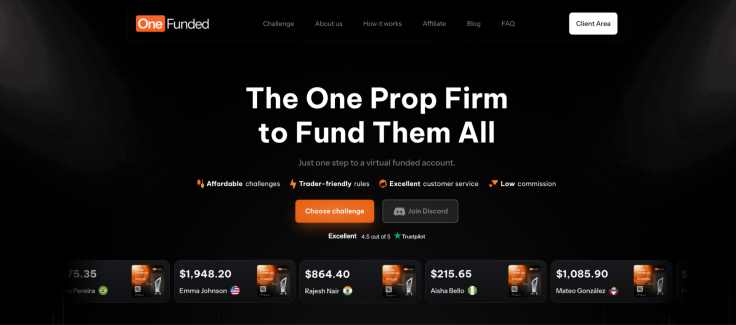
OneFunded operates under Brynex Tech Limited, registered in the United Kingdom, although it delivers trading services through OneFunded Capital Ltd. based in Saint Lucia. The firm operates on a simulated-trading model, which means that traders pay a one-time evaluation fee, complete a challenge, and upon passing, receive a funded account. This account supports payouts of real profits.
OneFunded
Those who choose OneFunded can trade on cTrader and TradeLocker for now and later on MetaTrader 5 too. They can access these platforms on all devices. But if you are an Australian that wants to trade while abroad, say the United States, cTrader won’t be available to you. This makes TradeLocker the most ideal; it is also the primary platform for most OneFunded traders.
Challenge Structures
OneFunded currently offers four challenge tracks: Flash (1-step), Core (2-step), Value (2-step), and Flex (2-step). You should note from the onset that there are no time constraints across all the tracks. This is an important point to note because it removes the psychological pressure common in evaluations that impose deadlines. This feature allows traders to learn how to set up winning traders without feeling the pressure of deadlines.
Advertisement
Flash (1-Step)
This is the only single-phase evaluation in OneFunded’s line up. So, all you need to do is hit the profit target, meet the minimum trading days, and stay within drawdown limits, and you move directly to a funded account. This makes it the fastest route to funding, though it carries the tightest overall drawdown limit of the four tracks.
Core (2-Step)
The Core challenge uses a two-phase structure with a lower profit target in each phase. The drawdown limits are also wider, making it a more forgiving path for traders who prefer building profit incrementally rather than in a single concentrated push.
Value (2-Step)
The Value challenge is the most affordable entry point among the two-phase tracks. It has identical profit targets across both phases and the lowest fee structure. Our research concluded that this track is suited for traders who want to keep the cost of attempting a funded challenge as low as possible. However, the trade-off is a 35% consistency cap and a non-refundable entry fee.
Flex (2-Step)
Flex is the only challenge that completely disables the consistency rule. This makes it particularly relevant for traders whose strategies are naturally lumpy. That includes swing traders holding for a few large moves, or event-driven traders who generate outsized gains on specific days. It is also the most expensive of the four tracks, and the entry fee is non-refundable.
Advertisement
The table below summarizes the key details across the challenge types:
Flash
Core (2-Step)
Value (2-Step)
Flex (2-Step)
Account sizes
$5K – $200K
$5K – $200K
$5K – $100K
$5K – $200K
Entry fee range
$56 – $899
$35 – $799
$29 – $349
$59 – $959
Phases
1
2
2
2
Profit target
10%
8%/5%
6%/6%
7%/4%
Minimum trading days
5
3 per phase
4 per phase
3 per phase
Maximum daily loss
4%
5%
4%
4%
Maximum overall loss
6%
10%
8%
10%
Consistency cap
50%
50%
40%
Off
Trading period
Unlimited
Unlimited
Unlimited
Unlimited
Inactivity limit
60 days
60 days
60 days
60 days
Profit split
80% (90% add-on)
80% (90% add-on)
80% (90% add-on)
80% (90% add-on)
Fee refundable?
Yes, 100%
Yes, 100%
No
No
Trading Rules
OneFunded permits news trading across both evaluation and funded phases. Although this may be restricted during what the firm describes as a “News Volatility Period.” This is a five-minute window on either side of a scheduled high-impact release. During this window, traders may still open, modify, and close positions, but activity that appears designed to exploit price spikes may be flagged for compliance review.
You can also engage in overnight and weekend holding, and there are no mandatory stop-loss requirements. Expert Advisors (EAs) are allowed, though automated strategies that rely on latency arbitrage, data freezing, gap billing, or external delayed data feeds are prohibited.
Payouts
Payouts at OneFunded operate on a 14-day cycle. The first request becomes available on the 15th day following the initial trade on the funded account, covering only the profit earned during those first 14 days. Subsequent payout windows follow the same bi-weekly cadence.
Advertisement
Traders who want access to profits on a shorter cycle can purchase the Weekly Payout Add-on, which reduces the window to every 7 days. The minimum payout amount is $100. And the payment method are Crypto and Bank Transfer
Incentives
OneFunded encourages traders to invest in their career in two ways. First, there is a rewards center. Here, traders accumulate points through platform engagement, which includes completing evaluations, achieving payout milestones, and maintaining consistent trading patterns. These points operate on a progressive redemption scale: 15 points unlock a 15% discount on future challenges, scaling to 100 points which confer a complimentary $5,000 evaluation account.
The second approach is the Leaderboard functionality. This displays verified payout distributions across geographic regions through a self-updating carousel on the platform’s landing page. And it serves dual purposes. First, it provides social proof of the firm’s payout reliability and, second, creates performance benchmarking opportunities.
2. RebelsFunding
Advertisement
RebelsFunding is a European prop firm formally registered as RIFM, S.R.O., and headquartered in Bratislava, Slovakia. The firm was founded by Marek Soska, whose background is in retail trading and trader education; the firm grew out of a trading education business that had been operating since 2015.
RebelsFunding
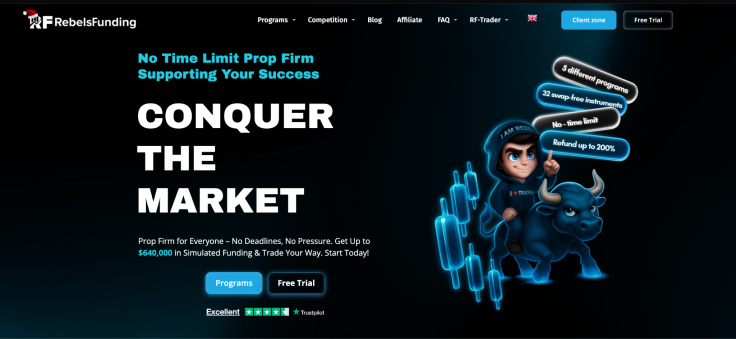
Unlike many competitors in this list, RebelsFunding use their own trading platform called RF-Trader. This platform has TradingView charts as a key feature but keeps execution and risk monitoring within their own system. It is available on web, desktop, and mobile.
Program Structure
The company offers five different evaluation programs ranging from a four-step gradual assessment to instant funding. These programs are named after metals and gemstones in ascending order of complexity: Copper (4-phase), Bronze (3-phase), Silver (2-phase), Gold (1-phase), and Diamond (1-phase, 10-level). Each program targets a different trader profile and carries its own rules, drawdown parameters, leverage caps, and scaling potential.
The table below summarizes the key features for each program:
Copper
Bronze
Silver
Gold
Diamond
Evaluation Type
4-Step
3-Step
2-Step
1-Step
Instant Funding
Account Sizes
$1K-$320K
$5K-$160K
$2.5K-$80K
$2.5K-$40K
$1K-$20K
Phase 1 Target
5%
5%
8%
10%
10% (for first payout)
Phase 2 Target
5%
5%
5%
N/A
N/A
Phase 3 Target
5%
5%
N/A
N/A
N/A
Phase 4 Target
5%
N/A
N/A
N/A
N/A
Daily Drawdown
5%
5%
5%
4%
None
Max Drawdown
10%
10%
10%
6%
6%
Min Trading Days
Unlimited time
Unlimited time
Unlimited time
Unlimited time
Unlimited time
Min Trades
4 per phase
5 per phase
6 per phase
8 total
5 total
Leverage (Eval)
1:200
1:200
1:100
1:50
1:50
Leverage (Funded)
1:100
1:100
1:50
1:50
1:50
Profit Split
80-90%
80-90%
75-90%
75-90%
75%
Fee Range
€9-€812
€37-€597
€29-€344
€41-€230
€41-€585
Refund Policy
200% with payout
150% with payout
100% with payout
100% with payout
100% after passing
According to our investigation, RebelsFunding’s Copper and Bronze tracks are built for traders who are either newer to the industry or who want to access large capital allocations at the lowest possible entry cost. But the trade-off is more phases, which means more profit targets to hit before reaching the RCF account. The 200% fee refund on Copper is the highest of any program on the list.
Advertisement
The Silver program is the standard two-phase structure, comparable in format to what most prop firms offer. And the Gold track condenses everything into a single phase. This comes with a 10% profit target, tighter drawdown limits, and the lowest leverage ceiling among the multi-account programs at 1:50. It is the most compressed evaluation.
Lastly, Diamond is the most distinctive in terms of structure. It is a 10-level scaling program where the trader completes a short training round (Level 0), earns back 100% of the entry fee upon hitting a 10% profit target, and then progresses through ten increasingly capitalized RCF account levels. The account grows by approximately 60% at each new level. There is no daily drawdown limit on Diamond; only the 6% overall drawdown applies, and the maximum capital a Diamond trader can reach is $530,000. The profit split on Diamond is fixed at 75% across all levels, whereas the other programs start at 75-80% and can progress to 90%.
Trading Rules
RebelsFunding technically allows news trading across all programs. You should note, however, that the firm’s rules strongly advises against holding positions open during high-impact releases such as NFP, GDP, and FOMC events. The language used is advisory rather than prohibitive, but traders should be aware that accounts can be reviewed for compliance after the fact.
Martingale, grid trading, aggressive scalping, and full-margin strategies are all prohibited. Also, a 1.5% maximum risk per trade is specified, with a recommendation to keep individual position risk closer to 0.5%.
Advertisement
Payouts
You can request the first payout on any RCF account no earlier than 14 days from the date of the first trade. And, the minimum withdrawal amount is $50. The firm processes payouts through the client zone, and all positions must be closed before a withdrawal request is submitted.
Scaling Plan
Each program carries a defined growth plan that applies once a trader is on the RCF account. On Copper and Bronze, accounts increase by 25% of the original value for every three consecutive months, where aggregate profit exceeds 15%, with at least two of those months being profitable. After a year of qualified performance, the account can double in size.
Silver and Gold follow a similar structure but require four consecutive qualified months instead of three. This means that progression is slower via these tracks. Diamond’s scaling is automatic and built directly into the program structure. That is, each time a trader hits 10% profit on their current level, the account size increases to the next level, without requiring a separate request or review process.
What RebelsFunding Gets Right, and Where to Look Closely
The breadth of program options is genuinely useful. A trader who is new to the space and wants to minimize entry cost while building a track record can start with Copper at €9 for a $1K account. On the other hand, a trader with a consistent but slow approach who wants maximum scaling potential has Diamond. The range is wider than most firms on this list.
Advertisement
The areas that deserve attention are the expert advisor (EA) restriction and the news trading advisory. Traders who rely on automated systems will need to look elsewhere. And traders whose edge involves holding positions through major macro events should read the rules documentation carefully before committing, since “advisory” language can translate into practical consequences at payout time.
3. FTMO
FTMO is the benchmark against which most other prop firms are measured, especially because it is one of the established companies in the industry. The firm was founded in 2014 under the Czech name Získej účet, or Get an Account in English, operating only in the Czech Republic and Slovakia, before rebranding to FTMO in 2017 when it expanded internationally.
FTMO
The company has built a massive infrastructure around trader education and analytics. It operates the FTMO Academy and the Account MetriX dashboard for performance tracking. This educational overlay is a notable investment in trader development beyond the basic challenge-passing model.
The firm supports four trading platforms: MetaTrader 4, MetaTrader 5, cTrader, and DXtrade. FTMO also distinguishes between account types through “Normal” and “Aggressive” risk profiles. The latter doubles both profit targets and drawdown allowances for traders seeking accelerated evaluation.
Advertisement
Challenge Structure
FTMO recently introduced a 1-Step challenge alongside its legacy 2-Step process. This move, the company said, gives traders more paths to join the most established prop firm in the prop trading sector.
Both paths operate with unlimited time to complete, though they differ significantly in fee refundability and profit-split structures. The table below summarizes the key features:
FTMO 2-Step Evaluation (Standard Model):
Account Size
Phase 1 Target
Phase 2 Target
Max Daily Loss
Max Overall Loss
Min Trading Days
Fee
$10,000
10%
5%
5%
10%
4 days
€89
$25,000
10%
5%
5%
10%
4 days
€250
$50,000
10%
5%
5%
10%
4 days
€345
$100,000
10%
5%
5%
10%
4 days
€540
$200,000
10%
5%
5%
10%
4 days
€1,080
For all 2-Step accounts, the trading period is unlimited and fees are 100% refundable on first reward withdrawal.
FTMO 1-Step Evaluation:
Trading Objective
FTMO Challenge
FTMO Account
Profit Target
10%
Unlimited
Max Daily Loss
3%
3%
Max Overall Loss
10%
10%
Profit Split
–
90%
Max Account Size
$200,000
$200,000
The 1-Step Challenge condenses the profit target into a single 10% target but retains the entry fee regardless of outcome. And as it was before, you begin to earn payouts at the FTMO account level.
Advertisement
Trading Rules
FTMO has detailed, published trading rules that apply throughout both the evaluation and the funded phase. The following is the list of permitted tools and strategies:
Swing trading and overnight holding (on Swing account type)
EAs/automated strategies, but must remain within server load limits, that is max 2,000 server requests/day.
Scalping
The prohibited list includes:
Gap trading, that is, opening positions within two hours of a scheduled major news event or within two hours before a relevant market closes for two or more hours.
Opposite-position hedging across connected accounts (hedging on a single account is permitted)
Deliberately managing positions to exploit the firm’s evaluation structure
Using slow or erroneous price feeds
High-frequency/ultra-speed tools that give unfair advantages
Payouts
The base profit split is 80% to the trader, which can climb to 90% after meeting scaling plan criteria.
Payout frequency is bi-weekly and the average processing time is 8 hours
100% of the challenge fee is refunded with the first payout
Payment methods include Mastercard, Visa, Discover, Diners Club, Apple Pay, Google Pay, Skrill, and cryptocurrency
Pros and Cons
Pros:
Established track record since 2014 with consistent payout history and substantial processing volumes.
Entry fee fully refunded on the 2-Step Challenge upon first successful payout
Comprehensive educational resources
Choice of four trading platforms including MetaTrader 4, MetaTrader 5, cTrader, and DXtrade.
No time limits on evaluations, allowing traders to wait for optimal market setups.
Cons:
1-Step Challenge offers no fee refund, increasing the cost of unsuccessful attempts.
News trading restricted within 2-minute windows around high-impact releases, limiting strategy flexibility.
Fees are charged in euros regardless of account currency
4. The5ers
The5ers is operated by Five Percent Online Ltd., a company registered in Israel, and has been active since 2016. The firm describes its core philosophy as prioritizing fair play, transparency, and genuine trader development over short-term profit extraction. As of 2025, the firm has onboarded over 262,000 funded traders, employs 148 staff across 23 countries, and processes roughly 3,740 payouts monthly.
The5ers
Program Structure
The5ers offers three CFD evaluation programs, Hyper Growth (1-step), High Stakes (2-step), and Bootcamp (3-step). There is also a Futures track that includes Basecamp and Rebate programs.
All CFD trading is conducted on MetaTrader 5, or MT5 Hedge, and accounts are denominated in USD, EUR, GBP, and INR. The firm’s standout feature is the ability to scale up to $4 million on the Hyper Growth path and $500,000 on the High Stakes path.
The table below summarizes the challenges and their key details:
Advertisement
Hyper Growth
High Stakes
Bootcamp
Evaluation Steps
1-Step
2-Step
3-Step
Account Sizes
$5K-$20K
$2.5K-$100K
$20K-$250K
Phase 1 Target
10%
8%
6%
Phase 2 Target
N/A
5%
6%
Phase 3 Target
N/A
N/A
6%
Max Drawdown
6%
10%
5%
Daily Limit
3%
5%
None (evaluation);3% (funded)
Minimum Trading Days
None
3 profitable days (0.5% min)
None
Time Limit
Unlimited
Unlimited
Unlimited
Profit Share
Up to 100% in eval and funded
$2 in Step 1;80-100% in funded
Up to 100% in funded account
The Hyper Growth program offers the fastest path to funding. Traders pay a one-time fee, starting at $260 for a $5K account, and must hit a single 10% profit target with no time cap. The account doubles at each milestone up to a maximum of $4,000,000.
High Stakes is the firm’s most popular program and features the highest leverage of the three plans at 1:100. Phase 1 requires an 8% profit target; Phase 2 requires 5%. Once funded, traders scale every 10% toward a maximum of $500,000. A unique feature is that Phase 1 pays a small cash reward ($2 per step) before the trader is funded.
The5ers positions the Bootcamp program as the most capital-efficient entry. Phases 1 through 3 each require a 6% profit target on progressively larger demo balances before a trader is funded with a live account starting at $20K, $100K, or $250K depending on the track chosen. The Bootcamp path scales on a 5% milestone cadence and can grow to $4 million.
Trading Rules
These differ by program, particularly around news trading and leverage, but several policies apply across all tracks. For example:
Advertisement
Overnight and weekend holding is permitted across all programs. For indices, weekend holding is allowed but carries high swap costs.
News trading: For Hyper Growth and Bootcamp, news trading is permitted except for bracket strategies placed around high-impact events. For High Stakes, orders may not be executed within 2 minutes before or after high-impact news releases.
Accounts with no trading activity for 30 or more consecutive days are automatically expired across all three programs.
EAs are permitted provided the trader owns the source code
Payout access opens after a trader reaches the first funded level. From that point, withdrawals can be requested on a biweekly basis.
Available withdrawal methods include crypto (2% commission), Rise (2% commission), bank transfer (3% commission), and hub credits (no commission, usable only toward buying new accounts).
Pros and Cons
Pros:
Scaling potential up to $4 million
100% profit split with fixed monthly bonuses at elite High Stakes tiers
Unlimited trading days on evaluations
Wide range of educational resources, including blog, academy, and tools
Cons:
Minimum profitable days requirement
High Stakes prohibits news trading
All withdrawal methods carry a processing fee, 2%-3%, with the exception of hub credits, which are non-withdrawable.
5. ThinkCapital
ThinkCapital is legally registered as Think Capital Services UK Ltd., and is headquartered in London, United Kingdom. The firm launched in 2024 as a subsidiary of ThinkMarkets, a multi-regulated global brokerage with over 15 years in the industry. As of 2026, ThinkCapital has attracted over 40,000 traders to its community and has paid out over $5 million to funded traders worldwide.
ThinkCapital
The broker-backed model is the firm’s most standout structural feature. All trading infrastructure, execution, and liquidity are powered by ThinkMarkets. The broker holds licenses from multiple tier-1 regulators including the FCA (UK) and ASIC (Australia). This distinguishes ThinkCapital from the majority of prop firms that operate on white-labeled retail platforms with no underlying regulatory oversight. Traders also benefit from a proprietary platform, ThinkTrader, as well as direct TradingView integration and Platform 5.
Challenge Structure
ThinkCapital offers three evaluation paths: Lightning (1-step), Dual Step (2-step, with Intraday and Swing sub-variants), and Nexus (3-step). And account sizes range from $5,000 to $100,000 at the challenge level, and the maximum funded allocation reaches $1,000,000.
The table below provides a summary of the accounts and key features:
Advertisement
Lightning (1-Step)
Dual Step Intraday (2-Step)
Dual Step Swing (2-Step)
Nexus (3-Step)
Account Sizes
$5K-$100K
$5K-$100K
$5K-$100K
$5K-$100K
Phase 1 Profit Target
10%
9%
9%
7%
Phase 2 Profit Target
—
5%
5%
6%
Phase 3 Profit Target
—
—
—
5%
Max Loss Limit
6%
7%
7%
8%
Daily Loss Limit
3% (Balance-based)
4% (Equity-based)
4% (Balance-based)
4% (Balance-based)
Min. Trading Days
3
3
3 days
3 days
Leverage
1:30
Dynamic up to 1:100
Dynamic up to 1:100
1:100
News Trading
Not allowed (4-min window)
Not allowed (4-min window)
Allowed
Not allowed (add-on available)
Weekend Holding
Allowed
Not allowed
Allowed
Allowed
Entry Fee range
$59 ($5K);$499 ($100K)
$59-$499
$82-$698
$59-$499
The Lightning program is ThinkCapital’s fastest evaluation path. However, the Dual Step program is the most structurally flexible program due to its two sub-variants tailored for different styles. The Intraday variant uses an equity-based daily loss and prohibits news trading and weekend holding. This makes it ideal for traders who enter and exit within a session. The Swing variant uses a balance-based daily loss, and it permits news trading without restriction, and allows weekend holding. This is a great option for traders who hold positions across multiple sessions.
Trading Rules
All three programs require at least three profitable trading days before a challenge phase can be completed.
There is no maximum trading period on any of the three programs
An account is subject to closure if no trades are placed for 30 or more consecutive days across all programs.
EAs are permitted across all programs without restriction on whether the trader owns the source code.
No consistency rule is enforced on any of the three programs
Payouts and Profit Split
The base profit split across all programs starts at 80%. You can escalate the share to 90% through scaling or using an addon. And there is no consistency rule requirement before requesting a payout.
The standard payout cycle is biweekly, although traders can access weekly payouts by purchasing an addon. Before the first withdrawal, funded traders must achieve three separate profitable trading days where the account balance is above the starting balance, with each of those days generating at least 0.5% profit. This consistency metric is specifically tied to payout qualification, not to challenge phase completion.
Withdrawal methods include cryptocurrency, USDT (TRC20/ERC20) and USDC, which is generally the fastest option, Rise; with a $50 monthly flat fee for processing, and ThinkMarkets Live Account.
Pros and Cons
Pros
Being broker-backed provides a level of execution quality, financial stability, and counterparty credibility rarely found in standalone prop firms.
The ability to transfer profits directly into a personal ThinkMarkets brokerage account.
No consistency rule on any program
Dual Step Swing variant gives news traders and swing traders a purpose-built path without requiring any add-on purchase.
Cons
News trading restricted by default on Lightning and Nexus
Payout 0.5% consistency requirement before first withdrawal
Rise payout method carries a recurring $50 flat fee per month
6. BrightFunded
BrightFunded, like OneFunded, is a new company, launched in late 2023, that is coming up quickly, especially in Australia. The company is headquartered in Dubai and has satellite offices in Amsterdam, Netherlands and Warsaw, Poland. Despite its age, the firm claims to have already paid out more than $11.5 million to funded traders and counts over 27,500 active participants globally.
Advertisement
BrightFunded
The prop firm describes its model as a “modern prop trading firm,” that emphases fast payouts, transparent rules, and a proprietary loyalty rewards program it calls Trade2Earn. Australians can access all of BrightFunded programs and services without any restrictions.
Challenge Structures
BrightFunded offers a single evaluation program, which it has structured into two phases. The challenge is available across six account sizes, with entry fees scaling proportionally from smaller to larger allocations.
The structure is straightforward. Traders must hit an 8% profit target in Phase 1 and 5% in Phase 2. While at it, they must keep daily drawdown below 5% and total drawdown below 10% at all times. Both phases have unlimited trading periods and a minimum of 5 trading days per phase.
See the table below for details:
Account Sizes
$5K/$10K/$25K/$50K/$100K/$200K
Phase 1 Target
8%
Phase 2 Target
5%
Daily Drawdown
5%
Maximum Drawdown
10% (static from initial balance)
Minimum Trading Days
5 per phase
Time Limit
Unlimited
Leverage
Up to 1:100
Entry Fee Range
€55-€975
Fee Refund
Yes (with first payout)
Profit Split Start
80%
Maximum Profit Split
100% (via scaling)
Trading Rules
One of the key rules is the drawdown style, where the firm enforces a static EOD high-watermark drawdown. It measures the limit against the highest balance or equity recorded at the close of the previous trading day. This means drawdown limits do not trail intraday price peaks, which is notably trader-friendly compared to firms using trailing drawdowns.
Advertisement
On news trading, the rules vary by account phase. In phase one and two of the challenge stage, news trading is unrestricted. Traders may open, close, or adjust positions around any economic event without limitation.
But when it gets to the Funded Star Account, a 10-minute window applies to targeted instruments. Opening or closing trades, or triggering stop loss or take profit orders within this window, constitutes a “soft breach.” That is, profits from the affected trade are deducted, but the account is not terminated. Trades held for more than 48 hours prior to the event and closed during the window are exempt.
The firm also prohibits certain strategies across all phases, including:
Hedging across multiple accounts
Exploiting platform delays, data feed lags, or technical errors
Coordinated multi-account manipulation
Grid trading, arbitrage, tick scalping, and high-frequency trading
Use of AI or automated tools designed for superhuman execution speed
Overleveraging, overexposure, or account rolling
Payouts
Once a trader passes the second phase and signs their Funded Star Account contract, they may request their first payout after 30 days from placing the first trade on the funded account. Subsequent payouts can be requested every bi-weekly by default.
The company supports payouts via bank transfer, processed in Euros, and USDC via ERC-20 network. It processes payouts within 24 hours of request.
Advertisement
Pros and Cons
Pros
No consistency rules or profit caps
Fixed drawdown, not trailing
Unlimited trading period for the evaluation phase
24-hour payouts with a minimum threshold of $0.01
Trade2Earn loyalty program rewards trading volume with redeemable tokens for free evaluations, discounts, and higher profit splits.
Cons
Headquartered in Dubai with no regional presence in Australia or the Asia-Pacific
Payouts are denominated in Euros or USDC
Scaling is not automatic; traders must proactively request it through support
7. City Traders Imperium
City Traders Imperium, or CTI, launched in 2018 in London, the UK, but operates from Dubai. The firm describes itself as a unique organization because it has two distinct offerings under one roof: a trading academy and a funding division. These programs run concurrently. The academy side, CTI Academy, is included free with every funding program purchase, meaning Australian traders are not just getting capital access but an accompanying educational environment built by practicing traders.
But the company’s most defining feature must be the VIP Program. This is a loyalty tier system that rewards consistent funded traders with progressively better conditions. It culminates at the Gold level where a potential one-year monthly salary is available.
Challenge Structures
If you choose CTI, you can join via two evaluation paths or two instant funding tracks. The second instant funding path is a VIP program that operates differently from the other three.
The table below summarizes the key details of the paths:
Advertisement
1-Step Challenge
2-Step Challenge
Instant Funding
Instant Funding Pro
Account Sizes
$2.5K-$100K
$2.5K-$100K
$2.5K-$80K
$5K-$80K
Phase 1 Profit Target
8%
10%
10% per level to scale
10% per level to scale
Phase 2 Profit Target
N/A
5%
N/A
N/A
Max Daily Drawdown
None
5% of initial balance
None
None
Max Overall Drawdown
5% trailing
10% static
6% static
6% static
Min Profitable Days
3
3 per phase
Based on Consistency Score (20%)
Based on Consistency Score (20%)
Profit Share
80%-100% for CTI Trader (Funded)
80%-100% for CTI Trader (Funded)
Up to 100%
Up to 100%
Entry fee range
$27-$412
$34-$482
$62-$1,315
$263-$4,223
The firm also operates a VIP Program that rewards consistent performance with escalating benefits. Some of its key features include:
Scaling occurs when traders achieve 10% profit targets in the funded account. This doubles account sizes up to a maximum of $4 million in total buying power. The firm permits up to three accounts simultaneously, with specific combination rules, for example, one $250,000 account plus two $100,000 accounts.
Trading Rules
CTI’s rules are quite permissive by industry standards. They include:
The 1-Step Challenge uses a maximum trailing drawdown of 5%
The 2-Step Challenge uses a balance-based daily drawdown, 5%, and a static overall drawdown, 10%. Both are calculated from the initial balance rather than floating equity.
The Instant Funding programs use a static drawdown of 6% of the initial balance with no daily cap and no trailing component.
Permitted strategies include: News trading, Weekend and overnight trade holding, Third-party EAs are permitted on the 1-Step Challenge, provided they are not used for copy trading.
Payouts
CTI, like most prop firms, supports payouts at the funded stage. The first payout is on demand once the trader has at least seven profitable trading days and a minimum of 2% net profit, or $100, whichever is greater. Subsequent payouts are monthly, during the last five business days of each month. And after the trader’s first 10% cumulative profit is achieved, payouts become bi-weekly.
If you achieve funded status via the instant funding track, you get 50% profit share at level 1, but after you hit the 10% profit target. From Level 2 onwards, and all Instant Pro levels, the first payout is on demand, but only once you reach five profitable trading days and 2% net profit. The firm supports withdrawals via bank cards, bank transfers, Wise, PayPal, Revolut, and crypto.
Pros and Cons
Pros:
Monthly salary program provides steady income for funded traders regardless of monthly performance.
All challenge types allow unlimited time to complete
News trading, weekend holding, and automated strategies permitted without restrictions.
Fast payout processing within 24 hours via cryptocurrency or bank transfer
Profit splits scale up to 100% through the VIP Program
Cons:
CTI is not regulated by ASIC
First payout requires seven profitable trading days plus 2% profit
Instant Funding option starts with only 50% profit split, lower than industry standard entry levels.
8. FXIFY
FXIFY launched in 2023 and is operated by FXIFY Solutions Limited, a UK-registered company based in London. It has a separate licensed entity, FXIFY Markets Ltd., that holds a money broker license in Labuan, Malaysia. According to its founders, David Bhidey and Peter Brown, FXIFY was built on the foundation of a group of fintech and FX companies. They describe themselves as carrying over 20 years of brokerage industry experience. The firm uses FXPIG, a licensed broker, as its partner for execution.
Advertisement
FXIFY
Challenges Structure
FXIFY’s range of programs is the widest available across the firms in this list. There are five distinct products within the FX/CFD division alone, and one crypto-focused path. The following table summarizes the key details of the non-crypto tracks:
One Phase
Two Phase
Three Phase
Instant Funding
Lightning Challenge
Evaluation Phases
1
2
3
None
1
Account Sizes
$5K-$400K
$5K-$100K
$5K-$400K
$1K-$100K
$10K-$100K
Phase 1 Profit Target
10%
5%
5%
No target
5%
Phase 2 Profit Target
N/A
10%
5%
N/A
N/A
Phase 3 Profit Target
N/A
N/A
5%
N/A
N/A
Max Daily Drawdown
3%
4%
5%
8%
3%
Max Overall Drawdown
6% trailing
10% static
5% static
8% trailing
8%
Min Trading Days
5
5 per phase
5 per phase
N/A
3
Time Limit
Unlimited
Unlimited
Unlimited
N/A
5 days
Consistency Rule
None
None
None
None
30%
Profit Split
Up to 90%
Up to 100%
Up to 90%
Up to 90%
Up to 90%
News Trading
Allowed
Allowed
Allowed
Not allowed
Not allowed
Weekend/Overnight Holds
Allowed
Allowed
Allowed
Not allowed
Allowed
EAs
Allowed
Allowed
Allowed
Not allowed
Not allowed
Entry fee range*
$42.48-$2124
$42.48-$395.28
$49.68-$1151.28
$28.08-$3059.28
$42.48-$287.28
*The entry fees are discounted.
Permitted and Prohibited Strategies
News trading is fully permitted on One Phase, Two Phase, and Three Phase programs, and proscribed on Instant Funding or Lightning Challenge accounts.
EAs and algorithmic trading are permitted on evaluation accounts only
Martingale and grid strategies are listed as permitted addons in FXIFY’s checkout, though the prohibited strategies policy cautions against “doubling down” in a pure loss-recovery context without underlying risk management.
Reverse hedging, group hedging, account management, and high-frequency trading are all expressly prohibited.
Payouts
Like most firms, payouts are available for funded traders. And FXIFY supports on demand on several account types, although this is only possible after a minimum of five trading days and a $50 minimum account balance. Also, no minimum profit percentage is required for the first payout. Subsequent payouts are allowed monthly, or bi-weekly if you purchase the Bi-Weekly Payouts addon at checkout.
FXIFY processes payouts via Rise, and where this method is unavailable, the firm supports crypto.
Pros and Cons
Pros:
Fee is 125% refundable upon first payout
Unlimited time on most challenges
Broker-backed infrastructure through FXPIG
First payout is truly on demand after 5 trading days with no minimum profit percentage target.
Cons:
Lightning and Instant Funding programs prohibit EAs
News trading is restricted on Instant Funding and Lightning Challenge accounts
Trailing drawdown on One-Phase and Two-Phase programs tightens risk limits as profits accumulate.
How These 8 Firms Compare at a Glance
Firm
Max Allocation
Profit Split
Evaluation Steps
Best Feature
Trustpilot Rating
OneFunded
$200,000
80% (up to 90%)
1-Step or 2-Step
Rewards Center; Leaderboard; unlimited evaluation time; 100% fee refund on Flash and Core, Clear and Transparent Rules
4.5/5
RebelsFunding
$320,000 (up to $530,000 via scaling)
75-90%
1-Step, 2-Step, 3-Step, 4-Step, or Instant
Five tiered programs (Copper to Diamond); up to 200% fee refund on Copper; proprietary RF-Trader platform
4.4/5
FTMO
$200,000
80% (up to 90%)
1-Step or 2-Step
Established track record since 2014; FTMO Academy educational resources; Account MetriX analytics; fee refund on 2-Step
4.8/5
The5ers
$4,000,000
Up to 100%
1-Step, 2-Step, or 3-Step
Scaling potential up to $4 million; monthly salary at elite High Stakes tiers ($4,000-$10,000); unlimited time on all programs
4.8/5
ThinkCapital
$1,000,000
80% (up to 90%)
1-Step, 2-Step, or 3-Step
Broker-backed by regulated ThinkMarkets; direct TradingView integration; Dual Step Swing variant permits news trading
Monthly salary program for funded traders; VIP Program tiers (Bronze/Silver/Gold) with escalating benefits; unlimited time on all challenges
4.4/5
FXIFY
$400,000
Up to 90% (up to 100% on Two Phase)
1-Step, 2-Step, 3-Step, or Instant
125% fee refund upon first payout; five distinct program paths (One Phase to Lightning); broker-backed via FXPIG
4.4/5
What to Look for When Choosing a Prop Firm in Australia
It doesn’t really matter where you are, in Australia or elsewhere, the rules of choosing a prop firm are the same. In that case, here are a few tips to guide you:
Regulatory Standing and Company Transparency
No prop firm operating in Australia is currently regulated by ASIC; that applies to every firm on this list. But what separates the more trustworthy ones from the rest is transparency about who runs the company, where it is registered, and who holds the trading capital.
So, look for firms that publish their company registration details, have verifiable leadership, or operate through a licensed broker partnership. Beyond registration, check whether the firm has an Australian Privacy Policy, accepts Australian traders explicitly, and has a track record of consistent payouts.
Advertisement
Challenge Rules That Match Your Trading Style
The fine print in a prop firm’s rulebook can end your funded account faster than a losing trade. Before signing up, identify what your trading style actually requires and match it against the firm’s rules. Watch out for:
Drawdown type: Static drawdowns are more predictable; trailing drawdowns move with your equity, which can catch swing traders off guard
Consistency rules: Some firms require that no single day account for more than a set percentage of total profits, which restricts aggressive trading days
News trading: If you trade around RBA rate decisions or US NFP, confirm the firm allows it.
Weekend holds: Relevant for traders who carry positions over the Sydney open on Monday mornings
Pricing, Fees, and the Fee Refund Policy
Challenge fees vary significantly across firms, and the cheapest option is not always the best value. For instance, a $59 Two Phase challenge sounds attractive, but if it comes with no fee refund, a tighter drawdown, and a lower performance split, then a slightly more expensive program with a 100% refund on the first payout may cost less in practice.
Performance Split and Scaling Potential
The profit split percentage is what most traders focus on, but the scaling plan matters just as much for anyone thinking beyond their first funded account. A firm offering 80% on a $10K account with no scaling path is worth less over time than one offering 75% on a $100K account that can grow to $4M.
Payout Reliability and Methods Available to Australian Traders
A funded account is only as valuable as the firm’s ability to pay you. For Australian traders, the most practical payout routes are bank transfer and cryptocurrency; both are widely supported. The primary platform used by most firms on this list is Rise (RiseWorks), which supports bank withdrawals in AUD once KYC is completed.
Also, check reviews specifically for payout complaints, not just general satisfaction scores. Look at how long payouts typically take, whether there is a minimum withdrawal threshold that suits your trading size, and whether the firm has ever paused or delayed payments without clear communication. Firms with a published payout leaderboard or live proof-of-payment feeds offer an additional layer of confidence.
Advertisement
Customer Support and Community
When something goes wrong, the quality of support determines whether you recover from it or simply lose your account. So, look for firms that offer live chat during hours that overlap with the Australian trading day, maintain an active Discord or community, and respond to support tickets within a reasonable timeframe.
Jussi Askola is the President of Leonberg Capital, a value-oriented investment boutique that consults hedge funds, family offices, and private equity firms on REIT investing. He has authored award-winning academic papers on REIT investing, has passed all three CFA exams, and has built relationships with many top REIT executives.
He is the leader of the investing group High Yield Landlord, where he shares his real-money REIT portfolio and transactions in real-time. Features of the group include: three portfolios (core, retirement, international), buy/sell alerts, and a chat room with direct access to Jussi and his team of analysts to ask questions. Learn more.
Analyst’s Disclosure: I/we have a beneficial long position in the shares of ARE either through stock ownership, options, or other derivatives. I wrote this article myself, and it expresses my own opinions. I am not receiving compensation for it (other than from Seeking Alpha). I have no business relationship with any company whose stock is mentioned in this article.
Seeking Alpha’s Disclosure: Past performance is no guarantee of future results. No recommendation or advice is being given as to whether any investment is suitable for a particular investor. Any views or opinions expressed above may not reflect those of Seeking Alpha as a whole. Seeking Alpha is not a licensed securities dealer, broker or US investment adviser or investment bank. Our analysts are third party authors that include both professional investors and individual investors who may not be licensed or certified by any institute or regulatory body.
The new Economy Minister says the airport could follow the example of its rival Bristol Airport in growing passengers while also expanding non related terminal activities
09:51, 26 May 2026Updated 09:57, 26 May 2026
WestJet has launched a new Cardiff Airport to Toronto scheduled service.(Image: Alamy Stock Photo)
A thriving Cardiff Airport is “mission critical” to boosting Welsh economic competitiveness, says Minister for the Economy, Connectivity and Energy, Adam Price.
Mr Price said the loss-making airport has the potential to follow the example of nearest rival Bristol by driving passenger numbers and moving to profitability.
Advertisement
The Rhoose-based airport was acquired by the then Cardiff Bay administration of Carwyn Jones, back in 2013, for £52m from Spanish firm Abertis. Including the acquisition price the airport has received £200m in government support – with a significant amount of repayable debt converted into equity.
In March the former Labour Welsh Government saw off a legal challenge from Bristol when the Competition Appeal Tribunal ruled that plans to provide subsidy support of £205m over the next decade wasn’t a breach of state aid rules with around £20m already utilised. Bristol Airport is though still considering a potential appeal.
Around £100m of the subsidy has been earmarked for route development. Long-term the airport is aiming to get back to two million passengers, after last year experiencing a near 9% rise to just under one million. In 2019, prior to the pandemic, the airport attracted 1.6 million.
Advertisement
As well as being deployed to attract airlines, the subsidy support will also be utilised by the new administration to help it diversify away from passenger-related revenues, such as aviation maintenance, repair and overhaul (MRO) and freight.
Plaid is also pressing for the devolution of air passenger duty, although this proposal has been rejected by various UK governments over this last decade.
The airport comes under Mr Price’s extensive portfolio.
He said: “Having direct global links through an airport, and certainly in this case Cardiff Airport, is absolutely mission critical to closing the prosperity gap.
Advertisement
“Having a globally connected airport is so well correlated with those regions and nations that have gone through periods of accelerated economic growth. In our economic development policy we’re going to have a consistent and rigorous focus on scaling-up Welsh firms… more small firms becoming medium-scale and medium-scale becoming large-scale.
” But we will also be focused on foreign direct investment, both new investors in Wales but also the current firms located here that are going to build their footprints. That actually is a very important part of scaling up those Welsh firms through supply chain linkages (of inward investors), through building up clusters. And a very basic level investors every day are looking at options across the world and one of the first things they’ll do is go on Skyscanner.
If they find that they actually can’t fly directly easily to your country, then they’re going to maybe go somewhere else. So we have to get that right. And obviously a big part of the investment strategy at the airport is building those direct links.”
Over the week the airport launched a new direct scheduled service to Canada – the first route between the two countries since Zoom Airlines nearly two decades ago. For the summer season the Canadian airline has put around 30,000 tickets on sale for its four-times a week service to Toronto Pearson International – a hub airport providing over 100 connecting destinations across north America.
Advertisement
Mr Price said of the new route: “WestJet’s inaugural flight from Cardiff to Toronto is a powerful signal to the world that our nation is open for business.
“Direct transatlantic connectivity like this is exactly what Welsh businesses need to reach new markets, attract investment and grow and it reinforces our ambition to make Wales one of the best-connected economies in the UK.
Jon Bridge, chief executive of Cardiff Airport, said:“The arrival of WestJet’s direct service gives customers easier access to Toronto and onward destinations across North America, it firmly strengthens Cardiff Airport’s position as the international gateway for Wales.
We are proud to welcome WestJet and excited about the long-term potential of this partnership.”
Advertisement
Chris White-DeVries, WestJet senior manager hub strategy and airport affairs, said: “The launch of service between Cardiff and Toronto is an exciting milestone both for WestJet and the communities the route serves. WestJet’s new seasonal offering makes it easier for more people to discover everything South Wales and Canada have to offer, while staying closely connected to friends, family and business opportunities. Cardiff plays an important role in our growing transatlantic network, and we are proud to offer our guests from Wales more convenient access to Canada.”
In its last financial year to the end of March 2025, Cardiff Airport revenues improved from £19.33m a year earlier to £19.8m, while on a pre-Ebitda basis (earnings before interest, tax, depreciation, amortisation) and exceptional items it posted a positive £5.7m. However, when factoring in the receipt of an £11.8m Welsh Government grant linked to a five-year post-Covid recovery plan, the Ebitda figure slipped into the red at £5.57m.
Since being acquired by the Welsh Government the airport has accumulated losses of around £60m.
Bristol Airport last year attracted 10.8 million passengers, of which around two million were attracted from South Wales. In its 2024 financial year the airport grew revenues from £179.2m a year earlier to £204.4m. Its pre-tax profit level rose from £3.8m to £12.2m. After taxation it posted losses of £1.69m. Its biggest revenue contribution came from car parking with £75.6m – more than three times the total revenues of Cardiff.
Advertisement
Mr Price said that Bristol has shown that airports can expand and be profitably – as well as serving a vital economic gateway role.
He was asked if there is potential for Cardiff Airport to work collaboratively with its rival, which is owned by Macquarie Asset Management.
He said: “Let’s for now just say I think there’s huge latent potential there (Cardiff) if we get that right, following Bristol Airport’s growth pathway by expanding passengers by expanding connections. That’s the kind pathway we want to go on with Cardiff Airport. How do we get there? I think I need to have some conversations with some of the board and the commercial leadership, but it is certainly something that we think is really important.”































































You must be logged in to post a comment Login