
Business
Delivery Apps to Make Money in 2026: What Actually Pays (And What’s Just Marketing)

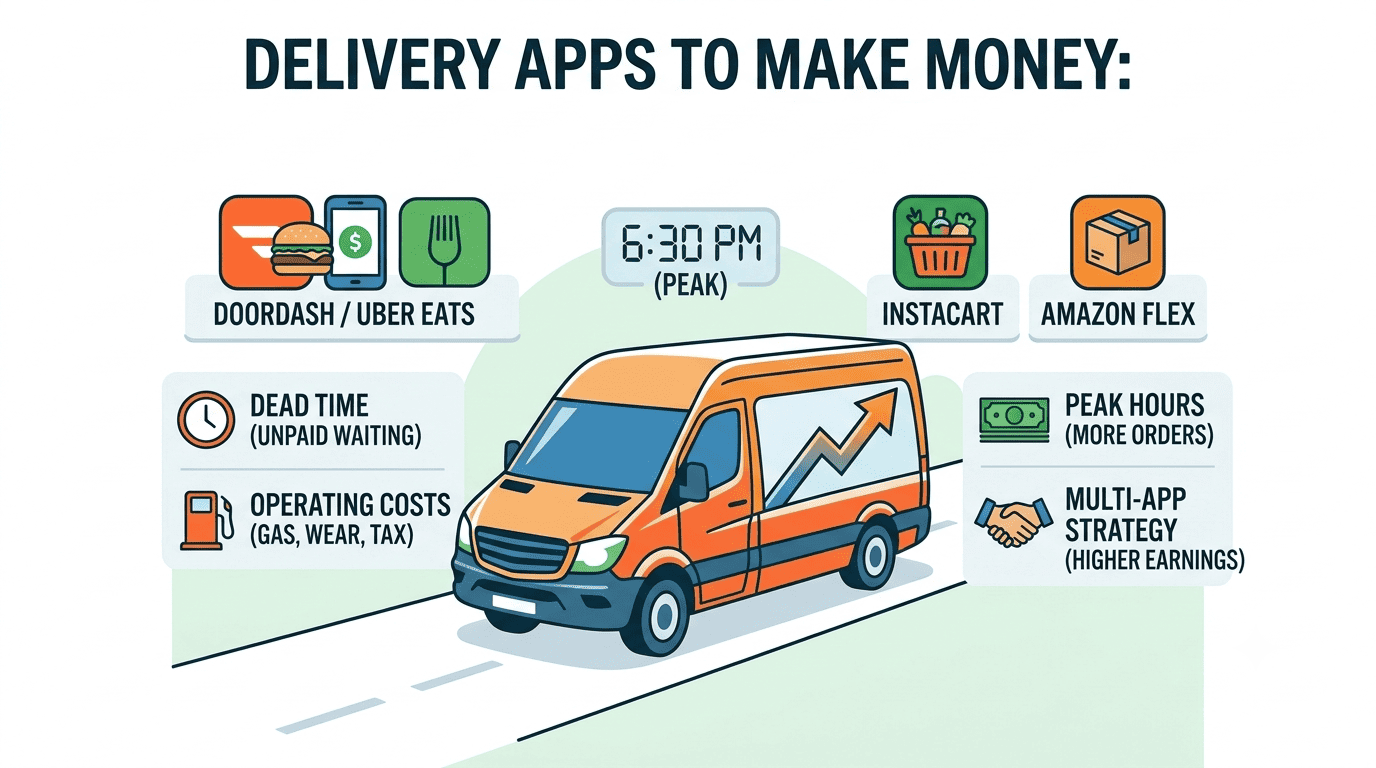
Three winters ago, I decided delivery driving was going to be my genius side hustle. I had a car, a phone, and crucially a wildly inflated sense of how much “flexible income” actually means. I pictured myself cruising around town, podcast on, cash rolling in between errands. Two hours and four food deliveries later, I’d made $19. Minus gas, that came out to something like $6.40 an hour, which is less than I would’ve made standing perfectly still and doing nothing. I still, for reasons I cannot defend, kept the app on my phone for another eight months.
So: are delivery apps actually a smart way to make money, or just a well-marketed way to burn a tank of gas for gas-station wages? The honest answer is it depends entirely on which app, which city, which hours, and whether you’re willing to treat it like a numbers game instead of a vibe. Here’s what the data and a lot of driver forums actually say.
The delivery apps worth your time in 2026
- DoorDash — biggest order volume, most markets
- Uber Eats — pairs well with rideshare driving
- Instacart — grocery shopping, higher per-batch pay
- Shipt — grocery delivery with a loyalty/tipping edge
- Amazon Flex — scheduled blocks, package delivery
- Walmart Spark — grocery and general merchandise delivery
- Grubhub — steadier in dense urban markets
- Roadie — “on-the-way” deliveries, good for spare vehicle space
- Apps for trucks/vans (Bungii, GoShare, Curri) — heavy-item hauling, higher hourly ceiling
Below is the real breakdown of what each one pays, who it’s actually good for, and where the marketing outruns reality.
Does DoorDash still pay off in 2026?
DoorDash remains the biggest name in the game, and for good reason- the order volume is unmatched in most cities, and sign-up takes about five minutes. Average pay lands around $15–$25 an hour before expenses, though that range swings hard depending on your market and whether you’re driving during a genuine rush or just refreshing the app hoping something pings. The tradeoff for that volume is competition: in saturated areas, you’ll spend real time waiting between orders, and that dead time doesn’t pay.
Worth it if you live somewhere with consistent lunch and dinner demand. Less worth it if you’re in a smaller market where three other Dashers are circling the same three restaurants.
Is Uber Eats better if you’re already driving for Uber?
If you’re already signed up to drive passengers, Uber Eats is close to a no-brainer — you can toggle to delivery when rides slow down and keep earning either way. On its own, though, the pay is a touch lower than DoorDash in most markets, generally $12–$20 an hour. The real value here is flexibility: fewer awkward conversations with strangers in your back seat, more control over exactly what kind of driving you’re doing at any given moment.
Is Instacart the better bet if you’d rather shop than drive?
Instacart flips the model: instead of picking up and dropping off, you’re shopping an actual grocery list, which means more time per order but noticeably higher pay — often $15–$30 an hour, with the top end reserved for big batches during peak hours. It’s more physically and mentally involved than food delivery (substitutions, weighing produce, hunting down that one specific brand of oat milk), but the tipping culture tends to reward shoppers who communicate well and get orders right the first time.
This is a strong option if you’d rather be inside a store than behind a wheel for three straight hours.
What makes Shipt different from Instacart?
Shipt runs on a similar model to Instacart — shop, deliver, repeat — but it’s built around Target and a handful of retail partners, and shoppers who build repeat relationships with the same customers often see it pay off in loyalty and better tips. Average pay sits around $16–$22 an hour. The catch: getting approved can take longer than some competitors, and route availability depends heavily on how saturated your zip code already is with other shoppers.
Is Amazon Flex actually the highest-paying option?
Of the mainstream apps, Amazon Flex is frequently cited as one of the better-paying choices — $18–$25 an hour is a common range, and you know your earnings upfront because you’re booking a fixed block (usually two to four hours) rather than gambling on per-order pings. The predictability is the whole appeal. The downside is that popular blocks get snapped up fast, so if you’re not fast on the draw when new slots post, you may find yourself checking the app repeatedly with nothing to show for it.
Does Walmart Spark deserve more attention than it gets?
Spark doesn’t get talked about as much as the bigger names, but it’s worth a look if there’s a Walmart or Sam’s Club nearby — you’ll deliver groceries and general merchandise, and pay tends to land in a similar range to Instacart and Shipt. Availability is the limiting factor here more than pay; it’s simply not as widespread yet.
Where does Grubhub fit into all of this?
Grubhub was one of the original food delivery apps, and while it’s lost significant market share to DoorDash and Uber Eats and changed corporate ownership more than once along the way, it still operates its own driver network in a number of cities. Pay tends to run $10–$17 an hour, generally lower than DoorDash or Uber Eats, but drivers in dense urban markets sometimes report steadier demand and fewer wild swings in order flow.
Is Roadie worth downloading if you’re not trying to drive full-time?
Roadie takes a genuinely different approach: instead of building a schedule around deliveries, it’s designed to monetize trips you’re already taking. Multi-stop gigs pay somewhere in the $25–$50 range, and there’s no requirement that you’re delivering food- it might be a suitcase, a piece of furniture, or a random Craigslist find someone needs moved across town. It’s less a full-time income stream and more a way to make an errand you were running anyway slightly less annoying.
Can you actually make more money hauling instead of delivering food?
This is the piece most “best delivery apps” lists gloss over: apps built around heavy or bulky items — think Bungii, GoShare, and Curri — consistently pay more per hour than food delivery, sometimes two to three times as much. One 2026 industry analysis tracking roughly a billion gig trips found task-based hauling work outearning standard food delivery by a wide margin. The logic checks out: fewer people own a pickup truck or cargo van, so the pool of available drivers is smaller, and platforms pay a premium to fill jobs. The tradeoff is obvious, you need the right vehicle, and you need to be willing to actually lift the couch.
How much should you realistically expect to make?
Here’s where the marketing and the math tend to part ways. Every app’s advertised hourly rate is gross pay- before gas, before the extra wear on your brakes and transmission, before the portion of your car’s depreciation that’s quietly happening every time you drive for money instead of pleasure. A driver technically “earning” $22 an hour on paper might be walking away with closer to $15–$17 once fuel and mileage are accounted for, and that’s before you’ve set aside anything for the self-employment tax bill waiting for you the following spring.
Is it smarter to run multiple apps at once?
Almost every experienced driver will tell you the same thing: don’t marry one app. Running DoorDash, Uber Eats, and Instacart simultaneously and accepting whichever offer pings highest first- is the closest thing to a proven strategy in this space. It fills the dead time that kills your hourly rate on any single platform, and it hedges against the days when one app’s demand mysteriously dries up for no explainable reason (every driver has a story about this).
The tradeoff is mental load. Juggling three notification streams while driving isn’t for everyone, and there’s a real argument for picking one or two apps you can actually manage well rather than spreading yourself across five and doing all of them mediocre.
What don’t the app store descriptions mention?
A few things worth knowing before you sign up for anything:
- You’re a 1099 contractor, not an employee. No withholding, no benefits, and a tax bill that can catch first-timers off guard.
- Vehicle wear adds up faster than people expect. Oil changes, brake pads, and higher insurance premiums (some personal auto policies exclude commercial delivery use entirely) are real costs, not hypothetical ones.
- Age and background-check requirements vary. Most platforms require drivers to be at least 18 or 19, hold a valid license, carry insurance, and pass a background check — Instacart’s shopper-only track is one of the few that doesn’t require a car at all.
- “Average pay” figures are averages, not guarantees. Your actual market, the time of day you drive, and local tipping culture will move your real number more than any app’s advertised range.
None of this means delivery apps are a bad way to make money for a lot of people, especially those with an already-flexible schedule, they’re a genuinely useful way to turn spare hours into cash without a job interview. But treating it as a strategic, numbers-driven side hustle instead of easy money is what separates the drivers actually building meaningful extra income from the ones burning gas for less than minimum wage- which, if it wasn’t already obvious, is a club I know from firsthand, deeply humbling experience.


Baxter International: The Gains Can Continue, But Should Slow

Despite The Headwinds, Earnings Are Exploding To The Upside

Aino Health reports Q2 sales decline on project delays

Yes. Corporate subscriptions are available for teams and organisations, with discounted rates as user numbers increase. Pricing starts from $1,625 + GST per user.
Get in touch
to discuss the right option for your organisation.
Business News subscriptions are used by executives, investors, consultants and professionals who need to stay informed and make better decisions about the WA market. When you subscribe you’ll get
- Unlimited access to WA’s most trusted business journalism
- Data & Insights — detailed profiles of WA companies, people, projects and deals
- MyBN — a personalised feed based on the companies, people and sectors you follow
- Special publications and industry reports
- Daily and weekly email newsletters
Data & Insights is a research tool built specifically for the WA market. It draws on more than 30 years of Business News reporting, updated regularly to reflect what’s happening now. Use it to:
- Look up detailed profiles of WA companies, including financials, directors and ownership
- Find decision-makers and track their career movements
- Research live and completed projects across WA industries
- Monitor deals, appointments and market activity
- Access industry rankings and league tables
Data & Insights is updated daily by our dedicated research team, which uses the latest announcements, ASX filings and editorial coverage to keep our person, company, list and project records up to date.
Business News welcome all opportunities to make our dataset accurate, complete and current, so if you have an update request, please email the team at
general@businessnews.com.au, and we’d be happy to assist.
MyBN
is part of every subscription. It’s your personalised view of Business News. You can follow the companies, people, sectors and projects that matter to you, and get a news feed and alerts tailored to your interests. You can save articles to read later and retain only what you need.
Only subscribers have full access to all content on the Business News website.
If staying informed about the WA economy is part of your job, and/or you’re looking for networking opportunities in WA, Business News is built for you.
Business News subscribers are:
- Executives and directors tracking competitors, clients and market movements
- Investors and advisers researching companies, deals and industry trends
- Consultants and professionals staying across sectors relevant to their clients
- Business owners looking for leads, context and market intelligence
Most Business News publications cover national or global markets. Business News is focused entirely on Western Australia, which means the journalism, the data and the intelligence are all built around WA companies, people and projects — not adapted from a national feed. Data & Insights, included with every subscription, combines more than 30 years of WA-specific editorial research with live business data. There’s no comparable product for the WA market.
The Morning Digest Email provides a comprehensive wrap of the major headlines, relevant to WA business, and includes with a snapshot of the overnight news covering oil, gold and ASX-listed companies.
The Afternoon Wrap Email focuses on the news covered by our team of journalists during the course of the working day, including exclusive stories and analysis, all of which relates to WA business and the local economy.
The BN Weekender Email contains a wrap of the Business News from the week that was, highlighting the top stories in each area of WA business.
Sign up for free.
We’re happy to help.
Get in touch
and our team will come back to you.
Business
Blue Dart Express shares surge 7% after Q1 results. Here’s why Nuvama retains Buy, raises target

The company’s consolidated net profit jumped 79.6% year-on-year (YoY) to Rs 88 crore in Q1FY27, compared with Rs 49 crore in the corresponding quarter last year. Revenue from operations increased 15.1% YoY to Rs 1,658 crore, from Rs 1,441 crore in Q1FY26.
The strong quarterly performance was supported by higher revenue traction, improved operational efficiency, and expansion in operating margins. Blue Dart’s EBITDA margin improved significantly, reflecting better cost management and disciplined execution despite a challenging business environment.
Commenting on the results, Balfour Manuel, Managing Director, Blue Dart, said, “Our Q1FY27 performance reflects focused execution, disciplined network management and continued customer confidence in the Blue Dart brand. Despite a challenging operating environment and higher operating costs, we delivered strong profit growth while maintaining our commitment to reliability, speed and service excellence.”
He added that the company remains focused on enhancing productivity, strengthening its integrated air and ground network, accelerating digital adoption, and investing in sustainable capabilities to create long-term value for stakeholders.

Nuvama remains bullish, raises valuation outlook
Brokerage firm Nuvama maintained its ‘Buy’ rating on Blue Dart Express, citing strong quarterly execution and the company’s positioning in the growing e-commerce logistics segment.
According to Nuvama Research, Blue Dart delivered a robust Q1FY27 performance, with revenue growth of 15% YoY, ahead of estimates. The brokerage highlighted that EBITDA margin expanded by 220 basis points YoY to 15.8%, while profit before tax (PBT) margin improved to 7.2% from 4.6% a year ago, reaching the company’s guided medium-term range of 7–8%.
The brokerage noted that profit after tax (PAT) surged 81% YoY to Rs 88.5 crore, significantly exceeding its estimates and consensus expectations. Following the strong quarter, Nuvama raised its FY27E and FY28E earnings per share (EPS) estimates by 4% and 2%, respectively.
Nuvama has retained its ‘Buy’ recommendation, valuing Blue Dart at 38x June 2028 earnings, and revised its June 2027 target price to Rs 7,350 from the earlier Rs 6,900.
The brokerage believes Blue Dart is well positioned to benefit from the ongoing consolidation in the e-commerce parcel market, which contributed around 30–31% of revenue in FY26. At the current market price, the stock trades at approximately 28x FY28E earnings.
With improving margins, sustained revenue growth, and a strong logistics network, Blue Dart remains a key beneficiary of India’s expanding express delivery and e-commerce ecosystem.
(Disclaimer: Recommendations, suggestions, views and opinions given by the experts are their own. These do not represent the views of The Economic Times)

Air travel across the Middle East continues gradually stabilizing more than five months after the outbreak of the U.S.-Iran conflict severely disrupted one of the world’s busiest aviation corridors, though several major hubs remain constrained by damaged infrastructure, safety advisories and ongoing regional hostilities.
The Iran war triggered widespread airspace closures beginning Feb. 28, when U.S. and Israeli strikes on Iran plunged the region into conflict, grounding tens of thousands of flights and severing key global transit hubs connecting Europe, Asia, Africa and North America. According to travel platform Wego, the resulting grounding of flights and temporary isolation of mega-hubs like Dubai and Doha represented the most disruptive systemic shock to global aviation since the COVID-19 pandemic.
Several major hubs are now operating close to normal levels. The United Arab Emirates, home to Dubai and Abu Dhabi, is described as fully open, according to Wego’s most recent assessment. Saudi Arabia, Qatar, Bahrain and Oman are all described as largely open, though each continues to carry some operational caveats depending on the specific airport and airline involved. Dubai International Airport is running flights across all three of its terminals, and Qatar Airways confirmed earlier this summer that it had restored flights to 85% of its pre-crisis schedule levels.
Kuwait represents the clearest ongoing exception to that broader recovery. Kuwait’s main airport remains not fully operational, according to Newsweek’s assessment of the current situation, with key infrastructure still damaged and some terminals remaining closed. Foreign airlines continue to face restrictions at the airport, and while portions of Kuwaiti airspace have reopened, international routes into and out of the country remain limited compared with pre-conflict levels. Terminal 1, the airport’s primary international facility, has remained closed since suffering significant structural damage, including a partial roof collapse, during a strike in early June, with Kuwait Airways and Jazeera Airways instead operating out of Terminals 4 and 5.
Even in airspace that is technically classified as open, aviation safety advisories tied to earlier missile, drone or military activity continue to shape how airlines operate throughout much of the region. Regulators and airlines have continued flagging elevated risk across Iran, Iraq and broader Gulf airspace, according to aviation safety tracking service safefly.aero, with some carriers selectively avoiding certain flight paths or reducing service frequencies even where no formal airspace closure remains in place.
The European Union Aviation Safety Agency has maintained some of the most cautious guidance among international regulators. EASA’s Conflict Zone Information Bulletin, most recently extended through Aug. 31, instructs EASA-regulated airlines to avoid flying within the airspace of the UAE, Bahrain, Kuwait and Qatar at any altitude, along with a defined portion of the Gulf of Oman, citing continued risk tied to missile, drone and combat aircraft activity linked to the region’s unstable security situation. That advisory has led numerous major international carriers, including British Airways, Singapore Airlines, Air Canada and members of the Lufthansa Group, to extend their own suspensions of Middle East routes well into the autumn, even as UAE-based carriers such as Emirates, Etihad Airways and flydubai continue operating the substantial majority of their networks.
Other pockets of restriction persist across the broader region as well. Four airports in southern Saudi Arabia were closed by NOTAM earlier this summer after a Houthi missile and drone attack, part of a broader pattern of intermittent strikes and closures that has continued affecting specific airports even as most of the region’s major hubs have returned to largely normal operations. Air traffic routing through the middle of the Gulf has also remained complicated by Kuwait’s ongoing limitations, forcing many international operators to route flights around the country via either a southern corridor through Egypt, Saudi Arabia and Oman, or a more northerly path, according to aviation monitoring group OPSGROUP.
Airlines have continued a gradual, staggered process of restoring previously suspended routes throughout the summer. British Airways resumed flights to Dubai and Doha beginning July 1, while Gulf Air has steadily rebuilt its network following Bahrain’s airspace reopening, restoring service to cities including London, Dubai, Istanbul and Riyadh, with additional routes continuing to phase in through the summer months. Iraqi Airways has similarly resumed both domestic and international operations as part of a broader phased return to service across the region’s national carriers.
Given how frequently conditions have continued shifting throughout the conflict, travel monitoring services consistently advise passengers to verify their specific flight status directly with their airline before heading to the airport, rather than relying solely on general regional status updates, given how quickly individual route restrictions, terminal closures and safety advisories have continued changing across different countries and airlines throughout the ongoing conflict.
With Kuwait’s main airport still working through infrastructure repairs and several international regulators maintaining cautious advisories through the end of August, the broader Middle East aviation sector appears likely to continue its gradual, uneven recovery in the weeks ahead, even as the region’s largest hubs in Dubai, Doha and Abu Dhabi have largely returned to something closer to their pre-conflict operating tempo.

Seeen’s 2025 revenue jumps 65% as EBITDA loss narrows

A minor earthquake shook the city of Hawthorne, California, on Sunday evening, according to the U.S. Geological Survey, though no damage or injuries were reported in connection with the tremor.
The magnitude 2.6 quake struck at 8:30 p.m. local time, with its epicenter located less than a mile from the neighboring communities of Gardena, Inglewood and Westmont, all situated within the greater Los Angeles area. Seismologists recorded the earthquake’s origin at a depth of 6.5 miles below the surface, according to USGS data.
Earthquakes of this magnitude are common across Southern California, a region crossed by numerous active fault systems, including segments of the broader San Andreas Fault network that runs through much of the state. The USGS estimates that Southern California experiences thousands of earthquakes each year, though the vast majority are too small to be felt by residents without sensitive seismic instruments. Quakes in the magnitude 2.5 to 3.0 range, like Sunday’s tremor near Hawthorne, are generally on the threshold of what a person standing near the epicenter might notice, often described as a brief jolt or vibration rather than significant shaking.
Hawthorne and the surrounding South Bay area of Los Angeles County have experienced similar small earthquakes in the past without resulting in damage. The USGS operates a real-time earthquake monitoring system that tracks seismic activity across the country, publishing data within minutes of a quake’s occurrence and inviting residents who felt shaking to submit reports through its “Did You Feel It?” online tool, which helps researchers map the extent and intensity of ground motion associated with a given event.
Sunday’s earthquake was one of several recorded across California in recent days, part of the routine background seismicity that characterizes the state. In the weeks prior, the USGS logged a magnitude 4.3 earthquake near California City on July 13 and a magnitude 4.1 quake near Frazier Park on July 12, both considerably stronger than Sunday’s Hawthorne tremor but still within the range of earthquakes that typically cause little to no damage. Larger, more damaging earthquakes in the magnitude 5.5 and above range remain comparatively rare events, though seismologists have long cautioned that Southern California remains overdue for a major rupture along sections of the San Andreas Fault, based on historical recurrence intervals.
No tsunami warning was issued in connection with Sunday’s earthquake, and the USGS did not report any immediate aftershock activity following the initial tremor. Local emergency services in Hawthorne and the surrounding communities did not report receiving calls related to damage or injuries stemming from the quake.
Residents throughout the greater Los Angeles area are routinely encouraged by California emergency management officials to maintain basic earthquake preparedness measures, including securing heavy furniture, keeping emergency supplies on hand, and staying familiar with the standard “drop, cover and hold on” response recommended during shaking, given the region’s ongoing exposure to both minor and, less frequently, more significant seismic activity.


Dhierin-Perkash Bechai is an aerospace, defense and airline analyst.
Dhierin runs the investing group The Aerospace Forum, whose goal is to discover investment opportunities in the aerospace, defense and airline industry. With a background in aerospace engineering, he provides analysis of a complex industry with significant growth prospects, and offers context to developments as they occur, describing how they might affect investment theses. His investing ideas are driven by data informed analysis. The investing group also provides direct access to data analytics monitors.
Learn more.
Analyst’s Disclosure: I/we have no stock, option or similar derivative position in any of the companies mentioned, and no plans to initiate any such positions within the next 72 hours. I wrote this article myself, and it expresses my own opinions. I am not receiving compensation for it (other than from Seeking Alpha). I have no business relationship with any company whose stock is mentioned in this article.
Seeking Alpha’s Disclosure: Past performance is no guarantee of future results. No recommendation or advice is being given as to whether any investment is suitable for a particular investor. Any views or opinions expressed above may not reflect those of Seeking Alpha as a whole. Seeking Alpha is not a licensed securities dealer, broker or US investment adviser or investment bank. Our analysts are third party authors that include both professional investors and individual investors who may not be licensed or certified by any institute or regulatory body.


I’m a passionate investor from the Netherlands with 12 years of stock market experience. My articles usually contain a good overview of important investment criteria. A stock for my portfolio is of interest to me if the company has the following characteristics:1. Companies that are growing in both revenue, earnings and free cash flow.2. Companies that have excellent growth prospects.3. Stocks with favorable valuations.I prefer steadily growing companies with high free cash flow margins, dividend stocks and stocks with generous share repurchase programs.Disclaimer: My articles do not provide financial advice, they reflect my own findings and insights.
Analyst’s Disclosure: I/we have no stock, option or similar derivative position in any of the companies mentioned, and no plans to initiate any such positions within the next 72 hours. I wrote this article myself, and it expresses my own opinions. I am not receiving compensation for it (other than from Seeking Alpha). I have no business relationship with any company whose stock is mentioned in this article.
Seeking Alpha’s Disclosure: Past performance is no guarantee of future results. No recommendation or advice is being given as to whether any investment is suitable for a particular investor. Any views or opinions expressed above may not reflect those of Seeking Alpha as a whole. Seeking Alpha is not a licensed securities dealer, broker or US investment adviser or investment bank. Our analysts are third party authors that include both professional investors and individual investors who may not be licensed or certified by any institute or regulatory body.

Politics Home Article | Dame Prue Leith: living and dying well

Jamshedpur FC Players Make Emotional Appeal As Owners Look To Dismantle Senior Team

How new Bake Me Home cake shed in Darlington is thriving


-

 Business4 days ago
Why Trees Belong on the Risk Register
-

 Fashion3 days ago
Weekend Open Thread: Wit & Wisdom
-

 Politics2 days ago
Meta enters AI-training agreement with far-right ‘propaganda rag’ Newsmax
-
 Entertainment5 days ago
‘Stargate’ Creator’s New Sci-Fi Series Returns for Season 3 Tomorrow
-

 Politics7 days ago
Luke Littler dismantles Gerwyn Price to retain title in Blackpool
-

 Crypto World2 days ago
MicroStrategy Post-Earnings CLARITY Act Push Could Add New Catalyst for Its Stock
-

 Politics6 days ago
The Part of the Electric Transition Nobody Wants to Discuss
-

 Business5 days ago
Major shareholder moves on Canyon
-

 Crypto World2 days ago
XRP Ledger v3.3.0 brings five institutional features
-

 News Videos4 days ago
Bitcoin Enters the 3rd Stage of the Bear Market
-

 Crypto World5 days ago
Kraken Enables Retail Access to Jersey Mike’s IPO via Tokenized Shares
-

 Tech6 days ago
New macOS Sequoia & Sonoma security updates for older Macs
-

 News Videos5 days ago
Claude: Build Financial Dashboards in Minutes (2026)
-

 Politics4 days ago
Luke Littler’s dominance sparks GOAT debate
-

 Business5 days ago
Johnson & Johnson agrees to $5.5B settlement over talc cancer claims
-

 Sports3 days ago
Seema Kaliramna Wins Discus Throw Bronze, Takes India’s CWG Medals Tally To 17
-

 Crypto World21 hours ago
Crypto PAC spending tops $2M in Michigan House race
-

 Business3 days ago
Trump Announces Hamas Disarmament Agreement as Iran Strikes Kuwait Air Base and US Attacks Pause Overnight
-

 Tech5 days ago
Gemini can now summarize the messiest comment threads in Google Docs
-

 Tech1 day ago
ESET tracks rise in malicious AI skills and adaptable malware
You must be logged in to post a comment Login