
Business
Dhaval Packaging’s Rs. 36.36 crore IPO to open on July 30


Dhaval Packaging has fixed a price band of Rs. 92 to Rs. 97 per share for the IPO. The net proceeds from the issue will be utilised for capacity expansion at its manufacturing facility at Sanand-II Industrial Estate, for which Rs. 27.19 crore has been earmarked. A further Rs. 3.75 crore will be utilised for the repayment or prepayment of certain loans, while the rest will be used for general corporate purposes.
Of the total issue of 37,48,800 equity shares, 17,18,400 shares (49.95%) are allocated to the QIB category, 5,17,200 shares (15%) are reserved for the HNI category, while 12,04,800 shares (35%) are reserved for retail investors.
The lot size is 1,200 shares. The minimum investment required by a retail investor is Rs. 2,32,800 (2,400 shares), while for HNI investors, the minimum investment is 3,600 shares, amounting to Rs. 3,49,200. The allotment is expected to be finalised on August 4, while the shares are slated to list on the BSE SME platform on August 6.
Established in 2015, Dhaval Packaging is engaged in the design, manufacture and supply of plastic packaging products for domestic and international markets. Led by Chairman and Managing Director Manish Dagla and a promoter-led management team with more than 75 years of combined industry experience, the company operates across two core business verticals: In-Mould Labelled (IML) food-grade packaging containers and SAW pipe protection plastic caps for industrial applications.

The company operates three manufacturing facilities at Sanand, spread across more than 60,000 sq. ft. of manufacturing area. Equipped with 21 injection moulding machines and one vacuum forming machine, the facilities have a production capacity of approximately 8,400 kg per day.
The company serves customers across food, dairy, confectionery, FMCG, pharma, construction, infrastructure, oil & gas, automotive, paint & coatings, and chemical & petrochemical sectors. Its integrated manufacturing capabilities, in-house tooling and design expertise, automation-led production processes and internationally recognised certifications have enabled the company to expand its presence in domestic as well as international markets. For the financial year ended March 31, 2026, the company reported revenue of Rs. 65 crore, up 24.4 per cent year-on-year. EBITDA increased 36.2 per cent to Rs. 13.9 crore, while profit after tax rose 33 per cent to Rs. 8 crore. During the year, Dhaval Packaging also expanded its export footprint by entering the Australian market and introduced a stackable tin-plastic hybrid packaging solution for premium food applications.
Rarever Financial Advisors Private Limited is the book-running lead manager to the issue, while KFin Technologies Limited is the registrar. New Berry Capitals Private Limited has been appointed as the market maker.
(Disclaimer: The above press release comes to you under an arrangement with PNN and takes no editorial responsibility for the same.)

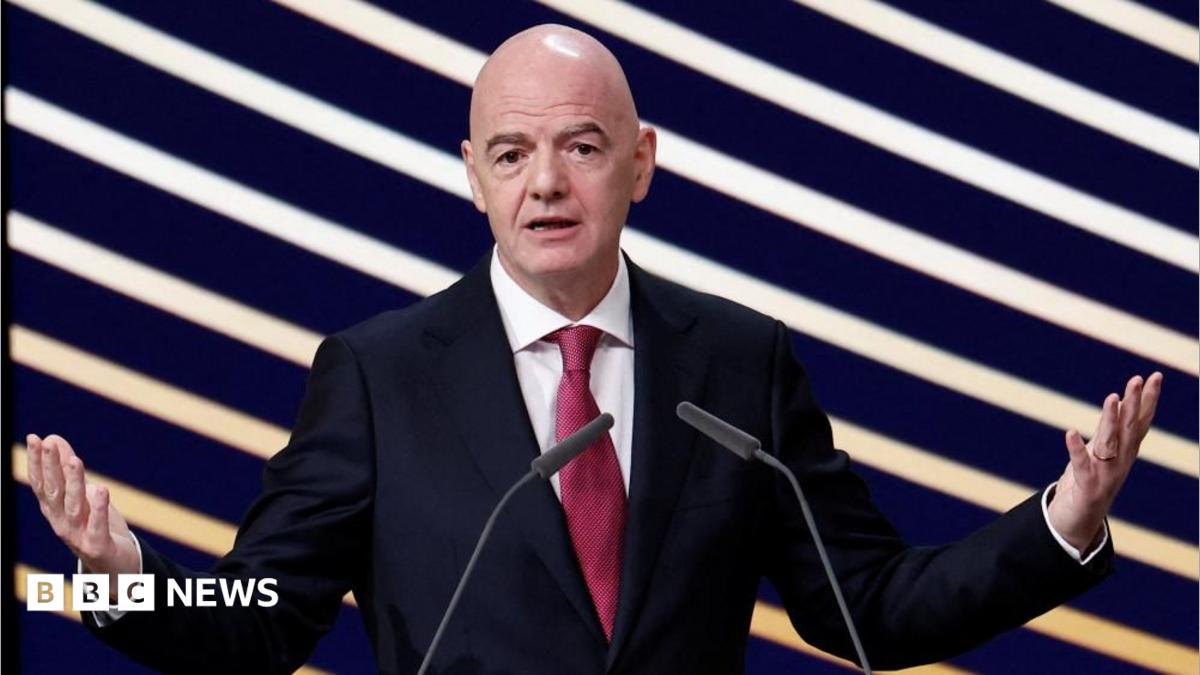
In the slides, Fifa’s central argument was that football does not raise enough cash in relation to its fan base, that “Fifa has been under-monetised versus other leagues” and so “global football development gets squeezed”.
It did this with reference to a comparative chart showing annual revenue as well as revenue per fan for Fifa, the Uefa Champions League, Premier League, US baseball and NFL American football.
On the face of it, Fifa is the poorer cousin at just $1 per global fan, compared to NFL’s $52.8. But this measure is rather suspect.
The World Cup is not an annual competition; it happens once every four years. If instead this was done on revenue per World Cup 2026 match, Fifa makes multiples of the Premier League, perhaps more than three times as much.
As important, football is decentralised globally, so more of the revenues go to individual leagues, such as the Premier League or Champions League. Fifa was effectively arguing it wanted to keep more of that overall football pie.
Football’s fans are also spread across the globe, in rich and poor countries alike. NFL has a much smaller base concentrated in the US and is pretty much the whole of American Football.
Finally, about half of NFL’s revenues are paid out as wages. Fifa does not pay Erling Haaland or Lionel Messi or Vozinha. Profits would have yielded a rather different result than the chart’s focus on revenues.


Seeking Alpha’s transcripts team is responsible for the development of all of our transcript-related projects. We currently publish thousands of quarterly earnings calls per quarter on our site and are continuing to grow and expand our coverage. The purpose of this profile is to allow us to share with our readers new transcript-related developments. Thanks, SA Transcripts Team

The sylvan Porthcurno valley in Cornwall, located on the Atlantic coast 506 km south-west of London, was the unlikely place of a revolution that enabled Britain and its former colonies to communicate with each other.
Museum officials told a visiting PTI correspondent that Porthcurno was the hub of international cable communications from 1870 to 1970, and a training college for the communications industry until 1993.
Now a museum housing rare equipment and details of the history of telegraph, Porthcurno has been granted millions of pounds in funding to develop an international education programme that includes community groups in India.
Among its rare archives discovered last week is a collection of the first telegraph messages sent from Porthcurno and Mumbai (then Bombay).
Until that landmark day, communication between England and India was unreliable, and often took months.
According to the document, the first message was dispatched on the night of 23 June, 1870, and a reply was received in 5 minutes, which was a technological feat at the time.The message was called a ‘complimentary telegram’ between the ‘Managing Director in London and the Manager in Bombay’.
The first message was from ‘Anderson to Stacey: How are you all?’, to which the reply was: ‘All well’.
The second message from Anderson was: ‘Please ask gentlemen of the press, Bombay, to send a message to gentlemen of the press, New York’.
After several messages that night, including some to the governor of Bombay, from Lady Mayo to viceroy Lord Mayo based in Shimla, and one from the Prince of Wales to the viceroy, a response was received from journalists based in Bombay.
It said: ‘From the Press of India to the Press of America: The Press of India sends salaam to the Press of America. Reply quick’.
The document notes that the viceroy of India had sent a telegraph to the president of the United States and “received a reply which reached him in 7 hours 40 minutes”.
The viceroy’s message, which was read in the American Congress the same evening, was: “The Viceroy of India for the first time speaks direct by telegraph with the President of the United States. May the completion of the long line of uninterrupted communication be the emblem of lasting union between the Eastern and Western World”.
Telegraphic communication with India was first established in 1864 by overland telegraph lines from Europe to the top of the Persian Gulf and then by an undersea cable to Karachi, but the overland section was never satisfactory, prompting efforts to lay more reliable cables below the sea.
In 1869, telegraph pioneer John Pender established the British Indian Submarine Telegraph Company, whose task was to lay undersea cables to India.
The five ships used to lay the thousands of km of cables were the Great Eastern, William Cory, Chiltern, Hawk and Hibernia.
It took six weeks to lay the cables from Suez to Bombay. This was followed by the laying of the final link from Malta to Porthcurno.
It was the first long distance cable ‘chain’, and opened to the public with much jubilation, museum records show.
After the link with India was established, Porthcurno was linked by undersea cables to several other areas across the world.
At its height, it was the world’s largest station with 14 cables in operation. Porthcurno’s telegraphic codename was ‘PK’.
During World War II, tunnels were dug by Cornish miners to house an underground building and Porthcurno’s entire telegraph operations.
The building today houses the museum and archives that started the communication revolution in the late nineteenth century.
Besides 1.44 million pounds funding received in January, the museum this week has been granted 35,000 pounds from the international telecommunications organisation SubOptic to develop an education project with community groups in India, among other countries.
Museum officials said the money will fund an international education programme that will benefit users from spring 2013.
It will include online learning resources, including video clips, animations and games that will enable users to discover the science of global cable-based telecommunications, as well as its impacts on local identity, democracy and culture.

Elon Musk designed Tesla’s TSLA China business to be easily separated from its U.S. business because of geopolitical tensions. It might also come in handy if he proceeds with a SpaceX SPCX merger.
Musk in recent years instructed Tesla executives to organize the company with a “laser” between its U.S. and China businesses, according to people familiar with the planning. He wanted to ensure that in the event of geopolitical strife between the two countries, at least the U.S. half of Tesla would survive.
Copyright ©2026 Dow Jones & Company, Inc. All Rights Reserved. 87990cbe856818d5eddac44c7b1cdeb8

M Rajeevan of National Atmospheric Research Laboratory said, “the failure to predict the 2009 drought has raised many serious issues. On the other hand, the state-of-the art coupled ocean atmospheric models have sho-wed improved skills in predicting inter annual variability of Indian summer monsoon rainfall.”
He was speaking at the golden jubilee conference of Indian Institute of Climate Change (IITM), Pune, on ‘opportunities and challenges in monsoon prediction in changing climate’. Since 2011, the IITM has used the coupled model for monsoon forecast.
Better weather forecast needs data from all parts of the globe. “In every part of the world, farmers are saying that the climate is not as it used to be. Hence, traditional knowledge is also failing. For better prediction of weather, we need observations from all countries. We need super computers of even higher capacities. We need to have knowledge about how to translate scientific progress into concrete applications,” said Michel Jarraud, secretary general, World Meteorological Organisation.
Business
The Kansai Electric Power Company, Incorporated 2027 Q1 – Results – Earnings Call Presentation (OTCMKTS:KAEPY) 2026-08-01
Seeking Alpha’s transcripts team is responsible for the development of all of our transcript-related projects. We currently publish thousands of quarterly earnings calls per quarter on our site and are continuing to grow and expand our coverage. The purpose of this profile is to allow us to share with our readers new transcript-related developments. Thanks, SA Transcripts Team
“Secretary Colin Powell received this gift from Indian Minister of Home Affairs Lal Krishna Advani,” the State Department said in its remarks written at the bottom of the elephant figurine.
In fact, it is one of the less than 50 gifts among the hundreds of those received by the Secretary of State over the year by foreign dignitaries that have been selected for display at the Exhibit Hall, in the centre of Henry S Truman Building, headquarters of the State Department, official sources said.
Describing the gift, the State Department said, “with royal aplomb, the great man rides in the howdah, or canopied seat, as the mahout or guide in front leads the elephant”.
“This colourful cloisonne figurine harks back to times when elephants were an indispensable part of Indian life – for transportation, fighting battles, protecting land and traversing forests,” it said.
The elephant figurine was made by Neeru Goel, an Indian artist from Bengal, who specialises in enamelware sculptures.
The Department officials, while explaining the reason for the selection of this particular gift from India to be displayed at the exhibition hall, said that elephants are a cultural icon of the country, which over centuries have become a status symbol representing wealth, wisdom, and strength.
Thomas Abraham
In Delhi it’s that time of year again when publishers, distributors and retailers are scrambling around frantically getting everything from point-of-sale to stocks right. It’s the World Book fair (WBF), which comes around once every two years sprawling across the giant halls of Pragati Maidan. This is the fair’s 20th edition, and although there are look-alikes all over the country, this one is undoubtedly the mother-of-them all.
In the 1980s and the ’90s, the Kolkata Book fair was the fair to go. But with the move from the maidan, apart from other venue and organisational problems, Kolkata has had to give up its title. Today the Delhi WBF is a mammoth affair, and has gone beyond just being a sort of retail exhibition.
Actually, no book fair in India would really qualify to be a ‘trade fair’ like Frankfurt or London, where business and rights deals are a norm. But like the Jaipur Literary Fest, what we lack in focus, or ‘order and method’, we make up for in sheer numbers.
The WBF is a giant carnival. The last edition had over 800,000 visitors, and the organizers are wondering whether this year the million mark will be touched, given that the Pragati Maidan now has direct metro connectivity and that admission is free. Certainly the exhibitors have gone up since last time to about 1,300. That’s still, of course, less than a tenth of the total number of publishers in the country, as estimated by the various federations who put the count at being well over 15,000.
Month of March
This year, for the first time, the dates of the WBF moved from the traditional January end to early February period to a whole month down the line. This has met with some consternation as many publishers felt that it was leaving it too late for library budgets, and many schools would have exams on, and that might affect the turnout a bit. The jury is out on that one – the verdict will be out on the 4th of March when it all gets over.
So what are the business stats from the fair? Herein lies the rub – there are none. Ironically, for an industry that is seeing technological change at a pace like never before, and typically of an industry still coming to grips with management information, there is no reliable data available apart from guesstimates.
The National Book Trust (NBT) – the fair organizers – blames it on traditional publisher mindsets and the archaic notion of ‘business secrets’ where exhibitors don’t divulge figures. But even just by conservative extrapolation, assuming a Rs 2.5 lakh average turnover per participant (incidentally, the big ones top Rs 20 crore) one is looking at a fair turnover of over Rs 30 crore in cash sales, which is more than three times the business done from all of the leading bookstores all over India in any given week. Trade buying, rights deals, subscription sales, print contracts, and other ‘collateral business’ are on top of this.
Trade & Rights
The WBF – indeed the industry – needs to take this to the next level with a dedicated two days for ‘trade and rights’. Years ago, the first two hours of the fair every day used to be designated trade hours where librarians and stockists could browse uninterrupted, a practice since discontinued. But if the 9-day fair could be shortened to seven days for consumers with two days as business days, India might yet see the fillip it needs in its rights business, as local-to-international rights networks build.
India has a large contingent going to Frankfurt but bulk of these is either English publishers-distributors, visiting principals or remainder merchants buying surplus stock. The size of the Indian rights pavilion is testament to the fact that our share of the rights pie is negligible.
When were the last time you heard of an Indian work in translation break out through a rights purchase the way Wolf-Totem was snapped up from Chinese or The Devotion of Suspect-X from the Japanese? It’s only if we build a rights module here within the WBF, that one can gradually work up (yes it will take years) to exploiting the rights potential from Indian languages in translation.
So what purpose does the fair serve? With the surge in online bookstores, does it still have any relevance? I believe it still has huge relevance. Quite simply it is at its most fundamental, the only real direct interface publishers have with their end readers. This is the only time you can actually put the range you want up there, and watch readers as they browse.
For most publishers, the long tedious day playing floor assistant and traffic cop rolled into one has its reward in watching that die-hard fan chasing that obscure book you thought would never sell. The ecstasy of finding that long lost book, the agony of seeing something priced beyond one’s budget, the amazement at seeing a bargain or combo offer…it’s all there every day, hour on hour. For readers, this is the one time you’ll get to see, touch, browse lists and full range as you can never anywhere else.
Online has its convenience, but by and large you need to know what book you want, notwithstanding the cross recommendations the better sites have. This is where a reader can experience that joy of discovery-where s/he will see full series, obscure imprints, rare titles.
Then there are the bargains. Fair rules make it impossible to deep discount but bargain tables with ‘fair prices’ and combination offers abound. What we have over the nine days of the fair is in essence the world’s largest bookstore-over a million square feet of books to choose from-in every Indian language, a lot of foreign ones, and of course English.
(The author is Managing Director, Hachette India)

Schaeffler shares dropped sharply after the auto supplier slashed its sales expectations for the medium term amid a darkening backdrop for the industry.
The German company, supplier to major automakers like BMW, Volkswagen and Ford, now expects sales for 2028 of between 24 billion and 26 billion euros ($27.7 billion-$29.98 billion), down from previous guidance of 27 billion to 29 billion euros, it said Friday.
Copyright ©2026 Dow Jones & Company, Inc. All Rights Reserved. 87990cbe856818d5eddac44c7b1cdeb8
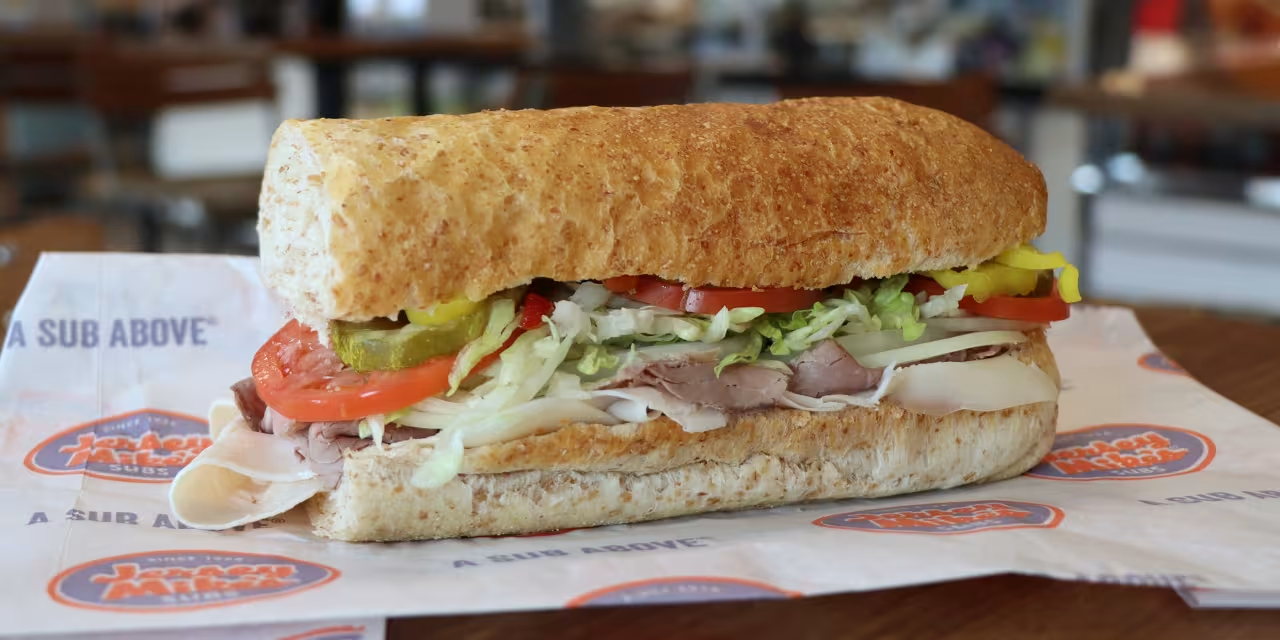
Jersey Mike’s Subs is a sandwich chain that professes to make “A Sub Above.” Hot, cold. Meats and cheese are sliced in front of customers. And regulars know “Mike’s Way” (onions, tomatoes, lettuce, oregano, and salt) and “The Juice” (an olive oil blend and red wine vinegar). But despite its popularity with consumers, investors weren’t taking a bite of the stock in its first day of trading.

Galaxy Maps Warns Coldcard Bitcoin Losses After Wallet Incident

Football Mourns AC Milan Legend Franco Baresi

One California town found Flock’s license plate cameras were wrong 71% of the time


-
 Sports6 days ago
Commonwealth Games boxing: Jadumani Singh seals dominant 5-0 win over Pakistan’s Sumama Rehman to enter quarter-finals | Commonwealth Games News
-

 Business3 days ago
Why Trees Belong on the Risk Register
-

 Fashion19 hours ago
Weekend Open Thread: Wit & Wisdom
-

 Politics16 hours ago
Meta enters AI-training agreement with far-right ‘propaganda rag’ Newsmax
-

 Tech6 days ago
Intel is reversing course and bringing hyper-threading back to its server chips
-

 Crypto World7 days ago
Ripple bought a bank in pieces. The $4 billion audit
-

 Politics5 days ago
Luke Littler dismantles Gerwyn Price to retain title in Blackpool
-

 Politics4 days ago
The Part of the Electric Transition Nobody Wants to Discuss
-

 News Videos6 days ago
BITCOIN JUST ENTERED THIS CRITICAL ZONE…
-
 Entertainment4 days ago
‘Stargate’ Creator’s New Sci-Fi Series Returns for Season 3 Tomorrow
-

 Business3 days ago
Major shareholder moves on Canyon
-

 Crypto World6 days ago
XRP Ledger adds $2.6B as RWA inflows rank second
-

 Politics6 days ago
Spain sweeps the board at 2026 World Cup with individual awards
-

 News Videos2 days ago
Bitcoin Enters the 3rd Stage of the Bear Market
-
Crypto World7 hours ago
XRP Ledger v3.3.0 brings five institutional features
-

 Entertainment6 days ago
Sara Gilson Killed By Husband After Viral “Pedophile” TikTok Video
-

 Crypto World4 days ago
Kraken Enables Retail Access to Jersey Mike’s IPO via Tokenized Shares
-

 News Videos4 days ago
Claude: Build Financial Dashboards in Minutes (2026)
-

 Tech4 days ago
New macOS Sequoia & Sonoma security updates for older Macs
-

 Politics2 days ago
Luke Littler’s dominance sparks GOAT debate
You must be logged in to post a comment Login