

Business
East Victoria Park warehouse sold for $5m



Business
10 Things to Know About SK Hynix’s Historic US Nasdaq IPO Listing as Regular Trading Officially Begins Monday
AFP
South Korean memory chipmaker SK Hynix completed its historic debut on the Nasdaq last week, and regular trading under its permanent ticker begins Monday, marking a milestone moment for the AI-driven memory boom that has transformed the once-overlooked semiconductor sector. Here are 10 key things to know about the listing.
- The offering was the largest-ever US equity listing by a foreign company. SK Hynix priced its American depositary shares at $149 apiece, raising approximately $26.5 billion, a figure that topped Alibaba’s previous record of $25 billion set in 2014. The deal ranks as the world’s second-largest stock sale on record, trailing only Elon Musk’s SpaceX, which went public roughly a month earlier.
- Shares surged on their first day of trading. The stock opened at $170 on Friday, July 10, and closed the session up roughly 13% at $168.01, giving US investors their first real-time confirmation of strong demand for a direct stake in the AI memory boom. Institutional orders during the offering’s bookbuilding process reportedly exceeded available shares by more than seven times.
- Trading tickers are changing this week. Shares traded Friday under the temporary “when-issued” ticker SKHYV, and are scheduled to convert to the company’s permanent ticker, SKHY, when regular trading begins Monday, July 13, according to Nasdaq’s official trader notice.
- Each American depositary share represents a fraction of the company’s Korean-listed stock. The offering consisted of 177.9 million ADSs, with each ADS representing one-tenth of a full share of SK Hynix’s common stock as traded on the Korea Exchange, a structure designed to make the shares more accessible and affordable to individual US investors.
- SK Hynix Chairman Chey Tae-won expressed emotional pride in the listing. Speaking with CNBC’s Kristina Partsinevelos on the day of the debut, Chey described the moment in personal terms. “It’s a kind of dream, and now it’s a dream come true,” Chey said. He added that demand from customers has consistently outpaced the company’s expansion plans, telling CNBC that even after SK Hynix announced it would double production capacity within five years, customers responded that the increase still wouldn’t be enough. “All my customers said that, ‘Well, that’s not enough, man, and, well, we need more,’” Chey said.
- The company’s valuation has climbed dramatically over the past year. SK Hynix’s stock has risen more than sevenfold over the past 12 months, pushing its overall market capitalization to roughly $1 trillion and making it South Korea’s second most valuable company behind only Samsung Electronics. That surge has been driven almost entirely by soaring demand for high-bandwidth memory, or HBM, chips used in artificial intelligence accelerators such as those produced by Nvidia.
- SK Hynix dominates the global HBM market. According to the company’s securities filing with US regulators, SK Hynix holds a 56.4% share of the global high-bandwidth memory market, ahead of rivals Samsung and Micron Technology, positioning it as the primary beneficiary of surging AI infrastructure spending among the world’s three major memory producers.
- Proceeds will fund a major expansion, including new US manufacturing. SK Hynix has said it will use funds raised through the offering to finance new factories and equipment. That includes a $4 billion advanced packaging plant under construction in West Lafayette, Indiana, scheduled for completion in 2028, which will handle a key step in HBM production involving the connecting and stacking of individual chips into larger systems. The company could also receive up to $458 million in funding through the US CHIPS and Science Act, along with up to $570 million in additional federal loans.
- The bulk of SK Hynix’s expansion remains centered in South Korea. Despite its new US manufacturing footprint, the majority of the company’s planned capital investment will continue to take place domestically, including a cluster of chip fabrication plants in Yongin, South Korea, expected to cost roughly $390 billion, according to figures cited by CNBC.
- Analysts are watching potential inclusion in the Nasdaq 100 Index as a key catalyst. SK Hynix chose to list on the Nasdaq specifically to position itself for inclusion in the Nasdaq 100, with the market widely expecting that inclusion to occur during the index’s routine rebalancing this December, according to TradingKey. Korea Investment & Securities has estimated that resulting passive investment flows, from funds tracking the index through vehicles such as the QQQ exchange-traded fund, could account for roughly 2% of the company’s total outstanding ADR shares, representing a meaningful source of guaranteed future demand independent of broader market sentiment.
Beyond those 10 headline facts, the listing carries broader significance for the memory chip industry as a whole. SK Hynix’s annual revenue nearly tripled between 2023 and 2025, reaching approximately $65 billion, and analysts polled by data provider LSEG expect that figure to more than triple again in 2026 to roughly $235 billion, reflecting the scale of the ongoing AI-driven memory shortage. More than three-quarters of the company’s revenue currently comes from RAM products, including HBM, while its NAND flash storage business, marketed under the Solidigm brand in the US, also holds the leading global market share in that category.
Some analysts have cautioned that the memory industry has historically been prone to boom-and-bust cycles, even as demand for AI infrastructure appears to be reshaping longer-term expectations. Chey has pushed back on that concern, arguing that current demand reflects a structural shift rather than a temporary spike tied to a single technology cycle. “The AI agent, physical AI robot, actually that needs a lot of memory chips,” Chey told CNBC, pointing to a broadening range of AI-driven applications he believes will sustain elevated demand for memory products well beyond the current wave of data center buildouts.
With regular trading now underway under the SKHY ticker, investors and analysts are expected to closely monitor whether the stock can sustain its early premium relative to its Korean-listed shares, and whether the broader memory rally that has powered SK Hynix’s extraordinary run over the past year continues to hold through the remainder of 2026.
Business
Nvidia or SK Hynix Stock in 2026? Comparing Two AI Chip Giants as Analysts Weigh Risks and Rewards
Investors looking to add AI infrastructure exposure to their portfolios now face a fresh choice: Nvidia, the dominant maker of AI accelerator chips, or SK Hynix, the memory supplier that just completed a historic Nasdaq debut and now sits alongside Nvidia as one of the most closely watched names in the AI chip supply chain. Each offers a different way to play the same underlying boom, and analysts say the right choice depends heavily on an investor’s risk tolerance and time horizon.
Nvidia remains the clear leader in accelerated computing, commanding the largest share of the AI chip market and continuing to roll out new hardware platforms at a rapid pace. The company’s latest generation GPU platform, Vera Rubin, has generated what analysts describe as extremely strong demand. Nvidia’s dominance is reinforced by its CUDA software platform, which has built an entrenched ecosystem of developers and created a competitive moat that rivals such as AMD and Broadcom have struggled to fully close, even as they continue gaining incremental market share.
SK Hynix, by contrast, occupies a different but increasingly critical position in the same supply chain. The South Korean memory maker controls roughly 56% to 58% of the global market for high-bandwidth memory, or HBM, the specialized memory that sits alongside AI accelerator chips and feeds them data fast enough to keep up with processing demands. SK Hynix has served as Nvidia’s largest HBM supplier throughout the current AI buildout, a relationship Nvidia chief executive Jensen Huang has publicly reinforced. “SK Hynix has been Nvidia’s largest memory partner and will continue to be our largest memory partner,” Huang said when the two companies signed an expanded multiyear technology partnership.
On valuation, the two stocks currently sit at very different levels. Prior to its ADR debut, SK Hynix traded at roughly 4.8 times forward 12-month earnings estimates, according to data from LSEG cited by CNBC, compared with an industry median of nearly 30 times and rival Micron Technology’s roughly 6.6 times. Nvidia, while not directly cited alongside those specific figures, has historically traded at a significant premium to memory makers given its dominant market position and higher profit margins, reflecting the market’s willingness to pay up for the company widely seen as the primary beneficiary of AI infrastructure spending.
SK Hynix’s growth metrics have been extraordinary in their own right. In its most recent quarter, the company reported revenue growth of 198% to about $35 billion, a record level, with net income soaring 398% and operating margin reaching 72%. SK Hynix’s South Korea-listed shares climbed roughly 222% so far this year and as much as 800% over the past twelve months, pushing the company’s market capitalization to approximately $1 trillion and making it South Korea’s second most valuable listed company behind only Samsung Electronics.
Analysts remain broadly favorable on SK Hynix following its Nasdaq listing. Of 37 analysts tracking the stock, 35 currently rate it a buy, according to data from Investing.com. UBS has raised its price target for the Korean shares, citing long-term supply agreements that lock in a substantial share of expected volume and pricing. Former Wedbush analyst Dan Ives has grouped SK Hynix together with Micron and Samsung Electronics as what he called the “golden jewels” of the AI revolution, arguing that recent stock weakness across the sector has overlooked persistent underlying demand for high-bandwidth memory and tight industry supply.
Investment writer Edward Sheldon, writing for The Twelfth Magpie, offered a direct comparison of the two companies’ respective strengths, noting that SK Hynix’s close relationship with Nvidia and its dominant HBM market position give it a compelling growth case at a lower valuation multiple than Nvidia carries. He noted that both stocks currently look inexpensive relative to their projected growth rates, though he cautioned that memory remains a more cyclical business than Nvidia’s core accelerator chip franchise.
That cyclicality represents the central risk cited across nearly every analysis of SK Hynix specifically. Memory has historically moved through pronounced boom-and-bust cycles, with periods of shortage and elevated pricing eventually giving way to oversupply and sharp price corrections once manufacturers expand capacity to meet demand. SK Hynix’s own stock has already demonstrated that sensitivity this year, dropping roughly 12% in a single session in late June amid reports that Nvidia might trim production of an upcoming chip platform, before rebounding in the weeks that followed. CNBC’s Kristina Partsinevelos captured the industry’s most persistent caveat succinctly: “The longer term risk, though, is that memory has never really met a supercycle that didn’t eventually crash.”
Nvidia, by comparison, has generally been viewed by analysts as less exposed to that specific boom-bust pattern given its software ecosystem and its position at the center of AI compute demand more broadly, though the company carries its own set of risks, including intensifying competition from AMD, Broadcom and custom chip efforts by major cloud providers, along with a valuation that assumes continued rapid growth in AI infrastructure spending industrywide.
Both companies also face questions about the durability of current elevated pricing. Partsinevelos noted that no significant new HBM supply is expected to come online before late 2027, a dynamic that should help keep memory prices and SK Hynix’s margins elevated in the near term, while also raising the stakes for what happens once that new supply eventually arrives. Passive investment flows could also provide a near-term tailwind for SK Hynix specifically, with some analysts estimating the stock could see as much as $14 billion in passive buying as it becomes eligible for inclusion in major indices such as the Nasdaq 100 later this year.
Ultimately, the choice between Nvidia and SK Hynix comes down to what kind of AI exposure an investor is seeking. Nvidia offers a bet on the continued dominance of a single company at the center of the entire AI accelerator market, with a software moat that has proven difficult for competitors to replicate. SK Hynix offers a more targeted, higher-growth bet on the memory bottleneck specifically, at a comparatively lower valuation, but with greater historical exposure to cyclical swings in pricing and demand.
As with any investment decision, analysts generally recommend that individual investors weigh their own risk tolerance, time horizon and overall portfolio diversification, and many suggest consulting a licensed financial adviser before making decisions based on any single company’s growth story, regardless of how compelling the underlying numbers may currently appear.


Pythia Research focuses on multi-bagger stocks, primarily in the technology sector. Our approach combines financial analysis, behavioral finance, psychology, social sciences, and alternative metrics to assess companies with high conviction and asymmetric risk-reward potential. By leveraging both traditional and unconventional insights, we aim to uncover breakout opportunities before they gain mainstream attention. Our multidisciplinary strategy helps us navigate market sentiment, identify emerging trends, and invest in transformative businesses poised for exponential growth. We don’t just follow the market—we anticipate where disruption will create the next big winners.Markets don’t move purely on fundamentals; they move on perception, emotion, and bias. We lean into that reality. Investor behavior, anchoring to past valuations, herd mentality during rallies, panic selling from recency bias, creates persistent inefficiencies. These moments of mispricing often mark the start of a breakout, not the end of one.Rather than avoid psychological noise, we analyze it. When the crowd sees volatility, we assess whether it’s driven by emotion or fundamentals. Status quo bias can keep investors blind to companies redefining their category. Fear of uncertainty can delay recognition of businesses with clear but unconventional growth paths. We look for these disconnects.Our process blends deep research with signals others miss: sudden shifts in narrative, early social traction, founder-driven vision, or underappreciated momentum in developer or user adoption. These are often the precursors to exponential moves, if you catch them early.We focus on conviction plays, not safe bets. Each opportunity is evaluated for Risk/Reward profile: limited downside, explosive upside. We believe that the best returns come from understanding where belief is lagging reality.
Analyst’s Disclosure: I/we have a beneficial long position in the shares of SNDK, MU either through stock ownership, options, or other derivatives. I wrote this article myself, and it expresses my own opinions. I am not receiving compensation for it (other than from Seeking Alpha). I have no business relationship with any company whose stock is mentioned in this article.
Seeking Alpha’s Disclosure: Past performance is no guarantee of future results. No recommendation or advice is being given as to whether any investment is suitable for a particular investor. Any views or opinions expressed above may not reflect those of Seeking Alpha as a whole. Seeking Alpha is not a licensed securities dealer, broker or US investment adviser or investment bank. Our analysts are third party authors that include both professional investors and individual investors who may not be licensed or certified by any institute or regulatory body.
Business
Netflix Explores Live TV Channels, Peacock Bundle as Viewer Engagement Slips to Multiyear Low, Stock Dips

Netflix is exploring live television channels and third-party streaming bundles, including a potential partnership with NBCUniversal’s Peacock, as the company works to reverse a quiet decline in viewer engagement despite continuing to post strong profits and industry-low subscriber cancellation rates, according to a Wall Street Journal report.
The strategic pivot, first reported by the Journal and confirmed through subsequent coverage from multiple outlets including GuruFocus and 9to5Mac, marks a notable departure for a company that built its identity around a simple, on-demand streaming library. According to people familiar with the matter cited by the Journal, top Netflix executives have discussed introducing continuously running live channels that would stream certain programs, genres or films around the clock, alongside a separate proposal to bundle third-party subscription services, including Peacock, directly within Netflix’s own app.
Importantly, the concern driving the shift is not subscriber losses. Netflix continues to maintain some of the lowest cancellation rates in the streaming industry and has kept posting strong profit growth, even as major hits such as “Bridgerton” and “Stranger Things” continue drawing large audiences. The issue instead centers on viewer engagement, a metric tracking factors such as total time spent watching content and completion rates for individual movies and series, both of which have shown signs of softening even among subscribers who remain paying customers.
That softening comes against a backdrop of broader competitive pressure. Netflix’s US television viewership share slipped to a multiyear low of 7.8% in April, according to Nielsen data cited by the Journal, even as the company’s shares have fallen more than 40% over the past year amid slowing growth and a failed bid to acquire Warner Bros. Discovery’s studio assets. News of the potential strategic shift contributed to a roughly 2% decline in Netflix shares in after-hours trading following the Journal’s initial report, with the stock also dipping in subsequent trading sessions.
Executives reportedly first discussed the engagement slowdown at length during the company’s annual business review this spring, and the topic has continued coming up in internal meetings in the months since, according to the Journal’s reporting. That internal review reportedly also touched on a related trend: several newly launched Netflix series have seen notably large drops in viewership between their first and second seasons, a pattern some analysts have pointed to as a symptom of the broader engagement concern rather than an isolated programming issue.
The live-channel concept under discussion would represent a meaningful departure from Netflix’s founding model, which has always centered on giving subscribers full control over what and when they watch, free of the scheduled programming grids associated with traditional cable television. According to analysis published by Business Model Analyst, the live-channel push may be less about content strategy in its own right and more about strengthening Netflix’s advertising business specifically, since viewers cannot skip commercials embedded within a continuously running live stream in the way they might navigate around ads inserted into on-demand programming.
That advertising angle carries significant financial weight for Netflix’s broader business strategy. The company’s ad-supported tier generated roughly $1.5 billion in revenue last year, and management has previously said it expects to roughly double that figure in 2026, pushing ad revenue toward approximately $3 billion. Netflix’s ad tier already reaches more than 250 million monthly active viewers globally, and more than half of new subscriber sign-ups now choose an ad-supported plan over the platform’s ad-free options, underscoring how central that business line has become to the company’s overall growth strategy even as engagement questions persist.
The proposed Peacock bundling arrangement, meanwhile, would push Netflix toward functioning more like an aggregator platform, a role that companies including Amazon and Apple have already established through their own bundling of third-party streaming subscriptions within their respective ecosystems. Under such an arrangement, Netflix would sell other companies’ streaming subscriptions directly through its main app interface, with those services appearing as selectable tiles alongside Netflix’s own content on the platform’s home screen, according to the Journal’s reporting.
Beyond the live-channel and bundling discussions, Netflix has also taken more incremental steps aimed at protecting engagement and controlling programming costs. The company has begun incorporating lower-cost content, including short-form video sourced from outside publishers, into its platform as one method of keeping viewers engaged without dramatically increasing content spending. CNBC has also previously reported separately that Netflix is exploring sports broadcasting rights, including potential involvement with World Cup coverage, as another avenue for driving live, appointment-viewing engagement that traditional on-demand programming has struggled to replicate.
Despite the engagement concerns, Netflix’s underlying financial performance has remained comparatively strong relative to much of the broader streaming and media industry. The company maintains a price-to-earnings ratio of roughly 24.38, according to GuruFocus, and holds a GuruFocus proprietary performance score of 95 out of 100, reflecting continued operational strength even amid the stock’s decline over the past year. Insider trading activity has shown significant selling in recent months, with roughly $80.1 million in Netflix shares sold by company insiders over the trailing three-month period, according to GuruFocus data, though such sales do not necessarily reflect a specific view on the company’s near-term prospects.
Investors and analysts are expected to gain further clarity on Netflix’s strategic direction and the scope of the engagement concerns when the company reports its second-quarter earnings on July 16, a date already being closely watched following at least one recent price-target cut from Wall Street analysts at Bernstein ahead of the report. Netflix has not publicly confirmed specific details, timelines or financial terms associated with either the potential live-channel rollout or the Peacock bundling discussion, and it remains unclear whether either initiative will ultimately move forward as described in the Journal’s reporting or whether the company will pursue an alternative approach to addressing its engagement challenge.

New Syrian parliament meets for first time in Damascus


The Investment Doctor is a financial writer, highlighting European small-caps with a 5-7 year investment horizon. He strongly believes a portfolio should consist of a mixture of dividend and growth stocks.
He is the leader of the investment group European Small Cap Ideas which offers exclusive access to actionable research on appealing Europe-focused investment opportunities not found elsewhere. The a focus is on high-quality ideas in the small-cap space, with emphasis on capital gains and dividend income for continuous cash flow. Features include: two model portfolios – the European Small Cap Ideas portfolio and the European REIT Portfolio, weekly updates, educational content to learn more about the European investing opportunities, and an active chat room to discuss the latest developments of the portfolio holdings. Learn more.
Analyst’s Disclosure: I/we have no stock, option or similar derivative position in any of the companies mentioned, and no plans to initiate any such positions within the next 72 hours. I wrote this article myself, and it expresses my own opinions. I am not receiving compensation for it (other than from Seeking Alpha). I have no business relationship with any company whose stock is mentioned in this article.
I may initiate a long position in Vornado’s Series L preferred stock but this is unlikely to happen within the next 72 hours.
Seeking Alpha’s Disclosure: Past performance is no guarantee of future results. No recommendation or advice is being given as to whether any investment is suitable for a particular investor. Any views or opinions expressed above may not reflect those of Seeking Alpha as a whole. Seeking Alpha is not a licensed securities dealer, broker or US investment adviser or investment bank. Our analysts are third party authors that include both professional investors and individual investors who may not be licensed or certified by any institute or regulatory body.
Business
Trump Says US Struck Iran ‘Very Hard’ as Strait of Hormuz Tensions Escalate Rapidly Across Persian Gulf


President Donald Trump said Sunday that the United States hit Iran “very hard” overnight, responding to renewed Iranian attacks on shipping in the Strait of Hormuz that Trump said derailed talks he described as nearing a breakthrough.
“We hit them very hard last night,” Trump told CNN by telephone, in an interview centered mainly on the death of Sen. Lindsey Graham. Trump said the U.S. and Iran had been close to reaching “a deal” on Saturday before the situation deteriorated. “They were giving up everything, and then all of a sudden, two hours after that, they hit a ship with a drone. These people, there is something wrong with them,” he said.
The latest exchange follows a pattern of escalating strikes since a ceasefire memorandum signed by Trump and Iran’s president on June 17 began breaking down amid disputes over safe passage through the strait. U.S. Central Command said Sunday that the waterway remained open despite Iranian claims to the contrary. “The Strait of Hormuz is open to all vessels seeking to lawfully transit the international waterway,” CENTCOM said on X, adding that U.S. forces “are positioned and prepared to ensure that freedom of navigation remains available despite unwarranted Iranian aggression.”
Iran’s parliament speaker, Mohammad Bagher Ghalibaf, accused Washington of failing to honor the agreement. “The era of one-sided deals is OVER. We told you: keep your word or pay the price. Reality is knocking,” he wrote on X.
Qatar’s military said it intercepted several ballistic missiles Sunday, while Kuwait reported confronting “hostile aerial targets” in its airspace and Oman said drone strikes hit sites in Musandam Governorate. Air raid sirens also sounded in Bahrain, though no attacks were officially confirmed there. This is a developing story.
Micron: The Mirage Of A Single-Digit P/E Ratio

Evaxion presents preclinical data on AI-designed CMV vaccine


I am a dedicated Finance professional with a Post-Graduate degree in Finance, specializing in independent market analysis and equity trading. My background is rooted in a deep understanding of macroeconomic trends and their direct impact on asset valuation. As an independent trader, I have developed a disciplined approach to the markets, focusing on capital preservation and a strict risk-to-reward ratio (typically 1:2 or higher). My areas of specialization include technical analysis, momentum trading, and fundamental research, particularly within the technology and financial sectors. On Seeking Alpha, I intend to provide readers with actionable, data-driven investment theses that bridge the gap between complex economic data and practical market execution. My sector focus primarily includes global tech and emerging market financials, where I utilize quantitative grounding to identify growth opportunities. My investing approach is a blend of “Growth At A Reasonable Price” (GARP) and momentum-based strategies, ensuring a rigorous margin of safety in every recommendation. I am motivated to write for Seeking Alpha to contribute high-quality, professional-grade analysis to a community of serious investors. By leveraging modern AI-enhanced research tools alongside traditional fundamental analysis, I aim to deliver clarity and strategic insights that help investors navigate volatile market cycles. My goal is to provide a fresh, expert perspective on market dynamics, helping readers make more informed and strategic investment decisions.
Analyst’s Disclosure: I/we have no stock, option or similar derivative position in any of the companies mentioned, and no plans to initiate any such positions within the next 72 hours. I wrote this article myself, and it expresses my own opinions. I am not receiving compensation for it (other than from Seeking Alpha). I have no business relationship with any company whose stock is mentioned in this article.
Seeking Alpha’s Disclosure: Past performance is no guarantee of future results. No recommendation or advice is being given as to whether any investment is suitable for a particular investor. Any views or opinions expressed above may not reflect those of Seeking Alpha as a whole. Seeking Alpha is not a licensed securities dealer, broker or US investment adviser or investment bank. Our analysts are third party authors that include both professional investors and individual investors who may not be licensed or certified by any institute or regulatory body.

Wimbledon trophy glimpse inspired Noskova to maiden Grand Slam title | Other Sports News

RedHook Android malware now uses Wireless ADB for shell access
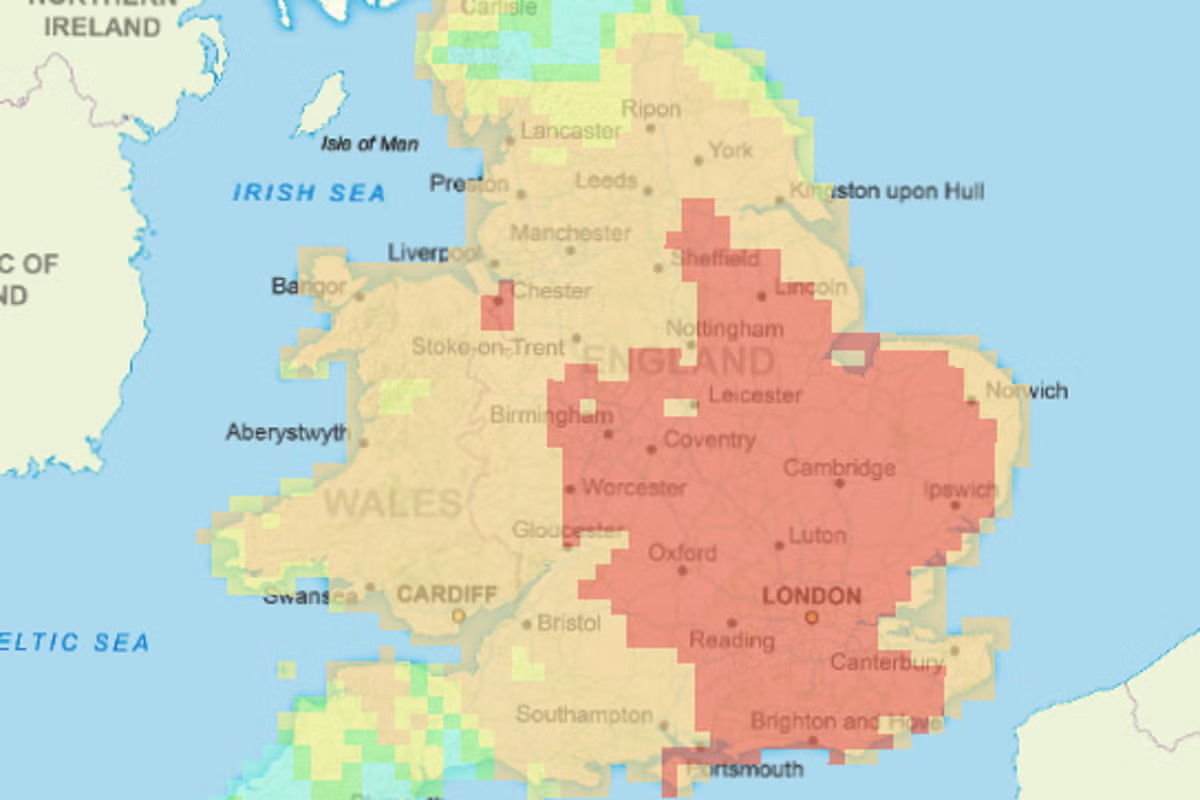
UK wildfire map: Areas most at risk as major incident declared in North Wales


-

 Fashion6 days ago
Open Thread: What Great Books Have You Read Recently?
-

 News Videos5 days ago
Whats Hidden Inside This Cash Register? #treasure #reselling #money
-

 Fashion2 days ago
Weekend Open Thread: Nutriplenish Leave-In Conditioner
-

 Fashion3 days ago
Loro Piana Fall 2026 Enters Houston’s Art Scene
-
 Tech5 days ago
Anthropic’s new “J-lens” reveals a silent workspace inside Claude that mirrors a leading theory of consciousness
-

 Crypto World6 days ago
$1,000 Credit Alert! BlockDAG X Exchange Pre-Registration Now Officially Open, Polkadot Dips & Zcash Rebounds
-

 Business6 days ago
AXT Shares Jump Nearly 14% as Semiconductor Materials Maker Rebounds on AI-Linked Indium Phosphide Demand
-

 Sports5 days ago
Joshua Pacio ‘more complete’ ahead of ONE rematch vs Malachiev
-
 Sports3 days ago
2026 Genesis Scottish Open Thursday TV coverage: Round 1
-

 News Videos6 days ago
Best Time to Enter Small Caps Right Now? Another Bull Run? | Financially Free
-
 Crypto World6 days ago
SK hynix (000660.KS) Stock Dips as $28B Nasdaq ADR Offering Drives AI Memory Expansion
-

 Tech5 days ago
Anthropic brings Claude Cowork to mobile and web as usage data shows most users aren’t coding
-

 News Videos6 days ago
Avoid entering in FOMO #bitcoin #cryptocurrency #trading #scalping
-

 Sports2 days ago
Super Eagles star Moses Simon opens up on Liverpool transfer regret
-
Sports5 days ago
We have punished the disrespect
-

 Crypto World6 days ago
Binance lists Strategy’s STRC stock as company expands Bitcoin funding
-

 Tech3 days ago
Character.AI enters the microdrama arena with its own productions, but there’s a twist
-
 Tech6 days ago
9 Best Keyboards (2025), Tested and Reviewed
-
 Business6 days ago
Enbridge: AI Tailwind Priced In (Rating Downgrade)
-

 News Videos5 days ago
“What’s going on?!” Carl Froch discusses Floyd Mayweather Jr financial issues
You must be logged in to post a comment Login