







Connect with us
DAPA Banner
DAPA Coin
DAPA
COIN PAYMENT ASSET
PRIVACY · BLOCKDAG · HOMOMORPHIC ENCRYPTION · RUST
ElGamal Encrypted MINE DAPA
🚫 GENESIS SOLD OUT
DAPAPAY COMING

Business

eBay Rejects GameStop’s $55.5bn Takeover Bid as “Not Credible”

Published

on

GameStop's $55.5bn eBay Takeover Bid: Ryan Cohen Targets Amazon Rival

In a move that has set the M&A community talking on both sides of the Atlantic, eBay has firmly slammed the door on a $55.5bn (£40.9bn) unsolicited takeover approach from American video games retailer GameStop, branding the bid “neither credible nor attractive”.

The rejection, communicated in a sharply worded letter from eBay’s board to GameStop chief executive Ryan Cohen, will come as little surprise to anyone with a passing acquaintance of the relative scale of the two businesses. GameStop, the bricks-and-mortar gaming chain that found cult status in 2021 as the original “meme stock”, is roughly a quarter of the size of the online auction house it is attempting to swallow, a David-and-Goliath dynamic that City analysts have long viewed as a near-insurmountable hurdle.

In its rebuff, the eBay board cited “uncertainty” over how the deal would be financed, alongside concerns about “the impact of your proposal on eBay’s long-term growth and profitability”. Directors also pointed to “operational risks, and leadership structure of a combined entity”, as well as questions over “GameStop’s governance”, a pointed reference, observers will note, to a company whose share price has historically been driven as much by social media sentiment as by retail fundamentals.

GameStop had attempted to bolster the credibility of its overture with a commitment letter from TD Securities for roughly $20bn of debt financing. Yet that prospective debt pile is precisely what gave eBay’s board, and a chorus of independent analysts, pause for thought. Sucharita Kodali, retail analyst at Forrester, told Business Matters the proposition was hardly “a terribly good offer”, warning that it would saddle the auction giant with GameStop’s borrowings at a moment when eBay is finally finding its feet again.

That recovery is no idle boast. Despite the well-documented competitive squeeze from Amazon, Etsy and, more recently, the Chinese disruptor Temu, eBay posted net profits of $418.4m in 2025, more than treble the $131.3m delivered the year before, even as sales softened. The board insists its turnaround strategy is bearing fruit and is in no mood to surrender the upside to an opportunistic suitor.

Advertisement

Mr Cohen, however, is unlikely to retreat quietly. The GameStop chief, who built his fortune through online pet retailer Chewy before becoming the unofficial figurehead of the meme-stock movement, claimed last week that eBay could be transformed under his stewardship into a credible challenger to Amazon. He has also signalled his willingness to bypass the boardroom and take his proposition directly to eBay’s shareholders, a hostile gambit that would set the stage for one of the more colourful takeover battles of the year.

For Britain’s SME owners watching from across the Atlantic, the saga is more than a transatlantic curiosity. eBay remains a vital sales channel for thousands of small British retailers, many of whom built post-pandemic businesses on its platform. Any prolonged ownership dispute, or a deal that materially loaded the company with debt, could have tangible consequences for the fees, listing policies and seller protections those firms depend on.

For now, eBay’s chairman and chief executive will be hoping the matter ends here. The bookies, and most of Wall Street, are betting it won’t.


Amy Ingham

Amy is a newly qualified journalist specialising in business journalism at Business Matters with responsibility for news content for what is now the UK’s largest print and online source of current business news.

Advertisement

Continue Reading
Click to comment

You must be logged in to post a comment Login

Leave a Reply

Business

Big Tech turns to Sesame Street, Girl Scouts to deflect scrutiny over kids’ screen time

Published

on

Big Tech turns to Sesame Street, Girl Scouts to deflect scrutiny over kids’ screen time


Big Tech turns to Sesame Street, Girl Scouts to deflect scrutiny over kids’ screen time

Continue Reading

Business

Lebanon to press Israel to cease fire as latest Washington talks begin

Published

on

Lebanon to press Israel to cease fire as latest Washington talks begin


Lebanon to press Israel to cease fire as latest Washington talks begin

Continue Reading

Business

Where is it, what to know

Published

on

Where is it, what to know
What the hantavirus says about U.S. readiness for future viral outbreaks

A cruise ship outbreak of hantavirus has rattled the public and reignited fears of another global health scare as passengers disperse across multiple countries, including the U.S. 

The World Health Organization reported 11 cases linked to the outbreak as of Tuesday, nine of which it confirmed, including three deaths. No Americans have tested positive as of Wednesday.

Other passengers are being monitored in specialized medical units, including 18 in the U.S. across Nebraska and Atlanta. A handful of people not connected to the cruise are also being evaluated for possible exposure across several states. Treatments specifically for hantavirus are still years away: Shares of Moderna rallied around 12% on Friday after it confirmed it was conducting early research on a potential vaccine to protect against hantavirus.

But as the number of exposed individuals and public concern grow, health experts aim to tamp down fears of another pandemic. Their message: This is not Covid-19 all over again. 

Advertisement

Unlike Covid, measles or the flu, the specific Andes strain of hantavirus in the outbreak does not spread easily between people, making the risk of widespread spillover to the public low. More cases could emerge in the coming weeks because hantavirus has a long incubation period, experts said.

Still, “we are not expecting a large number of infections and they will likely remain limited to passengers who were exposed aboard the ship, especially now that we have containment measures in place,” Dr. Nicole Iovine, chief hospital epidemiologist and an infectious disease physician at the University of Florida, said in an interview. 

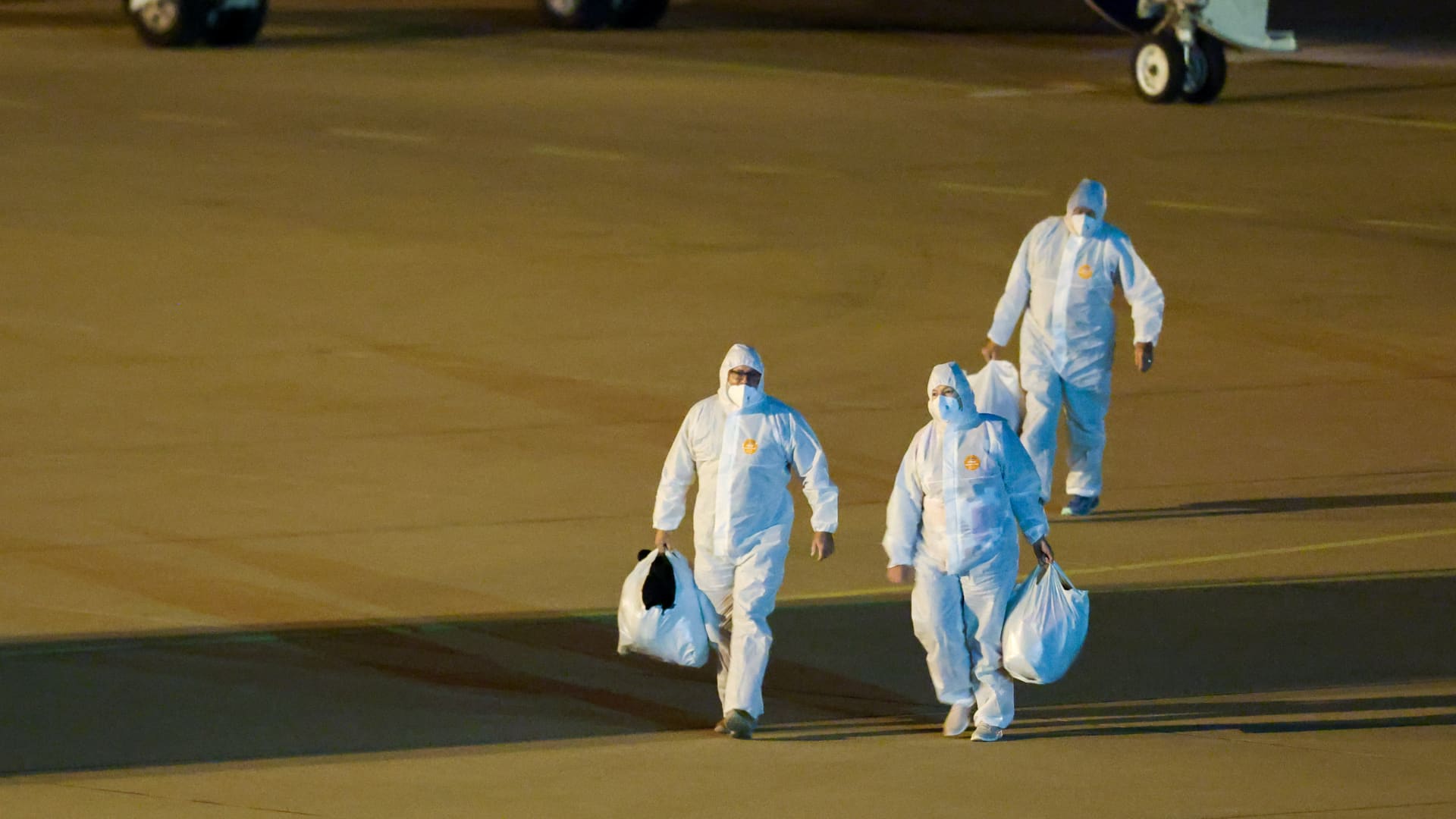
Crew members of the “Hondius” arrive at Eindhoven airport in the evening in two aircraft, including a German crew member.

Christoph Reichwein | Picture Alliance | Getty Images

Advertisement

But for other experts, the outbreak is raising broader concerns about how equipped the U.S. is to respond to future infectious disease threats, particularly after major cuts to the Centers for Disease Control and Prevention and the Trump administration’s move to withdraw from the WHO last year.

While experts say the CDC appears to have the hantavirus outbreak under control, some warn that the situation exposed cracks in the nation’s public health infrastructure that could carry greater consequences in the face of a more contagious pathogen.

“I’m not expecting any significant risk to the American public. But if this is a stress test, we failed this,” said Lawrence Gostin, professor of public health law at Georgetown University. “Just imagine if this were actually a highly transmissible agent.”

In the meantime, Modern

Advertisement

Here’s what to know about where the hantavirus outbreak stands, and what it says about the U.S. ability to contain infectious diseases.

Low risk to the general public

ILLUSTRATION of hantavirus testing concept with laboratory tubes containing cotton swabs and HANTAVIRUS labels photographed in front of a public domain hantavirus related microscopic image released by the U.S. Centers for Disease Control and Prevention in Paris, France, May 8, 2026.

Joao Luiz Bulcao | Afp | Getty Images

The Andes strain typically spreads through “close and usually prolonged contact” with an infected individual showing symptoms, said Dr. Kari Debbink of the Johns Hopkins Bloomberg School of Public Health. 

Debbink said that’s unlike Covid, which “spread pretty efficiently without a very long exposure.” Hantavirus is not considered airborne because it does not linger in the air to infect others in the same way that respiratory viruses like Covid, the flu and measles do.

Advertisement

But cruise ships like the MV Hondius are considered ideal environments for disease transmission because they bring together a wide variety of people and stick them in close quarters for days or even weeks. 

“Cruise ships are one of the greatest threats to public health. They are floating petri dishes isolated in the water,” said Dr. Tyler Evans, CEO of public health organization Wellness Equity Alliance and the former chief medical officer for New York City’s Covid response. 

WHO investigators believe the outbreak stemmed from a Dutch couple on board the MV Hondius cruise ship who later died from their infections. 

Before boarding, the couple had gone on a bird-watching trip through Argentina, Chile and Uruguay, Dr. Tedros Adhanom Ghebreyesus, director-general of the WHO, said at a May 7 briefing. He said the couple’s bird-watching trip included visits to sites where “the species of rat that’s known to carry hantavirus was present,” he said. 

Advertisement

Hantavirus has an incubation period of one-to-six weeks after exposure, which means that more cases will likely crop up, said Debbink. But the people who made contact with infected individuals are being monitored for symptoms in specialized facilities, so “this should be contained rather quickly,” she added. 

Concerns about the U.S. response

The U.S. likely has the outbreak under control given the nature of hantavirus. But some health experts raised concerns about the lack of a more robust response from the CDC under Trump, and raised broader fears about whether the U.S. is prepared for future, more transmissible global health threats.

“CDC has always been at the forefront of global health emergencies – from SARS-CoV-2 to Ebola to Zika,” said Georgetown’s Gostin. “And for this, the CDC is missing in action. Their response has been disjointed and late.”

For decades, the CDC has developed a reputation as the world’s premier public health agency, rapidly coordinating with the WHO and foreign governments during outbreaks. But experts say the agency has been weakened by deep staffing cuts, leadership vacancies and the Trump administration’s decision to sever ties with the WHO.

Advertisement

Trump cut roughly 10% of the CDC’s workforce in early 2025, leaving fewer epidemiologists and scientific staff to do boots-on-the-ground work or coordinate responses across governments. There is currently no permanent CDC director or U.S. surgeon general, both positions that play a critical role in responding to disease threats.

“They don’t have the right leadership at the CDC,” said Evans. “They’re sort of on a ship without a captain at the helm, so they’re scrambling a bit and doing the best they can. There are serious concerns about it.”

Gostin said the CDC lagged behind the WHO and European health authorities, saying the agency escalated its actions “a week after the international community started mobilizing around a potential global health crisis.” The outbreak was first reported on May 2 to the WHO, which quickly took a number of actions, including deploying an expert on board the ship.

The CDC issued its first public statement about the outbreak on May 6 and its first official health alert to U.S. doctors on May 8, which warned of the possibility of imported cases. The agency confirmed it had deployed a team on May 7 to Spain’s Canary Islands, where the ship arrived two days later, and a second group to Nebraska as part of a plan to evacuate U.S. passengers from the ship. 

Advertisement

While the CDC is now working with the WHO, experts say the Trump administration’s decision to sever ties with the international health body is detrimental to the U.S.’s ability to respond to future outbreaks. For example, the U.S. no longer has direct, automatic access to real-time information from member states of the WHO about emerging health threats. 

Neil Maniar, a public health professor at Northeastern University, said the response to hantavirus stands in stark contrast to 2020, when the CDC worked closely with international partners during Covid.

“That is what is needed to effectively respond to these types of outbreaks, and that is where the system has really broken down,” Maniar said. 

“We need to restore our country’s expertise and resources to respond because there are going to be future outbreaks,” he added. “It should raise significant alarm bells for everyone in terms of our readiness and ability to keep this country safe.”

Advertisement
Choose CNBC as your preferred source on Google and never miss a moment from the most trusted name in business news.
Continue Reading

Business

Dow Jones Surges 406 Points to Record High Above 50,000 on Strong Economic Signals

Published

on

FTSE 100 Surges 0.8% Today as Oil Eases and Markets

NEW YORK — The Dow Jones Industrial Average climbed more than 400 points Thursday, closing above the psychologically important 50,000 level for the first time as investors cheered resilient corporate earnings, cooling inflation signals and growing optimism about potential Federal Reserve rate cuts later this year.

The blue-chip index finished at 50,098.87, up 405.67 points or 0.82%. The milestone crossing of 50,000 comes amid a broader market rally fueled by solid first-quarter earnings from major companies and expectations that the central bank may begin easing monetary policy as early as September. The S&P 500 also posted gains, rising 0.65% to close at a fresh record, while the Nasdaq Composite advanced 0.48%.

The Dow’s strong performance was led by gains in financials, industrials and technology components. Goldman Sachs, American Express and Boeing contributed significantly to the index’s advance, reflecting renewed confidence in the economic outlook. Boeing shares jumped after the company reported better-than-expected aircraft deliveries and progress on supply chain issues. Financial stocks benefited from a steeper yield curve and expectations of improved lending conditions if rates ease.

Economists and strategists described the move as a vote of confidence in the U.S. economy’s underlying strength. Recent data showed inflation moderating more quickly than anticipated in certain categories, while consumer spending and employment figures remained robust. The combination has reduced fears of an imminent recession and increased bets on monetary easing.

Advertisement

“The market is pricing in a soft landing scenario,” said Michael Arone, chief investment strategist at State Street Global Advisors. “Corporate America is delivering solid results, inflation is trending in the right direction, and the Fed has flexibility to support growth if needed. That’s a constructive backdrop for equities.”

The Dow’s climb above 50,000 represents a significant psychological milestone. The index first crossed 40,000 in March 2024 and has shown remarkable resilience despite geopolitical tensions, election uncertainty and fluctuating interest rates. Year-to-date, the Dow is up approximately 8.5%, trailing the S&P 500 and Nasdaq but demonstrating broad-based participation beyond technology stocks.

Market breadth was positive, with advancers outnumbering decliners on the New York Stock Exchange. Volume was moderate, suggesting steady buying interest rather than speculative frenzy. The VIX, often called Wall Street’s fear gauge, remained subdued, indicating low levels of market anxiety.

Sector rotation continued to play out. Defensive sectors like utilities and consumer staples lagged, while cyclical areas such as financials, industrials and materials outperformed. Energy stocks were mixed as oil prices held above $100 per barrel amid ongoing tensions in the Middle East, particularly around the Strait of Hormuz.

Advertisement

The Trump administration’s diplomatic efforts also influenced sentiment. President Donald Trump’s ongoing summit with Chinese President Xi Jinping in Beijing raised hopes for potential trade stabilization and supply chain improvements. Any positive developments from those talks could further support market confidence.

Corporate earnings season has provided a solid foundation for the rally. More than 80% of S&P 500 companies that have reported so far have beaten analyst expectations on both revenue and earnings per share. Technology giants like NVIDIA and Microsoft continued to lead gains on AI enthusiasm, while traditional industrial names showed surprising strength.

Analysts at Goldman Sachs raised their year-end target for the S&P 500 to 6,000, citing strong earnings momentum and reasonable valuations. “We see further upside as the economy avoids recession and corporate profits expand,” the firm noted in a recent report.

However, risks remain. Persistent inflation in services and housing could delay Fed rate cuts. Geopolitical developments in the Middle East continue to pose upside risks to energy prices. Additionally, any escalation in U.S.-China tensions could pressure multinational companies with significant exposure to both markets.

Advertisement

For individual investors, today’s milestone offers encouragement but also serves as a reminder of the importance of diversification. Financial advisers recommend maintaining balanced portfolios with exposure to both growth and value stocks, along with international diversification.

The Dow’s record run reflects broader optimism about American economic resilience. Despite higher interest rates for longer than many expected, consumer spending has held up, unemployment remains low, and corporate America continues to innovate and adapt. The market’s ability to reach new highs demonstrates investor confidence in the long-term outlook.

Looking ahead, focus shifts to upcoming economic data releases, including retail sales, housing figures and the next round of corporate earnings. The Federal Reserve’s June meeting will also be closely watched for any signals on the timing of potential rate cuts.

As the Dow celebrates its first close above 50,000, the achievement represents more than just a number — it symbolizes the enduring strength of American enterprise and investor optimism about the future. Whether this milestone marks the beginning of a new leg higher or a temporary peak will depend on how the economy and corporate America navigate the challenges ahead.

Advertisement

For now, Wall Street is celebrating a significant psychological victory. The Dow’s climb to 50,000 caps a remarkable recovery from pandemic lows and underscores the market’s ability to adapt and thrive in a complex global environment. Investors will be watching closely to see if the momentum can be sustained through the remainder of 2026.

Continue Reading

Business

F2i to retain control of 2i Aeroporti after CDP Equity deal

Published

on


F2i to retain control of 2i Aeroporti after CDP Equity deal

Continue Reading

Business

Review: Air New Zealand redefines long-haul cabin design

Published

on

Review: Air New Zealand redefines long-haul cabin design

REVIEW: Air New Zealand has designed with long flights in mind, prioritising comfort and rest.

Continue Reading

Business

New Yorkshire distribution centre for Company Shop Group in multimillion-pound investment

Published

on

Business Live

The Barnsley business is set to open the new centre this summer, creating new jobs

The Company Shop Group site based in Darton, South Yorkshire

The Company Shop Group site based in Darton, South Yorkshire(Image: Company Shop Group)

Major surplus goods business Company Shop Group has announced it is launching a new multimillion-pound redistribution centre in Yorkshire. The Barnsley based group is a leading UK redistributor and retailer of surplus products, operating a network of 14 ‘Surplus Supermarkets’ across the UK selling discounted surplus from over 800 brands, retailers and manufacturers to its members.

It also operates a not-for-profit arm social enterprise, Community Shop, which provides access to heavily discounted food and household essentials. Now the business, which is owned by Biffa plc, is opening a new redistribution centre handing frozen products in Darton, South Yorkshire, marking a multimillion-pound investment.

Advertisement

The 73,007 sq ft site will open in the Summer, and become fully operational by October. The site is being refitted before bringing the freezers down to temperature and final testing ahead of becoming operational.

The investment in the new facility comes after Company Shop Group announced that it had reached the milestone of redistributing 1 billion surplus items since the business began, and marks one of the organisation’s biggest investments since it moved to its existing headquarters in Tankersley, where it processes ambient and chilled products.

Having doubled the amount of frozen surplus handled over the last five years, bosses said the fresh investment demonstrates Company Shop Group’s ongoing commitment to providing its partners with industry-leading solutions that prevent surplus food, drink and household products becoming waste.

The new redistribution centre, which is based a few miles from its existing Tankersley site, will process and redistribute millions of frozen food items across the UK through its network of supermarkets and its Community Shop.

Advertisement
Chris Burns, group managing director of Company Shop Group

Chris Burns, group managing director of Company Shop Group(Image: Company Shop Group)

The move brings its frozen operations entirely in-house providing increased scale to handle more items. Existing staff have moved to the new site and the new frozen redistribution centre will create at least five new roles.

Chris Burns, group managing director of Company Shop Group, said: “Over the last five years we have doubled the amount of frozen surplus that we handle and this new redistribution centre is a major investment for the future, bringing significantly increased operational capacity.

“By bringing our frozen operations in-house, we will be better positioned to support our industry partners, creating a more efficient system and a platform for continued investment in our product interventions. All of which will help stop even more perfectly good products from going to waste.”

Martin Upton, operations director at Company Shop Group, added: “The new frozen redistribution centre will allow us to process far more pallets per day reinforcing our unique ability to redistribute frozen surplus at a very large scale. This brings significant benefits, including the opportunity to introduce new product interventions that will enable us to provide even more support to our partners and redistribute more stock.”

Advertisement

Company Shop Group’s primary redistribution centre at Tankersley will continue to operate, handling ambient and chilled products.


Continue Reading

Business

P&N pursues new $30b bank merger

Published

on

P&N pursues new $30b bank merger

P&N Bank will pursue a merger with Bank Australia and a headquarters move away from Perth, less than six months after a $30 billion attempt to merge with Great Southern Bank fell flat.

Continue Reading

Business

B&G Foods winds down portfolio overhaul

Published

on

B&G Foods winds down portfolio overhaul

Sales trends for the remaining business begin to accelerate.

Continue Reading

Business

CoreWeave: Q1 Confirmed The Math Doesn't Work

Published

on

CoreWeave: Q1 Confirmed The Math Doesn't Work

CoreWeave: Q1 Confirmed The Math Doesn't Work

Continue Reading

Trending

Copyright © 2025