

Business
Elon Musk Highlights Starship as Planet-Colonizer and Tesla FSD Safety Milestone


NEW YORK — Elon Musk drew attention to two of his most ambitious projects on Sunday, March 29, 2026, praising SpaceX’s Starship as humanity’s first “planet-colonizer class rocket” while spotlighting new data showing Tesla’s Full Self-Driving (FSD) system is now nine times safer than the average American driver.

The posts on X came amid a busy period for Musk, who continues balancing leadership of Tesla, SpaceX, xAI and other ventures while remaining highly active on social media. The messages underscore his dual focus on making humanity multi-planetary and accelerating autonomous transportation on Earth.
In one post, Musk quoted user Dima Zeniuk’s statement that “Starship is the first planet-colonizer class rocket,” adding his own endorsement. The comment accompanied a short video clip showcasing Starship’s scale and capabilities. Hours later, Musk shared data from Peter H. Diamandis highlighting Tesla FSD’s impressive safety record: 5.3 million miles between accidents compared to the U.S. average of 660,000 miles.
Starship: A New Class of Spacecraft
SpaceX’s Starship represents the most powerful rocket system ever built, designed from the ground up for deep-space missions, including eventual crewed flights to Mars. Musk has long described Starship as essential for establishing a self-sustaining human presence beyond Earth, calling it a “planet-colonizer class” vehicle capable of carrying dozens of passengers and massive cargo payloads.
Recent test flights have demonstrated significant progress in reusability, heat shield performance and in-orbit refueling techniques. These capabilities are critical for long-duration missions where Starship would need to be refueled in space to reach Mars or establish lunar bases. SpaceX aims to conduct more orbital tests in 2026, with uncrewed Mars missions potentially following in the coming years.
The “planet-colonizer” label emphasizes Starship’s intended role not just as a transport vehicle but as part of a broader infrastructure for building settlements on other worlds. Musk has envisioned fleets of Starships ferrying people, supplies and equipment to create permanent outposts, starting with the Moon and eventually Mars.
Tesla FSD Safety Breakthrough
On the autonomy front, Musk shared encouraging safety statistics for Tesla’s Full Self-Driving software. According to the data, FSD now achieves one accident every 5.3 million miles driven, compared to the U.S. average of one accident every 660,000 miles — making the system roughly nine times safer than human drivers.
Tesla has gradually expanded FSD’s supervised capabilities, with version 12.5 and later iterations showing marked improvements in handling complex urban environments, highway merging and edge cases. The company continues collecting vast amounts of real-world driving data from its fleet to refine the neural networks powering the system.
Musk has repeatedly stated that achieving reliable autonomy is central to Tesla’s long-term value, potentially unlocking robotaxi services and transforming transportation economics. Regulators in the U.S. and elsewhere continue scrutinizing FSD and similar systems, with safety data playing a key role in future approvals for unsupervised operation.
Interconnected Vision
Both Starship and Tesla FSD reflect Musk’s overarching goal of advancing human technological capability. Starship aims to expand humanity’s reach into the solar system, while FSD seeks to eliminate road deaths and revolutionize mobility on Earth. Musk often describes these projects as complementary pieces of a future where sustainable energy and multi-planetary life reduce existential risks to humanity.
The timing of the posts also highlights Musk’s strategy of using X to communicate directly with followers, bypassing traditional media channels. His near-constant activity on the platform frequently moves markets, influences public opinion and generates both praise and criticism.
Challenges and Outlook
Despite the optimistic tone, both projects face significant hurdles. Starship must prove consistent reliability and orbital refueling before crewed missions become feasible. Regulatory approvals, technical complexities and enormous costs remain substantial barriers to rapid colonization timelines.
For Tesla FSD, regulatory scrutiny, public trust and competition from companies like Waymo continue to shape development. Achieving fully unsupervised autonomy at scale will require overcoming technical, legal and societal challenges.
Nevertheless, recent progress in both areas has bolstered investor confidence. Tesla shares and SpaceX’s valuation have reflected growing excitement around autonomy and space exploration. Musk’s ability to attract top talent and capital across his companies continues to fuel momentum.
As 2026 unfolds, attention will turn to upcoming Starship test flights, further FSD software releases and any regulatory developments affecting both programs. Musk’s latest posts serve as a reminder of the expansive vision driving his enterprises and the rapid pace of innovation under his leadership.
For followers of Musk and his companies, the messages reinforce a narrative of bold ambition tempered by incremental achievements. Whether Starship ultimately becomes the vehicle that colonizes other planets or FSD transforms daily transportation, both projects represent high-stakes bets on humanity’s technological future.
The coming months are likely to bring more updates, test results and public commentary from Musk as these initiatives advance. In the meantime, his Sunday posts have once again focused global attention on the twin frontiers of space travel and autonomous driving.



Some tickers are covered more than others on the site, so with The Undercovered Dozen our Editors highlight twelve actionable investment ideas on tickers with less coverage. These ideas can range from “boring” large caps to promising up-and-coming small caps. Specifically, the inclusion criteria for “undercovered” include: market cap greater than $100 million, more than 800 symbol page views in the last 90 days on Seeking Alpha, and fewer than two articles published in the past 30 days. Follow this account to receive a weekly review of twelve of these undercovered ideas from our valued analysts.
Analyst’s Disclosure: I/we have no stock, option or similar derivative position in any of the companies mentioned, and no plans to initiate any such positions within the next 72 hours. I wrote this article myself, and it expresses my own opinions. I am not receiving compensation for it. I have no business relationship with any company whose stock is mentioned in this article.
Seeking Alpha’s Disclosure: Past performance is no guarantee of future results. No recommendation or advice is being given that any particular security, portfolio, transaction or investment strategy is suitable for any specific person. The author is not advising you personally concerning the nature, potential, value or suitability of any particular security or other matter. You alone are solely responsible for determining whether any investment, security or strategy, or any product or service, is appropriate or suitable for you based on your investment objectives and personal and financial situation. The author is an employee of Seeking Alpha. Any views or opinions expressed herein may not reflect those of Seeking Alpha as a whole. Seeking Alpha is not a licensed securities dealer, broker or US investment adviser or investment bank.
Business
Wockhardt shares rocket 19% after FDA approval for antibiotic targeting drug-resistant infections. Check details
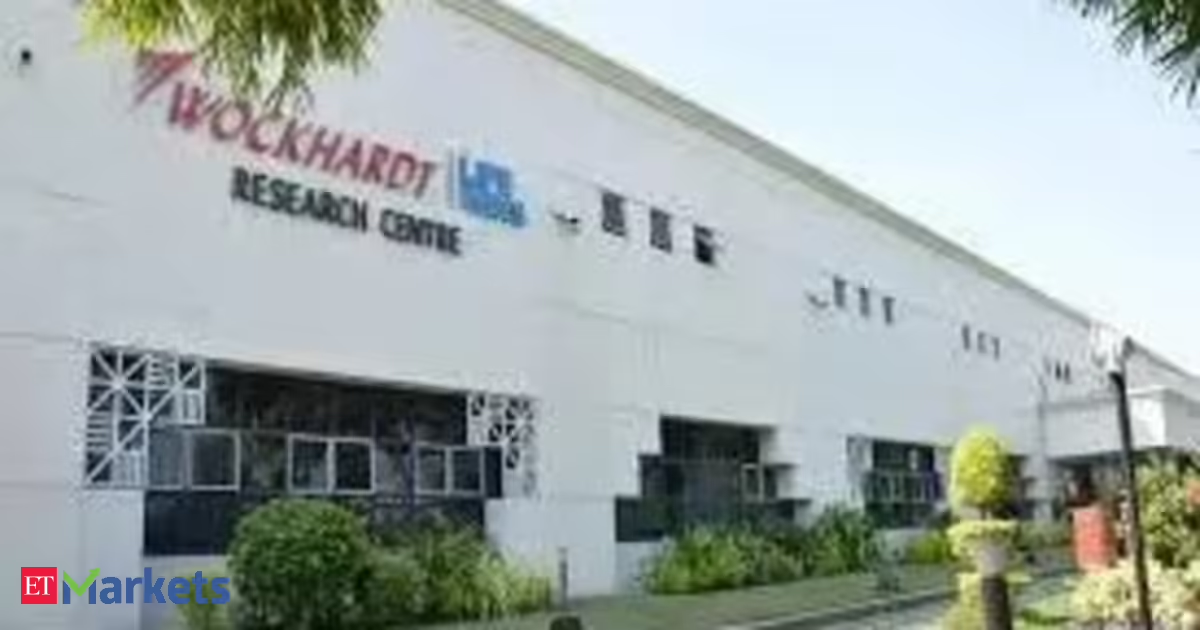
According to the company, ZAYNICH combines the fourth-generation cephalosporin cefepime with zidebactam and is designed to target multiple penicillin-binding proteins simultaneously. The antibiotic had earlier received Qualified Infectious Disease Product (QIDP) and Fast Track designations from the FDA.
The approval comes at a time when antimicrobial resistance remains a major healthcare challenge. Wockhardt cited data indicating that more than 2.8 million antimicrobial-resistant infections occur annually in the United States, resulting in over 35,000 deaths each year.
The company also noted that complicated urinary tract infections account for more than 6,00,000 hospitalisations annually in the U.S., with a growing proportion linked to antimicrobial-resistant and multidrug-resistant bacteria.
The FDA’s decision was based in part on results from the Phase 3 ENHANCE-1 study, a randomised, double-blind, multicentre trial that evaluated the efficacy, safety and tolerability of ZAYNICH against meropenem in hospitalised adults with complicated urinary tract infections or acute pyelonephritis.

Also read: FDA approval puts Wockhardt’s Zaynich in $9 billion antibiotics market
In the study, ZAYNICH achieved a composite clinical cure and microbiological response rate of 89% at the test-of-cure visit, compared with 68.4% for meropenem. The treatment difference was 20.6% with a 95% confidence interval of 12.3 to 29.5. The company said the drug was generally well tolerated during the trial.The ENHANCE-1 study enrolled 530 patients across 64 sites spanning the United States, Europe, Latin America, China and India.
Wockhardt stated that ZAYNICH targets penicillin-binding proteins PBP 1a/b, 2 and 3 simultaneously, a mechanism that it says provides bactericidal activity against multidrug-resistant Gram-negative bacteria for which treatment options remain limited.
The company also disclosed that ZAYNICH received approval from the Drugs Controller General of India (DCGI) on May 27, 2026. In addition, Wockhardt has submitted a Marketing Authorisation Application (MAA) to the European Medicines Agency for the antibiotic.
Sensex, Nifty today: Catch all the LIVE stock market action here
(Disclaimer: Recommendations, suggestions, views and opinions given by the experts are their own. These do not represent the views of The Economic Times)


US says it struck Iranian military sites, Tehran responds with air base attack

Asia’s factory output expands as firms stockpile buffers over Iran war risks
Business
Suzlon Energy shares fall over 2% after SEBI fines Rs 29 crore for misleading financial statements

In a 96-page order issued on May 29, Sebi said Suzlon and certain former executives violated provisions of the Sebi Act, PFUTP Regulations, listing regulations and disclosure requirements. The order replaces an earlier adjudication order issued in June 2025 and confirms multiple violations by the company and its executives.
Among the penalised individuals, former executive Vinod R. Tanti was fined Rs 5.75 crore, while Girish R. Tanti was directed to pay Rs 5.45 crore. Former Group CFO Kirti J. Vagadia was fined Rs 1.5 crore and former CFO Amit Agarwal was fined Rs 30 lakh.
The matter stemmed from an anonymous complaint received by Sebi in December 2019 alleging irregularities in transactions involving Suzlon’s subsidiaries and associate entities. A subsequent forensic audit and investigation covering FY15 to FY20 and the first nine months of FY21 examined several issues, including dealings with subsidiaries, impairment reversals, contingent liabilities and financial statement disclosures.
Sensex, Nifty today: Catch all the LIVE stock market action here
One key observation related to the transfer of Suzlon’s operations and maintenance services business to its subsidiary, Suzlon Global Services Ltd, in March 2014. Sebi noted that the business, valued at around Rs 77 crore, was transferred for Rs 2,000 crore, resulting in Suzlon recording an accounting gain of Rs 1,922.92 crore.
According to the regulator, the subsidiary lacked the financial capacity to fund the transaction. Sebi found that a significant portion of the consideration was subsequently reflected as paid through circular movement of funds between the two entities. The regulator said the arrangement created artificial profits and inflated the company’s net worth. It observed that Suzlon’s FY14 net worth would have been Rs 741 crore without the transaction, compared with the reported figure of Rs 2,664 crore.
Sebi further noted that Suzlon later booked an additional gain of Rs 829.78 crore by transferring its stake in the subsidiary to another wholly owned entity, effectively recognising profit a second time on the same underlying assets. According to the regulator, these transactions helped the company portray a stronger financial position and supported subsequent fund-raising and restructuring efforts.
The order also addressed a standby letter of credit connected to loans taken by a foreign subsidiary. Sebi said a contingent liability of about $569 million, or roughly Rs 4,050 crore, which had been disclosed in FY17, was not reflected in FY18 contingent liability disclosures after being reclassified under an accounting standard related to insurance contracts. The regulator held that the treatment was inappropriate and materially reduced the visibility of the company’s financial exposure.
In addition, Sebi reviewed investments and loans involving subsidiaries SE Forge Ltd and Suzlon Gujarat Wind Park. It found that several transactions involved circular routing of funds, conversion of loans into equity and later impairment of investments. According to the regulator, these transactions resulted in financial statements that did not accurately represent the underlying economic substance.
Sebi concluded that the company’s financial statements and disclosures failed to present a true and fair view of its financial position. The regulator said financial statements and disclosures form the basis on which investors and other market participants assess a listed company’s financial health and prospects.
While Sebi noted that disproportionate gains and investor losses could not be quantified with precision, it said the violations were serious because they related to financial information disseminated to investors and relied upon by the market.
Sebi imposed the penalties under provisions relating to fraudulent and unfair trade practices, disclosure lapses and violations of listing obligations. The notices must pay the penalties within 45 days of receiving the order.
(Disclaimer: Recommendations, suggestions, views and opinions given by the experts are their own. These do not represent the views of The Economic Times)

Janus Henderson Investors exists to help clients achieve their long-term financial goals. Formed in 2017 from the merger between Janus Capital Group and Henderson Global Investors, we are committed to adding value through active management. For us, active is more than our investment approach – it is the way we translate ideas into action, how we communicate our views and the partnerships we build in order to create the best outcomes for clients. While our investment managers have the flexibility to follow approaches best suited to their areas of expertise, overall our people come together as a team. This is reflected in our Knowledge. Shared ethos, which informs the dialogue across the business and drives our commitment to empowering clients to make better investment and business decisions.www.janushenderson.com

Operator
Hello, and welcome to the Cango Inc. First Quarter 2026 Earnings Conference Call. [Operator Instructions] Please note, this event is being recorded. I would now like to turn the conference over to Mr. Paul Yu, Chief Executive Officer. Please go ahead.
Peng Yu
CEO & Director
Good morning, everyone, and thank you for joining Cango’s First Quarter 2026 Earnings Call. First, I will summarize our key financials and operational performance for the quarter. The first quarter of 2026 was characterized by industry-wide adjustments and our results reflect these macro headwinds alongside our ongoing efforts to manage our strategic transition. During Q1, we generated total revenue of approximately $102 million, primarily driven by revenue from our Bitcoin mining business. We reported a net loss from continuing operations of $261.1 million primarily due to noncash impairment charges on Bitcoin mining machines and loss from changes in fair value of receivable for Bitcoin collateral, both resulting from the decline in Bitcoin market price. By the end of the quarter, we held 1,025.7 Bitcoin, and we reduced our long-term debt to $30.6 million. As of March 31, 2026, Cango’s total operational hash rate was 37.01 exahash per second, comprising 27.98 exahash per second of self-mining capacity and 9.02 exahash per second of hosted hash rate. This operational model prioritizes margin resilience over scale.
In Q1, we mined 1,266 Bitcoin. Through disciplined cost management, our average cash cost per Bitcoin mined was $76,928 showing a 9% decrease from Q4 2025. These figures reflect our continued focus on profitability and operational efficiency as our business model evolves.
US says it struck Iranian drone command sites at the weekend
The airline said its operational performance during the quarter was affected by disruptions linked to the ongoing conflict in the Middle East. Capacity, measured in available seat kilometres (ASKs), increased 3.4% YoY to 43.6 billion.
Passenger traffic stood at 31.6 million during the quarter, marking a marginal decline of 1.1% from a year earlier. EBITDAR, excluding foreign exchange impact, stood at Rs 6,435 crore, down from Rs 6,862 crore in the corresponding quarter last year. The EBITDAR margin narrowed to 28.7% from 31%.
IndiGo shares: Should you buy, sell or hold?
Goldman Sachs maintained its Buy rating and target price of Rs 5,200, implying an upside of 18% from current levels. The Wall Street major said the airline did not provide full-year FY27 capacity guidance, while elevated costs continue to remain an overhang. Goldman Sachs highlighted that the broader Indian aviation sector, barring IndiGo, continues to face weak profitability and balance sheet stress. The brokerage has retained its valuation at 10x FY28 estimated EV/EBITDAR.
Jefferies maintained its Buy rating but lowered its target price to Rs 5,380 (22% upside) from Rs 5,500. The brokerage said the airline delivered a weak but largely in-line performance in the fourth quarter and expects the near-term outlook to remain challenging amid elevated cost pressures. For the first quarter, IndiGo has guided for mid-teen growth in unit revenue, largely driven by higher pricing, with demand so far remaining resilient enough to absorb part of the cost increases. Jefferies believes operating conditions will remain difficult in the near term, though the environment is likely to be even more challenging for peers.
Motilal Oswal maintained its Buy rating on IndiGo with a target price of Rs 5,600, implying an upside potential of 27%. The brokerage said that despite near-term challenges from Middle East airspace disruptions, elevated fuel prices, rupee depreciation and higher damp-lease exposure, it remains positive on the airline’s long-term growth strategy.
It believes IndiGo is well positioned to benefit from India’s strong domestic aviation demand and steadily expanding international network. Looking ahead, Motilal Oswal expects a gradual normalisation of international operations, a reduction in Pratt & Whitney-related aircraft groundings, ongoing fleet additions, and the deployment of A321XLR aircraft on international routes to support an earnings recovery.JM Financial maintained its Add rating with a target price of Rs 5,000, noting that capacity growth remained subdued due to the Middle East conflict. IndiGo reported ASK growth of 3.4% year-on-year to 43.6 billion in Q4FY26 and has guided for 3-4% ASK growth in Q1FY27, with most of the increase expected to come from domestic metro and leisure routes.
The brokerage expects this, coupled with mid-teen PRASK growth on a favourable base, to support a recovery in unit economics. Capacity was significantly impacted by the West Asia conflict, with around 18% of total capacity affected and more than 160 daily international flights disrupted in March 2026. However, the airline indicated that capacity recovered to around two-thirds of normal levels in May and expects full normalisation by the end of June. JM Financial also highlighted that the number of grounded aircraft remains in the 40s but is likely to decline to the 30s by year-end, which could provide a meaningful boost to both capacity and costs.
Elara Capital maintained its Buy rating and target price of Rs 6,020, arguing that the stock’s roughly 25% decline over the past six months due to flight disruptions, the Middle East conflict, higher crude oil prices and rupee weakness has created an attractive opportunity. The brokerage believes the market is overly focused on near-term challenges while overlooking the benefits of a prolonged industry-wide capacity shortage.
It highlighted that domestic advance fares are up around 17% year-on-year, while international advance fares have risen nearly 40%. Elara also noted that IndiGo reported an adjusted profit of Rs 25 billion in Q4FY26 despite a non-cash foreign exchange loss of Rs 48 billion. Additionally, competitor capacity reductions have been deeper than IndiGo’s, supporting the airline’s market share gains and pricing power. While the brokerage has lowered its FY27 EBITDA estimate by 7% to account for higher crude oil and rupee assumptions, its FY28 estimates remain broadly unchanged.
(Disclaimer: Recommendations, suggestions, views and opinions given by the experts are their own. These do not represent the views of The Economic Times)

Nomura Tax-Free USA Fund Q1 2026 Commentary

Undercovered stocks: Aeluma, Agnico Eagle, Ciena, Rayonier And More
3 Things That May Move Bitcoin Price This Week

Britney Spears Slams ‘Mean Girls’ in Cryptic Instagram Posts


-

 NewsBeat5 days ago
Israel says it has killed new Hamas military leader in Gaza City airstrikes
-

 Tech5 days ago
NASA taps Blue Origin to deliver lunar rovers for Moon Base initiative
-

 Politics7 days ago
Bridgerton Season 5: Cast, Release Date And Everything We Know So Far
-

 Sports6 days ago
2026 NBA Finals schedule, odds: Knicks await Thunder or Spurs after winning East
-

 News Videos5 days ago
XRP *JUST* SUCCEEDED!!!! CLARITY ACT EXPOSED!!! (SHE EXPOSED IT)
-
 Crypto World5 days ago
Micron Crosses $1 Trillion Market Cap as AI Demand Reshapes Memory Sector
-

 News Videos3 days ago
This is BROKEN! INSANE 5x MONEY CAR WASH WEEK! The NEW GTA Online UPDATE Today! (GTA5 New Update)
-

 Business5 days ago
Selena Gomez Reportedly Upset Over Benny Blanco’s Comments on Her ‘Terrible’ Diet
-

 Business7 days ago
BTS Sells Out Four Las Vegas Shows at Allegiant Stadium for ARIRANG World Tour
-
 NewsBeat6 days ago
Hottest May day ever as London hits 34.8C in 2C leap from previous records
-
 Tech6 days ago
China assigns ID codes to 28,000+ humanoid robots
-

 Business6 days ago
Nikkei 225 Surges Past 65,000 for First Time as Iran Peace Hopes Fuel Record Rally
-

 Tech7 days ago
Microsoft’s quiet Claude Code retreat and the real cost of enterprise AI
-

 Tech3 days ago
Waymo dominates autonomous vehicle registrations as Tesla trails behind
-

 NewsBeat7 days ago
Crowds find riverside shade in York as temperatures soar
-
Tech5 days ago
The Samsung pay deal is the moment Korean unions changed register
-

 Tech7 days ago
Westone Audio and Etymotic Acquired by Fidelity Collective in Major IEM Market Move
-
 Entertainment6 days ago
‘Breaking Bad’ Star’s Easy-to-Binge 6-Part Crime Series Spin-Off Is Finally Heading to Free Streaming
-

 Tech5 days ago
Millions of AI agents imperiled by critical vulnerability in open source package
-
Crypto World5 days ago
SpaceX’s $2 Trillion IPO: Why Tech Giants Nvidia (NVDA), Apple (AAPL), and Microsoft (MSFT) May Face Pressure
You must be logged in to post a comment Login