









Connect with us
DAPA Banner
DAPA Coin
DAPA
COIN PAYMENT ASSET
PRIVACY · BLOCKDAG · HOMOMORPHIC ENCRYPTION · RUST
ElGamal Encrypted MINE DAPA
🚫 GENESIS SOLD OUT
DAPAPAY COMING

Business

Extended summer may lift AC sales, but growth likely to fall short of expectations: Praveen Sahay

Published

on

Extended summer may lift AC sales, but growth likely to fall short of expectations: Praveen Sahay
An extended summer and the possibility of hotter-than-usual weather due to El Niño are expected to provide a boost to India’s room air conditioner (RAC) market. However, the industry is unlikely to witness the 20-25% growth that many had anticipated at the beginning of the season, primarily because dealers have remained conservative in stocking inventory.

According to Praveen Sahay, PL Capital while consumer demand at the secondary level has been encouraging since mid-April, weak primary sales have prevented the industry from fully capitalising on the seasonal opportunity.

Secondary Demand Strong, But Primary Sales Lag
Sahay noted that channel checks indicate healthy off-take at the retail level throughout May, but manufacturers have not seen a proportional increase in shipments to dealers.”On the RAC, we did a channel check recently, and definitely the secondary demand has been very good post-15th April throughout May. That led to good traction at the secondary level. However, we also got to know that the primary sales have not been as expected, even though the summer is continuing. Expectations were for nearly 20-25% growth, but that is not happening at the primary level because inventory in the channel was lower. Dealers were not very enthusiastic about the extended or harsh summer in terms of building inventories.”

He added that the industry’s volume growth has remained below expectations.
“Nearly around 15% growth is what we had envisaged based on our channel checks as well as data published by secondary sources, so that is below expectations.”
El Niño Could Extend the Seasonal Boost
Although the first quarter may not deliver the anticipated growth, Sahay believes the extended summer could benefit the industry during the traditionally weaker second quarter.

He expects RAC sales to recover to around 58 lakh units in the first quarter, compared with approximately 51 lakh units last year, but does not foresee volumes exceeding that level.

Advertisement

“Coming to the El Niño impact, it may extend the summer, especially into July. Q2 is usually a lean quarter for RACs. In good years, the industry sold nearly 17-18 lakh RAC units in the secondary market, while last year it was around 15 lakh. We expect that, with the El Niño impact, sales may reach 18 lakh. Altogether, Q1 and Q2 growth would be nearly around 17% plus, not the 20-25% that was expected.”

He also pointed out that performance differs significantly across brands.

“Brand-to-brand, these numbers are varying. Some companies are very aggressive and are doing very well in terms of volumes, and one of them is Voltas right now.”

Partial Price Hikes Could Squeeze Margins
While inflationary pressures and rising commodity costs prompted manufacturers to announce price increases, Sahay said only part of those hikes has been implemented because of intense competition and soft consumer sentiment.

Advertisement

“The first price hike was taken in January to adjust to the BE norms, and all brands absorbed it because the GST reduction gave them some leeway. Ultimately, consumers did not face any price hike. In April, the announced price hike was around 10% to 11%. In our channel checks, we found that only 5% to 6% has been implemented so far. Some discounting and rollbacks have also happened.”

He believes companies have struggled to fully pass on higher costs.

“Competitive intensity has increased. Maybe consumer demand is also getting impacted because of inflation. Those are the reasons why the entire price hike has not been taken, and that will definitely lead to some margin pressure for all the players because they are not able to pass on the entire commodity cost increase.”

Dealers Playing It Safe
The industry’s biggest challenge this year has been the cautious approach adopted by dealers despite favourable weather conditions.

Advertisement

Sahay said dealer inventory levels remain significantly lower than in previous years.

“Our channel checks show that secondary demand has been good, but primary demand is still lower. Earlier, dealers were carrying inventories of more than 30 days. Right now, what we get to know is that inventory is nearly 10 days lower, at around 20 days. That has led to softness in primary sales. Expectations were for 20-25% growth, looking at the harsh summer, extended summer and El Niño impact, but dealers were quite cautious in building inventory. That has led to softer demand. Nearly around 15% growth is what we are estimating so far.”

Q1 Growth Seen at Around 15%, Margins Remain Under Pressure
Looking ahead, Sahay expects the industry to deliver around 15% volume growth in the first quarter of FY27, while profitability is likely to remain under pressure because companies have not been able to fully recover rising input costs through pricing.

“Earlier expectations for volume growth were higher. So far, for Q1, we are estimating around 15% growth. On the margin front, as I highlighted earlier, commodity inflation required a price hike of around 10-11%. The players announced it, but the absorption has been only 5% to 6% so far. There is a gap of nearly 5%, which will definitely impact the margin profile for all the players.”

Advertisement

While the extended summer could provide additional support in the coming months, the industry’s overall performance will largely depend on whether dealers become more confident in rebuilding inventories and whether manufacturers can protect margins amid competitive pricing.

Continue Reading
Click to comment

You must be logged in to post a comment Login

Leave a Reply

Business

Energy Fuels stock surges 16% on $725M defense loan

Published

on


Energy Fuels stock surges 16% on $725M defense loan

Continue Reading

Business

FTSE 100 today: Stocks slide as BoE holds rates, two MPC members push for hike

Published

on


FTSE 100 today: Stocks slide as BoE holds rates, two MPC members push for hike

Continue Reading

Business

BNDX And BND: After Warsh's Speech, I Don't Like Bond Funds Anymore

Published

on

AGG: Muted Volatility And Light Positioning, Why That's Bullish

BNDX And BND: After Warsh's Speech, I Don't Like Bond Funds Anymore

Continue Reading

Business

Why has Texas set its sights on London?

Published

on

Why has Texas set its sights on London?

Texas, which once had an embassy in London, strengthens its ties with the capital by opening a new trade office.

Continue Reading

Business

June FOMC Statement: Contrarian Perspective On The Expected Rate Hike

Published

on

June FOMC Statement: Contrarian Perspective On The Expected Rate Hike

June FOMC Statement: Contrarian Perspective On The Expected Rate Hike

Continue Reading

Business

Why is Capgemini stock sliding today?

Published

on


Why is Capgemini stock sliding today?

Continue Reading

Business

Migrant intake dips as anti-immigration voices swell

Published

on

Migrant intake dips as anti-immigration voices swell

Net overseas migration is slowly falling, but the figures remain above Labor’s forecasts and the dramatic cuts demanded by the coalition and One Nation.

Continue Reading

Business

Hollister partners with Target to sell dorm bedding, apparel

Published

on

Hollister partners with Target to sell dorm bedding, apparel

Abercrombie & Fitch‘s Hollister is branching out of its apparel roots and partnering with Target to start selling home and dorm decor for the first time as both brands look to new categories to drive growth. 

The collaboration, dubbed The Hollister Collection at Target, will launch online, in most Target stores and select Hollister locations on June 28 and will feature almost 60 items across men’s and women’s apparel and bedding. 

Hollister’s tie-up with Target comes as both companies contend with declines in discretionary spending and waning consumer confidence, which have forced retailers to get creative to entice shoppers to spend. 

Advertisement

Hollister, Abercrombie’s brand targeting shoppers ages 13 to 22, has been comfortably growing for much of the past year but is looking to become more of a lifestyle brand that sells more than clothes. By offering a wider assortment, especially across a larger footprint, Hollister can acquire new customers, encourage existing shoppers to spend more and create a new pipeline for organic growth. 

On the other hand, Target already has a large home and dorm decor department but has long leaned on brand collaborations as a competitive differentiator, especially because they’re not as common at rival Walmart. Across the business, it has regularly brought in buzzy names like Kendra Scott, Diane von Furstenberg, Bombas and Champion, even before it was dealing with sluggish sales and shrinking profits. 

For both companies, the collaboration offers access to the lucrative back-to-college shopping market, which reached $88.8 billion last year, or about $1,325 in spending per person that participates, according to data from the National Retail Federation

Within that market, spending on dorm or apartment furnishings has been steadily growing for more than a decade. In 2025, it reached $12.8 billion, second only to electronics or computer-related equipment. 

Advertisement

Hollister’s expansion into home and dorm decor comes as sister brand Abercrombie & Fitch expands into outside footwear brands like Puma, Sperry and Hunter as a means to drive growth. In interviews with CNBC, executives said category expansion across the business can both draw in new customers and entice existing shoppers to spend more. 

With Target’s “brick-and-mortar presence, we should be able to expose the Hollister brand to people who aren’t shopping with us today,” said Corey Robinson, the company’s chief product officer, overseeing both the Abercrombie and Hollister brands. “And then with those customers who love us so much today, to be able to be an even bigger part of their lives is something we’re looking forward to.” 

Under the terms of the collaboration, Hollister and Target are working together to design the products while Target, given its expertise in the space, will handle manufacturing, Robinson said. The collaboration will last at least through next year with drops expected during the fall, holiday and spring 2027 shopping seasons. 

“Moving beyond just bedding and thinking about blankets, wearable blankets, plush, that’s how we will evolve the partnership,” Robinson said. “With our target age, dorm is top of mind. From a seasonality perspective, there’s a lot of ways you can refresh your dorm, and decorate with newness based on seasonality.” 

Advertisement
Choose CNBC as your preferred source on Google and never miss a moment from the most trusted name in business news.
Continue Reading

Business

Abivax: Safety Signals Loom Ahead Of The NDA Submission

Published

on

Abivax: Safety Signals Loom Ahead Of The NDA Submission

Abivax: Safety Signals Loom Ahead Of The NDA Submission

Continue Reading

Business

Northern Powergrid invests in North East as Ofgem targets missed

Published

on

Business Live

The Newcastle-based firm, owned by US conglomerate Berkshire Hathaway, missed key Ofgem power cut targets for 2025 as storms battered the North East

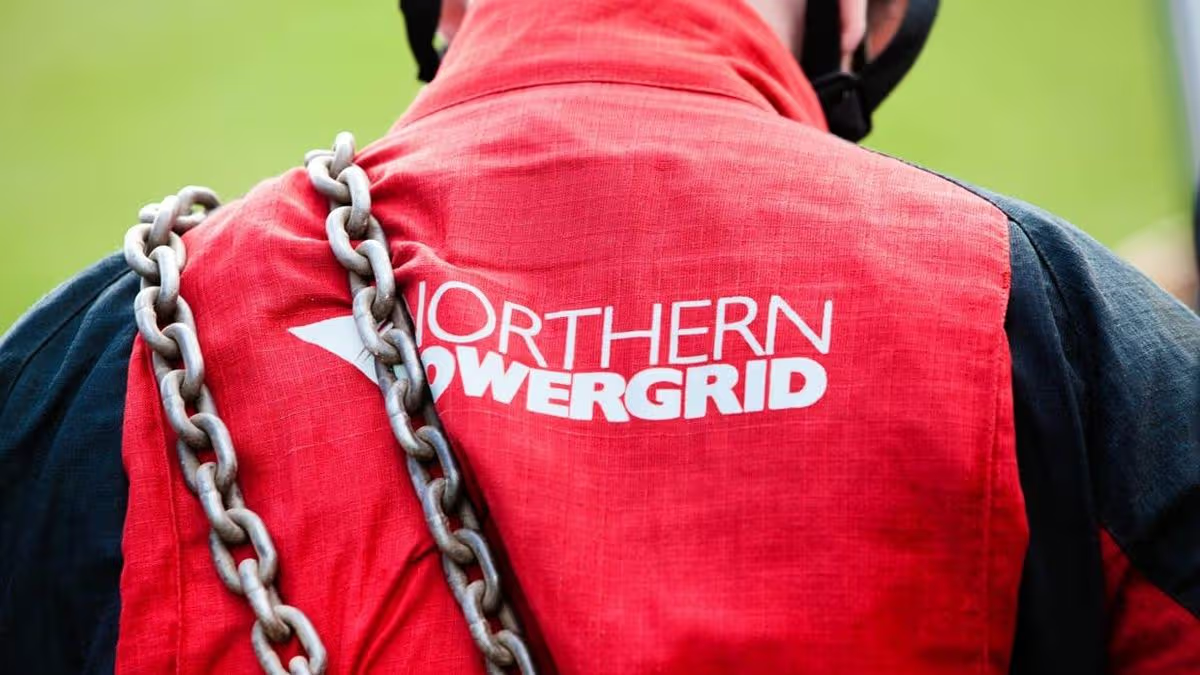
A Northern Powergrid worker.

A Northern Powergrid worker.

Energy network operator Northern Powergrid says it is ploughing billions of pounds into its infrastructure across the North East, despite falling short of key power outage targets owing to adverse weather conditions.

The Newcastle-based firm manages the power lines and network serving approximately 1.6million customers across an area stretching from the far reaches of Northumberland down to York, and westward to the Pennines.

Advertisement

Newly published accounts reveal that Northern Powergrid (Northeast) plc committed £271.4m in investment during 2025, as part of a wider £2.8bn spending programme running through to 2028. That expenditure encompassed transformer refurbishments, overhead line rebuilds, cable replacements and damaged pole renewals, amongst other works carried out across its 42,000km of overhead and underground cables and more than 28,000 substations.

The firm also pressed ahead with the installation of an automatic power restoration system across its high voltage network, while at low voltage level, “next generation” equipment fitted with fault-detection sensors was introduced.

These upgrades come despite Northern Powergrid falling short of key power outage targets set by industry regulator Ofgem. On the measure of customer minutes lost — the average number of supply minutes lost per connected customer due to outages lasting longer than three minutes — the company recorded 46.8 minutes, exceeding the target of 41.1 minutes, though this represents an improvement on the 2023/24 figure of 49.5 minutes.

On customer interruptions — the average number of supply disruptions per every 100 connected customers due to power cuts lasting more than three minutes — Northern Powergrid recorded 51 minutes, exceeding the 46.7-minute target and rising from the 2023/24 figure of 48.6 minutes. Senior figures attributed the results to adverse weather conditions throughout the year and a rise in planned maintenance works to upgrade equipment, reports Chronicle Live.

Advertisement

The overall duration of power cuts fell by 4.8% when compared to 2024. Those figures emerged as the North East was struck early in 2025 by the destructive Storm Éowyn, before Storm Bram unleashed wind and rain towards the end of the year.

The accounts also reveal that operating profits at the company dropped from £264.1m to £183.3m during the year, as revenue declined from £536.4m to £457.9m. A £160m dividend was paid out, with Northern Powergrid’s parent company being US conglomerate Berkshire Hathaway.

Alex Jones, finance director at Northern Powergrid, said: “Northern Powergrid is investing £2.8bn in the current five-year regulatory period through to 2028, following the successful delivery of a £3bn eight-year investment plan between 2015 and 2023, upgrading the power network to homes and businesses across the North East, Yorkshire and North Lincolnshire.

“To support this investment, since 2005 Northern Powergrid has reinvested over 70% of its profits, after tax, back into the business.

Advertisement

“We are committed to providing the best possible service to our customers and our investment programmes ensure we are continuing to improve network resilience and reliability for our customers, and helping to create a greener energy system for the communities we serve.”

Continue Reading

Trending

Copyright © 2025