

Business
Form 144 Dell Technologies Inc. For: 8 July




FOXBOROUGH, Mass. — France opens the World Cup’s quarterfinal round Thursday against Morocco, with kickoff set for 4 p.m. Eastern time, as Les Bleus look to continue an unbeaten run that has established them as the tournament’s most dominant team through six matches.
France enters the quarterfinal having won all six of its games this tournament while scoring 17 goals along the way, the standout performance of this year’s World Cup. Didier Deschamps’ side swept through the group stage with wins over Senegal, Iraq and Norway, then routed Sweden 3-0 in the Round of 32 before edging Paraguay 1-0 in the Round of 16 on a Kylian Mbappe penalty. That result extended France’s winning streak to six consecutive matches heading into Thursday’s contest, giving the squad significant momentum as it pursues a place in the semifinals.
Morocco has similarly impressed throughout the tournament, becoming the first African nation to reach back-to-back World Cup quarterfinals, following the team’s memorable run to the semifinals in 2022. The Atlas Lions advanced to this stage with a commanding 3-0 win over co-host Canada in the Round of 32. Morocco does enter Thursday’s match with an injury concern, however, as star striker Ismael Saibari is uncertain to play due to a hamstring issue that has been monitored throughout the team’s preparation for the quarterfinal.
According to odds from FanDuel Sportsbook, France is a heavy favorite on the 90-minute moneyline at -180, meaning a $180 bet would return $100 in profit, while Morocco is priced at +550 and a draw sits at +280. Looking at the broader outcome of the match, including extra time and penalties if necessary, France is priced at -420 to advance to the semifinals, with Morocco at +310. The over/under for total goals scored in the match is set at 2.5.
SportsLine’s Martin Green, who has built a strong track record handicapping this year’s tournament, has published his picks for the matchup ahead of kickoff. Green enters Thursday’s match on an 18-7 run on his World Cup picks this year, a stretch that has returned a profit of $908 for those following his selections, according to figures cited by SportsLine. He has also posted profitable results across other soccer competitions this year, including a plus-$211.25 return on Champions League picks and a plus-$100 return on Bundesliga selections, building his reputation as one of the more closely followed soccer handicappers heading into the World Cup’s knockout stage.
Green’s analysis of Thursday’s matchup points toward a high-scoring affair between the two sides. He is leaning toward the over on the 2.5 total goals line, priced at -102 with FanDuel. His reasoning centers on the attacking output both teams have shown throughout the tournament: France has scored at least three goals in all five of its previous matches at this World Cup, averaging 2.8 goals per game, while Morocco, despite recording only two clean sheets in five matches, has scored 10 total goals of its own, including a three-goal outing against Canada in the Round of 32. “Both teams have the quality to get on the scoresheet, and this quarterfinal has the makings of a high-scoring affair,” Green told SportsLine.
Beyond the over/under selection, Green has identified what he describes as a critical factor shaping the matchup, along with a pair of additional best bets for the contest, available to those following his full analysis through SportsLine.
Thursday’s match represents the first of four quarterfinal contests scheduled across the tournament’s knockout stage. The winner of France vs. Morocco will advance to face the winner of Friday’s quarterfinal between Spain and Belgium, a matchup set for Los Angeles Stadium. Spain reached this stage with a dramatic 1-0 win over Portugal that marked the end of Cristiano Ronaldo’s storied World Cup career, while Belgium advanced after routing co-host United States 4-1 in the Round of 16.
France’s tournament has been built around the continued excellence of Mbappe, who currently sits tied for the tournament’s Golden Boot lead with seven goals, level with Argentina’s Lionel Messi and Norway’s Erling Haaland. Mbappe’s penalty conversion against Paraguay in the Round of 16 proved decisive in a tightly contested match, and his continued scoring form is expected to be central to France’s attacking approach against a Morocco defense that has shown both resilience and occasional vulnerability throughout the tournament.
For Morocco, the potential absence of Saibari would represent a significant blow to the team’s attacking options heading into one of the biggest matches in the program’s history. Saibari scored in three consecutive group-stage matches earlier in the tournament, establishing himself as one of Morocco’s most important attacking contributors before the hamstring issue emerged. Coach Walid Regragui’s team will need to find alternative sources of scoring threat if Saibari is ultimately unable to feature, particularly against a France side that has conceded sparingly throughout the competition.
Fans looking to watch Thursday’s match can stream the contest through Fubo, which offers a free trial for new subscribers, among other broadcast options carrying the tournament in the United States.
With France entering as significant favorites both on the 90-minute moneyline and to advance overall, Thursday’s quarterfinal represents a considerable step up in competition for a Morocco side that has nonetheless proven capable of producing standout performances against elite opposition throughout this tournament and the previous World Cup in 2022. Whether Morocco can replicate that giant-killing capability against the tournament’s most in-form team will go a long way toward determining which side advances to face the winner of Friday’s Spain-Belgium quarterfinal in the tournament’s semifinal round.
Business
ASX 200 Slips as Oil Prices Surge on Iran Ceasefire Collapse While Energy Stocks Buck the Trend Today

SYDNEY — Australian shares closed lower Thursday, with the S&P/ASX 200 index falling 22.6 points, or 0.26 percent, to 8,762.5, as renewed hostilities between the United States and Iran pushed oil prices sharply higher and weighed on the broader market, even as energy stocks posted strong gains on the back of surging crude prices.
The decline extended a difficult run for Australian equities, marking the fourth consecutive session of losses. The index fell 0.3 percent to close at 8,804 on Tuesday, then dropped a further 0.2 percent to 8,785 on Wednesday, as investors grew increasingly cautious following the collapse of the ceasefire agreement between Washington and Tehran. President Donald Trump declared the U.S.-Iran ceasefire “over” earlier this week, and American forces launched fresh strikes against Iran on Tuesday in response to attacks on three commercial vessels transiting the Strait of Hormuz, sending oil prices climbing roughly 11 percent over the past five trading sessions.
Thursday’s session opened sharply lower, with the ASX 200 down as much as 0.9 percent in early trade before paring some losses through the day. Key sectors including materials, financials and healthcare each fell more than 1 percent during the session, while energy stocks continued their strong recent run, climbing further as oil prices extended their advance. The S&P/ASX 200 Energy index rose 1.9 percent Thursday, marking its second consecutive day of gains and pushing the sector to a near three-week high, with strength spanning coal, refining, uranium, and oil and gas names. Utilities stocks with exposure to liquefied natural gas markets, including AGL Energy and Origin Energy, also moved higher during the session.
Beyond the energy-driven divergence, several individual company developments shaped Thursday’s trading. Gold miner Pantoro fell sharply, dropping 19.6 percent to $1.77, after reporting full-year 2026 gold production of 77,400 ounces, roughly 10 percent below its downgraded guidance range of 86,000 to 92,000 ounces. The company attributed the shortfall to labor shortages, contractor underperformance and equipment availability issues affecting underground production, though it maintained a debt-free position with cash and gold holdings of $223.4 million. Pantoro’s fiscal 2027 guidance pointed to a step-up in output, targeting 90,000 to 105,000 ounces at an all-in sustaining cost of $2,800 to $3,400 per ounce, weighted toward the second half of the year, alongside plans to resume open-pit mining at its Green Lantern site and begin underground development at O’Briens Reef from the September quarter.
Elsewhere in the resources sector, gold miner Catalyst Metals entered forward contracts covering 30,000 ounces of gold at a fixed price of $6,075 per ounce, with deliveries spread evenly at 2,000 ounces per month over 15 months beginning in August, a move designed to protect near-term revenue against price volatility. Construction materials group Fletcher Building rallied after upgrading its fiscal 2026 earnings guidance, providing one of the session’s more notable positive company-specific catalysts.
Wednesday’s session had featured broader sectoral pressure, with electronic technology, non-energy minerals and industrial services stocks dragging on the index. BHP Group fell 2.3 percent that day after workers announced plans to strike July 16 at the company’s Western Australian iron ore terminal over demands for recognition of specialist skills and associated compensation. Trading Economics reported that early losses on Wednesday were trimmed somewhat after Reserve Bank of Australia Assistant Governor Sarah Hunter noted that domestic economic activity remained resilient despite weaker consumer and business sentiment following the recent oil price shock.
Tuesday’s session had seen even broader-based selling, with mining heavyweight BHP Group dropping 2.9 percent, Evolution Mining sliding 3.8 percent, Telstra losing 3.1 percent, and Macquarie Group falling 2.4 percent, while the four major banks each declined between 1.0 and 1.7 percent. Gold stocks were hit particularly hard that session, tumbling 4.3 percent as bullion prices retreated, with Northern Star Resources, Australia’s largest listed gold miner, dropping 5.1 percent. Not every stock struggled during that stretch, however, with WiseTech Global jumping 5.7 percent on Tuesday after the technology company named a new chair, a move the market interpreted as addressing lingering governance concerns that had weighed on the stock in recent months.
The broader macroeconomic backdrop has added further uncertainty to trading this week. The International Monetary Fund cut its 2026 global growth forecast to 3 percent, citing risks stemming from the Middle East conflict, while projecting Chinese economic growth would slow to 4.6 percent amid higher oil prices and structural headwinds, with India expected to lead major economies at 6.4 percent growth. The IMF’s updated forecast assumed energy prices would remain roughly 25 percent above prewar levels, based on an assumption that the Strait of Hormuz would reopen from mid-July, while flagging renewed Middle East conflict, trade fragmentation and a possible correction in AI-driven equity valuations as the primary downside risks to the global outlook.
Regional monetary policy also factored into Thursday’s session. The Reserve Bank of New Zealand raised its Official Cash Rate by 25 basis points to 2.5 percent, marking its first rate increase since 2023, and signaled further tightening was likely as it works to bring inflation back toward its target. The bank projected inflation would peak at 3.9 percent in the current quarter before easing to 3.3 percent by the September quarter, an improvement on its previous forecast of a 4.3 percent third-quarter peak.
Investors also remained focused on data due later this week from China, Australia’s largest trading partner, with June consumer price index and producer price index figures expected to offer fresh signals on the health of Chinese demand. Overnight, Wall Street finished mostly lower but well off session lows, with the S&P 500 closing down 0.28 percent after touching lows of negative 1.09 percent intraday, as chip stocks including Nvidia and Broadcom helped support the broader market even as risk sentiment soured following the collapse of the U.S.-Iran ceasefire.
With Middle East tensions continuing to develop and no clear resolution in sight, investors are likely to remain focused on further geopolitical developments, oil price movements, and this week’s Chinese economic data as they assess whether the current pullback in Australian equities represents a temporary pause or the beginning of a more extended period of volatility heading into the back half of 2026.
Business
Antony Waste shares tumble 5% after waste mound collapse at Pune facility; workers feared trapped

Rescue operations are currently underway to search for and assist individuals who may be trapped under the debris. The company said the number of people injured or otherwise affected is still being ascertained and will be confirmed by the concerned authorities, the company said in a regulatory filing.
The company said a waste mound located outside its PCMC Waste-to-Energy plant collapsed after becoming unstable due to continuous and exceptionally heavy rainfall. The debris fell onto the administration building, leading to the collapse of the structure.
According to the company, emergency response measures were initiated immediately after the incident. Personnel from the Fire Brigade, the National Disaster Response Force (NDRF), a squad of the Indian Army, senior officials of the company and the Pimpri Chinchwad Municipal Corporation (PCMC), disaster response teams and other emergency agencies reached the site.
Also read: About 16 people stranded in building collapse in Pune’s Pimpri-Chinchwad, rescue efforts underway

Antony Waste Handling Cell said its immediate priority is to support the ongoing rescue and relief efforts and extend all possible assistance to the municipal corporation, local administration, emergency response agencies and other authorities. It added that medical assistance is being provided to the injured, support is being extended to affected families, and efforts are underway to identify and account for all personnel who were present at the site.
Cause of collapse
Based on preliminary information, the company said the waste mound had become destabilised due to continuous and exceptionally heavy rainfall before collapsing onto the administration building. It said the incident appears, prima facie, to have been triggered by the unprecedented weather conditions, noting that the region had experienced continuous and exceptionally intense rainfall in the preceding period.
The company also said the plant was under a scheduled maintenance shutdown when the incident occurred, resulting in a limited number of operating personnel being present at the site. Based on the information currently available, it added that no immediate material impact on the company’s operations has been identified.
Antony Waste Handling Cell said it continues to work closely with the relevant authorities and emergency response agencies and will provide further updates as verified information becomes available.
Sensex, Nifty today: Catch all the LIVE stock market action here
(Disclaimer: Recommendations, suggestions, views and opinions given by the experts are their own. These do not represent the views of The Economic Times)
TCS shares have already crashed more than 36% this year so far amid multiple headwinds including AI worries, inflationary pressures due to the Middle East war and more. In this background, analysts on Dalal Street expect India’s largest IT services company to report modest profit growth for Q1 FY27, with weak revenue momentum.
What to expect from TCS Q1 earnings?
The Tata Group company is expected to report a 13% year-on-year growth in revenue and 4% YoY rise in profit for the quarter under review, based on an average of estimates by six brokerages. However, sequential growth is likely to be nearly flat.
IT services are expected to remain soft in Q1 FY27 amid a cautious demand environment, with growth partially supported by large deal ramp-ups, outcome-based engagements, and AI-led spending, Axis Securities said. It added that margins are likely to remain mixed, impacted by wage hikes and AI investments, but partly offset by currency depreciation and productivity gains.
Axis expects TCS to report a topline growth of 1% QoQ, supported by growth in BFSI, HiTech, and the benefit of rupee depreciation. EBIT margins are likely to decline by 98 bps QoQ due to wage hikes and continued AI investments. Key monitorables in TCS’ earnings print will include demand environment, deal pipeline, vertical-wise commentary and FY27 outlook, according to the domestic brokerage.
Also Read | TCS Q1 Preview | Can the IT bellwether earnings give hope to investors holding the battered stock?
Nomura in its note had said that Indian IT services companies, particularly largecaps like TCS, are in the midst of a perfect storm of two key headwinds. First, the macro uncertainty emanating from the ongoing Middle-East conflict and uncertainty around rates, particularly in the US, is keeping client spending subdued at the margin level. Second, when tech spending from clients is not increasing, there is heightened competition among IT services companies and the economic dividend of AI is being immediately surrendered to clients.
“With firms like Accenture indicating the lingering impact of the war on growth would continue in the near-term (implying a subdued 1H FY27F for Indian IT, in our view), we believe FY27F is likely to be another subdued year,” it said, while highlighting its optimistic outlook on long-term opportunities.
Nomura believes that the fear of frontier models implementation at enterprises displacing IT services vendors is overblown, as the context matters and tolerance for errors is zero. “We expect the upcoming earnings season to be sombre with weak quarterly growth trends from most of the large caps (weakest at -1.3% q-q from Wipro and the strongest at +1% for TechM. We expect mid-caps in general to continue posting stronger growth vs large caps. We do not expect any changes to the annual guidance from Infosys and HCL Technologies, and expect Wipro to guide -1% to +1% revenue growth in 2Q FY27E,” it said.
TCS shares have fallen around 39% in the past one year and 4% in one month, dropping to a fresh 52-week low of Rs 1,977 apiece earlier this month. The stock currently has a P/E ratio of around 15x.
In the longer term, the shares of the IT major have dropped more than 38% in three years and 36% in five years. The company currently has a market capitalisation of Rs 7.45 lakh crore.
Also Read | TCS braces for muted June quarter earnings; AI outlook and deal pipeline in focus
(Disclaimer: Recommendations, suggestions, views and opinions given by the experts are their own. These do not represent the views of The Economic Times)
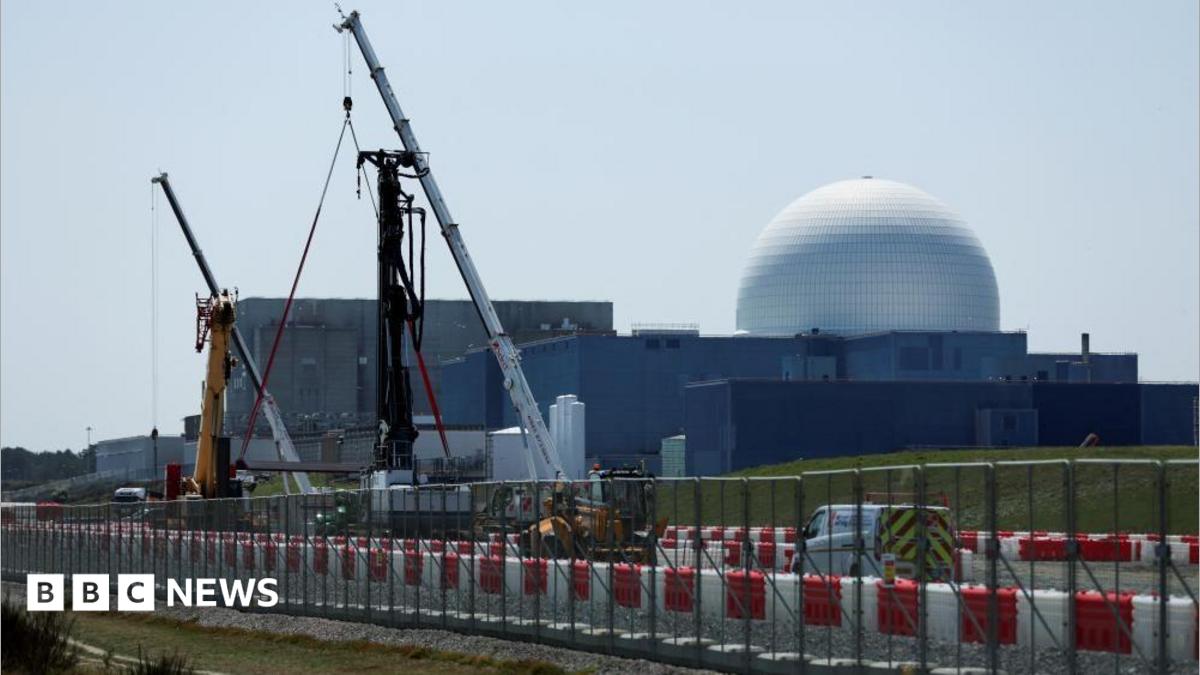
Wilson said TASC applauded the goal to phase out fossil fuels, but condemned “the government’s continued reliance on dirty and dangerous nuclear power”.
He said this created a “multi-generational financial and environmental liability”, leaving our descendants with years of flood defence maintenance and the “insurmountable challenge of safe, millennia-long, highly radioactive nuclear waste isolation, amid a changing climate”.
“Global instability and conflicts in Iran and Ukraine have highlighted that nuclear power plants and their waste facilities are highly vulnerable targets, undermining their promise of energy security,” he added.
“Relying on Sizewell B and C for a combined output of 4.4 GW concentrates immense power generation in East Suffolk, making the area a prime target for malicious attacks with potentially catastrophic environmental consequences.
“Furthermore, TASC believes this centralization increases the national grid’s exposure to massive blackouts caused by a single accident or technical failure.”
Business
Kalyan Jewellers shares jump 9%, extend two-day rally to over 15% after robust Q1 business update

The jewellery retailer posted an estimated 38% year-on-year increase in consolidated revenue for Q1 FY27, driven by strong demand across its domestic and international markets.
The company said its India business recorded revenue growth of over 38%, supported by healthy same-store sales growth of around 28% across key markets. The performance came despite the quarter being impacted by the 28-day Adhik Maas period, a once-in-three-years occurrence during which wedding-related jewellery purchases typically slow in several parts of the country.
A key highlight during the quarter was the launch of Kalyan’s ‘Shine with India’ gold recirculation campaign, aimed at increasing the use of recycled gold and reducing reliance on imports. The initiative gained strong customer traction, with recycled gold accounting for more than 46% of revenue during the quarter. In June alone, the share of recycled gold exceeded 55% of revenue.
The company’s international business also delivered solid performance, with revenue rising around 35% year-on-year. In the Middle East, revenue grew approximately 30%, despite softer footfalls in April due to geopolitical tensions. International operations contributed about 14% of consolidated revenue during the quarter.
Meanwhile, Kalyan’s digital-first jewellery platform, Candere, continued its strong momentum, registering an impressive 112% year-on-year revenue growth in Q1 FY27.
The company also expanded its retail footprint during the quarter by opening 12 Kalyan Jewellers showrooms and five Candere outlets across India, further strengthening its nationwide presence.Share Price Trend & Technical Snapshot
Kalyan Jewellers currently commands a market capitalisation of Rs 38,639 crore. Its 52-week high stands at Rs 617.70.
On the valuation front, the stock trades at a price-to-earnings (P/E) ratio of 28.61, with a price-to-sales (P/S) ratio of 1.09 and a price-to-book (P/B) ratio of 6.12.
From a technical perspective, the 14-day Relative Strength Index (RSI) stands at 50.3, indicating neutral momentum. Typically, an RSI reading below 30 signals oversold conditions, while a level above 70 suggests the stock may be overbought.
The trend remains mixed but is showing signs of improvement. Kalyan Jewellers is trading above five of its eight key simple moving averages (SMAs), reflecting positive near-term momentum. However, the stock is still below its 100-day and 200-day SMAs, indicating that it has yet to decisively reclaim its medium- and long-term bullish trend.
(Disclaimer: Recommendations, suggestions, views and opinions given by the experts are their own. These do not represent the views of Economic Times)

BOJ keeps regional economic view steady, sees receding hit from Iran war


I am a professional equity analyst at a value-focused investment firm, dedicated to identifying long-term opportunities through disciplined, fundamentals-driven research. My academic background from Columbia University spans finance, accounting, computer science, and risk management. Grounded in the valuation frameworks of Stephen Penman and Bruce Greenwald, my work emphasizes earnings quality, accruals analysis, and the residual income model to assess the sustainability of corporate performance. I focus on uncovering economic value beyond headline metrics, with sector coverage across Financials, TMT, and Healthcare. Disclaimer: The views expressed are my own and do not reflect those of my employer. I do not cover securities held or under active consideration by my firm. Any overlap will result in the prompt removal of related content to avoid conflicts of interest.
Analyst’s Disclosure: I/we have no stock, option or similar derivative position in any of the companies mentioned, and no plans to initiate any such positions within the next 72 hours. I wrote this article myself, and it expresses my own opinions. I am not receiving compensation for it (other than from Seeking Alpha). I have no business relationship with any company whose stock is mentioned in this article.
Seeking Alpha’s Disclosure: Past performance is no guarantee of future results. No recommendation or advice is being given as to whether any investment is suitable for a particular investor. Any views or opinions expressed above may not reflect those of Seeking Alpha as a whole. Seeking Alpha is not a licensed securities dealer, broker or US investment adviser or investment bank. Our analysts are third party authors that include both professional investors and individual investors who may not be licensed or certified by any institute or regulatory body.

How a Palestinian town is defending itself from Israeli settler attacks


I’m Jason Ditz and I have 20 years of experience in foreign policy research. My work has appeared in Forbes, Toronto Star, Minneapolis Star-Tribune, Providence Journal, Washington Times and the Detroit Free Press, as well as American Conservative Magazine and the Quincy Institute for Responsible Statecraft. I have been writing investment analysis, with a focus on deep-discount value plays, for over 25 years. I I got my start analyzing securities for a stock-picking contest on the now defunct StockJungle in college. After winning one of the top prizes for quarterly performance, I was hired to write a monthly article about micro-cap stocks, again with a value perspective. After StockJungle went belly-up, with its focus on momentum investing, I started to take a close interest in the contrarian investment philosophy of David Dreman. I began writing for Motley Fool and ultimately Seeking Alpha. My goal is to find underappreciated companies with a focus on returning value to investors.
Analyst’s Disclosure: I/we have no stock, option or similar derivative position in any of the companies mentioned, but may initiate a beneficial Long position through a purchase of the stock, or the purchase of call options or similar derivatives in PGY over the next 72 hours. I wrote this article myself, and it expresses my own opinions. I am not receiving compensation for it (other than from Seeking Alpha). I have no business relationship with any company whose stock is mentioned in this article.
Seeking Alpha’s Disclosure: Past performance is no guarantee of future results. No recommendation or advice is being given as to whether any investment is suitable for a particular investor. Any views or opinions expressed above may not reflect those of Seeking Alpha as a whole. Seeking Alpha is not a licensed securities dealer, broker or US investment adviser or investment bank. Our analysts are third party authors that include both professional investors and individual investors who may not be licensed or certified by any institute or regulatory body.

Odds, Prediction and Kickoff Time for Thursday’s Match

Senator Ron Wyden urges Congress to keep developer protections in CLARITY Act

Tom Holland Wins World Cup Bragging Rights Over Lupita Nyong’o


-

 Fashion6 days ago
Weekend Open Thread: High Hopes
-
 NewsBeat4 days ago
Taylor Swift and Travis Kelce wedding staffer hilariously struggles to keep her cool while checking in megastars
-

 Fashion3 days ago
Open Thread: What Great Books Have You Read Recently?
-

 Crypto World6 days ago
Standard Chartered Secures MiCA License as ESMA Adds 37 New Crypto Firms
-

 Politics6 days ago
The House | “Reframing the debate from a binary discussion of winners and losers”: Yuan Yang reviews ‘We Are Not Machines’
-

 News Videos2 days ago
Whats Hidden Inside This Cash Register? #treasure #reselling #money
-
 Tech2 days ago
Anthropic’s new “J-lens” reveals a silent workspace inside Claude that mirrors a leading theory of consciousness
-

 Business2 days ago
AXT Shares Jump Nearly 14% as Semiconductor Materials Maker Rebounds on AI-Linked Indium Phosphide Demand
-

 Sports2 days ago
Joshua Pacio ‘more complete’ ahead of ONE rematch vs Malachiev
-
 Crypto World5 days ago
ESMA Expands Crypto Register by 37 Firms Following MiCA Transition Period
-
Crypto World2 days ago
SK hynix (000660.KS) Stock Dips as $28B Nasdaq ADR Offering Drives AI Memory Expansion
-

 Crypto World4 days ago
South Africa proposes crypto tax guidance under existing rules
-

 News Videos3 days ago
Best Time to Enter Small Caps Right Now? Another Bull Run? | Financially Free
-

 Tech4 days ago
Lenovo laptops are now shipping with YMTC SSDs, a sign of Chinese NAND entering the mainstream
-
 NewsBeat7 days ago
New exhibition reflects five decades of movement between island of Ireland and GB
-

 Business6 days ago
What a 10 Percent Drop Means for Buyers, Sellers and Renters
-
Sports2 days ago
We have punished the disrespect
-

 Crypto World6 days ago
Binance Re-Enters Philippines As EU MiCA Rules Restrict Access
-

 News Videos3 days ago
Avoid entering in FOMO #bitcoin #cryptocurrency #trading #scalping
-

 Crypto World6 days ago
Alibaba bans Claude Code over alleged backdoor security concerns
You must be logged in to post a comment Login