
Business
Former BJP MP Kirit Somaiya seeks SEBI probe into sharp Sensex swing during CAS

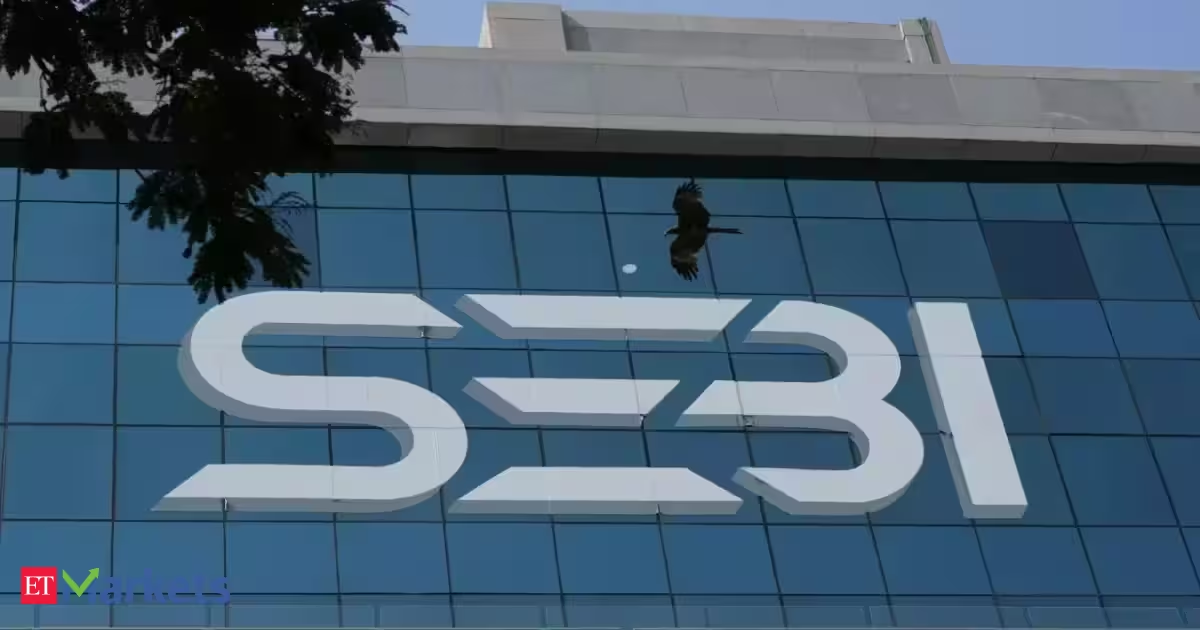
The Sensex plunged more than 2,000 points within minutes during the CAS on Thursday, falling from around 77,200 at 3:17 pm to nearly 74,983 at 3:23 pm. The index subsequently recovered some of its losses but still ended the day 539 points, or 0.7%, lower at 76,934.
India changed how closing prices are determined from August 3. Instead of calculating the close using the volume-weighted average price (VWAP) during the final half-hour of trading, exchanges introduced a short Closing Auction Session, in which buy and sell orders are aggregated, and a single equilibrium price is discovered.
In a communication seeking attention to the August 27 movement, Somaiya asked whether the sharp intra-session swing pointed to a weakness in the CAS mechanism and called for an inquiry and action.
“On 27 August, during the last 12 minutes of trading at NSE/BSE, the Sensex crashed over 2,200 points and then recovered 2,000 points,” Somaiya said, asking whether “it is a weakness in the CAS system”.

He also asked whether the move could have been linked to any deliberate attempt to undermine the implementation of CAS, while calling on SEBI to examine the matter.
“SEBI must not take this CASUALLY,” he said. “If it is a weakness, then the officials who drafted it should owe an explanation. If it is done knowingly, is it healthy? Is it sabotage to stop implementation of CAS?””Shockingly, such things happened during the process of having a healthy system,” Somaiya said, adding that he wanted “not only inquiry but action also.”
Liquidity concerns after 3:15 pm
Along with his communication, Somaiya shared an observation that attributed the sharp movement partly to a lack of liquidity after 3:15 pm.
“The fundamental problem is also – there is no depth due to lack of liquidity after 3.15. All now trade before 3.15 pm. Any person who wants to purchase/sale after 3.15 pm doesn’t find liquidity and hence volatility,” the observation said.
The accompanying note proposed temporarily suspending CAS and reintroducing it after a redesign, citing several concerns around liquidity, price discovery and the interaction between the cash and derivatives markets.
Under the present framework, continuous trading in CAS securities ends at 3:15 p.m., after which the market moves into a separate auction. Equity derivatives, however, continue to trade until 3:40 p.m.
The note argues that this structure removes continuous-market liquidity before the auction begins. At 3:15 p.m., the continuous price-discovery mechanism is stopped and replaced by the auction order book, which the note describes as materially shallower.
The note also raises concerns about the fragmentation of closing liquidity between NSE and BSE. It points out that the same security can undergo separate closing auctions on the two exchanges, with separate order books, imbalances and potentially different equilibrium prices.
According to the note, on the first day of CAS, reported auction turnover was approximately Rs 1,276 crore on NSE compared with around Rs 10.8 crore on BSE, a difference of more than 100 times.
It argues that while the purpose of a closing auction is to concentrate liquidity, separate auctions on the two exchanges could instead fragment liquidity.
Questions over closing-price formation
The note also questions whether a relatively small amount of auction trading can provide a sufficiently robust price for a much larger pool of capital whose value is determined using the official closing price.
The closing price feeds into mutual fund NAVs, portfolio valuations, index closing levels, passive-fund tracking, mark-to-market valuations, derivative settlement economics and performance measurement, according to the note.
It therefore argues that the framework should consider minimum liquidity and market-quality conditions before an auction price automatically becomes the official close.
Another concern relates to the CAS’s ±3% auction band. The note argues that such a range could result in a significant change in the marked-to-market value of large companies even when the quantity actually matched in the auction represents only a small portion of the company’s outstanding shares.
For a company with a Rs 5 lakh crore market capitalisation, the note estimates that a 3% movement would change its marked market capitalisation by approximately Rs 15,000 crore.
It proposes a more conservative, dynamic collar that expands only when supported by substantial two-sided auction liquidity.
Cash and derivatives operate on different timelines
The note further highlights the different trading timelines for the cash and derivatives markets. While continuous cash trading for CAS securities stops at 3:15 p.m., equity derivatives continue trading beyond the auction.
According to the note, this means futures and options can continue to reflect changing information and expectations even after the underlying cash security has ceased continuous price discovery.
It argues that this weakens the normal cash-futures arbitrage mechanism at the point when the official closing benchmark is being established.
Concern over thin liquidity and expiry-day volatility
The note also argues that inadequate CAS liquidity could create a self-reinforcing cycle. If large institutions perceive liquidity in the auction as insufficient, they may execute before 3:15 p.m., further reducing auction liquidity. Lower liquidity could then increase price impact and execution uncertainty, discouraging participation further.
The note calls this a “negative liquidity flywheel”: low liquidity increases auction impact, weakens execution certainty, reduces participation and further drains liquidity.
“Participation is therefore partly an outcome of good market design, not merely a
prerequisite that can be assumed to emerge over time,” it said.
(Disclaimer: Recommendations, suggestions, views and opinions given by the experts are their own. These do not represent the views of Economic Times)


ADS Analytics is a team of analysts with experience in research and trading departments at several industry-leading global investment banks. They focus on generating income ideas from a range of security types including: CEFs, ETFs and mutual funds, BDCs as well as individual preferred stocks and baby bonds.ADS Analytics runs the investing group Systematic Income which features 3 different portfolios for a range of yield targets as well interactive tools for investors, daily updates and a vibrant community.
Analyst’s Disclosure: I/we have a beneficial long position in the shares of FSCO either through stock ownership, options, or other derivatives. I wrote this article myself, and it expresses my own opinions. I am not receiving compensation for it. I have no business relationship with any company whose stock is mentioned in this article.
Seeking Alpha’s Disclosure: Past performance is no guarantee of future results. No recommendation or advice is being given as to whether any investment is suitable for a particular investor. Any views or opinions expressed above may not reflect those of Seeking Alpha as a whole. Seeking Alpha is not a licensed securities dealer, broker or US investment adviser or investment bank. Our analysts are third party authors that include both professional investors and individual investors who may not be licensed or certified by any institute or regulatory body.
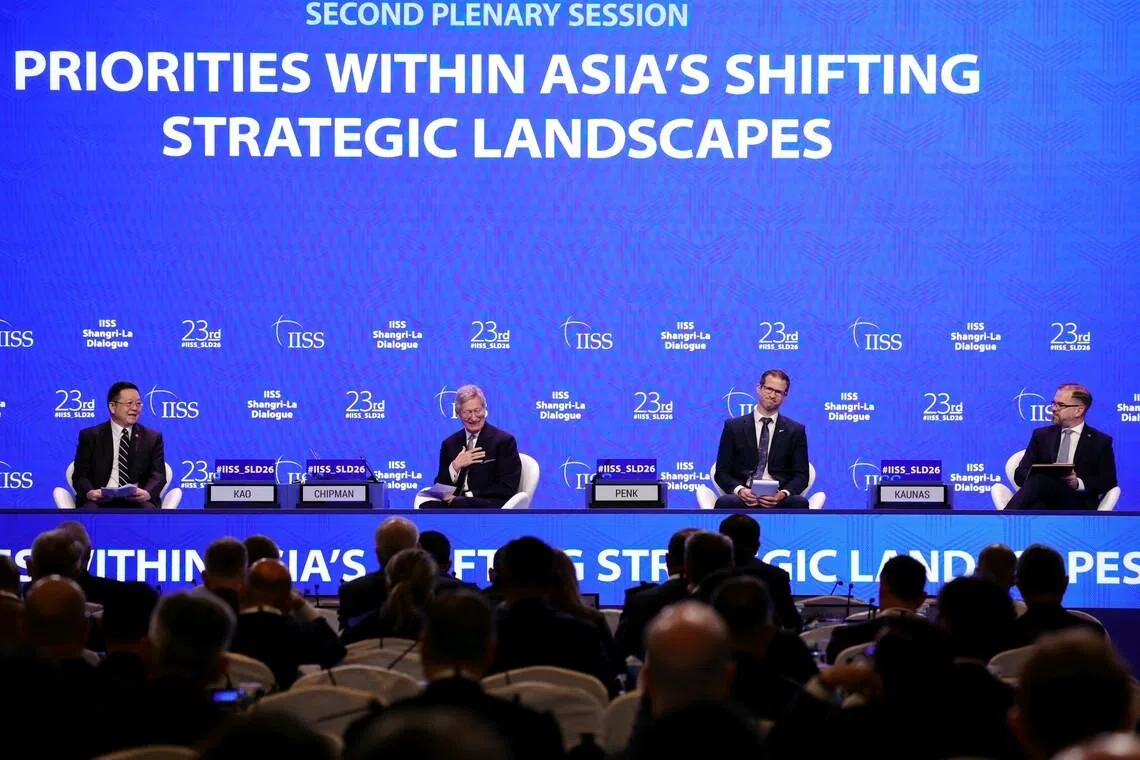
ASEAN Secretary-General Kao Kim Hourn stressed at the Shangri-La Dialogue that US-China tension-easing efforts are vital for South-east Asia. He urged the “constructive strategic stability” framework to translate into regional peace, while emphasizing ASEAN’s commitment to avoiding coercion and choosing sides.
Key Points
• ASEAN Secretary-General Kao Kim Hourn emphasized at the Shangri-La Dialogue that US-China efforts toward “constructive strategic stability” are vital for South-east Asia, as both superpowers are the region’s most consequential security and economic partners, following tensions sparked by sweeping tariffs and trade disputes since early 2025.
• Panellists highlighted pressure on smaller nations, with Lithuania and New Zealand drawing parallels between geopolitical coercion in Europe and Asia, stressing the importance of upholding international rules and collective regional cooperation.
• Dr Kao addressed rising defence spending concerns and Myanmar’s crisis, supporting recalibrated ASEAN engagement including virtual talks with Myanmar’s foreign minister, while maintaining the Five-Point Consensus peace plan remains active.
US-China Relations and ASEAN’s Strategic Priorities
The easing of tensions between the United States and China represents a critical development for South-east Asia, according to ASEAN Secretary-General Kao Kim Hourn, speaking at the Shangri-La Dialogue on May 30. Dr Kao emphasized that both superpowers are ASEAN’s most consequential security and economic partners, making their relationship of direct regional importance. The newly introduced framework of “constructive strategic stability” — built on the idea that competition and cooperation can coexist — emerged following meetings between President Trump and President Xi in May, offering cautious optimism for regional peace and development.
Trade War Tensions and the Path Toward Normalization
Sino-American relations deteriorated sharply after Trump’s return to office, with sweeping tariffs reaching 145 per cent, triggering Chinese retaliatory measures including export controls and restrictions on rare earths and critical minerals. A partial breakthrough in October 2025 saw tariff reductions and resumed trade flows, though full normalization only followed the May Trump-Xi summit. Dr Kao stressed that ASEAN nations must be able to pursue security and prosperity without coercion or being forced to choose sides, underscoring the bloc’s firm commitment to strategic independence amid intensifying great-power rivalry.
Geopolitical Pressure, Defense Spending, and the Myanmar Crisis
Smaller nations facing geopolitical pressure was a recurring theme at the plenary session, with Lithuania’s Defense Minister drawing parallels between European and Asian coercion tactics, and New Zealand’s Defense Minister advocating collective regional strength. On rising defense expenditure, Dr Kao cautioned that diverting resources toward military spending is “not very healthy,” reaffirming ASEAN’s preference for preventive diplomacy. Regarding Myanmar, Dr Kao signaled a recalibration of engagement, with ASEAN foreign ministers agreeing to a virtual meeting with Myanmar’s counterpart — a notable shift — while reaffirming the Five-Point Consensus peace plan remains the guiding framework.
Source : Easing of US-China tensions crucial for South-east Asia: ASEAN chief

FINAL HOURS: THIS IS YOUR LAST CHANCE to secure up to 55% off InvestingPro


An independent investor in the Indian and US equity markets with a CFA Charter and a PhD in Finance from University of Durham, U.K. I hold an Honorary Associate Professor in Finance and Corporate Governance title at Brunel University London. I have a YouTube and a Podcast channel, titled The Stock Doctor,’ where I discuss my views on the US and Indian markets every week. In addition, I actively undertake quantitative research in the areas of US equities, Behavioural Finance, Corporate Governance, Activist Hedge Funds, Cryptocurrencies and M&A , and have published in top-ranked peer-reviewed journals.
Analyst’s Disclosure: I/we have a beneficial long position in the shares of MSFT, GOOGL, AMZN, NVDA either through stock ownership, options, or other derivatives. I wrote this article myself, and it expresses my own opinions. I am not receiving compensation for it (other than from Seeking Alpha). I have no business relationship with any company whose stock is mentioned in this article.
Seeking Alpha’s Disclosure: Past performance is no guarantee of future results. No recommendation or advice is being given as to whether any investment is suitable for a particular investor. Any views or opinions expressed above may not reflect those of Seeking Alpha as a whole. Seeking Alpha is not a licensed securities dealer, broker or US investment adviser or investment bank. Our analysts are third party authors that include both professional investors and individual investors who may not be licensed or certified by any institute or regulatory body.
Business
(VIDEO) Lionel Messi Scores Four Goals as Inter Miami Thrashes CF Montreal 7-1, Snapping a Winless Streak

MIAMI — Lionel Messi scored four goals and added an assist Saturday night as Inter Miami routed CF Montreal 7-1, snapping the team’s winless run in emphatic fashion and pushing the Argentine superstar to the top of Major League Soccer’s scoring race.
The victory at Nu Stadium marked a club record for goals scored in a single match for Inter Miami, according to ESPN, and came after the team had gone five games without a win. Miami improved to 12-4-6 on the season, ending August with a 1-2-2 record for the month despite the emphatic finish.

Carlos Casemiro opened the scoring in the 20th minute, heading in a corner kick from Telasco Segovia for his first goal in his sixth appearance for the club, while the assist marked a career-best ninth of the season for Segovia in his second MLS campaign. Montreal answered in the 37th minute when Fabian Herbers scored his first goal of the year to level the match at 1-1.
Messi took over from there. He put Miami back in front in the 40th minute with a free kick that deflected off a Montreal defender and past goalkeeper Thomas Gillier, marking his 15th goal of the season. He extended the lead to 3-1 in the 52nd minute, dribbling through a cluster of Montreal defenders before finishing with his right foot, a goal that pulled him level with FC Dallas forward Petar Musa atop the league’s scoring chart. Messi then set up Luis Suarez for Miami’s fourth goal in the 80th minute before completing his hat trick three minutes later, chipping the ball over Gillier following a pass from Rodrigo De Paul to make it 5-1. Eighteen-year-old rookie Alexander Shaw added a sixth goal in the 89th minute, his first in three MLS appearances, before Messi capped the rout with a curling free kick deep into stoppage time to make it 7-1.
The four-goal outing marked the eighth time in Messi’s career that he has scored four or more goals in a single match, and the first time he has done so since joining Inter Miami, according to ESPN. His last previous four-goal performance came in February 2020 for Barcelona against Eibar in Spain’s La Liga. He is also now the fastest player in MLS history to reach 20 multigoal games in a regular season, doing so in just 72 appearances for the club. With the performance, Messi moved to 18 goals for the season, two ahead of Musa for the league’s Golden Boot lead, and now has 62 career hat tricks at the club level.
Inter Miami teammate Casemiro praised Messi’s continued influence on the team following the match. “That’s what it means to have Messi on the team,” Casemiro told Apple TV. “We have to enjoy these moments because he is a person, a player that makes history. We saw today that we have to enjoy it, keep supporting and keep competing with him because he continues to be the best.”
Miami interim head coach Guillermo Hoyos, who was serving under a suspension and unable to be on the bench for the match, echoed that sentiment afterward. “There are no words to describe such footballing beauty,” Hoyos said. “So much is going on that words simply fall short.”
Miami’s dominance extended well beyond Messi’s individual tally, with the team controlling 57% of possession and finishing with 11 shots on goal, according to MSN. Goalkeeper Dayne St. Clair made three saves for Miami, while Gillier finished with five saves for Montreal, which fell to 5-11-6 on the season and has now lost five consecutive matches to Inter Miami. Miami’s rout also comes at a significant point in the Eastern Conference standings, providing a substantial confidence boost as the club looks to remain in contention for a top playoff position down the stretch of the regular season.
The result caps a particularly productive individual stretch for Messi, who at 39 years old continues to anchor Inter Miami’s attack alongside longtime national team teammates Suarez and De Paul. His performance Saturday further cements his status as the driving force behind the club since his 2023 arrival, with Saturday’s four-goal haul standing as one of the signature individual performances of his MLS tenure to date.

Google Maps will show ’Lake America’ in US, not ’Lake Ontario’

https://www.fotogestoeber.de/iStock via Getty Images

Download this episode on Apple Podcasts/Spotify or listen below:

August’s jobs report could cement a September rate hike. (0:17) Broadcom earnings give another look at the AI spending. (1:24) John Ternus takes the reins from Tim Cook at Apple. (1:56)
The following is an abridged transcript:
This week brings the August jobs report, which could be crucial for the Federal Reserve’s next move.
Following what traders saw as a hawkish Jackson Hole speech from new Fed Chairman Kevin Warsh, odds of a quarter-point September rate hike have jumped to 57% from 40%, with an 18% chance of another hike in October.
Economists expect a modest rise in August nonfarm payrolls of 55K, with the unemployment rate holding at 4.1%.
Wells Fargo economists say alternative indicators “suggest job growth has stabilized, rather than continuing to deteriorate.”
“Hiring measures from regional Fed surveys have improved in recent months, small business hiring plans have perked back up, and job openings have leveled off. Meanwhile, initial jobless claims remain near multi-decade lows, underscoring that layoffs are still contained.”
SA Analyst Damir Tokic expects a strong August jobs report to “cement” a quarter-point rate hike.
“Warsh clearly stated in his Jackson Hole speech that the labor market is strong, as the unemployment rate at 4.1% is very low by historical standards,” he said. “The main implication for monetary policy is that the labor market is fine, thus, the focus shifts entirely to inflation.”
On the earnings front, Broadcom (AVGO) will give further insight into AI spending when it reports Wednesday. Analysts expect EPS of $3.24 on revenue of $29.4B.
SA analyst Dustin Quasney says the stock faces elevated near-term downside risk ahead of earnings due to high expectations set by Nvidia’s recent results.
For those long the stock, he recommends covered calls that prioritize downside protection.
Here’s how the rest of the earnings calendar shapes up:
On Tuesday, Palo Alto Networks (PANW), Dell (DELL), and Medtronic (MDT) report.
Snowflake (SNOW) weighs in on Wednesday.
Ciena (CIEN) and Zscaler (ZS) are up Thursday.
Also this week, on Tuesday, John Ternus will step into the role of Apple (AAPL) CEO, taking over from Tim Cook, aka Tim Apple, who has led the tech giant since 2011. Cook will move into the role of executive chairman.
SA analyst Envision Research says they are confident the new leadership will preserve the company’s “well-established earning power and shareholder return mechanisms.”
They also see “additional opportunities for Ternus to capitalize on the vast installed (customer) base and to continue growing the base with his deep understanding of the company’s various hardware lineups.”
And Tesla (TSLA) plans to hold an invite-only Cybercab launch event Thursday in Austin, Texas, that will also be livestreamed.
The compact two-seater is designed without a steering wheel or pedals, with fully autonomous passenger transport as its sole purpose. Reports indicate riders may be able to request a Cybercab through Tesla’s existing Robotaxi app in Austin as early as next week.
In the news this weekend, Nvidia (NVDA) CEO Jensen Huang is a notable omission from Time Magazine’s newly released list of the 100 most influential people in artificial intelligence for 2026.
On a list featuring SpaceX (SPCX) CEO Elon Musk, OpenAI (OPENAI) CEO Sam Altman and Anthropic (ANTHRO) CEO Dario Amodei, Huang’s absence raised eyebrows.
Huang was included in the three previous TIME100 AI editions.
And for income investors, Northrop Grumman (NOC) goes ex-dividend Monday, paying out on Sept. 16.
Nike (NKE) and McDonald’s (MCD) go ex-dividend Tuesday. Nike pays out on Oct. 1, and McDonald’s pays out on Sept. 16.
Qualcomm (QCOM) goes ex-dividend Thursday, with a Sept. 24 payout date.

How will U.S.-Iran conflict reshape the world?
Business
Five Advantages the iPhone 18 Pro Could Have Over Apples Pricier Foldable iPhone Ultra This Autumn Season

Apple is preparing to unveil its first foldable iPhone alongside the iPhone 18 Pro and iPhone 18 Pro Max at a Sept. 9 event, and mounting leaks suggest the standard Pro models could actually outperform the pricier foldable device, widely expected to be called the iPhone Ultra, in several meaningful ways.
Apple confirmed its fall product event this week with a media invitation carrying the tagline “Surprise and shine,” alongside rumors that the company will unveil three flagship devices this September rather than the usual four-model iPhone lineup: the iPhone 18 Pro, iPhone 18 Pro Max, and the company’s long-rumored foldable. Reports suggest the base iPhone 18 and a lower-cost iPhone 18e will instead arrive in spring 2027, a departure from Apple’s traditional September release pattern.
The first advantage centers on the camera. According to a report from 9to5Mac, the iPhone 18 Pro line is expected to gain a variable-aperture main camera, a feature that would let users manually adjust how much light reaches the sensor, potentially improving Portrait mode results and offering greater control over depth of field along with meaningful gains in low-light photography. Multiple outlets, including the technology site Gotechtor, have reported that the foldable iPhone is not expected to receive the same hardware, largely because the components required for variable aperture are believed to be too large to fit inside the device’s notably thin body.
A second advantage involves optical zoom. Current reports indicate the foldable iPhone will ship with only two rear cameras, a main sensor and an ultrawide lens, while the iPhone 18 Pro and Pro Max are expected to retain a dedicated telephoto lens as part of their triple-camera systems. That would leave Apple’s most expensive iPhone without true optical zoom capability, a notable gap for a flagship-priced device that could push buyers who prioritize zoom photography toward the standard Pro models instead.
Battery life represents a third area where the Pro line is expected to have an edge. According to 9to5Mac, the iPhone 18 Pro Max is rumored to receive a physical battery roughly 10% larger than the one in the iPhone 17 Pro Max, and it is expected to benefit further from efficiency improvements tied to Apple’s new A20 Pro chip and its in-house C2 modem. While regulatory filings suggest the foldable iPhone should still offer solid battery performance for its category, most reports agree the Pro Max’s combination of a larger physical battery and chip-level efficiency gains should make it the longest-lasting iPhone Apple has ever released, a benchmark the foldable’s unique thin-and-light form factor makes difficult to match.
A fourth potential advantage involves biometric security. Multiple outlets, including Tom’s Guide, have reported that the foldable iPhone may forgo Face ID entirely in favor of Touch ID built into its power button, a design choice likely driven by the challenge of fitting Face ID’s sensor array into such a thin device. The iPhone 18 Pro and Pro Max, by contrast, are expected to retain Face ID, preserving the more familiar unlocking and authentication experience current iPhone Pro owners are accustomed to.
Raw processing performance provides a fifth point of separation. According to Tom’s Guide, the foldable iPhone is rumored to use a standard A20 chip rather than the more powerful A20 Pro variant found in the iPhone 18 Pro and Pro Max, even though both chips are expected to be built on the same advanced 2-nanometer manufacturing process, which industry reports suggest could deliver roughly a 15% improvement in processing speed and a 20% boost in efficiency compared with the current generation.
These reported trade-offs come as the foldable iPhone is expected to command a substantially higher price than the Pro lineup, with multiple outlets estimating a starting price near 2,000 dollars, nearly double what the iPhone 17 Pro Max currently costs. Design-wise, the foldable is rumored to open in a book-style format with a titanium frame, an outer display measuring roughly 5.3 to 5.5 inches, and an inner display around 7.6 to 7.8 inches when unfolded, aiming for an iPad-like 4:3 aspect ratio and a display Apple hopes will be nearly free of the visible crease common to other foldable phones on the market.
Apple has not confirmed any of these specifications ahead of its Sept. 9 event, and the company’s official presentation remains the only source that will resolve the current wave of speculation. For consumers weighing whether the novelty of a folding screen justifies the foldable’s expected premium, however, current leaks suggest the more traditional iPhone 18 Pro and Pro Max could actually deliver stronger cameras, longer battery life, familiar biometric security and faster raw performance, at a considerably lower price than Apple’s most ambitious device to date.

Nabors Industries: I'm Not Going To Be Chasing This One

CEF Weekly Review: Allspring CEF Distributions Inline With MDPs

From Hawala to Swift: Inside the 1,000-year battle to move money safely
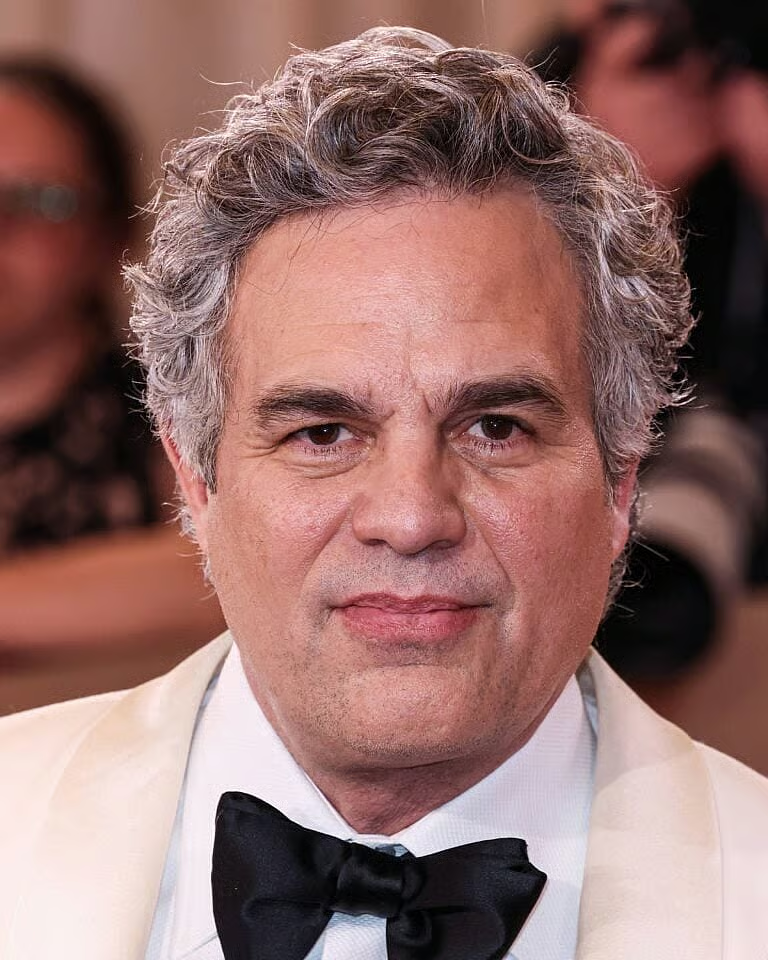
Marisa Tomei Stands With Mark Ruffalo Amid Antisemitism Row





-

 Crypto World5 days ago
SpaceX stock could rise 75% to $240, JPMorgan says
-

 Fashion2 days ago
Weekend Open Thread: Maeve – Corporette.com
-

 Crypto World3 days ago
Bitcoin’s 22% rally now needs real demand to outlast Treasury liquidity boost
-

 Crypto World4 days ago
Warsh Jackson Hole keynote puts financial innovation first
-

 Crypto World6 days ago
A $30 Billion AI Fund Implodes, Now the SEC Is Investigating Wall Street’s Role
-

 Business3 days ago
Salesforce Stock Soars 19% as Blowout Earnings and Agentforce AI Growth Silence Software Skeptics
-

 Crypto World4 days ago
Did Trump Just Move SpaceX Stock With One Truth Social Post?
-

 Business4 days ago
Walmart takes aim at younger shoppers with new fashion brand
-

 Crypto World4 days ago
Elon Musk Grok Bot Promise: We Will Make You Whole if AI Loses Your Money
-
 NewsBeat4 days ago
Lindsay Clancy jury braces for closing arguments as judge tells court: ‘You’ve heard all the evidence’ – Live updates
-

 Crypto World2 days ago
Bitcoin price tests $82K resistance as Brandt stays long
-

 Crypto World3 days ago
NVIDIA revenue hits $96.2B as AI demand doubles
-

 Business3 days ago
Apple Confirms September 9 Keynote and Reveals Its Full Pre-Order Schedule
-

 Business6 days ago
Moderna CEO warns China is pouring state money into mRNA technology
-

 Business5 days ago
Thailand’s Eastern Economic Corridor Capital City (EECiti): Key Developments and Investment Opportunities
-

 Business2 days ago
iPhone 18 Pro Pre-Orders Could Shift to Saturday as Apple Reportedly Avoids September 11 Anniversary
-

 Business6 days ago
NVIDIA Stock Drops Nearly 2 Percent to $210 on Seventh Losing Day Ahead of Critical AI Earnings
-
 Crypto World6 days ago
$92 Billion Nvidia Earnings Could Make or Break the AI Trade
-
 NewsBeat5 days ago
Trump’s trade truce with China faces test with Iran effort
-
 Crypto World4 days ago
Nvidia Q2 Earnings Reveal $96.2 Billion Beat, So Why Is NVDA Falling?
You must be logged in to post a comment Login