Iceland has voted against resuming talks on joining the European Union 13 years after they were broken off.
Public broadcaster RUV reported that 52.8% of the more than 225,000 people who voted had rejected the government’s proposal, while 47.2% had backed it. Some 12,600 votes separated them.
Prime Minister Kristrún Frostadóttir’s centre-left government promised to hold a referendum by 2027, but brought it forward because of international tensions, including US President Donald Trump’s threats against Greenland.
However, debate in this island nation of almost 400,000 people centred more on its fishing industry rather than security concerns.
Advertisement
With some 270,000 people eligible to vote, RUV reported the turnout of 82.5% was the highest in any Icelandic election since 2009.
Already part of the EU’s single market and Schengen border-free zone, full EU membership would bring Iceland into the customs union and eventually the eurozone currency union.
Iceland began its application to join the EU in 2009 in the aftermath of the 2008 financial crisis and the collapse of Iceland’s banking system.
Its application was already well advanced when a eurosceptic government came to power in 2013 and put those talks on hold.
Advertisement
Fishing rights were the biggest obstacle to Icelandic accession then – as they remain today.
Iceland fought successfully to protect its fisheries from foreign fishermen during the Cod Wars with the UK in the 1970s, and the country’s fish and marine industries still account for almost 40% of its exports.
Many No voters feared EU membership would mean ceding some control of these lucrative fishing grounds under the bloc’s policies, which control how much a member state can catch.
The referendum campaign fuelled debate about Iceland’s place in the world, Kristrún said after casting her ballot in the capital on Saturday.
Advertisement
She told a news conference on Sunday afternoon that there would be no further movement on the issue of EU membership while her government was in office.
One of her ministers denied that the result had been a setback for the government, pointing to the high turnout for the vote.
There was a significant geographical divide in which way people voted, with the capital, Reykjavík, backing EU accession talks and rural areas being more in against them.
The question on the ballot was: “Should Iceland resume accession negotiations with the European Union?”
Advertisement
A Yes vote would not have been a final decision on joining the EU, but a move towards an accession agreement, which would then have to be approved by a second referendum.
Equally, the No vote does not rule out the chance of Iceland resuming talks at some point in the future.
While economic concerns dominated the referendum campaigns, security issues also featured.
Iceland is a founder member of Nato but has no military and relies on its allies for defence. Being a part of the EU would have granted it full access to the bloc’s joint defence infrastructure.
Advertisement
The country has backed Ukraine during Russia’s full-scale invasion and officials have also been alarmed by Russia’s increased maritime manoeuvres near the island.
But Trump’s expressed interest in subsuming another Arctic island, Greenland, into the US has raised concerns more recently.
Iceland’s Foreign Minister Katrín Gunnarsdóttir told Sunday’s news conference that she would seek to strengthen the country’s defence relations with other countries following the referendum.
The win for the No camp was met with applause from eurosceptics elsewhere.
Advertisement
Reform UK leader Nigel Farage, one of the main proponents of the UK’s exit from the EU, said Icelanders had voted “to keep their independence”.
Marine Le Pen of France’s National Rally said the result pointed to an “obvious truth: membership in the European Union is not the natural horizon for every European democracy”.
Meanwhile, an EU diplomat described the outcome as “a clear setback for Brussels” to news agency Reuters, noting that issues of fishing and independence had been decisive.
HOHENFELS, Germany (AP) — On a moonless and rainy night, a group of soldiers emerged from a ramshackle building meant to resemble a church. The alpine terrain loomed over them as they quietly set off for the tree line of the German countryside a short distance away.
The soldiers are members of the Polish special forces and are taking part in an exercise designed only months ago that simulates moving through enemy lines, traversing miles of enemy territory and launching a drone strike on a key enemy location.
Initially designed by the Army’s Green Berets for U.S. special forces, the exercise that began Friday is informed by and simulates many of the challenges that Ukrainian troops have experienced in their conflict with Russia. It is the first time a NATO ally like Poland has undertaken the training, and it comes at a time when tensions between Russian President Vladimir Putin and NATO countries have escalated.
“We’re using lessons learned from Ukraine,” an Army Green Beret officer assigned to the training complex said Thursday. “All of those effects that we’re seeing either Russia or Ukraine having to overcome — we’re doing our best to replicate.”
Advertisement
The Associated Press received rare access to both the training ground and the troops conducting the exercise, which has only been conducted twice before, both times this year, by two different Green Beret teams.
How special forces are learning to sneak behind enemy lines to deploy drones
During the exercise in Germany, a senior enlisted soldier familiar with the training scenario at Joint Multinational Readiness Center Hohenfels — about an hour’s drive southeast from Nuremberg — said the plan is to run it several times a year. The officer said he expects most, if not all, of the 32 NATO nations to express interest in sending their troops to try the exercise.
Advertisement
Both spoke on condition of anonymity in line with the U.S. military’s longstanding policy of not publicly identifying individual members of special forces units.
Advertisement
Sign up for Morning Wire:
Our flagship newsletter breaks down the biggest headlines of the day.
The scenario, which runs for several days, takes place on a large, 1,100-square-mile (3,000-square-kilometer) plot of land nestled in the Bavarian countryside.
Advertisement
Poland’s special forces will be expected to sneak past a U.S. Army airborne infantry unit, whose soldiers will play the enemy. The U.S. airborne infantry unit will parachute into the closed-off training area at the Army’s Hohenfels base and set themselves up into a front line.
Assuming the Polish forces can make their way past the U.S. Army, they must then move north — through about 60 miles (100 kilometers) of German countryside — to another training area in the town of Grafenwoehr, where they are expected to destroy a simulated target.
In between lie German farms and villages, private and government cameras, as well as the city of Amberg with a population of more than 40,000 people, all of which not only pose as obstacles but also create the potential for them to be spotted.
“We have them take off their military attire, go in as civilians so they can blend in — but blend in also means don’t get seen by civilians,” the senior enlisted soldier said.
Advertisement
German civilians in the area largely are not aware of the exercise and serve as a reasonable test of how well special forces can blend into the local population. If they fail, reports of suspicious people to police will make it back to the military, which will use them to pinpoint the team.
“This is supposed to be Russia and you’re going to stand out in Russia,” the enlisted soldier added.
Plus, the U.S. Army also will be looking for the Polish forces with drones of their own.
If they’re spotted, “now you have the entire Russian arsenal coming at you,” the enlisted soldier said.
Advertisement
The U.S. Army can either send a military police unit to hunt for the Polish special forces with dogs or direct more drones to the area. In previous versions of the exercise, the U.S. Army had access to more than a hundred drones, the enlisted soldier said.
Troops are able to be “captured or killed” as part of the training.
Countries seek help from Ukraine on drone warfare
While the exercise taps into drones and NATO teamwork, the message of collaboration and the value of drones has been somewhat mixed lately across the military.
But overall, there is growing interest in tapping Ukraine for its expertise on modern warfare and, specifically, drones.
In March, Ukrainian President Volodymyr Zelenskyy said his country was helping five countries in the Middle East and Gulf region counter Iranian drone attacks launched during the war with the United States, while the U.S. and European countries were among those requesting support.
A man arrested on suspicion of the murder of a seven-year-old girl and her aunt who died in a house fire has been released without charge.
Cleveland Police said the 31-year-old would face no further action but stressed that detectives were continuing to question a second man in connection with the alleged attack, which led to the deaths of Natalie McDonald, 34, and her niece, Valentina Foster.
On Saturday he was named as Jaden Wright, 23, during an appearance in court in relation to separate offences of grievous bodily harm and intentional strangulation.
Magistrates in Teesside were told Wright, of Middlesbrough, was arrested on suspicion of murder in connection with the house fire, in the Grangetown area, on Wednesday.
Advertisement
He was subsequently charged with the GBH and strangulation offences which relate to another alleged incident in Grange Farm Road the day before, on August 25, the court heard.
Prosecutors said the unnamed complainant in the separate case was living in a tent when she was allegedly attacked by the defendant.
She was taken to hospital where it was found she had injuries including a fractured eye socket.
Magistrates agreed to an application for Wright, of King George’s Terrace, to be remanded into police custody.
Advertisement
Valentina Foster, seven, and her aunt Natalie McDonald, 34, died in the fire on Wednesday
Police officers at the scene of the Grangetown house fire last Wednesday
Dressed in a grey T-shirt, Wright sat in the glass-fronted dock for the 30-minute hearing next to a single security officer.
Advertisement
He did not enter a plea and spoke only to confirm his name and personal details.
Wright is due to appear again at the same court on Wednesday, September 2.
Four other people were injured in the house blaze, including a 48-year-old woman who remains in a ‘critical but stable’ condition at the Royal Victoria Infirmary in Newcastle and a 27-year-old man, who is undergoing treatment at James Cook University Hospital in Middlesbrough.
Two teenage girls were also treated in hospital for non-life-threatening injuries and were subsequently discharged.
Advertisement
On Friday, police said the property remained unstable and work will be carried out on the building over the coming days to make the site safe, which will also allow emergency services access inside.
They also confirmed the fire was not being linked to a fatal collision on the A66, which killed seven people, including two serving police officers, PC Matthew Blades and PC Tom Clough.
Pedro Neto 7: 12 of this, half a dozen of the other. Going forward, he was superb, using his natural attacking instinct to be a danger with his delivery and getting at Kadioglu, while his goalscoring knack was on show as he ghosted in to double the home side’s advantage. He was skinned for the visitors’ goal, however, showing that he still has plenty to learn if he is to master this new role.
The Republic of Türkiye Ministry of Interior has released on X.
It reads: “Press Statement on the Ongoing Search and Rescue Operations for the Passenger Ship Taking on Water Off the Coast of Girne
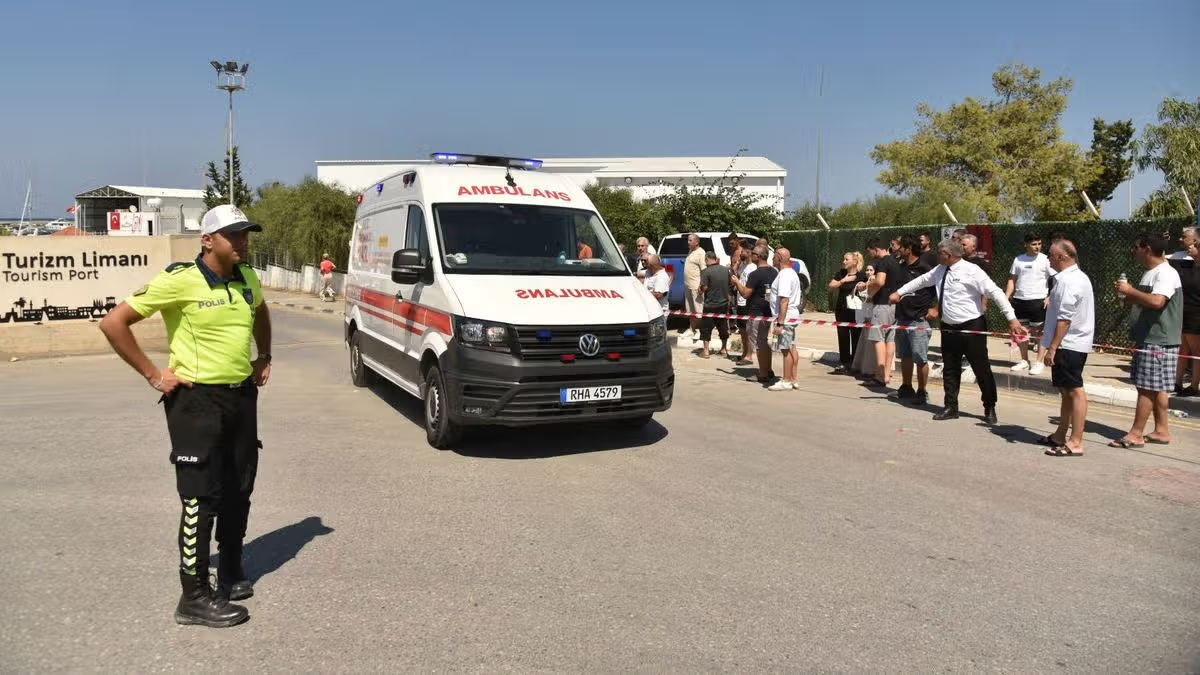
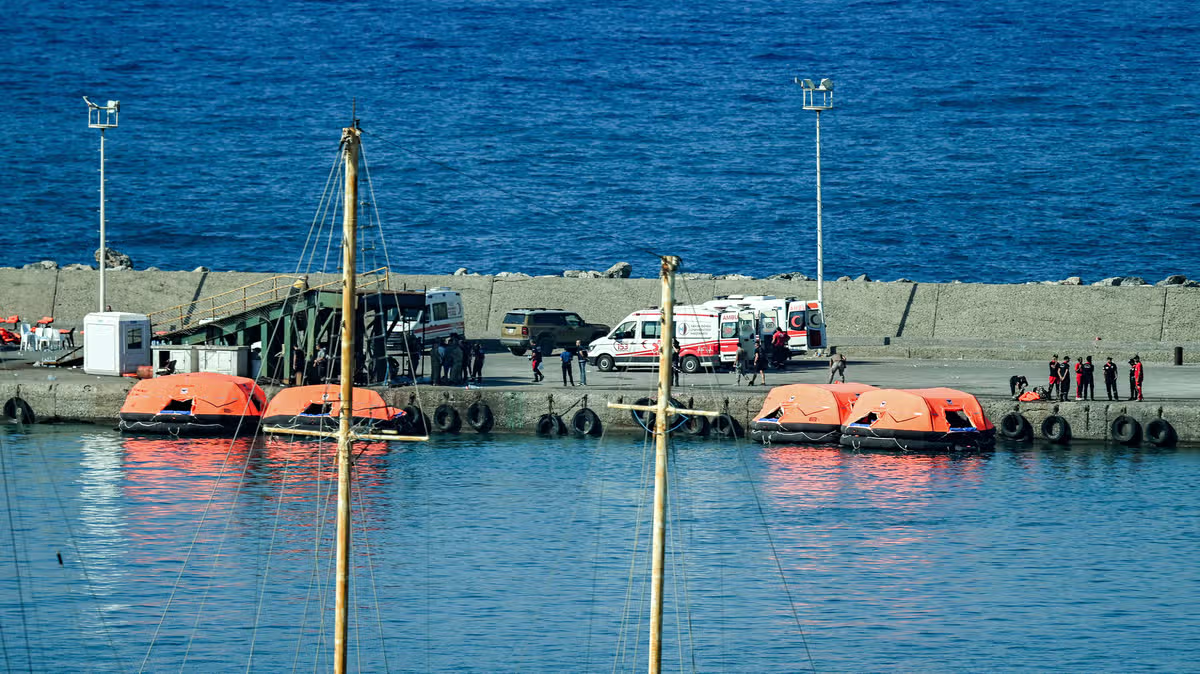
“On August 30, 2026, information was received that the passenger ship named FILOJET, which was en route from Girne Port to Taşucu Port with 259 passengers and 8 crew members on board, had begun taking on water 4 miles off Girne Port and was in danger of sinking.
Advertisement
“Following the receipt of the report, search and rescue operations were initiated in the area.
“As part of the search and rescue activities; 4 floating units affiliated with the T.R.N.C. Coast Guard Command and the passenger ship named AKGÜNLER 3 were assigned to the region, while 5 floating units and 2 Coast Guard helicopters were dispatched to the area by our Coast Guard Command.
“Additionally, 6 naval units have been assigned by the Naval Forces Command to support the operations being conducted in the region.
“The search and rescue operations are being meticulously continued in coordination among the relevant units.
Dolly Parton has been laid to rest after a private funeral, her family has confirmed.
Her death was announced by her nephew, Bryan Seaver, in an Instagram video posted August 25. The musician’s publicist confirmed Parton’s cancer diagnosis to the Associated Press later in the day, but did not give further details on her illness.
Dolly’s niece, Lainey Parton, shared a touching tribute to her aunt August 29, confirming the Queen of Country had been laid to rest the day prior.
“I wanted to wait until after my granny was laid to rest yesterday before I tried to put any of this into words,” Lainey wrote of her “Aunt Granny.”
Advertisement
“From the time I was little, my granny always had a way of making me feel like I was enough. She never made my dreams feel too big or made me feel like I couldn’t do something. She believed in me before I even knew how to believe in myself.
Dolly Parton died August 25 at the age of 80 (AFP/Getty)
“Most people can think of at least one bad memory with everyone in their family. I honestly can’t think of one with her.”
Lainey went on to thank fans and supporters for their love, and ended with a final message to Dolly: “Thank you for always believing in me, loving me, and making me feel like I could do anything.”
Dolly had made it clear before her death that she wanted a “small, private service” for immediate family, the singer’s team shared in a statement.
Advertisement
That service was held at Woodlawn Memorial Park and Mausoleum in Nashville. She was buried next to Carl Dean, her husband of 60 years who died in March 2025.
Dolly Parton has been laid to rest in Tennessee (AFP/Getty)
“There’s a song called ‘If We Never Meet Again.’ It’s an old country-gospel church song that talks about if we never meet again this side of heaven, I will meet you on that beautiful shore,” she told Entertainment Weeklyin a 2014 interview.
“‘Where the charming roses bloom forever and where separations come no more.’ That was my daddy’s favorite. We did sing it at his funeral, and I would like it to be sung at mine.”
It is unclear if there was a live rendition of the song at her funeral; however, Parton has duetted with her goddaughter, pop star Miley Cyrus, on a number of occasions in the past.
Richard Cassidy, 79, stabbed David Parish 14 times at his home in the Borders.
An OAP who murdered a fellow pensioner he believed had sexually abused a woman has died in jail. Richard Cassidy, 79, stabbed David Furnish 14 times in the savage attack at this home in the Scottish Borders in February 2016.
Advertisement
The former soldier was sentenced to 17 years in prison at the High Court in Glasgow in June of 2017. The Scottish Prison Service announced Cassidy died at HMP Shotts on June 26.
Cassidy suffered a heart attack and stroke while in custody but prison bosses have yet to reveal the cause of death. The court heard that after the murder, Cassidy himself contacted the police and handed himself in.
Cassidy’s defence lawyer Brian McConnachie explained that Cassidy went to visit Parish, 74, at his home and tried to get a confession out of him but had no plans of killing him.
Advertisement
He said the killing was a “moment of madness”, but he described the circumstances as “unique”. McConnachie said most people found it “hard to understand” that the then-70-year-old would be capable of murder.
The defence lawyer said: “He had never been in trouble in his life before this incident. He lived a fulfilling life until what he describes as a moment of madness in February 2016.”
However, the judge, Lord Summers, described the murder as “particularly brutal” with 14 stab wounds inflicted on the victim.
Advertisement
Lord Summers said Cassidy showed premeditation on the day of the attack, and referred to a social work report that found he had received Special Forces training while in the Army on how to infiltrate groups by befriending them.
When passing sentence the judge explained he took into account Cassidy’s lack of previous convictions and what he had reportedly been told about Farish as he passed a life sentence with a minimum term of 17 years in jail.
No charges had been brought against Mr Farish.
Get more Daily Record exclusives by signing up for free to Google’s preferred sources. Click HERE.
A ferry carrying 270 people has capsized off the coast of Cyprus shortly after departing from Kyrenia for the Turkish port of Tasucu
A ferry capsized off the coast of Cyrpus in the early hours of Sunday morning. The boat was heading from Kyrenia to Tasucu, a Turkish port.
Advertisement
It was around 2km north of Kyrenia when it sank, reports the Express. Turkish Cypriot coastguard boats were deployed to the scene alongside a search and rescue helicopter.
A further 23 people are still missing with 237 having been rescued. The boat is understood to be a catamaran-style Filo Jet, which was over 40 metres long and 10 metres wide.
Reports suggest it was sailing under the Turkish flag.
Advertisement
Turkey’s Vice President Cevdet Yılmaz has said the country is providing “all possible support” to the ongoing search and rescue operation following the ferry disaster off Kyrenia.
In a statement posted on social media, Mr Yılmaz said: “We are deeply saddened by the news we have received. A catamaran-type passenger ship has sunk after taking on water off the coast of Girne.
“Search and rescue operations have been launched by the TRNC and Republic of Turkey Coast Guard units and relevant institutions and are continuing without interruption.
Advertisement
“At this moment, our primary priority is the rescue of the passengers and crew. We are closely following the unfortunate incident that has occurred and providing all possible support to the search and rescue efforts.
“I extend my condolences to the passengers on board, the crew, and our nation.”
Ensure our latest stories always appear at the top of your Google Search by making us a Preferred Source. Click here to activate or add us as your Preferred Source in your Google search settings.
A gardener has issued advice to homeowners over a common landscape fabric weed control mistake that some experts say may cause more harm than good
There is a cheaper and more effective way to keep weeds out of your garden – and it does not involve expensive landscape fabric that can do more harm than good.
Advertisement
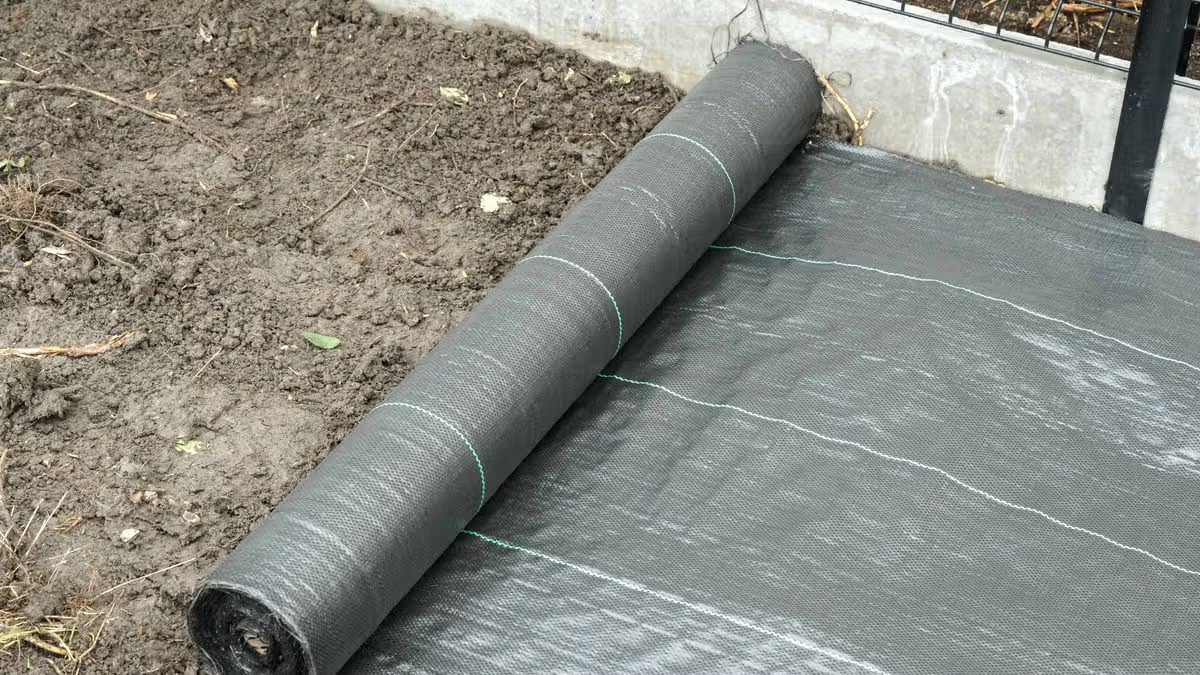
Many gardeners spend significant sums on synthetic or organic sheeting laid over soil to inhibit weed growth by cutting off sunlight and stopping seeds from germinating. While it is marketed as a low-maintenance solution, experts and experienced gardening enthusiasts warn it frequently ends up costing homeowners considerably more money in the long run and may prove largely ineffective.
A far simpler and cheaper alternative involves layering newspaper or cardboard directly on the soil and topping it with mulch. Not only does this method cost next to nothing, but it also breaks down naturally over time, enriching the soil rather than damaging it – and can suppress weeds for up to two years.
Gardener Gabriella the Garden Sage brought the issue to wider attention after sharing a Facebook post featuring photographs of kniphofia plants with compressed, stunted roots that were unable to push through a layer of landscape fabric buried beneath several inches of mulch. She explains that while mulch ordinarily breaks down and enriches the soil with nutrients, the fabric serves as a barrier, preventing those benefits from penetrating the clay soil underneath.
In the caption accompanying her post she wrote: “Builders and landscape companies convinced homeowners to roll out acres of the stuff, extolling it as a key tool to make landscaping low maintenance and weed free. Not to mention that weeds grow quite happily on top of the fabric! For the sake of your plants, your soil, the planet, and your friendly local garden sage, just say no to landscape fabric!”
Advertisement
Several gardening enthusiasts left encouraging remarks on Gabriella’s post, with one writing: “Yup. Our backyard is full of the stuff, it’s so frustrating!”
Another contributed: “I have had decent luck with either layers of newspaper or cardboard, then mulch on top.” They added: “Weed suppression lasts about two years with this method.”
A third sided with Gabriella, commenting: “Exactly!” while another Facebook user noted: “Wow! That’s good to know! How about laying newspapers down?”
Although landscape fabric may appear to offer a simple solution to garden weeds, numerous experts warn that it frequently creates more difficulties than it resolves. It can obstruct root growth, deprive soil of air and moisture, and ultimately become a nuisance once weeds begin establishing themselves on top.
Advertisement
Removing it is far from straightforward and can require hours of gruelling work. Instead, householders may wish to explore more sustainable and soil-friendly alternatives, such as transforming their lawns with native plants, clover, buffalo grass, or considering xeriscaping — which involves replacing lawn areas with soil, rocks, mulch, or native plant species.
These alternatives not only cut down on maintenance and reduce water consumption, but also provide vital support for pollinators — insects that are fundamental to our food supply. Even transforming just a section of your garden can save both time and money, while improving soil health and encouraging a more balanced ecosystem.
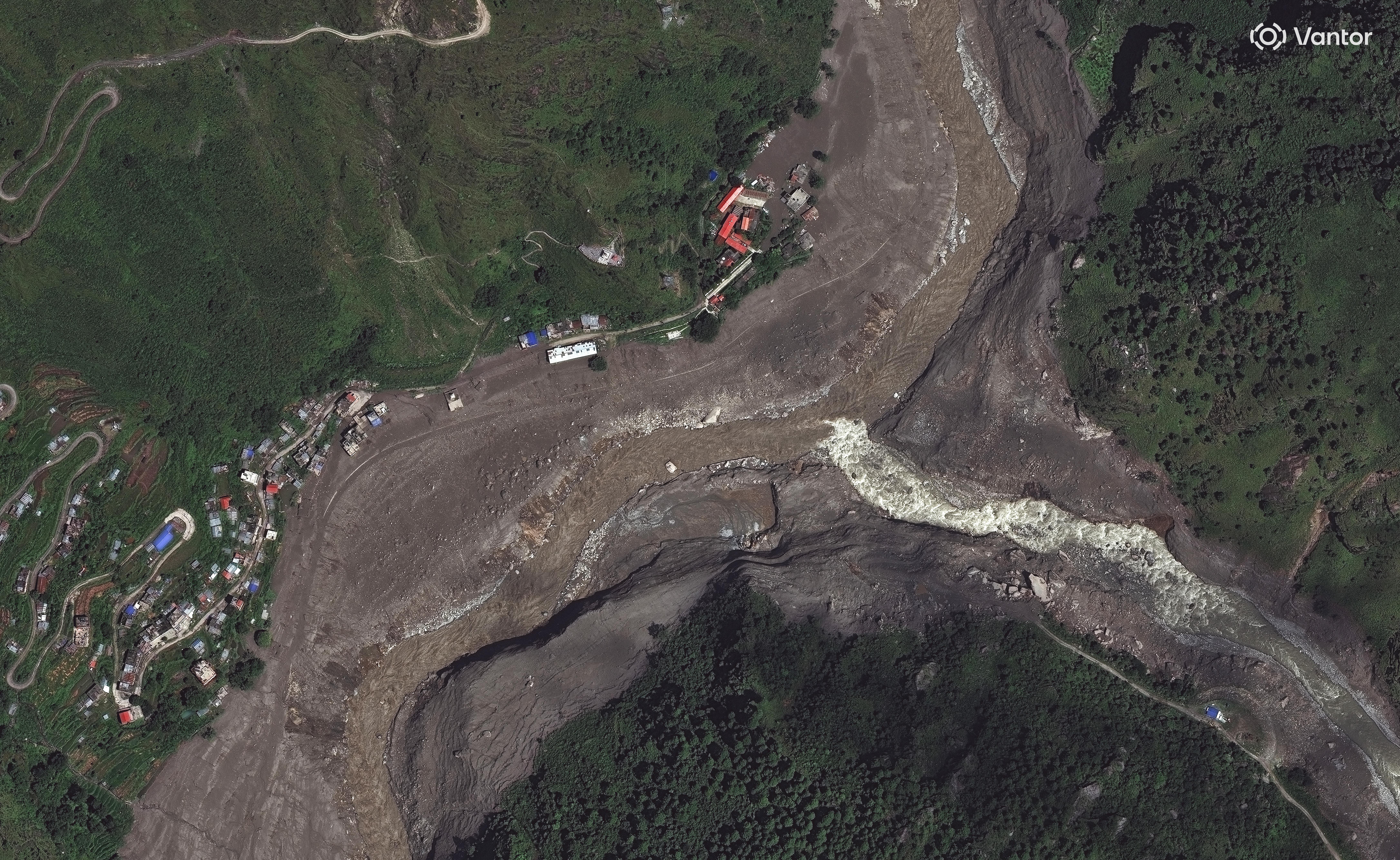
A wall of ice, rock and mud tore through Nepal and Tibet this week, killing hundreds of people. Scientists believe the disaster began when part of a glacier and the mountainside beneath it collapsed. Though it is unclear what set it off, it has raised a bigger question: are the Himalayas becoming a more dangerous place to live?
High on Langtang Lirung, a 7,000m mountain on the Nepal-Tibet border, part of the mountainside gave way and took a section of glacier with it.
The resulting mass of ice, rock and debris crashed into the Lhende Khola river below and grew as it travelled, picking up sediment and water before surging downstream into Nepal’s Rasuwa, Nuwakot and Dhading districts.
A lake formed by the initial landslide has since begun overflowing, triggering fresh panic in communities already devastated by Wednesday’s disaster. The death toll from this week’s Himalayan flash floods has risen to 768 in Nepal and Tibet combined.
Advertisement
The Red Cross says more than 90,000 people had been directly affected and were in urgent need of help, and warned the crisis was “still unfolding” as officials braced for further flooding.
Jeffrey Kargel, a senior scientist at the Planetary Science Institute, calculated that the flow covered its first 22km at an average speed of 193kmph, reaching the valley floor in under seven minutes.
Rivers in the affected valleys are reported to have risen by as much as nine metres in half an hour.
This is not the first time disaster has struck this exact stretch of the Himalayas.
A flood in July last year killed nine people and swept away the same border bridge, after heavy rain sent the Lhende and Bhote Koshi rivers over their banks.
Advertisement
The wider Langtang region was also badly damaged by an avalanche during Nepal’s 2015 earthquake, which destroyed the village of Langtang itself.
The mountains around Langtang are warming at an exceptional rate, and that warming is already reshaping the region in ways scientists say make disasters like this one more likely. Land above 4,000m in the Langtang catchment has warmed at roughly five times the global average since the 1960s, according to research led by Bethan Davies, chair in glaciology at Newcastle University, with that trend sharpening further over the past decade.
Part of the reason, she tells The Independent, is that as snow and ice disappear, they expose darker rock underneath, which absorbs more heat from the sun and warms the mountain even faster.
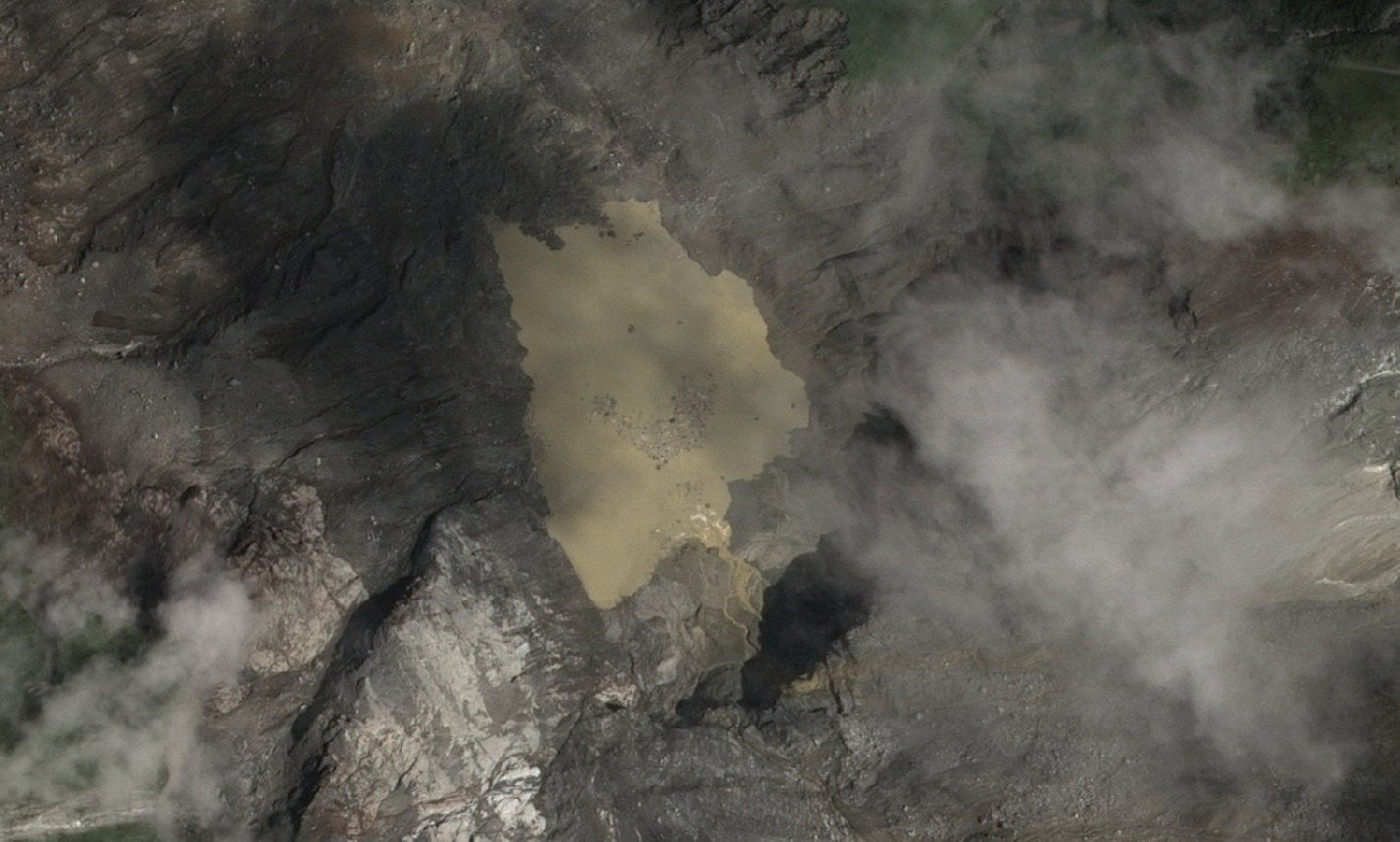
Satellite image shows one of two lakes at the site of the glacial collapse,in the border area between Nepal and Tibet Autonomous Region, China (Reuters)
Across the wider Himalayan region, the rate of ice loss from glaciers has doubled since 2000, according to Ella Gilbert, a climate scientist at the British Antarctic Survey.
“We know that climate heating is destabilising glaciers in the Himalaya,” she says, “when glacier stability is undermined, sudden failures can occur, leading to horrible incidents like this one.”
Advertisement
Dr Davies points to a related process: the thawing of permafrost, ground that normally stays frozen year-round and helps hold steep mountainsides together.
“Permafrost is like the ‘glue’ that holds rocks together,” she says.
As that ground warms and the glue melts, steep slopes like the one above Langtang Lirung become progressively less stable.
The Intergovernmental Panel on Climate Change has said, with high confidence, that declining glaciers, snow and permafrost are already destabilising mountain regions worldwide, and that events like this week’s collapse are likely to become more frequent as the climate continues to warm.
Advertisement
However, experts are not connecting this disaster to climate change yet.
“We don’t know exactly what happened here,” Dr Gilbert says, “but it’s likely that some combination of these factors was at play, and we know that all of these are enhanced by climate change.”
Asked whether the unusually warm, dry conditions reported in the area this week fitted the pattern typically seen before a major glacier collapse, Dr Gilbert says: “I’ve seen reports that temperatures were unusually warm and snow cover was low, which is consistent with what happens before a major calving or collapse event.”
Why some communities had time to escape and others did not has become a central question of its own. Hannah Cloke, professor of meteorology and climate science at the University of Reading, says the disaster unfolded across three distinct zones, each with different lessons for early warning.
Advertisement
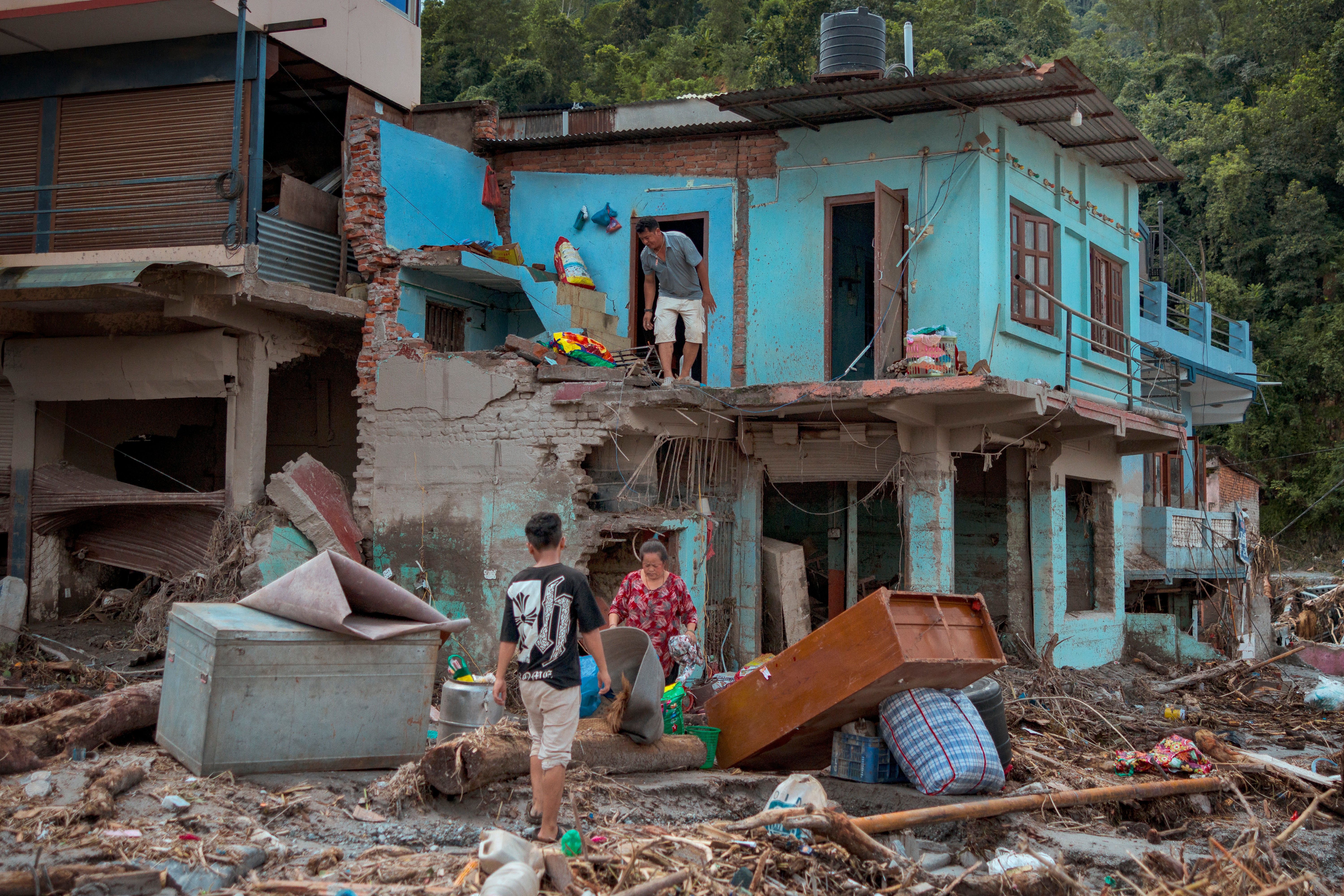
Residents salvage belongings from their destroyed home following flash floods (Getty)
Closest to the source, floodwaters arrived within minutes, leaving little chance for any warning to matter.
Further downstream, by contrast, Nepal’s forecasting authorities issued warnings several hours before the flood arrived, which officials say helped save many hundreds of lives.
The hardest zone lay in between, she says: a flood that struck under clear skies, with no rain to signal danger.
“For many, a flood is something that follows a storm,” Dr Cloke says. “When a warning describes a threat that does not match people’s mental picture of danger, it can be easy to dismiss.”
The physical unpredictability of the disaster also compounded that problem.
Advertisement
Fatima Pillosu, a hydrometeorologist at the University of Reading, said the debris blocking the river after the initial collapse formed what is known as a barrier lake, a natural dam with no engineered structure and no way to release pressure safely.
“Unlike an engineered dam, this barrier has no spillway and no solid core,” she says.
“The exact moment of failure cannot be predicted, because it depends on the internal structure of the dam.” That is largely why the same lake now threatens a second wave of flooding, days after the first.
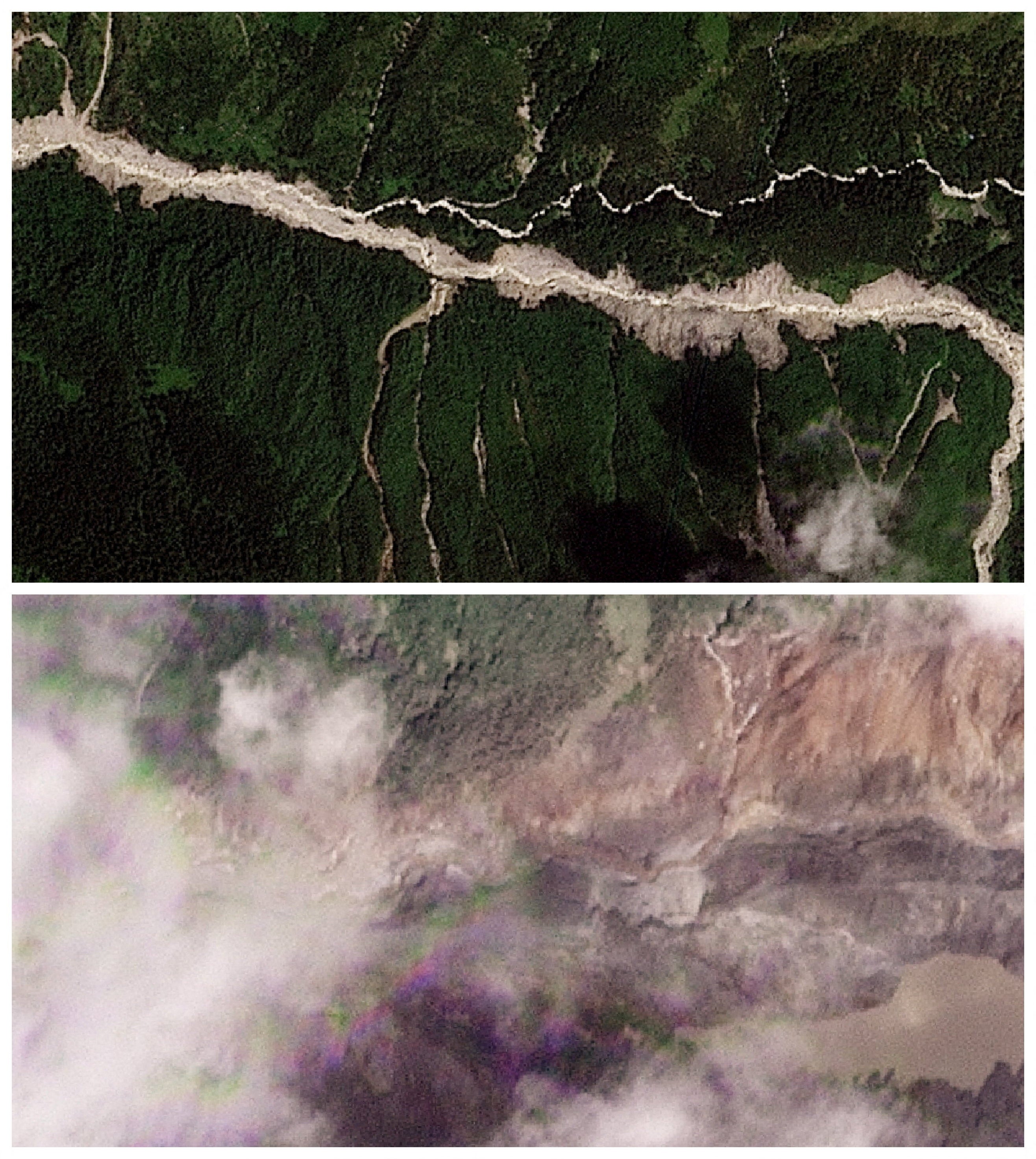
A combination of satellite images shows a site at the border of Nepal and Tibet Autonomous Region, China, before and after a barrier lake formed as a result of flash floods and a mudslide (Reuters)
Jeff Da Costa, a researcher in hydrometeorological hazards at the University of Reading, says the risk was worsened by a known gap in cross-border cooperation. After last year’s flood on the same river, he said, Nepal’s officials reported receiving no advance warning from China and said there was no formal mechanism for sharing that kind of information across the border.
Nepal subsequently committed to strengthening that coordination, though it remains unclear how much had changed by the time this week’s disaster struck.
Advertisement
“This is a transboundary river system, and information about the barrier lake is being shared between China and Nepal,” he says.
“Observations upstream can give people downstream valuable time, but they become useful when they are connected to modelling, warnings and practical decisions on the ground.”
Residents salvage belongings from their destroyed home following flash floods (Getty)
Beyond what caused the collapse, the disaster has reopened a longer-running argument about climate justice.
Nepal produces less than 0.1 per cent of the greenhouse gas emissions driving global warming, yet it is ranked as one of the most vulnerable countries in the world to climate-related disasters.
“This is the reality: those who have contributed the least are paying the highest price, especially with their lives,” Savio Carvalho, of the campaign group 350.org, says.
Advertisement
He says wealthier countries had a duty to help fund disaster preparedness before a crisis hits, not just respond afterwards, pointing to the well-resourced early warning systems used in the Alps as an example of what Nepal lacks.
“If only Nepal had good technology, like the Swiss or Italians do for the Alps, they could have had better forecasting mechanisms,” he said. He also called for taxes on the windfall profits of fossil fuel companies to help pay for the response.
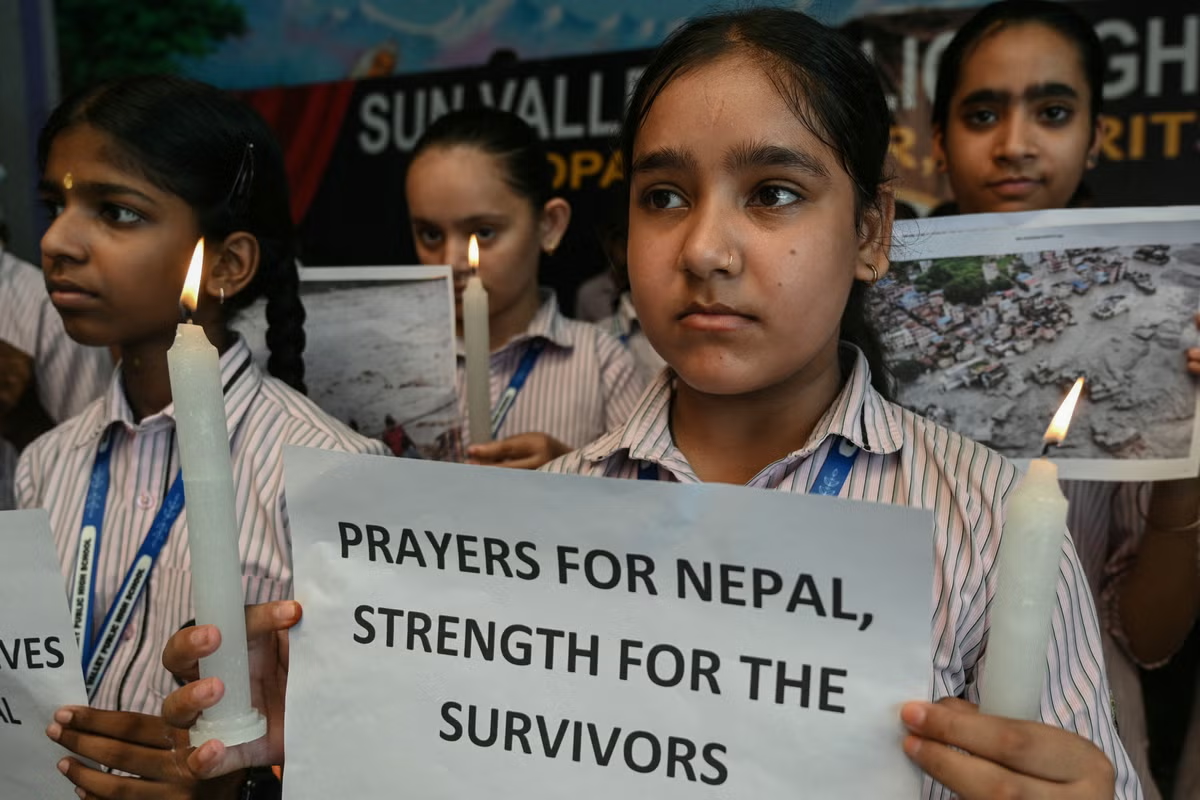
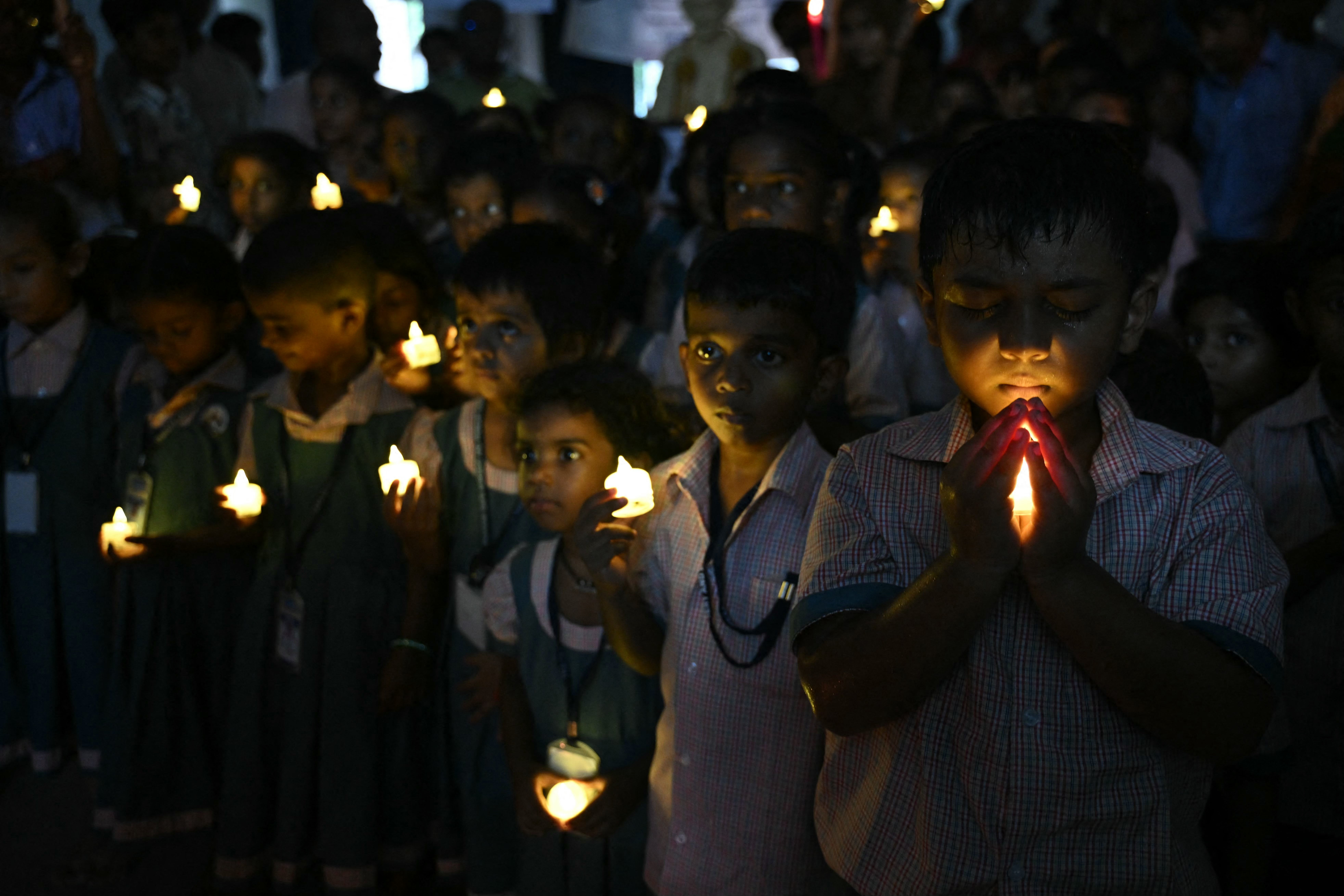
School students hold LED candles as they gather to pay their homage to people who died in Nepal’s flash flood, in Chennai (AFP/Getty)
Carvalho says the economic damage would reach far beyond the disaster zone itself.
Rasuwa sits on a major trekking and pilgrimage route, and tourism supports large numbers of people in Nepal, work that comes with none of the safety net available to workers in wealthier countries.
“Most of these communities, unlike many parts of the global north, have no state protections like unemployment allowances,” he said. The damage extends well beyond tourism too, he added, pointing to destroyed hydropower plants, bridges, power lines and roads.
Advertisement
Existing international funds meant to help countries like Nepal cope with disasters, he said, remain inadequate and hard to access, often taking months or years to arrive, and sometimes coming as loans that leave poorer countries deeper in debt rather than grants.
Sudarshan Neupane, WaterAid Nepal’s country director who grew up in Rasuwa district, says the damage to water and sanitation systems would need urgent attention during the recovery to protect public health and stop disease spreading through communities already reeling from the disaster.
“Having grown up in Rasuwa district, one of the hardest hit regions in the recent flash floods in Nepal, it is truly devastating to see so many families facing unimaginable loss, displacement and uncertainty,” he says.
The scheme, which took effect on August 28, includes a wide range of furniture and home essentials.
In a statement, IKEA said: “From much-loved favourites to everyday essentials, customers can discover New Lower Prices both online and in-store, helping make it easier to create a home you love, whatever your budget.”
Among the discounted items is the KALLAX shelving unit, soon to be available for £49—down 18% from £60.
Advertisement
The HEMNES daybed, which functions as a sofa, single bed, double bed, and storage unit, will be reduced by 15% from £329 to £279.
In addition to these savings, IKEA is offering more than 1,000 exclusive in-store-only prices with discounts up to 25%.
The company said: “In time for cosy season, in stores nationwide, IKEA is also offering 20% off throws, bedspreads, candles, floor and table lamps, plus selected rugs, thermal curtains, seasonal duvets and cookware, from 7th September to 1st November nationwide.”
The history of IKEA
IKEA was founded in 1943 by Ingvar Kamprad when he was just 17 years old.
Originally, the company sold small goods such as pens and wallets, but in 1948, Kamprad expanded into furniture.
Advertisement
This was facilitated by Ingvar’s father, who gave him a small sum of money for doing well in school, which he used to set up a company.
In 1953, the company adopted flatpack furniture, solving costly transportation problems.
IKEA grew steadily throughout the 1950s in Sweden, before expanding into Denmark and Norway in the 1960s.
By the 1970s, the brand had entered markets in Australia, Austria, Canada, Germany, Hong Kong, Japan, Kuwait, the Netherlands, Singapore, and Switzerland.
The first UK store opened in Warrington in 1987, marking the start of IKEA’s growth in the British market.
Advertisement
Today, IKEA employs nearly 12,000 people across its 22 UK locations.
Have you bought items from IKEA before? Let us know in the comments.























































You must be logged in to post a comment Login