

Business
Former medicinal cannabis boss Adam Blumenthal fights scope of document haul



Last week, the BSE benchmark Sensex climbed 663.44 points, or 0.86 per cent, and the NSE Nifty rose 214.85 points, or 0.89 per cent.
Markets ended the week on a firm footing, supported by resilient domestic macroeconomic indicators, healthy GST collections and improving industrial activity, Ajit Mishra, SVP, Research, Religare Broking Ltd, said.
“Expectations of a more accommodative global monetary policy following softer-than-expected US labour market data further strengthened investor sentiment,” he added.
The market valuation of Bharti Airtel jumped Rs 36,529.21 crore to Rs 11,63,877.30 crore, the most among the top-10 firms.

Bajaj Finance added Rs 33,059.83 crore, taking its valuation to Rs 6,43,141.36 crore.
ICICI Bank‘s valuation surged Rs 16,084.29 crore to Rs 10,11,695.03 crore, and that of Life Insurance Corporation of India (LIC) climbed Rs 8,601.99 crore to Rs 5,44,139.55 crore.The market capitalisation (mcap) of HDFC Bank rallied Rs 7,664.89 crore to Rs 12,33,646.33 crore, and that of Hindustan Unilever edged higher by Rs 6,461.38 crore to Rs 5,17,086.30 crore.
However, the mcap of Larsen & Toubro tumbled Rs 26,572.2 crore to Rs 5,53,978.63 crore.
The mcap of Reliance Industries eroded by Rs 18,945.56 crore to Rs 17,64,981.36 crore, and that of State Bank of India (SBI) declined by Rs 4,846.08 crore to Rs 9,59,891.92 crore.
The market valuation of Tata Consultancy Services (TCS) dipped by Rs 1,031.15 crore to Rs 7,57,175.27 crore.
Reliance Industries remained the country’s most valued firm, followed by HDFC Bank, Bharti Airtel, ICICI Bank, SBI, TCS, Bajaj Finance, Larsen & Toubro, LIC and Hindustan Unilever.


Wolf Report is a senior analyst and private portfolio manager with over 10 years of generating value ideas in European and North American markets, and the owner of Wolf of Value, a service focusing on international dividend-paying value investments.He further covers the markets of Scandinavia, Germany, France, UK, Italy, Spain, Portugal and Eastern Europe in search of reasonably valued stock ideas.
Analyst’s Disclosure: I/we have a beneficial long position in the shares of FINMY either through stock ownership, options, or other derivatives. I wrote this article myself, and it expresses my own opinions. I am not receiving compensation for it (other than from Seeking Alpha). I have no business relationship with any company whose stock is mentioned in this article.
While this article may sound like financial advice, please observe that the author is not a CFA or in any way licensed to give financial advice. It may be structured as such, but it is not financial advice. Investors are required and expected to do their own due diligence and research prior to any investment.
Short-term trading, options trading/investment and futures trading are potentially extremely risky investment styles. They generally are not appropriate for someone with limited capital, limited investment experience, or a lack of understanding for the necessary risk tolerance involved.
I own the European/Scandinavian tickers (not the ADRs) of all European/Scandinavian companies listed in my articles. I own the Canadian tickers of all Canadian stocks I write about.
Please note that investing in European/Non-US stocks comes with withholding tax risks specific to the company’s domicile as well as your personal situation. Investors should always consult a tax professional as to the overall impact of dividend withholding taxes and ways to mitigate these.
Seeking Alpha’s Disclosure: Past performance is no guarantee of future results. No recommendation or advice is being given as to whether any investment is suitable for a particular investor. Any views or opinions expressed above may not reflect those of Seeking Alpha as a whole. Seeking Alpha is not a licensed securities dealer, broker or US investment adviser or investment bank. Our analysts are third party authors that include both professional investors and individual investors who may not be licensed or certified by any institute or regulatory body.


Lawrence Fuller has been managing portfolios for individual investors for 30 years, starting his career at Merrill Lynch in 1993 and working in the same capacity with several other Wall Street firms before realizing his long-term goal of complete independence when he founded Fuller Asset Management. He also manages the Focused Growth portfolio on the new fintech platform called Dub, which is the first copy-trading platform approved by securities regulators in the US, allowing retail investors to copy the portfolio and ongoing trades of the manager they choose automatically. You can also find him on Substack and lawrencefuller.substack.com.He is the leader of the investing group The Portfolio Architect, which focuses on an overall economic and market outlook that complements an all-weather investment strategy designed to produce consistent risk-adjusted market returns. Features include: Portfolio construction guidance, access to an “All-Weather” model portfolio and a dividend and options income portfolio, a daily brief summarizing current events, a week ahead newsletter, technical and fundamental reports, trade alerts, and 24/7 chat. Learn More.
Analyst’s Disclosure: I/we have a beneficial long position in the shares of RSP, IWM either through stock ownership, options, or other derivatives. I wrote this article myself, and it expresses my own opinions. I am not receiving compensation for it (other than from Seeking Alpha). I have no business relationship with any company whose stock is mentioned in this article.
Lawrence Fuller is the Principal of Fuller Asset Management (FAM), a state registered investment adviser. He is also the manager of the Focused Growth portfolio on the copy-trading platform Dubapp.com. Information presented is for educational purposes only intended for a broad audience. The information does not intend to make an offer or solicitation for the sale of purchase of any specific securities, investments, or investment strategies. Investments involve risk and are not guaranteed. FAM has reasonable belief that this marketing does not include any false or material misleading statements or omissions of facts regarding services, investment, or client experience. FAM has reasonable belief that the content as a whole will not cause an untrue or misleading implication regarding the adviser’s services, investments, or client experiences. Past performance of specific investment advice should not be relied upon without knowledge of certain circumstances or market events, nature and timing of investments and relevant constraints of the investment. FAM has presented information in a fair and balanced manner. FAM is not giving tax, legal, or accounting advice.
Mr. Fuller may discuss and display charts, graphs, formulas, and stock picks which are not intended to be used by themselves to determine which securities to buy or sell, or when to buy or sell them. Such charts and graphs offer limited information and should not be used on their own to make investment decisions. Consultation with a licensed financial professional is strongly suggested. The opinions expressed herein are those of the firm and are subject to change without notice. The opinions referenced are as of the date of publication and are subject to change due to changes in market or economic conditions and may not necessarily come to pass.
Seeking Alpha’s Disclosure: Past performance is no guarantee of future results. No recommendation or advice is being given as to whether any investment is suitable for a particular investor. Any views or opinions expressed above may not reflect those of Seeking Alpha as a whole. Seeking Alpha is not a licensed securities dealer, broker or US investment adviser or investment bank. Our analysts are third party authors that include both professional investors and individual investors who may not be licensed or certified by any institute or regulatory body.


Three sons of Iran’s slain leader Khamenei appear at funeral, not his successor

FRANKFURT—For decades, thousands of niche, world-class manufacturers that form the backbone of the German economy relied on an unassailable moat: unmatched quality. Now that moat is drying up.
The Mittelstand—a broad tier of midsize manufacturers, mainly specialized in capital and intermediate goods and reliant on exports—once thrived by making machines for factories everywhere. But China is now closing the quality gap and offering prices as low as half those of their European rivals.
Copyright ©2026 Dow Jones & Company, Inc. All Rights Reserved. 87990cbe856818d5eddac44c7b1cdeb8

Bread Financial: A High-Quality Lender Trading At A Discount

EV battery durability exceeds expectations as replacement fears persist

Artisan Partners Asset Management: Limited Downside
Business
Equity mutual funds delivered up to 8% return last week; international funds led. Check top 10 performers

Equity mutual funds delivered up to 8% return last week; international funds led. Check top 10 performers


Taiwan military resumes ’anti-communist’ classes for graduates, citing Chinese threat
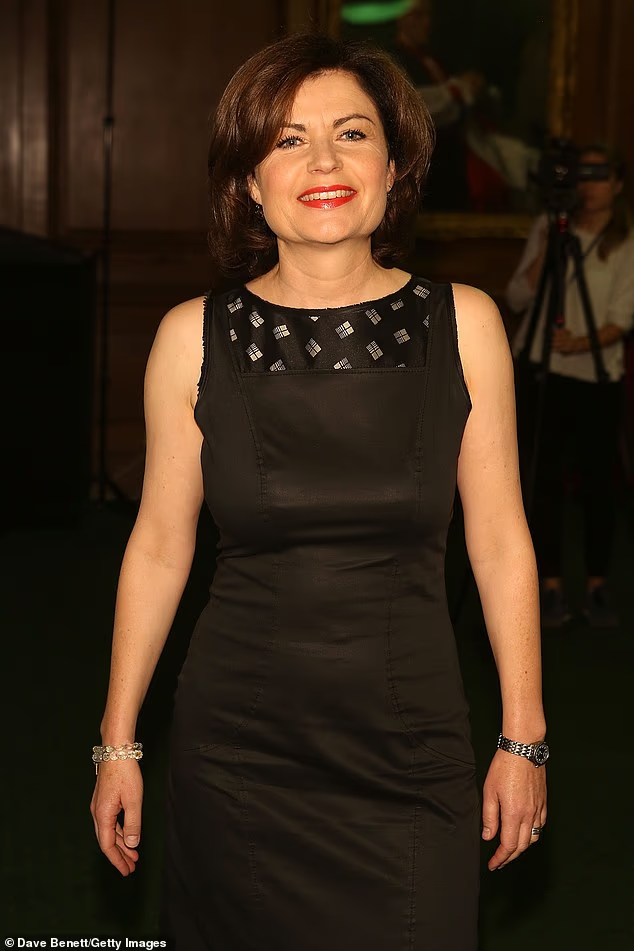
BBC newsreader goes viral for the unbelievable way she pronounces ‘Socceroos’: ‘Said it like the team is a Greek player’
M-cap of 6 of top-10 most valued firms surges Rs 1 lakh cr; Airtel, Bajaj Fin top winners

Lucas Glover tied atop 2026 John Deere Classic leaderboard with Max Homa, Zach Johnson among chasers


-

 Fashion2 days ago
Weekend Open Thread: High Hopes
-

 Politics2 days ago
The House | “Reframing the debate from a binary discussion of winners and losers”: Yuan Yang reviews ‘We Are Not Machines’
-

 Crypto World5 days ago
Strategy authorizes up to $1.25B in Bitcoin sales under new capital plan
-

 News Videos7 days ago
MAJOR BITCOIN & MARKET UPDATE!!!! (MUST WATCH ASAP!!!)
-

 Tech5 days ago
Anonymous researcher drops 0-day ‘exploitarium’ repo
-

 Business5 days ago
Australia treasurer says alleged access of prime minister’s bank data ’incredibly concerning’
-
 NewsBeat4 hours ago
Taylor Swift and Travis Kelce wedding staffer hilariously struggles to keep her cool while checking in megastars
-
 Business6 days ago
The AI boom won’t burst all at once. It will pop in ‘rolling bubbles’: Macquarie
-

 Sports4 days ago
Broncos roster: OL Ben Powers (No. 74) entering final year of contract
-

 NewsBeat4 days ago
Presenter Caroline Flack’s brother Paul Flack dies aged 55
-

 Crypto World3 days ago
Binance stock trading tops $1B in first month after launch
-

 News Videos5 days ago
How to Build INSANE Live Financial Dashboards With Claude
-

 Crypto World3 days ago
Alibaba-affiliate Ant Group enters the humanoid robot market with 12 deals
-
 NewsBeat3 days ago
New exhibition reflects five decades of movement between island of Ireland and GB
-

 Business2 days ago
What a 10 Percent Drop Means for Buyers, Sellers and Renters
-

 Business3 days ago
Meta Platforms Stock Jumps 7% Today as Bloomberg Reports Company Plans to Enter the Cloud Business
-

 Crypto World2 days ago
Binance Re-Enters Philippines As EU MiCA Rules Restrict Access
-
 Crypto World4 days ago
Airdrop Registration Becomes Key Focus For Remittix As RTX Launch Updates Approach
-

 Tech6 days ago
The attack that hijacked Claude Code came through Sentry. Datadog, PagerDuty, and Jira have the same exposure.
-
 Business5 days ago
PRISM’s IPO filing mentions Zostel case, CCI investigation
You must be logged in to post a comment Login