Business
Francesca’s files for bankruptcy, to close all stores nationwide
Check out what’s clicking on FoxBusiness.com.
Women’s specialty retailer Francesca’s filed for Chapter 11 bankruptcy protection and launched going-out-of-business sales across all of its stores.
The company, founded in Houston in 1999, announced Friday that it voluntarily filed for protection in the U.S. Bankruptcy Court for the District of New Jersey. The retailer said the move is intended to facilitate a court-supervised process designed to maximize value for stakeholders.
Francesca’s currently has 457 locations across 45 states.

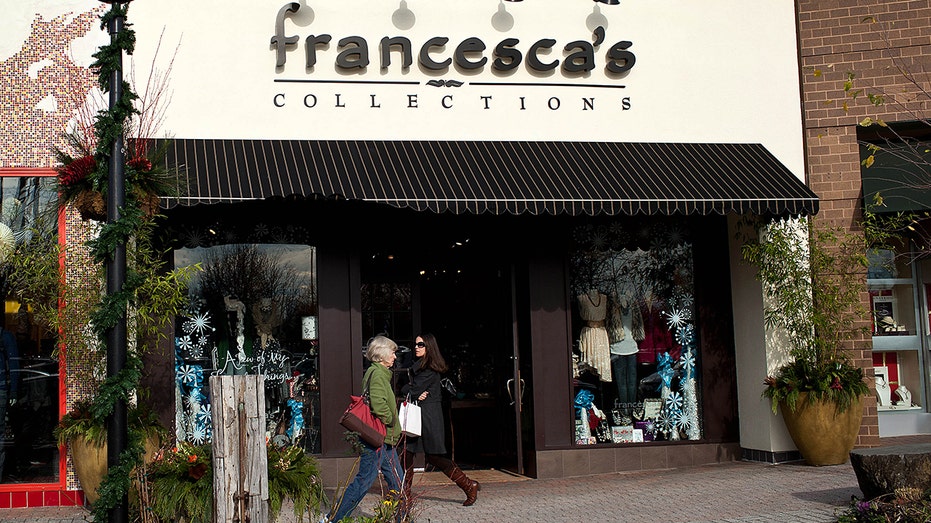
The company previously filed for bankruptcy in Decemember 2020. (Emile Wamsteker/Bloomberg via Getty Images)
Advisors Tiger Group, SB360 Capital Partners and GA Group have launched court-approved store closing sales across the company’s entire fleet.
“Shoppers will find discounts of 25 to 40 percent off across all product categories, and new merchandise will continue to arrive at stores,” Michael McGrail, member at Tiger Group, said in a statement. “It’s an opportunity to add to or accessorize your wardrobe, find unique gifts, or just go on a treasure hunt for extraordinary deals.”
Discounted merchandise includes sweaters and cardigans, blouses and skirts, loungewear and intimates, denim jackets, party and wedding guest dresses, rompers and jumpsuits, as well as jewelry, gifts and accessories.

Inside a Francesca’s store in Southlake, Texas. (Peter Larsen/WireImage)
Francesca’s previously filed for Chapter 11 bankruptcy protection in December 2020, and was later acquired out of bankruptcy by TerraMar Capital and Tiger Group for $18 million.
In the years after exiting bankruptcy, Francesca’s attempted revival efforts, including launching a tween-oriented line called Franki by Francesca’s and acquiring Miley Cyrus and Suki Waterhouse’s lifestyle brand Richer Poorer. The chain also opened a new store at the American Dream mall in East Rutherford, New Jersey, in April 2024.

Francesca’s was founded in Houston in 1999. (Josh Brasted/Getty Images)
A spokesperson for Francesca’s did not immediately respond to FOX Business’ request for comment.
FOX Business’ Kristen Altus contributed to this report.
Business
Iron Mountain Incorporated 2025 Q4 – Results – Earnings Call Presentation (NYSE:IRM) 2026-02-12
Q4: 2026-02-12 Earnings Summary
EPS of $0.61 beats by $0.02
| Revenue of $1.84B (16.56% Y/Y) beats by $39.87M
Seeking Alpha’s transcripts team is responsible for the development of all of our transcript-related projects. We currently publish thousands of quarterly earnings calls per quarter on our site and are continuing to grow and expand our coverage. The purpose of this profile is to allow us to share with our readers new transcript-related developments. Thanks, SA Transcripts Team
Business
HUL sees demand recovery as rural, urban traction improves; Q3 volumes rise 4%
However, it reported 70 basis point contraction in operating margin before depreciation and amortisation (Ebitda margin) at 23.3% driven by labour code related charges; the margin still remained above the company’s guidance band of 22-23% indicating lack of any stress from operating costs such as raw material prices and inventory management.
The FMCG major expects second half of the current fiscal year ending in March 2026 to be better than the first half and to report even better numbers next year. Its optimism is driven by progress in portfolio and channel transformation, and better macroeconomic scenario including improved consumer sentiments and better consumption demand in rural regions and improving urban traction.
Agenciesgame is on Co is betting on rebound in rural & urban consumption and portfolio transformation
The company’s shares fell 2% on Thursday after it reported a 30% YoY decline in net profit for the December quarter, largely on account of a one-off impact from labour code provisions. Excluding this and one-time gain from sales of the ice cream division, net profit grew by a modest 1%.
HUL’s inorganic growth strategy to expand in new consumer segments is paying off. The acquisition of Minimalist in January last year has helped the company to gain traction in the premium skincare space. The brand has grown faster under HUL. Its sales are not disclosed separately but is included in the beauty & wellbeing division. This division’s revenue grew fastest among all categories, rising 11% year-on-year and 5.3% sequentially. This segment’s share in total revenue has gradually increased to 24.2% in the December 2025 quarter from 20.8% in March 2025.
HUL’s decision to buy the remaining 49% stake in Zywie Ventures (Oziva), appears to be a part of the same strategy to drive long-term growth.
Business
Taylor Swift asks US government to block 'Swift Home' trademark
Her team argued that a bedding firm’s designs showed similarities to her trademarked signature.
Business
Freehills, WA Inc twist in Tronox injunction fight as judge stands aside
Supreme Court judge Gary Cobby stood aside from an injunction battle after a self-styled whistleblower pointed to his work three decades ago with law firm Freehills and its connections to WA Inc.
Business
Rox calls on MACA for gold plant
Rox Resources has engaged MACA to build a processing plant for ore from the Youanmi gold project, as it inches closer to a final investment decision at the historic site.
Business
ETMarkets Smart Talk | Not rock-bottom yet, but India looks attractive vs mid-2024 excesses: Rahul Singh
While the market may not be at “rock-bottom” levels that warrant aggressive allocation, the excess froth seen in pockets such as manufacturing, defence and capital goods has largely receded, bringing the valuation premium over other emerging markets down significantly.
In an interaction with ETMarkets Smart Talk, Rahul Singh, CIO–Equities at Tata Asset Management, explains why India is now better positioned to attract its fair share of emerging market flows, how earnings growth is gradually reviving, why IT may no longer be a drag on profitability, and why investors should look beyond just gold and silver when playing the commodities theme.
He also shares his take on mid- and small-cap opportunities as valuation gaps narrow. Edited Excerpts –
Q) Thanks for taking the time out. It looks like there is some nervousness on D-Street post Budget then it got stabalized. How should investors decode?
A) Foreign Institutional Investors (FIIs) do not have only India to invest in. In mid-2024, India valuations were at an 80–90% premium to other emerging markets (EMs).
After that, we saw earnings growth slowdown and other economies benefited either because of participating in the Artifical Intelligence (AI) theme or because China recovery post stimulus. So global capital followed there.
Now growth is coming back in India and the valuation premium has come down to 50%. It’s still at a premium but much lower than 2024.
We have reached a point where if emerging markets start getting flows — which is possible given the uncertainty in the US macro environment — India will get its share.
Now an FPI does not have to sell India to buy China. India will not get a disproportionate share of the EM flows but the selling intensity can decline.
We look much better than we did a year and a half ago. Valuations were expensive. Are we at absolute rock-bottom valuations where one should put 100% into equities? I would not say that.
But we are much better positioned than we were in July 2024. A lot of thematic froth in manufacturing, defense, capital goods has gone away.
Q) There are 2 precious metals which have not lost their sheen even in 2026 – Gold & Silver. We have seen some volatility – how should one play this theme?
A) While gold and silver remain important, focusing only on these two commodities may be limiting. The world today is seeing geopolitical tensions and supply disruptions that impact a much wider set of commodities.
Commodity price movements are no longer restricted to gold, silver, or crude oil, but are extending into metals and other commodities as well. Investors should therefore look beyond just gold and silver and consider a broader range of commodities when approaching this theme.
Q) The December quarter earnings are underway – what is your take on the earnings which have so far?
A) The growth has just started in different pockets and the earnings season has been either in line or better than expectations including in challenged sectors like IT services. We have not witnessed any downward earnings revision as a result so far.
GST cuts have been structurally positive but the demand revival will probably come by fiscal 2027 and not really this year. In the last quarter we saw the starting signs of GST cuts working in the insurance and auto sector.
Last year, Nifty 50 earnings per share growth was in the 3% range. This year, it is likely to be in the 7–8% range. And next year (FY2027) the expectations are around 15%.
Q) Hiring has taken back seat in the Indian Technology sector. What is your take on the service space amid rupee depreciation, rise of AI and global slowdown?
A) IT downgrades have stopped, even though there are no strong upgrades. There will be no drag on corporate profitability for IT companies. That is a relief, though not a growth driver.
Q) How should one play the small & midcap theme?
A) Mid and small cap valuation premium (vs. Nifty50) has come down materially since mid-2024. This is providing opportunities to re-enter mid/small cap segments selectively.
(Disclaimer: Recommendations, suggestions, views, and opinions given by experts are their own. These do not represent the views of the Economic Times)
Business
Job Seekers Pay to Get Recruited, White-Collar Workers Switch to Trades and the Labor Market’s ‘Deep Freeze’ | Careers & Leadership for February 11
This is an edition of the WSJ Careers & Leadership newsletter, a weekly digest to help you get ahead and stay informed about careers, business, management and leadership. If you’re not subscribed, sign up here.
In the Workplace
Job hunters are so desperate that they’re paying to get recruited. Landing a white-collar job is getting so tough that candidates—not companies—are paying recruiters to match them with positions, a reversal of the traditional model.
Copyright ©2026 Dow Jones & Company, Inc. All Rights Reserved. 87990cbe856818d5eddac44c7b1cdeb8

Business
Thailand’s corruption index score drops, ranking lower than Laos and Vietnam
Corruption is escalating in Thailand, reflected by a declining CPI score of 33. Structural reforms are needed, as the public and private sectors push for anti-corruption measures to restore economic competitiveness.
Key Points
- Declining CPI Score: Thailand scored 33/100 in 2025, ranking lower than Laos and Vietnam, reflecting worsening corruption.
- Economic Impact: Corruption is estimated to cost the private sector up to 500 billion baht annually, stifling growth and investor confidence. Addressing corruption could boost GDP by up to 4%.
- Government Negligence: Successive governments have failed to implement serious anti-corruption measures, entrenching corruption as systemic.
Corruption remains a significant issue in Asia-Pacific, with Thailand scoring 33/100 in 2025, its lowest in 19 years. The private sector estimates annual losses of up to 500 billion baht due to corruption, hindering economic growth and investor confidence. Continued negligence by governments over the past two years has entrenched corruption as a systemic problem.
Countries like Maldives and Vietnam show improvements via structural reforms, while fragile states like Afghanistan and North Korea remain near the bottom of the corruption index due to poor governance and limited civic freedoms. High-scoring countries include Denmark (89/100) and Finland (88/100), whereas most regional countries fall below the global average.
Political parties have proposed diverse anti-corruption measures for the upcoming election, emphasizing transparency and technology. Initiatives include regulatory revisions, creating accessible public data platforms, and strengthening whistleblower protections. A united effort is critical, as solving corruption is vital for Thailand’s economic recovery and national competitiveness.
Corruption and Governance Trends in Asia-Pacific
The recent Transparency International’s Corruption Perceptions Index (CPI) reveals troubling trends in perceived corruption across the Asia-Pacific region, highlighting Thailand’s decline, which saw a score drop to 33 out of 100, marking the lowest in 19 years. Public sentiment indicates that abuse of power is prevalent among those in authority, contributing to a lack of essential public services and economic instability. Nations like the Maldives, Vietnam, and Timor-Leste have made advancements due to governance reforms, yet they still fall below the index average, suggesting a need for continued improvement.
Economic Impacts and Structural Challenges
Corruption in Thailand is projected to result in economic losses nearing 500 billion baht annually, driven by “under-the-table” payments in public procurement. The private sector believes this environment stifles growth, estimating potential GDP increases of up to 4% if corruption issues were addressed.
Despite recent growth concerns, the lack of serious anti-corruption measures from successive governments has entrenched corruption as a systemic issue. Prominent business leaders stress that the focus should not only be on stimulating the economy but also on establishing robust governance to rebuild investor confidence and mitigate risks associated with “grey capital.”

Corruption is not inevitable. Our research and experience as a global movement fighting corruption show there is a clear blueprint for how to hold power to account for the common good, from democratic processes and independent oversight to a free and open civil society.
François Valérian, Chair of Transparency International
Political Responses and Future Directions
In light of the corruption crisis, political parties in Thailand are emphasizing anti-corruption measures in their election platforms. Proposals include the Zero Corruption initiative, aiming for concrete reforms and greater transparency in governance. Key strategies involve regulatory revisions, a move to AI and open data systems, and shifting governmental roles to facilitate easier business practices.
The Pheu Thai and Democrat parties also propose comprehensive legal overhauls and public accountability initiatives. However, consistent political will and stable governance are essential to enforce these reforms and address the systemic roots of corruption effectively, ensuring a healthier economic environment for all.
Global Corruption: Key Findings
The Corruption Perceptions Index (CPI) 2025 reveals a concerning global increase in public sector corruption, attributed to a decline in bold and accountable leadership, and a dangerous disregard for international norms. The global average CPI score has dropped to 42 out of 100, the lowest in over a decade, with 122 out of 182 countries scoring below 50, indicating pervasive corruption. A shrinking number of countries now score above 80, with even high-scoring democracies showing signs of regression.
Key findings and trends from the CPI 2025 include:
- Global Overview of Corruption:
- The global CPI average is 42, with 122 countries scoring below 50, indicating widespread public sector corruption.
- Only five countries score above 80, a significant drop from 12 a decade ago, while over two-thirds (68%) of countries fall below 50.
- Denmark maintains the highest score at 89, while Somalia and South Sudan are the lowest with a score of 9.
- Democratic Backsliding and Civic Space:
- A strong correlation exists between restricted civic space and worsening corruption; 36 of the 50 biggest CPI decliners since 2012 also saw a reduction in freedoms of expression, association, and assembly.
- Over 90% of journalists murdered for investigating corruption since 2012 were in countries with CPI scores lower than 50, highlighting the danger faced by those holding power accountable.
- High-scoring democracies, including the United States (64), Canada (75), the United Kingdom (70), France (66), Sweden (80), and New Zealand (81), have experienced slippage, indicating increased corruption risks due to weakened checks and balances and political polarisation.
- Autocracies like Venezuela (10) and Azerbaijan (30) exhibit systemic corruption at all levels.
Data indicates that democracies, traditionally stronger in combating corruption compared to autocracies or flawed democracies, are witnessing a troubling decline in performance. This concerning trend is evident in countries such as the United States (64), Canada (75), and New Zealand (81), as well as across parts of Europe, including the United Kingdom (70), France (66), and Sweden (80). Equally alarming is the growing imposition of restrictions by many states on freedoms of expression, association, and assembly. Since 2012, 36 out of the 50 countries with significant drops in CPI scores have also faced a shrinking civic space.
Other People are Reading
Business
AI Bubble, Tech Funeral? Who Will Fail And Who Will Double Down? (SPX)
I’m a Portfolio manager (flexible equity funds and private clients), fundamental equity research, macro and geopolitical strategy.Over 10 years across global markets, managing multi-asset strategies and equity portfolios at a European asset manager.I combine top-down macro, bottom-up stock selection and real-time positioning (Bloomberg, models, data).I focus on earnings, tech disruption, policy shifts and capital flows — to identify mispriced opportunities before the market.On Seeking Alpha I share high-conviction ideas, contrarian views and deep breakdowns of both growth and value names.For more insights: follow me on X @AgarCapital
Analyst’s Disclosure: I/we have a beneficial long position in the shares of SPX, NDX either through stock ownership, options, or other derivatives. I wrote this article myself, and it expresses my own opinions. I am not receiving compensation for it (other than from Seeking Alpha). I have no business relationship with any company whose stock is mentioned in this article.
Seeking Alpha’s Disclosure: Past performance is no guarantee of future results. No recommendation or advice is being given as to whether any investment is suitable for a particular investor. Any views or opinions expressed above may not reflect those of Seeking Alpha as a whole. Seeking Alpha is not a licensed securities dealer, broker or US investment adviser or investment bank. Our analysts are third party authors that include both professional investors and individual investors who may not be licensed or certified by any institute or regulatory body.
Business
ICE blocked detainees’ access to lawyers in Minnesota, judge finds

ICE blocked detainees’ access to lawyers in Minnesota, judge finds
-
Politics4 days agoWhy Israel is blocking foreign journalists from entering
-
Sports6 days agoJD Vance booed as Team USA enters Winter Olympics opening ceremony
-
Business4 days agoLLP registrations cross 10,000 mark for first time in Jan
-
NewsBeat3 days agoMia Brookes misses out on Winter Olympics medal in snowboard big air
-
Tech6 days agoFirst multi-coronavirus vaccine enters human testing, built on UW Medicine technology
-
Sports1 day agoBig Tech enters cricket ecosystem as ICC partners Google ahead of T20 WC | T20 World Cup 2026
-
Business4 days agoCostco introduces fresh batch of new bakery and frozen foods: report
-
Tech2 days agoSpaceX’s mighty Starship rocket enters final testing for 12th flight
-
NewsBeat4 days agoWinter Olympics 2026: Team GB’s Mia Brookes through to snowboard big air final, and curling pair beat Italy
-
Sports4 days agoBenjamin Karl strips clothes celebrating snowboard gold medal at Olympics
-
Sports6 days ago
Former Viking Enters Hall of Fame
-
Politics5 days agoThe Health Dangers Of Browning Your Food
-
Sports7 days ago
New and Huge Defender Enter Vikings’ Mock Draft Orbit
-
Business5 days agoJulius Baer CEO calls for Swiss public register of rogue bankers to protect reputation
-
NewsBeat7 days agoSavannah Guthrie’s mother’s blood was found on porch of home, police confirm as search enters sixth day: Live
-
Crypto World1 day agoPippin (PIPPIN) Enters Crypto’s Top 100 Club After Soaring 30% in a Day: More Room for Growth?
-
Video1 day agoPrepare: We Are Entering Phase 3 Of The Investing Cycle
-
Crypto World2 days agoBlockchain.com wins UK registration nearly four years after abandoning FCA process
-
NewsBeat4 days agoResidents say city high street with ‘boarded up’ shops ‘could be better’
-
Crypto World3 days agoU.S. BTC ETFs register back-to-back inflows for first time in a month