Easter Sunday 2026 will be celebrated on Sunday, April 5, marking the resurrection of Jesus Christ for billions of Christians worldwide. Good Friday falls on Friday, April 3, commemorating the crucifixion, with the full Holy Week unfolding from Palm Sunday on March 29 through Easter.
George Dolgikh/Pexels.com
The movable feast, determined by a complex formula involving the first full moon after the spring equinox, lands relatively early in 2026. While Western Christian denominations following the Gregorian calendar observe Easter on April 5, most Eastern Orthodox churches using the Julian calendar will celebrate on Sunday, April 12.
This year’s timing places Easter just after the April school holidays begin in many regions and coincides with heightened travel and retail activity. Families across the United States, Europe, Australia and beyond are already planning gatherings, egg hunts, church services and festive meals.
Palm Sunday: Sunday, March 29 — Marks Jesus’ triumphal entry into Jerusalem, often observed with palm frond processions.
Maundy Thursday (Holy Thursday): Thursday, April 2 — Commemorates the Last Supper and the washing of the feet.
Good Friday: Friday, April 3 — A solemn day of mourning and reflection on the crucifixion. Many Christians attend services featuring the Stations of the Cross or Passion readings.
Holy Saturday: Saturday, April 4 — A day of waiting and preparation, sometimes marked by Easter Vigil services that begin after sundown.
Easter Sunday: Sunday, April 5 — The central celebration of resurrection, joy and new life.
Easter Monday: Monday, April 6 — Observed as a public holiday in many countries, including parts of Europe, Canada and Australia.
Good Friday is recognized as a state holiday in several U.S. states, including Connecticut, Delaware, Hawaii, Indiana, Kentucky, Louisiana, North Carolina, North Dakota, New Jersey, Tennessee and Texas, where many government offices, schools and businesses may close or operate on reduced hours. It is not a federal holiday nationwide.
In Australia, Good Friday on April 3 and Easter Monday on April 6 are national public holidays, with Easter Saturday and Sunday also carrying special significance. Many businesses close, and long weekends drive domestic tourism. Similar patterns appear in the United Kingdom, Canada and much of Europe, where Easter Monday often provides an extra day off.
Advertisement
The date of Easter has varied widely throughout history. It can fall as early as March 22 or as late as April 25. In 2026, April 5 sits comfortably in the middle of that range, avoiding the extremes seen in other years. The calculation, rooted in early Church councils, aims to align the celebration with the Jewish Passover while ensuring it falls on a Sunday.
For Eastern Orthodox Christians, the later April 12 date reflects continued use of the older Julian calendar for determining the equinox and full moon. This creates a one-week gap in 2026 between Western and Eastern observances, a common occurrence that sometimes leads to shared or staggered family celebrations in interdenominational households.
Religious and Cultural Significance
Easter stands as Christianity’s most important holy day, surpassing even Christmas in theological weight for many believers. It celebrates the core tenet of the faith: Jesus rising from the dead three days after his crucifixion, offering hope of eternal life.
Advertisement
Lent, the 40-day period of fasting, prayer and repentance leading up to Easter, began on Ash Wednesday, February 18, in 2026. Many Christians give up indulgences or adopt spiritual disciplines during this time. Holy Week intensifies these observances, with daily services guiding the faithful through the final days of Jesus’ earthly ministry.
In addition to worship, cultural traditions enrich the holiday. Children anticipate Easter egg hunts, chocolate bunnies and baskets filled with treats. Families gather for ham dinners, lamb roasts or seafood feasts depending on regional customs. In some communities, sunrise services or elaborate pageants retell the resurrection story.
Retailers and the travel industry ramp up promotions well in advance. Candy makers, greeting card companies and florists see significant sales spikes. Airlines and hotels report increased bookings for long weekends, particularly around the April 3-6 period.
Practical Considerations for 2026
Advertisement
With Easter falling on April 5, the preceding Friday (April 3) and following Monday (April 6) create an extended weekend for many workers. Parents should check school calendars, as some districts schedule breaks around the holiday. In Victoria, Australia, for example, recent announcements of free public transport throughout April may ease travel for families attending services or visiting relatives.
Travelers are advised to book early, as demand typically surges. Road congestion, airport delays and crowded public transit are common during peak holiday periods. Those observing religious fasts or dietary restrictions during Holy Week should plan meals accordingly.
Churches across denominations encourage attendance at special services. Many offer online streaming options for those unable to attend in person due to health, mobility or scheduling issues. Clergy remind congregants that Easter extends beyond one day into the Easter season, which continues for 50 days until Pentecost.
Broader Context and Interfaith Awareness
Advertisement
While Easter holds profound meaning for Christians, awareness of its dates helps foster respect in diverse workplaces and communities. Employers in multicultural settings often accommodate requests for time off on Good Friday or Easter Monday. Schools and universities may adjust exam schedules or events.
Interfaith organizations note that Easter sometimes overlaps with other spring observances, such as Passover or secular spring festivals, creating opportunities for dialogue and shared community events.
For those tracking the liturgical calendar, resources like official church websites or calendar apps provide precise service times and readings. The Old Farmer’s Almanac and timeanddate.com remain popular references for confirming movable feast dates years in advance.
As March 2026 draws to a close, anticipation builds for Holy Week. Retail shelves overflow with pastel-colored candies and decorations. Weather forecasts for early April will influence outdoor plans, from backyard egg hunts to community parades.
Advertisement
Easter’s message of renewal resonates particularly in spring, when many regions experience blooming flowers and longer daylight hours. For millions, the holiday blends deep faith with joyful family traditions that span generations.
Whether observed solemnly or festively, Easter 2026 on April 5 offers a moment of reflection and celebration. Good Friday on April 3 serves as a poignant reminder of sacrifice, while the resurrection on Easter Sunday points to hope and new beginnings.
Communities worldwide prepare to mark the occasion in churches, homes and public spaces. As the dates approach, families and individuals are encouraged to check local schedules for services, closures and events to make the most of the meaningful season.
Nick Ackerman is a former financial advisor using his experience to provide coverage on closed-end funds and exchange-traded funds. Nick has previously held Series 7 and Series 66 licenses and has been investing personally for over 14 years.He contributes to the investing group CEF/ETF Income Laboratory along with leader Stanford Chemist, and Juan de la Hoz and Dividend Seeker. They help members benefit from income and arbitrage strategies in CEFs and ETFs by providing expert-level research. The service includes: managed portfolios targeting safe 8%+ yields, actionable income and arbitrage recommendations, in-depth analysis of CEFs and ETFs, and a friendly community of over a thousand members looking for the best income ideas. These are geared towards both active and passive investors. The vast majority of their holdings are also monthly-payers, which is great for faster compounding as well as smoothing income streams. Learn More.
Analyst’s Disclosure: I/we have a beneficial long position in the shares of CSQ either through stock ownership, options, or other derivatives. I wrote this article myself, and it expresses my own opinions. I am not receiving compensation for it (other than from Seeking Alpha). I have no business relationship with any company whose stock is mentioned in this article.
Seeking Alpha’s Disclosure: Past performance is no guarantee of future results. No recommendation or advice is being given as to whether any investment is suitable for a particular investor. Any views or opinions expressed above may not reflect those of Seeking Alpha as a whole. Seeking Alpha is not a licensed securities dealer, broker or US investment adviser or investment bank. Our analysts are third party authors that include both professional investors and individual investors who may not be licensed or certified by any institute or regulatory body.
Thapanee Techajareonvikul, CEO of Berli Jucker, shares her journey of leading her family’s multi-billion-dollar TCC Group empire, emphasizing strategic growth, family succession, and leveraging AI to drive innovation and efficiency.
Summary of the Video
Thapanee Techajareonvikul, President & CEO of Berli Jucker (BJC) and a second‑generation leader of Thailand’s TCC Group, reflects on inheriting and expanding one of Southeast Asia’s largest family business empires. She discusses her father Charoen Sirivadhanabhakdi’s rise from humble beginnings, the family’s succession structure, her leadership philosophy, and how technology—especially AI—is reshaping their operations. The conversation also explores the dynamics of working with her husband, the group’s expansion into Vietnam, and preparing the third generation for future roles.
Highlights
00:00:00 Foundations of the Empire
Her father began in the liquor business at age 15.
He believed “waste is gold,” building efficiency from the ground up.
Strategic partnerships and consolidation turned the whiskey business into a national powerhouse.
00:03:35 Diversification with Discipline
Expansion always stayed close to core competencies.
Property investments and acquisitions (e.g., Berli Jucker, ThaiBev) were made only when they strengthened the ecosystem.
The family built an integrated conglomerate spanning F&B, packaging, retail, property, and finance.
00:07:01 Leadership Transition with Her Husband
Thapanee took over BJC in 2023; her husband Aswin moved to lead Big C.
They have always worked side‑by‑side and maintain an open, debate‑friendly leadership style.
Work and life blend seamlessly: “Life is work and work is life.”
00:09:10 Her Leadership Style
She emphasizes listening, respect, and creating a supportive environment.
Encourages open discussion and values diverse viewpoints.
Focuses on building strong foundations for future challenges.
00:10:02 AI and Operational Efficiency
AI is used in logistics (truck routing), boosting sales by 40% YoY.
Manufacturing uses AI to reduce energy consumption in glass production.
Optimization initiatives saved USD 36 million last year.
00:11:13 Expansion into Vietnam
BJC acquired MM Mega Market for nearly USD 700M.
Vietnam is seen as the next major growth engine for TCC Group.
Combining B2B (MM) with B2C (Big C) creates a powerful regional retail platform.
00:12:12 Succession Strategy
Five siblings each oversee a different business vertical.
A family council, led by her brother Thapana, ensures unity and smooth decision‑making.
The second generation is learning to collaborate more closely as the businesses grow.
00:14:16 Preparing the Third Generation
14 members meet twice a year to explore roles and interests.
Unlike the second generation, they are free to choose their own paths.
Exposure, not pressure, is the guiding principle.
00:15:46 Core Lessons from Her Parents
Never expand into areas unrelated to the core business.
Build step by step, with discipline and long‑term vision.
Always give back to society—community impact is a core family value.
Rida Morwa is a former investment and commercial Banker, with over 35 years of experience. He has been advising individual and institutional clients on high-yield investment strategies since 1991. Rida Morwa leads the Investing Group High Dividend Opportunities where he teams up with some of Seeking Alpha’s top income investing analysts. The service focuses on sustainable income through a variety of high yield investments with a targeted safe +9% yield. Features include: model portfolio with buy/sell alerts, preferred and baby bond portfolios for more conservative investors, vibrant and active chat with access to the service’s leaders, dividend and portfolio trackers, and regular market updates. The service philosophy focuses on community, education, and the belief that nobody should invest alone. Learn More.
Analyst’s Disclosure: I/we have a beneficial long position in the shares of PFFA, CCD either through stock ownership, options, or other derivatives. I wrote this article myself, and it expresses my own opinions. I am not receiving compensation for it (other than from Seeking Alpha). I have no business relationship with any company whose stock is mentioned in this article.
Beyond Saving, Philip Mause, and Hidden Opportunities, all are supporting contributors for High Dividend Opportunities. Any recommendation posted in this article is not indefinite. We closely monitor all of our positions. We issue Buy and Sell alerts on our recommendations, which are exclusive to our members.
Advertisement
Seeking Alpha’s Disclosure: Past performance is no guarantee of future results. No recommendation or advice is being given as to whether any investment is suitable for a particular investor. Any views or opinions expressed above may not reflect those of Seeking Alpha as a whole. Seeking Alpha is not a licensed securities dealer, broker or US investment adviser or investment bank. Our analysts are third party authors that include both professional investors and individual investors who may not be licensed or certified by any institute or regulatory body.
Most social impact campaigns choose one of two registers. They go big and abstract, asking readers to care about a system, or they go small and personal, asking readers to care about one person inside it. Incomplete Sentences, a yearlong initiative launched in March 2026 by The Millbrook Companies in partnership with the Lone Star Justice Alliance, tries to do both at once. It does so by treating narrative itself as the system.
The campaign launched with a simple framing. When a person is sentenced, the language of that sentence enters the public record and starts doing work the person can no longer control. It travels into search results, news clips, family conversations, future job applications. Over time, the sentence becomes a stand-in for the person. Incomplete Sentences asks what is lost when that substitution happens, and what changes when the rest of the story is allowed back in.
Advertisement
A campaign built around four voices
The campaign is structured around four LSJA clients who were sentenced to prison as minors in Texas. Each will be featured throughout 2026 through a combination of long-form profiles, first-person essays, original poetry, and educational content. The first to be introduced was Delicia Carmichael, a survivor of sex trafficking sentenced at fifteen, whose own writing now anchors part of the campaign’s editorial canon.
What the campaign refuses to do is treat these voices as case studies. There are no thumbnail biographies. There is no rush to a moral. The structure is closer to literary nonfiction than to advocacy communications, and the editorial choice is intentional. Readers who arrive expecting a brief get something else, which is room to actually meet the person they are reading about.
That patience is unusual in cause-based content, and it is one of the things that makes the campaign worth paying attention to as a piece of communications craft.
Advertisement
Why a reputation collective and a legal nonprofit
The pairing of partners is also unusual. The Millbrook Companies is a collective of agencies whose specialties run from digital reputation management to performance marketing to strategic advisory. Lone Star Justice Alliance is a Texas-based legal nonprofit that has been advocating for youth and emerging adults inside the criminal legal system since 2017.
On paper, those are different worlds. In practice, they share a working language. Both organizations spend their days thinking about how information moves, what gets emphasized, what gets buried, and how a single framing can determine outcomes for a real human being. Incomplete Sentences is what happens when those two practices are pointed at the same problem.
The campaign’s launch announcement put it directly. Access to accurate, balanced information is essential to personal empowerment and functional systems. That is a sentence equally at home in a courtroom brief and a brand strategy document.
Advertisement
Storytelling as infrastructure
There is a quieter craft layer running beneath the campaign that bears noticing. The work of reaching readers in 2026 is not the same as the work of reaching readers a decade ago. Audiences live inside an information environment shaped by social platforms, search algorithms, and increasingly by AI-generated summaries that compress source material into a few sentences before a human reader ever sees it.
In that environment, storytelling is no longer the soft tissue around the campaign. It is the infrastructure. If the story is not built carefully enough to survive compression, it will not survive at all. Incomplete Sentences appears to have been designed with that pressure in mind. The campaign produces multiple formats around each featured voice, including long-form articles, first-person pieces, poetry, and explainer content, so that whichever surface a reader encounters first, the picture they receive is closer to whole.
That is communications work in the most literal sense: the work of making something communicable. It is also why a campaign that looks at a glance like a justice reform initiative reads, on closer inspection, like a meditation on attention itself.
Advertisement
What good looks like
It is too early to measure Incomplete Sentences by traditional impact metrics. The campaign is a few months old. Stories are still being released. Volunteer cohorts are still being seated for later quarters. By the end of 2026, there will be data, including reach numbers, fundraising totals, and policy moments where the campaign’s editorial work shows up in advocacy contexts.
The early signal worth tracking is something quieter. It is whether readers who arrive through one entry point, an Instagram post, a syndicated article, a Substack essay, leave with a more complete sense of a person they had previously known only through a charge sheet. That is the campaign’s working definition of success, and it is the one most worth taking seriously.
For now, the invitation is simple. Visit incompletesentences.org. Read one full story instead of one summary. Sit with what shifts. Then decide what to do with that shift.
Advertisement
That is what whole stories ask of the people who read them, and it is what this campaign is built to make possible.
Jussi Askola is the President of Leonberg Capital, a value-oriented investment boutique that consults hedge funds, family offices, and private equity firms on REIT investing. He has authored award-winning academic papers on REIT investing, has passed all three CFA exams, and has built relationships with many top REIT executives.
He is the leader of the investing group High Yield Landlord, where he shares his real-money REIT portfolio and transactions in real-time. Features of the group include: three portfolios (core, retirement, international), buy/sell alerts, and a chat room with direct access to Jussi and his team of analysts to ask questions. Learn more.
Analyst’s Disclosure: I/we have a beneficial long position in the shares of FR, INVH, NHI either through stock ownership, options, or other derivatives. I wrote this article myself, and it expresses my own opinions. I am not receiving compensation for it (other than from Seeking Alpha). I have no business relationship with any company whose stock is mentioned in this article.
Seeking Alpha’s Disclosure: Past performance is no guarantee of future results. No recommendation or advice is being given as to whether any investment is suitable for a particular investor. Any views or opinions expressed above may not reflect those of Seeking Alpha as a whole. Seeking Alpha is not a licensed securities dealer, broker or US investment adviser or investment bank. Our analysts are third party authors that include both professional investors and individual investors who may not be licensed or certified by any institute or regulatory body.
Whitehall has turned to one of the City’s most seasoned retail chiefs in an attempt to head off what ministers are now privately describing as the most acute youth unemployment crisis in more than a decade.
Marc Bolland, the former chief executive of Marks & Spencer, has been drafted in by the government to corral Britain’s biggest employers behind a renewed push to get young people into work, following an excoriating review by the former Labour cabinet minister Alan Milburn that warned the country risked sacrificing a generation to worklessness.
Milburn’s interim report, published this week, found that one in six 16- to 24-year-olds will be out of work, education or training within five years unless ministers act decisively. The figure currently stands at one in eight. Official data has already pushed the cohort of so-called NEETs above the one-million mark, the highest level in more than 12 years, and Milburn warned of a “generational fault line” opening up beneath the labour market.
“The problem is that for too many young people, opportunities are not growing, they’re shrinking,” Milburn wrote. His review found that six in ten NEETs have never held a job, yet 84 per cent of those surveyed said they wanted to work or train, a finding that has galvanised support inside Number 11 for a more interventionist approach.
Bolland, who also ran Morrisons and served as chief operating officer at Heineken, will report to Work and Pensions Secretary Pat McFadden and take up the role of Lead Non-Executive Director at the Department for Work and Pensions. His brief, confirmed by the government, is to convene chief executives across sectors and to advise ministers on how to respond to Milburn’s findings.
Advertisement
It is familiar territory. In 2012, in the wake of the previous summer’s riots, Bolland founded Movement to Work, the employer-led charity that has since helped more than 200,000 disadvantaged young people into employment. That track record, built on persuading rival boardrooms to pool resources rather than wait for state schemes, is precisely what ministers hope he can replicate at scale.
“I believe the government is serious about tackling this generational crisis of youth unemployment,” Bolland said on his appointment, “and I know that working hand-in-hand with business to support young people gives them the best possible chance of success.”
Alongside Bolland’s appointment, the government has secured commitments from some of the UK’s largest employers to back 300,000 work experience and training placements over the next three years. McDonald’s was first off the blocks earlier this year with 2,500 paid work experience placements, and Whitehall is now banking on a long tail of mid-market and SME employers following suit.
The push dovetails with the Treasury’s £725m package of apprenticeship reforms, which is expected to create 50,000 new roles and introduce shorter, more flexible training routes from April. Together, the measures represent the most concerted attempt to rebuild the rungs of the working ladder since the Coalition’s apprenticeship drive of the early 2010s.
Advertisement
Whether it works will depend in no small part on whether Bolland can persuade boardrooms that the cost of a placement now is cheaper than the cost of a hollowed-out talent pipeline later. As Milburn put it in his own assessment of the review’s findings, for every £1 the state spent on employment support for young people in 2024/25, roughly £25 went on benefits. That, more than any speech from the Despatch Box, is the number business will be asked to help shift.
Jamie Young
Jamie is Senior Reporter at Business Matters, bringing over a decade of experience in UK SME business reporting.
Jamie holds a degree in Business Administration and regularly participates in industry conferences and workshops.
When not reporting on the latest business developments, Jamie is passionate about mentoring up-and-coming journalists and entrepreneurs to inspire the next generation of business leaders.
French energy giant EDF said it had taken ‘months of planning and close coordination’
10:14, 01 Jun 2026Updated 10:21, 01 Jun 2026
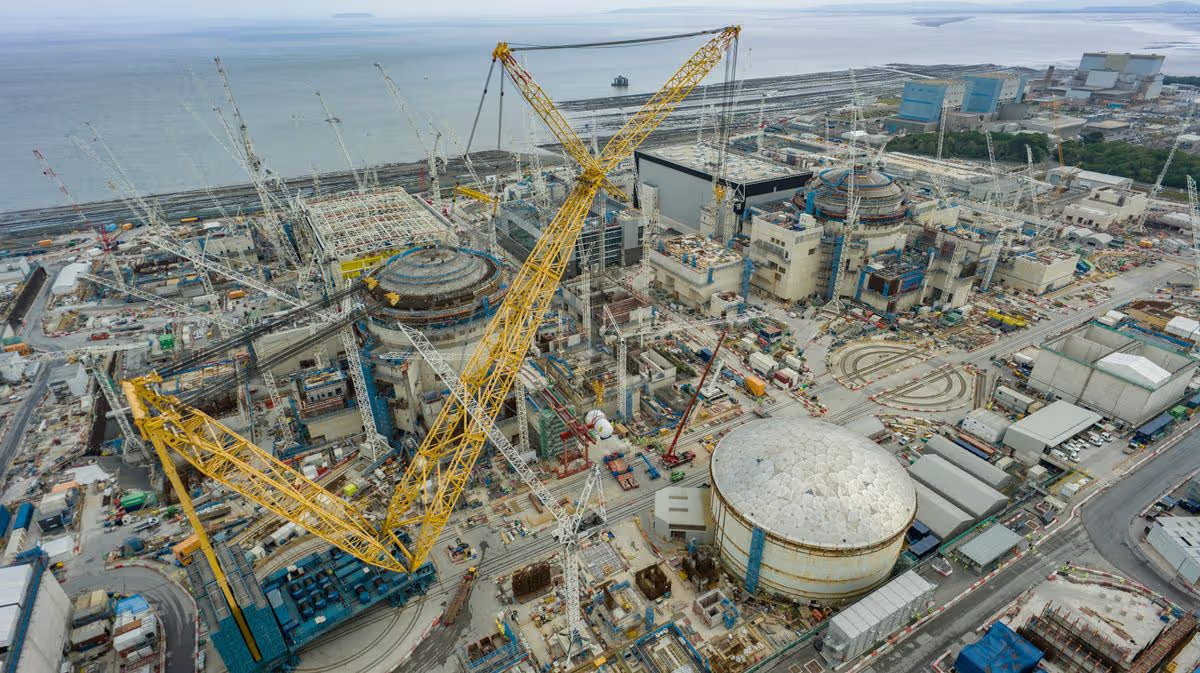
Hinkley Point C power station in Bridgwater, Somerset(Image: Hinkley Point C)
A huge crane has installed the second reactor at Hinkley Point C nuclear power station in a milestone described as “tremendous” by EDF.
The reactor was shipped from from France to Avonmouth Docks in Bristol before arriving in Somerset by barge earlier this year, with the final four miles to the Bridgwater site on a transporter.
Advertisement
Now French-owned energy giant EDF says it has used a crane – named ‘Big Carl’ – to lift the 500-tonne cylinder into place before its precision installation inside the reactor building.
Simon Parsons, Hinkley Point C’s delivery director, said: “This marks a tremendous achievement by the entire team and one that has taken months of planning and close coordination between the 10 main contractors involved.”
Once inside the reactor building, the 13-metre-long vessel was lifted and rotated into a vertical position by the large internal crane and lowered onto a support ring with just 40mm clearance on either side.
Mr Parsons said Hinkley had not used a “cut and paste” approach but had taken lessons from the first reactor’s installation in 2023 to save time, money and disruption to the site.
Advertisement
“Importantly, we are also applying those lessons to put Unit 2 well ahead of the first unit’s position at the equivalent stage, with more materials in place and more work achieved,” he said.
The Unit 2 reactor building is further ahead than at the same stage for Unit 1, EDF said, with more equipment installed, as well as more structural steel work and the outer containment layer already in place.
Big Carl lifts Hinkley Point C’s second nuclear reactor into place(Image: Hinkley Point C)
The reactor pressure vessel uses nuclear fission to make heat and steam for the world’s largest turbines, the Arabelle.
The announcement comes just months after it was revealed Britain’s first new nuclear station in a generation would face further delays at a cost of some €2.5bn to EDF, which is responsible for the project.
Advertisement
Hinkley Point C is set to provide six million UK homes with zero-carbon electricity when it is up and running but the project has been plagued by cost overruns and delays since it received government approval in 2016.
EDF said in February the first reactor at Hinkley Point C would start operating in 2030 – a year later than expected and nearly 13 years since work began on the scheme.
The delay is expected to take the cost of the project up to £35bn – far more than the original estimate of £18bn when the scheme was green lit. But, in reality, the final price tag could be far higher once inflation is considered as the French-owned energy firm has outlined its estimates in 2015 prices.
























































You must be logged in to post a comment Login