Connect with us

Business

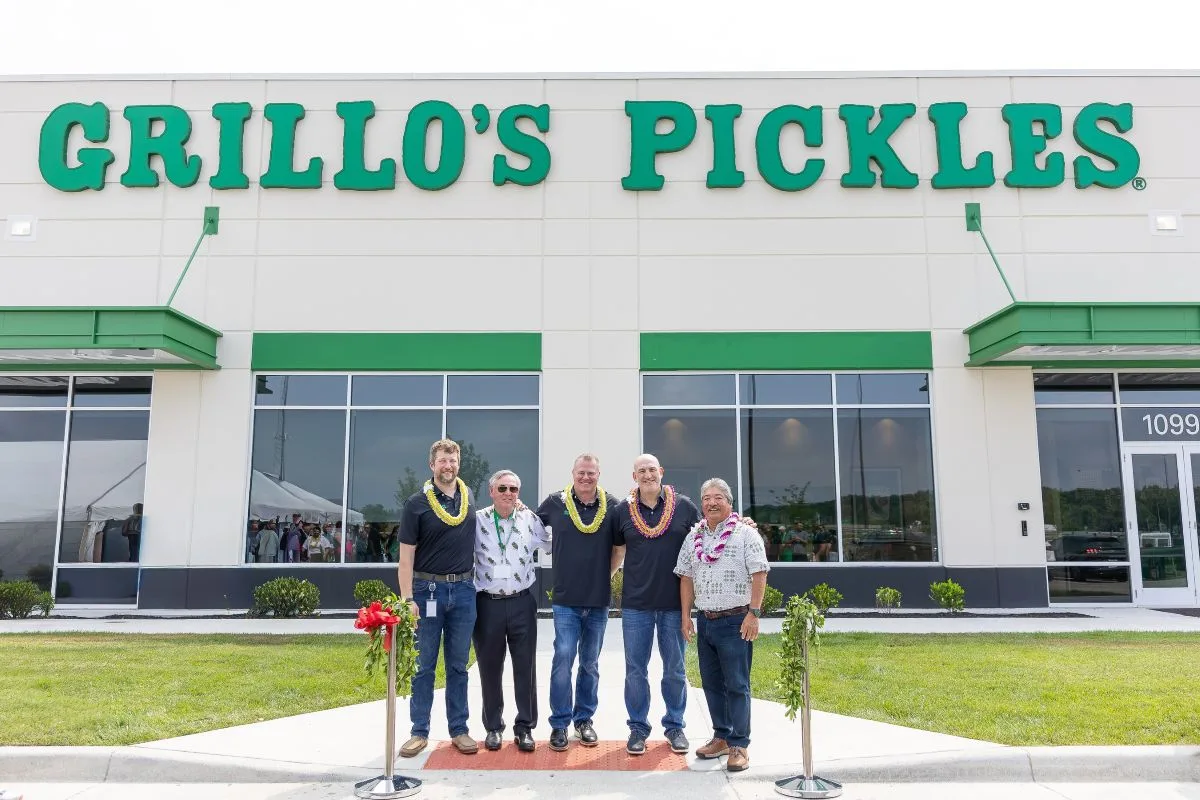
Grillo’s Pickles starts production in Indiana

Published

on

Grillo’s Pickles starts production in Indiana

Irresistible Foods Group subsidiary opens 155,000-sq-ft manufacturing facility.

Continue Reading
Click to comment

You must be logged in to post a comment Login

Leave a Reply

Business

Worst is over and bookings are improving, Amadeus CEO says about Iran war hit

Published

on


Worst is over and bookings are improving, Amadeus CEO says about Iran war hit

Continue Reading

Business

Samsung Electronics Shares Soar 27% as Record KOSPI Rally Follows Microsoft’s Blockbuster Earnings Beat

Published

on

Samsung Electronics said it expected fourth-quarter profits to be sharply down from the previous quarter

Shares of Samsung Electronics surged 26.81% on Friday, climbing 55,500 won to close at 262,500 won, effectively hitting the exchange’s daily limit for individual stock price movements as South Korea’s benchmark KOSPI index posted the largest single-day rally in its history.

The KOSPI closed up 17.91% at 6,595.45, marking a record in both point and percentage terms, according to the Korea Herald, as chip stocks across the board rebounded sharply from a punishing weeklong selloff. Rival chipmaker SK Hynix climbed 29.95% during the same session, according to TradingKey, as both of South Korea’s dominant memory chip producers effectively erased much of the ground they had lost during three brutal preceding trading sessions.

Friday’s rally traced its origins directly to a powerful overnight session on Wall Street. Microsoft’s shares soared 15.5% Thursday for the company’s best single-day performance in nearly 18 years, according to the Associated Press, after the technology giant reported that its Azure cloud computing division grew 43% during the quarter, easing broader investor concerns about the sustainability of massive capital spending on artificial intelligence infrastructure. Amazon and Meta Platforms also posted upbeat results that reinforced expectations that AI-related spending remains robust, according to CNBC, sending shockwaves of optimism through Asian technology markets overnight.

Samsung’s own earnings had already reflected the underlying strength driving the rally, even before Friday’s dramatic share price move. The company’s semiconductor division reported operating income of 89.5 trillion won, beating the 88.13 trillion won analysts had expected, with robust artificial intelligence demand continuing to drive growth across Samsung’s memory chip business. The results confirmed that DRAM and NAND flash memory sales remained at all-time highs during the quarter, providing powerful third-party validation that the artificial intelligence-driven memory supercycle remains firmly intact even amid the recent bout of extreme volatility across the sector.

Advertisement

Friday’s rebound followed a brutal stretch for Korean equities. The KOSPI had plummeted more than 17% over the three trading sessions preceding Friday, driven by investor concerns about a potential bubble in artificial intelligence valuations and intensifying competition from Chinese chipmaking rivals, according to the Associated Press. At one point during that selloff, the index had fallen roughly 40% from its June peak, wiping out nearly $2 trillion in market value, according to reporting from the Private Banker.

Foreign investors were the driving force behind Friday’s historic rebound, posting net purchases of 7.25 trillion won, or roughly $5.06 billion, on the KOSPI, according to the Korea Herald. That marked a second consecutive day of net foreign buying, following four straight sessions of net selling that had preceded Thursday. Institutional investors, who began Friday’s session as net sellers, reversed course around midday and ended the day with net purchases of 1.15 trillion won.

Additional factors beyond the Microsoft-driven rally appeared to reinforce Friday’s gains for Samsung and SK Hynix alike. SK Group Chairman Chey Tae-won disclosed personal purchases of SK Hynix shares during the recent selloff, a move that bolstered broader investor confidence in South Korea’s memory chip sector, according to CNBC. New cash-deposit requirements for investors using leveraged exchange-traded funds also took effect July 31, a regulatory change some analysts said may have contributed to a broader repositioning among traders active in that corner of the market, while short-covering and mechanical rebalancing tied to leveraged ETFs were also cited as factors amplifying the scale of Friday’s move.

Despite the historic single-day gain, market analysts urged caution about reading too much into the rebound. Speaking to CNBC, one analyst identified only as Jung said foreign investors appeared to be the primary force behind Friday’s rally, but cautioned against assuming the gains signal a durable trend reversal. “I would not expect gains of this magnitude to continue,” Jung said, adding that asset prices had become “completely disconnected” from underlying fundamentals during the recent volatility.

Advertisement

Even after Friday’s rally, the KOSPI remained well below its levels from earlier in the year. The index recorded its worst monthly performance since 1997, dropping 22.19% over the course of July, according to TradingKey, underscoring that Friday’s rebound, while historic in scale, only partially offset the scale of losses the index had absorbed over the preceding weeks.

South Korean authorities also announced new measures Friday aimed at supporting the country’s technology and artificial intelligence sector more broadly. The government said it would inject a minimum of 20 trillion won, or approximately $13.9 billion, into the Korea Investment Corporation for strategic investments in artificial intelligence, data centers and broader infrastructure, according to the Private Banker, marking the first time the sovereign wealth fund’s mandate has been expanded to include domestic assets.

With Samsung shares having now hit the exchange’s daily trading limit and the broader KOSPI having posted its largest single-day gain on record, investors are likely to watch closely in the sessions ahead for signs of whether Friday’s rebound marks a genuine stabilization in sentiment toward AI-linked technology stocks or another dramatic swing within a period of extraordinary volatility that has gripped South Korea’s chip-heavy equity market throughout the second half of July.

Advertisement
Continue Reading

Business

White House official says no weaponized drones seized during FIFA World Cup

Published

on


White House official says no weaponized drones seized during FIFA World Cup

Continue Reading

Business

Asustek Computer Shares Jump Nearly 10% as Taiwan Tech Rally Follows Microsoft’s Blowout Earnings Beat

Published

on

Samsung Unveils Three New Foldable Phones and Smart Glasses Ahead

Shares of Asustek Computer surged 9.91% on Friday, climbing 73.00 Taiwan dollars to reach 810.00 Taiwan dollars, as the personal computer and AI server maker’s stock rode a powerful rally sweeping across Taiwan’s technology sector following blockbuster earnings from Microsoft and other major U.S. technology companies.

Friday’s gains build on a stretch of strong performance for Asustek that has continued for months, driven by surging global demand for artificial intelligence infrastructure. Shares had already climbed to 757.00 Taiwan dollars on Wednesday, up 2.85% that session, before Friday’s session pushed the stock decisively higher still, with Investing.com reporting the stock trading between 722.00 and 762.00 Taiwan dollars during Friday’s session against a previous close of 609.00 Taiwan dollars.

The rally traced its roots to a powerful overnight session on Wall Street. Microsoft shares soared roughly 15.5% Thursday, the company’s best single-day performance in nearly 18 years, after reporting that its Azure cloud computing division grew 43% during the quarter, easing broader investor concerns about the sustainability of massive capital spending on artificial intelligence infrastructure. Amazon and Meta Platforms also posted results that exceeded market expectations, reinforcing confidence that demand for AI-related computing infrastructure remains robust across the technology sector.

Asustek’s stock has been underpinned by genuinely strong underlying business results throughout the year rather than sentiment alone. The company reported record first-quarter 2026 brand revenue of roughly 194.05 billion Taiwan dollars, or about $6.19 billion, marking a 44% increase year over year, driven by surging AI server demand alongside stable notebook computer shipments. That momentum has persisted despite industry-wide component shortages and rising input costs that have affected much of the broader electronics manufacturing sector this year.

Advertisement

The company’s most recent quarterly earnings report showed net profit surging 34% year over year to 4.82 billion Taiwan dollars, equivalent to roughly $160.9 million, up from 3.60 billion Taiwan dollars in the same period a year earlier, though the result still fell short of analyst expectations, which had called for net profit of 4.37 billion Taiwan dollars. Revenue for the quarter climbed 31% to 94.20 billion Taiwan dollars. Looking ahead, the company projected it would ship 4.8 million notebook PCs in the third quarter, up from 4.4 million units shipped during the second quarter.

Asustek’s ambitions in artificial intelligence have extended well beyond data center hardware and traditional personal computers. At Computex 2026, the company unveiled its latest generation of AI-enabled consumer laptops and desktop computers, including new ProArt creator laptops built around Nvidia’s RTX Spark platform and featuring AI-powered software tools designed to optimize system performance for demanding creative workflows. Company chairman Jonney Shih has described Asustek’s broader strategic ambitions as extending beyond both servers and personal computers into what he has called agentic AI, edge AI and physical AI.

Not every recent analyst assessment of the stock has been uniformly bullish. Goldman Sachs downgraded Asustek to neutral from buy earlier this year, with a price target of 672 Taiwan dollars, down from 854 Taiwan dollars, citing relatively lower earnings growth ahead for the company. Morgan Stanley separately downgraded the stock to underweight from equal weight, with a price target of 500 Taiwan dollars, down from 625 Taiwan dollars, citing concerns about growing margin risk facing hardware companies more broadly amid rising component costs.

Despite those more cautious calls, the current consensus among analysts covering the stock remains positive. According to Investing.com, five analysts recommend buying Asustek shares while one suggests selling, resulting in an overall buy rating, with an average 12-month price target of 802.00 Taiwan dollars, a high estimate of 1,200 Taiwan dollars and a low estimate of 570 Taiwan dollars, implying modest additional upside potential even after Friday’s sharp gains.

Advertisement

Asustek has continued to reward shareholders through dividend payments even amid its aggressive growth-focused expansion into AI infrastructure. The company’s most recent dividend of 42.00 Taiwan dollars per share represented a 24% increase from the prior year, with an ex-dividend date of July 1 and a payment date of July 22, translating to a dividend yield of approximately 5.3%, above the broader technology industry average of 3.0%. Analysts have noted the dividend is currently covered by earnings at a 75% payout ratio, though the company’s lack of available free cash flow at present suggests it may be drawing on cash reserves or debt to help sustain the payout.

Asustek’s stock currently trades within a 52-week range of 490.00 to 964.00 Taiwan dollars, according to Investing.com, reflecting substantial volatility over the past year even as the overall trend has remained strongly upward. The company’s next quarterly earnings report is scheduled for release on August 12, which will give investors their next detailed look at whether the strong order visibility and margin resilience management has emphasized in recent guidance continues to translate into results that justify the stock’s sharp rally, particularly within its fast-growing AI server division that has emerged as the primary driver of investor enthusiasm for the stock over the past several months.

Continue Reading

Business

Texas Stock Exchange officially goes live to rival NYSE and Nasdaq

Published

on

Texas Stock Exchange officially goes live to rival NYSE and Nasdaq

A new rival to Wall Street officially debuted on Friday as the Texas Stock Exchange went fully live for the first time with trading available for all of its listed tickers.

The Texas Stock Exchange, which is based in Dallas, is the first new major stock exchange to launch in the U.S. in decades. The TXSE, called the “Tex-ee,” is looking to compete with the New York Stock Exchange and Nasdaq Composite for listings.

Advertisement

The exchange boasts several prominent financial backers, including BlackRock, Goldman Sachs and Charles Schwab, among others.

It currently plans to begin corporate listings later this year and intends to facilitate initial public offerings (IPOs) starting in 2027. The TXSE sees the economic rise of Texas and a broader swath of the South that it’s calling the “Boom Belt” as being the “center of gravity for American capitalism” and a market it can tap into for IPOs.

CALIFORNIA LOSES FORTUNE 500 CROWN TO TEXAS AS BILLIONAIRE TAX THREAT LOOMS

Dallas Metro Skyline

The Texas Stock Exchange (TXSE) is based in Dallas and is currently operating out of a temporary headquarters. (Kirby Lee / Getty Images)

“As the only primary corporate and ETP listings venue built and headquartered in the Boom Belt, TXSE is both a product of the region’s rise and a catalyst to accelerate it,” TXSE explained.

Advertisement

The company’s website notes the region has an annualized GDP of $8.9 trillion – more than all world economies other than the U.S. and China. It adds that 40% of American exports pass through the Boom Belt, while 57% of U.S. job growth has occurred in the region in the last five years.

Currently, the exchange is operating from temporary offices in the Uptown neighborhood of Dallas, where it will hold a bell-ringing ceremony Friday afternoon to mark its official launch.

A NEW ECONOMIC IRON CURTAIN IS FALLING ACROSS AMERICA AS TRILLIONS IN WEALTH FLEE TO THE ‘BOOM BELT

Traders on floor of New York Stock Exchange

The TXSE hopes that its proximity to the “Boom Belt” will make it a better option among companies in the South that are pursuing IPOs. (Michael M. Santiago/Getty Images)

The exchange plans to move its permanent headquarters to the city’s Bank of America Tower, where it will operate the Texas Market Center.

Advertisement

The tower will be the tallest building in Uptown Dallas when it’s completed. The exchange’s Texas Market Center will include executive offices, a Texas business museum and a broadcast studio.

An announcement by designer KPF from May added that the exchange will take up multiple areas within the building, including ground-floor space and a 12th floor sky lobby.

DELL SHAREHOLDERS APPROVE LEGAL MOVE FROM DELAWARE TO TEXAS

A screen displays the Dow Jones Industrial Average

The New York Stock Exchange and Nasdaq have each opened exchanges in Texas to allow dual listings. (Reuters/Jeenah Moon)

The opening of the Texas Stock Exchange comes as the Lone Star State is working to attract businesses looking to relocate their headquarters or change their state of incorporation, touting business-friendly policies and favorable tax regimes in comparison to states like California and New York.

Advertisement

The Texas Stock Exchange’s rivals – the New York Stock Exchange and Nasdaq – have also expanded their footprint in the state of Texas and have enticed companies to dual list on the new duplicate exchanges at no cost.

GET FOX BUSINESS ON THE GO BY CLICKING HERE

Continue Reading

Business

Nearly 200 cruise passengers rescued after ship runs aground

Published

on

Nearly 200 cruise passengers rescued after ship runs aground

Police in Bulgaria evacuated nearly 200 passengers from a Viking cruise ship after the vessel ran aground due to “exceptionally low water levels” in the Danube River. 

The Bulgaria News Agency reported that the ship became stranded early Tuesday about 15 miles upstream from Vidin, where it planned to stop to take on supplies. Bulgarian border police ended up rescuing 186 passengers after another ship dispatched to the scene wasn’t able to get close enough to pick them up. 

Advertisement

“We can confirm that the Viking Ullur experienced a grounding incident on the Danube River on July 28, 2026, after coming into contact with a sandbank during a period of exceptionally low water levels,” Viking said Friday in a statement to FOX Business. 

“The safety and wellbeing of our guests and crew is always our highest priority. There were no injuries, and the vessel remained safe throughout the incident,” it added. “The ship was well-stocked with all necessary supplies, including food and water, to keep guests and crew safe and comfortable.” 

PRINCESS CRUISE SHIP WORKER DEAD AFTER GOING OVERBOARD NEAR CANCUN 

Passengers rescued from Viking Ullur ship

A Bulgarian border police boat evacuates passengers from a stranded cruise ship on the Danube River after the Swiss-flagged Viking Ullur ran aground near the northwestern city of Vidin, Bulgaria, in this handout image released on Tuesday, July 28, 20 (Reuters/Bulgarian Interior Ministry / Reuters)

“Guests were safely transferred ashore and continued their planned itinerary, including a full day in Bucharest,” Viking also said. 

Advertisement

Attempts to refloat the vessel Tuesday morning were unsuccessful, according to the Bulgaria News Agency.

All of the passengers were from European countries and there were 52 crew members onboard as well, it added. 

CARNIVAL BEGINS BUILDING RECORD-BREAKING DESTINY CRUISE SHIP THAT BOOSTS NUMBER OF OCEAN-FINDING BALCONY CABINS 

Cruise passengers walk off ship that became stuck

Passengers are seen disembarking the Viking Ullur cruise ship after it became stuck this week near Vidin, Bulgaria, which is located along the Danube River. (Reuters / Reuters)

The current status of the crew members and location of the ship wasn’t immediately clear. Viking did not immediately respond to an inquiry on the matter. 

Advertisement

Viking said on its website that the Viking Ullur, built in 2019, is 443 feet long. 

Person walks off cruise ship that became stuck in Europe

Viking told FOX Business “there were no injuries” after the Ullur ship ran aground, and that “the vessel remained safe throughout the incident.” (Reuters / Reuters)

CLICK HERE TO READ MORE ON FOX BUSINESS   

A prolonged drought in the region has been setting record low water levels on the Danube River, The Associated Press reported. 

Advertisement
Continue Reading

Business

AMD Q2 Preview: Moment Of Truth (Rating Downgrade)

Published

on

AMD: The CPU King

AMD Q2 Preview: Moment Of Truth (Rating Downgrade)

Continue Reading

Business

Historic Cornish bakery Warrens strikes deal with soft drink brand

Published

on

Business Live

The pasty maker has signed an agreement with Cornish drink producer Jolly’s

Warrens Bakery (the world’s oldest pasty maker) and Jolly’s Drinks(craft soft drinks made with local spring water) have partnered to bring a classic taste of Cornwall to Warrens’ 50 UK stores.

Warrens Bakery has struck a deal with Jolly’s Drinks(Image: PR handout)

Historic Cornish pasty maker Warrens has agreed a partnership deal with local soft drink producer Jolly’s. Under the terms of the agreement, the bakery will stock Cornish-made Jolly’s Drinks in its 50 UK stores.

Jolly’s was founded in 1986 by John Jolly in the Cornish village of Carharrack and its range of drinks are made from local spring water. The business now has a large factory in Saltash and is still family run.

Cheryl Ingram, managing director of Jolly’s Drinks, said “We’re delighted to see Jolly’s Drinks available in Warrens Bakery. As two proud Cornish brands with long-standing heritage, it’s a natural partnership that brings together the great Cornish pasty and refreshing original Cornish soft drinks.

“Both businesses share a passion for quality, tradition, and championing Cornwall, so we’re excited that customers can now enjoy a Jolly’s drink alongside a famous Warren’s pasty or bakery treat. We look forward to working together and introducing even more people to the taste of Cornwall.”

Advertisement

Warrens Bakery was established on the cobbled streets of St Just in Cornwall when two Cornish families – the Warrens and the Harveys – were united in marriage in 1860.

The Helston-headquartered chain now has 50 bakery stores in high streets, railway stations and roadside locations across the UK.

Craig Wood, assistant retail director at Warrens Bakery said: “We’re thrilled to be partnering with Jolly’s to give people a delicious taste of two of Cornwall’s leading food and drink producers. It’s a perfect pairing.”

Earlier in July, Warrens opened its 50th store in Malmesbury in Wiltshire.

Advertisement

The new site at the Texaco garage on Crudwell Road is the seventh petrol station concession in the Warrens Bakery and SGN Retail partnership, and follows the success of its six other petrol forecourt sites in Calcot, Didcot, Lechlade, Ludlow, Lydney and Frenchay, the company said.

Warren Bakery’s chief executive Mark Sullivan said at the time: “Our expansion into forecourts reflects how consumer habits are evolving, with people wanting speed and convenience but also quality, provenance and a better food-to-go experience. All this is now on offer at our new Malmesbury site”.

Continue Reading

Business

The threat to summer holidays looming with jet fuel shortages

Published

on

BBC InDepth

Addressing the structural reasons why the UK is so dependent on imports, meanwhile, is likely to be trickier. Back in the 1970s, the country had 18 refineries – but that’s now down to four.

“I think there is probably a point in saying, actually, do we need more resilience from a homegrown perspective in terms of our capacity in the UK to be able to refine a higher proportion of our fuel?” says Skybus’ CEO Jonathan Hinkles.

The question is how that could be done. The remaining refineries have already been asked to prioritise jet fuel production. But according to Amaar Khan, “this doesn’t happen overnight, and doesn’t result in a significant increase in jet fuel output”.

One option could be to boost local production of Sustainable Aviation Fuel (SAF). A synthetic fuel, it can be derived from wastes, such as old cooking oil and agricultural residues; from dedicated energy crops; or from using renewable energy to convert water and carbon dioxide into liquid hydrocarbons known as e-fuels.

Advertisement

So far SAF, as the name suggests, has been promoted mainly for its environmental credentials. These can vary widely depending on the method used to make it, but in general burning SAF adds less carbon to the atmosphere than burning fossil fuels. Both the UK and the EU have mandates to significantly increase the amount of SAF used over the next 25 years.

However, the industry is in its infancy. There is relatively little SAF available at the moment, a large chunk of what we use comes from East Asia, and it is very expensive – typically trading at more than $1000 per tonne more than conventional fuel. Nevertheless, Hinkles believes if these problems can be overcome, SAF can help reduce our reliance on foreign imports.

“It really becomes a question of; can you actually get SAF? Can we scale up production of SAF at a meaningful rate in the UK or Europe to take over an increasing proportion of jet fuel supply?”, he says.

Green campaigners agree. “Increasing SAF production won’t eliminate jet fuel imports overnight,” says Tom Taylor, UK policy manager for lobby group Transport and Environment.

Advertisement

“But by scaling it up, we can shift the source of aviation fuel from geopolitically sensitive fossil fuels to locally managed renewable grids and waste streams.”

That would require investment on a large scale, however, and clearly remains a long way off.

In the short term, meanwhile, dark clouds are hanging over the industry. There seems little prospect of jet fuel prices coming down quickly, and if fears of a shortage prove justified, then the aviation industry and the travellers that rely on it are heading for a turbulent summer.

Advertisement
Continue Reading

Business

Nobody Approved Power BI. It’s Now Running Your Business.

Published

on

Poorly designed and inadequately maintained workplaces are draining the UK economy of more than £71 billion a year, according to new research from facilities and security services company Mitie.

In most small and mid-sized businesses, Power BI does not arrive as a project. There is no rollout plan, no steering group, no launch. Someone in finance discovers it, finds it instantly familiar, and builds a report.

The report is good. Other people want one. Eighteen months later there are reports everywhere, half the business relies on them, and nobody is in charge of any of it.

I have trained hundreds of new Power BI users over the years, and I see the same light-bulb moment every time. “Oh, this feels like Excel and PowerPoint!” That familiarity is exactly why the tool spreads so quickly, people are not being pushed onto it, they are pulling it into the business themselves. As adoption stories go, that is the good kind. The enthusiasm is real and it is priceless.

But here’s the thing… the same freedom that makes a tool spread is the freedom that creates the mess. Because it grew without guardrails, everyone built things their own way. And a growing business eventually meets the consequences, usually in a meeting.

The day the numbers disagree

The moment this stops being invisible is nearly always the same one. Two people bring two versions of the same figure into the same room. Sales says one number, finance says another, and the conversation that was supposed to be about the business becomes a debate about whose report is right.

Advertisement

It gets called a data problem. It usually is not. Both reports are doing exactly what they were built to do, they were just built by different people, at different times, on different assumptions. One counts orders, the other counts invoices. One strips out cancellations, the other never did. Nobody decided this. It accumulated, one reasonable report at a time.

And underneath it sit the questions that quietly matter more. Who owns these reports? Who fixes the refresh that failed on Monday? Who checked what the new starter can see, and whether the margin data in that shared workspace was ever meant to be visible to everyone with the link? In an unmanaged estate, the honest answer to all of these is usually nobody.

The cost is time, trust and eventually money

None of this shows up as a line on the P&L, which is why it runs for so long. But the costs are real.

Staff time goes first. People rebuild reports that already exist because they cannot find or do not trust the originals. Someone senior spends hours reconciling two dashboards before every board meeting. Then trust goes, and this one is expensive, because once people stop believing the numbers, they stop using the reports and retreat to their own private spreadsheets, and the business is now paying for a reporting tool and running on Excel exports anyway.

Advertisement

And occasionally the cost is sharper than that. A figure nobody can stand behind lands in front of the bank, an investor or an auditor, and the awkward question is not about the number. It is about whether the business is in control of its own information.

The fix is lighter than most owners fear

At this point some owners reach for the opposite extreme, lock it all down, route everything through one person, approve every report. I would gently push back on that too. I have seen over-control fail as often as chaos. Clamp down too hard and people do not stop building reports, they just stop telling you, and the mess moves somewhere you can no longer see it.

For a growing firm, the structure that works is lighter than most people fear. It looks something like this. Every report that matters has a named owner, one person who answers for the figures and one route for fixing it when it breaks. The handful of numbers the business runs on, revenue, margin, active customers, get defined once, in one agreed place that every report draws from, so the same word means the same thing everywhere. Access follows job roles rather than one-off requests and forwarded links. And somewhere, there is a simple, written answer to “how do we do reporting here”, short enough that people actually read it.

That is it. Not a committee, not a six-month programme. Microsoft’s own adoption roadmap covers this ground thoroughly and is genuinely worth a read, I have gone back to it time and time again over the years. But for a small business the heart of it fits on a page. Owners, shared definitions, sensible access, and a bit of support for the people doing the building, because the analyst who taught themselves Power BI is an asset worth investing in, not a risk to be managed.

Advertisement

The stakes are about to get higher

There is one more reason to sort this now rather than later. Power BI is no longer a standalone tool. It now sits inside Microsoft Fabric, Microsoft’s wider data platform, which means the thing your business adopted for reports is increasingly connected to where data is stored, moved and prepared across the company. More capability, and more ways for an unmanaged setup to grow expensive.

This is often the point where firms bring in outside help, and having done a lot of this work, I will tell you what it should look like. When businesses explore Microsoft Fabric consulting in the UK, the first job is usually not the platform at all. It is mapping what already exists, which reports are trusted, which models are duplicated, who owns what, where the access risks sit. Moving a messy estate onto a bigger platform does not clean it up. It gives the mess a bigger stage. Diagnosis first, then the technology.

Boring is the goal

Good reporting in a growing business should be slightly boring. The figures refresh, the definitions hold, people know where to look and stop arguing about whose number is right. The meetings get shorter and go back to being about the business.

The tool that spread through your company without permission got there because it is genuinely useful. That part is a win, and the enthusiasm behind it is worth protecting. It just needs what every useful thing eventually needs, an owner, a shared set of definitions and someone paying attention. The best time to give it those was before it mattered. The second best time is before the platform underneath it gets any bigger.

Advertisement

Continue Reading

Trending

Copyright © 2025