Connect with us
DAPA Banner
DAPA Coin
DAPA
COIN PAYMENT ASSET
PRIVACY · BLOCKDAG · HOMOMORPHIC ENCRYPTION · RUST
ElGamal Encrypted MINE DAPA
🚫 GENESIS SOLD OUT
DAPAPAY COMING

Business

Here’s why the housing market is hurting so much this summer

Published

on

Here's why the housing market is hurting so much this summer
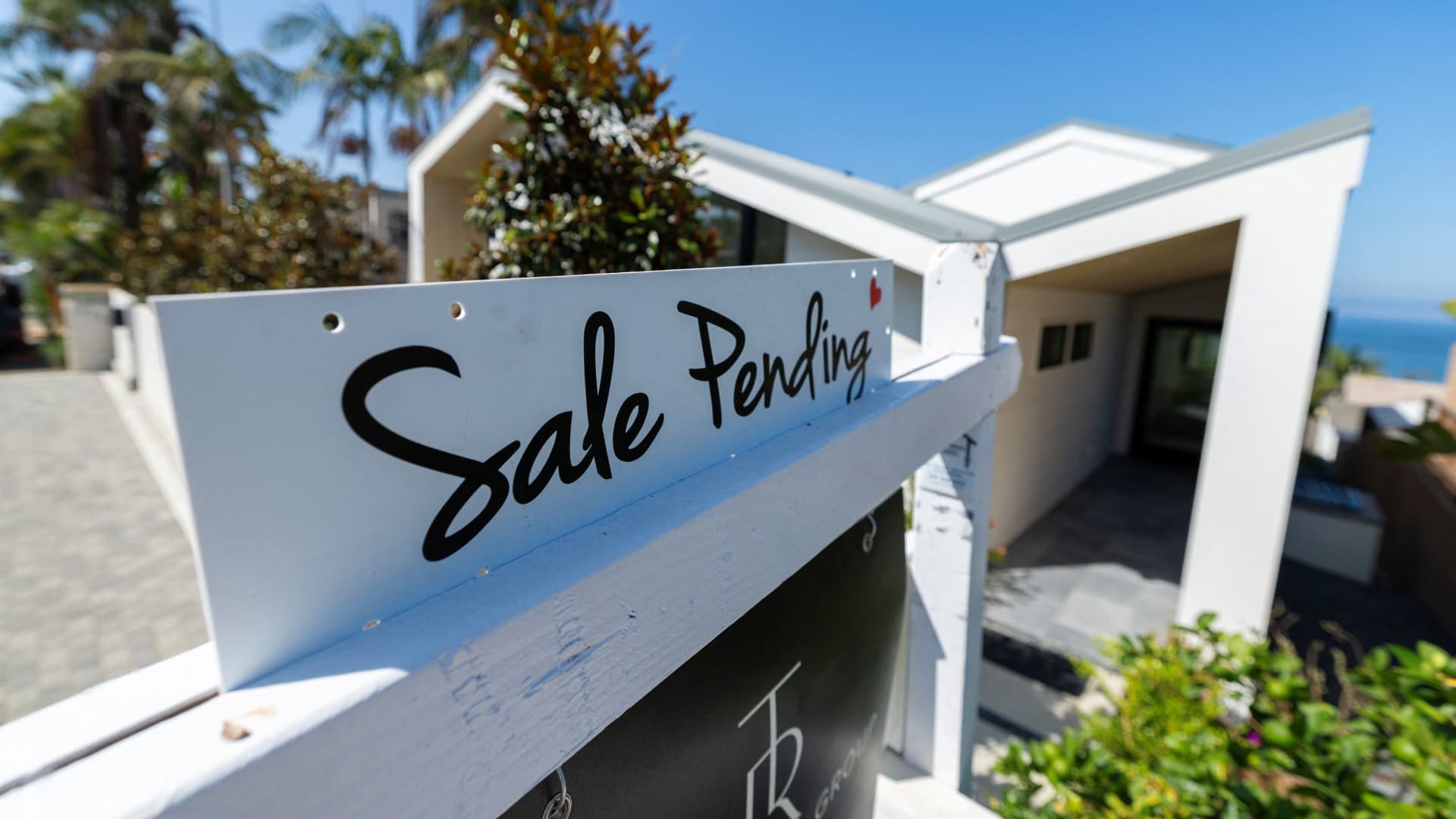
Pending home sales plunge in June

Two different reads on the housing market released Thursday point to the same problem, one that appears to be getting worse. Housing is just too expensive — to own and to build.

Pending home sales in June, a measure of signed contracts on existing homes, fell 5.4% from May, according to the National Association of Realtors. Sales were down 0.3% from June 2025 and were well below analysts’ expectations.

This read is based on people out shopping for homes in June and making the decision to sign a deal, so it is the most timely measure on the state of the market.

“The highest mortgage rates in nearly a year and the record-high national median home price together are contributing to a tepid housing market that is especially difficult for first-time homebuyers,” NAR Chief Economist Lawrence Yun said in a release.

Advertisement

Mortgage rates in June bounced around a narrow but higher range, with the average rate on the popular 30-year fixed mortgage starting the month at 6.6% and ending at the exact same rate, according to Mortgage News Daily. It had been as low as 5.99% at the end of February, the day before the Iran war started.

Mortgage demand from homebuyers has been weakening in the past month. Last week, applications for a mortgage to buy a home were 2% lower than they were the same week the year before, even though mortgage rates were slightly higher last year.

Meanwhile, sentiment among the nation’s single-family builders fell in July, according to another report released Thursday from the National Association of Home Builders. It dropped to 34, down from an upwardly revised reading of 36 in June. Sentiment has stayed below 40 for 15 consecutive months, the longest such stretch since 2012. Anything below 50 is considered negative sentiment.

“Affordability remains the home building industry’s primary challenge, as elevated mortgage rates, costly land, rising material prices, and persistent skilled labor shortages continue to affect the market,” Robert Dietz, NAHB’s chief economist, said in a release.

Advertisement

Get Property Play directly to your inbox

CNBC’s Property Play with Diana Olick covers new and evolving opportunities for the real estate investor, delivered weekly to your inbox.

Subscribe here to get access today.

A rising share of builders, 37%, cut prices in July, up from 35% in June and 32% in May. The use of sales incentives was 63% in July, up slightly from 62% in June and marking the 16th consecutive month that share has reached 60% or higher, according to the NAHB.

Dietz said the newly enacted housing legislation from Congress, which attempts to cut red tape and help localities speed up permitting for housing, “is a positive step that will help expand housing supply and lower overall housing costs, although more policy change is needed at the state and local level.”

Advertisement

Prices for existing homes continue to rise, with the median hitting a new record in June, according to the NAR. While there are local pockets of weakness, low supply of housing in general is keeping upward pressure on prices.

“Bottom line, housing remains the downer in the US economy and according to the NAHB makes up about 15-18% of the US economy all in,” wrote Peter Boockvar, chief investment officer of OnePoint BFG Wealth.

Choose CNBC as your preferred source on Google and never miss a moment from the most trusted name in business news.
Continue Reading
Click to comment

You must be logged in to post a comment Login

Leave a Reply

Business

The financial winners and losers from the World Cup

Published

on

The 16 host cities across the US, Canada and Mexico have been welcoming an influx of fans and tourists boosting hospitality, hotels and local businesses.

But while the Scots drank Boston dry and have won the heart of the city and its people, experts say the long-term economic benefits are minimal.

Fifa estimated some $41bn would be added to the global economy, of which $17bn would boost the US economy alone, with 185,000 jobs created, mostly in hospitality and accommodation.

But Alexander Budzier, a fellow in management practice at Oxford University and chief executive of project management company Oxford Global Projects, says the long-term economic benefits of hosting such a big sporting event just do not materialise.

Advertisement

Host cities actually typically see a big drop in visitors, he says, as many seek to avoid the tournament chaos.

And while there may be a spike in hiring, he argues it is typically only for lower-paid jobs in hospitality. “It creates jobs, but it does not create wealth,” he says.

Official figures show that hiring in US pubs, bars and restaurants ramped up ahead of the tournament in May, but the boom was short-lived.

The only “worthwhile” economic benefit, Budzier argues, is the regeneration projects that can be done, such as the redevelopment and housing built in Stratford in London following the 2012 Olympic Games.

Advertisement

But due to much of this World Cup using existing stadia, hotels, training complexes and travel infrastructure, “there won’t be any economic benefits from development”.

Continue Reading

Business

Diploma PLC (DPMAY) Q3 2026 Sales/Trading Call Transcript

Published

on

OneWater Marine Inc. (ONEW) Q1 2026 Earnings Call Transcript

Jonathan Thomson
CEO & Director

Good morning, everyone. Thanks for joining us. I’m here, as usual, with our CFO, Wilson Ng. I’ll say a few words on quarter 3, and then we’ll move as usual to Q&A. It’s been another great quarter for us, 15% organic growth, continuing the momentum from the first half of the year. The sector trends are broadly the same as they were in the first half. Controls, very strong broad-based growth, IS Group, Clarendon, Peerless, Windy still growing double digits, taking good market share in fast-growing end markets. Life Sciences, conversely, markets are tougher. We’re going through a little bit of product cycle — product life cycle refresh. I’m really, really pleased with what we’re doing in Life Sciences, what the team are doing, but we will expect low single-digit growth for the year.

Seals, we’ve seen some acceleration in quarter 3, and we’re expecting a good quarter 4, too, not celebrating. International is a bit better, but patchy and North American Seals is still doing very well. So look, overall, we’re really happy with the quality, with the performance of the portfolio. Peerless continues to perform fantastically, taking share in really good market conditions. Growth is moderating in the second half as we expected against very big comps. And that will continue to moderate into next year until we return to the track record of high

Advertisement
Continue Reading

Business

Dow Jones Rises to 52,747 as Investors Rotate Into Blue-Chip Stocks While Tech and Chip Shares Slide

Published

on

FTSE 100 Surges 0.8% Today as Oil Eases and Markets

The Dow Jones Industrial Average edged higher Thursday, climbing 88.62 points, or 0.17%, to 52,747.26, as investors continued rotating into industrial and blue-chip names even as technology and semiconductor stocks struggled to build on recent momentum.

The modest gain extended a two-day winning streak for the 30-stock index, which closed Wednesday up 150.37 points, or 0.29%, at 52,658.64. That session saw the S&P 500 and Nasdaq Composite both post stronger gains, rising 0.38% and 0.62%, respectively, as investors digested a softer-than-expected wholesale inflation reading and a bullish outlook from Dutch chip equipment maker ASML.

Thursday’s session unfolded with more caution across broader markets, even as the Dow pushed modestly higher. S&P 500 futures slipped 0.2% and Nasdaq 100 contracts dropped 0.8% ahead of the opening bell, as traders weighed whether recent earnings results justified further gains in artificial intelligence-related stocks. A strong earnings beat and raised sales outlook from Taiwan Semiconductor Manufacturing failed to translate into fresh gains for the broader chip sector, a dynamic that has fueled much of this year’s stock market advance. Europe’s Stoxx 600 index was down 0.6% in early trading, while Asia’s technology-heavy indexes had another volatile overnight session.

The divergence between the Dow’s modest advance and weakness in more tech-heavy benchmarks reflects a broader rotation that has played out across markets in recent sessions, with investors shifting money away from semiconductor stocks that have led this year’s rally and into other sectors, including industrials and select technology names less exposed to chip supply chains.

Advertisement

Corporate earnings have played a significant role in shaping sentiment this week. IBM shares tumbled more than 22% Tuesday after the company said it expected second-quarter earnings per share of $2.93 on revenue of $17.2 billion, both below Wall Street’s consensus estimates. The company attributed the shortfall to weaker-than-expected growth in its software and infrastructure businesses, saying customers had shifted spending toward memory chips instead. IBM’s stumble weighed on the Dow and rippled into the broader software sector, with Workday, Salesforce and Adobe shares falling 9%, 6% and 5%, respectively, as investors grew concerned about softening demand across enterprise software.

Chip stocks, meanwhile, showed signs of stabilizing after a rough stretch earlier in the week. South Korean memory chip maker SK Hynix rose nearly 7% ahead of Tuesday’s opening bell, reversing part of a double-digit decline from the prior session, as investors returned to some of the sector’s most beaten-down names.

Inflation data released this week offered some reassurance to markets. June’s Consumer Price Index came in better than expected, falling 0.4% on a monthly basis, while core CPI, which excludes food and energy, was flat. Major indexes climbed on the data initially, though the reading came with a caveat: the decline reflected falling oil prices from earlier in the year that have since risen sharply again. Crude oil topped $80 a barrel this week after Iran and the United States traded attacks and the Trump administration reinstated a blockade on Iranian shipping through the Strait of Hormuz, a move President Trump described in a social media post as intended to secure the strait while allowing the U.S. to collect a 20% fee on cargo shipped through the region. Crude prices have risen 16% from a recent low, a shift that could eventually pressure consumer and transportation-related stocks if sustained.

Federal Reserve Chairman Kevin Warsh’s remarks to Congress this week have also factored into market sentiment, with investors watching closely for any signals about the central bank’s next moves on interest rates amid the mixed inflation and growth data.

Advertisement

Thursday’s trading session carried a heavy earnings and economic data calendar. Wall Street was watching for results from Taiwan Semiconductor Manufacturing, GE Aerospace, UnitedHealth Group, Abbott Laboratories, US Bancorp, Netflix and Intuitive Surgical, alongside June retail sales figures and the weekly initial jobless claims report, both of which were expected to offer fresh insight into the health of the U.S. consumer and labor market.

Big Tech names that led Wednesday’s rally showed a mixed picture heading into Thursday. Apple shares closed at a record high Wednesday after a report indicated the company had received approval to launch its generative artificial intelligence features in China, sending the stock up more than 4%. Alphabet shares rose nearly 3% the same session, while Amazon and Microsoft each gained close to 3%. Whether those gains would hold on Thursday remained uncertain given the more cautious tone in premarket trading, with technology shares broadly turning negative even as the Dow’s more industrial and financial-heavy composition helped it post a modest gain.

Financial sector earnings have generally come in strong this reporting season. BlackRock shares jumped more than 5% earlier this week after the asset management giant posted second-quarter results that beat expectations, with the company reporting earnings of $13.91 per share on revenue of $7.08 billion. Morgan Stanley shares rose more than 1% in premarket trading after the bank reported record quarterly revenue and profit, posting $3.46 in earnings per share on revenue of $21.35 billion.

Market strategists have cautioned that expectations for this earnings season remain elevated. According to CFRA Research chief investment strategist Sam Stovall, second-quarter earnings per share for S&P 500 companies are projected to rise 20.9% year-over-year, well above the average quarterly increase of 11.6% seen since 2009. Full-year S&P 500 earnings are projected to climb 22.9% in 2026 and 18.2% in 2027, according to Stovall, even as the index’s forward price-to-earnings ratio sits at a premium to its 10-year average, raising the bar for companies to justify current valuations with their results.

Advertisement

Billionaire investor Warren Buffett offered a note of caution on the broader market environment this week, telling CNBC’s Becky Quick that today’s market has become increasingly shaped by speculative trading rather than long-term investing, a dynamic he said has made it harder to find good value.

With crude oil prices elevated on Middle East tensions, corporate earnings delivering a mixed bag of results, and investors continuing to reassess the AI trade that has powered much of this year’s rally, Thursday’s modest gain for the Dow reflected a market still searching for consistent direction as the second-quarter earnings season moves into full swing.

Continue Reading

Business

Wise Group plc (WSE) Q1 2027 Sales/Trading Call Transcript

Published

on

OneWater Marine Inc. (ONEW) Q1 2026 Earnings Call Transcript