
Business
How 90% IPOs in August beat volatile India market to return up to 72% after listing


Out of 17 IPOs that listed in August, 15 gave positive listing-day returns, translating into a hit rate of about 88%. The same number of issues are also trading above their issue price as of the latest available data, which means nearly 90% of August IPOs are still in the green.
The performance shows that the primary market remained strong even as the broader secondary market stayed selective. Investor appetite was healthy across sectors such as healthcare, logistics, engineering, dairy, energy, jewellery, industrials and consumer-facing businesses.
Tempsens leads gains
Tempsens Instruments was the standout listing of the month. The company doubled investor money on debut, making it the biggest winner among August IPOs. Among others, Dhoot Transmission delivered the strongest current return. The stock was issued at Rs 871 and is now trading at Rs 1,499, giving investors a gain of 72%. It had already listed strongly at Rs 1,187, a listing-day gain of 36%.
Technocraft Ventures was another big winner. The stock listed at around Rs 311 against an issue price of Rs 212, giving a listing gain of 47%. It is now at Rs 358, up 69% from the issue price. Behari Lal Engineering also rewarded investors sharply. The stock listed at Rs 502 against an issue price of Rs 285, a gain of 76% on listing day. It is currently at Rs 469, still up 64% from the IPO price.

Also Read: Reliance Jio IPO: 7 risk factors investors should know as firm gets Sebi nod for Rs 37,000-crore issue
Milky Mist Dairy Food gave investors both listing gains and follow-up gains. The stock listed at Rs 181 against an issue price of Rs 140, a gain of around 30%. It has since moved to Rs 217.31, taking total gains to 56%.MV Electrosystems was another strong performer. It listed at Rs 624 against an issue price of Rs 425, a gain of 47%, and is currently at Rs 646.8, up 52%.
Most IPOs hold gains
Several IPOs that listed with decent gains continued to trade above issue price. Molbio Diagnostics is currently trading nearly 42% higher over the issue price, while Shiprocket is still up 37%. Manipal Health Enterprises also held firm after listing. The stock was issued at Rs 590, listed at Rs 667 and is now at Rs 798, giving investors a gain of 35%.
Only two IPOs turn negative
Only two August IPOs are currently below their issue prices. Shankesh Jewellers listed with a small gain of 2%, but has slipped below issue price and is trading about 4% lower. Horizon Industrial Parks had a weak debut, listing 3% below issue price, and is currently down 5%.
September pipeline remains strong
The strong August report card comes just as the IPO pipeline is set to get heavier in September. Investment banking sources expect more than 20 companies to tap the market during the month, with the total fundraising pipeline potentially going up to Rs 70,000 crore if one of the two mega issues, Jio Platforms or NSE, is launched.
Jio Platforms has already received Sebi approval for its much-awaited IPO. The Reliance Industries-backed digital services company is expected to raise around Rs 37,700 crore, which could make it one of India’s largest-ever public issues. NSE is also likely to receive Sebi approval soon and may launch its IPO as early as September, according to people aware of the matter. The exchange’s tentative issue size is pegged at around Rs 30,000 crore.
The pick-up follows a busy July and August for the primary market. Companies raised about Rs 28,000 crore in July and more than Rs 23,000 crore in August, showing that issuers have returned after holding back during the volatile first half of the year.
(Disclaimer: Recommendations, suggestions, views and opinions given by the experts are their own. These do not represent the views of Economic Times)


Check out what’s clicking on FoxBusiness.com.
Northwest Naturals is recalling nearly 2,000 pounds of raw cat and dog food after federal testing found salmonella and Listeria monocytogenes contamination in two chicken products distributed nationwide.
The Portland, Oregon-based company is voluntarily recalling 53 cases, or 1,272 pounds, of Northwest Naturals Frozen Chicken Recipe and 19 cases, or 684 pounds, of Northwest Naturals Frozen Raw Diet for Dogs Chicken Recipe, according to a company announcement posted Friday by the Food and Drug Administration.
The recall covers a total of 1,956 pounds of product.
The 2-pound Frozen Chicken Recipe, which is marketed as cat food and a protein topper for dogs, tested positive for salmonella. The 6-pound Frozen Raw Diet for Dogs Chicken Recipe tested positive for both salmonella and Listeria monocytogenes, according to the announcement.
NEARLY 25K POUNDS OF FROZEN BUFFALO CHICKEN RECALLED OVER INSPECTION LAPSE

The recall covers a total of 1,956 pounds of product. (Getty Images)
The contamination was identified after product samples were collected and tested by the FDA. No illnesses had been reported in connection with the recall as of Aug. 28, the company said.
The affected 2-pound Frozen Chicken Recipe bears lot number B-5, a best-by date of Jan. 26, 2028, and UPC 087316384956. The affected 6-pound Frozen Raw Diet for Dogs Chicken Recipe bears lot number B-19, a best-by date of Jan. 25, 2028, and UPC 087316380392. The recalled products were distributed to retail stores nationwide.
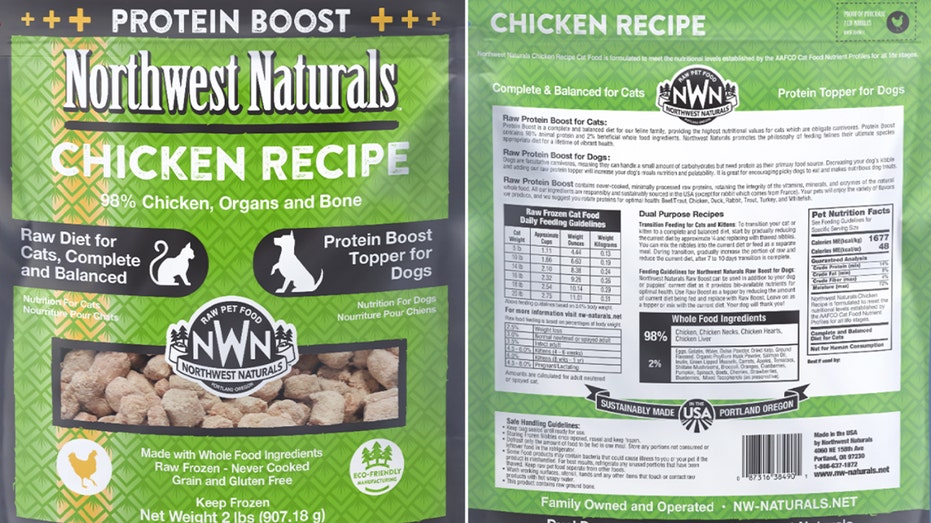
Northwest Naturals Chicken Recipe raw frozen pet food is among the products recalled over possible salmonella contamination. (Northwest Naturals / FDA)
Salmonella and Listeria monocytogenes can sicken animals that eat contaminated products and can also pose a risk to people who handle the food or come into contact with contaminated surfaces, according to the recall notice.
Pets infected with either bacteria may experience lethargy, diarrhea or bloody diarrhea, fever, vomiting, decreased appetite, and abdominal pain. Infected animals can also carry the bacteria and potentially spread them to people or other animals.
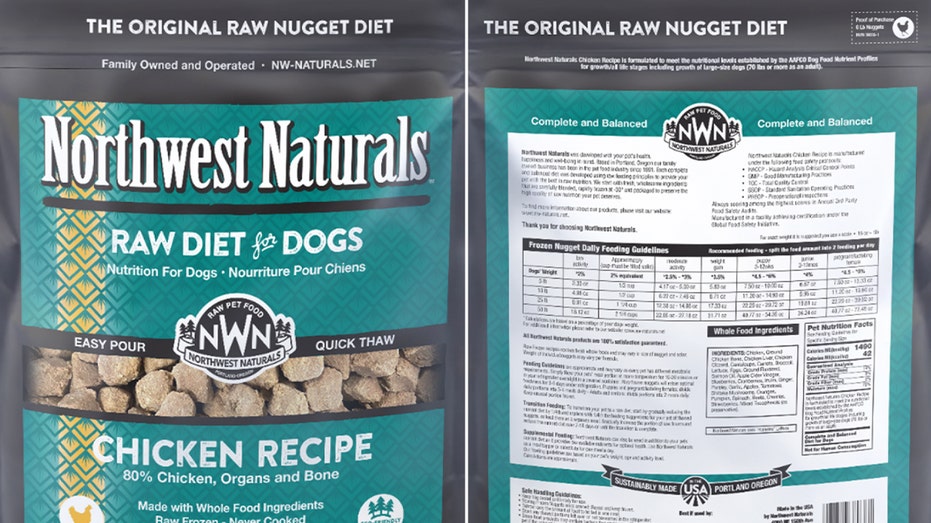
Northwest Naturals Raw Diet for Dogs Chicken Recipe is being recalled after testing found salmonella and Listeria monocytogenes. (Northwest Naturals/FDA)
Consumers who purchased the affected products are being advised to stop feeding them to their pets and return the unused portion to the place of purchase for a full refund.
CLICK HERE TO GET FOX BUSINESS ON THE GO
Northwest Naturals also advised consumers handling raw pet food to wash their hands thoroughly and clean and sanitize bowls, utensils, surfaces and storage areas that come into contact with the products.
FOX Business reached out to Northwest Naturals for additional comment.
Following a beat-and-raise earnings report for its fiscal second quarter last week, artificial intelligence behemoth Nvidia (NVDA) continues to tease a fresh breakout. And as it holds support above its 10-week moving average, Nvidia stock has also secured a spot on the Investor’s Business Daily Leaderboard and the Stock Spotlight screen. More than a dozen Wall Street analysts raised their…
Copyright ©2026 Investor’s Business Daily, LLC. All rights reserved. 87990cbe856818d5eddac44c7b1cdeb8

FDIC defeats $1.71 billion claim over Silicon Valley Bank collapse, US judge rules
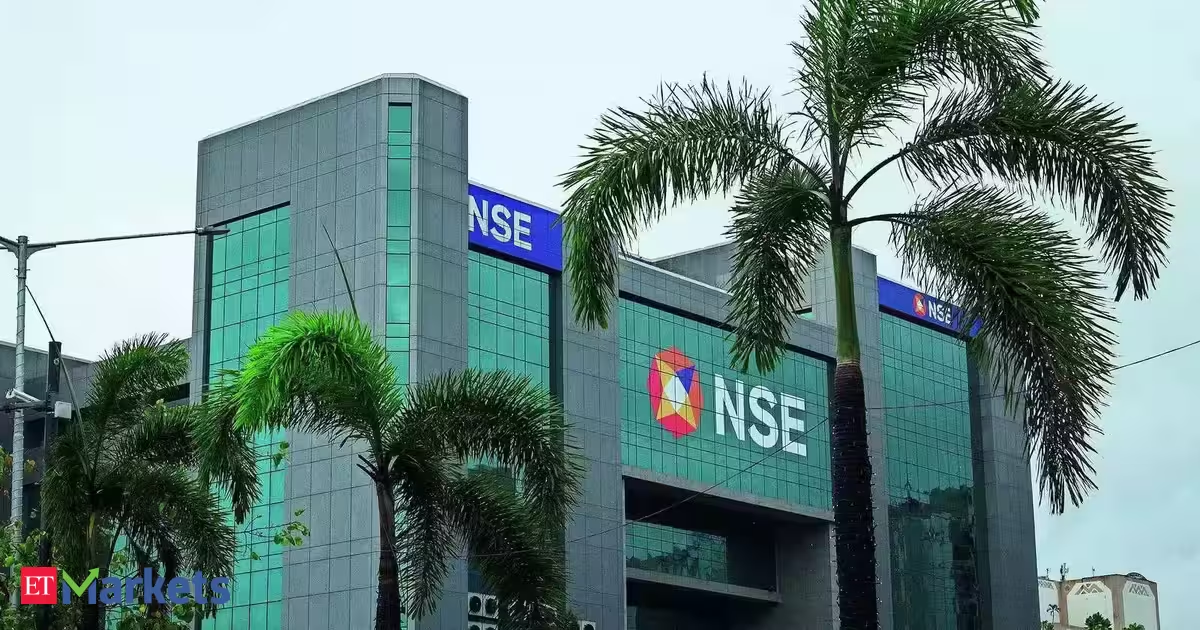
Securities and Exchange Board of India (SEBI) chairman Tuhin Kanta Pandey on August 27 said the market regulator was close to clearing the draft red herring prospectus (DRHP) filed by NSE, the world’s largest derivatives exchange by trading volume.
NSE filed its draft prospectus in June for an IPO that will comprise entirely of an offer for sale (OFS), allowing existing shareholders to pare their stakes. The exchange had initially expected SEBI clearance for its DRHP by early August. The timeline was subsequently pushed back by around three weeks following changes to the roster of selling shareholders, with SBI Capital Markets being added.
At the top end of the marketed valuation of Rs 5.26 lakh crore ($55 billion), NSE would rank sixth among global exchange operators by market capitalisation, narrowly behind London Stock Exchange Group Plc and ahead of Nasdaq Inc, according to Bloomberg.
NSE unlisted share price
NSE’s unlisted shares are currently changing hands at around Rs 1,970, according to data from Unlisted Arena. The shares were quoted at around Rs 2,010 when NSE filed its DRHP.
Over the past year, the unlisted stock has traded in a range of around Rs 1,800-2,150, well below its June 2025 peak of Rs 2,590.The shares had slipped to around Rs 1,950 on July 28-29 before recovering to current levels.
ALSO READ: NSE IPO coming soon: Should investors buy unlisted shares now or wait for the mega issue?
With NSE’s IPO expected in the second half of September, investors are now assessing whether to enter the stock through the unlisted market or wait for the public offering and its eventual listing.
How to buy NSE unlisted shares
NSE shares currently trade in the unlisted, over-the-counter market, where investors can acquire equity in companies ahead of their listing on recognised stock exchanges.
Unlike a listed stock, NSE’s unlisted shares do not have a continuous exchange-based price discovery mechanism or a live market price. Trades are negotiated privately between buyers and sellers, with the final transaction price depending on the prevailing quote and available liquidity.
Investors looking to acquire NSE shares can approach SEBI-registered investment banks, brokers or specialised unlisted-share dealers. These intermediaries facilitate transactions by matching investors seeking to buy pre-IPO shares with existing shareholders looking to sell.
Investors can also purchase shares directly from existing shareholders, including promoters, founders, angel investors and employees holding vested ESOPs. Such transactions are generally negotiated over the counter and may involve sizeable minimum ticket sizes.
Pre-IPO platforms also aggregate such opportunities and facilitate the KYC, price discovery and share-transfer process.
Step-by-step process to buy NSE unlisted shares
Choose an intermediary or platform: Register with a specialised unlisted-share platform or dealer offering NSE shares.
Complete KYC: Submit documents including PAN, Aadhaar, bank account details and the Client Master Report (CMR/CML) issued by your depository participant. The CMR contains details such as your demat account, DP ID, Client ID and linked bank account.
Check the quote and lot size: Unlike an exchange-traded stock, there is no central order book or exchange-determined price for NSE’s unlisted shares. Buyers and sellers negotiate the transaction price and quantity, with intermediaries facilitating the trade.
Place the order and make payment: Once the price and quantity are agreed upon, the buyer transfers funds through the payment channel specified by the platform, including UPI, NEFT, RTGS or a designated escrow account.
Complete the transfer documentation: Depending on the transaction, documentation may include the share purchase agreement (SPA), delivery instruction slip (DIS), proof of payment and transfer deed (SH-4).
Receive the shares in the demat account: Once the transaction is verified and the seller confirms the transfer, the shares are moved through an off-market transfer and credited to the buyer’s demat account through the depository system. The shares may typically be credited within 24 to 48 business hours, according to the details provided.
The two depositories, CDSL and NSDL, oversee the electronic transfer of shares. Proper documentation is critical to establishing the transfer of title, as unlisted transactions do not pass through the standard order-matching and settlement mechanism of a stock exchange.
(Disclaimer: Recommendations, suggestions, views and opinions given by the experts are their own. These do not represent the views of Economic Times)


Lawrence Fuller has been managing portfolios for individual investors for 30 years, starting his career at Merrill Lynch in 1993 and working in the same capacity with several other Wall Street firms before realizing his long-term goal of complete independence when he founded Fuller Asset Management. He also manages the Focused Growth portfolio on the new fintech platform called Dub, which is the first copy-trading platform approved by securities regulators in the US, allowing retail investors to copy the portfolio and ongoing trades of the manager they choose automatically. You can also find him on Substack and lawrencefuller.substack.com.He is the leader of the investing group The Portfolio Architect, which focuses on an overall economic and market outlook that complements an all-weather investment strategy designed to produce consistent risk-adjusted market returns. Features include: Portfolio construction guidance, access to an “All-Weather” model portfolio and a dividend and options income portfolio, a daily brief summarizing current events, a week ahead newsletter, technical and fundamental reports, trade alerts, and 24/7 chat. Learn More.
Analyst’s Disclosure: I/we have no stock, option or similar derivative position in any of the companies mentioned, and no plans to initiate any such positions within the next 72 hours. I wrote this article myself, and it expresses my own opinions. I am not receiving compensation for it (other than from Seeking Alpha). I have no business relationship with any company whose stock is mentioned in this article.
Lawrence Fuller is the Principal of Fuller Asset Management (FAM), a state registered investment adviser. He is also the manager of the Focused Growth portfolio on the copy-trading platform Dubapp.com. Information presented is for educational purposes only intended for a broad audience. The information does not intend to make an offer or solicitation for the sale of purchase of any specific securities, investments, or investment strategies. Investments involve risk and are not guaranteed. FAM has reasonable belief that this marketing does not include any false or material misleading statements or omissions of facts regarding services, investment, or client experience. FAM has reasonable belief that the content as a whole will not cause an untrue or misleading implication regarding the adviser’s services, investments, or client experiences. Past performance of specific investment advice should not be relied upon without knowledge of certain circumstances or market events, nature and timing of investments and relevant constraints of the investment. FAM has presented information in a fair and balanced manner. FAM is not giving tax, legal, or accounting advice.
Mr. Fuller may discuss and display charts, graphs, formulas, and stock picks which are not intended to be used by themselves to determine which securities to buy or sell, or when to buy or sell them. Such charts and graphs offer limited information and should not be used on their own to make investment decisions. Consultation with a licensed financial professional is strongly suggested. The opinions expressed herein are those of the firm and are subject to change without notice. The opinions referenced are as of the date of publication and are subject to change due to changes in market or economic conditions and may not necessarily come to pass.
Seeking Alpha’s Disclosure: Past performance is no guarantee of future results. No recommendation or advice is being given as to whether any investment is suitable for a particular investor. Any views or opinions expressed above may not reflect those of Seeking Alpha as a whole. Seeking Alpha is not a licensed securities dealer, broker or US investment adviser or investment bank. Our analysts are third party authors that include both professional investors and individual investors who may not be licensed or certified by any institute or regulatory body.

Cantor Fitzgerald reiterates Fiserv stock rating on model update

Meta Platforms (META) is on track to surpass Google Search as the largest digital advertising platform by year-end, according to projections by Bernstein. Analysts with the firm say the Facebook parent is clearly getting a boost from its AI investments — even if those gains haven’t helped Meta stock this year. Google, Meta and Amazon (AMZN) are the “big three”…
Copyright ©2026 Investor’s Business Daily, LLC. All rights reserved. 87990cbe856818d5eddac44c7b1cdeb8
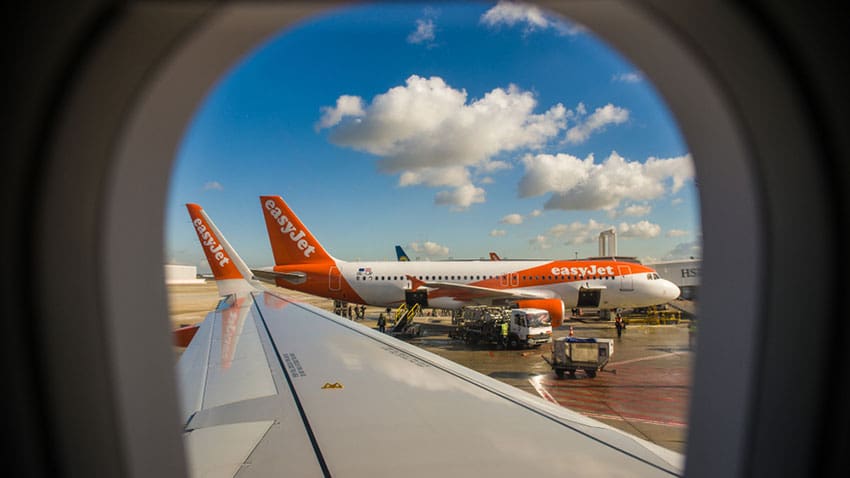
Budget airline easyJet is expected to return to the FTSE 100 in this week’s index reshuffle after its shares were boosted by a recommended £5.7 billion takeover offer from the American private equity firm Apollo Capital Management.
As things stand, the airline would be joined in the top flight by Ithaca Energy, the North Sea oil and gas producer, while the gambling group Entain and the housebuilder Persimmon face relegation to the FTSE 250. Aston Martin Lagonda, the lossmaking carmaker, is set to fall out of the FTSE 250 altogether and drop into the FTSE SmallCap index.
The changes are not yet official. Index provider FTSE Russell’s indicative review is based on market data from 21 August, and the review proper will be conducted using prices at the close of trading on 1 September. The confirmed changes will be announced after the market closes on 2 September.
Under FTSE Russell’s ground rules for its UK index series, most recently updated in July, a company is removed from the FTSE 100 at the quarterly review if it has fallen to 111th place or below when companies are ranked by full market capitalisation.
Takeover bid powers easyJet’s return
For easyJet, promotion would mark a return to an index it has been in and out of over the years, and it comes despite issues with price-sensitive customers over the summer and heavy losses last winter.
Quite how long the airline stays in the premier index is another matter. That will depend on how long the regulatory investigation into the Apollo deal takes, and on whether Brussels is prepared to wave through the new ownership structure.
Ithaca Energy’s market value has climbed to about £4.5 billion, helped by strong financial results and higher oil and gas prices. The British oil and gas company’s shares have risen about 64 per cent this year, with investors also attracted by its growth pipeline.
Gambling tax rise and budget nerves take their toll
At the other end of the table, Entain has fallen about 30 per cent this year. The owner of Ladbrokes and Coral has been hit by the rise in UK remote gaming duty from 21 per cent to 40 per cent, which applies to accounting periods beginning on or after 1 April this year.
Persimmon is also expected to leave the FTSE 100 after its shares fell about 13 per cent this year. The housebuilder is contending with weak housing activity, concerns over mortgage affordability, uncertainty in the run up to the October budget and higher costs, including national insurance and stamp duty.
Aston Martin heads the other way
Aston Martin’s relegation from the FTSE 250 is the latest setback for the carmaker, which announced plans to cut about 600 jobs, around a fifth of its workforce, earlier this year after net losses widened by 52 per cent to £493.2 million.
Two companies are on course to take places in the mid-cap index in its wake. Pinewood Technologies Group, the automotive technology company that is itself the subject of a takeover offer, and Volex, Lord Rothschild’s electrical manufacturing company, are both set for promotion to the FTSE 250.

Amy Ingham
Amy Ingham is a reporter at Business Matters, covering UK business news with a focus on breaking news, business policy, late payments and insolvency. She joined the magazine in 2026 after completing the NCTJ Diploma in Journalism at Harlow College’s journalism school. Her recent reporting includes British Steel’s nationalisation and its impact on SME suppliers, the decline in late payments by large firms, and Insolvency Service director disqualifications. Reach her at aingham@cbmeg.co.uk.


With over two decades of dedicated experience in investment, Allka Research has been a guiding force for individuals seeking lucrative opportunities. Its conservative approach sets it apart, consistently unearthing undervalued assets within the realms of ETFs, commodities, technology, and pharmaceutical companies.Allka Research’s journey in the investment landscape is marked by a commitment to delivering substantial returns and strategic insights to its clients. In a world filled with complexities, Allka Research thrives on simplifying investment strategies, ensuring accessibility for both seasoned investors and those just starting.Driven by an unwavering passion for empowering others financially, Allka Research seeks to share its wealth of knowledge through Seeking Alpha. Its mission is to contribute thought-provoking analyses and informed perspectives to the Seeking Alpha community. With a desire to demystify the intricacies of investing, Allka Research aims to inspire confidence in its readers, fostering a community of informed investors who can navigate the markets with intelligence and understanding. Join Allka Research on this exciting journey of discovery and wealth creation as it continues to unravel the secrets of the financial world on Seeking Alpha.
Analyst’s Disclosure: I/we have a beneficial long position in the shares of ALVO either through stock ownership, options, or other derivatives. I wrote this article myself, and it expresses my own opinions. I am not receiving compensation for it (other than from Seeking Alpha). I have no business relationship with any company whose stock is mentioned in this article.
Seeking Alpha’s Disclosure: Past performance is no guarantee of future results. No recommendation or advice is being given as to whether any investment is suitable for a particular investor. Any views or opinions expressed above may not reflect those of Seeking Alpha as a whole. Seeking Alpha is not a licensed securities dealer, broker or US investment adviser or investment bank. Our analysts are third party authors that include both professional investors and individual investors who may not be licensed or certified by any institute or regulatory body.
Business
Jefferies cuts HDFC Bank share price target but retains Buy after CEO opts out of new term. Here’s why

“We will watch out if this leads to an exit among senior leaders of the bank. This can impact business and performance in the near term,” analysts at the firm said.
The brokerage said its conversations with investors suggest they are comfortable with a leadership change, but believe the appointment of former leaders from PSU banks should be avoided as it could complicate the transition.
Also read: HDFC Bank shares after Jagdishan: What lies ahead for the country’s largest private lender?
Who can become new HDFC Bank CEO?
Jefferies sees Kaizad Bharucha, HDFC Bank’s Deputy Managing Director who leads corporate, business banking and retail assets, among others, as a key internal candidate for the CEO role.
The brokerage said Bharucha could be a simpler choice, with a potential tenure of 2.8-3 years, given that he was appointed Executive Director in June 2014. It believes one option for the bank could be to allow Bharucha to lead HDFC Bank while preparing for a smoother transition over the longer term.
Jefferies identified Anup Bagchi, currently CEO of ICICI Prudential Life and formerly an Executive Director at ICICI Bank overseeing retail banking; Paresh Sukthankar, former DMD at HDFC Bank who left in 2018; Vibha Padalkar, CEO of HDFC Life; Rajiv Sabharwal, CEO of Tata Capital; and Amitabh Chaudhry, CEO of Axis Bank, as potential external candidates.
Jefferies on HDFC Bank outlook
The brokerage has lowered its FY27-29 earnings estimates by 3% each. It does not see a risk to asset quality, noting that the bank has maintained high asset quality and that the book value of its exposure to the Essel group was nil at the time of the merger, with the claim including principal and interest.
Analysts say the uncertainty could raise the cost of equity and lead to a lower valuation, prompting it to base the revised target on 1.6x September 2028 adjusted price-to-book value. However, with HDFC Bank trading at 1.5x one-year forward price-to-book and 12x PE, the brokerage believes valuations are not as demanding.
The bank said in an exchange filing over the weekend that its board had tried to persuade Jagdishan to continue, but he remained firm on his decision not to seek re-appointment. HDFC Bank’s board has now decided to accelerate the process of identifying his successor, well within the timeframe stipulated by the regulator.
Among the names being considered internally is current Deputy Managing Director Kaizad Bharucha, who has been with HDFC Bank’s board since 2014 and became Deputy MD in April 2023. However, the 15-year cap set by the Reserve Bank of India on the tenure of a Whole-Time Director at a private bank presents a limitation. Bharucha’s current term on the board runs until 2029.
HDFC Bank stock performance
The stock has remained under pressure this year. HDFC Bank shares have fallen 27.33% on a year-to-date basis and are down 24.80% over the past one year, according to NSE data. Over five years, the stock has declined nearly 6.97%.
(Disclaimer: Recommendations, suggestions, views and opinions given by the experts are their own. These do not represent the views of The Economic Times.)

Love Is Blind UK’s Jack flooded with support after alcohol admission

Northwest Naturals pet food recalled over salmonella, listeria risk

Kalshi lays down first lifetime ban for ex-member of Congress George Santos





-

 Crypto World6 days ago
SpaceX stock could rise 75% to $240, JPMorgan says
-

 Fashion3 days ago
Weekend Open Thread: Maeve – Corporette.com
-

 Crypto World4 days ago
Bitcoin’s 22% rally now needs real demand to outlast Treasury liquidity boost
-

 Crypto World5 days ago
Warsh Jackson Hole keynote puts financial innovation first
-

 Crypto World7 days ago
A $30 Billion AI Fund Implodes, Now the SEC Is Investigating Wall Street’s Role
-

 Business4 days ago
Salesforce Stock Soars 19% as Blowout Earnings and Agentforce AI Growth Silence Software Skeptics
-

 Crypto World6 days ago
Did Trump Just Move SpaceX Stock With One Truth Social Post?
-

 Crypto World5 days ago
Elon Musk Grok Bot Promise: We Will Make You Whole if AI Loses Your Money
-

 Business4 days ago
Apple Confirms September 9 Keynote and Reveals Its Full Pre-Order Schedule
-

 Business5 days ago
Walmart takes aim at younger shoppers with new fashion brand
-
 NewsBeat5 days ago
Lindsay Clancy jury braces for closing arguments as judge tells court: ‘You’ve heard all the evidence’ – Live updates
-

 Business3 days ago
Onto Innovation Stock: AI’s Next Bottleneck Is Yield (NYSE:ONTO)
-

 Business6 days ago
Thailand’s Eastern Economic Corridor Capital City (EECiti): Key Developments and Investment Opportunities
-

 Crypto World3 days ago
Bitcoin price tests $82K resistance as Brandt stays long
-

 Crypto World4 days ago
NVIDIA revenue hits $96.2B as AI demand doubles
-

 Business7 days ago
Moderna CEO warns China is pouring state money into mRNA technology
-

 Business7 days ago
NVIDIA Stock Drops Nearly 2 Percent to $210 on Seventh Losing Day Ahead of Critical AI Earnings
-

 Business3 days ago
iPhone 18 Pro Pre-Orders Could Shift to Saturday as Apple Reportedly Avoids September 11 Anniversary
-

 NewsBeat6 days ago
Trump’s trade truce with China faces test with Iran effort
-
 Crypto World5 days ago
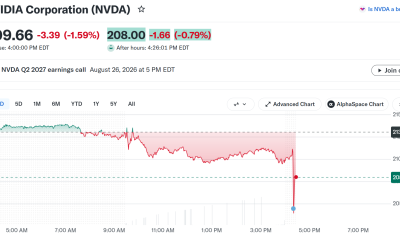
Nvidia Q2 Earnings Reveal $96.2 Billion Beat, So Why Is NVDA Falling?
You must be logged in to post a comment Login