

Business
How Australian Businesses Are Rethinking CRM in the Age of AI Agents


A new generation of AI-native platforms is transforming customer relationship management from a record-keeping tool into an autonomous driver of business outcomes — and Australian enterprises are beginning to take notice.
Australian businesses are collecting more customer data than at any point in their history. Sales interactions, support tickets, marketing touchpoints, e-commerce behaviour — the volume of signals that companies now capture would have seemed extraordinary a decade ago. The problem, for many organisations, is not a lack of data. It is the inability to act on it quickly enough.
Customer expectations have shifted accordingly. Buyers in financial services, retail, and manufacturing increasingly expect personalised, timely responses that reflect an understanding of their history and needs. To deliver that experience consistently and at scale, organizations need systems that can process customer signals and respond to them in real time.
That operational gap is driving a significant reassessment of how Australian enterprises approach customer relationship management. The question is no longer simply which platform to use, but what kind of platform is needed for a business environment in which speed and personalisation are baseline requirements.
What CRM Is — And Why It Is Changing
At its core, CRM software is designed to help organisations manage and analyse their interactions with existing and prospective customers. Traditionally, that has meant a centralised database of contacts, deal histories, and communication records — a system of record that sales, marketing, and service teams can query and update.
For much of the past two decades, this model served businesses adequately. The major platforms in the space built large ecosystems around this foundational capability, adding layers of reporting, integration, and workflow automation over time.
The arrival of enterprise-grade artificial intelligence is now changing the underlying logic of what CRM systems are expected to do. Rather than waiting for a sales representative to query a database or a manager to review a pipeline report, AI-native platforms are designed to surface insights proactively, automate routine interactions, and in some configurations, act on customer signals without requiring human initiation.
This shift from passive data repository to active operational system is what analysts and vendors are increasingly describing as the transition from traditional CRM to agentic, or AI-native CRM.
The Rise of AI Agents in CRM
The concept of AI agents, defined as software systems capable of autonomously executing multi-step tasks based on specified goals, has moved from research papers into enterprise software with notable speed. According to Gartner, fewer than 5% of enterprise applications included task-specific AI agents in 2025. By the end of 2026, Gartner projects that figure will reach 40%.
The implications for CRM are substantial. In practice, AI agents embedded in customer management platforms can handle tasks such as lead qualification and prioritisation, appointment scheduling, follow-up sequencing, and case routing, all of which previously consumed significant hours of skilled employee time.
The market response has been correspondingly strong. IDC projects that year-on-year spending on artificial intelligence will grow by 31.9% between 2025 and 2029, reaching $1.3 trillion globally by the end of that period. A significant share of that investment is directed toward agentic AI applications, including CRM automation.
Gartner’s 2026 CIO and Technology Executive Survey found that while only 17% of organisations had deployed AI agents to date, more than 60% expected to do so within two years, representing the steepest adoption curve among all emerging technologies tracked in the survey. Analysts note, however, that speed of adoption will need to be balanced against governance maturity: Gartner separately estimated that more than 40% of agentic AI projects risk cancellation by 2027 due to unclear business value or inadequate risk controls.
What This Means for Australian Businesses
Australia’s CRM market is currently valued at approximately USD 2 billion and is projected to grow at a compound annual rate of around 10% through to 2033, according to IMARC Group. The sectors driving adoption most aggressively are financial services, retail, and manufacturing, industries where customer volume is high, margins on individual interactions are meaningful, and the cost of losing a relationship to a faster-responding competitor is material.
For financial services organisations in particular, the integration of AI into CRM workflows addresses a specific operational pressure: regulatory obligations demand accurate, auditable records, while market competition demands faster and more personalised client engagement. AI-native platforms that combine workflow automation with compliance-aware governance are increasingly seen as a practical resolution to that tension.
Retail businesses face a related but distinct challenge. The growth of e-commerce has compressed the window in which a timely follow-up or personalised recommendation can influence a purchase decision. Manual CRM processes are structurally unable to operate at the speed required. AI-native systems that can detect a behavioural signal and trigger a contextualised response within minutes are therefore attracting serious evaluation.
Mid-market manufacturers and distributors have historically been underserved by CRM vendors that focus on either large enterprise or SME deployments. The emergence of no-code configuration tools within AI-native platforms is helping to reduce barriers to adoption for this segment. Businesses that previously lacked the IT resources to customise and maintain a CRM implementation can now build and modify workflows without specialist development skills.
One Platform Shaping the Agentic CRM Category
Among the vendors positioning themselves at the intersection of AI and no-code CRM, Creatio has drawn notable attention from industry analysts. The company was recognised as a Leader in the Gartner Magic Quadrant for B2B Marketing Automation Platforms for the fifth consecutive year in 2025, and as a Visionary in the Gartner Magic Quadrant for Sales Force Automation Platforms the same year.
Independent research firm Nucleus Research, which interviewed Creatio customers to assess real-world outcomes, found that the platform’s no-code capabilities deliver a 37% reduction in total cost of ownership compared to alternative solutions, alongside a 70% reduction in implementation timelines and a 61% reduction in lead response time for sales teams. Users also reported measurable improvements in organisational agility and the ability to run continuous improvement initiatives without relying on specialist development resources.
Creatio’s architecture combines a no-code development environment with natively embedded AI agents, enabling organisations to build and modify CRM workflows without writing code. The company reported 40% year-on-year revenue growth in 2025, continuing its accelerated expansion among enterprise customers across financial services, manufacturing, and the public sector, with organisations including Nasdaq, Allianz, MetLife, and E.ON Next among those selecting the platform.
The platform’s real-world impact has been documented across a range of industries. BSN Sports, a US distributor of sporting equipment serving more than 150,000 institutional customers, reported a 60% increase in sales book size per representative over five years following its implementation of Creatio, alongside 100% user adoption across its sales organisation.
What Australian Organisations Should Evaluate
For Australian businesses beginning to assess AI-native CRM options, analysts and practitioners generally point to four criteria as foundational to a sound evaluation.
Integration flexibility is frequently the first consideration. A CRM platform, however capable in isolation, delivers limited value if it cannot connect cleanly with the ERP, marketing automation, and data warehousing systems already in use. Organisations should assess both the depth of available native integrations and the availability of open APIs for custom connections.
No-code configurability has become a significant differentiator as businesses seek to reduce dependence on specialist development resources. Platforms that allow business users to modify workflows, build automation rules, and deploy new capabilities without requiring IT involvement can materially reduce both implementation timelines and ongoing maintenance costs.
AI governance and transparency is emerging as a critical selection criterion, particularly for regulated industries. As AI agents take on a greater share of customer-facing decision-making, organisations need visibility into how those decisions are made, the ability to audit outcomes, and clear controls over which tasks agents are authorised to execute autonomously.
Total cost of ownership over a three-to-five year horizon, accounting for licensing, implementation, customisation, and ongoing support, frequently tells a different story than headline subscription pricing. Platforms with strong no-code capabilities tend to reduce ongoing professional services dependency, which can represent a meaningful cost advantage over time.
Looking Ahead
The shift from traditional CRM to AI-native platforms is no longer a distant prospect for Australian businesses. The transition is already under way across the market segments facing the greatest competitive pressure to deliver superior customer experiences. The organisations that move thoughtfully and early are likely to accumulate structural advantages that compound over time: faster response cycles, more efficient sales operations, and customer data assets that become progressively more valuable as AI capabilities improve.
The technology is maturing rapidly. What has changed is the availability of platforms that make sophisticated AI-native CRM accessible to organisations without large technology teams or significant IT budgets. For Australian businesses still operating legacy systems, that accessibility is both an opportunity and, over a medium-term horizon, a strategic risk if competitors move first.
The question for most enterprises is no longer whether to modernise their approach to customer relationship management, but how quickly they can do so without disrupting the operations they already depend on.
Sources
• Gartner, Hype Cycle for Agentic AI, 2026
• Gartner, CIO and Technology Executive Survey, 2026
• Gartner, Magic Quadrant for B2B Marketing Automation Platforms, September 2025
• IMARC Group, Australia Customer Relationship Management Market, 2025–2033
• Creatio, Marks a Landmark Year of AI Innovation and Accelerated Global Growth, January 2026
• Forrester Wave: CRM Software for Financial Services, Q1 2025
• Nucleus Research, Creatio’s No-Code Capabilities Reduce TCO by 37 Percent, April 2025
• Creatio, Company News and Investor Announcements, 2024–2025
• BSN Sports / Creatio, Customer Success Case Study, 2024
• Creatio Glossary: CRM Software


Check out what’s clicking on FoxBusiness.com.
Buc-ee’s is fueling up for a larger national expansion, with 15 additional travel centers in the pipeline as the Texas-based chain pushes its empire farther beyond its home state.
The company opened its first Arizona location on Monday in Goodyear, a suburb of Phoenix, marking Buc-ee’s first stop in the Grand Canyon State and giving road-trippers another supersized destination for fuel, snacks and the chain’s famously clean restrooms, according to USA Today.
The 74,000-square-foot travel center features 120 fuel pumps and will operate 24 hours a day, 365 days a year. The store is expected to create more than 200 jobs, and city officials said as many as 40,000 vehicles could visit during opening day and the following week, the outlet reported.
BUC-EE’S SET TO DEBUT IN 6 NEW STATES IN MAJOR EXPANSION PUSH ACROSS US

Buc-ee’s has 15 additional travel centers in the pipeline as the Texas-based chain pushes its empire farther beyond its home state. (Getty)
“We could not have picked a better location for our first store in the Grand Canyon State. Perfectly placed for our road-trippers headed out to California or coming in for the destination-rich Phoenix area, Goodyear will be the place to stop,” Stan Beard, director of real estate development at Buc-ee’s Ltd., said in a statement.
Buc-ee’s, founded in 1982, has grown from a Texas roadside favorite into one of the state’s most recognizable exports. The chain now has 56 locations across 13 states.
More openings are already on the calendar for 2026. A Buc-ee’s spokesperson confirmed to FOX Business upcoming locations in San Marcos, Texas, on Aug. 12; Benton, Arkansas, on Aug. 17; and Murfreesboro, Tennessee, on Nov. 16.
BELOVED BUC-EE’S CONVENIENCE STORE CHAIN FACES CUSTOMER SERVICE CRISIS AFTER DEVASTATING ‘F’ RATING
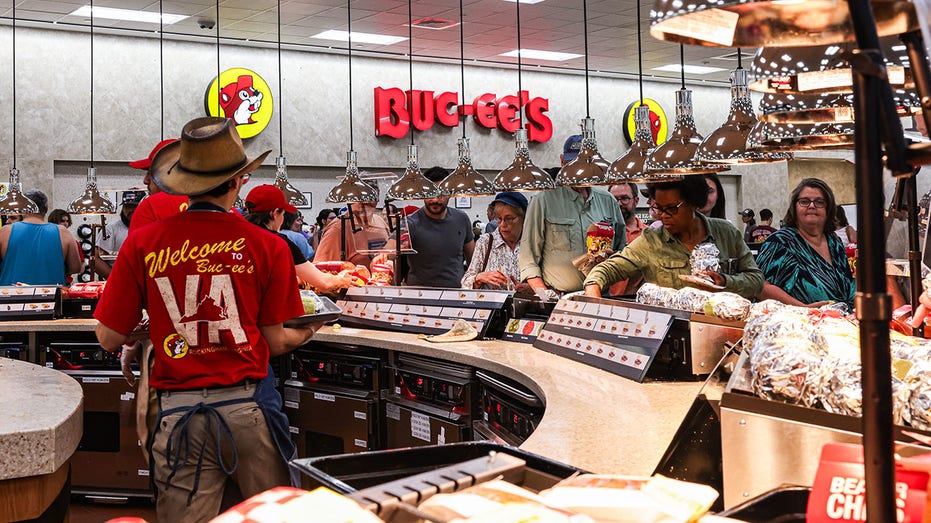
The chain now has 56 locations across 13 states. (Valerie Plesch/For The Washington Post via Getty Images)
The company’s website also lists several planned locations but does not specify exact opening dates.
Six are expected in 2027: Ruston, Louisiana; Kansas City, Kansas; Gallaway, Tennessee; St. Lucie, Florida; Boerne, Texas; and Monroe County, Georgia.
Two more locations are listed for 2028: Mebane, North Carolina, and Lafayette, Louisiana.
WILDLY POPULAR GAS STATION BUC-EE’S TO OPEN FIRST-EVER LOCATIONS IN NEW STATES THIS SUMMER

Buc-ee’s, founded in 1982, has grown from a Texas roadside favorite into one of the state’s most recognizable exports. (Brandon Bell/Getty Images)
GET FOX BUSINESS ON THE GO BY CLICKING HERE
Additional stores are planned for 2029 and beyond, including Ocala, Florida; West Memphis, Arkansas; Oak Grove, Kentucky; and Hardeeville, South Carolina, which is listed for 2031.
Earlier this year, the company opened its first Ohio location in Huber Heights, according to FOX 8 News.

Clear Harbor Asset Management founder and CEO Aaron Kennon analyzes the Federal Reserve’s recent hawkish pivot under chairman Kevin Warsh on ‘Making Money.’
The Federal Reserve’s preferred inflation gauge rose in May as price pressures persist in the wake of the energy shock caused by the Iran war.
The Commerce Department on Thursday reported that the personal consumption expenditures (PCE) index rose 0.4% on a monthly basis in May and is 4.1% higher than a year ago.
The monthly figure came in slightly cooler than the expectations of economists polled by LSEG, who predicted a 0.5% rise, while the annual figure was in line with the estimate.
Core PCE, which excludes volatile measurements of food and energy prices, was up 0.3% on a monthly basis and 3.4% from a year ago. Both figures were in line with expectations.
FEDERAL RESERVE LEAVES INTEREST RATES UNCHANGED AS WARSH ERA BEGINS
Federal Reserve policymakers are focused on the PCE headline figure as they try to bring inflation back to their long-run target of 2%, though they view core data as a better indicator of inflation. Compared with April’s readings, headline PCE rose from 3.8% to 4.1%, while core PCE increased from 3.3% to 3.4%.
Goods prices were up 2.3% in May from a year ago, and were up 0.4% from the prior month.
Services prices rose 2% compared with a year ago, and were up 0.5% on a monthly basis in May.
US ECONOMY GREW AT 2.1% IN FIRST QUARTER
The personal savings rate as a percentage of disposable personal income was 3% in May, a level that was unchanged from the prior month.
Since the start of 2025, the personal savings rate has declined from a peak of 5.5% in April 2025, and it began this year with a 4.4% reading in January.

The energy price shock caused by the Iran war has helped drive inflation higher. (Ariana Drehsler/Bloomberg via Getty Images)
What experts are saying
Heather Long, chief economist at Navy Federal Credit Union, said that, “Inflation is at a 3-year high due to the war in Iran and it’s painful for middle-class and moderate-income Americans.”
“People are spending more on gas, along with healthcare and utilities. New Fed Chair Kevin Warsh has made his commitment clear to bring inflation down,” Long said. “The key will be how much relief happens by September. In encouraging news, jobless claims remain low and the personal savings rate ticked up slightly in May.”
AMERICANS GROW MORE PESSIMISTIC ABOUT FINANCES AS RENT AS FOOD COST FEARS SURGE, FED SAYS

Americans’ household budgets are strained by elevated inflation. (Justin Sullivan/Getty Images)
Ellen Zentner, chief economic strategist for Morgan Stanley Wealth Management, noted that “Sliding oil prices will take a while to work their way through the economy.”
“Today’s data is a reminder that inflation remains well above target and growth remains solid. This will keep the Fed on hold for quite some time, until conditions allow for a cut,” Zentner added.
GET FOX BUSINESS ON THE GO BY CLICKING HERE
Jeffrey Roach, chief economist at LPL Financial Research, said that, “Given the growth trajectory, the Fed is rightly focused on price stability and will remain hawkish this summer.”
“If the Iran crisis creeps into Labor Day timeframe, we have a much higher chance that inflation pressures will seep into other categories and will force the Fed’s hand,” Roach said.

IBM says it has created the world’s first known chip tech below 1 nanometre – but it will be some time before it’s ready for production.

A company that sells meal kits is to close its Lincolnshire warehouse, putting 290 jobs at risk.
Gousto said it would shut its Clay Lake unit, near Spalding, and centralise the production of its food boxes at one site in Cheshire to reduce costs.
The firm said it had heavily invested in its Warrington facility, where about 600 people work.
It also said running two warehouses was no longer efficient and was leading to duplication.
Founder and chief executive Timo Boldt said the closure was “an incredibly difficult proposal given the impact on our colleagues in Clay Lake, who have contributed enormously to Gousto’s journey over a number of years”.
“In a highly competitive food market, it is however essential that we operate as efficiently as possible so that we can continue to invest in our proposition and keep prices as low as possible for customers,” he said.
“Our focus now is on supporting people through this process with care, respect and practical help.”
The BBC has contacted the company for a response.
Listen to highlights from Lincolnshire on BBC Sounds, and watch the latest episode of Look North.

Former Council of Economic Advisors acting chair Tomas Philipson discusses the price of crude oil and the Middle East conflict on ‘The Bottom Line.’
This is a developing story about the final reading of U.S. first-quarter GDP. Please check back for updates.
The U.S. economy grew at a faster pace than expected in the first quarter, according to the Commerce Department’s estimate.
The Bureau of Economic Analysis (BEA) on Thursday released its final reading of first-quarter GDP, which showed the economy grew at an annualized rate of 2.1% in the three-month period including January, February and March.

The Commerce Department released its final estimate of first-quarter GDP on Thursday. (Brandon Bell/Getty Images)
That figure was higher than the expectations of economists polled by LSEG, who had estimated 1.6% GDP growth in the first quarter. The figure was initially estimated at 2% before it was lowered to 1.6% in the BEA’s first revision.


I am an individual investor who is now fully focused on managing my own capital. My investing background focuses on value investing with an emphasis and interest in small to mid-cap stocks. I believe history often repeats itself, and investors can gain valuable insights into the future of companies by examining their historical performance and industry peers. By understanding the history of how they got here, meaningful insights can be inferred about where the companies are going in the future. The reason to write on SeekingAlpha is to use this platform as a tracker for my investing ideas, research, performance, and also to connect with like-minded investors who have similar investing interests. I believe clarity of thought can not be obtained without clarity in writing. Putting ideas down on paper helps me refine my thinking and thesis. I tend to write a lot as I look at multiple companies a day and use writing as a tool to track and evaluate my ideas. By writing down all of my ideas it will help me to become a better investor. Although my focus is on small to mid-cap companies, I have an interest in analyzing technology, mining and the retail industry. One area I tend to avoid is biotech, as the industry is highly specialized with technical knowledge requirements and almost impossible for generalists to gain an edge. I hold a degree in accounting, and it has been particularly useful when analyzing companies that are under financial distress (commonly amongst small to mid-cap companies). Evaluating the company’s solvency and ability to continue operations is one of the necessary checks.
Analyst’s Disclosure: I/we have no stock, option or similar derivative position in any of the companies mentioned, and no plans to initiate any such positions within the next 72 hours. I wrote this article myself, and it expresses my own opinions. I am not receiving compensation for it (other than from Seeking Alpha). I have no business relationship with any company whose stock is mentioned in this article.
Seeking Alpha’s Disclosure: Past performance is no guarantee of future results. No recommendation or advice is being given as to whether any investment is suitable for a particular investor. Any views or opinions expressed above may not reflect those of Seeking Alpha as a whole. Seeking Alpha is not a licensed securities dealer, broker or US investment adviser or investment bank. Our analysts are third party authors that include both professional investors and individual investors who may not be licensed or certified by any institute or regulatory body.

One of Australia’s largest planned renewable energy projects will begin life as a 1-gigawatt wind and solar farm feeding power to a future Port Hedland hydrogen site.

Potential name for the AI industry regulatory authority:
AI Associated Institute of America, Inc or AIAIAI, pronounced “ay yai yai”
— Elon Musk (@elonmusk) June 25, 2026
Elon Musk, the chief executive of xAI and Tesla, suggested a tongue-in-cheek name for a potential artificial intelligence regulatory authority, sparking discussion about the future of AI oversight as the technology continues rapid advancement.
Musk proposed “AI Associated Institute of America, Inc.” or AIAIAI, pronounced “ay yai yai,” in a post on X. The comment highlighted ongoing debates about how governments should approach regulation of artificial intelligence systems while the industry expands at unprecedented speed.
The suggestion comes as policymakers worldwide grapple with balancing innovation incentives with concerns about safety, bias, job displacement and potential misuse of powerful AI models. Musk has been vocal about both the opportunities and risks associated with artificial intelligence development.
His companies, including xAI, Tesla and SpaceX, are deeply involved in AI applications ranging from autonomous driving to scientific discovery. Musk’s perspective carries significant weight in technology circles given his track record of ambitious projects.
Context of AI Regulation Discussions
Governments and international organizations have proposed various frameworks for AI governance. The European Union has implemented comprehensive AI regulations, while the United States has taken a more sector-specific approach with executive orders and agency guidelines.
Industry leaders, researchers and ethicists continue debating optimal regulatory structures. Concerns include ensuring AI systems remain aligned with human values, preventing harmful applications and maintaining global competitiveness.
Musk has advocated for proactive regulation while warning about potential existential risks from superintelligent AI. His proposal for AIAIAI reflects a skeptical view of bureaucratic approaches while acknowledging the need for some oversight.
The humorous acronym plays on the Spanish expression “ay, ay, ay,” often used to express dismay or surprise. This lighthearted tone contrasts with the serious nature of AI governance discussions.
Industry Growth and Challenges
Artificial intelligence development has accelerated dramatically, with major companies investing billions in computing infrastructure and talent. Models like those powering chatbots, image generators and autonomous systems demonstrate increasing capabilities.
xAI, Musk’s AI venture, focuses on understanding the universe through advanced models. The company’s Grok chatbot aims for maximum truthfulness and helpfulness without heavy content restrictions.
Regulatory uncertainty creates challenges for companies planning long-term investments. Clear frameworks could provide certainty while addressing legitimate safety concerns raised by experts.
International coordination remains difficult as nations compete for technological leadership. Differing approaches risk creating fragmented global standards that complicate compliance.
Broader Implications
Effective AI regulation could help mitigate risks while preserving innovation benefits. Poorly designed rules might stifle progress or drive development to less regulated jurisdictions.
Public trust in AI systems depends on transparency, safety measures and accountability. Regulatory bodies could play important roles in establishing standards and enforcement mechanisms.
Musk’s comment highlights the tension between rapid technological advancement and governance needs. His companies’ experiences with regulation in automotive, space and social media sectors inform his perspective.
The AI industry’s growth affects numerous sectors, from healthcare and education to transportation and entertainment. Balanced oversight could maximize benefits while addressing legitimate concerns.
Musk’s Influence on AI Discourse
As one of technology’s most prominent figures, Musk’s statements often shape public and industry conversations. His warnings about AI risks have influenced policy discussions while his companies push boundaries in practical applications.
The AIAIAI suggestion reflects Musk’s characteristic blend of humor and serious commentary. Similar playful proposals have appeared in his commentary on other regulatory topics.
xAI’s mission to advance scientific discovery through AI represents one approach to beneficial development. The company’s progress will be watched alongside regulatory developments.
Future Regulatory Landscape
Policymakers face the challenge of creating adaptable frameworks for rapidly evolving technology. Agile regulation that can respond to new capabilities may prove more effective than static rules.
International cooperation could help establish consistent standards while respecting national priorities. Organizations like the United Nations and OECD continue facilitating dialogue on AI governance.
Industry self-regulation through best practices and safety commitments offers another avenue for responsible development. Many companies have signed voluntary agreements addressing key concerns.
The coming years will likely see continued evolution in AI regulation as capabilities advance and societal impacts become clearer. Musk’s commentary contributes to this ongoing conversation about balancing innovation with safety.
As artificial intelligence becomes more integrated into daily life, public understanding and engagement with governance issues will grow in importance. Transparent discussion about benefits and risks helps inform policy decisions.
Musk’s proposal, while humorous, draws attention to the need for thoughtful approaches to AI oversight. The technology’s transformative potential requires careful consideration of how best to guide its development for maximum benefit to humanity.

Alphabet's Dip Looks Increasingly Hard To Ignore


As the New York Knicks clinched their first championship in 53 years and the NBA notched its highest Finals series ratings since 1998, professional basketball was inking another record.
The five-game series between the Knicks and the San Antonio Spurs generated “15 billion views and counting on social media, the most ever for an NBA Finals and nearly triple the previous record set in 2025,” according to the NBA. Game 5 alone generated more than 4 billion views on social media platforms, breaking the record set three days prior by Game 4.
It’s emblematic of an intensifying battleground in live sports as professional leagues seek to reach new and younger fans and media consumption shifts online.
TV and streaming platforms have been attracting some of the biggest audiences for live sports this year. The NBA Finals series claimed an average of 20.6 million viewers per game on Disney’s ABC and ESPN networks.
And yet social platforms like TikTok and Google’s YouTube are claiming a disproportionate amount of viewing time for Generations Z and Alpha — often at no cost. That’s left the sports leagues and live rights holders weighing whether to go all in on social as a funnel for future audiences or to reinforce the walled garden of subscription programming to offset rising broadcast fees.
New York Knicks fans gather outside of Madison Square Garden before Game 4 of the NBA Finals between New York Knicks and San Antonio Spurs, on June 10, 2026 in New York City.
Adam Gray | Getty Images
“It’s always a question of what the leagues are doing versus what the rights holders want to do,” said Jonathan Miller, a former Fox Corp. and NBA executive who currently serves as chief executive of Integrated Media, which specializes in digital media investments.
“Reaching and cultivating the youth sports base is a major priority and focus of the leagues themselves,” Miller said. “In today’s fragmented landscape, it is no longer a luxury to have a young base, it is a necessity to ensure a healthy future.”
New fans, new ways to watch
For years YouTube has snagged the biggest share of streaming viewership, according to Nielsen’s monthly report known as “The Gauge.”
Rather than watching live games in their entirety, consumers are increasingly watching sports clips, highlights, athlete-made videos and creator content on social platforms.
According to S&P Global’s 2025 “State of U.S. sports viewing” report, 68% of sports viewers reported watching live games on TV or through streaming; 38% reported watching highlights, interviews and other clips on social media, YouTube and other platforms; and 12% said they interact with social media accounts or fan forums for professional players, teams or leagues.
“What we’re seeing today is the evolution of consumption,” said Adam Kelly, president of global sports marketing agency IMG.
The TKO Group–owned firm packages and sells media rights and brand rights as well as providing consultancy on some of the biggest TV deals globally.
Live games that are aired exclusively on streaming consistently draw significantly younger audiences than those aired on linear TV, according to Nielsen, which recently began breaking down weekly sports viewership consumption.
If you are the broadcaster and proactively using your social and digital platforms to push out tons and tons of highlights and content … you’re kind of feeding the beast.
William Mao
senior vice president of media rights consulting at Octagon
The NBA Finals saw an increase in new viewers to streaming platforms like Disney’s ESPN, according to Apptopia. Even streaming-only versions of pay TV bundles like Fubo and YouTube saw similar results.
However, when broken down by age, those new viewers for the NBA postseason tended to skew older, according to Apptopia’s data.
ESPN streaming saw an increase of 38% in new users over the age of 46, while the youngest cohort between 17 and 25 was up just 8%. For Fubo and YouTube, the growth was also heavily skewed toward the over-46 audience.
“Our hypothesis when it comes to young fans is that they play a very important part in consuming sport and will continue to, but their consumption behavior is slightly different,” said Kelly. “People talk about fragmentation of the audience, but actually, consumption numbers have continued to increase.”
Sports highlights
Industry executives told CNBC that as sports migrate more and more onto social platforms, the content is acting as a conduit to live games, not a pure replacement.
“It’s just a continued development of the accessibility of content — a lot more platforms in the marketplace catering to short-form content,” said William Mao, senior vice president of media rights consulting at Octagon, a global sports and entertainment agency.
Mao said the rise of social content around live sports is an acknowledgment that companies need to “target and engage those younger demographics, those future consumers … where they are,” Mao said.
The appetite for clips is creating something of a land grab between leagues and media rights holders, according to Mao.
Both the broadcasters and the leagues have their own social media presences. If multiple accounts want use of the same footage, it could dilute the audience.
Mao said as a result, media negotiations can go so far as to determine how long a highlight or clip can be used exclusively on one platform versus another.
The hope is that a healthy highlight reel on social feeds spurs interest among younger fans in live matchups.
Alicia Windzio | Picture Alliance | Getty Images
Rollo Goldstaub, the global head of sport at TikTok, said 42% of users watching sports content on the short-form video platform will go on to tune into a live game on TV or streaming.
Goldstaub said his job includes making sure the platform has content from across the sports ecosystem — the leagues, athletes, media broadcasts and content creators. He said content directly from the broadcaster or the league, such as game highlights, typically has high engagement.
IMG’s Kelly said younger audiences “have been asked to fit into the existing framework when it comes to sports consumption.”
“Distribution has stayed very much on the traditional means of delivery because it’s what worked so well for so long,” he said. “Non-linear [TV] young fans are spending most of their time on these platforms. Their preference is to consume content where they’re already consuming other material.”
While there are ways to monetize highlights and content on social media — such as ad revenue sharing on platforms like YouTube and other sponsorship opportunities — the main source of value for these games comes from the airing of the live matches on TV and streaming.
With sports fees skyrocketing, the need to earn that investment back grows.
The NBA is in the early years of its 11-year, $77 billion deal. The NFL, which is in the midst of its own 11-year deal worth a record $111 billion, has put heavier weight on advertising to drive revenue.
“There’s an argument that if you are the broadcaster and proactively using your social and digital platforms to push out tons and tons of highlights and content, you’re kind of accelerating that trend even further right?” Mao said. “You’re kind of feeding the beast.”
Reaching young fans
To embrace younger fans, the major players are starting to adapt.
FIFA, the governing body over the World Cup, is allowing its global broadcasts to post more content on TikTok, whether that’s of the matches themselves or surrounding game footage.
The tournament is currently underway in the U.S., Canada and Mexico, and the first 10 minutes of every match can be shown on TikTok. When the stream ends there’s a direct link to stream the game, shown in the U.S. via networks owned by Fox and Comcast’s Telemundo.
Malik Tillman #17 of the United States is challenged by Miguel Almiron #10 of Paraguay during the FIFA World Cup 2026 Group D match between USA and Paraguay at Los Angeles Stadium on June 12, 2026 in Los Angeles, California.
Dean Mouhtaropoulos | Getty Images Sport | Getty Images
In February, the NBA leaned into creator content during its All-Star weekend, inviting more than 200 digital natives to the event.
Rights holders Paramount Skydance and Disney have rolled out kid-friendly simulcasts to capture the youngest fans who may be tuning in alongside their parents.
Paramount’s CBS has aired alternate broadcasts of live sports on its children’s TV network Nickelodeon — from Christmas Day games to the 2023 Super Bowl — complete with slime graphics and characters like SpongeBob SquarePants running on the field.
Disney has tapped into its intellectual property for ESPN’s NFL games, too, including overlays with characters from films like “Monsters Inc.” and “Toy Story.”
And leagues across sport have partnered with Gamefam, a leading Roblox game developer, to bring their team jerseys and content to the video game platform that’s popular with Gen Z and Gen Alpha.
Roblox collaborated with Paramount for its Super Bowl broadcast on Nickelodeon, which became the biggest event ever on Roblox with 70 million visits in 30 days: “It was huge,” said Gamefam CEO Ricardo Briceno.
Briceno noted that building fandom and converting users from Roblox to beyond the platform is “very important.” That could mean watching a game or buying a jersey or other merchandise.
“That’s the funnel. You build awareness and love for the brand, then you put your dollars into it,” said Briceno.
From TV to tech
There’s a flipside to fueling the funnel.
The tech companies and streamers acting as a bridge to younger viewers are becoming established bidders for the live games in their own right.
Google’s YouTube, Amazon’s Prime Video, Apple and Netflix have begun to nab more games and garner big viewership numbers.
NFL Commissioner Roger Goodell at the Netflix advertising presentation in 2025.
Courtesy of Netflix
NFL Commissioner Roger Goodell has been vocal about meeting young fans where they are on streaming services. The NBA’s latest media deal brought in Prime Video to replace Warner Bros. Discovery’s TNT Sports. YouTube aired its first-ever NFL game in September.
The strategy appears to be working. The NBA scored some of its highest-rated games this season, and the NFL’s “Thursday Night Football” on Prime Video has continued to capture more viewers — delivering its most-watched season in its 20-year history.
Still, IMG’s Kelly, TikTok’s Goldstaub and others said they don’t view the shift toward social media as a threat to the traditional media partners.
“We can be that partner that’s driving the value of these younger and more likely female fans, the ones that broadcasters are struggling to reach,” Goldstaub said.
“I think right now we’re really happy operating in this space of almost like part of the game,” he said. “We get to promote the full match live, we get to promote the broadcaster, but we also get to give users something really amazing and interesting to see.”

Buc-ee’s opens first Arizona location as chain plans 15 new travel centers

SBI to Buy Bitbank in $289M Deal, Forming Japan’s Largest Crypto Exchange

Joseline Hernandez & Lemuel Plummer Make Amends (Video)


-

 Fashion6 days ago
Weekend Open Thread: Miami – Corporette.com
-

 Entertainment5 days ago
Renter of Home in Anne Heche Crash Denies Settlement With Son
-
 Sports2 days ago
Two goals and an assist by sheer aura: Cristiano Ronaldo just entered the World Cup chat
-

 Tech3 days ago
Microsoft accidentally kills epic Outlook email threads
-

 Business5 days ago
Soccer-U.S. defends Iran World Cup travel restrictions, says discussions ongoing
-

 Politics5 days ago
Andy Burnham and the meaning of Makerfield
-
Crypto World1 day ago
Bitcoin (BTC) Dips Below $62K, Ethereum (ETH) Plunges 6% Daily: Market Watch
-

 Politics7 days ago
BBC Reporter Discusses Cross Party Criticism Of Trumps Iran Deal
-

 Crypto World1 day ago
Securitize Wraps Roubini's SEC-Registered ETF as Dubai VARA Digital Security
-
Business2 days ago
Entergy settles forward sale agreements, raises $672 million in cash proceeds
-

 NewsBeat6 days ago
Keir Starmer Allies Question His Chances For No 10
-
 Business5 days ago
Wall Street Week Ahead: Investors see Micron earnings as pulse check of AI rally momentum
-

 Tech7 days ago
AWS enters the context layer race with a graph that learns from agents, not manual curation
-
 Crypto World5 days ago
Can Charles Hoskinson Really Rescue Cardano?
-

 Crypto World5 days ago
HIVE shares jump as $220M AI deal speeds Bitcoin mining pivot
-

 Crypto World5 days ago
Jake Chervinsky accuses CME of protecting derivatives monopoly
-

 Entertainment5 days ago
Jose Alvarado Wants Taylor Swift at More Knicks Games
-
 Tech4 days ago
Signal’s Meredith Whittaker says AI chatbots ‘are not your friends’ and calls Copilot agents a backdoor
-

 Tech3 days ago
Nearly 7,000 fake Amazon domains registered ahead of Prime Day 2026, researchers warn
-

 Sports7 days ago
FIFA World Cup 2026: Canada beat 9-men Qatar 6-0 to register first ever win | FIFA World Cup 2026
You must be logged in to post a comment Login