
Business
How To Safely Make DIY Solar Eclipse Viewers At Home Ahead Of The August 12, 2026 Total Eclipse Event


With a total solar eclipse set to sweep across parts of the Arctic, Greenland, Iceland and Spain on August 12, interest in do-it-yourself eclipse viewing tools has surged — but safety experts and space agencies are cautioning that not every homemade option is safe for the eyes.
According to NASA and the National Solar Observatory, looking directly at the sun without proper protection can cause permanent eye damage, and that risk applies during a solar eclipse just as it does on any ordinary day, except during the brief window of total darkness known as totality. Outside of that narrow period, any glimpse of the sun’s bright surface — even a thin sliver during a partial eclipse — can harm the retina, since the eye lacks pain receptors that would otherwise warn of the damage occurring in real time.
The August 12 eclipse will be total along a path crossing a remote stretch of northern Russia, Greenland, Iceland, northern Spain and a small corner of Portugal. Much of Europe, North America and northwestern Africa will see only a partial eclipse, meaning the moon will cover just a portion of the sun’s disk rather than blocking it entirely. For viewers along the path of totality, NASA says it is safe to remove eye protection and look directly at the sun only during the short period when the moon fully covers it — and protection must go back on the instant any sliver of sunlight reappears.
For those hoping to build their own viewing equipment rather than buy certified glasses, safety officials say there are really only two legitimate do-it-yourself paths, and they are not the same thing.
The first, and by far the safest option for anyone without access to certified equipment, is an indirect method that does not involve looking at the sun at all: a pinhole projector. The concept is simple. A small hole poked into a piece of cardboard or an index card, held so sunlight passes through it and lands on a second surface such as another card, a wall or the ground, will project a small image of the sun’s crescent shape during the partial phases of the eclipse. Because the viewer never looks directly at the sun, and instead observes its projected image, the method carries essentially no risk to eyesight and requires no special materials beyond basic household items.
The second path — building an actual pair of wearable eclipse glasses — is more involved and requires sourcing the correct material rather than improvising with household substitutes. According to the National Solar Observatory, homemade filters and ordinary sunglasses, even very dark ones, are not safe for looking at the sun under any circumstances, regardless of how many layers are stacked together. The only safe way to look directly at the sun’s bright surface is through solar filter material specifically manufactured for that purpose and certified to the ISO 12312-2 international safety standard. That standard limits the amount of visible, ultraviolet and infrared light that reaches the eye to levels considered safe for direct solar viewing.
Genuine do-it-yourself eclipse glasses can be assembled at home, but only by purchasing pre-certified ISO 12312-2 solar filter sheets from a reputable supplier and mounting them into a simple cardboard or paper frame, rather than attempting to fashion the filtering material itself. The American Astronomical Society, the leading professional organization for astronomers in North America, maintains a list of verified, safe suppliers of solar filter material and eclipse glasses, and safety experts recommend checking any product against that list before use, particularly given a history of counterfeit eclipse glasses circulating around past eclipse events that failed to provide adequate protection despite carrying misleading safety labels.
For observers who already own welding equipment, the American Astronomical Society has said that welding filters with a shade rating of 12 or higher can also provide safe direct viewing, with shade 13 or 14 generally considered closest in darkness to standard eclipse glasses. Ordinary sunglasses, smoked glass, exposed photographic film, polarizing filters and stacked layers of dark plastic are all explicitly not considered safe substitutes, regardless of how dim the sun appears through them.
Anyone planning to photograph the eclipse or view it through binoculars, a telescope or a camera lens faces an additional layer of risk. NASA and other experts warn that a solar filter must be attached to the front of any such optical device, not simply held up to the eyepiece, since the lens will concentrate sunlight to a degree that can damage both the equipment and the eyes almost instantly. Wearing eclipse glasses while looking through unfiltered optics is not a safe workaround, experts say, since the concentrated light passing through the lens can burn through the glasses’ filter material.
Timing will also matter for viewers hoping to catch the moment of totality. According to eclipse path data, totality is set to begin over Iceland at 1:45 p.m. Eastern time and reach Spain by 2:28 p.m. Eastern time on August 12. NASA has said it will provide live coverage of the eclipse beginning at 1:15 p.m. Eastern time, including footage from telescopes positioned along the path of totality and from a high-altitude research aircraft tracking the moon’s shadow, for viewers outside the path who want to watch the event unfold in real time.
With demand for certified eclipse glasses expected to rise as the date approaches, safety officials are urging anyone planning to view the event directly to secure verified protective equipment well in advance, rather than relying on last-minute homemade alternatives that may not meet the safety standards needed to protect their eyesight.


Citing strong prospects but a risk of order delays, domestic brokerage firm JM Financial downgraded its rating on the stock from Buy to Add, with a target price of Rs 905 (previously Rs 875), due to the strong run-up in the stock, i.e. 100% in the last six months.
Ministry of Defence’s Drone Procurement Programme
The Indian Ministry of Defence (MoD) has planned a Rs 20,000-crore drone procurement programme, largely focused on tactical and surveillance UAVs. These are expected to be procured through the fast-track procurement route, with an 18–24-month delivery timeline. However, other opportunities under the programme are at various stages of approval, which could defer project awards to FY28/29.
JM Financial’s outlook
According to JM Financial, the company’s Q1 results were strong on execution but weak on order inflows and profitability. Order book at the end of this quarter stood at Rs 257 crore, implying order inflows of Rs 11.2 crore for the quarter, which is significantly lower both year-on-year as well as quarter-on-quarter, as per the brokerage’s note.
While order prospects remain strong with strong policy thrust on procurement of tactical drones, most of the tenders are in the approval phases, which may push the translation of these prospects to inflows to FY28–29. JM Financial expects order inflows to weaken YoY in FY27 and pick up in FY28 and FY29, with inflow estimates aggregating to Rs 1,500 crore over the next two years.

JM Financial expects execution momentum to remain strong in the coming quarters. Management has guided for gross margins to remain at 50–55% in FY27, supported by the execution of high-margin orders. The brokerage estimates revenue to grow at a CAGR of around 47% over FY26–29E as order inflows pick up in FY28/29. It expects operating leverage to drive EBITDA margins from 2% in FY26 to around 30% in FY29, with profit after tax estimated to rise to Rs 27.6 crore in FY28 and Rs 170 crore in FY29.
ideaForge Technology Q1 results
ideaForge Technology reported a gross profit of Rs 33.6 crore, up from Rs 7.9 crore in the year-ago quarter. However, gross profit margin declined to 49% from 62% in the same quarter last year. Revenue from operations stood at Rs 68.6 crore during this June quarter, with the company executing over 20% of its opening FY27 order book, according to a regulatory filing released after market hours on Monday.According to the company’s statement, global supply chain disruptions and component availability continue to pose challenges since the March quarter of FY26. However, the company remains focused on completing delivery of the opening order book of FY27 by Q3 as per customer timelines.
Also read | ideaForge Technology shares slide 5% after Q1 gross profit margin falls 49%
On order book visibility for FY27, co-founder and CEO Ankit Mehta said that the higher operational procurement limits for field commanders of Indian Defence Forces under DFPDS 2026 would accelerate procurement activities in Q3 and Q4, and that the company continues to see regular cycles on the civil side of the business that lean towards Q3 and Q4.
(Disclaimer: Recommendations, suggestions, views, and opinions given by experts are their own. These do not represent the views of The Economic Times.)

Franchising can be an exciting way for a successful business to expand its reach, increase brand awareness and enter new markets without relying entirely on company-owned locations.
However, not every successful small business is automatically ready to become a franchise. Turning an established operation into a franchise requires careful planning, reliable systems and a business model that can be successfully replicated by other people. Before deciding to franchise, business owners should take an honest look at their performance, processes, finances and ability to support franchisees.
Is Your Business Proven?
One of the first questions to ask is whether your business has a proven track record. While there is no universal definition of a successful franchise-ready business, evidence of consistent demand, profitability and customer satisfaction can provide an important foundation.
A business that is still experimenting with its products, pricing or basic operating procedures may not be ready to franchise. Franchisees are investing their own money and will expect to receive a business model that has already been tested. Ideally, the original business should have demonstrated that its products or services can generate sustainable demand rather than relying on a short-term trend.
Researching The Franchise Model
Before taking the next step, business owners should learn as much as possible about franchising. Websites such as UK Franchise Opportunities can provide useful information for entrepreneurs researching the franchise business model, including guidance about franchising, franchise opportunities and the considerations involved in becoming a franchisor.
Online resources can help business owners understand the terminology and basic principles of franchising before they begin developing their own franchise strategy. This research can also help clarify the differences between simply expanding a business and creating a structured franchise system that independent franchisees can operate.
Can Your Business Be Replicated?
A franchise needs to be repeatable. If the success of your company depends entirely on your personal involvement, knowledge or relationships, it may be difficult to turn it into a franchise.
Consider whether another entrepreneur could follow your processes and achieve comparable results with appropriate training and support. Your products or services should ideally be delivered through clear procedures rather than relying solely on intuition or individual expertise.
This does not mean every aspect of the business must be rigidly controlled. However, the essential elements responsible for delivering the customer experience and generating revenue should be clearly understood and capable of being taught.
Do You Have Documented Systems?
If you are thinking, franchise my business, one of the most important questions to ask is whether your existing systems are sufficiently documented. Franchisees need clear guidance on how to operate the business, from opening procedures and customer service to stock management, sales processes and marketing.
Creating detailed operational manuals can help transform the knowledge contained within the original business into a system that can be followed by franchisees. Documentation can also make training more effective and provide franchisees with a reference point when questions arise.
If most of your processes exist only in your head or are understood by a small number of employees, more preparation may be required before franchising.
Is Your Brand Strong Enough?
A recognisable and trusted brand can be a significant asset when developing a franchise. Franchisees are not simply buying instructions for running a business; they are also investing in the reputation, identity and customer proposition associated with the brand.
Before franchising, consider whether customers recognise what makes your business different from competitors. You should have a clear understanding of your target market and the reasons customers choose your products or services.
A strong brand proposition can make the franchise opportunity more attractive while providing a consistent foundation for future locations.
Can You Support Franchisees?
Franchising changes the role of the business owner. Instead of focusing solely on customers and employees within your own operation, you will also need to support independent business owners operating under your brand.
This can involve initial training, ongoing advice, marketing support, operational guidance and regular communication. If you do not have the time, resources or infrastructure to provide this support, rapid franchise expansion could create problems.
Consider what a new franchisee would need during their first few months and whether your business is equipped to provide it. Building a suitable support structure before recruiting franchisees can make the transition considerably smoother.
Are Your Finances Ready?
Franchising can reduce some of the capital required for opening company-owned locations, but creating a franchise system still involves costs. Legal advice, franchise documentation, training, marketing, recruitment and operational development can all require investment.
Business owners should therefore have realistic financial expectations and a clear understanding of how the franchisor will generate revenue. Franchise fees and ongoing payments should be structured carefully, while the underlying franchise model needs to provide a worthwhile opportunity for franchisees.
The financial performance of the existing business should also be sufficiently stable to support the transition into franchising without placing unnecessary pressure on the company.
Can You Let Go Of Some Control?
Becoming a franchisor requires a different mindset. You will no longer be the only person making decisions about how each location operates. Franchisees will be independent business owners with their own ideas, management styles and local knowledge.
Although franchise agreements and operational standards provide important controls, successful franchising also requires trust. You need to be comfortable delegating responsibility while ensuring franchisees follow the essential elements of your business model.
If you find it difficult to accept other people making decisions within your brand, franchising may present particular challenges.
Do You Have A Clear Growth Strategy?
Being ready to franchise means having a realistic plan for where and how the franchise network should grow. Rather than attempting to recruit as many franchisees as possible, it is generally more sensible to consider which markets, territories and franchisee profiles are most appropriate.
A measured expansion strategy can help protect the quality of the network. The first franchisees can also provide valuable feedback about training, systems and support, allowing the franchisor to improve the model before expanding further.
Getting Professional Guidance
Even if your business appears ready to franchise, obtaining specialist advice can help identify issues that may otherwise be overlooked. Experienced franchise consultants can assess your business model, help develop franchise systems and provide guidance on areas such as recruitment, marketing and network development.
Professional advice should complement, rather than replace, your own research. Business owners should take time to understand the financial, legal and operational commitments involved before proceeding with a franchise launch.
Conclusion
Knowing whether you are ready to franchise your business requires more than simply having a successful company. You need a proven and repeatable business model, strong systems, a compelling brand and the resources to support independent franchisees. Financial stability and a willingness to delegate are equally important.
Franchising can provide a powerful route to growth when the foundations are right, but rushing into the process can create unnecessary risks for both the franchisor and its franchisees. By researching the franchise model, documenting operations, developing a robust support structure and seeking appropriate professional guidance, business owners can make a more informed decision about whether the time is right to take their company to the next level.

Bergen Carbon Q2 2026 slides: cash burn cut 33%, patent milestone reached

Sparkies at South32’s Worsley alumina refinery are threatening to strike unless the company brings wages in line with those by their future employer, Alcoa.

While consolidated revenue from operations surged 67% year-on-year (YoY) to Rs 3,056 crore, from Rs 1,826 crore in Q1 FY26, profitability came under pressure. Consolidated Profit After Tax (PAT) declined 3% YoY to Rs 101 crore, from Rs 105 crore in the year-ago period. Margins also weakened, with the PAT margin contracting 240 basis points to 3.3%, from 5.7% a year earlier.
Earnings Before Interest, Taxes, Depreciation, and Amortization (EBITDA) grew 16% YoY to Rs 213 crore, from Rs 184 crore in Q1 FY26. However, the EBITDA margin contracted 310 basis points to 7%, from 10% a year earlier, due to promotional discounting, lower gold prices and changes in customs duty.
Strong operational growth across retail network
Despite margin pressures, Senco Gold maintained operational momentum across retail operations. Retail sales grew 50% YoY to Rs 2,651.5 crore, supported by robust same-store sales growth of 39%.
The company’s performance was boosted by key festive and wedding occasions in the early part of the quarter, including Poila Boishakh, Akshaya Tritiya, Baisakhi, and Bihu. Old jewellery exchange played a crucial role in maintaining sales momentum amid high gold prices, accounting for 43% of total sales quantity.
Diamond jewellery also posted strong growth, expanding 43% YoY in value terms and 18% in volume terms. This expansion was largely driven by demand for lower-ticket offerings priced below Rs 50,000 under the Everlite collection.
Showroom expansion and subsidiary impact
During the April-June period, Senco Gold expanded its network by adding eight net new showrooms, taking its total count from 201 stores as of March 31 to 209 showrooms by June 30. The group remains on track to add another 12-15 showrooms during the rest of FY27, focusing on Tier-2 and Tier-3 cities and franchise partners.Subsidiary performance weighed on consolidated results. While Senco Global Apparel turned a profit, losses at Senco Gold Fine Jewellery LLC and Dubai-based SGJTL weighed on overall group profitability amid geopolitical uncertainties and the war.
Management commentary on performance and outlook
Suvankar Sen, Managing Director & CEO of Senco Gold, expressed confidence in the company’s underlying growth trajectory.
“We are pleased to begin FY27 with a strong Q1 performance, building on the momentum achieved in FY26. Consolidated revenue from operations increased 67% YoY, reflecting the continued trust of our customers in Brand Senco and broad-based demand during the festive and summer wedding seasons,” Sen said.
Looking forward, Sen noted that while Q2 is seasonally softer, Senco Gold remains focused on new design launches, store productivity, and margin protection. “We remain focused on achieving 20%+ value growth in FY27 while strengthening Brand Senco across the country,” he added.
Sanjay Banka, Group CFO & Head IR, highlighted that the company reduced quarterly inventory by Rs 300 crore to optimize efficiency and inventory days.
“We remain committed to FY27 value growth of 20%+ and EBITDA margin of 7.5%-7.8%, while working towards a sustainable PAT margin of 4%-4.5% with a sharp focus on Return on Capital Employed,” Banka added.

The Food and Drink Federation has warned that grocery prices will continue rising into 2027, with the possibility of shortages, as one of the UK’s hottest and driest summers on record cuts supplies of fruit, vegetables and grain.
The trade body, which represents food and drink manufacturers, said the lack of rainfall and arid conditions were likely to lead to higher prices and lower supplies of fruit and vegetables, putting upward pressure on food inflation into next year.
The supply of a number of UK-grown crops, including broccoli and cherries, has already come under pressure, while poor grain harvests are driving up the cost of animal feed, which could lead to more expensive meat.
The warning comes as Britain braces for the fifth heatwave of the summer, with temperatures expected to reach as high as 38C on Thursday. More than two thirds of England has been declared to be in drought this week.
Dr Liliana Danila, chief economist at the FDF, said: “Not only is the UK experiencing one of its hottest and driest summers on record, but across most of Europe heatwaves and severe droughts are impacting fruit, vegetable and grain supply.
“Competition for fewer resources will in turn push up the price of ingredients for manufacturers. The UK’s food and drink manufacturers work hard to absorb costs where they can, but are already grappling with rising costs as a result of war in Ukraine and in Iran, so we expect the additional upward pressure of reduced crops will be reflected in retail prices into next year.”
Retailers have already reported food prices rising this summer as hot weather reduced harvest yields. Food inflation climbed to a peak of 19.2 per cent in 2023, and household bills rose rapidly after Russia’s invasion of Ukraine four years ago.
At its interest rate meeting last month, the Bank of England warned that an especially strong El Niño weather phenomenon, as has been predicted this year, would lead to “hotter and drier conditions across several major agricultural-exporting regions [which] could reduce crop yields and put upward pressure on global food prices”.
The Agriculture and Horticulture Development Board said milk production has already been affected by the extreme heat, with yields hit by heat-stressed cows and poor conditions for grass grazing.
NatWest has drawn up plans to offer loan repayment holidays and overdrafts to its more than 40,000 farming borrowers, who face the prospect of lower crop yields. The bank warned that the impact could outlast the immediate heatwave, with warmer weather increasing the risks of disease outbreaks and damaging livestock productivity.
Ian Burrow, head of agriculture at NatWest, said: “British farmers are increasingly being forced to manage the consequences of weather extremes, from flooding one season to drought the next. The challenge for many businesses is no longer simply recovering from a single event but building resilience for a future where these conditions are becoming more frequent.
“With harvests progressing earlier than usual in some areas and livestock farmers already relying on winter feed stocks due to poor grass growth, cashflow and feed availability could become increasingly challenging.”
Analysts at Shore Capital have warned that Britain faces its worst food security crisis in decades as repeated heatwaves risk ruining farmers’ harvests.

Amy Ingham
Amy Ingham is a reporter at Business Matters, covering UK business news with a focus on breaking news, business policy, late payments and insolvency. She joined the magazine in 2026 after completing the NCTJ Diploma in Journalism at Harlow College’s journalism school. Her recent reporting includes British Steel’s nationalisation and its impact on SME suppliers, the decline in late payments by large firms, and Insolvency Service director disqualifications. Reach her at aingham@cbmeg.co.uk.

The city is no stranger to complaints about soaring prices during August – but are costs on the rise?
Business
Wacoal Holdings Corp. 2027 Q1 – Results – Earnings Call Presentation (OTCMKTS:WACLY) 2026-08-12


Seeking Alpha’s transcripts team is responsible for the development of all of our transcript-related projects. We currently publish thousands of quarterly earnings calls per quarter on our site and are continuing to grow and expand our coverage. The purpose of this profile is to allow us to share with our readers new transcript-related developments. Thanks, SA Transcripts Team

Brenntag Q2 profit jumps on higher chemical prices, raises annual outlook

In a consultation paper issued on Tuesday, the Securities and Exchange Board of India (Sebi) listed proposals aimed at widening the scope of FPI participation in commodity derivatives. At present, overseas investors can trade in non-agricultural commodity derivative contracts that are only cash-settled. For commodity index derivatives, FPIs currently can participate only where the index and its underlying contracts are cash-settled.
The market regulator has now proposed removing this restriction as index derivatives are always cash-settled irrespective of whether their underlying contracts are cash-settled. “It would also facilitate greater integration of India’s commodity derivatives market with international commodity markets and support the development of Indian commodity contracts as credible price discovery venues,” said Sebi, which has invited comments on the proposals.
Also read | Sebi proposes to allow FPIs to participate in physically settled commodity derivatives
JPMorgan on MCX share price
JPMorgan upgraded its rating on the shares of MCX to ‘Overweight’ from ‘Neutral’, and hiked its target price to Rs 3,500 apiece from Rs 2,560 apiece. The latest target price implies 21% upside potential from the stock’s previous closing price of Rs 2,895 apiece on NSE.
It noted that Sebi’s new consultation paper proposes to admit FPIs into non-agri commodity index derivatives, and more materially into physically-settled non-agri contracts, marking the deepest structural widening of the foreign investor base in Indian exchange-traded commodity derivatives (ETCDs) since FPIs were first onboarded in 2022.
JPMorgan reads this as a structural volume catalyst for MCX, with bullion as the primary beneficiary.
Jefferies on MCX share price
Jefferies has a ‘Buy’ call on the shares of MCX, with a target price of Rs 3,600 apiece. This implies more than 24% upside potential.
The international brokerage noted that the FPI participation in cash-settled commodity F&O is 5-6% currently. Similar participation in physically settled non-agricultural contracts could add 3% to MCX’s profit, it added.
A deepening of commodity index options, which currently have no volumes, could add 10% to MCX’s profits, should they become 10% of monthly equity ADTO in three years, Jefferies further said.
Morgan Stanley on Sebi proposal
Morgan Stanley noted that FPIs contributed to approximately 4% of total notional turnover in FY26 and around 2% in Q1 FY27, as per Sebi data. The share from FPIs is likely to be higher when based on cash-settled contracts notional turnover, where FPIs are currently allowed to participate, it added.
MCX share price
MCX shares have gained around 13% in a week and 6% in a month, with the stock overall being up more than 33% in 2026 so far. It has overall gained more than 79% in one year.
In the longer term, MCX shares have delivered stellar returns of more than 828% in three years and 868% in five years. The company currently has a market capitalisation of over Rs 73,968 crore.
Also read | Sebi proposes to expand FPI play in commodities
(Disclaimer: Recommendations, suggestions, views and opinions given by the experts are their own. These do not represent the views of The Economic Times)

Donald Trump Just Became The World’s Most Famous Anti-Vaxxer Nonsense Peddler

Is XRP Really Going to Zero? Why This Is a Massive Buy Signal

Energy bill warning as Government urged to make major change


-

 Fashion5 days ago
Weekend Open Thread: Mattifying Sunscreen
-

 Fashion5 days ago
Frugal Friday’s Workwear Report: Cap-Sleeve Pointelle Crewneck Sweater
-

 Sports6 days ago
Jordan Coyle & Cordiamo take Laya Arena Stakes at RDS
-

 News Videos4 days ago
Can Astrology Help Find Gold and Silver Trends? A Financial Astrology Guide
-
 Business6 days ago
US stocks: Dow closes at record on Mideast optimism; SpaceX, AMD drag Nasdaq
-

 Politics6 days ago
Reform UK And Greens Sink To Lowest Favourability Ratings To Date
-

 Business6 days ago
Supply chain issues impact Ingredion
-

 Tech4 days ago
Rinn Pharma & Biopharma to join NordicPharmaTrain network
-

 Business3 days ago
How to Start a Cleaning Business: A Step-by-Step Guide
-

 Business3 days ago
Datadog: Best Of Breed For Multiple Reasons
-

 Business3 days ago
BDC Weekly Review: Private BDC Q2 Numbers Are Strong
-
 NewsBeat8 hours ago
Communication cards help banking customers access services or report scams
-
Sports6 days ago
Spider-Man: Brand New Day ending explained: Is Peter Parker alive?
-

 Fashion7 days ago
Suit of the Week: Me + Em
-

 Crypto World7 days ago
Robinhood files $200M second venture fund focused on YC startups
-

 Tech5 days ago
Price Hikes May Be Coming for PC Motherboards Next
-
 Fashion7 days ago
Birthstone pendant necklaces for women by ottomanhands – 18ct gold plated
-
 Crypto World6 days ago
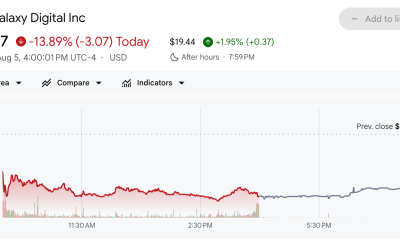
Galaxy Digital Stock Slides 14% as Crypto Prices Hit Earnings
-

 Business5 days ago
Brightwater secures funding for WA-first dementia projects
-

 Politics6 days ago
Comedian Jimmy Cricket Has Died, Aged 80
You must be logged in to post a comment Login