
Business
Is Starbucks App Down Again? Mobile Ordering Frustrates Users on Busy April 7, 2026

Starbucks customers across the United States reported widespread issues with the company’s mobile app Tuesday, with many unable to place orders, log in or complete payments during the morning rush as the coffee giant’s digital platform experienced another disruption amid ongoing reliability concerns.

Downdetector, which tracks user-reported outages, showed elevated complaints for Starbucks on April 7, with the majority — about 68% — centered on the app itself, followed by checkout problems at 30% and login difficulties at 1%. Users flooded social media with screenshots of error messages, spinning loading wheels and failed order attempts, many expressing frustration as they stood in longer lines or resorted to in-store cash or card payments.
As of mid-morning Pacific Time, Starbucks had not issued an official statement confirming a full outage, but the pattern of reports mirrored previous incidents where server-side issues or high traffic temporarily crippled mobile ordering. The Starbucks website remained accessible, and many physical locations continued operating normally, though mobile order and pay — a cornerstone of the company’s convenience strategy — appeared impacted for thousands.
This latest hiccup comes as Starbucks pushes its “Back to Starbucks” initiative under CEO Brian Niccol, which includes sunsetting up to 90 mobile-order-and-pickup-only locations by the end of fiscal 2026 to refocus on full-service cafes and in-store experiences. While the strategy aims to revitalize the brand and reduce reliance on app-heavy operations, customers who depend on the app for quick rewards redemptions, customized orders and contactless pickup voiced irritation at the timing.
“I can’t even add my usual latte to the cart — it just spins forever,” one user posted, echoing complaints that echoed past outages tied to high-demand periods or technical glitches.
Starbucks has faced recurring app troubles in recent years. Previous widespread disruptions, including those linked to broader cloud outages or heavy traffic during new menu launches, have drawn similar spikes in reports on Downdetector. In early 2026, users reported similar problems, with some attributing intermittent failures to iOS updates or backend server strain. The company has typically resolved such issues within hours, often without detailed public explanations beyond acknowledging “temporary technical difficulties.”
For a brand built on convenience and loyalty, the app is critical. Launched years ago and continually updated with features like personalized recommendations, Starbucks Rewards integration and seamless payment, the platform handles millions of transactions daily. It allows customers to order ahead, skip lines and earn stars toward free drinks — features that became especially vital during the pandemic and remain popular even as foot traffic rebounds.
Analysts note that repeated app instability could erode customer trust at a time when Starbucks is battling sluggish same-store sales growth, increased competition from rivals like Dutch Bros and local coffee shops, and internal operational challenges. The company has been closing underperforming stores and adjusting its menu and staffing to improve the in-cafe experience, but digital ordering remains a key growth driver.
Troubleshooting tips circulated quickly on social media and help sites. Common advice included closing and reopening the app, restarting the phone, checking for app updates, clearing cache, or reinstalling the software entirely. Users were also directed to check Downdetector or Starbucks’ official social channels for real-time updates. In many cases, these steps resolved individual issues when the problem was device-specific rather than a broad server outage.
Starbucks customer service has acknowledged past problems via its support accounts, sometimes directing users to wait or try alternative ordering methods. On Tuesday, no immediate dedicated post appeared addressing the reports, though the company has a history of restoring service quietly once engineers identify and fix the root cause — often related to capacity limits, software bugs or third-party integrations.
The timing of Tuesday’s issues coincided with typical morning peak hours when commuters and office workers rely heavily on mobile orders for their daily caffeine fix. In affected areas, baristas reported busier counters as customers shifted to in-person ordering, potentially slowing service and frustrating both patrons and staff.
Broader context reveals Starbucks’ digital transformation has been both a strength and a vulnerability. The app drives significant revenue through rewards members who spend more on average, but any downtime highlights the risks of heavy dependence on technology. The company continues investing in backend infrastructure, AI-driven personalization and loyalty enhancements, yet scaling reliably during surges remains a challenge shared by many retail apps.
Some customers used the moment to voice longer-standing grievances. Complaints about app glitches have appeared on Reddit’s r/starbucks forum for months, with threads discussing everything from loading errors after recent updates to persistent problems on certain iPhone models. Others noted that while the app usually recovers quickly, the frequency of disruptions feels higher than in prior years.
Starbucks, founded in 1971 and now operating thousands of locations worldwide, has leaned into technology to stay competitive. Features like mobile tipping, gift card management and seasonal promotions keep users engaged, but reliability is paramount. CEO Niccol, who joined in 2024, has emphasized returning to core coffeehouse roots while modernizing operations — a balance that includes refining the digital experience without over-relying on it.
As reports continued into the afternoon, some users noted partial recovery in certain regions or for lighter functions like browsing the menu. Others continued facing full blocks on ordering. Monitoring sites like IsItDownRightNow showed the main Starbucks website as operational, suggesting the issue was isolated to the mobile application backend rather than a total service collapse.
For affected customers, alternatives included using the website on a browser (though less convenient on phones), ordering in person or switching to competitors’ apps. Loyalty members worried about missing out on daily challenges or bonus stars, adding to the annoyance.
Industry observers say such outages, while temporary, underscore the need for robust redundancy in retail tech. Starbucks has not commented on specific investments in failover systems or expanded server capacity, but past incidents have prompted internal reviews.
By late morning, the volume of new reports on Downdetector appeared to moderate in some graphs, a common sign that resolution efforts were underway. Starbucks has resolved similar spikes within a few hours in the past, restoring full functionality without long-term impact.
Still, the episode serves as a reminder for heavy app users to have backup payment methods or flexibility in their routines. For a company whose stock and reputation ride on customer convenience, even short disruptions can amplify perceptions of unreliability during a period of brand revitalization.
Starbucks employs hundreds of thousands globally and generates tens of billions in annual revenue, with mobile orders forming a growing share of transactions. Its Rewards program boasts millions of members who expect seamless digital access.
As the day progressed, attention turned to whether the company would provide an official explanation or simply let the service normalize. In the meantime, baristas across the country likely fielded extra questions from disappointed app users.
For now, customers experiencing problems are encouraged to try basic troubleshooting or monitor official channels. Most incidents like Tuesday’s resolve without permanent data loss or reward issues, but the inconvenience highlights how integral the app has become to the modern Starbucks experience.
Whether this proves to be a minor blip or part of a larger pattern of digital growing pains will be watched closely by investors and loyal patrons alike. In the fast-paced world of specialty coffee, a few hours without mobile ordering can feel like an eternity — especially when that first cup of the day is on the line.

Business
Sebi grants relief in minimum public shareholding compliance norms, waives penalties amid Middle East conflict
Sebi’s relief comes following representations from industry bodies highlighting the difficulties in achieving compliance amid volatile markets. The regulator has decided to ease these provisions temporarily.
The relaxation takes effect immediately, with stock exchanges instructed to notify listed entities and make necessary amendments to their rules and regulations to implement the directive.
Under existing rules, companies that fail to comply with MPS requirements face penal actions such as fines, freezing of promoter shareholding and other restrictions as outlined in Sebi’s master circular on listing obligations.
Sebi said that listed entities whose deadlines for meeting MPS norms fall between April 1, 2026 and September 30, 2026 will be exempt from penal actions during this period. Stock exchanges and depositories have been directed not to initiate any punitive measures against such companies. Additionally, any penalties already imposed for non-compliance during this window will be withdrawn.

The move comes as heightened uncertainty and subdued investor participation have made it difficult for companies to dilute promoter holdings and raise public shareholding to mandated levels.
Earlier today, Sebi provided relief to companies planning to tap the capital markets by granting a one-time extension for the validity of its observation letters, citing challenging market conditions due to ongoing geopolitical tensions in the Middle East.Under existing norms, companies are required to launch their public issues within 12 to 18 months from the date of receiving SEBI’s observations. However, the regulator noted that issuers are facing difficulties in mobilising funds and accessing capital markets amid subdued investor participation and heightened uncertainty.
Read more: Sebi grants one-time extension for IPO observation validity amid geopolitical volatility
(Disclaimer: The recommendations, suggestions, views, and opinions given by the experts are their own. These do not represent the views of The Economic Times.)

Goldman Sachs Funds – Goldman Sachs India Equity Portfolio held over 29.51 lakh equity shares in the company, representing a 1.34% stake.
Shares of Cello World Limited remained largely steady on Tuesday even as a bulk deal took place in the counter. The stock ended at Rs 404, up Rs 2.20 or 0.55% from Monday’s closing price.
Goldman Sachs’ stake sale follows significant underperformance by the stock over the past year. Its share price has eroded by 24% in this period, while the Nifty and the BSE Sensex have traded flat.
The stock is currently trading below its 50-day and 200-day simple moving averages (SMAs) of Rs 446 and Rs 551, respectively, according to Trendlyne data.
Cello Plastic Industrial Works commenced offering plastic houseware products under the Cello brand in 1982. The company owns and operates 13 manufacturing facilities across five locations in India.
Cello World’s December quarter delivered a weak set of numbers, posting a consolidated net profit of Rs 64 crore, a 26.3% growth year-on-year. The company had reported a profit after tax (PAT) of Rs 86 crore in the year-ago period.The total revenue in the quarter under review stood at Rs 570 crore, flat compared with Rs 569 crore in the corresponding quarter of the last financial year.
Also read: Goldman Sachs picks stakes in Jio Financial, BHEL via block deals. Check sellers
(Disclaimer: The recommendations, suggestions, views, and opinions given by the experts are their own. These do not represent the views of The Economic Times.)

Shares of UnitedHealth jumped more than 10%, CVS Health nearly 7%, while Humana gained 8% and Elevance Health added 3%. The Centers for Medicare & Medicaid Services said late on Monday it would raise payments to private insurers offering Medicare Advantage plans to older adults in 2027 by 2.48% on average, much higher than the smaller-than-expected 0.09% rate increase that was proposed in January.
“This improvement should allow the industry to expand margins in 2027 when coupled with benefit cuts,” said Mizuho analyst Ann Hynes.
BETTER-THAN-FEARED RATES
Investors had expected a rate increase of at least 1%, Wall Street analysts had said earlier.
“This elevates the case for some margin growth in 2026 and lessens the growing perception that CMS’ harsh policy stance on the group is worsening,” said Leerink analyst Whit Mayo.
“At minimum, the sector will be perceived to be more investable.”Health insurers had argued the disappointing rates proposed in January did not reflect the reality of rising medical costs, which have been squeezing industry margins for nearly three years.
“The industry has continued to face a tough environment, but on the heels of this more favorable release, we might be seeing the tide changing,” Oppenheimer analyst Michael Wiederhorn said.
Insurers would also get a 2.5% benefit from a change to risk assessment payments related to health status, for a total increase of about 5%, a Medicare agency official said on Monday in a call with media.


Global cuisine awareness driving growth, co-founder says.
Financial influencer Taylor Price joins ‘Varney & Co.’ to break down how shifting your mindset can help Americans grow wealth and achieve the American Dream.
American consumers who are in the market for used cars are facing the highest prices in nearly three years, according to a new report.
Wholesale prices for used vehicles rose to their highest level since the summer of 2023 in March, with the Manheim Used Vehicle Value Index rising 6.2% year over year to a reading of 215.3.
Data from Manheim, a Cox Automotive brand and the largest wholesale marketplace in the U.S., found that demand for used vehicles remains strong. Values rose 1.4% in the month of March, which the report noted is well above long-term norms, and are up 2.3% from the start of 2026.
“As soon as this year began, prices at Manheim started moving higher as dealers anticipated strong demand from higher tax refunds to consumers,” said Jeremy Robb, chief economist at Cox Automotive.
AMERICANS DITCH EVS FOR BIGGER VEHICLES AS AUTO TRENDS REVERSE
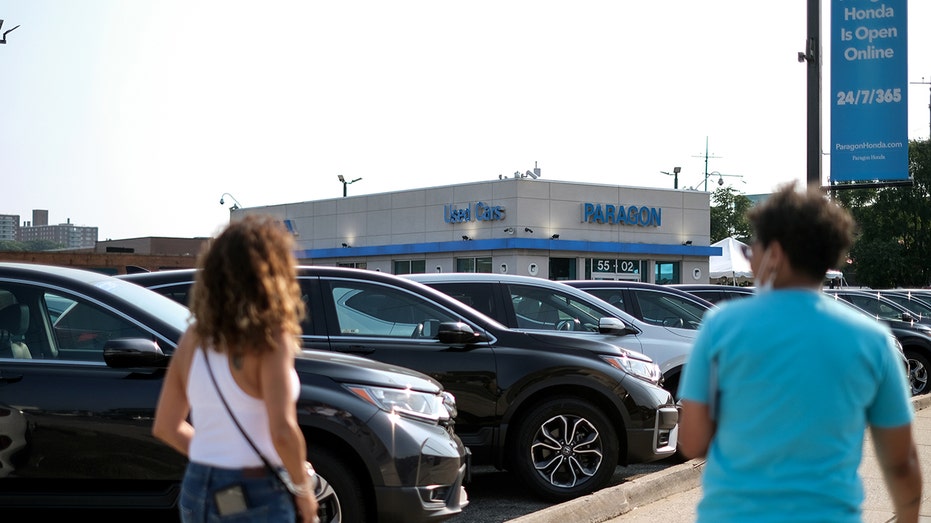
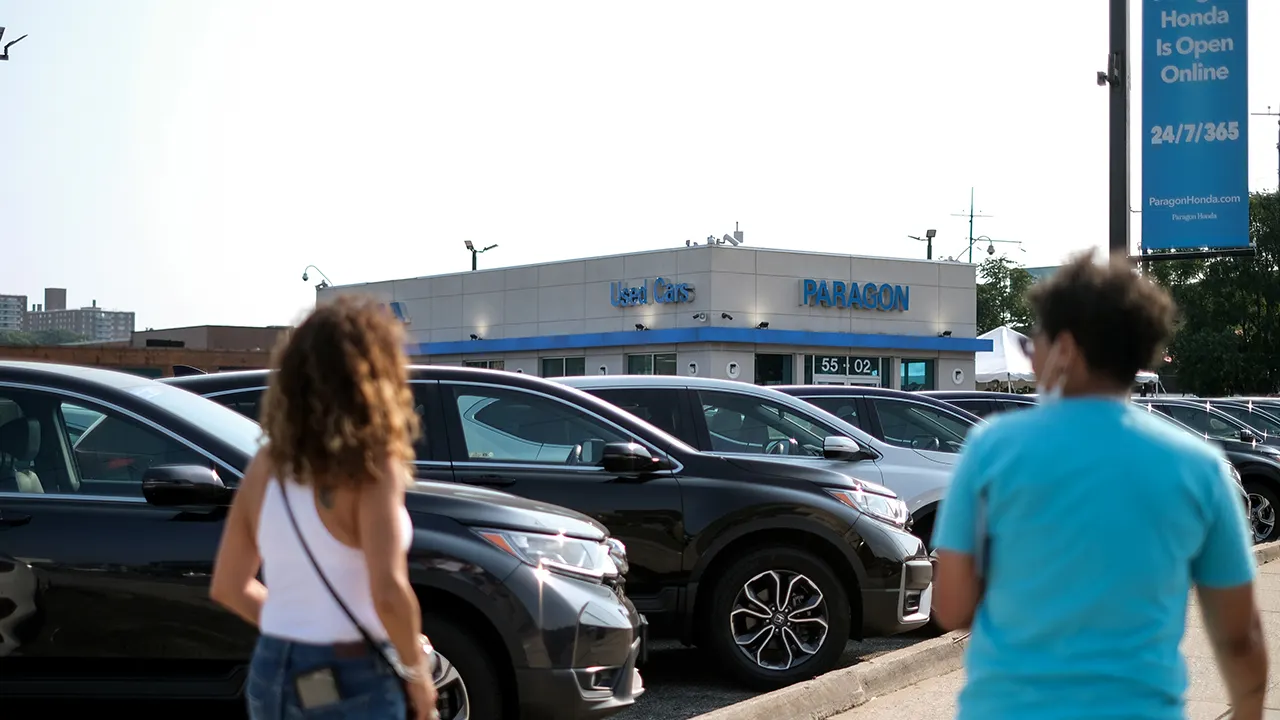
Used car prices at the wholesale level rose to their highest level in nearly three years, the Manheim data showed. (Bess Adler/Bloomberg via Getty Images)
“Sales conversion rates, a clear sign of demand, were higher against 2025 for every week but one in Q1, and vehicle value trends at auction show we are well ahead of last year and where we would normally be during a spring bounce in the wholesale markets,” Robb added.
“We thought we’d see some impact from the Middle East conflict, and that may still happen. But right now, the data is clear: used-vehicle demand is healthy and inventory levels are relatively tight,” he added.
CAR DEALERS WARNED BY FTC ABOUT DECEPTIVE PRICING PRACTICES, HIDDEN FEES
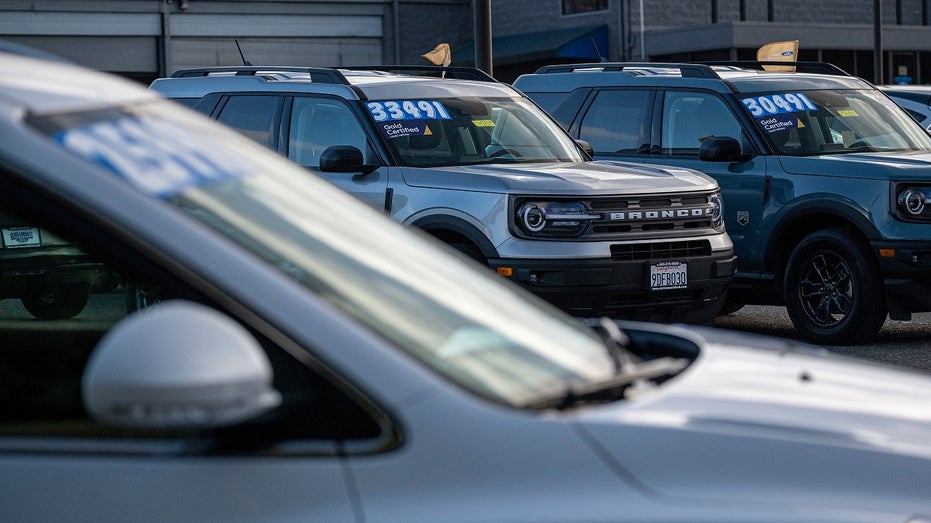
Cox said it’s unclear whether the Middle East conflict will impact U.S. consumer demand. (David Paul Morris/Bloomberg via Getty Images)
The Manheim report found that buyer activity was strengthening and there was increased competition for the available inventory in the wholesale lanes, as the sales conversion rate rose to 68.2% in March. That’s 4.6 percentage points higher than the most recent three-year average for March and is up 5.5 percentage points from the revised-higher February rate of 62.7%.
Used electric vehicles (EVs) also showed strength in the first quarter with firm pricing and activity for the quarter as values rose alongside the seasonal increase.
It noted that used EVs offer consumers affordability advantages over new EVs, while there’s also an increasing flow of off-lease EVs entering wholesale channels.
FORD WINS OVER DEMOCRATS AND REPUBLICANS AS ‘MOST AMERICAN’ BRAND IN NEW SURVEY

Demand for used EVs has been strong given the affordability differential with new EVs, the report found. (David Paul Morris/Bloomberg via Getty Images)
Retail used vehicle sales also showed momentum, with first quarter sales up about 2% compared with the same level a year ago. Inventory also tightened, with the days’ supply metric declining below 40 in March, which was the lowest point this year and down from a year ago.
Cox Automotive’s outlook for 2026 sees used vehicles continuing a stronger-than-expected start to the year, before being offset by a softer second half of 2026 with total used vehicle sales declining 1% year over year.
“As we move towards summer, we expect Manheim values to hold their ground with many more consumers yet to file their tax returns this year,” Robb said.
GET FOX BUSINESS ON THE GO BY CLICKING HERE
“The end of March typically proves to be the ‘peak’ for price action at Manheim. The Middle East conflict could dampen the spirits of the U.S. consumer, but we just haven’t seen it yet – our data is showing resiliency in the economy,” Robb said.


Turning Startup Challenges into Growth will be on April 15.
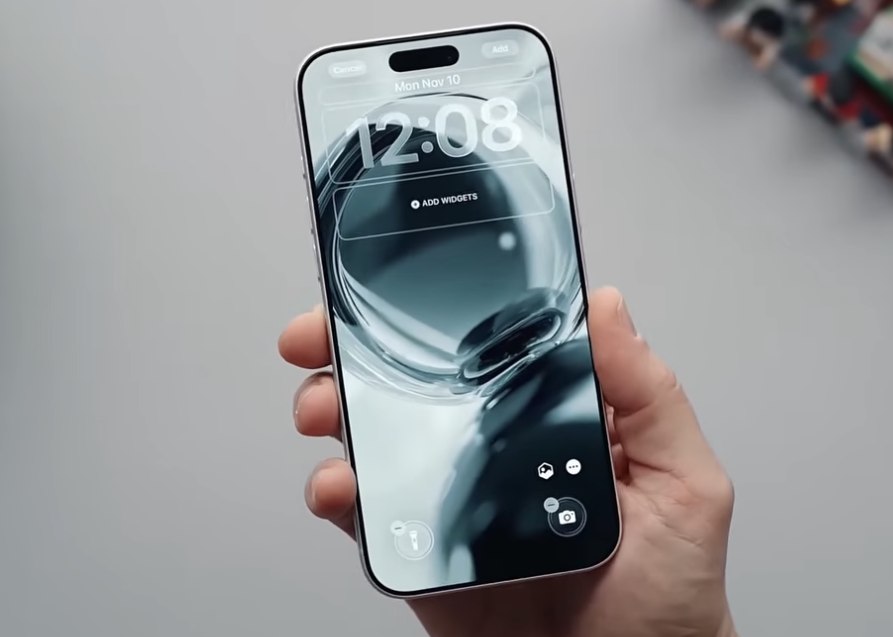
Fresh leaks about Apple’s iPhone 18 Pro models promise significant upgrades for the 2026 lineup, including the company’s first 2-nanometer A20 Pro chip, a dramatically smaller Dynamic Island cutout and a striking new deep red color option that could replace the traditional black finish.

The reports, circulating widely in early April 2026, paint the iPhone 18 Pro and iPhone 18 Pro Max as evolutionary yet meaningful steps forward, even as attention shifts toward Apple’s anticipated foldable iPhone launching alongside them in September. Analysts say the combination of advanced chip technology, refined design elements and improved efficiency could help Apple maintain its premium positioning amid intensifying competition from Android flagships.
The most talked-about upgrade centers on the processor. Multiple reliable sources indicate the iPhone 18 Pro models will feature the A20 Pro chip, built on TSMC’s first-generation 2nm process. This marks a major leap from the 3nm architecture used in the current A19 Pro. The shift to 2nm is expected to deliver noticeable gains in both performance and power efficiency, potentially up to 15% faster processing and 30% better energy savings compared with the previous generation.
The new manufacturing process also incorporates Wafer-Level Multi-Chip Module (WMCM) packaging, which integrates the CPU, GPU, Neural Engine and RAM more closely on the same wafer. This tighter integration could boost memory bandwidth and enable more flexible configurations for demanding AI tasks. Rumors suggest the Pro models may ship with 12GB of RAM, up from 8GB in recent generations, further enhancing multitasking and on-device artificial intelligence capabilities.
Apple’s in-house C2 5G modem is also expected to debut, promising improved connectivity, lower power draw and better performance in challenging signal conditions. Combined with the efficient 2nm chip, these changes could translate into meaningfully longer battery life — a perennial user request.
Leaks point to a Pro Max battery exceeding 5,000 mAh for the first time, possibly reaching 5,100 to 5,200 mAh depending on whether the model includes a physical SIM tray. The standard iPhone 18 Pro could see a more modest but still improved capacity around 4,100 mAh or higher. Faster charging up to 40W wired is another rumored enhancement.
Design-wise, one of the most visible changes involves the Dynamic Island. Recent leaks suggest the pill-shaped cutout on the iPhone 18 Pro could shrink by approximately 35%, giving users more usable screen real estate while retaining the interactive notification and control features introduced with the iPhone 14 Pro. Some reports indicate this reduction may come alongside progress toward under-display Face ID, though full implementation might not arrive until later models. The front camera could shift to the top-left corner in certain configurations, further minimizing the notch area.
The rear camera system is expected to retain the triple 48-megapixel setup — main, ultrawide and telephoto — but with meaningful refinements. A variable aperture on the main Fusion camera would allow users greater control over depth of field and light intake, mimicking professional camera behavior. Other rumored camera tweaks include an 18MP selfie camera with improved Center Stage capabilities.
On the exterior, Apple is reportedly testing a deep red finish as the signature color for the iPhone 18 Pro lineup. The bold hue could join more traditional options while notably skipping the black titanium finish that has been a staple in recent Pro models. A “coffee” or bronze-like shade has also been mentioned in some leaks. The overall chassis is expected to maintain the same 6.3-inch and 6.9-inch display sizes as the current generation, with the familiar camera “plateau” housing the triple-lens array. A slightly thicker and more uniform design has been floated, potentially to accommodate larger batteries and improved thermal management via a stainless steel vapor chamber.
These changes arrive as Apple navigates a transitional period. The standard iPhone 18 models may face a delayed launch until spring 2027, shifting the spotlight entirely to the Pro duo and the new foldable device in the fall 2026 event. That foldable iPhone, expected to measure roughly 5.5 inches when closed and 7.8 inches when open, is also rumored to use the A20 Pro chip, creating a cohesive high-end ecosystem.
Industry watchers say the 2nm process represents a critical milestone for Apple’s silicon ambitions. TSMC’s N2 technology is viewed as one of the most advanced in the semiconductor industry, promising denser transistor packing that benefits everything from gaming performance to machine learning inference. Enhanced Neural Engine capabilities could supercharge Apple Intelligence features, enabling more sophisticated on-device processing with greater privacy and speed.
Battery and thermal improvements are particularly important as devices handle increasingly complex AI workloads. Longer runtime without compromising the slim form factor remains a key selling point for premium smartphones.
The smaller Dynamic Island addresses a common aesthetic complaint while preserving functionality. Early concept renders circulating online show a noticeably sleeker front face, which could make the iPhone 18 Pro feel more modern and immersive for media consumption and productivity.
Color choices have always generated buzz in Apple’s lineup. A deep red option would echo past vibrant finishes like (PRODUCT)RED while offering a fresh, premium look that stands out from the titanium grays and blues of recent years. Dropping black could disappoint some traditionalists but aligns with Apple’s pattern of refreshing its palette periodically.
Pricing is expected to remain in line with current Pro models, starting around $999 for the iPhone 18 Pro and $1,199 for the Pro Max, though storage tiers and regional variations could influence final figures. Storage options may extend to 2TB on higher-end configurations.
Supply chain analysts note that moving to 2nm production involves significant technical and cost challenges. Yields on the new process could initially be lower, but Apple’s close partnership with TSMC typically ensures priority access and rapid improvements.
As excitement builds, some caveats remain. Many details stem from unverified leaks and analyst notes, and Apple has a history of refining or altering plans before launch. Official confirmation won’t arrive until the expected September 2026 keynote.
Still, the early buzz suggests the iPhone 18 Pro could deliver one of the most substantial under-the-hood upgrades in recent cycles. The combination of cutting-edge 2nm silicon, refined display elements and thoughtful design tweaks positions it as a compelling upgrade for users seeking peak performance and longevity.
For consumers holding onto older iPhones, the rumored efficiency gains and battery improvements may provide extra incentive to wait. Photography enthusiasts are particularly intrigued by the variable aperture possibility, which could elevate mobile imaging beyond current capabilities.
Apple continues to face pressure to innovate amid slowing iPhone sales growth in some markets and rising competition from foldable devices offered by Samsung and Chinese manufacturers. The 2026 lineup, including the foldable, represents a pivotal moment as the company balances incremental Pro refinements with bolder form-factor experiments.
Whether the deep red color becomes an instant classic or the smaller Dynamic Island noticeably improves the everyday experience will ultimately be judged by users when the devices ship. For now, the leaks have generated considerable anticipation and discussion across tech communities.
As development continues through the summer, more concrete details are likely to surface. In the meantime, the iPhone 18 Pro appears poised to carry forward Apple’s tradition of blending powerful hardware with elegant design — this time with a bolder color palette and more efficient core technology at its heart.

Wolf Richter is the analyst at, and the publisher of, WOLF STREET, where he discusses business, finance, and money. Core focus: Federal Reserve, credits, equities, residential and commercial real estate, the auto industry, trade, consumers, and energy. He started this operation in 2011. Prior to that, he worked for 20 years in C-level positions, including 10 years in the auto industry. MBA from the University of Texas at Austin.

Iraqi militia group to release abducted U.S. journalist
Business
Wedding Planner Shuts Down Taylor Swift-Travis Kelce Ocean House Rumors: 'Taylor Is Not My Bride'

A prominent luxury wedding planner has directly debunked viral speculation that Taylor Swift and Travis Kelce will tie the knot at Rhode Island’s exclusive Ocean House resort on June 13, delivering a clear message to eager fans and tabloids: “Taylor is not my bride this weekend!”

Apple’s iPhone Fold might debut at the September launch event after all

The Importance of Trade in Islam | Sunnah for Financial Success

Lost parrot reunited with owner after Dublin Airport stay


-

 NewsBeat5 days ago
Steven Gerrard disagrees with Gary Neville over ‘shock’ Chelsea and Arsenal claim | Football
-

 Business5 days ago
No Jackpot Winner and $194 Million Prize Rolls Over
-

 Fashion4 days ago
Weekend Open Thread: Spanx – Corporette.com
-

 Crypto World6 days ago
Gold Price Prediction: Worst Month in 17 Years fo Save Haven Rock
-

 Business2 days ago
Three Gulf funds agree to back Paramount’s $81 billion takeover of Warner, WSJ reports
-

 Business4 days ago
Expert Picks for Every Need
-

 Sports3 days ago
India men’s 4x400m and mixed 4x100m relay teams register big progress | Other Sports News
-

 Business6 days ago
Login and Checkout Issues Spark Merchant Frustration
-

 Crypto World7 days ago
Bitcoin enters the public bond market as Moody’s gives a first-of-its-kind crypto deal a rating
-
Business2 days ago
No Jackpot Winner, Prize to Climb to $231 Million
-
Crypto World7 days ago
Bitcoin stalls below key resistance as technical signals skew bearish
-

 Tech5 days ago
Commonwealth Fusion Systems leans on magnets for near-term revenue
-

 Politics7 days ago
Starmer’s centre has collapsed, and the left was right all along
-

 Fashion1 day ago
Massimo Dutti Offers Inspiration for Your Summer Mood Board
-

 Crypto World6 days ago
Ripple rolls out enterprise crypto treasury platform for corporates
-

 Crypto World6 days ago
Why It’s Partnering, Not Issuing
-
Crypto World7 days ago
AI Memory Rout Wipes 9% Off Nvidia Stock: Chart Says More Pain Ahead
-

 Business3 days ago
Akebia Therapeutics, Inc. (AKBA) Discusses Pipeline Progress and Strategic Focus on Kidney Disease Treatments at R&D Day – Slideshow
-

 Tech7 days ago
Solo Leveling: Ranking All Sung Jinwoo Shadows by Power
-

 Tech6 days ago
Drawing Tablet Controls Laser In Real-Time
You must be logged in to post a comment Login