
Business
Is the UK Falling Behind the Rest of the World on Full Fibre Broadband?


For years, Britain had an uncomfortable problem with its broadband infrastructure. While countries including Spain, Japan and South Korea pushed fibre deeper into their fixed networks, millions of UK homes continued to rely on copper for the final stretch of their connection.
That gap has not disappeared. But it is closing remarkably quickly.
Full-fibre broadband was available to 82% of UK homes by January 2026, according to Ofcom, up from less than a quarter just five years earlier. Gigabit-capable broadband, which also includes technologies other than full fibre, had reached 89% of homes.
The figures represent one of the fastest infrastructure transformations Britain has undertaken in recent years. They also complicate the familiar argument that the UK is simply falling behind the rest of the world.
Britain was late to the fibre race. Increasingly, however, it is becoming one of its fastest runners.
The countries Britain is still chasing
There remains a group of countries where fibre is considerably more mature.
Ofcom’s international comparison for the first quarter of 2025 put full-fibre coverage at 100% in Singapore, Japan and Spain, followed by South Korea at 99% and France at 95%. The UK stood at 77% at the time, ranking sixth among the countries compared.
Other measures tell a similar story. Across the OECD, fibre accounted for 44.6% of fixed broadband subscriptions by mid-2024, but the proportion was dramatically higher in some markets. Iceland, South Korea and Spain were among the countries where fibre represented more than 80% of fixed broadband connections.
These countries did not necessarily arrive there in the same way.
South Korea and Japan benefited from dense urban populations and began investing heavily in fibre infrastructure much earlier. Spain combined favourable deployment economics in its cities with sustained investment by competing operators. France pursued an aggressive nationwide programme that extended fibre well beyond its largest urban centres.
Britain, by contrast, spent years extracting more performance from its existing copper and cable infrastructure.
That approach was economically rational. Fibre-to-the-cabinet could provide much faster broadband without replacing the final copper connection into every property, while cable networks provided another route to higher speeds.
But it also delayed the point at which fibre would need to be built all the way to millions of individual premises.
Britain is now building at extraordinary speed
The result is an unusual position: Britain remains behind the world’s most mature fibre markets while simultaneously carrying out one of Europe’s largest fibre deployments.
Ofcom says the UK has gone from full fibre reaching less than one in four homes five years ago to more than eight in ten today. In the six months to January 2026 alone, another 1.2 million homes gained access.
Much of that acceleration has come from competition.
Openreach remains the country’s largest fixed network operator, but it is no longer building in isolation. Virgin Media O2, CityFibre and a collection of smaller alternative networks have invested heavily in their own infrastructure, sometimes building competing fibre networks in the same towns and cities.
That competition has not been painless. Some alternative network operators have struggled to convert homes passed into paying customers, while consolidation across the sector has become increasingly likely as investors scrutinise the returns generated by duplicated infrastructure.
For consumers, however, the investment boom has helped turn Britain’s fibre deficit into a rapidly shrinking one.
Geography changes the economics
International broadband rankings can obscure just how different the challenge is from one country to another.
Countries such as South Korea and Japan combine highly urbanised populations with relatively high population density, making it possible for networks to reach large numbers of households efficiently. Spain has also benefited from dense cities and extensive fibre investment, helping it become one of Europe’s most mature fibre markets.
The challenge looks different in larger and more sparsely populated countries. Canada and Australia, for example, must connect populations spread across enormous geographic areas, while the United States combines dense metropolitan markets with vast rural regions where the economics of fixed infrastructure can be considerably more difficult.
“Fibre coverage is difficult to compare between countries without considering the geography behind the numbers,” says Tomas Novosad of Home Internet Plans. “Population density, the distance between communities and the infrastructure already in place can dramatically change the economics of a fibre rollout. Reaching another million premises in one country may require a very different level of investment than reaching the same number somewhere else.”
Britain sits in a comparatively favourable position. Its relatively high population density and compact geography allow network operators to reach large numbers of premises without covering the distances required in countries such as Canada or Australia.
That advantage becomes less significant, however, as coverage approaches universality. The homes left behind tend to be precisely those that are most difficult and expensive to connect.
The last homes are the hardest
This is where Britain’s fibre story enters its next and potentially more difficult stage.
Ofcom forecasts that full-fibre networks could reach 96% of UK premises by 2027 if operators complete their planned deployments.
Reaching the remaining premises is another matter.
Commercial networks naturally prioritise areas where the cost of construction can be justified by the number of potential customers. Remote homes, isolated communities and difficult terrain can produce precisely the opposite equation: substantial construction costs for relatively few connections.
That is why public programmes such as Project Gigabit remain important even as commercial fibre coverage approaches nationwide levels. The challenge is increasingly not bringing faster broadband to Britain’s major population centres, but preventing the final pockets of the country from being left behind as networks move away from copper.
It also means the definition of success is changing.
Five years ago, the central question was how quickly Britain could build fibre. As coverage approaches maturity, the questions increasingly concern who remains unconnected, how much it costs to reach them and whether consumers actually migrate onto the new networks once they arrive.
From catching up to finishing the job
So, is Britain falling behind?
Against the world’s fibre leaders, the UK still has ground to make up. Countries such as Spain, Japan and South Korea reached near-universal fibre coverage earlier, while Britain spent longer relying on technologies that incorporated its existing copper and cable infrastructure.
But describing Britain today simply as a broadband laggard misses what has happened over the past five years.
The country has moved from less than a quarter of homes having access to full fibre to more than four in five. It now ranks ahead of several comparable developed economies on full-fibre availability, and network operators are approaching the expensive final stage of nationwide deployment.
Britain entered the full-fibre era late.
The more relevant question now is whether it can finish the rollout as strongly as it has caught up.


Pensacola, Florida-area resident Jacob Rockwell joins ‘The Sunday Briefing’ to discuss his concerns over red-light camera surveillance and raises questions about who is liable for camera tickets after disputing his own out-of-state citation.
Florida drivers may soon see fewer high-tech eyes monitoring their highway commutes after state officials ordered local police to strip automated license plate readers from state roads, dealing a blow to private surveillance vendors like Flock Safety while drawing a hard boundary against what Gov. Ron DeSantis warns is an expanding “digital AI surveillance state.”
“If you want to get in your car and you want to go down to Buc-ee’s in St. Augustine, it’s really none of the government’s damn business if you’re doing that, right? What we don’t want in the state of Florida is to have a digital AI surveillance state where everything we’re doing is being tracked at all times,” DeSantis said at a Monday news conference.
“There’s obviously times when I think it’s probably been useful, but where is this data going?” the governor continued. “They claim that the companies aren’t going to misuse it, but no one’s watching that. And I know you can make some money selling cameras, but you really can make a lot of money if you can sell people’s data.”
DeSantis’ comments come as the Florida Department of Transportation announced in a one-page memo Monday that it was revoking existing permits for automated license plate readers within state highway rights-of-way and giving law enforcement agencies 30 days to remove existing devices.
FDOT said the action was prompted by the rapid expansion of automated license plate readers, along with reports of misuse, data privacy concerns and surveillance schemes. The license plate readers record vehicle sightings, feed searchable databases and, when agencies choose to share data, can connect searches across jurisdictional lines.
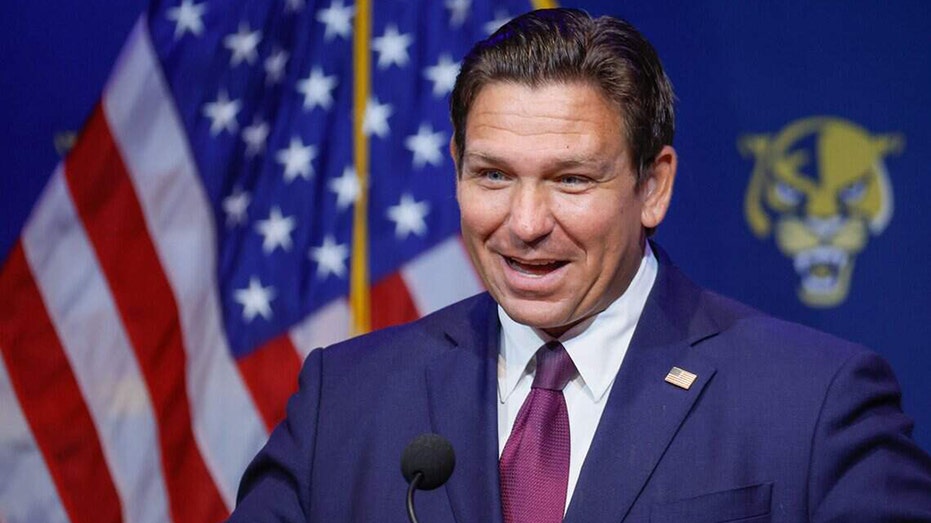
Florida Gov. Ron DeSantis holds a press conference at Florida International University in Miami on Wednesday, Aug. 26, 2026. (Getty Images)
Automated license plate readers (ALPRs), which are often small, solar-powered cameras mounted on poles, buildings or police cars, can capture vehicle license plates and locations as drivers pass by. Flock Safety, one of the leading ALPR vendors, has rapidly expanded its business with law enforcement, municipalities and businesses in recent years.
The ACLU says about 120,000 Flock cameras are currently installed nationwide.
“I guarantee you every sheriff in Florida can point to examples where it’s been used appropriately and probably effectively. And I have no doubt that that’s the case. But you also have to say, okay, how could this be misused?” DeSantis said.
Rep. Byron Donalds, R-Fla., joins ‘Varney & Co.’ to discuss the gubernatorial race, his position on data centers and Florida’s ban on flock cameras.
“We know there was an officer in Florida who was using the LPR data to track, like, an ex-girlfriend or something like that. I don’t think we have really strong penalties at all for that type of misuse,” he added. “So I’ve called for legislation that will protect Floridians from allowing the state to turn it into some type of digital prison, digital surveillance state where somebody knows everything about what you’re doing every day of the week.”
In a statement to Fox News Digital, a Flock spokesperson said, “Flock’s technology is an important public safety tool for law enforcement agencies across Florida, helping officers solve serious crimes, find missing people, recover stolen vehicles and support safer communities. In just the last few weeks in Florida, the technology was used to find missing children, led to the arrest of a murder suspect and assisted in solving numerous other crimes.”
“Rather than banning a critical public safety tool,” the spokesperson continued, “we support thoughtful legislation and strong privacy, transparency and accountability guardrails that ensure technology is used responsibly while preserving law enforcement’s ability to use effective tools to keep people safe.”
Knox County commissioners Larsen Jay and Andy Fox discuss privacy concerns over flock cameras in their area on ‘The Bottom Line.’
DeSantis’ office did not immediately respond to Fox News Digital’s request for comment.
GET FOX BUSINESS ON THE GO BY CLICKING HERE
Florida’s directive mirrors broader pushback across the country. Texas Gov. Greg Abbott recently halted state funding for Flock cameras, while municipalities across the U.S. have ended or declined to renew contracts with the company.
Public resistance has also escalated into proposed class-action lawsuits and reports of camera vandalism in dozens of states across the U.S.
Fox News’ Kerri Kupec Urbahn contributed to this report.

Consumer expert Harry Kind explains how you can get your money back.

Earnings call transcript: Michelmersh Brick H1 2026 profit gains offset weak sales

The new prime minister tells the Commons they can lift the prospects of all people in all places.


MSc in Finance. Long-term horizon investor mostly with 2-5 year horizon. I like to keep investing simple. I believe a portfolio should consist of a mix of growth, value, and dividend-paying stocks but usually end up looking for value more than anything. I also sell options from time to time.
Analyst’s Disclosure: I/we have no stock, option or similar derivative position in any of the companies mentioned, but may initiate a beneficial Long position through a purchase of the stock, or the purchase of call options or similar derivatives in DSP over the next 72 hours. I wrote this article myself, and it expresses my own opinions. I am not receiving compensation for it (other than from Seeking Alpha). I have no business relationship with any company whose stock is mentioned in this article.
Seeking Alpha’s Disclosure: Past performance is no guarantee of future results. No recommendation or advice is being given as to whether any investment is suitable for a particular investor. Any views or opinions expressed above may not reflect those of Seeking Alpha as a whole. Seeking Alpha is not a licensed securities dealer, broker or US investment adviser or investment bank. Our analysts are third party authors that include both professional investors and individual investors who may not be licensed or certified by any institute or regulatory body.


NYC Mayor Zohran Mamdani states he’s not interested in a ‘back and forth’ with Benjamin Netanyahu, claiming one of his top priorities is keeping Jewish New Yorkers safe.
Bank of America Vice President Erin Piacenti was killed during a high-profile stabbing in New York City’s Times Square on Monday.
The New York City Police Department (NYPD) identified Erin Piacenti, 32, of Chester, New Jersey, as the deceased victim.
Bank of America acknowledged Piacenti’s death in an email obtained by Reuters.
“We are shocked and deeply saddened by the tragic loss of our colleague. She was a valued teammate who will be greatly missed. Our hearts go out to her family and all of her loved ones,” the bank wrote in the email.
After receiving a 911 call shortly before 4:30 p.m. on Monday, NYPD officers found a 49-year-old woman wielding two knives in Times Square.
Officers shot the assailant, who was later pronounced dead at the hospital.
GET FOX BUSINESS ON THE GO BY CLICKING HERE
This is a developing story. Please check back for updates.

VFLO: Outstanding Returns And Appealing Fundamentals Lead To Buy Rating

Burnham said his government’s first moves were designed to give people ‘breathing space’.

Medtronic (MDT) stock popped Tuesday as its diabetes spinoff Minimed (MMED) rallied, reversing premarket losses, after both lifted their full-year guidance. Medtronic posted organic sales growth of 13.7%, roughly 200 basis points above the midpoint of its guidance, Evercore ISI analyst Vijay Kumar said in a report. Importantly, cardiovascular and medical-surgical sales all topped forecasts, but neuroscience coming in line.…
Copyright ©2026 Investor’s Business Daily, LLC. All rights reserved. 87990cbe856818d5eddac44c7b1cdeb8

Check out what’s clicking on FoxBusiness.com.
Dyson is expanding into oral care with a $499 smart toothbrush that uses a built-in camera and targeted liquid jet to clean between teeth.
The CameraJet, which launches on Tuesday, uses a 100,000-pixel macro camera and artificial intelligence to identify gaps between teeth and automatically directs mouthrinse toward them.
The $499 device marks Dyson’s latest expansion beyond the vacuum cleaners and hair care products for which the company is best known, adding another high-priced consumer product to its lineup.
Dyson says the camera can analyze 28 images per second. Its software can trigger the jet within 100 milliseconds of detecting a gap.
LASER-WIELDING MOSQUITO KILLER HITS MARKET PROMISING TO TRACK AND ZAP BACKYARD PESTS MIDAIR

The $499 device marks Dyson’s latest expansion beyond the vacuum cleaners and hair-care products. (Dyson)
The CameraJet uses a conical liquid jet rather than the narrow stream found on traditional water flossers. Dyson says the system is designed to remove plaque between teeth while operating at lower pressure.
A 12.5-milliliter reservoir holds mouthrinse, while an included dock can refill the tank in about three seconds, according to the company.

Users can connect the device to the MyDyson app for live camera viewing. (Dyson)
Users can connect the device to the MyDyson app for live camera viewing, cleaning guidance, coverage maps and feedback on brushing technique.
Dyson says images are not stored or shared and that processing takes place on the device.
The company also says laboratory testing found the CameraJet removed nearly 70% more plaque in hard-to-reach areas than premium electric toothbrushes under certain test conditions. Dyson conducted the testing using proxy plaque developed through research with the National University of Singapore.
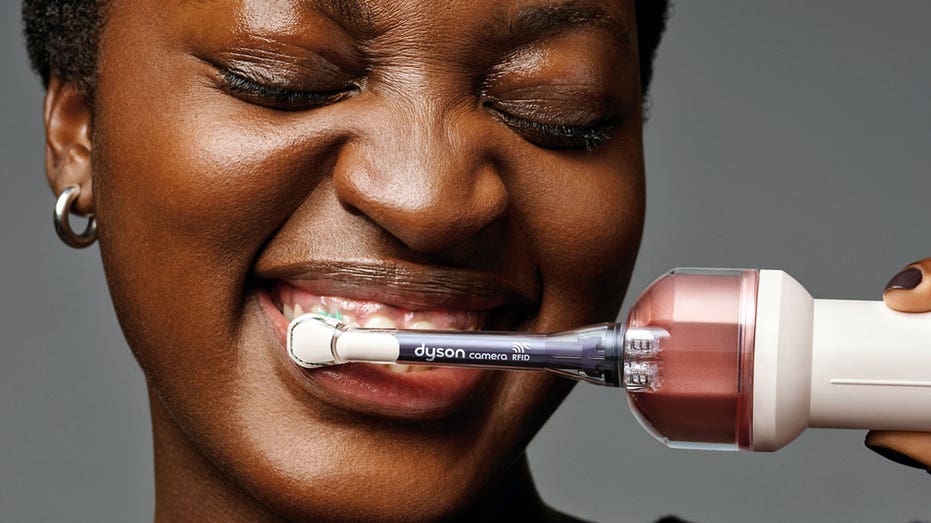
Dyson says images are not stored or shared and that processing takes place on the device. (Dyson)
Dyson is also developing low-foaming mouthrinse and SLS-free toothpaste for use with the device.
CLICK HERE TO GET FOX BUSINESS ON THE GO
The CameraJet is available through Dyson’s website and Dyson Demo Stores.

21 Financial Giants Form Venture for G7 Stablecoins

Sacha Baron Cohen’s Ali G Movie Faces Boycott

Travis Kelce finally shares glimpse of new dog with Taylor Swift as pup makes public debut alongside NFL star… with adorable name ‘revealed’



![Everyone Wants a Bitcoin Pullback. History Says They Don't Get One [Kalshi Live Trading]](https://wordupnews.com/wp-content/uploads/2026/09/1788281404_maxresdefault-80x80.jpg)


-

 Crypto World7 days ago
SpaceX stock could rise 75% to $240, JPMorgan says
-

 Fashion4 days ago
Weekend Open Thread: Maeve – Corporette.com
-

 Crypto World5 days ago
Bitcoin’s 22% rally now needs real demand to outlast Treasury liquidity boost
-

 Crypto World6 days ago
Warsh Jackson Hole keynote puts financial innovation first
-

 Business5 days ago
Salesforce Stock Soars 19% as Blowout Earnings and Agentforce AI Growth Silence Software Skeptics
-

 Crypto World6 days ago
Elon Musk Grok Bot Promise: We Will Make You Whole if AI Loses Your Money
-

 Business5 days ago
Apple Confirms September 9 Keynote and Reveals Its Full Pre-Order Schedule
-

 Crypto World7 days ago
Did Trump Just Move SpaceX Stock With One Truth Social Post?
-

 Business4 days ago
Onto Innovation Stock: AI’s Next Bottleneck Is Yield (NYSE:ONTO)
-
 NewsBeat6 days ago
Lindsay Clancy jury braces for closing arguments as judge tells court: ‘You’ve heard all the evidence’ – Live updates
-

 Business6 days ago
Walmart takes aim at younger shoppers with new fashion brand
-

 Crypto World4 days ago
Bitcoin price tests $82K resistance as Brandt stays long
-

 Crypto World6 days ago
NVIDIA revenue hits $96.2B as AI demand doubles
-

 Business7 days ago
Thailand’s Eastern Economic Corridor Capital City (EECiti): Key Developments and Investment Opportunities
-

 Business4 days ago
iPhone 18 Pro Pre-Orders Could Shift to Saturday as Apple Reportedly Avoids September 11 Anniversary
-

 NewsBeat7 days ago
Trump’s trade truce with China faces test with Iran effort
-
 Crypto World6 days ago
Nvidia Q2 Earnings Reveal $96.2 Billion Beat, So Why Is NVDA Falling?
-
 Tech3 days ago
Hugging Face built a $4.5 billion empire on free AI models. Now Nvidia is buying it for $12.9 billion
-

 Tech6 days ago
Claude Cowork gets its own browser that doesn’t touch your tabs, bookmarks, or saved passwords
-

 Crypto World5 days ago
Truflation calls for Fed rate cut after PCE forecast
You must be logged in to post a comment Login