
Business
Jury in Lindsay Clancy’s US murder trial deliberates for fifth day after reporting deadlock





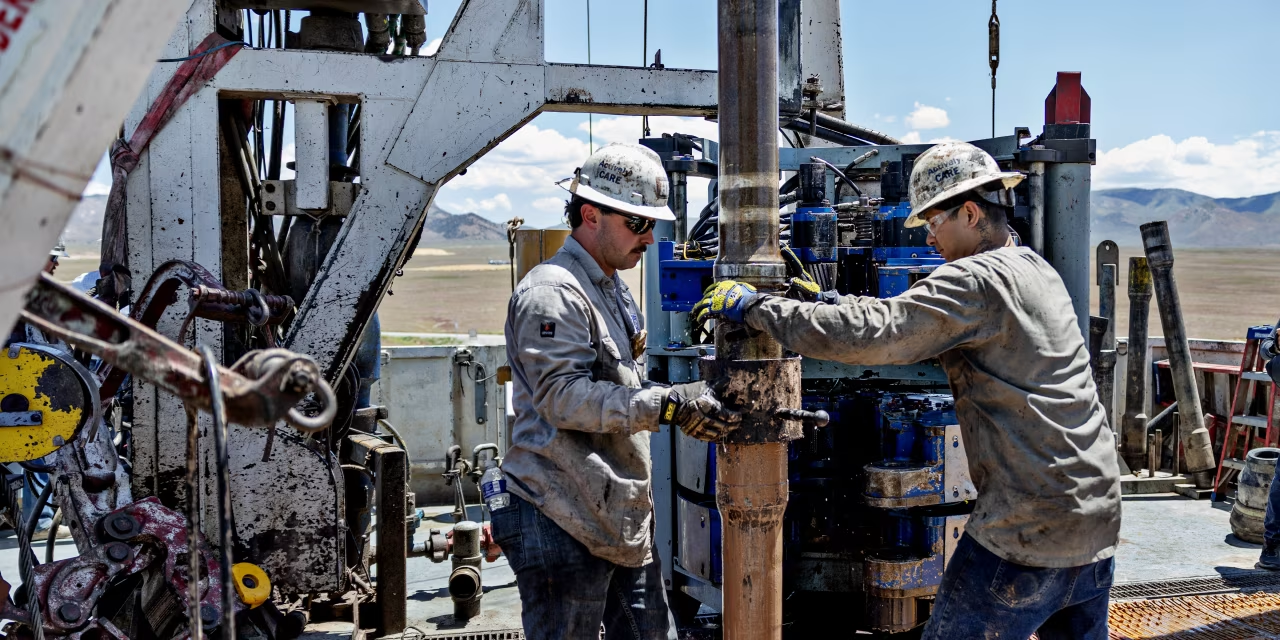
Geothermal company Fervo FRVO -9.42%decrease; down pointing triangle Energy has signed a major deal to sell power to Alphabet’s GOOGL 1.01%increase; up pointing triangle Google from a Utah project that it plans to turn into the world’s largest enhanced geothermal facility.
The agreement for nearly 400 megawatts of electricity is enough to power a midsize city and would be Fervo’s largest-ever power deal. Fervo plans to begin selling power to Google in 2028 from its Cape Station project in southwestern Utah.
Copyright ©2026 Dow Jones & Company, Inc. All Rights Reserved. 87990cbe856818d5eddac44c7b1cdeb8

Fed survey shows economic activity edged up, prices rose moderately in recent weeks
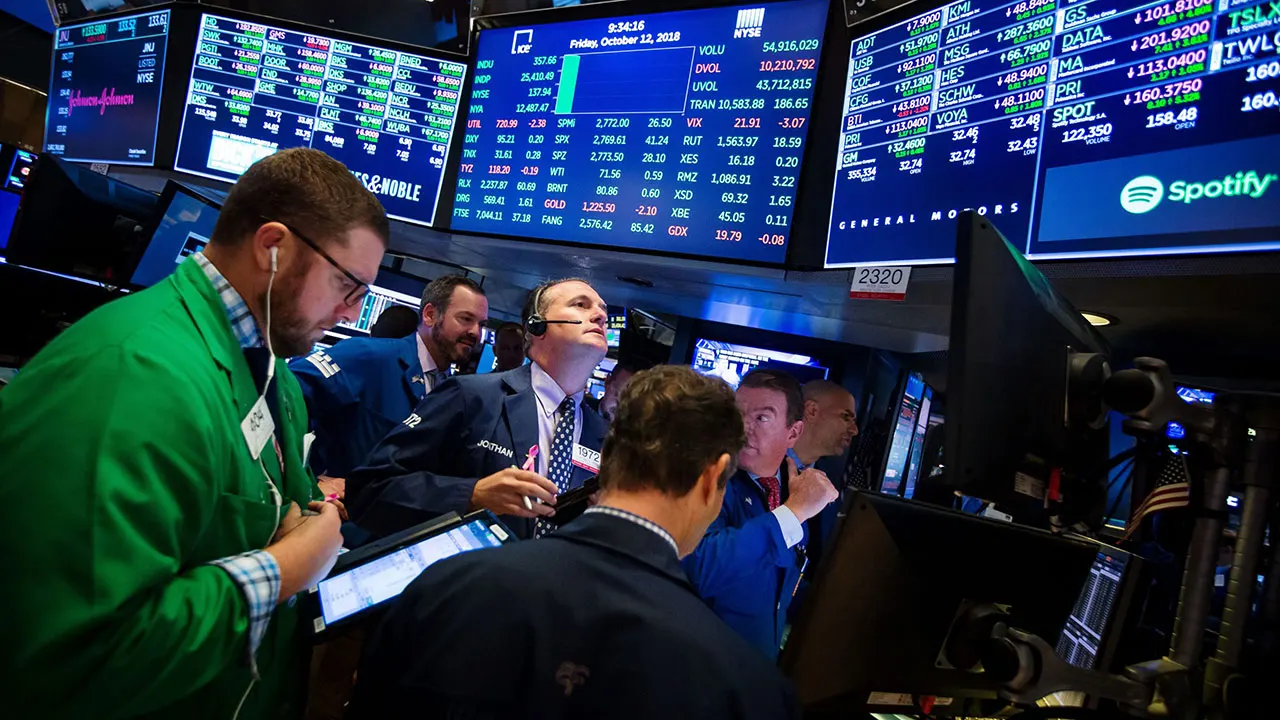
Financial Markets Economist John Lonski discusses whether the U.S. economy is reaccelerating under Trump. Lonski analyzes rising bond yields and consumer sentiment.
Yields on U.S. Treasurys hovered near multi-year highs on Wednesday, as the global bond market experienced a sell-off amid concerns over energy prices keeping inflation elevated as well as government debt burdens.
The yield on the benchmark 10-year Treasury note was around 4.8% in the early afternoon on Wednesday, slightly lower than the intraday high of 4.818% – which was the highest level since November 2023.
Sovereign debt yields were elevated in other notable developed countries, with Japan’s 10-year yield above 3% for the first time in 30 years, German 10-year Bund yields at their highest level since 2011, and Britain’s equivalent yield at its highest since 2008. Bond yields rise as prices fall, and vice versa.
Bond yields have been under pressure since the Iran war began earlier this year due to the disruption of oil supplies causing gas prices to rise, putting inflationary pressure on consumers. Concerns about government debt have also contributed to the rise in yields.
WARSH SAYS FED’S MAIN FOCUS SHOULD BE ON PRICES WITH CENTRAL BANK’S RATE POLICY IN FOCUS
Government bond yields have been near multi-year highs amid a selloff caused by uncertainty over inflation and sovereign debt. (Michael Nagle/Bloomberg via Getty Images)
Angelo Kourkafas, senior global strategist for investment strategy at Edward Jones, said in a statement, “Rising government bond yields have been the primary challenge for markets amid solid economic growth and strong corporate earnings, as higher rates continue to put pressure on equity valuations.”
“We believe several factors have contributed to the rise in yields, including uncertainty surrounding the Fed’s policy path and increased bond issuance from both public and private borrowers,” Kourkafas added. “More recently, however, investor concerns have shifted toward the potential inflationary impact of higher energy prices.”
Government bond yields are also facing pressure from increased issuance of corporate debt, as tech giants and firms in other sectors use debt to help finance the buildout of artificial intelligence (AI) infrastructure, such as data centers.
Naka Matsuzawa, chief macro strategist at Nomura Securities, said the AI hyperscalers’ willingness to pay reasonably high rates was pulling up yields broadly, with the focus now on whether economic growth can rise along with them to help economies cope with higher borrowing costs.
WHAT WARSH’S JACKSON HOLE SPEECH SIGNALS ABOUT WHERE INTEREST RATES ARE HEADED
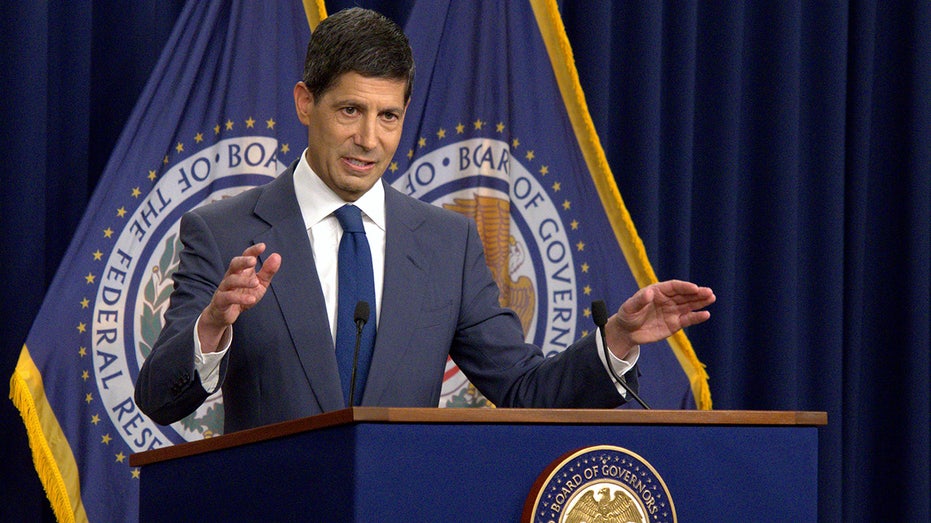
Federal Reserve Chair Kevin Warsh said the central bank is focused on bringing down inflation during his Jackson Hole address. (Li Yuanqing/Xinhua via Getty Images)
State Street’s head of macro strategy, Michael Metcalfe, said rising energy prices are causing traders to bet on interest rate hikes by the Federal Reserve to tamp down inflation.
Metcalfe added that the “narrative is also getting wrapped up with longer-term concerns about the fiscal path,” and said the bond market sell-off was “orderly.”
The Fed is set to hold its next monetary policy meeting in two weeks on Sept. 15-16, with markets seeing a 64.2% probability that policymakers will hike the benchmark federal funds rate by 25 basis points from the current target range of 3.5% to 3.75%, according to the CME FedWatch tool.
Those odds shifted dramatically over the last week, when the tool showed a 63.4% chance of rates remaining at their current level following the Fed’s meeting this month.
FED’S FAVORED INFLATION GAUGE ROSE MORE THAN EXPECTED IN JULY
Fed Chair Kevin Warsh’s keynote address at the annual Jackson Hole Symposium emphasized that the central bank is aware that inflation remains above its 2% target, with the most recent reading of the Fed’s preferred measure – the PCE index – showing prices 3.7% higher than a year ago.
Warsh said policymakers’ focus should be on the price stability side of the Fed’s dual mandate given “concerning” inflation data and jobs data reflective of a labor market that is “broadly consistent with full employment.”
Policymakers will get fresh data on both the labor market and inflation ahead of the meeting later this month, with the August jobs report due out this Friday and last month’s CPI inflation report set to be released next Friday.
GET FOX BUSINESS ON THE GO BY CLICKING HERE
Reuters contributed to this report.

European diesel margins hold steady despite US inventory rise

Harmony Biosciences stock hits 52-week high at $42.70


NEW YORK — Pure Genius Protein is expanding its portfolio with the launch of Protein + Fiber shots.
The shots are formulated with 20 grams of protein and 5 grams of fiber. Each shot is 100 calories.
The shots are available in mango banana and orange blast flavors.
The product may be purchased online through the company’s website, Target and Amazon.

David Spencer-Percival, the recruitment entrepreneur who sold almost everything he owned to build a business empire, is facing a High Court battle against bankruptcy.
The 55-year-old founded the recruitment firm Huntress from scratch and built it into a £100 million a year business before selling his stake for a seven-figure sum. He then took an extraordinary gamble 16 years ago, selling his country home, antiques, watches and a collection of classic cars, including a Ferrari, a Bentley and two Aston Martins, to raise money for his next venture.
The proceeds helped launch Spencer Ogden, a recruitment business that became a global success before Spencer-Percival sold his stake in 2020.
His most recent recruitment venture, Life Science People, has fared less well. The company was compulsorily wound up last summer after HMRC petitioned the courts over money it was owed.
Less than three weeks after the winding up, Alexandra Vintila, who business records show was a recruitment consultant at the firm, launched proceedings seeking Spencer-Percival’s personal bankruptcy. Her creditor’s bankruptcy petition was filed at the High Court in August last year before the case was transferred to Central London County Court.
The precise nature and value of the debt claimed by Vintila is not disclosed in publicly available court records.
Spencer-Percival, who appears to be representing himself, has now taken the fight back to the High Court by launching an appeal against Vintila. The Chancery appeal was filed in July and remains open, court records show.
The case is a reminder that a director’s personal finances can come under pressure once a company has been wound up. Under government guidance for creditors, an individual or business can apply to make someone bankrupt if they are owed at least £5,000, or a share of debts totalling at least £5,000, and the process requires a £1,500 petition deposit and £352 in court costs. The guidance notes that presenting a petition can be complicated and that most people use a solicitor or other professional to do so.
Creditor petitions remain a small share of personal insolvencies. Figures from the Insolvency Service show there were 664 bankruptcies in England and Wales in July 2026, of which 132 were creditor petitions, 23 per cent lower than in July 2025, while 532 were debtor applications.
Life Science People is not the only recruitment business to have run into trouble with the tax authority. HMRC is currently chasing around £90 million in unpaid taxes after the collapse of the staffing group Challenge, another recruitment business, where four group companies in administration owe it around £34 million.
The wider backdrop is a difficult one for UK companies. BTG, the insolvency and restructuring group formerly known as Begbies Traynor, reported that the number of firms in critical financial distress rose 9 per cent to 53,756 in the three months to the end of June, compared with 49,309 a year earlier. BTG defines critical distress as companies facing severe liquidity shortages, active creditor enforcement or formal legal action such as winding-up petitions.
The scale of the gamble Spencer-Percival took to build his second business was set out in a 2014 interview with Forbes, in which he described a car collection that included a vintage Ferrari GT, a Bentley, an Aston Martin DB6, an Aston Martin DB7 and another three classic cars, joking that there was “one for each day of the week”.
Those cars, along with the country home and other possessions, were sold to fund the launch of Spencer Ogden. Twelve years on from that interview, court records show the appeal against the bankruptcy petition remains open.

Jamie Young
Jamie Young is Senior Reporter at Business Matters, covering SME finance, employment law and Westminster policy since 2016. He has reported on every Budget and Autumn Statement since 2018, helped make sense of the ‘covid era’ and the bounce-back loan scheme from launch through the fraud investigations, and broke the magazine’s coverage of the 2024 late-payment reforms. He joined Business Matters straight from completing his BA in Administration from Exeter University and is NCTJ-qualified. Reach him at jyoung@cbmeg.co.uk
Business
Explained: How multi-decade high global bond yields spell caution for Indian stock market investors
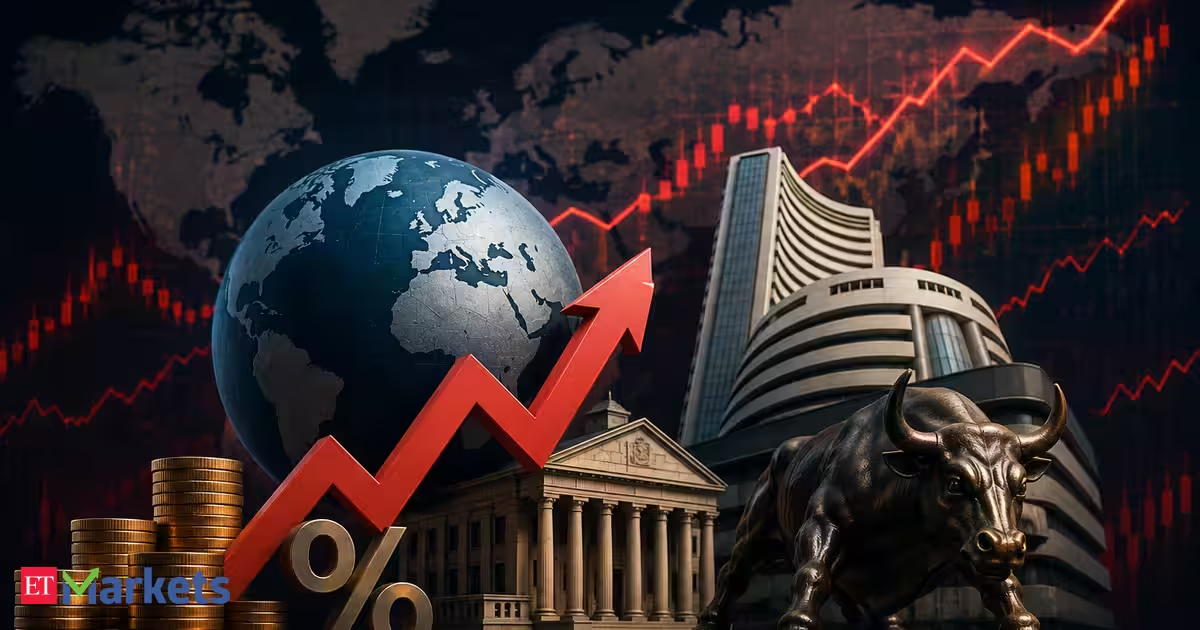
That matters far beyond the bond market. Bond yields influence borrowing costs across economies, from government debt and mortgages to student and car loans. As yields rise, the cost of borrowing goes up, making spending and investment less attractive and potentially weighing on economic growth.
Multi-decade-high global bond yields
The warning signs are now visible across the world’s biggest bond markets. The yield on 10-year US Treasury notes climbed to a near three-year high of 4.81%, with a further move towards 5% threatening to unsettle already jittery stock markets.
Indian government bonds declined early Wednesday, with yields briefly exceeding seven percent. A global debt selloff and rising oil prices are impacting investor sentiment. Higher developed market yields reduce emerging market debt attractiveness and can spur outflows. Brent crude prices surged, increasing India’s vulnerability to inflation and fiscal strain. Markets now anticipate tighter monetary policy from both the US Federal Reserve and the Reserve Bank of India.
Japan’s 10-year yield has moved above 3%, its highest level in 30 years, while Australia’s 10-year government bond yield rose to 5.198%, the highest in more than 15 years.
India has not been insulated from the selloff. The 10-year Indian government bond yield briefly crossed 7% on Wednesday for the first time in three months, as the worsening global debt rout and another spike in oil prices rattled investors.

Britain’s 30-year borrowing costs are at 30-year highs, while German and French 10-year yields have reached levels last seen in 2011 and 2008, respectively. In the US, 30-year yields climbed to their highest level since 2007 earlier in August.
First, why are bond yields rising?
Debt loads increase: One of the biggest forces behind the rise is the sheer amount of debt being issued by major economies. Countries including the US have sharply expanded their debt loads through deficit spending in recent years, with US debt now hitting $40 trillion.The US federal debt has breached the $40 trillion mark for the first time. Total US debt has increased by $3.8 trillion since Donald Trump returned to the White House in January 2025, following a nearly $8.5 trillion increase during the four-year term of his predecessor, Joe Biden.
Rising AI spending: The AI boom is adding another layer of pressure to bond markets. Big technology companies are raising huge amounts of debt to finance their investments in data centres and models, adding to the supply of bonds hitting the market.
The dynamic is straightforward: When demand for borrowing rises, lenders can demand higher interest rates, pushing bond yields higher.
Five of the biggest AI hyperscalers, Alphabet, Amazon, Meta, Microsoft and Oracle, have already issued $220 billion of debt this year to fund investments in data centres and models, according to a Reuters report. That is more than double last year’s total figure.
AI-related borrowing has also helped push global corporate bond issuance to a record $4.9 trillion so far in 2026, up 14% from the same point a year ago, the report added.
Soaring oil prices, hawkish US Fed: The US-Iran conflict that began in February shows no sign of ending, leaving the Middle East stalemate threatening to push energy prices higher. Falling inventories and seasonal fuel demand ahead of winter in the northern hemisphere mean the direct impact on headline inflation around the world is to the upside.
US administration policies, including sanctions against Iran’s trade partners and renewed tariff threats, are also potential triggers for rapid price increases.
Against this backdrop, US Fed Chair Kevin Warsh said the US central bank will “have work to do” if policymakers do not gain the confidence needed to see inflation heading back to 2%. His remarks came closer than before to acknowledging that interest rate hikes may be needed to ease price pressures.
Markets have responded by sharply increasing their bets on a rate hike following Warsh’s speech at the Jackson Hole Symposium. The probability of a hike has risen to 66% from 41% a week earlier, according to official CME FedWatch data.
For India, the combination matters because it points to a weaker global liquidity cushion. A hawkish Fed, higher US yields and rising Japanese yields together can keep foreign investors cautious on emerging markets.
Why should Indian investors care?
The bond selloff is increasingly spilling into equities. Higher yields theoretically make stocks less attractive, although strong earnings have kept equities buoyant. Heavily leveraged hedge funds, which trade across countless markets, could also come under pressure.
The most direct impact comes from the changing return equation. As bond yields rise, investors can earn more from a relatively low-risk US asset. That makes Indian equities comparatively less attractive, particularly for foreign investors.
Higher US yields can therefore encourage global investors to move money into US fixed-income assets. For Indian stocks, that can translate into selling pressure from foreign institutional investors, particularly when valuations are already elevated.
The pressure becomes broader when yields rise simultaneously across Japan, the US and Europe. Global investors then demand higher returns to hold risk assets, which can weigh on foreign flows into Indian equities and bonds, push domestic bond yields higher, put pressure on the rupee and hurt valuation multiples in stocks.
There is another problem for India: oil. The bond selloff is taking place alongside higher energy prices linked to the Middle East conflict. If oil prices remain elevated, India’s massive reliance on imports means the country could face higher imported inflation. That can squeeze corporate margins and limit the scope for easier monetary policy.
A shift towards higher-yielding US assets can also put emerging-market currencies under pressure. For India, a weaker rupee makes imported commodities, particularly crude oil, more expensive.
(Disclaimer: Recommendations, suggestions, views and opinions given by the experts are their own. These do not represent the views of The Economic Times)
Business
(VIDEO) Tiger Woods Pleads Guilty To Reckless And Careless Driving, Gets 5-Year License Suspension In DUI Case
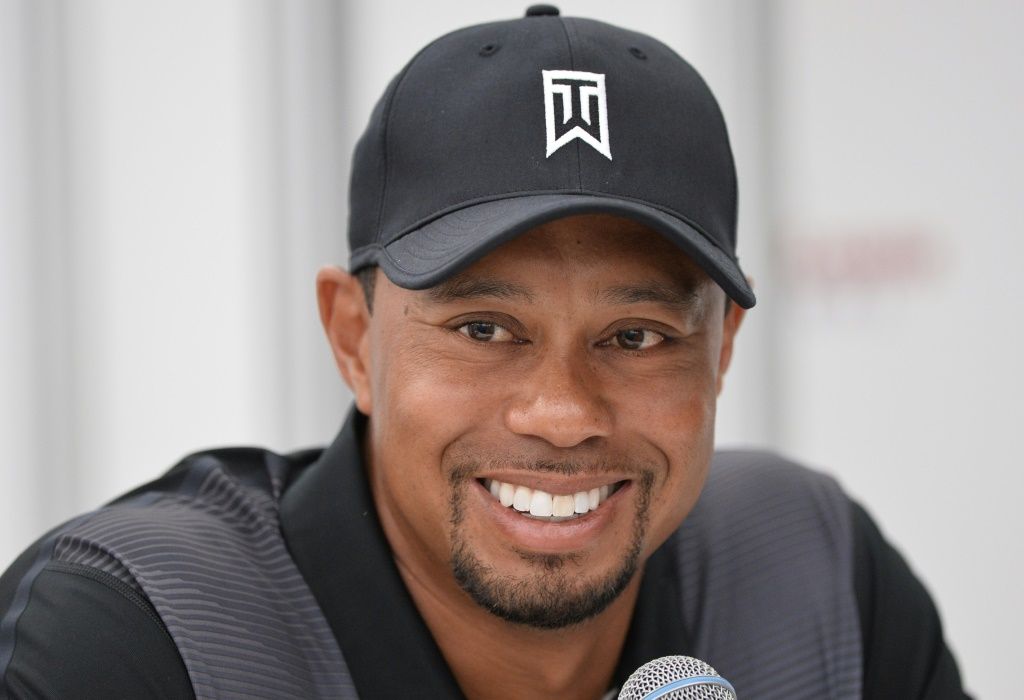
STUART, Fla. — Tiger Woods pleaded guilty Wednesday to reduced charges of reckless and careless driving stemming from a rollover crash near his Florida home in March, agreeing to a five-year suspension of his driver’s license as part of a plea deal that resolved a case initially built around a driving-under-the-influence charge.
The 50-year-old golf legend appeared before Judge Darren Steele at the Martin County Courthouse in Stuart, Florida, for a change-of-plea hearing, months after initially pleading not guilty to misdemeanor charges of DUI with property damage and refusal to submit to a lawful sobriety test.
Tiger Woods pleaded guilty to careless driving in his DUI case and faces five years without a driver’s license under the plea deal, after the judge allowed two five-year suspensions to run concurrently instead of stacking into 10 years. pic.twitter.com/dwLQqiCCBL
— Breaking911 (@Breaking911) September 2, 2026
Under the terms of the agreement reached with prosecutors, the DUI charge was amended to reckless driving, a second offense, while the refusal-to-submit charge was amended to a careless driving citation. Woods pleaded guilty to both amended charges.
Judge Steele imposed a five-year driver’s license suspension on each of the two charges, but ordered the suspensions to run concurrently rather than consecutively, meaning Woods will lose his license for five years total rather than facing a combined ten-year suspension had the terms been stacked.
Addressing Woods directly during the brief hearing, Steele made clear the consequences of violating the suspension.
“If you were to drive for any reason at all you would go immediately back to jail,” Steele told Woods.
The judge also told Woods that the suspension was intended to protect others on the road, framing the penalty as a matter of public safety rather than punishment alone.
As part of the plea deal, Woods also agreed to pay a fine, with figures reported between $1,000 and $1,500 depending on the outlet, along with associated court costs tied to the case.
The charges stemmed from a March 27 crash on Florida’s Jupiter Island, near Woods’ home in Martin County. According to an incident report from the Martin County Sheriff’s Office, Woods’ Land Rover moved into the oncoming lane of traffic while a truck pulling a trailer was making a right turn ahead of him, causing Woods’ vehicle to strike the truck and flip onto its side. The collision caused an estimated $5,000 in damage to the other vehicle. Neither driver was injured in the crash.
Woods exited his vehicle by climbing out through the passenger side after the rollover, according to the sheriff’s report. Officers at the scene said Woods exhibited several signs of impairment, including slow movements, glassy eyes and profuse sweating. Woods told officers the crash occurred because he had been looking at his phone and changing the radio station, and that he had not noticed the vehicle ahead of him slowing down. He denied having consumed alcohol but acknowledged taking prescribed medication, according to an arrest affidavit tied to the case.
Wednesday’s hearing marked the resolution of a case that had drawn significant public attention since the crash, given Woods’ stature as one of the most prominent figures in golf history and a 15-time major champion. Woods appeared relaxed during the proceeding and was seen smiling at points during the hearing, according to reporters present in the courtroom.
The case is not the first time Woods has faced legal consequences tied to impaired or reckless driving. In 2017, Woods was arrested in Florida after police found him asleep behind the wheel of his car. A subsequent toxicology report found a combination of pain, anxiety and sleep medications in his system, along with THC, the psychoactive compound found in marijuana. Woods pleaded guilty to reckless driving in that earlier case and completed a first-offender DUI diversion program, which required him to attend a DUI education class, perform community service and pay fines, ultimately allowing the more serious DUI charge to be dropped from his record.
Wednesday’s plea deal adds to a broader pattern of vehicle-related incidents involving Woods over the past decade and a half. In addition to the 2017 arrest, Woods was also involved in a serious single-car rollover crash in February 2021 near Los Angeles that left him with severe leg injuries and launched a long and difficult rehabilitation process, one that significantly limited his ability to compete on the PGA Tour in the years that followed.
Woods’ legal troubles this year come amid what had appeared to be signs of a tentative return to competitive golf. After more than a year away from tournament play following his recovery from the 2021 crash and subsequent injuries, Woods briefly competed in March at the TGL Finals, a made-for-television golf league event, fueling speculation among fans and golf commentators that he might be preparing for a return to major championship competition, potentially including the Masters Tournament in April. Those plans were scrapped following the March 27 crash and the subsequent legal proceedings that culminated in Wednesday’s plea hearing.
Woods arrived at Wednesday’s hearing accompanied by his girlfriend, Vanessa Trump, according to reporters covering the proceedings. The relationship between Woods and Trump, the ex-wife of Donald Trump Jr., has drawn substantial media attention since it became public.
With Wednesday’s plea now finalized, Woods will be barred from legally driving for the next five years, a restriction that is likely to have practical implications for his day-to-day life even as it does not directly affect his ability to compete in golf tournaments, which do not require players to personally drive themselves to and from competition venues.
Neither Woods nor his legal representatives issued extended public remarks following Wednesday’s hearing beyond his responses during the court proceeding itself. It remains unclear whether Woods plans to pursue any further competitive golf appearances in the near term, though Wednesday’s resolution of his legal case removes one significant source of uncertainty that had loomed over his public profile since the March crash.

Court denies NCAA motion, rules Missouri DT Sterling Webb eligible

Slideshow: Texture, flavor innovation elevating the candy aisle

Personality Is Linked to Genes, New Study Finds





-

 Fashion5 days ago
Weekend Open Thread: Maeve – Corporette.com
-

 Crypto World6 days ago
Bitcoin’s 22% rally now needs real demand to outlast Treasury liquidity boost
-

 Business6 days ago
Apple Confirms September 9 Keynote and Reveals Its Full Pre-Order Schedule
-

 Crypto World7 days ago
Elon Musk Grok Bot Promise: We Will Make You Whole if AI Loses Your Money
-

 Business6 days ago
Salesforce Stock Soars 19% as Blowout Earnings and Agentforce AI Growth Silence Software Skeptics
-

 Business5 days ago
Onto Innovation Stock: AI’s Next Bottleneck Is Yield (NYSE:ONTO)
-
 NewsBeat7 days ago
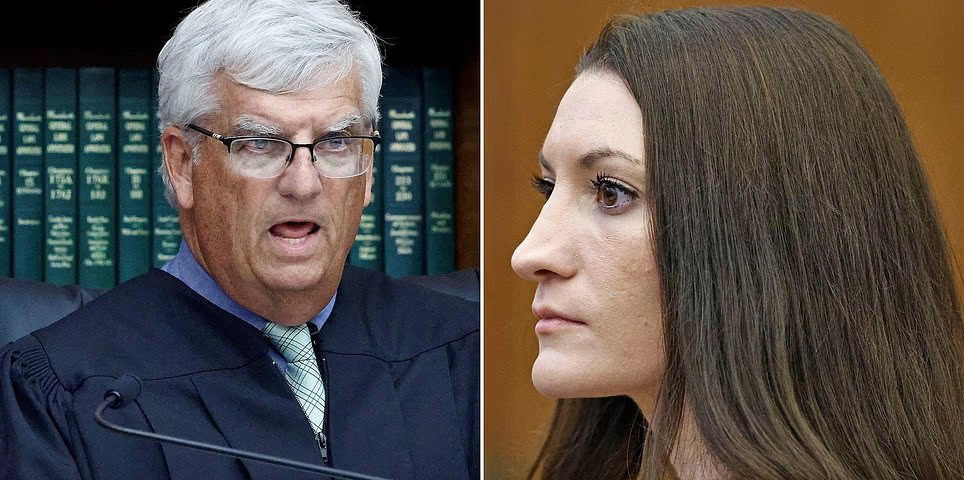
Lindsay Clancy jury braces for closing arguments as judge tells court: ‘You’ve heard all the evidence’ – Live updates
-

 Crypto World7 days ago
NVIDIA revenue hits $96.2B as AI demand doubles
-

 Crypto World5 days ago
Bitcoin price tests $82K resistance as Brandt stays long
-
 Tech4 days ago
Hugging Face built a $4.5 billion empire on free AI models. Now Nvidia is buying it for $12.9 billion
-
 Crypto World7 days ago
Nvidia Q2 Earnings Reveal $96.2 Billion Beat, So Why Is NVDA Falling?
-

 Business5 days ago
iPhone 18 Pro Pre-Orders Could Shift to Saturday as Apple Reportedly Avoids September 11 Anniversary
-

 Tech7 days ago
Claude Cowork gets its own browser that doesn’t touch your tabs, bookmarks, or saved passwords
-

 Crypto World6 days ago
Truflation calls for Fed rate cut after PCE forecast
-

 Crypto World7 days ago
GENIUS Act missed its deadline as OCC writes rules anyway
-

 Tech5 days ago
PaperCut releases second emergency patch for exploited flaws
-

 News Videos3 days ago
Charlie Munger on Robinhood: No one should believe that Robinhood’s trades are free
-

 Tech7 days ago
Apple’s iPhone 18 Pro event is on September 9
-

 Tech6 days ago
The fix for the AI agent that hijacked a company’s DNS: it can propose the change, but it can’t approve it
-
 Entertainment5 days ago
‘Adults’ Creators Break Down Season 2’s Most Shocking Moments and Tease a Potential Season 3
You must be logged in to post a comment Login