

Business
LARRY KUDLOW: A new Goldilocks: Strong growth and falling prices

After two great inflation numbers where the level of both consumer and producer prices actually declined in June from the prior month, reported out Tuesday and Wednesday, today we get another big number this time on retail sales — also known as consumer spending.
Core sales have risen 8 percent at an annual rate over the past three months. And the biggest category was online sales, where non-store retailers have jumped by 1.9 percent in June, 1.4 percent in May, 1.5 percent in April, and 21 percent annually for the last 3 months. Those are big numbers.
By the way, car sales are up more than 20 percent annually in the second quarter. Another big number. We will get manufacturing tomorrow, but two booming regional manufacturing reports from New York and Philadelphia have already been reported.
So allow me to modestly redefine the reemergence of a Goldilocks economy. It used to be not too hot and not too cold. Yet that was Wall Street, and I was guilty of it too, suggesting limits to growth that might cause inflation. My new Goldilocks definition is rapid economic growth combined with stable or even disinflating prices.
American Action Forum president Douglas Holtz-Eakin and Evenflow Macro managing director Marc Sumerlin interpret the U.S. economic outlook on ‘Kudlow.’
That is to say, the Phillips Curve is dead. There’s no trade off between growth and inflation. Or between jobs and inflation. Speaking of jobs, weekly initial unemployment claims are rock bottom. Nobody is getting fired, but plenty of folks are being hired.
This is a new Goldilocks, on the supply-side, technologically driven. We’re talking AI, quantum computing, advanced manufacturing, and space technology breakthroughs. At the bottom of all of this is surging productivity — output per person — which is holding down business costs and consumer prices. We saw some of this movie before during the 1990s. Yet we’re seeing it again right now even bigger time.
And we have pro-growth fiscal and monetary policies, including a strong dollar, and a new regime at the Fed, and lower taxes and fewer regulations from the White House. All this is nurturing the new Goldilocks. Pessimists beware, you’re about to get whacked and you won’t even see it coming.


When Sarah Reeve got engaged she gave fiance Lee an ultimatum: he had to pay off his debt before she would marry him.
“I was paying my mortgage and bills whereas he was giving his mum some rent,” Sarah says of their situations when they met in their early 20s.
“I told him I wouldn’t marry him if he had any debts,” says the 45-year-old.
So they set a wedding date for two years ahead which gave Lee the time to pay off the £2,000 bank loan – £4,000 in today’s money, external – he had taken out to buy a car.
Once Lee’s debt was cleared, the couple paid everything into a joint account and Sarah took charge of bills, saving and budgeting.
“He said ‘you can sort it all out and take charge with money because I’m rubbish with it,’” she says.
Sarah’s experience reflects a wider trend of more than four fifths of women being actively involved in managing daily finances like day-to-day spending and household budgeting, according to St James’s Place’s Women and Wealth Report.
Sarah earns £24,000 working part-time in insurance and Lee worked in maintenance at the same factory for 27 years, earning about £26,000, before being made redundant four years ago.
He now works for himself in property maintenance and earns about £30,000.
The couple, who have been together for 25 years and have two daughters, aged 19 and 21, have always thought of money as shared.
“It’s very much our money rather than mine or yours which is really nice especially as I took four years off work when we had children,” says Sarah.
Business
TSI Holdings Co.,Ltd. 2027 Q1 – Results – Earnings Call Presentation (OTCMKTS:TSIHF) 2026-07-16


Seeking Alpha’s transcripts team is responsible for the development of all of our transcript-related projects. We currently publish thousands of quarterly earnings calls per quarter on our site and are continuing to grow and expand our coverage. The purpose of this profile is to allow us to share with our readers new transcript-related developments. Thanks, SA Transcripts Team

But money managers aren’t dialing back on risk. They have cut their cash holdings to an “uber-low” 3.6% and upped their allocations to U.S. equities, taking their exposure to its highest level since late 2024, according to Bank of America’s monthly fund manager survey.

Progressive Is The P&C Insurer To Hold, After Policies Grow In Q2
Business
Wall Street’s Fear Gauge VIX Jumps 3.66% to 16.24 as Chip Stock Selloff Reignites Investor Anxiety Again

The CBOE Volatility Index, Wall Street’s primary measure of expected market turbulence, climbed 3.66% Thursday, rising 0.57 points to 16.24, as a renewed selloff in semiconductor stocks and lingering geopolitical tensions in the Middle East pushed investors back toward hedging strategies after a brief period of calm earlier in the week.
The move higher followed a close of 15.67 on Wednesday, when major U.S. stock indexes rallied broadly on cooler-than-expected inflation data. Thursday’s jump reversed that decline in volatility as technology and chip stocks came under renewed pressure, with the Nasdaq Composite falling more than 1% during the session even as the Dow Jones Industrial Average managed a modest gain, a divergence that has become increasingly common as investors reassess valuations across the artificial intelligence trade.
The VIX, often referred to as Wall Street’s “fear gauge,” measures the market’s expectation of volatility in the S&P 500 over the coming 30 days, derived from real-time pricing in S&P 500 index options. The index tends to move inversely with the broader stock market, rising when investors rush to buy protective options during periods of uncertainty and falling when demand for such hedges eases during calmer stretches. Thursday’s reading of 16.24 remains within what market analysts generally characterize as a “mid” range for the index, spanning roughly 12 to 20, a level historically associated with normal, non-crisis market conditions rather than acute distress.
Still, Thursday’s increase reflects a broader pattern of volatility that has persisted through much of July as investors have grappled with an unusually complex mix of catalysts. Chief among them has been the ongoing conflict between the United States and Iran, centered on the Strait of Hormuz, a critical corridor through which roughly one-fifth of global oil trade passes. The volatility gauge spiked to an intraday high of 17.40 on July 13 after the U.S. and Iran exchanged fresh military strikes over the preceding weekend, with both sides offering conflicting accounts of whether the strategic waterway remained open to commercial shipping. That spike coincided with a sharp selloff in equities, as the Nasdaq fell 1.5% and the S&P 500 declined roughly 0.8% that day, while Brent crude oil jumped more than 9% to above $83 a barrel.
Volatility in oil markets has closely tracked the swings in equity market sentiment throughout the conflict. Options market data tracked by Cboe show that one-month implied volatility for West Texas Intermediate crude surged as high as 68% at one point last week before easing to around 51% by the end of the week, as fears of a prolonged and severe disruption to oil supply moderated somewhat following the initial round of strikes. Notably, despite the sharp moves in energy markets, broader U.S. inflation expectations have shown relatively little reaction to the latest run-up in oil prices, a marked contrast to the inflationary shock that followed Russia’s invasion of Ukraine in 2022, according to data compiled by Cboe.
The VIX has swung considerably over the course of 2026, reflecting a year marked by alternating waves of optimism around artificial intelligence spending and periodic bouts of anxiety tied to chip-sector valuations, inflation data and geopolitical risk. The index’s 52-week high of 35.30 was reached on March 9, a period of heightened market stress, while its 52-week low of 13.38 came on December 24 of last year, during a stretch of relative calm heading into the new year.
Recent weeks have illustrated just how sensitive the volatility index remains to shifts in the technology sector specifically. Chip stocks have whipsawed repeatedly since late spring, with sharp single-day selloffs followed by equally sharp rebounds as investors debate whether current spending levels tied to the AI buildout can be sustained. Earlier in June, the volatility gauge briefly tumbled as investors bid up shares of newly public companies including SpaceX, only to reverse a week later as what market commentators described as a “crash up” in chip stocks unwound just as quickly as it had begun.
Market strategists caution that a single day’s move in the VIX carries less significance than the broader trend and rate of change over time. A jump from the mid-teens to the low 20s over the course of several sessions, for instance, is generally viewed as more informative than the index holding steady at an elevated level for an extended period. Analysts also often examine the VIX in conjunction with the broader Fear and Greed Index, a composite measure that combines volatility with six other indicators, including market momentum, safe-haven demand and options market activity, to gauge whether investor sentiment has become excessively fearful or excessively greedy relative to historical norms.
For now, Thursday’s uptick in the VIX appears consistent with a market caught between competing forces: strong second-quarter earnings from several major companies, including Taiwan Semiconductor Manufacturing, UnitedHealth Group and GE Aerospace, set against renewed skepticism about elevated valuations in AI-linked technology stocks and the unresolved military standoff between the United States and Iran. With crude oil prices remaining elevated and the Federal Reserve’s next policy meeting scheduled for July 28-29, traders said they expect volatility to remain a persistent feature of markets in the weeks ahead, even as the VIX’s current level suggests investors are not yet pricing in the kind of acute stress seen during past market crises.
Options traders will likely continue watching the relationship between near-term and longer-dated VIX futures contracts for additional signals about market expectations, a dynamic known as the volatility term structure that can offer clues about whether investors anticipate current turbulence to persist or fade in the months ahead.

Netflix: Selling Pressure Builds As Reality Sets In
Business
Meta Workers Allege Company Used AI for Discriminatory Layoffs | Careers & Leadership for July 15

This is an edition of the WSJ Careers & Leadership newsletter, a weekly digest to help you get ahead and stay informed about careers, business, management and leadership. If you’re not subscribed, sign up here.
In the Workplace
Meta workers are accusing the company of using AI to conduct discriminatory layoffs. A federal suit alleges that the company relied on a “constellation” of internal AI systems—which weighed metrics like productivity, output and token usage—to conduct its mass layoffs in May. The plaintiffs, a group of former and current employees, claim this effectively targeted those who missed work or took leave for medical reasons.
Copyright ©2026 Dow Jones & Company, Inc. All Rights Reserved. 87990cbe856818d5eddac44c7b1cdeb8

First Citizens BancShares Is No Longer A Prime Candidate After Its Monumental Rise
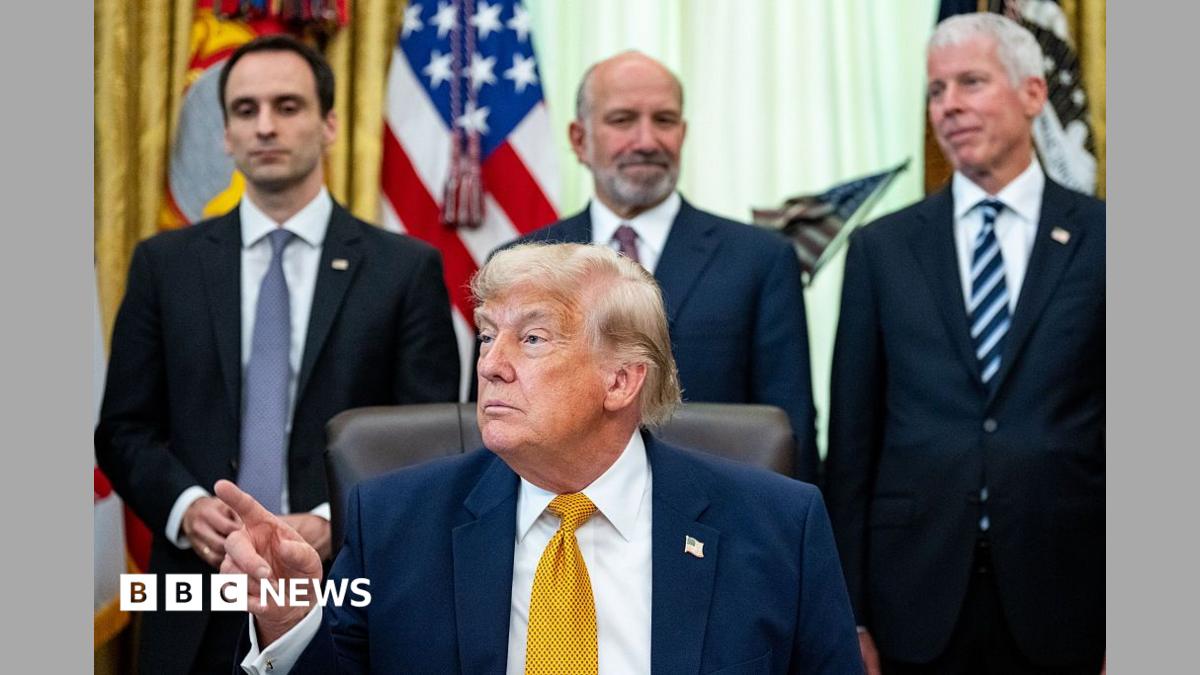
Trump Media & Technology Group, which owns Truth Social, is launching a paid service to give Wall Street firms high-speed access to its most influential posts, though it is not clear if the paid service will include President Trump’s posts.
Launching 1 August, instant updates will be delivered from key accounts, it said.
The company behind the app hopes it will create a steady new source of money for the firm which is currently loss-making.
It is likely aimed at financial traders who want to see market-moving news fast. Trump’s social media posts often cause sudden swings in global markets, especially when he writes about trade and tariffs. For firms, a delay of even seconds can be costly.
Until now, banks and traders had to monitor the app manually. The new system will send posts directly to paying clients.
”Markets already move on Truth Social posts“, said Kevin McGurn, the interim boss of Trump Media, adding that the service will create a steady profit.
The service will run 24 hours a day, seven days a week.
The company, which launched its social media app in 2022, said some firms have been copying its data for months without permission.
McGurn warned that Trump Media will soon block these methods, forcing firms to buy the official feed instead.
While other social media networks already sell data, the move highlights the unique overlap between Trump’s private business and his public role as president.

Fresh signs of cooling U.S. inflation revive demand for Treasuries, pushing yields down.
June producer price index falls 0.3%. Ex-food and energy, PPI rises 0.2%. Both measures come below WSJ consensus forecast. The data follow yesterday’s softer-than-expected consumer price index.
Yields had been rising as U.S.-Iran tensions escalate and oil prices rise above $80 a barrel, but the soft inflation drags them below yesterday’s settle. Markets reprice the outlook for monetary policy, reducing odds of a Fed hike this year.

What went right this week: eco leader Estonia, plus more

I wouldn’t marry him until he paid off his debt, now I’m in charge of our money

Nobody needed exchanges to begin with


-

 Fashion6 days ago
Weekend Open Thread: Nutriplenish Leave-In Conditioner
-
 NewsBeat8 hours ago
London Mayor Sadiq Khan handed a peerage by Keir Starmer alongside 15 other Labour figures… just days before the PM leaves No10
-

 Sports7 days ago
Super Eagles star Moses Simon opens up on Liverpool transfer regret
-

 Crypto World22 hours ago
CFTC blocks Kalshi from unwinding Michigan trades after court order
-

 Business20 hours ago
Nvidia Stock Slips After Big Tuesday Rally as Huang Confirms Vera Rubin Chip Is Now in Production Today
-

 Politics1 day ago
Young campaigners urge incoming PM to act on outdoor junk food ads
-

 News Videos2 days ago
XRP BOMBSHELL… XRP OMBOARDED FOR TRANSACTIONS!!!
-

 Tech3 days ago
Get Your ESP32 Sunny Side Up With This Solar Dev Board
-
 Entertainment1 day ago
Disney’s Most Ambitious Failed Star Wars Attraction Is Coming to SDCC
-

 Tech2 days ago
Dark Secrets Emerge When Jailbreaking LLMs
-

 Crypto World2 hours ago
Injective Submits SEC Transfer-Agent Registration to Onchain Ownership Records
-
 Sports1 day ago
New Cornerback Enters Vikings Trade Rumor Mill
-
 Tech3 days ago
Cloudflare Precursor Watches Your Mouse and Keyboard To Decide If You Are Human
-

 News Videos3 days ago
how to make coin bank box with cardboard #scienceproject #money #diy #shorts
-
 Entertainment1 day ago
Vicki Gunvalson Defends Discussing Heather Dubrow’s Money
-
Crypto World2 days ago
Ripple, Coinbase, Circle Join Linux x402 Foundation to Help Shape AI Payments
-

 Business2 days ago
ACCC warns AI could lift insurance costs in risk-prone areas
-

 NewsBeat1 day ago
Watch: Is Donald Trump facing a popular backlash on immigration?
-

 Sports23 hours ago
Michigan officials not expected to discuss AD Warde Manuel at Thursday meeting
-

 Business2 days ago
Subaru recalls 541,000 vehicles over federal safety sticker mistake: NHTSA
You must be logged in to post a comment Login