

Connect with us
DAPA Banner
DAPA Coin
DAPA
COIN PAYMENT ASSET
PRIVACY · BLOCKDAG · HOMOMORPHIC ENCRYPTION · RUST
ElGamal Encrypted MINE DAPA
🚫 GENESIS SOLD OUT
DAPAPAY COMING

Business

Lords drought warning: taps could run dry by 2055 without urgent government action

Published

on

Lords drought warning: taps could run dry by 2055 without urgent government action

England’s water security is heading for a serious squeeze, and the bill for inaction will land squarely on the desks of farmers, food producers, manufacturers and the wider small business community.

That is the blunt message from a cross-party House of Lords committee, which on Thursday 21 May publishes a report warning that the taps risk running dry unless the Government moves quickly to capture, store and reuse more of the rain that already falls on these islands.

In Surviving drought: reclaim the rain, the House of Lords Environment and Climate Change Committee argues that climate change, a growing population, leaky Victorian pipework and thirsty industries are pushing the system towards a tipping point. Britain, the peers note, is not actually short of rainfall. The problem is that far too much of it is wasted, washed straight into rivers and the sea rather than held back for the dry months that climate science now tells us to expect with growing frequency.

The figures the committee cites are arresting. If ministers fail to act, public demand for water could outstrip supply by five billion litres every day by 2055, the equivalent of around 2,000 Olympic swimming pools draining away unmet each morning. That projection sits in line with the Environment Agency’s own National Framework for Water Resources, which has previously warned of a shortfall of similar scale unless leakage is cut and new sources of supply brought online.

A warning aimed at Whitehall, but felt on the shop floor

Baroness Sheehan, who chairs the committee, says the experience of the 2025 drought should serve as an early warning rather than a one-off. “Climate change is increasing the risk of drought through a combination of hotter summers and heavier winter rains, making the capture and storage of rainwater increasingly important,” she said. “We have already had a dry start to this spring, so it is critical that action is taken now to prepare for serious drought conditions, particularly as we enter a reported El Niño year.”

Advertisement

Forecasters at the Met Office have signalled a likely return of El Niño conditions from mid-2026, raising the probability of hotter, drier summers. For SMEs already nursing tight margins through a sluggish economic recovery, another summer of hosepipe bans, abstraction restrictions and stressed supply chains is the last thing the order book needs.

That much was clear last spring, when Business Matters reported on how drought conditions had begun hitting UK crop production, with reservoirs running low and farmers warning of early yield losses after the driest spring in 69 years. A year on, the peers say the lesson has barely been absorbed.

Four areas where ministers are urged to move

The committee’s recommendations sit in four broad buckets, each of them with direct read-across to the boardroom.

First, the peers want a proper grip on the numbers. That means better drought monitoring and impact data, and a full environmental and economic assessment that weighs the cost of doing nothing against the long-term value of building resilience. Without that, the committee argues, capital spending decisions on reservoirs, transfer schemes and demand-management measures will continue to be made in the dark.

Advertisement

Second, the report calls for a whole-of-society push on demand. Awareness campaigns, tougher water-efficiency standards in new homes, and incentives for water reuse and rainwater harvesting all feature. For the SME estate, this is likely to translate into firmer expectations on water-using appliances, fittings and processes, particularly in hospitality, food and drink and light manufacturing.

Third, the committee zeroes in on sectors that rely on direct abstraction from rivers and aquifers. It urges ministers to make it easier for farms, golf courses and other appropriate operations to build local resource reservoirs, and to introduce more flexibility into the abstraction licensing regime so that catchment-based water projects can scale. For the rural economy, that flexibility could be the difference between a viable harvest and a written-off crop.

Finally, the peers want emergency planning brought up to date. They are asking the Government to publish a prioritisation plan for severe drought by autumn 2026 at the latest, alongside a wider rollout of nature-based solutions, from wetland restoration to sustainable urban drainage, in both town and country.

Why this is a balance-sheet issue, not just an environmental one

The temptation in many quarters will be to file this report alongside the broader stack of climate warnings. That would be a mistake. Water is an input cost like any other, and one that the City is only now starting to price properly. Investors, lenders and insurers are sharpening their interrogation of corporate exposure to physical climate risk, and water scarcity sits near the top of that list for any business with a meaningful UK footprint.

Advertisement

The point was made forcefully in a recent Business Matters opinion piece arguing that the UK economy risks collapse without urgent investment in nature, with the financial sector urged to wake up to the fact that nature loss and water stress are no longer fringe concerns but central to long-term economic stability.

There is also a competitive angle. UK SMEs are, on the whole, ahead of the curve on sustainability, with Business Matters previously reporting that nearly two-thirds of small firms are taking practical steps to cut their environmental footprint. Those firms that have already invested in water-efficient kit, leak detection and on-site capture should find themselves better placed if regulatory pressure tightens, as the Lords clearly want it to.

The bottom line

Baroness Sheehan is unequivocal in her closing remarks: “Water is the foundation of life itself. The Government must act now to secure England’s most vital resource for the future and work with the public to ensure the taps don’t run dry.”

For business owners, the practical implications are already taking shape. Expect higher water bills in catchment areas under stress, tighter rules on abstraction and discharge, growing investor scrutiny of water risk in annual reports, and new commercial opportunities for firms offering harvesting, reuse and efficiency technologies. The smart money will not wait for Whitehall to catch up. The companies that get ahead of this curve, in much the same way that the best-prepared firms got ahead of net zero, are the ones likeliest to keep producing, serving and selling when the next dry spring arrives.

Advertisement

The peers have laid out the warning and the to-do list. The question now is whether ministers, water companies and businesses themselves are prepared to treat rainwater as the strategic national asset it has quietly become.


Amy Ingham

Amy is a newly qualified journalist specialising in business journalism at Business Matters with responsibility for news content for what is now the UK’s largest print and online source of current business news.

Advertisement
Continue Reading
Click to comment

You must be logged in to post a comment Login

Leave a Reply

Business

UK inflation rate drops as Rachel Reeves Budget policies curb energy price surge

Published

on

Business Live

Inflation dropped to 2.8 per cent in the year to April, latest ONS figures have revealed

A woman shopping

A woman shopping(Image: Hinckley Times)

Inflation fell slightly compared to the previous month’s figure as Chancellor Rachel Reeves’ Budget policies held back an anticipated surge in price growth. The Office for National Statistics revealed the consumer price index (CPI) reading came in at 2.8 per cent, below what City forecasters had predicted.

Advertisement

The price growth data for the year to April was measured against a previous inflation reading of 3.3 per cent in the year to March.

Both of the last two readings have exceeded initial expectations as a consequence of the Iran war, where disruption across the Strait of Hormuz has triggered an energy price shock and threatened critical supply shortages.

Core inflation, which strips out volatile items such as food and energy, stood at 2.5 per cent, as reported by City AM.

The services inflation rate came in at 3.2 per cent, which may ease concerns among some Bank of England policymakers, as the figure is regarded as a key indicator of underlying price pressures.

Advertisement

Yael Selfin, chief economist at KPMG, said she anticipated prices would climb as “food costs feed through”, with the ONS reporting a 7.7 per cent rise in prices for raw materials over the year.

“Firms are likely to seek to protect margins by passing on some of these higher costs to consumers,” Selfin said.

“However, weak domestic demand is likely to limit firms’ ability to pass on higher input costs in full, reducing the risk of a broader pickup in inflation.”

Economists believe inflation will “hover” around the three per cent mark until July.

Advertisement

The latest figures may offer Reeves some justification that her Budget policies have helped to ease price pressures.

Responding to the data, she said: “The war in Iran is not our war but one we will need to respond to, and the decisions I took in the Budget last year have kept inflation down as we deal with global instability.

“We have the right economic plan, and to change course now would risk our economic stability and leave working people worse off.”

The central policy involved removing the renewable obligation subsidy from household energy bills and transferring them to general taxation, resulting in a £117 reduction on Ofgem’s energy price cap for April.

Advertisement

Reeves also financed a freeze on train fares and prescription charges in a bid to tackle the cost of living.

However, inflation is anticipated to deteriorate further in the coming months, with the Bank of England cautioning that the CPI figure could surpass six per cent within months in the worst case scenario where the US and Iran fail to re-open the Strait in peace negotiations.

Economists are concerned that second-round factors – whereby robust wage growth and escalating price rises fuel a spiralling effect – could trigger a surge in inflation, after the economic phenomenon was underestimated following Russia’s full-scale invasion of Ukraine.

Traders and prominent economists also believe the UK is especially vulnerable to the energy price shock, given its position as a net importer of oil and gas.

Advertisement

The latest batch of figures could offer Reeves and fellow Labour ministers a brief reprieve from the mounting political turbulence engulfing the party.

The Chancellor is expected to set out a full energy support package, which is understood to include scrapping a planned fuel duty rise in September.

On Tuesday evening, reports emerged that Reeves was seeking to broker a deal with supermarkets whereby prices on essential food items would be capped in return for a suspension of packaging and health regulations.

The proposal has faced a backlash from leading City economists, while a retail boss has cautioned that it could prove damaging to businesses.

Advertisement

Shadow chancellor Sir Mel Stride said: “Any fall in inflation is welcome, but prices are still rising far too fast and Labour have left our economy weak and exposed to the impacts of the Iran war.

“The recent spike in borrowing costs shows markets are increasingly worried about Labour’s leadership chaos and economic mismanagement, leaving families to pick up the bill for a £300 Burnham Penalty.”

Continue Reading

Business

Trader Joe’s announces 25 new stores across the country

Published

on

Trader Joe’s announces 25 new stores across the country

Trader Joe’s is expanding its footprint with 25 new locations across 14 states, adding to its previously announced growth pipeline, the company said.

The popular California-based grocery chain announced Wednesday that nine additional stores are now in development, bringing the total slate of upcoming openings to more than two dozen.

Advertisement

All locations have been identified, though opening dates remain to be determined.

“We are proud to be joining the neighborhood, and to continue our commitment to providing nourishment to the surrounding communities through our Neighborhood Shares program,” the company said.

TRADER JOE’S WORKERS SHUT DOWN LONG-RUNNING CHECKOUT LINE RUMOR: ‘OVER-THE-TOP FRIENDLINESS’

Inside a Trader Joe's store.

A customer walks past a produce aisle at Trader Joe’s. (Scott Olson/Getty Images / Getty Images)

The new round of storefronts spans Arizona, Florida, Illinois, Massachusetts, Michigan, New York, Ohio and Utah.

Advertisement

The nine new locations across eight states include:

  • Arizona: Phoenix (21001 North Tatum Boulevard, Suite 1030)
  • Florida: Sarasota (8199 S Tamiami Trail, Unit 100)
  • Illinois: Chicago (804 West Montrose Ave.)
  • Massachusetts: Quincy (111 General McConville Way)
  • Michigan: Farmington Hills (27658 Middlebelt Rd.)
  • New York: Syracuse (3515 West Genesee St.)
  • New York: Yonkers (2482 Central Park Ave.)
  • Ohio: University Heights (2643 Warrensville Center Rd.)
  • Utah: West Jordan (5561 W 7800 S.)

COSTCO FANS ERUPT AFTER BELOVED FOOD COURT ITEM REPLACED BY HIGH-CALORIE NEWCOMER

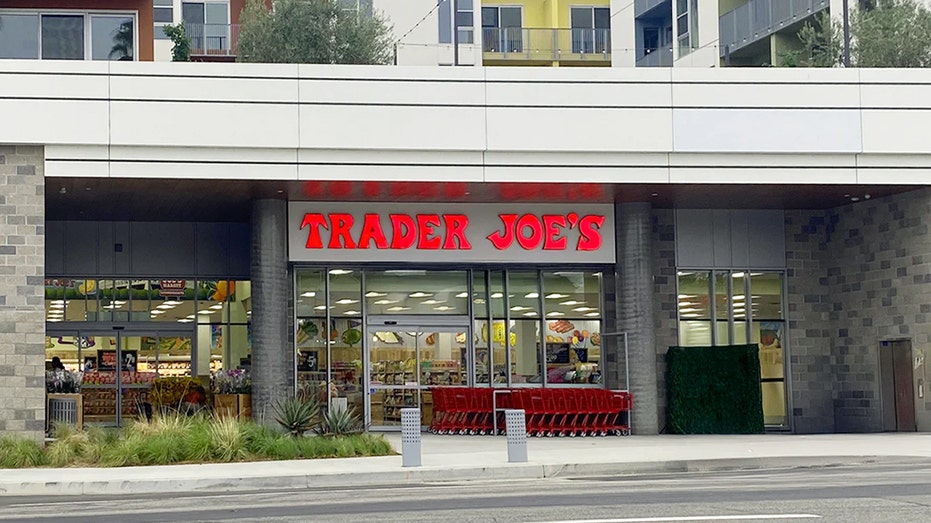
Trader Joe's storefront in Sherman Oaks, California

A Trader Joe’s store is seen during nonoperating hours in Sherman Oaks, California. (Trader Joe’s)

The other 16 previously announced locations include: 

  • Arizona: Tucson (2150 E. Broadway Blvd.)
  • California: Anaheim Hills (6336 E. Santa Ana Canyon Rd.)
  • California: Paso Robles (2457 Golden Hill Rd.)
  • Florida: Orlando (1444 North Alafaya Trail)
  • Florida: West Palm Beach (8111 S. Dixie Highway)
  • Georgia: Johns Creek (1000 Medley Blvd.)
  • Illinois: Oswego (1930 US-34)
  • Kansas: Merriam (8700 Shawnee Mission Parkway)
  • Louisiana: New Orleans (2428 Napoleon Ave.),
  • Louisiana: Mandeville (3377 US Highway 190)
  • Louisiana: Lafayette (1710 Camellia Blvd.)
  • Massachusetts: Reading (34 Walkers Brook Drive)
  • New Jersey: West Orange (471 Mt. Pleasant Ave.)
  • Utah: Herriman (4850 W. 13400 South)
  • Washington: Seattle (401 NE Northgate Way)
  • Washington: Spokane Valley (13414 E. Sprague Ave.)

Details surrounding the store openings — including store size, parking capacity and inventory offerings — remain limited beyond the listed addresses. 

As of May 20, Trader Joe’s opened four new storefronts across the country earlier this year, including one in Hamden, Connecticut; Miller Place, New York; McKinney, Texas; and Woodinville, Washington.

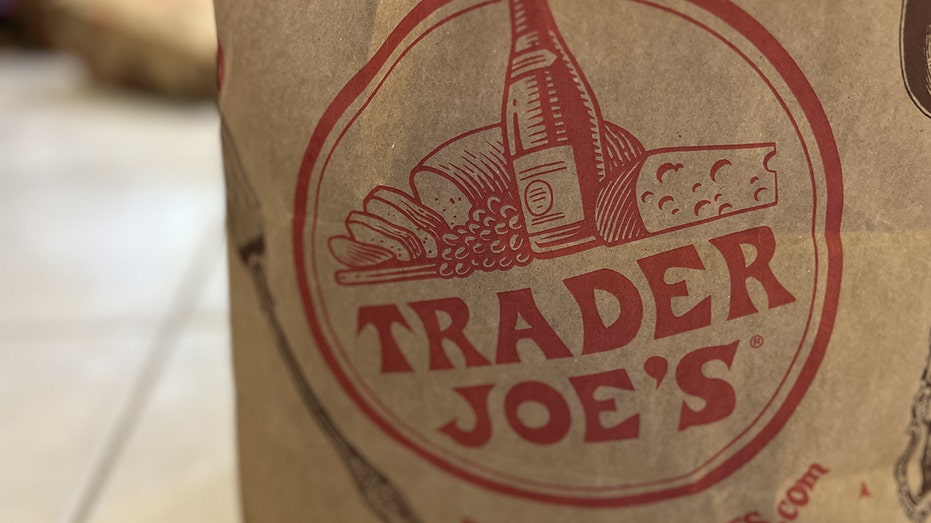
Trader Joe's bag

Close-up of a Trader Joe’s grocery bag, showcasing the store’s logo, in Reliez Valley, California, May 29, 2024. (Smith Collection/Gado/Getty Images / Getty Images)

CLICK HERE TO DOWNLOAD THE FOX NEWS APP

Advertisement

The chain, known for its private-label products, affordable prices and upbeat shopping experience, currently operates stores across 42 states and the District of Columbia.  

States currently without a Trader Joe’s location include Alaska, Hawaii, Mississippi, Montana, North Dakota, South Dakota, West Virginia and Wyoming. 

Continue Reading

Business

Why CBS Cancelling Late Night’s Number One to Appease Donald Trump Should Terrify Us All

Published

on

Why CBS Cancelling Late Night's Number One to Appease Donald Trump Should Terrify Us All

“Don’t confuse cancellation with failure.” That, famously, was the line David Letterman, the bloke who actually built The Late Show, passed to Jon Stewart years ago. And it was the line Stewart hurled back across the Ed Sullivan Theater this week, voice catching, finger jabbing, as Stephen Colbert prepared the wake for America’s number-one late-night programme.

Read that again. Number. One. As in top of the bloody pile, comfortably ahead of Fallon and Kimmel, the most watched chat show in the United States. And tonight, somewhere around 11:35pm in New York, CBS will pull down the shutters, sweep the studio and try to convince us, with all the conviction of a teenager denying he’s been at the cooking sherry, that this was, and I quote, “purely a financial decision.”

Of course it was. And I am Beyoncé.

Let us be grown-ups about this. CBS euthanised its highest-rated chat show three days after its host called the network’s parent company, Paramount, out for paying Donald Trump a sixteen-million-dollar settlement over a 60 Minutes interview. Colbert called it, with the kind of plainness America used to specialise in, a “big fat bribe”. Seventy-two hours later, the man was told he was for the chop. The merger Paramount needed waved through by Trump’s pet FCC sailed merrily on soon after. If you don’t smell something on the breeze, you’ve no nose.

Letterman, never knowingly understated, called CBS executives “lying weasels” and signed off with a parting shot, borrowed from Ed Murrow and inflected with a vowel Lord Reith would not have approved, that I cannot quote in these pages without an asterisk. Quite right too. The man invented the franchise. He owns the moral high ground and he’s busy strewing it with broken set furniture flung from the roof of the Ed Sullivan Theater.

Advertisement

For those of us who have written before about Colbert and the slow strangulation of political satire in the age of Trump, tonight is not so much a final episode as a final warning. The message coming out of West 53rd Street is now horribly simple: take the mickey out of the man in the Oval Office, embarrass the parent company in front of the regulators he appoints, and your career, Emmy-bedecked, network-leading, fifty-two weeks a year, is over before the band finishes the play-out.

That is not a financial decision. That is a precedent. And a vile one.

I happen to run businesses for a living. I have spent thirty years arguing that British plc should be tougher, braver, more willing to stick its hand up at the back of the room. So I am the last person to wring my hands when an American media giant decides it can no longer afford a hundred-million-dollar talk show. Late-night is unwell. Audiences are migrating to TikTok and YouTube faster than commissioners can flick the studio lights on. Even my dog has a podcast.

But that is not what happened here. What happened here is that a man told a joke about a man who cannot take a joke, and the bean counters folded the chair he was sitting on. As I argued when Trump’s tariffs began squeezing British exports, this White House treats business as an extension of grievance. CBS didn’t get cancelled by the market. It got cancelled by a sulk.

Advertisement

That is the bit that ought to terrify British boardrooms, not just American ones. Because the chilling effect does not stop at the Hudson. Every UK media business doing deals in the United States, every studio, streamer, format house, news brand, is now reading the body language. Don’t annoy the President. Don’t let your talent annoy the President. Settle, smile, soften the gag. It is, to borrow from another television creation I have written about, Jed Bartlet’s worst nightmare arriving on a Wednesday afternoon: the executive branch quietly dictating the punchlines.

We are British. We invented taking the mickey out of the powerful. From Spitting Image to Mock the Week, Have I Got News For You to whatever Charlie Brooker fancies doing next Wednesday, satire is, for us, a load-bearing wall of national life. A democracy that cannot laugh at its leaders is not a democracy in good health; it is a banana republic with better dental cover.

Colbert, for what it is worth, will be seen off in his final week by Jon Stewart, Tom Hanks and Barack Obama, hardly the send-off you stage for a man whose ratings have gone south. Letterman is right. Cancellation is not failure. The failure belongs to CBS, to Paramount, and to every executive who decided that the easiest way to grow up was to crouch down.

The joke, on this last night, is not on Stephen Colbert. The joke is on the rest of us, if we sit politely and watch.

Advertisement

Richard Alvin

Richard Alvin

Richard Alvin is a serial entrepreneur, a former advisor to the UK Government about small business and an Honorary Teaching Fellow on Business at Lancaster University.

A winner of the London Chamber of Commerce Business Person of the year and Freeman of the City of London for his services to business and charity. Richard is also Group MD of Capital Business Media and SME business research company Trends Research, regarded as one of the UK’s leading experts in the SME sector and an active angel investor and advisor to new start companies.

Richard is also the host of Save Our Business the U.S. based business advice television show.

Advertisement
Continue Reading

Business

How freeports ‘could make all Wales successful’ : Latest from UKREiiF

Published

on

Business Live

Debate at giant Leeds showcase on how to ‘Unlock Wales’ Competitive Edge’

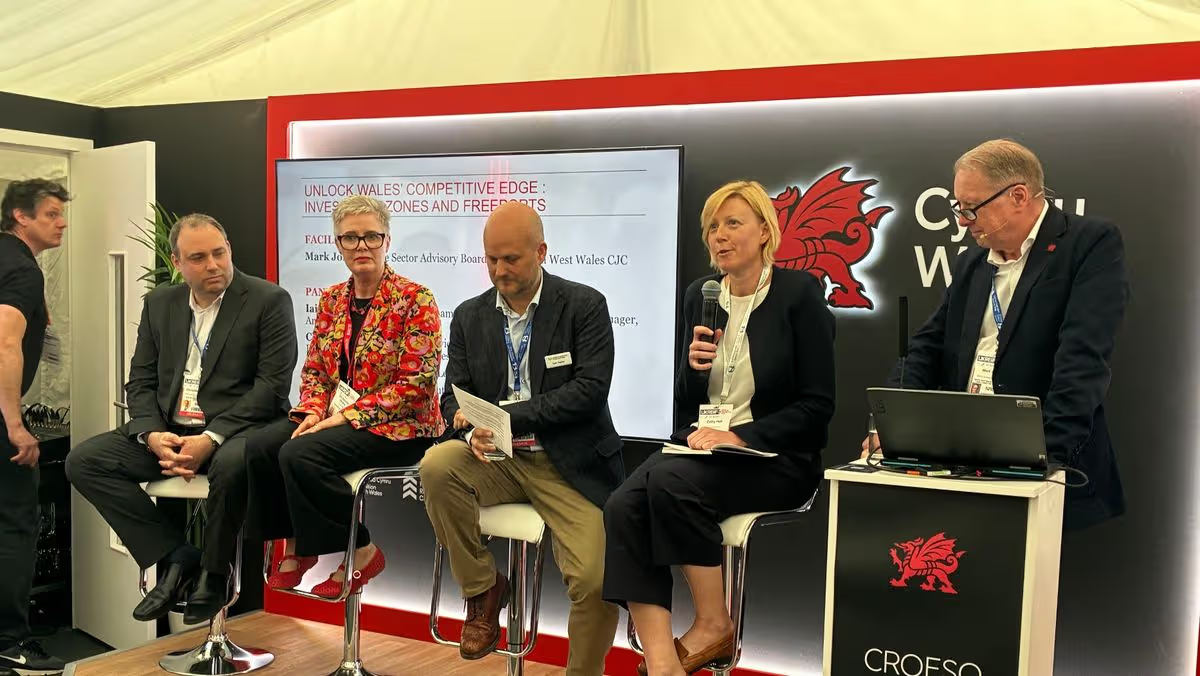
The Wales freeports and investment zones event at the UK Real Estate Investment & Infrastructure Forum (UKREiiF) in Leeds.

Cathy Hall, interim chief executive at Celtic Freeport, centre, speaks at the Wales freeports and investment zones event at the UK Real Estate Investment & Infrastructure Forum (UKREiiF) in Leeds(Image: Reach plc)

Freeports and investment zones in Wales can all complement each other and help the nation as a whole to grow, giant UK regeneration showcase UKREiiF has been told.

The Leeds showcase has attracted thousands of delegates to Leeds this week to hear about investment and regeneration opportunities across the UK.

Advertisement

The Wales pavilion hosted a debate on place based impact and development, as well as seeing the launch of the South West Wales investment prospectus which identifies investment opportunities from Pembrokeshire to Port Talbot.

And it hosted a panel discussion on whether Wales’ freeports and investment zones, which both offer tax advantages to investors to encourage them to choose Wales, can “Unlock Wales’ Competitive Edge”.

Host Mark John asked how they could be used to help promote Wales as an “investable nation”.

Christian Branch, head of service at the Regulation and Economic Development Service at the Isle of Anglesey Council, explained that Anglesey Freeport was a public-private partnership between the local authority and Stena Line, owner of the Port of Holyhead.

Advertisement

Asked if the freeports and investment zones across Wales were competing with each other, he said there were in fact opportunities for them to work together. He said: “From a national perspective it’s very much about complementing each other and I think there’s very much scope for all areas to improve”.

And he added that if one free port is successful “then all Wales is successful” and that it could help spark growth well beyondthe port boundaries.

Mr Branch said the freeport aimed to boost economic activity on Anglesey and beyond.

He said the island was dealing with challenges including an ageing population, young people moving away, and with thousands of job losses in recent years. But he said it also had many opportunities, including the Port of Holyhead, Rolls-Royce’s development of its Small Modular Reactor project at Wylfa, and the announcement of an AI Growth Zone on the island.

Advertisement

Cathy Hall, interim chief executive at Celtic Freeport – which covers the ports of Milford Haven and Port Talbo – said that while Mr Branch “hasn’t let me copy his homework yet”, she did expect that the freeports would learn from each other.

She explained that her freeport covers the ports of Milford Haven and Port Talbot, with a focus on the green economy through supporting offshore wind and the hydrogen economy. She said “It’s not just the two ports but the whole industrial ecosystem.”

Ms Hall said there were many similarities between coastal areas across Wales and the UK, but said each port also had its own specialities.

Ms Hall said one aim for the Celtic Freeport was to develop a “stickiness” in the supply chain – making sure that work in and around its ports helped to “build a long term skills base for the region as a whole”, rather than relying on contractors coming in and then leaving.

Advertisement

She highlighted the success at the Humber ports, particularly Grimsby, which have pivoted from fishing to supporting offshore wind in a move that has created skills and opportunities for local people.

Ms Hall said freeport and investment zone bosses could also act as “convening powers” for potential inward investors in areas such as offshore wind. They could, she said, help businesses new to Wales to get in touch with the right people to drive investments forward.

Iain Taylor, Flintshire and Wrexham Investment Zone programme manager at Ambition North Wales, said that zone was focused on areas including advanced manufacturing and supporting SMEs. Key sites include Gateway Deeside, Wrexham industrial estate, and Warren Hall.

He said the zone’s developers wanted to create thousands of jobs and to help smaller firms as well as the big companies in the region such as Airbus.

Advertisement

He talked about the tax reliefs on offer at particular sites, but said those reliefs in North East Wales and at the other sites featured on the panel were designed to attract long-term investors. He said: “The message across the panel is we’re here for the next generation,” and added that he wanted the local economy to be able to adapt to broader economic changes in the decades to come.

The Cardiff and Newport Investment Zone covers three strategic sites.

Cllr Deborah Davies, deputy leader at Newport City Council, said they include the proposed Cardiff Parkway station and integrated business park on the outskirts of Cardiff at St Mellons, which she added should develop its own business “ecosystem” once it opens.

But key industries in the investment zone will include advanced manufacturing and semiconductor R&D, which Cllr Davies described as “investment that matters to all Wales”. Key companies in the area include IQE, while its semiconductor expertise is attracting interest from around the world as the area still boasts plenty of space for firms to base themselves around that semiconductor cluster, and it also has strong transport links.

Advertisement

That investment, she said, will continue to lead to the development of local industries and businesses.

The investment zone also covers Imperial Park at Newport, which is home to leading tech firms including KLA and Vishay, and a parcel of land stretching from the Central Quay development in the centre of Cardiff down to Cardiff Bay and the Atlantic Wharf regeneration site.

The South West Wales Corporate Joint Committee (SWWCJC) has also unveiled its first regional investment prospectus at UKREiiF, marking a milestone in the region’s long-term economic development strategy.

The statutory body, that covers the local authority areas of Carmarthenshire, Neath Port Talbot, Pembrokeshire, and Swansea, has identified a portfolio of strategic opportunities across a range of sectors including clean energy, advanced manufacturing, innovation, tourism, and infrastructure.

Advertisement

Councillor Rob Stewart, chair of the SWWCJC and leader of Swansea Council, said: This prospectus is a statement of confidence in South West Wales. We are presenting a single, coherent regional offer to investors- one that reflects our shared priorities, our world-class natural assets, and our commitment to sustainable, inclusive growth.

“UKREiiF is one of the country’s leading events for driving investment, regeneration, and infrastructure development, making it the perfect platform to showcase the scale of opportunity in our region. It brings together public and private sector leaders from across the UK and beyond, and we are proud to support the Welsh Government, Ambition North Wales, Cardiff Capital Region, and Growing Mid Wales in showcasing the very best that Wales has to offer.

“Our participation at UKREiiF forms part of a wider programme to strengthen investor engagement and promote South West Wales as a dynamic, future-focused region ready to play a leading role in growing Wales’ and the UK’s economy.”

Advertisement
Continue Reading

Business

CLM: AI Theme Across Multiple Sectors (NYSE:CLM)

Published

on

SCHD: 3 Reasons Why I'm Buying More Right Now (NYSEARCA:SCHD)

This article was written by

Monte Independent Investment Research: Michael Del Monte is a buy-side equity analyst with expertise in the technology, energy, industrials, and materials sectors. Prior to working in the investment management industry, Michael spent over a decade in professional services working across industries that include O&G, OFS, Midstream, Industrials, Information Technology, EPC Services, and consumer discretionary.

Analyst’s Disclosure: I/we have a beneficial long position in the shares of GEV, NVDA, INTC, AVGO either through stock ownership, options, or other derivatives. I wrote this article myself, and it expresses my own opinions. I am not receiving compensation for it (other than from Seeking Alpha). I have no business relationship with any company whose stock is mentioned in this article.

Seeking Alpha’s Disclosure: Past performance is no guarantee of future results. No recommendation or advice is being given as to whether any investment is suitable for a particular investor. Any views or opinions expressed above may not reflect those of Seeking Alpha as a whole. Seeking Alpha is not a licensed securities dealer, broker or US investment adviser or investment bank. Our analysts are third party authors that include both professional investors and individual investors who may not be licensed or certified by any institute or regulatory body.

Advertisement
Continue Reading

Business

Smruti Sriram OBE & Alisha Fredriksson Named Winners

Published

on

Smruti Sriram OBE & Alisha Fredriksson Named Winners

Smruti Sriram OBE, the second-generation chief executive who has built Bags of Ethics by Supreme Creations into one of Britain’s most quietly influential sustainable manufacturers, has been named winner of the 2026 Veuve Clicquot Bold Woman Award. Alisha Fredriksson, the 31-year-old co-founder of maritime carbon-capture pioneer Seabound, takes home the Bold Future Award.

The awards, now in their 54th year and the longest-running international honours for women in business, were presented in London last night by Thomas Mulliez, president of the champagne house. The pair join an alumni list that includes Dame Julia Hoggett DBE, chief executive of the London Stock Exchange, vaccine scientist Professor Dame Sarah Gilbert, and Anne Pitcher, the former chief executive of Selfridges Group. Hoggett picked up the same honour at last year’s ceremony alongside Shellworks co-founder Insiya Jafferjee.

For Sriram, the award caps an eighteen-year run at the helm of a business that has done more than most British SMEs to give the much-abused phrase “purpose-driven” some commercial heft. Founded in 1999 by her father, Dr R. Sri Ram, Supreme Creations has grown into a vertically integrated supplier of reusable merchandise and sustainable packaging that, on the company’s own reckoning, has displaced an estimated 30 billion single-use items. Its “Bags of Ethics” label, which guarantees full supply-chain transparency, has become something of a quiet standard in a sector still riddled with greenwashing.

The judging panel, which this year included Kristina Blahnik of Manolo Blahnik, Allwyn UK managing director Bridget Lea, Ada Ventures co-founder Matt Penneycard and The Dots founder Pip Jamieson, cited Sriram’s work scaling a globally integrated supply chain alongside her commitment to social impact. More than 80 per cent of the workforce at the group’s factory in Pondicherry, southern India, is female; partnerships with the British Fashion Council and the Royal Forestry Society have raised millions for environmental and educational causes.

“As a second-generation entrepreneur, my journey has been shaped by a strong foundation of values, kindness, purpose and business acumen from my family, and especially my father, who founded the business in 1999 and is still very much involved,” Sriram said. “These eighteen years have been a professional and personal evolution, with a strong belief that business can and should be a force for good. To be recognised alongside such inspiring women is a reminder of what is possible when we use our skills not just to succeed, but to serve.”

Advertisement

She was quick to share the credit. “Our global teams from Pondicherry, and across Europe, are creative, highly skilled, and have always been showcased as partners to our clients, not just suppliers. This award is a spotlight on them, not me. They are the backbone and deserve the full recognition.”

Sriram beat a strong shortlist that also featured Paula MacKenzie, the chief executive of PizzaExpress, and Kanya King CBE, founder of the MOBO Group, as flagged when the nominees were announced earlier this year.

A shipping disruptor with a 95 per cent answer

If Sriram’s award nods to two decades of patient compounding, the Bold Future Award recognises a business that did not exist five years ago. Fredriksson co-founded Seabound in 2021 with a single, audacious proposition: that shipping — the industry behind roughly three per cent of global CO₂ emissions and long regarded as “too hard to abate” — could be cleaned up with retrofittable, container-sized carbon-capture kit bolted onto vessels already at sea.

The London-headquartered start-up’s modular system uses calcium looping to trap CO₂ from exhaust gases and convert it into solid calcium carbonate pebbles that can be offloaded at port. Independent assessments, including a case study published by Innovate UK Business Connect, put potential capture rates at up to 95 per cent. Following successful pilots with Lomar Shipping and Hapag-Lloyd, Seabound has now moved into commercial deployment, with the first full-scale units serving a cement carrier chartered to Heidelberg Materials.

Advertisement

“I am incredibly proud of the journey we have taken at Seabound, tackling one of the toughest challenges out there: reducing emissions in global shipping,” Fredriksson said. “What began as an ambitious idea to address the climate crisis has grown into a brand new category of technology for the industry. With successful pilot projects behind us, we are now at an exciting inflection point: heading into our first full-scale deployments, with the world’s largest shipping companies and regulators actively engaging with us.”

Fredriksson’s win lands at a moment when capital for female-led climate tech is still vanishingly scarce, a recurring theme are investors such as Sustainable Ventures, which backs female founders at twelve times the industry average. The Bold Future shortlist, which also included Josephine Philips of repair-and-alteration platform SOJO and Marisa Poster of matcha disruptor PerfectTed, suggests the talent pipeline is healthier than the funding statistics imply.

A 54-year-old hymn to Madame Clicquot

The awards trace their lineage to Madame Barbe-Nicole Clicquot Ponsardin, who took over her late husband’s champagne house in 1805 at the age of 27 and turned it into a global business in defiance of nineteenth-century convention. More on the programme’s history and previous winners is available on the Veuve Clicquot Bold Woman Award UK page.

“Madame Clicquot led Veuve Clicquot to become a brand of excellence and courage,” Mulliez said. “Building on her legacy, Smruti Sriram OBE and Alisha Fredriksson are shaping the future of business. Their businesses tackle global issues and their achievements extend far beyond commercial success, offering powerful inspiration to the next generation of female entrepreneurs.”

Advertisement

For British SMEs watching from the sidelines, the more useful inspiration may be quietly structural. Sriram’s eighteen-year build of a profitable, transparent manufacturing group, and Fredriksson’s rapid commercialisation of a deep-tech climate solution, between them sketch out two viable archetypes for bold business in the second half of the 2020s: patient and purposeful on one hand, fast and technically ambitious on the other. Both are evidently still rewarded.


Amy Ingham

Amy is a newly qualified journalist specialising in business journalism at Business Matters with responsibility for news content for what is now the UK’s largest print and online source of current business news.

Advertisement
Continue Reading

Business

TikTok and YouTube 'not safe enough' for kids, says Ofcom

Published

on

TikTok and YouTube 'not safe enough' for kids, says Ofcom

YouTube said it worked with experts to provide appropriate experiences. TikTok said it was disappointed Ofcom had not acknowledged its safety features.

Continue Reading

Business

Samsung strike on hold – but the fight isn't over yet. Why?

Published

on

Samsung strike on hold - but the fight isn't over yet. Why?

The walkout, which was due to start on Thursday, has been suspended while union members vote on a tentative deal.

Continue Reading

Business

Acarix AB (publ) (ACIXF) Q1 2026 Earnings Call Prepared Remarks Transcript

Published

on

OneWater Marine Inc. (ONEW) Q1 2026 Earnings Call Transcript

Aamir Mahmood
President & CEO

Good morning, and welcome to the Q1 2026 earnings call from Acarix. I appreciate everybody joining this morning. And before we kick off, it’s important for us to all kind of understand and realize that the world is in a very dynamic shift as we speak. The geopolitical tension, most prominently in the Middle East markets right now are ongoing, and we don’t see an end in sight. However, what I want to rest assure is all operations from Acarix standpoint are fully functional. While we do have a lot of entry and focus within the MENA region, nothing has come to a stop. So things are moving along slower than expected. However, given the rhetoric and the challenges we face across the board globally, I think that everybody recognizes it, but it’s important to make sure we address those situations as we continually press forward. Second, I’ll apologize in advance, I have a mild cough due to my allergies, but nothing to be concerned about. So let’s go ahead and move into the deck.

For all our new investors, thank you for joining. Just a quick update on who we are. This is — we’re Acarix. We have a CADScor System, and we’re really trying to revolutionize early onset diagnostics in the cardiovascular range. We have a point-of-care device that is fairly quick, within 10 minutes, and can calculate a CAD-score for patients feeling low to moderate chest pain or shortness of breath. We can quickly and very easily identify those things using high-fidelity acoustics, listening into the arterial flow. And our negative predictive value is 96.2% in the United States and 97.2% in the European markets. We have over 15 years of R&D, over 45 patents, and we

Advertisement
Continue Reading

Business

New CEO for Siemens UK & Ireland vows to ‘build on strong foundations’ at global giant

Published

on

Business Live

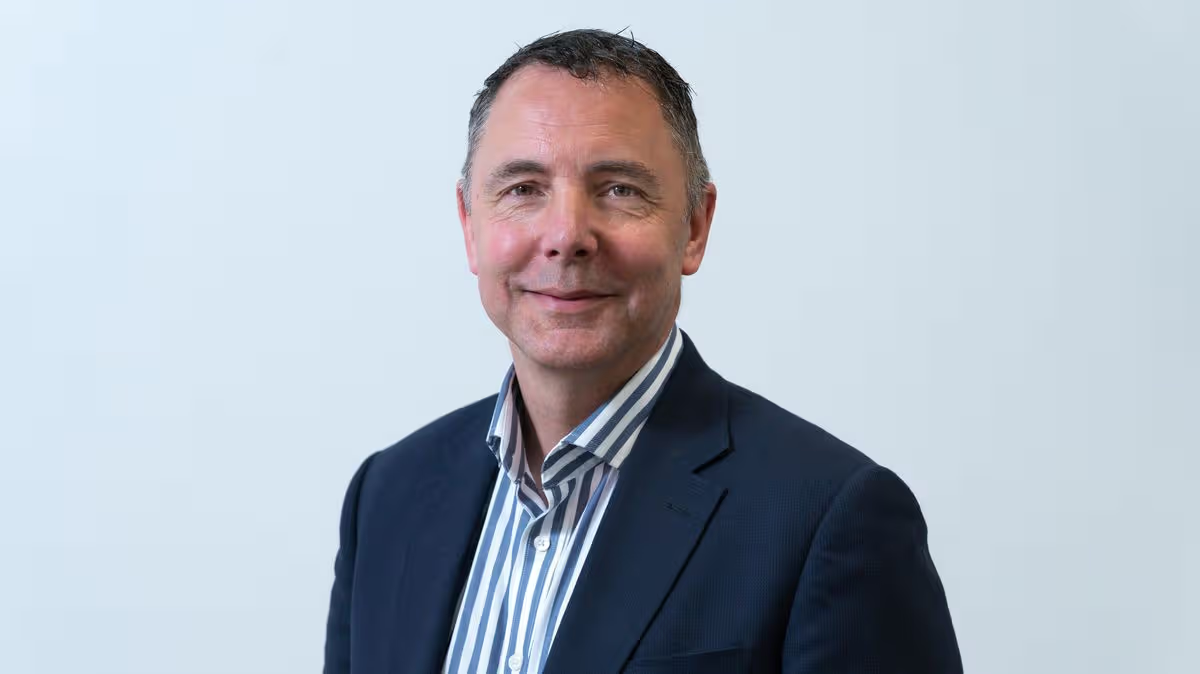
Brian Holliday has worked at Siemens for more than 32 years

Manchester-based Brian Holliday has been named as the new Chief Executive Officer of Siemens UK and Ireland.

Manchester-based Brian Holliday has been named as the new Chief Executive Officer of Siemens UK and Ireland(Image: Siemens)

Industrial and technology giant Siemens has named Brian Holliday as its CEO of its £4.6bn UK and Ireland business to “build on the strong foundations already in place”.

Manchester-based Mr Holliday has worked for Siemens for more than 32 years across a number of leadership and tech roles. He has been a member of the UK and Ireland senior leadership team for 10 years and will continue as managing director of Siemens Digital Industries.

Advertisement

Mr Holliday is a Fellow of the Royal Academy of Engineering and visiting Professor at the University of Sheffield, holding degrees from Cardiff University and the University of Manchester as well as an honorary doctorate from Middlesex University.

He is co-chair of the Made Smarter Commission, which works with SMEs to improve manufacturing productivity, and was recently appointed to the board of Skills England to advocate for SMEs and social mobility. He started his career as an apprentice with Texas Instruments and continues to focus on applied learning and vocational training.

Siemens’ UK & Ireland business employs 12,000 people and generated £4.6bn in revenue in 2025.

Matthias Rebellius, managing board member of Siemens AG, responsible for UK and Ireland, said: “Brian brings a deep understanding of our strategic priorities and our customers, as well as strong insight into the challenges facing industry as it digitalises. His external experience with the Catapults and Made Smarter will also be a real asset.

Advertisement

“Brian will build on the strong foundations already in place, continuing to drive focus on the areas where we can make the greatest difference and create more value for customers. This will be even more important as we take forward our ONE Tech Company programme and ensure we serve our customers in a seamless, straightforward way.”

Mr Holliday said: “I’m honoured to take up this position at a time of significant change, where technology and talent can make a real difference. I’ve always been proud of our people and struck by the commitment and sense of purpose evident across our UK and Ireland organisation thus I’m genuinely excited to lead this strong team. With global leadership in industrial technology and AI, as well as the partnerships we’ve developed, Siemens is well set to help our customers with their competitiveness, resilience and sustainability.”

Continue Reading

Trending

Copyright © 2025