Connect with us

Business

Mayor Bev Craig’s plan to transform Greater Manchester’s high streets

Published

on

Business Live

New mayor says there are ‘too many extractive or low-quality businesses on too many of our high streets’

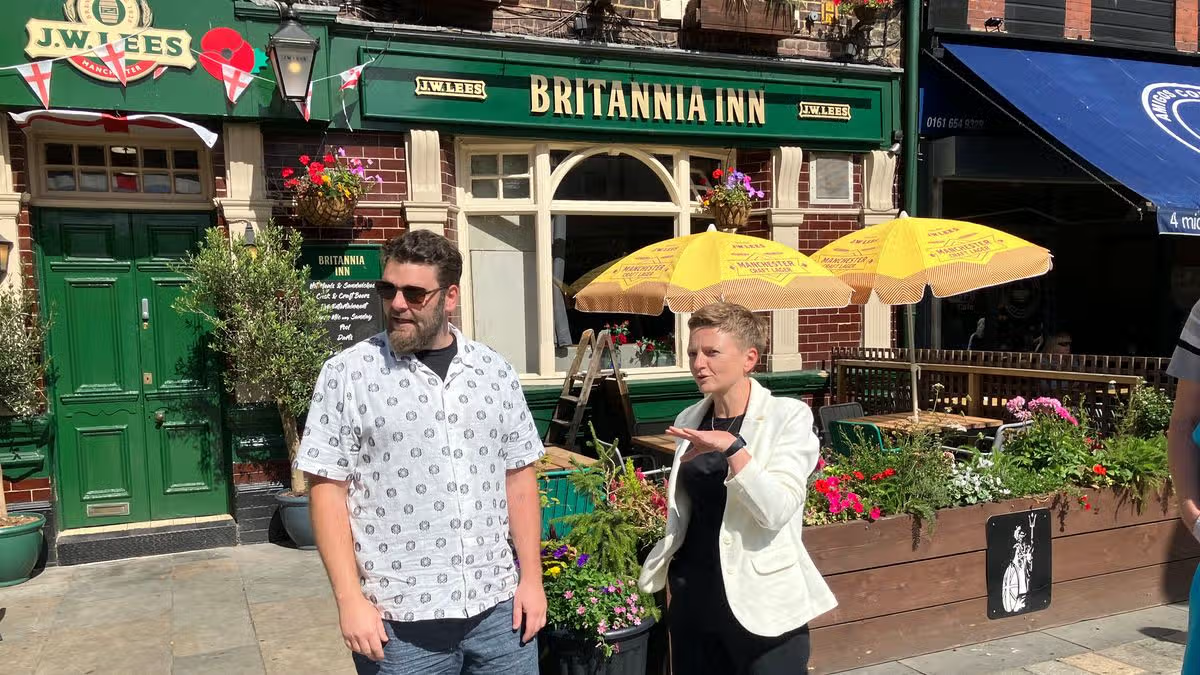
Bev Craig with Jack Howard, landlord of the Britannia Inn, Middleton

Bev Craig, right, with Jack Howard, landlord of the Britannia Inn, Middleton (Image: LDRS)

New plans have been announced to transform high streets across Greater Manchester.

Advertisement

Mayor Bev Craig is launching a £20m high streets fund which businesses and community groups can bid into, as a way of making improvements and attracting more visitors to local shops.

It comes as residents and leaders around the region have long warned that Greater Manchester’s high streets are struggling from changing shopping habits.

The mayor said ‘too many high streets’ in Greater Manchester don’t currently have the type of shops and services that local people want.

“My view is that there are too many extractive or low-quality businesses on too many of our high streets,” she said on Monday.

Advertisement

“I think vape shops have become a bit of a symbol for that, how there can be so many on a high street people simply don’t understand.

“I’ve consistently called on government to make sure that they reform the system nationally that gives councils the power to say stop, too many, we don’t currently have that at the moment.

“I hope that the government will listen in the coming days around some of their announcements to do that.

“I think a high street just filled with those kinds of businesses means that people don’t come in, they don’t shop, they don’t spend time, and people want shops that they can go to.

Advertisement

“I would like to see less vape shops, but I would also like to see more local independents supported to thrive, yes you need a mix of national corporations on the high street, but actually how we support locals and indies is a priority for me.”

Funding for the pledge will come from Greater Manchester’s Good Growth Fund.

A new high streets taskforce will also be set up to steer how the funding will be used and set priorities for breathing life back into high streets.

The announcements were made in Middleton town centre, where there are plans for a mayoral development corporation to drive improvements.

Advertisement

People in Middleton said they want to see changes on their high streets.

Michael Joyce, 36, is a mental health nurse from Middleton and said: “They want to start by putting a bank in, and we need more shops, more places to go to.

“The high street connects the whole community really.”

Andrew Lord, 57, is the owner of Lords of Middleton butchers shop, a family-run business which has been in the town since 1893.

Advertisement
Andrew Lord, owner of Lords of Middleton butchers

Andrew Lord, owner of Lords of Middleton butchers (Image: LDRS)

His shop was one of those visited by Bev Craig during a tour of the town centre.

Mr Lord said he felt ‘good’ after his conversation with the mayor about the future of Middleton.

“More banks and shops would give it a real boost, and there are all these empty buildings, they need to find a way of taxing landlords who own them to encourage them to get a shop in there,” he said.

Mr Lord said the loss of banks has been an issue in Middleton, adding: “They say they close because no one was visiting them, but here people were queuing out the door to go to the banks.

Advertisement

“The banks save money when it’s all online.”

Jack Howard, 40, landlord at the Britannia Inn, said: “Middleton’s a great town, it’s not really that anti-social, I’ve been here 18 months and there’s very few incidents.

“You get the odd idiot, but it’s a handful of people. Middleton town centre is fantastic, it just needs a lick of paint, and it needs all the old buildings sorting out.

“You go to other town centres and they look beautiful and well kept, and we need to try and do that here.”

Advertisement

Bev Craig said she would work with local leaders in Middleton to help get banking facilities back to the town.

She said: “We’re working with the shopping centre to see a new post office open.

“There was a lot of anxiety around the closure of the post office in the shopping centre, and I think that’s been task one.

“But secondly, through what we’ve been doing with the Middleton cooperatives, is trying to look at different banking solutions, be that the post office banking hub, where we’re making the case that Middleton should at least have one of those, where you can have different banks on different days.

Advertisement

“Working with other financial institutions in and around Greater Manchester, and piloting some work with Manchester Building Society around community banking into community facilities.

“But different towns, depending on the size, depending on the need, need different things.

“The post office has been the priority because local businesses tell me, particularly when they operate in cash, it’s putting their trading at risk, not having somewhere to go to put in their cash and to operate businesses.

“So a matter of priorities, but using Middleton as a testbed as to how we solve some of the problems that we see in other places across Greater Manchester.”

Advertisement

Dylan Williams is a councillor in Rochdale and serves as vice chair of Middleton Township Committee.

He said: “It’s a really exciting time for Middleton, we’ve got the mayoral development corporation which the Prime Minister [Andy Burnham] helped us set up, and I think Bev’s really keen to see it through.

“We’ve got some really positive announcements that we’re expecting for Middleton in the next few weeks that’s going to really enthuse people in the town.”

Mark Robinson, director of economy and place at Rochdale council, added: “We recognise that Middleton has got a really strong community, we want to put more events on, the events we do here are really successful, we’ve got this fantastic public space outside the shopping centre here, so there are opportunities for us to do more.

Advertisement

“We really want to drive the footfall into the centre, improving those active travel public transport connections into the centre, and also we want much more residential, so the future of Middleton, like a lot of centres, will probably be a smaller retail core and introducing more evening night-time leisure uses and developing that housing offer around the town centre as well.”

Robert Downes, regional business manager for the Federation of Small Businesses in Greater Manchester, welcomed Bev Craig’s plan for high streets and said: “Our nation is essentially built around the notion of the ‘village centre’, with everything else emanating outwards. They are the beating hearts of communities and we need to look after them better.

“High streets need to be bright, welcoming and safe, with a healthy mix of shops and services that bring people in, where they will enjoy spending both time and money and keep coming back.

“Dilapidated centres that are poorly maintained and neglected should become a thing of the past, but making that vision a reality will require bold, out-of-the-box decision-making to ensure this new money is spent wisely on projects that can deliver the renaissance our high streets desperately need, and that’s ultimately about increasing footfall – substantially.

Advertisement

“Bringing unloved, long-term empty premises back into use, I hope, will be a key part of this new scheme, and there has to be some work on accessibility too.

“Easy in, easy out – that’s what’s needed. Local councils and other bodies like TfGM and GMP will all need to work in lockstep with the mayor to make this a success.”

Continue Reading
Click to comment

You must be logged in to post a comment Login

Leave a Reply

Business

Andy Burnham plans crackdown on new betting and vape shops

Published

on

Business Live

PM scrapping Blair-era planning rule and requiring planning permission for e-cigarette outlets on the high street

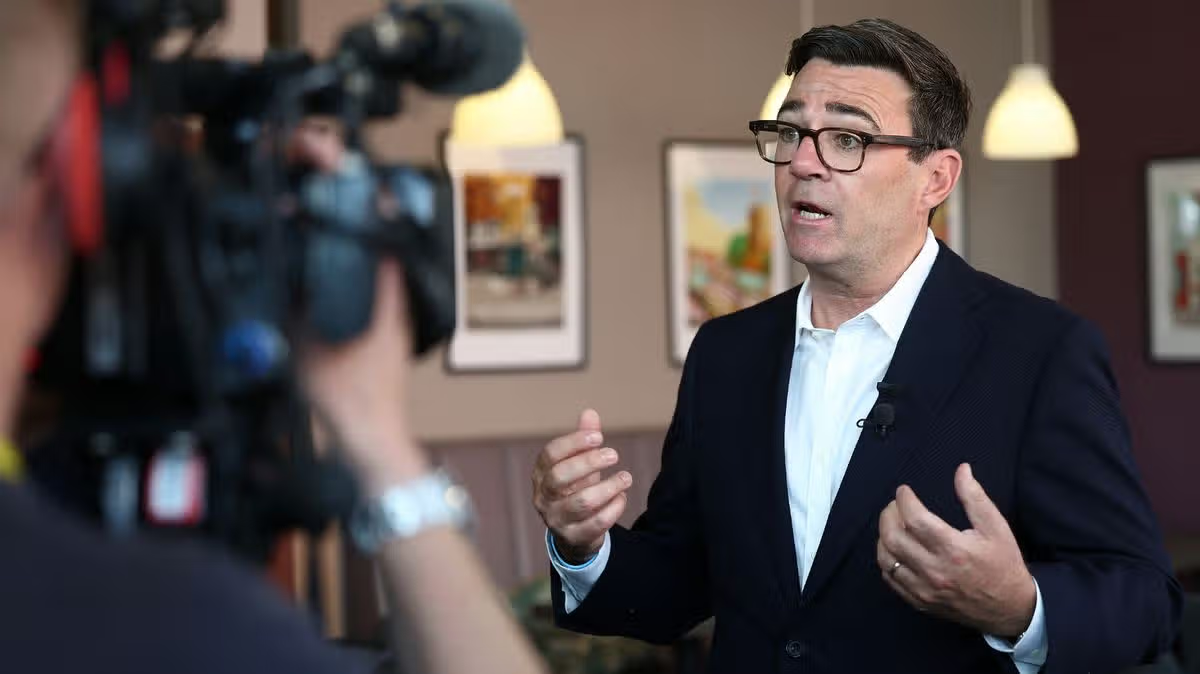
UK Prime Minister Andy Burnham speaks during a TV interview at The Hub cafe following a visit on August 11, 2026 in Ilkeston, Derbyshire.

UK Prime Minister Andy Burnham speaks during a TV interview at The Hub cafe following a visit on August 11, 2026 in Ilkeston, Derbyshire(Image: Getty Images)

Andy Burnham has vowed to grant councils greater powers to block new bookmakers and vape shops in a bid to revive Britain’s “hollowed-out high streets”.

Advertisement

The Prime Minister intends to abolish the so-called “aim to permit” rule, which restricts the ability of local authorities to prevent betting shops and 24-hour slot machine venues from opening in their area.

Planning permission will also be required for outlets selling e-cigarettes, as part of wider efforts to give communities a stronger voice under the proposed changes.

The formal definition of a vape shop will be tightened to prevent businesses circumventing the new rules by claiming to be a “convenience store or a retailer”, officials confirmed.

Adult gaming centres offering up to 24 hours of access to slot and fruit machines will likewise require planning permission under the shake-up, which is expected to come into force at the start of next year.

Advertisement

Under proposals first announced by Sir Keir Starmer’s government, police will also be empowered to shut down “dodgy” barbers, vape shops and nail salons for up to a year.

The maximum duration of so-called “closure orders” will be extended from six months to 12, affording officers more time to investigate premises linked to organised crime.

Officials added that the Government would also establish clearer expectations for the design of high-street shop fronts, with the aim of improving their appearance and heading off complaints about “garish neon signs” and “oversized logos.”

Working alongside local authorities, the Government will publish “practical guidance” for councils on how to make town centres more appealing, officials confirmed.

Advertisement

The “aim to permit” policy was introduced when Sir Tony Blair’s Labour government, in which Mr Burnham served as a minister, liberalised gambling legislation in 2005.

The Prime Minister, having taken a holiday just over a fortnight into his tenure, is set to spend much of the remainder of August travelling across the country consulting people on how the Government can better their lives.

Officials have indicated he will be in “listening mode”, with a particular focus on rejuvenating high streets and addressing the cost of living.

However, he faces mounting pressure over his management of the prisoner-release row, as two of Pc Andrew Harper’s killers are still to be freed early despite Mr Burnham’s review of the proposals.

Advertisement

Mr Burnham said Tuesday’s announcement would help put local communities “back in control”, enabling councils to curb the proliferation of unwanted shops and breathe new life into town centres.

He said: “For many people, the high streets they grew up with have been hollowed out and become unrecognisable over decades of decline.

“The rise of vape shops, betting shops and rogue operators have replaced the shops, services, and community spaces that people are crying out for.

“That’s not on. I said we would improve Britain’s high streets, and that’s exactly what we are starting to do.”

Advertisement

He added: “High streets are the beating heart of local communities, but for too long Westminster has stood by while they have been in decline. This Government is committed to restoring our high streets and bringing back hope across Britain.”

The Centre for Social Justice think tank, which has conducted analysis revealing that Britain has lost nearly 1,800 pubs and bars while vape and tobacco shops have grown in number to almost 2,200 since 2016, welcomed the proposals.

Joshua Nicholson, head of housing and communities at the think tank, said: “The Government is right to give councils new powers to say no to these dodgy shops. High street renewal is vital to restoring security within our communities.”

However, the Betting and Gaming Council challenged any suggestion that betting shops were proliferating unchecked, insisting the real threat to high streets was “more empty units and fewer local jobs, not businesses rooted in the communities they serve”.

Advertisement

A spokesperson for the industry body said: “We support tough action against criminal operators and agree local people should have a proper say over their high streets. But the suggestion that betting shops are spreading unchecked is simply wrong.

Andy Burnham speaking in Derbyshire today

Prime Minister Andy Burnham speaking in Derbyshire today

“Betting shop numbers have fallen by over a third since 2019. Around 3,000 shops have closed and over 15,000 jobs have already been lost.

“It is wrong to lump highly regulated, licensed betting shops together with rogue or criminal businesses. Betting shops still support 37,500 jobs, bring vital footfall to neighbouring businesses and, for many customers, are valued community hubs.”

Eamonn O’Brien, chairman of the Local Government Association, said: “It is positive that councils and communities will get a greater say on what shops and services are found on their high streets through these changes to the Use Class Order which will require vape shops to acquire planning permission.”

Advertisement

He added: “Extra powers will help councils in revitalising high streets and shaping their communities, particularly in regulating betting and vaping shops, while also breathing new life in to empty premises.”

Gillian Golden, chief executive of the Independent British Vape Trade Association, said: “Rogue vape traders on the high street have been a blight on the legitimate sector, so we welcome measures such as extending closure orders on dodgy shops.

“For too long the media have conflated organised criminal networks with law abiding vape businesses, when in fact these criminals just see illicit vapes as a commodity in the same way as illicit tobacco or counterfeit goods. That has damaged the public’s understanding of our sector.

“Research has shown that if even half of England’s current adult smokers were to switch to vaping, it would save the NHS £0.5 billion. Vaping will be soon be subject to excise duty, which HM Treasury estimates will bring in £0.2 billion in its first partial financial year (2026–27) and £0.6 billion per year by 2030. Cutting out illegal trade in vapes will be key in ensuring Vaping Products Duty contributes to the UK economy rather than reinforcing an existing illicit sector.”

Advertisement

Opposition critics have attributed the high street’s decline to the burden of business rates and called on Labour to introduce more ambitious reforms.

Shadow communities secretary Sir James Cleverly said: “Everyone can see what has happened to our high streets, with once-treasured shops being replaced by a smattering of rogue operators, many of which have links to organised crime and fraud.

“Labour’s business rates hikes have hollowed out our high streets, driving out the shops people want and leaving empty units for whoever is left standing to fill.

“Conservatives would cut business rates for high street firms and back the small businesses that give a town centre its character.

Advertisement

“Unless the Government takes steps to support the high streets and hard-working businesses, Labour’s increases in planning regulation will just mean more empty and boarded-up shops.”

Reform UK Treasury spokesman Robert Jenrick stated: “Until this Government scraps the jobs tax, addresses sky-high business rates and provides real, fundamental support for high street businesses, this policy will only create even more empty shops on our high streets.

“Preventing businesses from opening only works if the Government and local councils make it attractive for the right kind of shops to open in their place.

“Labour is doing the opposite by making life harder for small, legitimate businesses to operate on our high streets.”

Advertisement

Liberal Democrat home affairs spokesperson Max Wilkinson remarked: “Unless he beefs up powers to properly crack down on vape shops and dodgy operators, Burnham’s plans could go up in a puff of smoke.

“Our high streets are in crisis, so rolling the dice and keeping his fingers crossed these minor changes are enough simply won’t win the hand.

“He should scrap the failed business rates system and urgently give sweeping new powers to councils so high streets can prosper and trading standards officers can permanently shut repeat offenders.”

Advertisement
Continue Reading

Business

Trump wants to split childhood shot up

Published

on

Trump wants to split childhood shot up
Trumps signs order to cut child vaccine recommendations from 18 to 11

President Donald Trump‘s latest executive order calls for splitting the measles, mumps and rubella, or MMR, vaccine into three separate shots – but doctors and other experts say that effort has no scientific basis and is unlikely to get off the ground. 

Trump on Monday said without evidence that the vaccine could be “quite lethal” in its combined form, even though the shot has repeatedly been proven safe and effective across large-scale studies. Experts called that claim “completely false” and said there is no scientific data showing benefits of separating the shot. 

Splitting the vaccine would also come with “significant logistical limitations,” and having three standalone shots that require multiple doctor’s visits could result in more delayed or missed vaccinations among kids, Neil Maniar, a public health professor at Northeastern University, told CNBC. 

“They’re not solving a problem here. They’re creating a new one,” Maniar said. “Based on false scientific rationale and political ideology, they’re changing something that works into something that we have no idea what it will do.” 

Advertisement

The U.S. has already seen a decrease in the share of parents who are willing to use the MMR shot to vaccinate their children, which has contributed to the recent resurgence in U.S. measles cases, Dr. Andrew Racine, president of the American Academy of Pediatrics, told reporters on Wednesday. The U.S. has logged its highest number of measles cases in decades this year.

Trump’s rhetoric and recommendations could also further undermine the public’s confidence in the safety of the MMR vaccine, said William Moss, a pediatrician and epidemiological professor at Johns Hopkins University.

Roughly 9% of parents report either skipping or delaying the MMR vaccine for their children, according to a 2025 survey conducted by health policy organization KFF and the Washington Post. It’s unclear how that compares to previous years. 

It’s also not clear where Trump initially got the idea to split the shots, but some experts say it can likely be traced to a British gastroenterologist, Andrew Wakefield. He is an anti-vaccine advocate who published a paper in 1998 claiming to show a connection between MMR vaccines and an increase in autism. That paper has since been retracted, and Wakefield was removed from the U.K.’s medical register.

Advertisement

Why splitting the MMR vaccine may not happen

US President Donald Trump holds a “Gold Standard Childhood Vaccine Recommendations” sign during an executive order signing in the Oval Office of the White House in Washington, DC, US, on Monday, Aug. 10, 2026.

Bonnie Cash | Bloomberg | Getty Images

Manufacturers of the MMR vaccine – Merck and GSK – seem to have little incentive to develop standalone shots, which would take significant time and resources away from their other crucial work toward treating and finding cures to other diseases. Those vaccines would likely reach the market long after Trump’s term ends. 

“I don’t see any world in which vaccine manufacturers have any interest in developing and going through the rigorous regulatory process, getting FDA approval, doing the trials for monovalent measles, mumps, and rubella vaccines,” said Moss. “It would be a foolish investment to make.”

Advertisement

AAP’s Racine also said that it would likely take more than a decade to develop those standalone shots.

In a statement on Wednesday, Merck added that evidence suggests using combination shots improves childhood vaccination outcomes, increasing the completion of all recommended doses and compliance rates. 

One dose of the MMR shot is currently given at 12 to 15 months of age, with a second dose at 4 to 6 years of age. Separating the vaccine could result in a child needing to receive six different doses in their early life. 

“It’s just so counterintuitive and counterproductive,” Moss said. It’s ironic when they’re claiming that children receive too many shots, and then they turn around and propose a policy that’s just going to increase the number of shots they get.”

Advertisement

Northeastern’s Maniar said a single visit can already be challenging for parents who have to take time off work. Healthcare access is also more complicated in certain communities, such as rural areas, he added. 

Maniar said that the U.S. childhood vaccination schedule is designed based on both the child’s “immune system readiness” for a particular shot and their risk for a certain illness. Spacing out those vaccines could increase the chance of a child missing or delaying a shot for a preventable disease they’re at risk for.

Racine added, “Why would we not give children a vaccine that is safe, that prevents death?”

He also noted that two healthy children died in the U.S. from measles last year. 

Advertisement

Some experts fear that splitting the MMR shot and Trump’s broader effort to change federal vaccine recommendations could confuse parents and cause more of them to hold off on immunizing their children. There’s also the possibility that some states could align with the new guidance. 

Moss said he doesn’t see the effort having an immediate or short-term impact on the ongoing measles outbreak.

Still, Maniar emphasized that “we should be doing everything possible to increase those rates rather than implementing policies that present additional barriers to vaccination.”

Choose CNBC as your preferred source on Google and never miss a moment from the most trusted name in business news.
Advertisement
Continue Reading

Business

Dividends Are Sending A Signal

Published

on

Dividends Are Sending A Signal

Dividends Are Sending A Signal

Continue Reading

Business

RBA holds cash rate steady at 4.35pc

Published

on

RBA holds cash rate steady at 4.35pc

Australia’s central bank has chosen to keep the cash rate on hold at 4.35 per cent in a move “universally expected” by the market.

Continue Reading

Business

Court rules over Strandline Resources staff payments

Published

on

Court rules over Strandline Resources staff payments

More than 150 Strandline Resources employees are likely to be paid out of a Commonwealth scheme instead of a $4.75 million trust after a court ruling over the liquidated company.

Continue Reading

Business

Institutional homebuying ban will lower prices long-term

Published

on

Institutional homebuying ban will lower prices long-term
Invitation Homes CEO: Focused on creating new supply and bringing it into the housing system

The CEO of Invitation Homes, the nation’s largest single-family rental landlord, said he believes the recently passed housing bill that bans investors like him from buying existing homes will eventually lower home prices, but not in the short-term.

“I believe in the medium- to long-term, it definitely will,” said Invitation Homes chief executive Dallas Tanner. “I think 90% of the bill focuses on deregulation. How do we simplify capital coming into housing? Are there ways that we can spur up the supply side challenges that we have? I think overnight in the immediate term, it’s a bit trickier because there’s more to the story than just what the bill addresses.”

Tanner pointed to mortgage rate volatility, high construction costs, and zoning and regulatory imbalances.

In early January, President Donald Trump called for a ban on large-scale investors buying single-family homes to rent. He posted on social media that, “People live in homes, not corporations.” This was part of a larger push to tackle the affordability crisis in housing. Some argued that institutional investors were pushing owner-occupants out of the market and inflating home prices.

Advertisement

The ban became law in July, preventing investors who own more than 350 homes from purchasing any more existing units. They can, however, buy new single-family homes specifically built for rent. That is where Invitation Homes is leaning in.

“Our focus as an industry and as a company has been, how do we create new supply and bring that into the housing system today? We built or acquired, in our partnerships with builders, over 6,000 new homes in the last five years,” said Tanner.

In January, just weeks after Trump’s post, Invitation Homes purchase a homebuilder, ResiBuilt. It has also purchased homes from large public builders like Pulte Homes and Lennar to use as rentals.

“We found through trial and error … that this new product, this beta product, the product that we do amongst these master planned developments — it works really, really well for our families. And so we were indexing on that, and that is part of our growth strategy,” said Tanner, adding that the company has been selling off hundreds of its older rental properties.

Advertisement

Get Property Play directly to your inbox

CNBC’s Property Play with Diana Olick covers new and evolving opportunities for the real estate investor, delivered weekly to your inbox.

Subscribe here to get access today.

The largest investors, those owning more than 1,000 homes, represent less than 3% of the single-family rental market, according to various sources. They do, however, have an outsized footprint in certain metropolitan markets, like Atlanta (representing 25% of single-family homes there), Jacksonville (21%) and Charlotte (18%), according to the Urban institute.

Invitation Homes reported better-than-expected earnings at the end of July, even though rents and demand are not as healthy as they were in the first few years of the pandemic.

Advertisement

“We’ve seen sort of fundamentals reset. We talked about it on our last earnings call. We’re starting to see actual pretty positive green shoots in several of our markets,” said Tanner. “But we’re really focused on — how do we navigate this and what does this mean?”

Choose CNBC as your preferred source on Google and never miss a moment from the most trusted name in business news.
Continue Reading

Business

Bellway urges Government help for housing market despite rising sales

Published

on

Business Live

The Newcastle-based housebuilder saw rising sales and profits but says it is still facing significant challenges

A Bellway estate in Northumberland

A Bellway estate in Northumberland(Image: Newcastle Chronicle)

Housebuilder Bellway has called for the Government to do more to boost the housing market despite seeing a rise in sales.

The Newcastle firm has issued a trading update in which it said it expects operating profit to rise to £320m after an increase in the number of housing completions from 8,749 to 9,695 in the year to the end of July. But it highlighted “ongoing headwinds” around mortgage affordability, challenges to the general economy and rising costs for builders.

Advertisement

Chief executive Jason Honeyman said action was needed to reinvigorate the housing market and help support potential new homeowners. He highlighted reductions to stamp duty as one way of boosting house sales.

Bellway said that it had outperformed expectations on the number of houses it sold, while its average selling price rose slightly to £324,000.

Mr Honeyman said: “Bellway has delivered a robust performance and growth in volume output, despite ongoing headwinds for our industry. Our sharp focus on operational improvement and drive for capital efficiency has provided resilience and supported a strong increase in cash generation and shareholder returns.

“The board remains confident that, with supportive market conditions, Bellway is in a strong position to capitalise on future growth opportunities. However, with the near-term outlook remaining uncertain, we call on the Government to act now to improve access to housing across all tenures, both by helping first-time buyers onto the property ladder and supporting the delivery of affordable and social housing for those who need it most.

Advertisement

“In order to ease affordability constraints and stimulate demand, an immediate reduction in stamp duty alongside a Government-backed deposit support scheme for first-time buyers would both drive economic growth and accelerate the delivery of much-needed new homes across the country.”

Bellway said it saw positive trading in the early part of the spring selling season, but has seen a “moderation” in customer demand since April due to the uptick in mortgage rates. It had seen a slight fall in private reservation rates, the update said.

It said it would continue to exercise tight cost controls while the housing market remained subdued, as well as “maintaining a sharp focus on the monetisation of our well-invested land bank and work-in-progress position to support improvements in asset turn and cash generation.”

Bellway – which last week celebrated its 80th anniversary, having been founded as a family firm in Newcastle – added that it expected to complete a £150m share buyback scheme this month and would then launch a scheme to buy another £50m of shares.

Advertisement
Continue Reading

Business

Man Who Took Steroids Without Lifting Finishes Last in Bodybuilding Debut After Missing Finals

Published

on

Man Who Took Steroids Without Lifting Finishes Last in Bodybuilding

A social media personality who built his physique primarily through anabolic steroids and heavy alcohol consumption while avoiding weight training competed in his first bodybuilding contest this past weekend and finished last in his class.

Peter Mossfield, known online through the BoozeBagFitness account, entered the Men’s Classic Physique Open Class B division at the 2026 NPC East Coast Mecca Classic on Aug. 8 in Flushing, New York. Official results listed him in eighth place, the final position among competitors who received a ranking.

The order of finish was Gavin Connelly in first, followed by Ahmed Eid, Fedor Zhurov, Enrique Bonilla, Joshua Nabbie, Diego Da Silva, Joseph Mauceri and Mossfield.

Mossfield’s preparation stood out for its unconventional methods. He previously described taking steroids while consuming as many as 24 alcoholic drinks per day during parts of the process and largely skipping resistance training. During a cutting phase he switched from beer to vodka mixed with diet soda in an effort to lower calories. The approach drew significant online attention and criticism over potential health risks.

Advertisement

In a post-competition video, Mossfield expressed a more optimistic view of his stage presentation. “In my mind, it was me or one other guy had the best package out there,” he said.

After prejudging, several hours remained before the evening finals. Mossfield said he used the interval to drink. He noted that his tolerance had decreased after reducing alcohol intake in the final weeks of preparation, when he averaged fewer than 12 drinks per day. “I kinda lost track of time,” he admitted. By the time he realized the schedule, he had missed the finals and the individual posing portion of the event.

He also suggested that failing to shave may have affected his placement. “I didn’t expect to get disqualified that hard or docked that hard for it,” Mossfield said. The official results nevertheless placed him eighth.

The competition itself is a National Physique Committee national qualifier held at the Goldstein Theatre at Queens College. Prejudging typically occurs in the afternoon, with finals later in the evening, a structure that left a window of free time many competitors use for rest, meals or final preparations.

Advertisement

Mossfield’s experiment had begun months earlier as a high-stakes personal challenge, at times tied to substantial bets. He had previously completed a wager involving developing and then quitting an alcohol addiction. The bodybuilding version evolved after he decided against consistent gym work and turned to performance-enhancing drugs as the primary means of building muscle.

Despite the unusual methods and public backlash, he followed through on competing. The result provided a clear ranking against athletes who had trained conventionally.

Following the show, Mossfield announced a shift in approach. He said he stopped taking steroids after the competition and planned to begin lifting weights without them. “I’m a born again natural,” he joked. “I’m excited to start lifting as a natty.”

His stated goal is to determine whether the muscle developed during the steroid phase can be maintained or improved through resistance training alone. He indicated he wants to allow his body time to reset, specifically monitoring sleep patterns and sexual function, before considering any future use of performance-enhancing substances.

Advertisement

Additional unconventional challenges remain under consideration. Mossfield has expressed interest in MMA training focused on securing a first-round knockout rather than building endurance for longer fights. He also plans to rehabilitate a previously injured shoulder and attempt to throw a 90-mph fastball, with the aim of trying out for a professional baseball team outside Major League Baseball in the spring of 2027. Other ideas include a “cigarette marathon” and a progressive push-up challenge that would involve adding weight daily until performing the movement with roughly 365 pounds on his back.

Whether those projects materialize is uncertain. What is established is that Mossfield completed the bodybuilding preparation and competition he had publicly documented. He consumed large quantities of alcohol, used steroids, largely avoided traditional training, stepped on stage and received an eighth-place finish.

The episode has fueled discussion within fitness communities about the relative contributions of pharmacology, training stimulus, nutrition and recovery. Conventional bodybuilding emphasizes progressive resistance training as a foundational driver of muscle growth, with diet and recovery as supporting elements. Mossfield’s approach inverted that hierarchy for the duration of his experiment.

Health professionals generally caution against unsupervised steroid use and heavy alcohol consumption, citing risks to cardiovascular, hormonal and liver function among other systems. Mossfield has acknowledged experiencing various side effects during the process yet continued to the contest.

Advertisement

His decision to step away from steroids and introduce weight training marks a reversal of the methods that generated his online following. The next phase will test whether the visible changes achieved under the previous protocol can be sustained or improved through more standard practices.

The NPC East Coast Mecca Classic attracts regional competitors seeking national qualification opportunities. Placing last in a class does not preclude future entries, and many athletes use early contests as learning experiences regarding presentation, conditioning and stage protocol.

Mossfield’s post-show comments focused on both the immediate result and longer-term plans. He maintained that his physique compared favorably in his own assessment while accepting the official ranking. The missed finals portion removed any opportunity for additional scoring or audience presentation that evening.

As of the days following the event, Mossfield has framed the competition as the conclusion of one experiment and the beginning of another centered on natural training. The public documentation of both phases continues through his social media channels, where earlier posts detailed daily alcohol intake, steroid protocols and visual progress without corresponding training footage.

Advertisement

The story illustrates the extremes some individuals pursue for online visibility and personal wagers. It also underscores the structured nature of sanctioned bodybuilding events, where competitors are judged on specific criteria of muscularity, conditioning, symmetry and presentation within defined classes. Mossfield met the entry requirements, appeared on stage for prejudging and received a placing, even if the overall process departed sharply from traditional preparation methods.

His next stated steps involve establishing a consistent lifting routine while monitoring physiological recovery from the prior cycle. Future challenges, if pursued, would again test unconventional limits. For now, the record shows an eighth-place finish in a debut Classic Physique class after a preparation defined by steroids, alcohol and the near absence of weight training.

Continue Reading

Business

The challenges of phasing out synthetic food dyes

Published

on

The challenges of phasing out synthetic food dyes

Report provides guidance for farmers, ingredient suppliers and retailers.

Continue Reading

Business

US power demand to reach new highs through 2027, EIA says

Published

on


US power demand to reach new highs through 2027, EIA says

Continue Reading

Trending

Copyright © 2025