

Business
Netherlands Faces Must-Win Test Against Group F Leaders Sweden in Houston

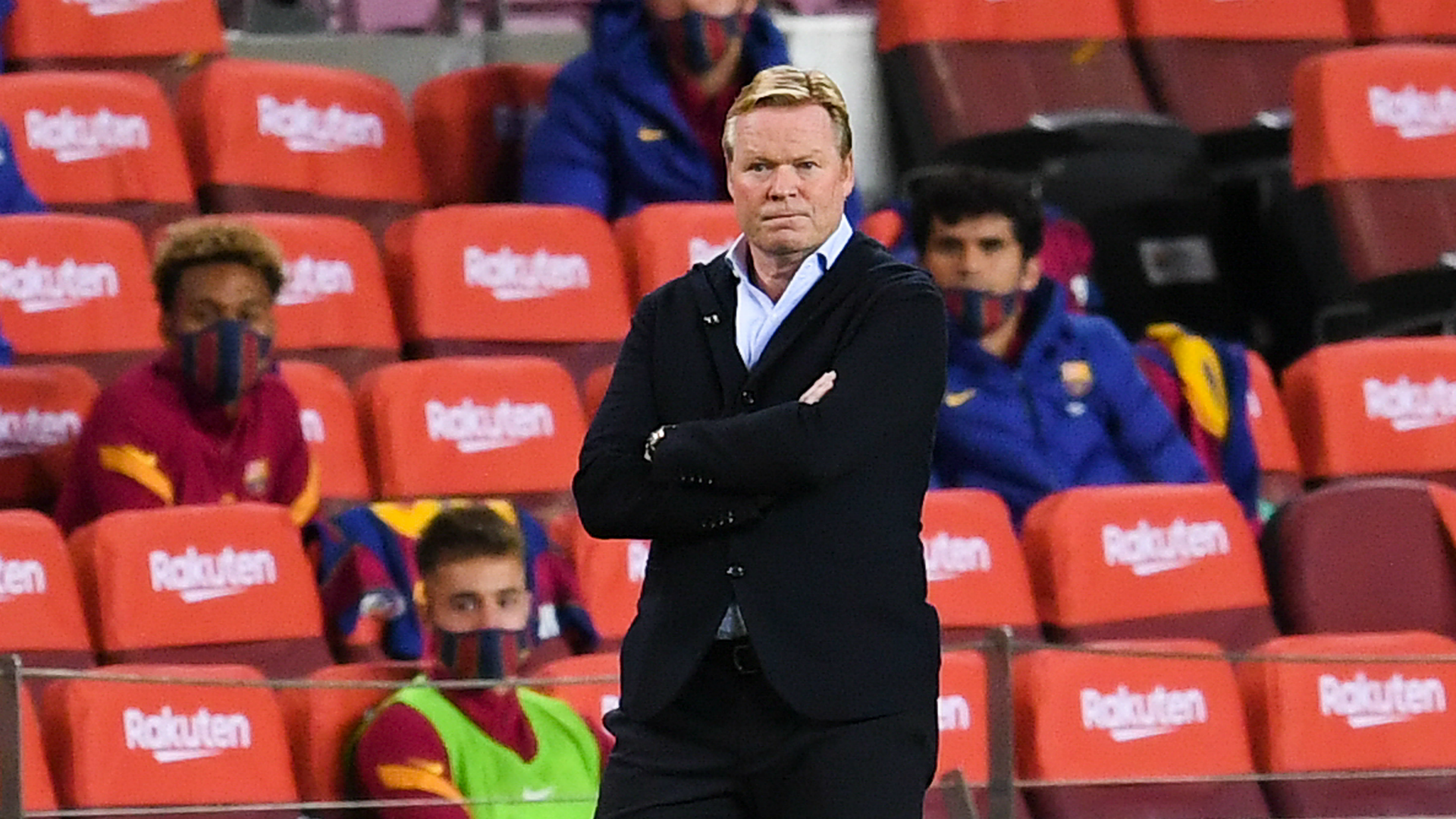
HOUSTON — European foes collide in Houston on Saturday when the Netherlands seek a first tournament victory at the expense of Group F’s current leaders Sweden. Conceding late to Japan in its opener has proven costly for the Oranje, who now find themselves chasing top spot heading into a pivotal clash at NRG Stadium.
A Costly Late Equalizer in the Opener
The Netherlands’ position in the group traces directly back to a heartbreaking finish in their tournament debut. The Oranje appeared to have wrapped up three points against Japan in their opener, only for Daichi Kamada to score an 88th-minute equalizer which consigned Koeman’s side to a 2-2 draw. Goals from Virgil van Dijk and Crysencio Summerville, either side of Keito Nakamura’s first equalizer, had the Dutch on course for victory, but Kamada’s deflected header from a late corner meant the spoils were ultimately shared.
Ronald Koeman’s men were not wholly convincing in the 2-2 stalemate last Sunday, but will still be regarded as favorites to progress from their group in first place.
Sweden’s Statement Win
Standing in the Netherlands’ way is a Swedish side that delivered one of the tournament’s most eye-catching results in the opening round. Sweden surprised a few with its thumping 5-1 victory over Tunisia, with the Premier League trio of Alexander Isak, Viktor Gyökeres, and Yasin Ayari all on the scoresheet. Graham Potter knows a much sterner test lies in wait at NRG Stadium this time around, though.
The scale of that result carries genuine historical significance for the Swedish program. Sweden’s five goals against Tunisia in their opener has already equalled their tally from the entire group stage at the 2018 World Cup, and they’ve only netted more group-stage goals in one of their previous six editions of the tournament — six goals back in 1994.
What’s at Stake
Victory will be enough for Sweden to qualify for the last 32 and would clinch top spot if teamed with a draw or win for Tunisia against Japan later in the day. The Netherlands cannot secure passage to the next round on Saturday, but would take a sizable step toward the knockout stage by collecting three precious points.
Sweden are currently top of Group F on three points, having beaten Tunisia 5-1 in their tournament opener, two points ahead of third-placed Netherlands, who drew 2-2 with Japan last time out. Netherlands will finish their group stage against Tunisia on June 25, and four points is likely to be enough to qualify for the next round, even if it means finishing third.
Historical Context Between the Two Nations
Despite Sweden’s strong start, history leans heavily in the Netherlands’ favor across the broader scope of the rivalry. Netherlands lead the overall head-to-head record with Sweden, having posted 12 wins from their 25 matches in all competitions, suffering eight defeats in the process. This match will represent just the second-ever meeting between the two teams at the finals of a World Cup, with their previous group-stage clash in 1974 finishing goalless. Netherlands made the final that year, ultimately losing to West Germany.
An Impressive Recent Unbeaten Run
Beyond the head-to-head history, the Netherlands carries a remarkable streak of resilience into Saturday’s match that speaks to their pedigree at this level of competition. The Dutch have avoided defeat in normal time in their last 13 World Cup games, dating back to losing 1-0 to Spain in the 2010 final — that’s the joint-longest unbeaten run by any team in the tournament’s history, alongside Brazil’s stretch between 1958 and 1966.
Both nations also share an unusual distinction in World Cup history. The Netherlands and Sweden are two of just five nations to have contested a World Cup final without winning — the Netherlands in 1974, 1978, and 2010, and Sweden in 1958 — meaning both Ronald Koeman and Graham Potter’s squads will be looking to advance as far as possible at this edition with that shared history in mind.
Predicted Lineups
The Netherlands is expected to field its strongest available squad for the pivotal clash. Ronald Koeman has a largely fit Netherlands squad available for this fixture. Virgil van Dijk leads the side as captain and will anchor the center of defense, likely alongside Micky van de Ven. Frenkie de Jong is expected in midfield alongside Ryan Gravenberch and Tijjani Reijnders, giving the Dutch control and athleticism through the center. Memphis Depay and Cody Gakpo are both available and likely to feature prominently in the attacking line, while Crysencio Summerville will be pushing for a continued starting role after his goal against Japan.
Netherlands predicted lineup in a 4-3-3 formation: Bart Verbruggen; Micky van de Ven, Virgil van Dijk, Jan Paul van Hecke, Denzel Dumfries; Frenkie de Jong, Ryan Gravenberch, Tijjani Reijnders; Cody Gakpo, Donyell Malen, Crysencio Summerville.
The Betting Market’s View
Despite Sweden’s position atop the group standings, oddsmakers and statistical models continue to favor the Netherlands heading into Saturday’s contest. The Opta supercomputer makes the Netherlands favourites for this game against Sweden, winning 55.9% of its 25,000 pre-match simulations.
That sentiment was echoed by other analytical assessments of the matchup. The market still favors the Netherlands despite the table, a sign that the books trust their squad depth over Sweden’s hot start. But Sweden have the tournament’s most in-form strike pairing in Alexander Isak and Viktor Gyokeres, who feasted on Tunisia, and a Dutch back line that just conceded twice will be wary.
Match Details
This World Cup Group F fixture will be played on Saturday, June 20, at 1 p.m. Eastern Time at NRG Stadium in Houston, Texas. The match will be available to watch live on FOX in the United States, available via cable and live streaming services such as YouTube TV. In the United Kingdom, the match is live on BBC and BBC iPlayer, with kickoff at 17:00 BST, with coverage free-to-air and available to stream with no subscription required.
With the third of just four all-European meetings in the 2026 World Cup group stage taking center stage in Houston, both teams enter Saturday’s clash eager to build momentum from the opening round of matches. A win for Sweden would all but guarantee a place in the next round and could clinch top spot in the group outright depending on results elsewhere. For the Netherlands, anything less than a victory would not necessarily end their tournament hopes, but it would significantly complicate their path back to the top of a group they entered as the pre-tournament favorites to win.

From a structural perspective, Nifty continues to remain trapped inside a broad trading range that has governed price action over the past several weeks. The index has resisted the 20-week MA at 24027 and remains below the 100- and 50-week moving averages at 24511 and 24,832, respectively, keeping the medium-term trend in a neutral-to-cautious zone.
 Agencies
The area between 24,500 and 24,850 remains a significant supply zone, as it coincides with multiple technical resistances, including the key moving averages. A sustained move above this zone would improve the technical setup and open the door for a stronger directional upmove.
The coming week, being a truncated four-day trading week due to the Muharram holiday on Friday, may begin on a stable note with stock-specific action dominating the broader market. Immediate resistance levels are expected at 24,250 and 24,400, while supports are likely to come in at 23,850 and 23,700.
The weekly RSI stands at 47.49 and remains below the neutral 50 mark. The indicator is showing no meaningful divergence against price and remains neutral in its configuration.

The weekly MACD remains above its signal line, with an expanding histogram indicating modest improvement in the upside momentum. Pattern analysis suggests that Nifty is attempting to stabilize within the confines of its long-term trading range after a sharp corrective phase. The index has successfully defended the lower range support and has rebounded from levels near the 200-week moving average at 22,150, reinforcing the long-term bullish structure.
However, resisting the 20-Week MA at present and the inability to reclaim the 50-week and 100-week moving averages keep the index vulnerable to resistance-led consolidation. The 20-week MA has also crossed below both 50, and 100-DMAs.Given the prevailing setup, market participants should avoid becoming overly aggressive on either side of the market. While the sharp decline in volatility and successful defense of key support levels are encouraging, the index still faces a formidable resistance cluster overhead. Fresh buying should be selective and focused on stocks exhibiting relative strength and improving momentum characteristics.
Traders should continue protecting gains and avoid chasing extended moves until Nifty decisively clears the 24,500-24,850 zone. The most prudent approach for the week would be to maintain a stock-specific strategy while closely monitoring the index’s behavior around the identified resistance band for signs of a stronger directional move.
In our look at Relative Rotation Graphs®, we compared various sectors against the CNX500 (NIFTY 500 Index), representing over 95% of the free-float market cap of all the listed stocks.
AgenciesAgenciesThe Relative Rotation Graph (RRG) shows that the Nifty Media, Midcap 100, and Energy Sector Indices are the only three Indices that are inside the leading quadrant. While the Energy Sector Index is seen sharply giving up on its relative momentum, this group may relatively outperform the broader markets.
The Nifty Metal and the PSE Indices are inside the weakening quadrant. They may continue slowing down on their relative performance. The Pharma and the Infrastructure Indices are also inside the weakening quadrant, but they are seen improving on their relative momentum against the broader markets.
The IT, Auto, and Financial Services Index stays inside the lagging quadrant. They may relatively underperform the broader markets. The Banknifty, Services sector, and the PSU Bank Index are also inside this quadrant, but they are improving their relative momentum against the benchmark. The Realty and the FMCG Indices are inside the improving quadrant.
Important Note: RRGTMchartsshow the relative strength and momentum of a group of stocks. In the above Chart, they show relative performance against the NIFTY500 Index (Broader Markets) and should not be used directly as buy or sell signals.
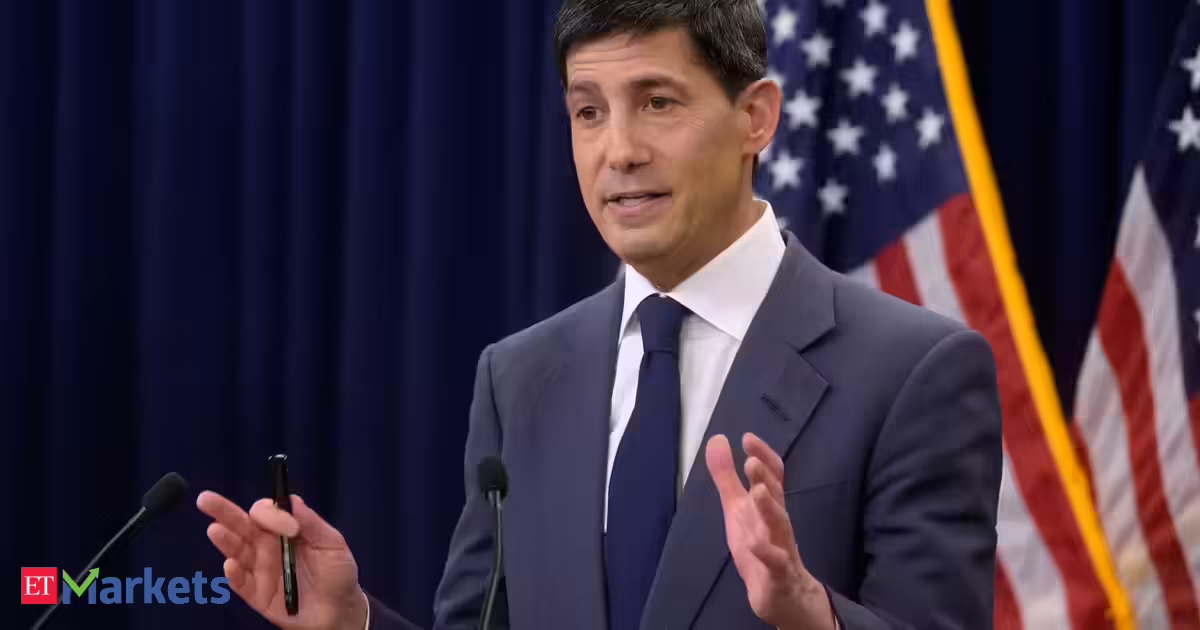
But in his first press conference Wednesday, new chair Kevin Warsh began to reverse some of those steps. Warsh, like many economists, thinks the financial markets have become too dependent on Fed guidance, and that such direction is more effective in financial crises or economic downturns.
Warsh quickly made changes: The Fed’s statement on its interest-rate decision was slashed to 132 words, from 341 in April. And Warsh pointedly noted that the statement excluded any hints, or “forward guidance,” about what the Fed’s next moves might be.
In short, Warsh rapidly delivered on a promise to slash the Fed’s communications, particularly the guidance it gives to financial markets about its next interest-rate moves. Yet such an approach carries the risk of more violent swings in stock and bond prices, analysts say, and ultimately could lead to higher interest rates for consumers and businesses.
“Forward guidance in general has served to suppress volatility and anchor market expectations,” said George Pearkes, global macro strategist at Bespoke Investment Group. “And that has led to lower borrowing rates, relative to alternatives.”
Still, the impact on consumers is likely to be modest, Pearkes added, with mortgage rates perhaps a quarter-point higher than they would be otherwise.
Financial markets see-sawed, then fell Wednesday after the statement and news conference. The yield on the 10-year Treasury, which strongly influences mortgage rates, jumped Wednesday to 4.49% from 4.43%, though it fell back in Thursday trading. The yield on the 2-year Treasury, which closely tracks expectations for Fed action, was 4.16% Thursday, up sharply from 4.05% before the Fed’s meeting. The broad S&P 500 stock index dropped 1.2% Wednesday. Warsh may be headed back to 1990s Such swings could be a sign of things to come. Previous chairs have signaled the Fed’s next moves clearly enough that financial markets have largely anticipated the central bank’s actions. But Warsh has frequently cited as a model former chair Alan Greenspan, whose circumspect comments often kept investors guessing.
Greenspan, who served as chair from 1987 to 2005, did usher in the statement the Fed now issues after each meeting announcing its decision. The first statement was issued Feb. 4, 1994, and said the Fed would increase its key rate for the first time in five years. The move caught investors off-guard and the Dow Jones Industrial Average plunged 2.4% that day.
The paring back of Fed communications is part of a larger package of potential reforms to the central bank’s operations that Warsh signaled Wednesday. He announced that the Fed will set up five task forces to examine the Fed’s communications, its balance sheet, how it analyzes and gathers economic data, the impact of AI on productivity and jobs, and the frameworks it uses to analyze inflation.
Warsh said the communications task force would consider changes to the quarterly economic projections the Fed issues as well as look at other recent innovations, including press conferences. Former chair Ben Bernanke was the first to hold them, though he did so only after every other Fed meeting. Warsh’s predecessor, Jerome Powell, shifted to holding them after every meeting.
Such steps are a sharp contrast with the 1990s, when Greenspan never explained a Fed decision, on the record, to reporters. Warsh could ultimately dial back some of the Fed’s increased transparency.
“This is a big change in how the Fed has conducted itself since the (2008-2009) global financial crisis,” Matthew Luzzetti, chief U.S. economist at Deutsche Bank, said. “Since then there has been a one-way train to greater communication, more transparency, and more forward guidance. Warsh has now put that train in reverse.”
Fed chairs have seen benefits to forward guidance Previous Fed chairs, starting with Bernanke, have seen a clear benefit to more communication: It helps guide the markets in the direction the Fed wants. Fed officials control a short-term interest rate, but the rates that affect the economy – such as the yield on the 10-year Treasury – are heavily influenced by investors’ expectations for inflation and economic growth. By telegraphing their next moves, policymakers can cause those longer-term rates to change even before the Fed adjusts its own benchmark rate.
Yet Warsh’s view is that financial markets have become too dependent on Fed guidance. Instead, he wants investors to gauge where the Fed may move next by examining economic data and making their own judgments, which the Fed can then consider as part of their assessments of where the economy is headed.
“Financial market prices are probably the most important source of information to guide central bankers,” Warsh said at Wednesday’s news conference.
Guidance can help with unexpected events David Andolfatto, an economics professor at the University of Miami and former economist at the St. Louis Fed, said he agreed with Warsh that forward guidance has flaws. It can be easily upended by unexpected events, he said, such as Russia’s invasion of Ukraine or the Iran war.
But the chair should set out guidelines for how the Fed will react to unexpected events, Andolfatto said, or to challenges such as the persistent inflation it is grappling with now, yet Warsh so far hasn’t done so.
“I’m with him on dispensing with forward guidance, but you have to replace it with a contingency plan,” Andolfatto said. “It’s not enough to say, trust me, we’ll keep inflation at target.”
Ironically, Warsh’s decision to drop forward guidance may empower the other 18 members of the Fed’s rate-setting committee, Pearkes said. Those officials – six members of the Fed’s governing board, plus the presidents of the 12 regional Fed banks – frequently give public speeches, and their remarks will get even more attention as financial markets seek clues about what the Fed may do next.
A big challenge to Warsh’s approach will come if there is a sharp financial downturn or economic crisis, as occurred during the COVID pandemic. In those circumstances, economists said, forward guidance can play an important role calming markets.
“Whether it will stand the test of time and he will behave this way for five years is a very different question, but one that we’re going to have to wait for events to unfold to get an answer to,” Pearkes said.

Dilok Klaisataporn/iStock via Getty Images

In April, Seeking Alpha invited analysts to participate in a Best Commodity Idea competition. We received 40 submissions. Here’s a look at all the winners as determined by the judging editors:
1) Joffrey Simonet – McEwen: Buy A World-Class Copper Project, Get Gold Upside For Free – McEwen offers a compelling risk-adjusted opportunity with near-term catalysts, anchored by its world-class Los Azules copper project—a uniquely ESG-differentiated asset, which is translating into blue-chip strategic investor support and immensely derisks the project financing—while the current valuation entirely discounts numerous upside sources and MUX’s entire gold business.
2) LA Capital – Alphamin Resources: The High-Grade Tin Miner With A Low-Grade Multiple – Alphamin Resources operates the world’s highest-grade tin mines, delivering elite profitability, a fortress balance sheet, and strong shareholder yield, and it is deeply undervalued; tin’s growth outlook is protected by a vast technological and regulatory moat.
3) Matthew Smith – Mogotes Metals: Possibly The Next Major Deposit In The Vicuna District – Mogotes Metals offers compelling speculative upside as drill results at Filo Sur indicate potential for a world-class copper-gold-silver-molybdenum deposit; near-term catalysts include additional drill results; positive outcomes could drive a buyout in the CAD $500M-$1B range, with downside supported by the Beskauga project in Kazakhstan.
We selected the winners based on how compelling the thesis is (50%) and independent insights (50%).
First place receives an award of US $1,500, second place US $1,250, and third place US $1,000.
Thank you to everyone who participated—we certainly enjoyed reading your submissions. For those who didn’t place, don’t worry, we’ll post another competition in the near future. Stay tuned for more details.
Editor’s Note: This article discusses one or more securities that do not trade on a major U.S. exchange. Please be aware of the risks associated with these stocks.
Business
Monsoon risk, younger investor base, and skewed trading activity define NSE outlook: NSE data
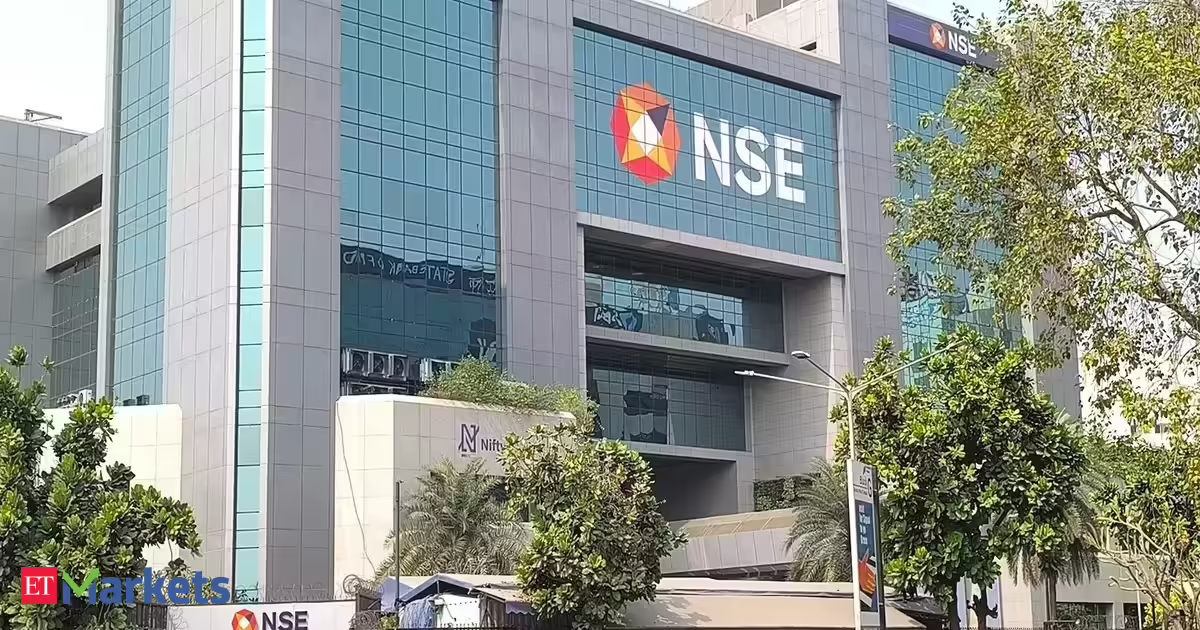
The National Stock Exchange flagged the monsoon as the key macro risk for 2026. NSE said IMD has revised its South-West monsoon forecast to 90 per cent of the long-period average, one of its lowest forecasted values on record, with a 60 per cent probability of deficient rainfall and a further 24 per cent probability of below-normal rainfall. “For 2026, the key challenge is the emergence of El Nino risk,” the report noted. The downside skew is visible across regions, with the probability of below-normal rainfall highest in Northwest India at 46 per cent, followed by the South Peninsula at 45 per cent, and Central India and the Monsoon Core Zone at 43 per cent each. NSE said historical El Nino years warrant caution, with deviations ranging from -5.4 per cent in 2023 to -22.1 per cent in 2002, and deficient rainfall has historically impacted kharif sowing, reservoir levels, rabi production and food inflation.
On investor demography, NSE said the nature of growth is changing as penetration broadens beyond traditional large-market states and the profile becomes younger and gradually more gender-diverse. The registered investor base rose to 13.1 crore as of May 2026, with the last crore of additions taking about seven months. The overall base grew at a 25.3 per cent CAGR during FY21-FY26 compared with 16.3 per cent CAGR during FY16-FY21. Regionally, North India now accounts for the largest share at 36.7 per cent, having surpassed Western India in 2022. States outside the top 10 now account for 27 per cent vs ~22 per cent in FY17, “pointing to a gradual broadening of the investor base beyond the traditional large states,” NSE said.
The investor base is also trending younger. The share of registered investors below 30 years increased from 23.5 per cent in Mar 2020 to 38.3 per cent in May 2026, while the median age fell from 38 years to 33 years. Incremental additions remain even younger, with investors below 30 accounting for 53-59 per cent of new registrations. Female participation improved steadily, with women accounting for around 25 per cent of all individual investors as of Apr 2026.
Trading activity, however, remains skewed. NSE data for May 2026 showed the top 2.6 per cent of active cash market investors accounted for 92.3 per cent of turnover, with investors trading Rs 10 crore and above forming just 0.3 per cent of active investors but contributing 79.4 per cent of turnover. In equity options, the top 0.3 per cent of investors alone accounted for 69 per cent of premium turnover, while in equity futures the top 7.8 per cent accounted for 93.3 per cent of turnover.

SOUTHAMPTON, N.Y. — Halfway through the 2026 U.S. Open and one thing is clear: Wyndham Clark is on a heater.
The 32-year-old has had just one top-10 finish in a major since his 2023 U.S. Open victory. But Clark won in Dallas a few weeks ago at the Byron Nelson and is clearly on top of his game. His 1-under 69 was good enough to leave him at 7 under for the tournament, four shots clear of the field through 36 holes.
The question now is whether Clark will be able to extend his lead, or if anyone — like fellow major champions Xander Schauffele, Matt Fitzpatrick, or even Justin Thomas — can make a move on the leader.
The Leaderboard Entering Round 3
Leaders at the start of Round 3 were led decisively by Clark, with a deep pack of contenders separated by just a handful of strokes behind him. Wyndham Clark sat at 7 under, four shots clear of a tie for second between Matt Fitzpatrick, Xander Schauffele, Sam Stevens, and Tom Kim, all at 3 under. Collin Morikawa followed at 2 under in sole possession of sixth place, while a four-way tie for seventh at 1 under included Justin Thomas, Harry Higgs, Sam Burns, and Sahith Theegala.
Betting Markets Reflect Clark’s Lead
Oddsmakers have installed Clark as the clear betting favorite heading into the weekend, reflecting both his commanding margin and his recent form. According to BetMGM, Clark is priced at +175 to win the championship, with Matt Fitzpatrick and Xander Schauffele both listed at +650. Scottie Scheffler sits at +1000 despite trailing significantly on the leaderboard, while Collin Morikawa is priced at +1400 and Rory McIlroy at +1600.
Notable Names Who Missed the Cut
The weekend field will be missing several recognizable names, most notably the tournament’s defending champion. Among the group of players who missed the cut at the 2026 U.S. Open, defending champion J.J. Spaun stands out most, unable to advance within the top 60 players plus ties. Florida amateur Giuseppe Puebla also missed the cut, along with other former major champions Jon Rahm, Brooks Koepka, and Graeme McDowell.
Saturday’s Tee Times
Round 3 tee times sent the morning groups out starting at 9 a.m. Eastern Time, with the leaders teeing off in the afternoon as the day progressed. The day began with Dylan Wu and Jacob Bridgeman at 9 a.m., followed by groups including Chris Gotterup paired with amateur Eric Lee, and Robert MacIntyre alongside amateur Marek Flemming.
Notable afternoon pairings included Jordan Spieth and Joaquin Niemann at 10:55 a.m., Russell Henley and Dustin Johnson at 11:06 a.m., and Tommy Fleetwood paired with Ludvig Åberg at 12:50 p.m. Scottie Scheffler went out with Brian Harman at 2:01 p.m., while Rory McIlroy was paired with Maverick McNealy at 2:12 p.m.
The leaders rounded out the day’s final groups, with Ryder Cowan, an amateur, paired alongside William Mouw at 2:50 p.m. Sahith Theegala and Sam Burns followed at 3:01 p.m., with Harry Higgs and Justin Thomas at 3:12 p.m., Collin Morikawa and Tom Kim at 3:23 p.m., Sam Stevens and Xander Schauffele at 3:34 p.m., and the final pairing of the day, Matt Fitzpatrick alongside leader Wyndham Clark, set for 3:45 p.m.
TV and Streaming Schedule
Round 3 of the 2026 U.S. Open will broadcast nationally on USA starting at 10 a.m. before switching to NBC at noon. The main broadcast is available to stream via Sling, which carries the NBC networks. Featured group and hole streaming is available on Peacock, NBCUniversal’s subscription streaming service, or for free at USOpen.com when play begins.
A Record Purse on the Line
This year’s championship carries the largest financial stakes in tournament history, reflecting the broader trend of escalating prize money across professional golf’s major championships. The overall purse for the 2026 U.S. Open is a record $22.5 million, an increase of $1 million from the 2025 purse. The winner’s share will be another record — $4.5 million.
About the Venue
The U.S. Open site rotates every year, and this year’s host is Shinnecock Hills Golf Club on Long Island in Southampton, New York. The course opened in 1891 and has hosted five previous U.S. Opens, most recently in 2018. Shinnecock Hills plays at par-70 over 7,440 yards, presenting one of the more demanding tests on the major championship rotation, with its firm, undulating greens and exposed coastal positioning historically producing some of the most dramatic scoring swings in U.S. Open history.
A Look Back at Last Year’s Champion
The current championship follows directly on the heels of a dramatic finish at last year’s tournament, where a relatively unheralded contender claimed his breakthrough title. J.J. Spaun picked up his first career major title when he was the only player to finish under par at the 2025 U.S. Open at Oakmont Country Club in Pennsylvania. His 65-foot birdie putt on the final hole capped a two-stroke victory over Robert MacIntyre.
What’s at Stake This Weekend
With Clark holding a substantial four-shot cushion heading into the third round, the central storyline for the remainder of the weekend centers on whether that lead can hold up against a deep and accomplished chasing pack that includes multiple past major champions. Clark’s recent victory at the Byron Nelson, combined with his existing U.S. Open pedigree from his 2023 title, gives him both the recent form and the championship experience that often proves decisive in closing out a major down the stretch.
For the chasing group — particularly Schauffele and Fitzpatrick, both former major winners sitting four shots back — Saturday’s third round represents a critical opportunity to either close the gap or watch Clark extend his advantage into what would become an increasingly commanding position heading into Sunday’s final round. With Shinnecock Hills’ demanding setup historically capable of producing dramatic swings in either direction, the tournament’s outcome remains far from decided despite Clark’s strong position at the midway point.
Business
NSE’s Rs 30,000 crore IPO set to spotlight exchange’s dominance in Indian markets, dependence on options trading: Zerodha analysis
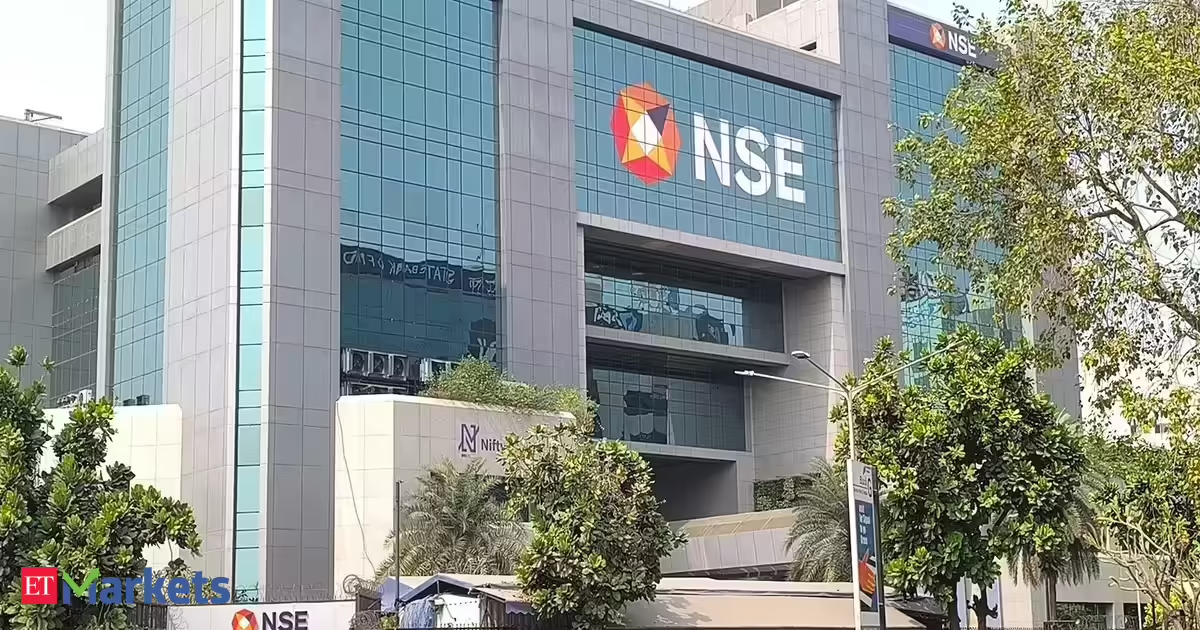
Calling the NSE “the beating heart” of India’s financial market infrastructure, the analysis noted that the exchange sits at the centre of a rapidly expanding investor ecosystem, with nearly 13 crore registered investors as of March 2026, up from just over 9 crore two years ago.
“India is now the fourth-largest equity market in the world by market capitalisation,” the report said, adding that “India added about 4 crore new investors in just two years.”
The analysis highlighted that NSE generated about Rs 16,600 crore in operating revenue during FY26, with nearly 79 per cent coming from transaction charges collected on trades executed on its platform. Equity options alone contributed around Rs 10,000 crore, accounting for roughly 60 per cent of total revenue.
“The mega-earner, however, were equity options, which singularly generated Rs 10,000 crore – or 60 per cent of NSE’s total revenue,” the report said. “Much of that was the result of a single instrument: the Nifty 50 weekly options contract.”
However, the report noted that such dependence makes NSE highly sensitive to regulatory changes. It pointed to the Securities and Exchange Board of India’s (SEBI) derivatives market reforms in October 2024, which reduced weekly expiries and increased lot sizes, leading to a decline in trading volumes.
“These measures reduced retail speculation, as intended. Derivatives volumes fell sharply, and NSE’s revenue fell with them,” the analysis said. Revenue from operations declined from about Rs 17,100 crore in FY25 to Rs 16,600 crore in FY26, while profit fell from approximately Rs 12,200 crore to Rs 10,000 crore. The report also underscored NSE’s strong profitability. Despite spending around Rs 6,000 crore during FY26, the exchange reported a profit of nearly Rs 10,000 crore, translating into a margin of about 51 per cent.
“For a company with Rs 16,600 crore in revenue, that is exceptionally lean,” the report said while discussing employee expenses, which stood at Rs 790 crore. “This just isn’t a people business. NSE’s product is a matching engine: software that processes millions of orders per second.”
Another key takeaway from the analysis was the role of NSE Clearing Ltd (NCL), the exchange’s subsidiary that guarantees settlement of trades. The report said NCL clears about 88 per cent of all cash market trades and 91 per cent of equity derivatives in India.
“It is the silent guardian ensuring the sanctity of every trade on the NSE,” the report said.
According to the analysis, NSE distributed Rs 8,660 crore as dividends in FY26, representing a payout ratio of 84 per cent, while continuing to hold investments worth Rs 64,771 crore on its balance sheet.
Summing up the exchange’s business model, the report said, “NSE has as privileged a place as the financial markets can offer. It earns whether markets go up or down, and whether individual trades are profitable or not.” It added that unless there is a major collapse in India’s financial markets, “few things can touch this giant”.
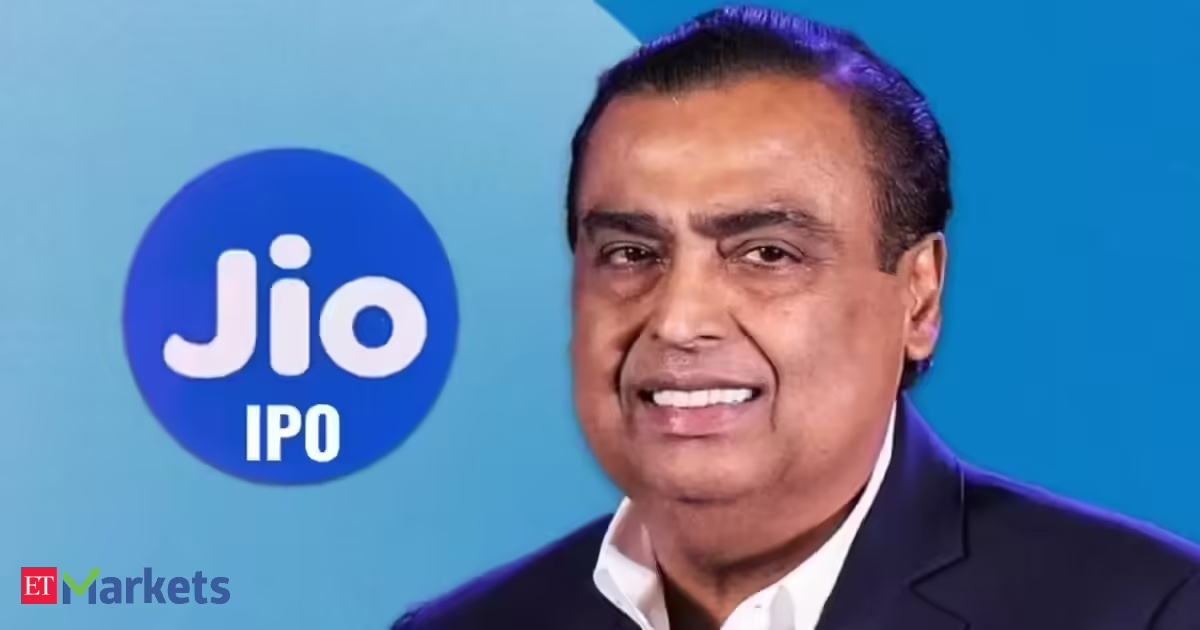
Jio, a crown jewel of billionaire Mukesh Ambani’s oil-to-retail conglomerate, filed the draft documents on Friday for an IPO that includes the issuance of as many as 270 million new shares, kick-starting a long-awaited process of unlocking shareholder value.
While the draft document didn’t specify the potential size of IPO, it mentioned that 275 billion rupees ($2.9 billion) will be used for repaying existing loans while some funds could be used for general corporate purposes.
Reliance Jio Infocomm Ltd., its telecom unit, holds three so-called ECB facilities totaling 300.6 billion rupees in dollar and yen terms, the document showed. Australia & New Zealand Banking Group Ltd., Bank of America Corp., Barclays Bank Plc, BNP Paribas and Citibank are among lenders. The borrowings are proposed to be prepaid in full or in part from Jio Platforms’ IPO net proceeds, according to the draft document.
AgenciesSuch prepayments will help reduce net debt and associated servicing costs, Jio Platforms said in the draft herring prospectus.
“Additionally, the company believes that this would improve our ability to raise further resources in the future to fund potential business development opportunities,” it said.
The deleveraging of the balance sheet will also position Jio Platforms favorably for continued investment in its strategic priorities, including 5G network densification and expansion, fixed broadband penetration, AI and cloud services, it said.
Citigroup Has Two PFDs To Consider: N & R


As an individual investor nearing retirement I am trying to build my financial assets in order to have a fulfilling retirement. I am interested in trading both long and short; or at least using inverse ETFs, to take advantage of market declines. Having long term and short term trading strategies, proper execution of my trading plan, and absolute investing results are my goals. I see my articles as a way to keep me focused on developing winning trades. I also expect to learn much from the feedback that is provided in the comments section.
Analyst’s Disclosure: I/we have no stock, option or similar derivative position in any of the companies mentioned, but may initiate a beneficial Long position through a purchase of the stock, or the purchase of call options or similar derivatives in KMX over the next 72 hours. I wrote this article myself, and it expresses my own opinions. I am not receiving compensation for it (other than from Seeking Alpha). I have no business relationship with any company whose stock is mentioned in this article.
Seeking Alpha’s Disclosure: Past performance is no guarantee of future results. No recommendation or advice is being given as to whether any investment is suitable for a particular investor. Any views or opinions expressed above may not reflect those of Seeking Alpha as a whole. Seeking Alpha is not a licensed securities dealer, broker or US investment adviser or investment bank. Our analysts are third party authors that include both professional investors and individual investors who may not be licensed or certified by any institute or regulatory body.


Financial analyst by day and a seasoned investor by passion, I’ve been involved in the world of investing for over 15 years and honed my skills in analyzing lucrative opportunities within the market.I specialize in uncovering high quality dividend stocks and other assets that offer potential for long term-growth that pack a serious punch for bill-paying potential. I use myself as an example that with a solid base of classic dividend growth stocks, sprinkling in some Business Development Companies, REITs, and Closed End Funds can be a highly efficient way to boost your investment income while still capturing a total return that follows traditional index funds. I created a hybrid system between growth and income and manage to still capture a total return that is on par with the S&P.
Analyst’s Disclosure: I/we have no stock, option or similar derivative position in any of the companies mentioned, but may initiate a beneficial Long position through a purchase of the stock, or the purchase of call options or similar derivatives in ITWO over the next 72 hours. I wrote this article myself, and it expresses my own opinions. I am not receiving compensation for it (other than from Seeking Alpha). I have no business relationship with any company whose stock is mentioned in this article.
Seeking Alpha’s Disclosure: Past performance is no guarantee of future results. No recommendation or advice is being given as to whether any investment is suitable for a particular investor. Any views or opinions expressed above may not reflect those of Seeking Alpha as a whole. Seeking Alpha is not a licensed securities dealer, broker or US investment adviser or investment bank. Our analysts are third party authors that include both professional investors and individual investors who may not be licensed or certified by any institute or regulatory body.

Nothing’s Budget Brand CMF Won’t Be Releasing A New Phone This Year

Four injured after topless man ‘with knife’ marches through Edinburgh streets
Dalal Street Week Ahead: Lower volatility signals calm, but resistance looms large


-

 Business6 days ago
No Jackpot Winner as $257 Million Prize Rolls Over to $269 Million Monday Draw
-
 Crypto World6 days ago
Zimbabwe Requires Crypto Businesses to Register Annually Under New FIU Regulations
-

 Fashion19 hours ago
Weekend Open Thread: Miami – Corporette.com
-
 Entertainment6 days ago
Matt Damon’s Viral Sci-Fi Thriller Has Taken Over HBO Max
-

 Tech6 days ago
As AI companies race to go public, who else is along for the ride?
-

 Business6 days ago
Anthropic staff to meet White House officials next week, Axios reports
-
 Crypto World6 days ago
Bitcoin could crash to $48,000, if this historical pattern is triggered
-

 Entertainment7 days ago
Deion Sanders Shares Powerful Post After Viral Advice To Deiondra
-
 NewsBeat6 days ago
what doctors are seeing in ebike crashes
-
 NewsBeat6 days ago
Warning of disruption as Cardiff Crossrail works to start
-
 NewsBeat6 days ago
Tributes to former deputy head teacher at Cambridge school among death and funeral notices
-

 Politics6 days ago
“Israel’s” ban on ICRC visits ruled illegal, but Knesset moves to stop them permanently
-

 News Videos6 days ago
Financial Accounting | Last Day Revision Strategy and Booster | CMA Inter – June 2026
-
 Entertainment6 days ago
Kate Middleton Glare Goes Viral After Kids Booed At Royal Event
-

 Tech6 days ago
Over 400 Arch Linux packages compromised to push rootkit, infostealer
-

 Crypto World6 days ago
XRP ETFs Outperform As Bitcoin And Ethereum Funds Extend Outflow Trend
-

 Business6 days ago
Invesco Quality Income Fund Q1 2026 Commentary
-

 NewsBeat6 days ago
Singer Oliver Tree dies aged 32 in helicopter crash in Brazil
-
 Crypto World6 days ago
Market Preview: SpaceX (SPCX) IPO Record, Federal Reserve Meeting, and Iran Nuclear Agreement
-

 Sports6 days ago
Dick Advocaat’s Curacao scores first-ever World Cup goal against Germany
You must be logged in to post a comment Login