
Business
New conservative report outlines 10 ways to bring down costs for Americans


Richard Stern, vice president of the Plymouth Institute for Free Enterprise, spoke to Fox News Digital about a new report from Advancing American Freedom focused on improving affordability for Americans.
As Americans continue to feel the squeeze from high housing, food and energy costs, affordability has emerged as a defining issue ahead of November’s midterm elections, with both parties under pressure to show voters they can bring down the cost of living.
Now, a new report from the conservative group founded by former Vice President Mike Pence is offering its own prescription, laying out 10 proposals aimed at lowering costs by cutting red tape and boosting production across the economy.
“Yes, there’s an unaffordability crisis, and it’s the government’s fault,” Richard Stern, vice president of the Plymouth Institute for Free Enterprise at Advancing American Freedom (AAF), told Fox News Digital.
That argument is at the heart of the report, “10 Ways to Improve Affordability Now Across 10 Levels of the Economy,” which calls affordability the “No. 1 issue facing the American people” and targets costs associated with housing, energy and business, among others.
The report’s proposals range from easing zoning restrictions and expanding oil and gas access to overhauling Social Security and SNAP eligibility, echoing parts of President Donald Trump’s second-term agenda.
But the conservative blueprint breaks with Trump on two key pocketbook issues: tariffs and credit card interest rates.
THINK YOUR STATE IS EXPENSIVE? NEW DATA REVEALS WHERE AMERICANS FACE THE HIGHEST COST OF LIVING
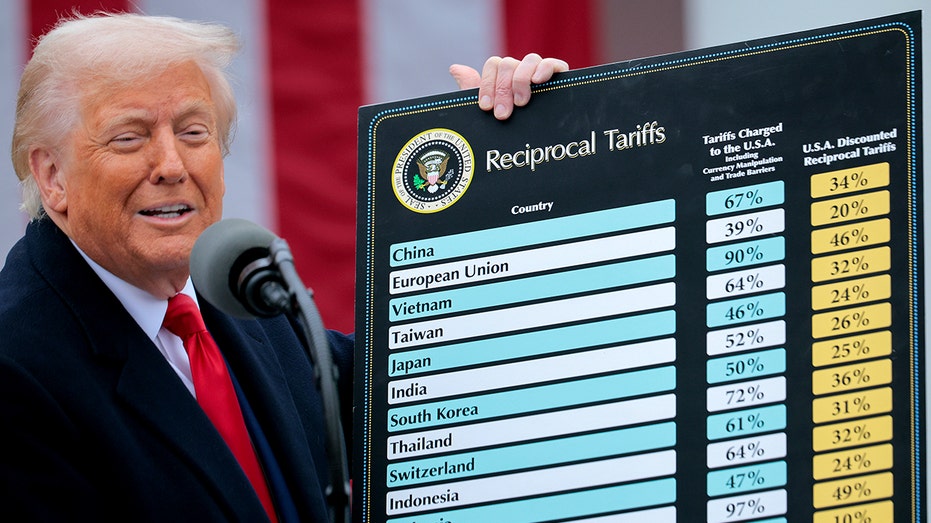
President Donald Trump has defended tariffs as a tool to protect American industries and boost domestic production. (Chip Somodevilla/Getty Images / Getty Images)
On trade, the report argues Trump’s sweeping tariffs have come at a cost to American consumers and the broader economy, raising prices, straining U.S. alliances and resulting in nearly 900,000 fewer jobs than expected.
The authors at AAF call for shifting more tariff authority back to Congress.
But while the report paints a bleak picture of the tariffs’ broader economic impact, they have generated a windfall for Washington. In January alone, duties totaled $30.4 billion, up about 242% from $8.9 billion a year earlier, according to Treasury data.
On housing, the report blamed zoning restrictions for pushing families farther from jobs and making homeownership harder for younger Americans.
Those costs can be substantial. The National Association of Home Builders estimates government regulations account for about 26% of the price of a new single-family home.
THE SURPRISING HIDDEN COST QUIETLY ADDING NEARLY $132K TO NEW HOME PRICES REVEALED

Housing industry leaders say states that have prioritized homebuilding have been better positioned to accommodate population growth and economic expansion. (Joshua Lott/Bloomberg/Getty Images / Getty Images)
The report recommends limiting local zoning restrictions, streamlining approval for projects that meet existing rules and tying roughly $50 billion in annual federal housing aid to zoning reform.
On energy, the proposal calls for more oil and gas leasing and rejecting state fracking bans. Stern argued greater domestic production could lower costs throughout the economy because energy touches “every good we move, every service provided.”
CLICK HERE TO DOWNLOAD THE FOX NEWS APP

The cost of living remains a major concern for Americans as households face high prices for everyday necessities. (Li Rui/Xinhua via Getty Images / Getty Images)
Stern warned that economic frustration can turn Americans against one another, toward “viewing each other as the enemy, and that’s what socialism is.”
“I hope that people can take away from this, that it’s not businesses that are the problem,” he said. “It’s not entrepreneurs. It’s not other Americans. It’s government.”


Bronny James has finally addressed his father LeBron James’ decision to sign with the Philadelphia 76ers this offseason, offering a brief, five-word reaction after weeks of speculation about how the younger James felt watching his father leave the Los Angeles Lakers.
The 21-year-old guard was captured on video Friday signing autographs and taking photos with young fans when he was asked directly about his father joining a new team. According to Yahoo Sports, Bronny’s response was simple and unbothered. “It’s whatever. It’s my dad,” he said, delivering the line with a smile, according to a video shared by Purp & Gold Media on the social platform X.
The moment marked the first public comment from Bronny since LeBron officially confirmed his decision to leave the Lakers after eight seasons with the franchise. Speculation had circulated for weeks over whether Bronny might follow his father to a new team, given that the two had made NBA history as the first father-son duo to play together in league history during Bronny’s first two professional seasons. Instead, Bronny remains with the Lakers, the team that selected him with the 55th overall pick in the 2024 NBA Draft, while LeBron begins a new chapter in Philadelphia.
LeBron’s departure ended an eight-year run in Los Angeles that included the franchise’s 2020 NBA championship and cemented his standing as one of the most accomplished players in Lakers history. Across 479 regular-season games with the team, LeBron averaged 25.9 points, 7.9 assists and 7.7 rebounds before ultimately deciding to continue his career elsewhere. He signed a two-year, $8 million contract with the 76ers for what will be his 24th NBA season, a milestone unmatched by any player in league history.
LeBron addressed the decision directly in a statement posted to social media at the time of the announcement, describing it as the final chapter of his storied career. “This is my last decision. I’m not going for money. I’m not going for family. I still want to sacrifice. I still want to work. I still want to grind. I still want to compete, to win and to have a chance at the feeling of winning another championship,” James wrote. He went on to express enthusiasm specifically about his new team’s prospects. “I believe I can help make the Philadelphia 76ers a championship team and I am so excited to energize a new fan base and start this incredible journey one last time.”
Bronny’s path forward with the Lakers became clearer in the weeks leading up to his father’s decision. In late June, Bronny’s $2.3 million salary for the 2026-27 season became fully guaranteed after the Lakers declined to waive him ahead of a contractual deadline. According to Fox News, LeBron informed the Lakers of his own decision to continue his career elsewhere just one day after that guarantee became official, a sequence of events that effectively separated the father-son duo’s NBA paths going forward.
Rich Paul, who serves as agent for both LeBron and Bronny, addressed the situation publicly around the time of LeBron’s signing, making clear that the two were operating independently of one another in free agency. “They are not a package deal,” Paul told ESPN, adding that there was “no current plan or request for Bronny James to join his father” in Philadelphia.
Bronny’s second NBA season saw him splitting time between the Lakers and the team’s G League affiliate, the South Bay Lakers, a common developmental path for young players still working to establish themselves at the professional level. Across 42 NBA games during that second season, Bronny averaged 2.9 points and 1.2 assists, while also making eight postseason appearances for the Lakers. Heading into his third season, Bronny’s role is expected to remain focused primarily on continued development under Lakers head coach JJ Redick, who has overseen his growth since the start of his professional career.
Bronny delivered his five-word reaction while traveling with the rest of the Lakers roster to Slovenia for a basketball camp organized by star guard Luka Doncic, according to Yahoo Sports. The trip placed Bronny in a casual, fan-facing setting when the question about his father’s move was posed, contributing to the relaxed, matter-of-fact tone of his response.
LeBron’s move to Philadelphia has generated significant reaction across the NBA, including from members of his new team. According to The Philadelphia Inquirer, forward Jaylen Brown, despite past public tension with LeBron over comments Brown had made questioning Bronny’s readiness for professional basketball, was among the first players to publicly welcome LeBron to the Sixers following the announcement, posting a brief celebratory message on social media. Teammate Tyrese Maxey similarly shared a video of himself celebrating enthusiastically after the news broke.
Despite no longer playing alongside one another, LeBron and Bronny are still scheduled to face off against each other multiple times this coming season as opponents. According to Yahoo Sports, the Lakers and 76ers are set to meet on Christmas Day at 5 p.m. ET in Los Angeles, followed by a second matchup on March 2, 2027, in Philadelphia, giving fans two high-profile opportunities to watch the father and son compete against one another for the first time in their NBA careers.
With LeBron now fully settled into his new chapter with the 76ers and Bronny entering his third professional season still developing within the Lakers organization, Bronny’s brief comment appears to reflect a broader sense of acceptance regarding the situation, treating his father’s decision as a straightforward professional matter rather than a significant personal disruption. As both players prepare for the 2026-27 season with their respective teams, their upcoming head-to-head matchups are likely to draw significant attention as one of the more closely watched storylines of the coming NBA campaign.
Business
Federal Judge Strikes Down Trump’s Immigrant Visa Ban Targeting 75 Countries as ‘Patently Unlawful’

NEW YORK — A federal judge in Manhattan struck down a Trump administration policy Friday that had suspended the issuance of immigrant visas to applicants from 75 countries, ruling that the policy exceeded the statutory authority of Secretary of State Marco Rubio and violated federal immigration law.
U.S. District Judge Jeannette Vargas of the Southern District of New York issued the ruling in a lawsuit brought by immigrant rights groups, along with individual visa applicants and U.S. citizens sponsoring family members from the affected countries. Vargas, an appointee of former President Joe Biden, found that the policy, implemented in January, was “contrary to law” and fell outside Rubio’s legal authority.
In her written decision, Vargas was direct in her characterization of the policy’s legal standing. “The Policy, which categorically prohibits the issuance of immigrant visas based upon the nationality of the applicant, represents a direct abrogation of this statutory scheme,” Vargas wrote, according to Reuters. The judge determined the policy ran afoul of a 1965 federal law barring nationality-based discrimination in the granting of visas, as well as a separate statutory provision that strips the secretary of state of direct authority over how individual consular officers adjudicate visa applications.
According to CNN, Vargas found that, in practice, U.S. consular officers were being directed to reject immigrant visa applications, even from applicants who could demonstrate they were financially self-sufficient, solely based on the applicant’s country of origin. The policy specifically halted permanent-residence visas for individuals seeking to join family members or take up employment in the United States, though it did not extend to nonimmigrant visas such as those issued for tourism or academic study.
A State Department cable sent by Rubio to every diplomatic and consular post worldwide, which was entered into the court record as part of the case, directed officers to refuse applicants even in cases where an applicant “provides additional evidence that demonstrates he or she overcomes the public charge refusal,” according to CNN’s review of the document. Vargas characterized the practical effect of that directive bluntly in her ruling. “The outcome is predetermined,” she wrote. “The visa will be refused.”
The State Department had defended the policy by arguing that applicants from the 75 designated countries posed a heightened risk of becoming a “public charge,” meaning they might rely on local, state or federal government assistance after arriving in the United States, according to Reuters. The suspended countries spanned a wide geographic range, including Latin American nations such as Brazil, Colombia and Uruguay; Balkan countries including Bosnia and Albania; South Asian nations Pakistan and Bangladesh; and numerous countries across Africa, the Middle East and the Caribbean, according to Reuters’ reporting.
The lawsuit challenging the policy was filed by the Catholic Legal Immigration Network and African Communities Together, immigrant rights organizations that joined with individual visa applicants and U.S. citizens sponsoring family members from the affected countries as plaintiffs in the case, according to Reuters.
According to reporting from SCOTUS Wire, Vargas specifically distinguished her ruling from the Supreme Court’s 2018 decision in Trump v. Hawaii, which had upheld a separate Trump administration travel ban permitting nationality-based restrictions on entry into the United States. Vargas drew that distinction on the grounds that the current policy directly restricted the issuance of visas themselves, rather than restricting entry at the border for individuals who had already obtained valid travel documents, a legal difference the judge found significant in assessing the scope of the executive branch’s authority under existing immigration statutes.
Al Jazeera’s coverage of the ruling noted that Vargas’ decision centered specifically on the question of statutory authority, finding that Congress had explicitly reserved to consular officers, rather than the secretary of state directly, the authority to adjudicate individual immigrant visa applications, a structural allocation of power the judge found the January policy had improperly overridden.
The State Department did not immediately respond to requests for comment on the ruling, according to Reuters. As of this report, it remained unclear whether the administration intended to appeal Vargas’ decision to the Second Circuit Court of Appeals, a step commonly taken by the federal government following adverse rulings on major immigration policy matters.
Friday’s ruling adds to a broader, ongoing pattern of legal challenges facing the Trump administration’s immigration enforcement priorities during its second term. The administration has pursued what Reuters described as an aggressive approach to restricting various forms of visa issuance and immigration processing since returning to office, a strategy that has repeatedly drawn legal challenges from immigrant rights organizations, state attorneys general and individual plaintiffs affected by specific policies.
The 75-country visa suspension represents one of several immigration-related policies from the current administration to face significant legal setbacks in federal court. Earlier iterations of broad, nationality-based travel restrictions pursued by the Trump administration during its first term similarly drew successful legal challenges in multiple jurisdictions before the Supreme Court ultimately upheld a narrower, revised version of that earlier travel ban in the 2018 Trump v. Hawaii decision, a precedent Vargas’ ruling explicitly distinguished from the current case.
Immigrant rights advocates involved in the litigation are likely to view Friday’s ruling as a significant victory, given the broad geographic scope of the policy the judge struck down and the explicit finding that the policy’s practical operation left consular officers with no genuine discretion to approve applications regardless of individual applicants’ financial circumstances. For families and individuals affected by the suspension, including U.S. citizens seeking to sponsor relatives for immigrant visas from any of the 75 designated countries, Vargas’ ruling would, if it stands, restore the ability to have those applications processed and adjudicated on an individual basis rather than being categorically denied based on nationality alone.
As the legal fight over the policy continues, with an appeal from the administration considered a likely next step, immigration attorneys and advocacy organizations are expected to closely monitor how quickly the State Department moves to comply with Vargas’ order and resume standard visa processing for applicants from the affected countries, pending any further action either from the administration or from a higher court reviewing the case.


Rida Morwa is a former investment and commercial Banker, with over 35 years of experience. He has been advising individual and institutional clients on high-yield investment strategies since 1991. Rida Morwa leads the Investing Group High Dividend Opportunities where he teams up with some of Seeking Alpha’s top income investing analysts. The service focuses on sustainable income through a variety of high yield investments with a targeted safe +9% yield. Features include: model portfolio with buy/sell alerts, preferred and baby bond portfolios for more conservative investors, vibrant and active chat with access to the service’s leaders, dividend and portfolio trackers, and regular market updates. The service philosophy focuses on community, education, and the belief that nobody should invest alone. Learn More.
Analyst’s Disclosure: I/we have a beneficial long position in the shares of HQH, RVT either through stock ownership, options, or other derivatives. I wrote this article myself, and it expresses my own opinions. I am not receiving compensation for it (other than from Seeking Alpha). I have no business relationship with any company whose stock is mentioned in this article.
Beyond Saving, Philip Mause, and Hidden Opportunities, all are supporting contributors for High Dividend Opportunities. Any recommendation posted in this article is not indefinite. We closely monitor all of our positions. We issue Buy and Sell alerts on our recommendations, which are exclusive to our members.
Seeking Alpha’s Disclosure: Past performance is no guarantee of future results. No recommendation or advice is being given as to whether any investment is suitable for a particular investor. Any views or opinions expressed above may not reflect those of Seeking Alpha as a whole. Seeking Alpha is not a licensed securities dealer, broker or US investment adviser or investment bank. Our analysts are third party authors that include both professional investors and individual investors who may not be licensed or certified by any institute or regulatory body.
Business
Mystery Bread Dumping Near Japanese National Park Sparks Fears of Attracting Wild Asiatic Black Bears

Authorities in Japan’s Tottori Prefecture are investigating a series of mysterious incidents in which someone repeatedly dumped large quantities of bread along a roadside inside Daisen-Oki National Park, with local officials warning the act could be an attempt to lure wild bears, which have been spotted with increasing frequency in the area this year.
According to a report by Nippon TV cited by the JoongAng Ilbo, the first batch of dumped bread was discovered on Aug. 14 along a road running through the midsection of Mount Daisen within the national park. A representative from the Tottori branch of Japan’s Nature Conservation Society, who first came across the discovery, found approximately 30 loaves of bread laid out at regular intervals along the roadside. Most of the loaves were individually wrapped, standard-sized units, and the total collected that day alone weighed 16.7 kilograms.
The foundation official described the initial confusion upon encountering the scene. “At first, I thought squared logs had fallen onto the road,” the official said, according to the JoongAng Ilbo. “I was truly shocked that bread kept appearing all along the road. I’ve never experienced anything like this before.”
The dumping did not stop after the initial discovery. According to the report, foundation staff collected an additional 6.3 kilograms of bread on Aug. 15 and 5.5 kilograms on Aug. 16, bringing the three-day total to 28.5 kilograms. After the matter was reported to police, another 10.5 kilograms of freshly dumped bread was discovered on Aug. 20. In total, roughly 39 kilograms of bread have been collected from the site since the incidents began.
Adding to the mystery, what appeared to be discarded chicken entrails were found along the same roadside area on Aug. 19, though authorities have not confirmed whether that discovery is connected to the bread dumping incidents.
Local officials have raised the possibility that the food was deliberately placed to attract wild animals, a suspicion rooted partly in the pattern of how the bread was distributed. Rather than being dumped in a single large pile, the loaves were spread out at consistent intervals along the road, a pattern the Nature Conservation Society said it could not fully explain but has treated as a potential indication that someone intended to draw animals toward the area.
The concern carries particular weight given a rise in sightings of Asiatic black bears, commonly known as moon bears, around the Mount Daisen area this year. Wildlife officials have warned that when wild animals become accustomed to food left out by humans, they are more likely to venture toward roads and residential areas in search of similar food sources, raising the risk of vehicle collisions or direct encounters between bears and people.
A representative from the Nature Conservation Society issued a direct appeal to the public following the discovery. “If food meant for human consumption is left out, it can lead to unfortunate encounters between people and animals,” the official said. “Please do not dispose of or leave out this kind of food under any circumstances.”
In response to the repeated incidents, Tottori Prefecture increased patrols of the area to twice daily beginning Aug. 20. According to the report, authorities are considering further measures, including daily patrols or the installation of surveillance cameras, should the dumping continue. More than a week after the first bread was discovered, authorities have not identified who is responsible or determined a clear motive behind the incidents.
The dumped bread and chicken entrails found along the roadside may constitute waste under Japan’s Waste Management and Public Cleansing Act, according to the report. If the dumping is formally classified as illegal disposal under that law, those responsible could face up to five years in prison or a fine of up to 10 million yen, or roughly $67,700. Because the incidents occurred within a national park, authorities have also indicated that violations of Japan’s Natural Parks Act could come into play if investigators confirm the intent was specifically to feed wildlife.
The incidents have drawn attention on social media within Japan, with some commenters speculating about possible motives behind the unusual dumping pattern, ranging from theories involving wildlife feeding to more critical commentary questioning why someone would discard so much food along a protected natural area.
Japan has experienced a broader increase in bear-related incidents and public safety concerns in recent years, as expanding bear populations and shrinking rural human populations in some regions have led to more frequent encounters between bears and residents across the country. Wildlife and conservation officials in Japan have periodically issued public warnings cautioning against feeding wild bears or leaving food accessible to them, given the significant safety risks that can arise once bears begin associating human areas with reliable food sources, a pattern that has, in past cases elsewhere in the country, ultimately required authorities to capture or cull bears that had become habituated to human-populated areas.
As the investigation into the Mount Daisen bread dumping continues, Tottori Prefecture officials say they remain focused on both determining the identity and motive of whoever is responsible and on preventing any further incidents that could increase the risk of dangerous encounters between bears and the public along the affected roadway. Authorities have not indicated a timeline for when the investigation might be resolved, and the increased twice-daily patrol schedule is expected to remain in place as officials continue monitoring the area for any additional dumping activity.
Business
(VIDEO) 300-Pound Bear Dies Trapped Inside Car in Colorado Amid Record-Breaking Statewide Bear Activity

COLORADO SPRINGS, Colo. — A 300-pound black bear died after breaking into an unlocked car in central Colorado Springs and becoming trapped inside, according to Colorado Parks and Wildlife, an incident that comes amid what the agency is describing as a record-breaking year for bear activity across the state.
The bear entered the unlocked vehicle, destroyed much of its interior while attempting to get out, and ultimately became stuck, according to Colorado Parks and Wildlife. The animal died inside the car and went undiscovered for several days in the summer heat before being found. Wildlife officials estimated the bear weighed roughly 300 pounds and believe it was likely drawn into the vehicle by a scent or food attractant left inside.
The incident is one of a growing number of bear-related conflicts reported across Colorado this year, as extreme drought conditions have significantly reduced the natural food sources bears typically rely on, pushing them farther into neighborhoods, campgrounds and other areas populated by people. According to figures from Colorado Parks and Wildlife, the agency received 6,129 reports of bear sightings and conflicts statewide between Jan. 1 and Aug. 13, nearly double the 3,115 reports recorded during the same period in 2025. A separate, more recent tally from the agency put the statewide total at more than 7,000 reports as of Aug. 20, compared with roughly 5,400 reports recorded by that same point in 2025.
Rachael Gonzales, public information officer for Colorado Parks and Wildlife, described the scale of this year’s bear activity in stark terms. “This year, it’s not even that we are on track for a record year; it is a record year for the number of human bear reports that CPW as an agency has seen,” Gonzales said.
The surge in reported conflicts has been especially pronounced in parts of northwest Colorado. In Routt County, reported bear sightings have climbed 219% compared with 2025, according to new data from Colorado Parks and Wildlife. Gonzales connected that spike directly to the region’s ongoing drought conditions. “Bears right now are in search of food, and they are opportunistic,” Gonzales said.
Statewide, Colorado Parks and Wildlife reported a 68% increase in bear reports over the prior year for the first seven months of 2026. Brad Banulis, the agency’s senior terrestrial biologist, addressed the trend during a July 28 sportspersons’ meeting in Grand Junction. “Bears are tough this year,” Banulis said, noting that while conflicts had increased gradually through early summer, the situation intensified more sharply in recent weeks. “Now we’re definitely seeing conflicts go up a lot across the region, really across the Western Slope at least, maybe even statewide, with this drought,” he said.
Kris Middledorf, the agency’s area wildlife manager, described the situation in Routt County specifically as an “unprecedented surge in human-bear interactions.”
Beyond property damage and vehicle break-ins, this year’s drought-driven bear activity has also coincided with a rare cluster of bear attacks. According to Colorado Parks and Wildlife, the agency’s northwest region, which covers counties west of Jackson, Grand and Summit counties and north of Mesa, Pitkin and Eagle counties, recorded four bear attacks between Jan. 1 and Aug. 20, the highest number of reported attacks in that region over the past decade. Statewide, five bear attacks have been reported so far in 2026, a total that, while elevated, still falls short of the seven attacks recorded in 2020, six each in 2019 and 2023, and five in 2017.
Gonzales emphasized that bear attacks remain a genuinely rare occurrence in Colorado despite this year’s unusual activity levels. “Bear attacks in Colorado are very rare,” Gonzales said. “Between 1960 and today, Colorado has only had 105 bear attacks.” Over that same 66-year period, four of those attacks have proven fatal, with the most recent fatal attack occurring in 2021 near Durango.
The underlying driver behind this year’s spike in bear activity is Colorado’s ongoing extreme drought, which has significantly reduced the availability of natural food sources bears depend on, particularly berries, during the late summer months. With berry supplies limited this year, bears have increasingly searched closer to towns and communities for alternative food sources. Wildlife officials have expressed particular concern about how conflict levels might continue evolving into the fall, as bears enter a biological state known as hyperphagia, during which their caloric needs spike dramatically, reaching as much as 20,000 calories per day, as they work to build fat reserves ahead of winter hibernation.
Colorado is home to an estimated 17,000 to 20,000 black bears, the vast majority of which live on the state’s Western Slope, according to wildlife officials. In recent years, a combination of population growth, increased tourism and fluctuating food availability has steadily driven up bear conflicts, particularly in mountain communities where human development increasingly overlaps with bear habitat.
Colorado Parks and Wildlife has repeatedly emphasized that incidents like the Colorado Springs vehicle death are largely preventable. Wildlife managers say residents and visitors can significantly reduce the risk of bear encounters by keeping vehicles locked, ensuring windows are fully closed, and removing all trash, food and scented items from cars and outdoor spaces. Officials have specifically warned that once a bear successfully obtains food from a vehicle, it is highly likely to return to the same area seeking similar opportunities, a pattern that increases risk for both people and the bears themselves over time.
As Colorado’s drought conditions show no clear signs of easing heading into the fall, wildlife officials continue urging residents across the state to remain vigilant about securing food, trash and other potential attractants, both to protect public safety and to reduce the likelihood of additional bears becoming trapped, injured or killed while searching for food in populated areas during what has already proven to be one of the most active bear seasons in the state’s recorded history.
Business
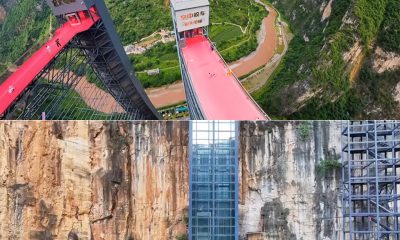
(PHOTO) China Unveils 288-Meter Glass Cliff Elevator That Cuts Kids’ Perilous 3-Hour School Trek to 30 Minutes
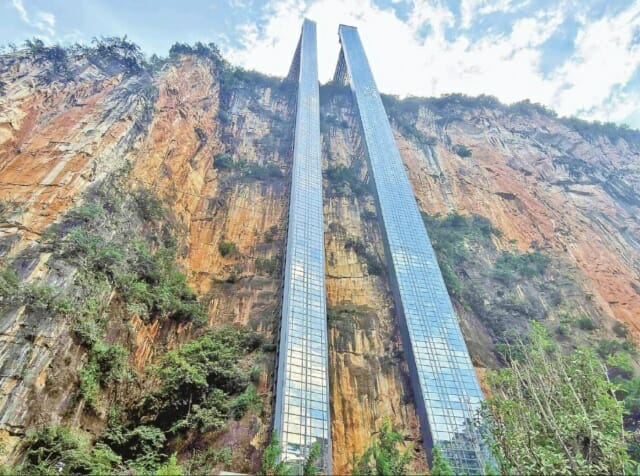
XUANWEI, China — A new 288-meter glass elevator clinging to the sheer walls of a remote canyon in southwestern China has transformed a dangerous multi-hour mountain climb into a swift, safe journey for local schoolchildren, while simultaneously boosting tourism in one of Yunnan province’s most isolated communities.
The Fuyao elevator, which began operating on July 31, rises along the vertical cliff face of the Nizhu River Grand Canyon in Xuanwei city’s Puli Township. It stands beside the 268-meter Qingyun elevator that opened in 2022. Together the two lifts, combined with a cable car and shuttle buses, have reduced the one-way trip from Nizhuhe village at the canyon floor to Guanzhai Village Primary School on the rim from more than three hours to about 30 minutes.
For generations, children living in the deep valley faced a perilous commute. Nizhuhe village sits at roughly 1,100 meters above sea level. The primary school is perched near 1,650 meters, leaving a vertical drop exceeding 500 meters. Students and parents once negotiated steep, exposed trails, ladders and slippery rock faces. Round trips could approach six hours, and many children boarded at the school, returning home only every 10 days or so.
“The Fuyao is faster and much more spacious than the Qingyun,” said Lei Xin, a 12-year-old from Nizhuhe village who attended Guanzhai Primary School until the previous year, after taking one of the first rides on the new lift.
The Fuyao climbs at about 5 meters per second, completing the ascent in roughly 50 seconds. Its fully transparent 360-degree glass curtain wall offers panoramic views of the canyon and its winding streams. The cabin can carry up to 81 passengers, nearly three times the capacity of the older elevator. Combined, the two lifts move as many as 1,200 people per hour.
Cai Xiong, chairman of Xuanwei Yatuo Tourism Development, the company behind the project, said the new structure’s shaft is 20 meters taller than its predecessor. “The Fuyao goes from the bottom to the top in just 50 seconds, which is nearly twice as fast as the Qingyun, and it can carry up to 81 passengers at a time, nearly double the capacity,” Cai said, adding that the canyon views are unbeatable.
Local residents and students ride free of charge, with a dedicated school commute lane and staff support to keep children separate from tourist crowds. The system functions as what local media have called a “sky school bus.”
The project is part of a broader tourism development that has already drawn more than 1 million visitors since the first elevator opened. Daily visitor capacity in the scenic area has risen from about 4,000 to 15,000 with the second lift in operation. Cai projected that if trends continue, the site could see more than 600,000 tourists next year, with elevator revenue exceeding 3 million yuan.
China already holds the Guinness World Record for the tallest outdoor elevator: the Bailong Elevator in Zhangjiajie National Forest Park, which rises 326 meters. The Yunnan installations are shorter but serve a dual purpose of daily local transport and sightseeing. The Fuyao and Qingyun are outdoor glass elevators fixed to the cliff face, engineered for the humid, foggy canyon environment with multiple power backups and monitoring systems.
Construction of the second elevator began in late 2024. The main structure was completed in 2025, and final work enabled the late-July opening. Ningbo Hongda Elevator, based in Zhejiang province, built both lifts. Engineers had to contend with long travel distances, mountain moisture and structural movement on the steel framework.
Before the elevators, local authorities had tried to improve the trail by cutting footholds and installing chains, yet the route remained hazardous, especially in rain. The combination of sightseeing shuttles, the cliff elevators and the cable car has eliminated the need for that climb for most daily travel.
Around 20 children from Nizhuhe and nearby villages use the route regularly. Guanzhai Primary School serves as a boarding school for students from the surrounding mountain communities. Parents rotate accompaniment duties, and dedicated staff and police help oversee the children’s passages.
The elevators have also changed how residents view their landscape. One 10-year-old student told state media that riding the lift made her realize how beautiful her hometown was. Cai, who grew up in the mountains, recalled walking the dangerous path many times and said safety was a primary motivation for the project.
Tourism growth has brought additional benefits. Job opportunities and higher incomes have followed the influx of visitors drawn by the dramatic canyon scenery, glass bridges, observation decks and the elevators themselves. The dual-lift system has eased congestion that previously built up around the single Qingyun elevator.
Officials emphasize that the infrastructure prioritizes local access. Villagers and students retain free priority use even as tourist numbers climb. The scenic area includes other attractions such as a high glass footbridge and viewing platforms, positioning the canyon as a destination that pairs natural drama with engineering spectacle.
The Fuyao’s 288-meter height and transparent design allow passengers to experience the full vertical drama of the canyon in under a minute. At 5 meters per second, the ride is faster than the original Qingyun, which traveled at about 3 meters per second. The increased capacity and speed address both the practical needs of school transport and the demands of growing visitor traffic.
In a region long isolated by its steep topography, the elevators represent a practical solution that also generates economic returns. The shift from a life-threatening trek to a short, scenic ride has altered daily routines for families in Nizhuhe. Children who once spent hours climbing can now reach class more reliably and return home more frequently.
As the second elevator settles into regular service, local leaders expect the combined system to sustain both educational access and tourism growth. The “sky school bus” continues to carry students upward each school day while offering visitors a brief, dramatic ascent along one of Yunnan’s most striking canyon walls.
The project illustrates how targeted infrastructure can address long-standing isolation in China’s mountainous interior. For the children of Nizhuhe, the glass elevators have turned a once-dreaded journey into a routine half-hour trip that ends with a view of the canyon they once had to climb.

StubHub: Still A Buy, Still Strong, Still Underrated

InvestingPro’s Fair Value spotted TTM’s 38% drop before it happened

SYDNEY — A New South Wales tribunal has become the first known legal body in Australia to explicitly factor the potential impact of artificial intelligence on the job market into a worker’s compensation payout, awarding an injured former warehouse worker nearly $1 million after finding his future earning capacity had to account for growing workplace uncertainty tied to AI.
The NSW Personal Injury Commission assessed earlier this month that Andrew Duong, a 34-year-old former warehouse worker for Aldi and a home delivery service, suffered damages totaling $950,000 following a head-on car collision on his way to work in 2023. The award included $400,000 specifically tied to Duong’s future economic loss, after the commission found he could continue working only with significant restrictions, and that his ongoing injuries and pain would further limit his ability to find alternative employment if he were to lose his current position.
Duong was working roughly 70 hours per week across his warehouse roles for Aldi and the home delivery service before the crash. The collision caused injuries to his right hand and wrist, shoulder, elbow and lower back, along with a psychological injury, and required two separate operations on his wrist. He ultimately lost his position at Aldi because he was not medically cleared to return to full-time work, though he remained employed by the delivery company on reduced hours following the accident.
Commission member Philip Carr, who assessed the case, found that Duong had 33 years of working life remaining that would be affected by his reduced capacity. Carr determined that Duong should receive what he described as a “significant buffer” to account for broader uncertainty surrounding his future earning potential, explicitly citing the disruptive potential of artificial intelligence as one of several contributing factors. “[And] with the uncertainty of any occupation in today’s workforce, especially with the advent of artificial intelligence and its workplace challenges during his working life, which requires an allowance for his future continuing loss of capacity,” Carr wrote in his determination.
Importantly, the tribunal did not find that artificial intelligence had already cost Duong his job, nor did it predict with certainty that AI would do so in the future. Instead, Carr’s reasoning centered on the idea that AI-driven disruption could contribute to broader job market uncertainty in the years ahead, a dynamic that could disproportionately affect an injured worker who requires greater workplace accommodations than an uninjured colleague performing the same role. Carr identified artificial intelligence as one of several considerations factored into his overall assessment of Duong’s future earning capacity, alongside his physical injuries, ongoing medication needs, and the general risk that he could eventually lose his current, accommodated position.
The ruling arrives amid broader national debate over how significantly artificial intelligence is currently reshaping, or is likely to reshape, the Australian labor market. Dr. Leonora Risse, an associate professor in economics at Queensland University of Technology, said substantial uncertainty remains regarding AI’s overall impact on employment. “There’s no one definitive clear result. In some ways it’ll be positive, in other aspects, it will be negative,” Risse said. She noted that even in industries or roles not directly threatened by automation, AI is still likely to reshape the specific tasks and skills required within many jobs. “Work and tasks are going to look very different,” Risse said, adding that labor markets have historically undergone continuous change in response to technological shifts of various kinds.
The tribunal’s decision follows the Australian federal government’s first-ever formal analysis of AI’s impact on the national jobs market, which found no clear evidence of broad, AI-driven disruption within Australia’s labor force to date. Modelling conducted by the Department of Employment and Workplace Relations suggested that employment in occupations more heavily exposed to AI technology was running approximately 2% lower by February than would have been expected under pre-ChatGPT employment trends. However, the department cautioned repeatedly that this finding did not constitute proof that AI itself had directly caused job losses, noting that occupations more exposed to the technology had already been experiencing slower employment growth even before ChatGPT became widely available to the public. The government indicated it would continue monitoring available data as further evidence emerges regarding AI’s longer-term effects on the labor market.
A separate economic analysis from consultancy firm Deloitte, referenced alongside coverage of the Duong ruling, suggested that the organizations most likely to succeed amid AI-driven workplace changes will be those that effectively combine human judgment with machine capabilities, with recruiters interviewed for that report emphasizing that human decision-making will remain a critical factor even as AI tools become more deeply integrated into various industries.
The Duong case is likely to draw significant attention from personal injury lawyers, insurers and tribunal members across Australia, given its status as what is believed to be the first instance of a legal body explicitly incorporating AI-related job market uncertainty into a formal compensation calculation. Legal and insurance industry observers may view the ruling as an early indicator of how tribunals and courts could increasingly grapple with quantifying the economic risk artificial intelligence poses to injured workers’ future earning capacity, particularly as AI adoption continues expanding across a broader range of industries and job functions.
As the debate over AI’s economic and employment impact continues to develop in Australia, both within government policy circles and now within the legal system itself, further cases addressing similar questions of AI-related occupational uncertainty may follow, particularly as additional workers navigating injury-related compensation claims seek to account for the same kind of long-term labor market unpredictability that shaped the commission’s assessment in Duong’s case. The federal government has indicated it considers it too early to draw firm conclusions about AI’s current or future effect on job losses in Australia, but has committed to continuing to monitor emerging data as the broader technology continues to evolve and become more widely adopted across the national workforce.

Nvidia: It's All About SpaceX Now

Bolton Council confirms Saturday bin collections after issue

Bronny James Breaks Silence on LeBron’s 76ers Move With Simple Five-Word Response
Ripple CEO Speaks Out After White House and CFTC Meetings: Here’s What He Said





-

 Fashion21 hours ago
Weekend Open Thread: Madewell – Corporette.com
-

 Business4 days ago
SMA Solar Technology AG (SMTGY) Q2 2026 Earnings Call Transcript
-

 Tech4 days ago
Qwen3.8-27B runs frontier-class coding agents and reasoning locally, no cloud API required
-

 Crypto World5 days ago
OCC Greenlights Trump Family Crypto Firm for Trust Charter
-

 Crypto World5 days ago
NAVI Prime launches institutional lending framework on Sui
-

 News Videos2 days ago
Don’t Leave Your Financial Future To Chance | August 19, 2026
-
 Crypto World6 days ago
Data of 54K Wallet Users Leaked, Clarity Odds Just 10%: Hodler’s Digest, Aug. 16
-
 NewsBeat6 hours ago
The ‘Lucky Dip Gang’ causing carnage for clicks: After five thugs were killed speeding in the wrong direction on a motorway, GUY ADAMS investigates a sick new trend… and why police aren’t even allowed to pursue them
-

 Business7 days ago
Stephen Curry Trade Rumors Persist as Warriors Insist Superstar Remains Committed to Golden State
-

 Politics6 days ago
Britain is facing a housing disaster
-

 Tech6 days ago
What are the rumors about the AirPods Pro 4?
-

 Politics3 hours ago
6 months on, Irish renters crushed by effects of government housing bill
-

 Business6 days ago
Rebel Creamery files Chapter 11 with $23.8M Van Leeuwen judgment on appeal
-
 Crypto World5 days ago
Dow’s 3-Year Winning Run Isn’t a Crash Signal, Still 49% Odds of Double-Digit Gains
-

 Business4 days ago
Stock Market Today: Tech Futures Slide As Treasury Yields Jump; Nvidia, Micron, Sandisk Sell Off
-

 Tech7 days ago
DeepSeek’s innovative harness treats everything as a plug-in
-

 Tech7 days ago
Three new Windows flaws can bypass security, gain system privileges, and even install malware remotely
-
 Tech6 days ago
OpenAI’s new ChatGPT feature logs your keystrokes and stores them in plain text
-
 Tech5 days ago
Straight Up the Cliff, Yunnan’s New Fuyao Ladder Turns a Three-Hour Climb Into a 50-Second Ride for Students
-

 Politics7 days ago
Andy Burnham’s I’m Not Listening Tour
You must be logged in to post a comment Login