
Connect with us
DAPA Banner
DAPA Coin
DAPA
COIN PAYMENT ASSET
PRIVACY · BLOCKDAG · HOMOMORPHIC ENCRYPTION · RUST
ElGamal Encrypted MINE DAPA
🚫 GENESIS SOLD OUT
DAPAPAY COMING

Business

New Ram Rumble Bee muscle truck has 777 horsepower, 170 mph top speed

Published

on

New Ram Rumble Bee muscle truck has 777 horsepower, 170 mph top speed

2027 Ram 1500 Rumble Bee SRT.

Courtesy: Ram Trucks

DETROIT — Stellantis plans to launch a lineup of what it’s calling “muscle trucks” for its Ram brand despite high U.S. gas prices due to the Iran war.

Advertisement

The automaker on Wednesday said the Rumble Bee pickup trucks will feature V-8 engines, special parts and designs, and a range of performance specifications.

A top-end SRT Hellcat model with a 6.2-liter supercharged Hemi V-8 engine will feature 777 horsepower, a targeted top speed of 170 miles per hour and other metrics that rival some sports cars.

“This is absolutely a ‘hold my beer,’ watch this, push the chips in moment,” Ram boss Tim Kuniskis said before a truck sped by him during a media event at the company’s Chelsea Proving Grounds in Michigan. “Welcome to the era of muscle trucks.”

Despite nationwide average gas prices of $4.56, Kuniskis said he believes it’s a “critical” time to launch the trucks as full-size pickup trucks have expanded into luxury and off-road segments. He also said there’s a lack of traditional muscle car offerings as Stellantis and other automakers have focused on all-electric vehicles.

Advertisement

Ram Rumble Bee launches with the 5.7-liter Hemi V-8 (left), with availability starting late 2026; Rumble
Bee 392 (right) and Rumble Bee SRT (center) arrive in the first half of 2027.

Courtesy: Ram Trucks

“We chased electrification, and that tide changed. This tide will change as well,” he told reporters after the trucks were revealed. “I would like to believe by the time this thing’s sitting on a showroom floor, I would like to believe that the gas prices will be back in line.”

Kuniskis also noted that while the volumes of its highest performance models typically make up a small portion of sales, they’re generally “three times the margin than an average vehicle” and act as halo products to bring attention to the brand.

Advertisement

“It’s still great, great business, but that’s your ultimate halo effect to sell the other ones,” he said.

Halo vehicles are often iconic products that are unique in design and feature high-performance parts. They’re regularly used to attract attention to a car nameplate or brand.

Kuniskis declined to disclose volume expectations but said the company should be able to “easily” recover its investments in the new trucks, which share many components with the brand’s current trucks with specific performance parts added.

Ram Trucks boss Tim Kuniskis, who also oversees Stellantis’ other U.S. brands, during the reveal of the company’s new Hemi V-8 engine-powered Rumble Bee pickup trucks in May 2026.

Advertisement

Michael Wayland / CNBC

Stellantis did not release pricing for the trucks, which are expected to arrive in U.S. dealerships beginning this fall. Kuniskis compared pricing for an “entry-level” 5.7-liter Hemi V-8 muscle truck to a “well-equipped” current Big Horn model that can top $60,000 and said the SRT model could be a new halo alongside the $100,000 TRX off-road performance truck.

The new muscle trucks, which will be quad cabs with smaller backseat doors than most full-size pickups sold in the U.S., will be built at Stellantis’ plant in Saltillo, Mexico.

The lineup will launch with the 5.7-liter Hemi V-8 model later this year, followed by the Rumble Bee 392 and Rumble Bee SRT during the first half of 2027.

Advertisement

S&P Global auto analyst Stephanie Brinley said she doesn’t believe Ram will sell major volumes of the muscle trucks, but she thinks they should be able to bring attention to the brand, specifically in retaining current customers.

“The SRT is kind of a nice counterpoint to the off-road version, but, again, that’s not gonna be high volume,” she said. “The combination of having it all can drive some excitement into the brand.”

2027 Ram 1500 Rumble Bee 392

Courtesy: Ram Trucks

Advertisement

Kuniskis, who also oversees the company’s other U.S.-focused brands, has become well known for using high-performance models as marketing tools to attract attention to brands, like when he introduced Hellcat models to Dodge.

Performance trucks aren’t new to the automotive industry, but they’ve often been short-lived. Ram, formerly a part of Dodge, has off-road performance trucks such as the Rebel and TRX. It also previously offered Rumble Bee models and a pickup roughly 20 years ago that shared a V-10 engine with the company’s then-Dodge Viper sports car.

“There is no market research that’s going to tell you what we’re doing is a good thing. It’s not even a safe bet. … It’s been done before and it has never worked,” Kuniskis said during the event. “But we think the last time it was done the strategy was not right.”

The muscle truck lineup was announced on the eve of Stellantis’ first investor day under CEO Antonio Filosa. It’s also the first investor day for Kuniskis since his return last year to the automaker after a seven-month “retirement.”

Advertisement

Stellantis’ investor day is expected to focus regionally on key brands such as Jeep and Ram in the U.S. and Fiat and Peugeot in Europe, detail how executives plan to reduce costs and lay out how the company aims to return to profitability following a net loss of 22.3 billion euros (US$26.3 billion) last year.

2027 Ram 1500 Rumble Bee.

Courtesy Ram Trucks

Filosa has been touting the return of Ram’s Hemi V-8 engine that was canceled under former CEO Carlos Tavares as a positive catalyst for investors despite high gas prices in the U.S.

Advertisement

Kuniskis said Hemi production continues to increase, but demand is still outpacing supply.

“It’s ramping up; it’s not where we need it to be yet,” he said, adding that the mix is “significantly better” than where it was at the beginning of this year.

Choose CNBC as your preferred source on Google and never miss a moment from the most trusted name in business news.
Continue Reading
Click to comment

You must be logged in to post a comment Login

Leave a Reply

Business

How freeports ‘could make all Wales successful’ : Latest from UKREiiF

Published

on

Business Live

Debate at giant Leeds showcase on how to ‘Unlock Wales’ Competitive Edge’

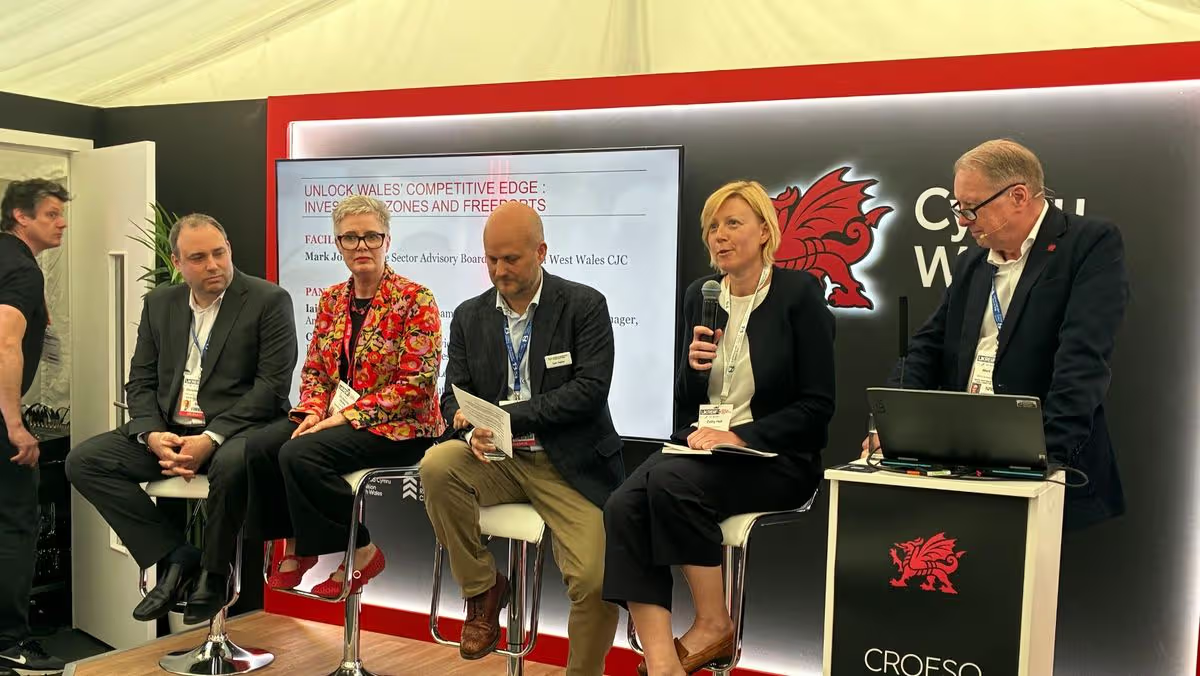
The Wales freeports and investment zones event at the UK Real Estate Investment & Infrastructure Forum (UKREiiF) in Leeds.

Cathy Hall, interim chief executive at Celtic Freeport, centre, speaks at the Wales freeports and investment zones event at the UK Real Estate Investment & Infrastructure Forum (UKREiiF) in Leeds(Image: Reach plc)

Freeports and investment zones in Wales can all complement each other and help the nation as a whole to grow, giant UK regeneration showcase UKREiiF has been told.

The Leeds showcase has attracted thousands of delegates to Leeds this week to hear about investment and regeneration opportunities across the UK.

Advertisement

The Wales pavilion hosted a debate on place based impact and development, as well as seeing the launch of the South West Wales investment prospectus which identifies investment opportunities from Pembrokeshire to Port Talbot.

And it hosted a panel discussion on whether Wales’ freeports and investment zones, which both offer tax advantages to investors to encourage them to choose Wales, can “Unlock Wales’ Competitive Edge”.

Host Mark John asked how they could be used to help promote Wales as an “investable nation”.

Christian Branch, head of service at the Regulation and Economic Development Service at the Isle of Anglesey Council, explained that Anglesey Freeport was a public-private partnership between the local authority and Stena Line, owner of the Port of Holyhead.

Advertisement

Asked if the freeports and investment zones across Wales were competing with each other, he said there were in fact opportunities for them to work together. He said: “From a national perspective it’s very much about complementing each other and I think there’s very much scope for all areas to improve”.

And he added that if one free port is successful “then all Wales is successful” and that it could help spark growth well beyondthe port boundaries.

Mr Branch said the freeport aimed to boost economic activity on Anglesey and beyond.

He said the island was dealing with challenges including an ageing population, young people moving away, and with thousands of job losses in recent years. But he said it also had many opportunities, including the Port of Holyhead, Rolls-Royce’s development of its Small Modular Reactor project at Wylfa, and the announcement of an AI Growth Zone on the island.

Advertisement

Cathy Hall, interim chief executive at Celtic Freeport – which covers the ports of Milford Haven and Port Talbo – said that while Mr Branch “hasn’t let me copy his homework yet”, she did expect that the freeports would learn from each other.

She explained that her freeport covers the ports of Milford Haven and Port Talbot, with a focus on the green economy through supporting offshore wind and the hydrogen economy. She said “It’s not just the two ports but the whole industrial ecosystem.”

Ms Hall said there were many similarities between coastal areas across Wales and the UK, but said each port also had its own specialities.

Ms Hall said one aim for the Celtic Freeport was to develop a “stickiness” in the supply chain – making sure that work in and around its ports helped to “build a long term skills base for the region as a whole”, rather than relying on contractors coming in and then leaving.

Advertisement

She highlighted the success at the Humber ports, particularly Grimsby, which have pivoted from fishing to supporting offshore wind in a move that has created skills and opportunities for local people.

Ms Hall said freeport and investment zone bosses could also act as “convening powers” for potential inward investors in areas such as offshore wind. They could, she said, help businesses new to Wales to get in touch with the right people to drive investments forward.

Iain Taylor, Flintshire and Wrexham Investment Zone programme manager at Ambition North Wales, said that zone was focused on areas including advanced manufacturing and supporting SMEs. Key sites include Gateway Deeside, Wrexham industrial estate, and Warren Hall.

He said the zone’s developers wanted to create thousands of jobs and to help smaller firms as well as the big companies in the region such as Airbus.

Advertisement

He talked about the tax reliefs on offer at particular sites, but said those reliefs in North East Wales and at the other sites featured on the panel were designed to attract long-term investors. He said: “The message across the panel is we’re here for the next generation,” and added that he wanted the local economy to be able to adapt to broader economic changes in the decades to come.

The Cardiff and Newport Investment Zone covers three strategic sites.

Cllr Deborah Davies, deputy leader at Newport City Council, said they include the proposed Cardiff Parkway station and integrated business park on the outskirts of Cardiff at St Mellons, which she added should develop its own business “ecosystem” once it opens.

But key industries in the investment zone will include advanced manufacturing and semiconductor R&D, which Cllr Davies described as “investment that matters to all Wales”. Key companies in the area include IQE, while its semiconductor expertise is attracting interest from around the world as the area still boasts plenty of space for firms to base themselves around that semiconductor cluster, and it also has strong transport links.

Advertisement

That investment, she said, will continue to lead to the development of local industries and businesses.

The investment zone also covers Imperial Park at Newport, which is home to leading tech firms including KLA and Vishay, and a parcel of land stretching from the Central Quay development in the centre of Cardiff down to Cardiff Bay and the Atlantic Wharf regeneration site.

The South West Wales Corporate Joint Committee (SWWCJC) has also unveiled its first regional investment prospectus at UKREiiF, marking a milestone in the region’s long-term economic development strategy.

The statutory body, that covers the local authority areas of Carmarthenshire, Neath Port Talbot, Pembrokeshire, and Swansea, has identified a portfolio of strategic opportunities across a range of sectors including clean energy, advanced manufacturing, innovation, tourism, and infrastructure.

Advertisement

Councillor Rob Stewart, chair of the SWWCJC and leader of Swansea Council, said: This prospectus is a statement of confidence in South West Wales. We are presenting a single, coherent regional offer to investors- one that reflects our shared priorities, our world-class natural assets, and our commitment to sustainable, inclusive growth.

“UKREiiF is one of the country’s leading events for driving investment, regeneration, and infrastructure development, making it the perfect platform to showcase the scale of opportunity in our region. It brings together public and private sector leaders from across the UK and beyond, and we are proud to support the Welsh Government, Ambition North Wales, Cardiff Capital Region, and Growing Mid Wales in showcasing the very best that Wales has to offer.

“Our participation at UKREiiF forms part of a wider programme to strengthen investor engagement and promote South West Wales as a dynamic, future-focused region ready to play a leading role in growing Wales’ and the UK’s economy.”

Advertisement
Continue Reading

Business

CLM: AI Theme Across Multiple Sectors (NYSE:CLM)

Published

on

SCHD: 3 Reasons Why I'm Buying More Right Now (NYSEARCA:SCHD)

This article was written by

Monte Independent Investment Research: Michael Del Monte is a buy-side equity analyst with expertise in the technology, energy, industrials, and materials sectors. Prior to working in the investment management industry, Michael spent over a decade in professional services working across industries that include O&G, OFS, Midstream, Industrials, Information Technology, EPC Services, and consumer discretionary.

Analyst’s Disclosure: I/we have a beneficial long position in the shares of GEV, NVDA, INTC, AVGO either through stock ownership, options, or other derivatives. I wrote this article myself, and it expresses my own opinions. I am not receiving compensation for it (other than from Seeking Alpha). I have no business relationship with any company whose stock is mentioned in this article.

Seeking Alpha’s Disclosure: Past performance is no guarantee of future results. No recommendation or advice is being given as to whether any investment is suitable for a particular investor. Any views or opinions expressed above may not reflect those of Seeking Alpha as a whole. Seeking Alpha is not a licensed securities dealer, broker or US investment adviser or investment bank. Our analysts are third party authors that include both professional investors and individual investors who may not be licensed or certified by any institute or regulatory body.

Advertisement
Continue Reading

Business

Smruti Sriram OBE & Alisha Fredriksson Named Winners

Published

on

Smruti Sriram OBE & Alisha Fredriksson Named Winners

Smruti Sriram OBE, the second-generation chief executive who has built Bags of Ethics by Supreme Creations into one of Britain’s most quietly influential sustainable manufacturers, has been named winner of the 2026 Veuve Clicquot Bold Woman Award. Alisha Fredriksson, the 31-year-old co-founder of maritime carbon-capture pioneer Seabound, takes home the Bold Future Award.

The awards, now in their 54th year and the longest-running international honours for women in business, were presented in London last night by Thomas Mulliez, president of the champagne house. The pair join an alumni list that includes Dame Julia Hoggett DBE, chief executive of the London Stock Exchange, vaccine scientist Professor Dame Sarah Gilbert, and Anne Pitcher, the former chief executive of Selfridges Group. Hoggett picked up the same honour at last year’s ceremony alongside Shellworks co-founder Insiya Jafferjee.

For Sriram, the award caps an eighteen-year run at the helm of a business that has done more than most British SMEs to give the much-abused phrase “purpose-driven” some commercial heft. Founded in 1999 by her father, Dr R. Sri Ram, Supreme Creations has grown into a vertically integrated supplier of reusable merchandise and sustainable packaging that, on the company’s own reckoning, has displaced an estimated 30 billion single-use items. Its “Bags of Ethics” label, which guarantees full supply-chain transparency, has become something of a quiet standard in a sector still riddled with greenwashing.

The judging panel, which this year included Kristina Blahnik of Manolo Blahnik, Allwyn UK managing director Bridget Lea, Ada Ventures co-founder Matt Penneycard and The Dots founder Pip Jamieson, cited Sriram’s work scaling a globally integrated supply chain alongside her commitment to social impact. More than 80 per cent of the workforce at the group’s factory in Pondicherry, southern India, is female; partnerships with the British Fashion Council and the Royal Forestry Society have raised millions for environmental and educational causes.

“As a second-generation entrepreneur, my journey has been shaped by a strong foundation of values, kindness, purpose and business acumen from my family, and especially my father, who founded the business in 1999 and is still very much involved,” Sriram said. “These eighteen years have been a professional and personal evolution, with a strong belief that business can and should be a force for good. To be recognised alongside such inspiring women is a reminder of what is possible when we use our skills not just to succeed, but to serve.”

Advertisement

She was quick to share the credit. “Our global teams from Pondicherry, and across Europe, are creative, highly skilled, and have always been showcased as partners to our clients, not just suppliers. This award is a spotlight on them, not me. They are the backbone and deserve the full recognition.”

Sriram beat a strong shortlist that also featured Paula MacKenzie, the chief executive of PizzaExpress, and Kanya King CBE, founder of the MOBO Group, as flagged when the nominees were announced earlier this year.

A shipping disruptor with a 95 per cent answer

If Sriram’s award nods to two decades of patient compounding, the Bold Future Award recognises a business that did not exist five years ago. Fredriksson co-founded Seabound in 2021 with a single, audacious proposition: that shipping — the industry behind roughly three per cent of global CO₂ emissions and long regarded as “too hard to abate” — could be cleaned up with retrofittable, container-sized carbon-capture kit bolted onto vessels already at sea.

The London-headquartered start-up’s modular system uses calcium looping to trap CO₂ from exhaust gases and convert it into solid calcium carbonate pebbles that can be offloaded at port. Independent assessments, including a case study published by Innovate UK Business Connect, put potential capture rates at up to 95 per cent. Following successful pilots with Lomar Shipping and Hapag-Lloyd, Seabound has now moved into commercial deployment, with the first full-scale units serving a cement carrier chartered to Heidelberg Materials.

Advertisement

“I am incredibly proud of the journey we have taken at Seabound, tackling one of the toughest challenges out there: reducing emissions in global shipping,” Fredriksson said. “What began as an ambitious idea to address the climate crisis has grown into a brand new category of technology for the industry. With successful pilot projects behind us, we are now at an exciting inflection point: heading into our first full-scale deployments, with the world’s largest shipping companies and regulators actively engaging with us.”

Fredriksson’s win lands at a moment when capital for female-led climate tech is still vanishingly scarce, a recurring theme are investors such as Sustainable Ventures, which backs female founders at twelve times the industry average. The Bold Future shortlist, which also included Josephine Philips of repair-and-alteration platform SOJO and Marisa Poster of matcha disruptor PerfectTed, suggests the talent pipeline is healthier than the funding statistics imply.

A 54-year-old hymn to Madame Clicquot

The awards trace their lineage to Madame Barbe-Nicole Clicquot Ponsardin, who took over her late husband’s champagne house in 1805 at the age of 27 and turned it into a global business in defiance of nineteenth-century convention. More on the programme’s history and previous winners is available on the Veuve Clicquot Bold Woman Award UK page.

“Madame Clicquot led Veuve Clicquot to become a brand of excellence and courage,” Mulliez said. “Building on her legacy, Smruti Sriram OBE and Alisha Fredriksson are shaping the future of business. Their businesses tackle global issues and their achievements extend far beyond commercial success, offering powerful inspiration to the next generation of female entrepreneurs.”

Advertisement

For British SMEs watching from the sidelines, the more useful inspiration may be quietly structural. Sriram’s eighteen-year build of a profitable, transparent manufacturing group, and Fredriksson’s rapid commercialisation of a deep-tech climate solution, between them sketch out two viable archetypes for bold business in the second half of the 2020s: patient and purposeful on one hand, fast and technically ambitious on the other. Both are evidently still rewarded.


Amy Ingham

Amy is a newly qualified journalist specialising in business journalism at Business Matters with responsibility for news content for what is now the UK’s largest print and online source of current business news.

Advertisement
Continue Reading

Business

TikTok and YouTube 'not safe enough' for kids, says Ofcom

Published

on

TikTok and YouTube 'not safe enough' for kids, says Ofcom

YouTube said it worked with experts to provide appropriate experiences. TikTok said it was disappointed Ofcom had not acknowledged its safety features.

Continue Reading

Business

Samsung strike on hold – but the fight isn't over yet. Why?

Published

on

Samsung strike on hold - but the fight isn't over yet. Why?

The walkout, which was due to start on Thursday, has been suspended while union members vote on a tentative deal.

Continue Reading

Business

Acarix AB (publ) (ACIXF) Q1 2026 Earnings Call Prepared Remarks Transcript

Published

on

OneWater Marine Inc. (ONEW) Q1 2026 Earnings Call Transcript

Aamir Mahmood
President & CEO

Good morning, and welcome to the Q1 2026 earnings call from Acarix. I appreciate everybody joining this morning. And before we kick off, it’s important for us to all kind of understand and realize that the world is in a very dynamic shift as we speak. The geopolitical tension, most prominently in the Middle East markets right now are ongoing, and we don’t see an end in sight. However, what I want to rest assure is all operations from Acarix standpoint are fully functional. While we do have a lot of entry and focus within the MENA region, nothing has come to a stop. So things are moving along slower than expected. However, given the rhetoric and the challenges we face across the board globally, I think that everybody recognizes it, but it’s important to make sure we address those situations as we continually press forward. Second, I’ll apologize in advance, I have a mild cough due to my allergies, but nothing to be concerned about. So let’s go ahead and move into the deck.

For all our new investors, thank you for joining. Just a quick update on who we are. This is — we’re Acarix. We have a CADScor System, and we’re really trying to revolutionize early onset diagnostics in the cardiovascular range. We have a point-of-care device that is fairly quick, within 10 minutes, and can calculate a CAD-score for patients feeling low to moderate chest pain or shortness of breath. We can quickly and very easily identify those things using high-fidelity acoustics, listening into the arterial flow. And our negative predictive value is 96.2% in the United States and 97.2% in the European markets. We have over 15 years of R&D, over 45 patents, and we

Advertisement
Continue Reading

Business

New CEO for Siemens UK & Ireland vows to ‘build on strong foundations’ at global giant

Published

on

Business Live

Brian Holliday has worked at Siemens for more than 32 years

Manchester-based Brian Holliday has been named as the new Chief Executive Officer of Siemens UK and Ireland.

Manchester-based Brian Holliday has been named as the new Chief Executive Officer of Siemens UK and Ireland(Image: Siemens)

Industrial and technology giant Siemens has named Brian Holliday as its CEO of its £4.6bn UK and Ireland business to “build on the strong foundations already in place”.

Manchester-based Mr Holliday has worked for Siemens for more than 32 years across a number of leadership and tech roles. He has been a member of the UK and Ireland senior leadership team for 10 years and will continue as managing director of Siemens Digital Industries.

Advertisement

Mr Holliday is a Fellow of the Royal Academy of Engineering and visiting Professor at the University of Sheffield, holding degrees from Cardiff University and the University of Manchester as well as an honorary doctorate from Middlesex University.

He is co-chair of the Made Smarter Commission, which works with SMEs to improve manufacturing productivity, and was recently appointed to the board of Skills England to advocate for SMEs and social mobility. He started his career as an apprentice with Texas Instruments and continues to focus on applied learning and vocational training.

Siemens’ UK & Ireland business employs 12,000 people and generated £4.6bn in revenue in 2025.

Matthias Rebellius, managing board member of Siemens AG, responsible for UK and Ireland, said: “Brian brings a deep understanding of our strategic priorities and our customers, as well as strong insight into the challenges facing industry as it digitalises. His external experience with the Catapults and Made Smarter will also be a real asset.

Advertisement

“Brian will build on the strong foundations already in place, continuing to drive focus on the areas where we can make the greatest difference and create more value for customers. This will be even more important as we take forward our ONE Tech Company programme and ensure we serve our customers in a seamless, straightforward way.”

Mr Holliday said: “I’m honoured to take up this position at a time of significant change, where technology and talent can make a real difference. I’ve always been proud of our people and struck by the commitment and sense of purpose evident across our UK and Ireland organisation thus I’m genuinely excited to lead this strong team. With global leadership in industrial technology and AI, as well as the partnerships we’ve developed, Siemens is well set to help our customers with their competitiveness, resilience and sustainability.”
Continue Reading

Business

Immunovant director Atul Pande sells $192,000 in shares

Published

on


Immunovant director Atul Pande sells $192,000 in shares

Continue Reading

Business

Bolt CEO Ryan Breslow Defends Firing Entire HR Team After 30% Layoffs

Published

on

Bolt CEO Ryan Breslow Defends Firing Entire HR Team After 30% Layoffs

The chief executive of US fintech Bolt has mounted a robust defence of his decision to sack the company’s entire human resources department, telling a Fortune audience that the team “created problems that didn’t exist” and that those issues “disappeared” the moment he showed them the door.

Ryan Breslow, the 32-year-old co-founder who returned to the helm last year after a three-year absence, insisted the move was central to his attempt to drag the one-time darling of Silicon Valley back into “start-up mode”. The online checkout software business shed roughly 30 per cent of its workforce in April, its fourth round of redundancies in as many years.

“We had an HR team, and that HR team was creating problems that didn’t exist,” Breslow told delegates. “Those problems disappeared when I let them go.”

He argued that traditional HR professionals were better suited to the “peacetime” rhythms of larger, more mature businesses than to the bare-knuckle conditions of a turnaround. In their place, Bolt has installed a leaner “people operations” function, charged with employee training and day-to-day support rather than policy-making.

“We need a group of people who are very oriented around getting things done,” Breslow said. “There is just a culture of not getting things done and complaining a lot.”

Advertisement

The remarks land at a delicate moment for the company. Bolt’s valuation has plunged from $11 billion at the peak of the 2022 fintech boom to just $300 million, according to The Information, a humbling reset for a business once held up as the future of one-click commerce.

Breslow, who stepped away from the chief executive’s office in 2022 before returning in 2025, has made little secret of his view that the workforce he inherited had grown soft on venture capital largesse.

“There’s a sense of entitlement that had festered across the company,” he said. “People who felt empowered, felt entitled — but weren’t actually working hard. And this is the number one thing that I had to battle. Ultimately, most of those people just had to be let go.”

Bolt has confirmed that fewer than 40 staff were affected by the latest cull, which it said was driven in part by the rapid adoption of artificial intelligence. In a company-wide Slack message in April, Breslow reportedly told employees: “Developing products and operating in 2026 is very different than it was in prior years, and we need to adapt as an organisation to be leaner and more AI-centric than ever to keep up with competition.”

Advertisement

The comments echo a broader trend across the technology sector, with employers from Meta to Microsoft using AI investment as cover for sweeping headcount reductions. Recent CIPD research suggests one in six UK employers now expect AI to eliminate jobs within the next 12 months, with white-collar roles bearing the brunt.

For founders of smaller British businesses watching from afar, the Breslow doctrine will provoke equal measures of admiration and unease. Few would deny that bloated middle layers can hobble a growth-stage company, and the temptation to strip back in tougher times is real. But UK employment law offers far less latitude than the at-will culture of the United States, and dispensing with HR expertise carries reputational as well as legal risks.

Employment lawyers have long warned that getting redundancy wrong can prove ruinously expensive, particularly for SMEs without the budgets to absorb tribunal claims. The Advisory, Conciliation and Arbitration Service (Acas) continues to urge employers to follow a structured, transparent process, including meaningful consultation and fair selection criteria — protections that, in practice, are typically marshalled and monitored by an HR function.

Breslow’s broader argument, that growth-stage businesses must run leaner and faster in an AI-driven economy, is one that increasingly few in the City would dispute. The challenge for British founders is to translate that ambition into a culture that delivers results without falling foul of either employment law or staff morale. As the wave of AI-related layoffs sweeping global tech has shown, the line between bold restructuring and reckless cost-cutting is easily crossed.

Advertisement

Whether Bolt’s stripped-back, founder-led model can return the business to its former $11 billion valuation — or simply hasten its slide — will be one of the defining fintech stories of the year. As reported by Fortune, Breslow has slimmed the headcount from a peak of around 800 to roughly 100. For a man who once championed the worker-friendly four-day week, it is a striking volte-face — and one his remaining staff, and his investors, will be watching closely.


Amy Ingham

Amy is a newly qualified journalist specialising in business journalism at Business Matters with responsibility for news content for what is now the UK’s largest print and online source of current business news.

Advertisement
Continue Reading

Business

GoodRx: Evident Stabilization, But GLP-1 Dependence Is A Risk (Upgrade)

Published

on

GoodRx: Evident Stabilization, But GLP-1 Dependence Is A Risk (Upgrade)

GoodRx: Evident Stabilization, But GLP-1 Dependence Is A Risk (Upgrade)

Continue Reading

Trending

Copyright © 2025