
Business
Nifty mega caps are going nowhere. Why Samco CIO Umesh Mehta put 75% of his Flexicap fund beyond largecaps

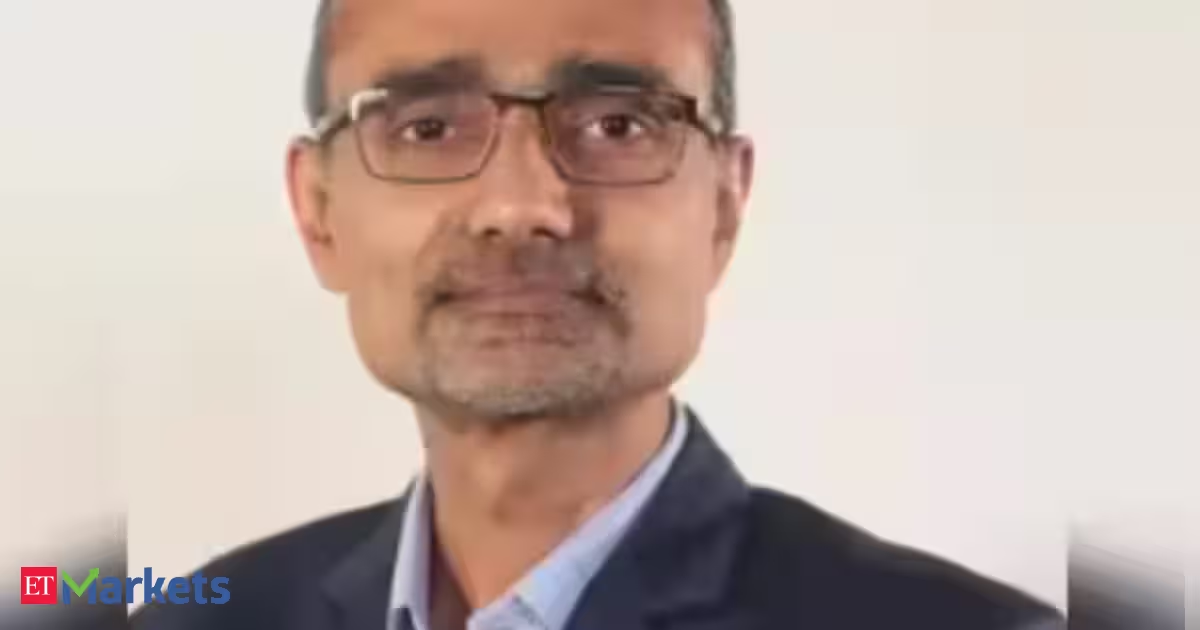
Samco has responded with an unusually aggressive positioning in its Flexicap fund, allocating around 70–75% of the portfolio to mid caps, small caps and select micro caps, while maintaining limited large-cap exposure. Although Mehta sees mega caps offering downside protection, he believes investors seeking growth must take calculated risks beyond the headline indices.
Edited excerpts from an interview.
The Nifty 50 has delivered little at the index level over the past two years, even as sector-specific activity has continued, particularly in mid- and small-cap stocks. Where do you think the market is in the current cycle?
The largest Nifty 50 companies by market capitalisation are languishing. These are mega-cap companies, and traditional businesses globally are not receiving the valuations they historically commanded.

Fortunately or unfortunately, traditional businesses account for a large part of our indices. That is why the headline indices have not generated the kind of returns investors might have expected over the past two or three years. But if you move beyond the mega caps and look at the next rung of the market—mid caps and small caps—there is considerable activity. That should continue because numerous opportunities are opening up.
The world is changing rapidly. Government spending remains supportive, while global developments sometimes provide tailwinds and sometimes create headwinds. There is considerable flux: some stocks are performing well, while others are languishing.At an aggregate level, smaller pockets of the market are moving, but a significant part of the market—large caps and mega caps—is doing very little. Even for foreign institutional investors, it can appear as though India is going nowhere.
In this environment, a bottom-up approach will help investors, traders and asset managers. They need to focus on individual stocks instead of looking only at the headline indices.
After two years of underperformance, do mega-cap stocks now offer value, or should investors continue looking beyond them?
When stocks underperform, can they become good investment opportunities? The answer is yes. But the second question is whether it makes sense to invest in a stock that is already fully owned by everyone. The answer may be no.
Everyone who wants to own these mega-cap stocks may already own them. Every fund and asset manager may have exposure to them, leaving few net new buyers. Even if incremental buyers emerge, there may also be incremental sellers. Investors therefore do not necessarily need to own all these stocks.
The other consideration is where growth is coming from. We are largely looking at growth investing. Small caps, mid caps and other growth stocks are rising, and their valuations may be high because their businesses are growing and investors are willing to pay for that growth.
The market offers a wide spectrum of risk-reward opportunities. Investors seeking safety can consider large mega caps because they may offer downside protection. Those seeking growth will need to take calculated risks and invest in growth companies.
Flexicap funds often tend to have a very strong large-cap bias. How have you positioned Samco Flexicap Fund in this market?
Flexicap funds have traditionally been managed as surrogate large-cap funds. We have instead built our portfolio around the areas where the action and momentum are.
Around 70–75% of our portfolio is tilted towards small caps, mid caps and some micro caps, with very limited exposure to large caps. That is where the market action is, and the portfolio has been designed to capture those opportunities.
The overall earnings season was very good. Mid- and small-cap companies, in particular, delivered an earnings season that broke several records.
Do the earnings delivered by mid- and small-cap companies justify their valuations and the subsequent rally?
We need to differentiate between the sources of those earnings. Did the improvement come from inventory gains, with companies liquidating stock at higher prices, or is there a genuine industry tailwind? Has geopolitics allowed a company to create a sustainable earnings and revenue stream? There are many moving parts.
At an aggregate level, the numbers were good and stock prices reflected that performance. But will the momentum sustain across the board? Obviously not. Supply-chain restrictions remain and are likely to have an impact. The same earnings numbers may not be repeated over the next three or six months.
Some companies will continue to benefit from the advantages they have captured. Refining margins are one example. Integrated companies may face difficulties, but pure refining businesses that are not also involved in retailing could have a significant opportunity. Russian refineries and some Middle Eastern capacity are moving out of the system, which could increase refining cracks and support the earnings of pure refiners. These companies have created genuine economic streams from the war.
Defence is another sector that has developed—and should continue to benefit from—a strong earnings tailwind because of geopolitics. Opportunities will continue to emerge.
Besides defence and oil and gas, which sectors look attractive?
Power, at an aggregate level, offers a significant opportunity. The challenge is that the stock market discounts developments faster than they unfold on the ground. Power projects take time and can face delays, creating a mismatch between secondary-market expectations and project execution.
Over the past three or four years, power stocks have experienced a whipsaw, moving sharply in both directions. Following the correction, the sector looks attractive again, but it remains a long-term theme requiring substantial capital expenditure before earnings follow. Demand and growth are present, but investors need a longer-term horizon to realise that potential.
AI ancillaries also present an opportunity, much like real-estate ancillaries such as cables and related products. Trillions of dollars are being spent globally on artificial intelligence, and Indian companies will participate in parts of that value chain. This could include heavy electrical cables required for power transmission, optical-fibre cables and other AI-related infrastructure.
These opportunities could remain relevant over the next one to two years. Growth investing can work in such areas, and higher valuation multiples may sustain, rewarding investors willing to take the associated risks.
Within power, do you prefer power producers or companies linked to power-sector capital expenditure?
Both. Power generators are undertaking capital expenditure and expanding across thermal, solar and wind power. However, these projects take time to deliver. The opportunity exists, but investors must be patient rather than chase stock prices.
There is also a substantial opportunity in power-sector capital expenditure. India requires investment not only in generation but also in transmission, distribution and substations. In metropolitan areas, distribution will increasingly move underground from the present overhead system. That creates a large opportunity for heavy electrical-cable manufacturers and the engineering, procurement and construction companies that install those cables.
The opportunity is sizeable, sustainable and potentially high-margin. Capacity cannot be created overnight, so heavy electrical-cable manufacturers could have a significant profit-pool opportunity for the next year or two.
Power capital expenditure is currently a very hot market theme, and valuations have risen. However, the sector will correct again because bidding up a stock is much easier than executing a project on the ground. When quarterly numbers fail to meet expectations, some liquidation will follow. Power will remain cyclical rather than move in a straight line. Several power-capex companies are also exporters.
Could exports become a bigger opportunity for power-related companies than the domestic market?
India has performed well in domestic power and solar manufacturing, and today there is overcapacity. Globally, however, solar capacity remains inadequate outside China. The US has a substantial deficit and needs additional power generation, although vested interests and lobbying are affecting the entry and impact of renewable-energy players. Politics therefore plays an important role alongside economics.
Solar is the quickest way to add power capacity, as India has demonstrated. China and Europe are also expanding, and the US will eventually have to do the same. But these opportunities will not be determined by economics alone; politics will remain an important factor.
Indian companies with solar-cell and module-manufacturing capacity currently face headwinds, although the sector retains considerable long-term potential. Nuclear power is another emerging theme, but its gestation period will be long.
Is this the right time to invest in the nuclear-power theme?
When we speak with industry participants, they indicate an eight-to-10-year time frame before the first nuclear power begins flowing and companies start earning from it. That illustrates the length of the gestation period.
The stock market can bid up share prices well before plants are established. When the narrative is driven by a theme, government support or a policy tailwind, the relevant stocks can rise. But as time passes and execution does not immediately follow, those stocks can become available at lower valuations.
That would be the more appropriate time to evaluate nuclear-power investments, rather than bidding up the stocks now, including companies catering to the broader nuclear ecosystem.
Could the high earnings base begin weighing on sectors such as automobiles and consumption from the second half of the financial year?
Automobiles are a typical sector where the base effect could become visible. The GST reduction was the opposite of a black swan—a “good swan.” That favourable window is likely to end, after which the high-base effect will begin to play out.
The auto index is already correcting. The last phase of the rally was concentrated in auto ancillaries, where considerable euphoria emerged. Eventually, reality should set in.
Maruti is near the bottom of the return table even though Maruti, Hyundai and Mahindra are among the biggest customers and value accumulators for these ancillary businesses. Auto ancillary stocks have outperformed the passenger-vehicle manufacturers they supply. The market should eventually recognise this divergence. The cyclical effect will reassert itself, leading to a correction and normalisation in prices.
Some auto-ancillary companies are increasing exports and diversifying into areas such as aerospace. Could that cushion the domestic slowdown?
Exports represent a significant opportunity, although their current contribution remains small for passenger-vehicle and commercial-vehicle manufacturers in aggregate. The impact is more visible for ancillary companies because the incremental export opportunity is substantial relative to their size.
India aspires to become a global manufacturing and automotive hub, and the government is supporting that ambition. These companies continue to generate domestic sales while also expanding exports.
If exports perform well, they could make the Indian automobile sector more secular and less cyclical from an investment perspective. For now, however, exports remain a relatively small proportion of the business. The high-base effect in the domestic market should therefore result in mean reversion, with automobile stocks likely to correct.
Over time, investors should monitor export growth. Bajaj Auto, for example, is performing very well in overseas markets, and other companies will eventually attempt to expand their export presence.
How do you assess the current IPO momentum and the quality of new listings?
IPO momentum is strong, but if it keeps accelerating, it could take momentum away from the secondary market. Liquidity is the biggest driver of stock-market performance. If liquidity is absorbed by primary issuances, that may be positive for the economy, but it can create difficulties for the secondary market.
If increasingly large IPOs continue to arrive, retail money channelled through mutual funds is absorbed by new supply, and FIIs do not return, the net liquidity equation becomes adverse. When liquidity deteriorates, markets can correct.
Either FIIs must return and provide enough liquidity to sustain the market, or IPO supply must slow. If fundraising continues at this scale, it could wreck the market. One of those two conditions needs to change for the market to sustain. We have seen this dynamic since 2024.
The supply pressure is not limited to IPOs. We are also seeing offers for sale, including LIC’s ₹32,000-crore OFS, along with numerous qualified institutional placements.
Consider the market as an investor facing a series of suppliers. If one issuer takes ₹30,000 from the investor and another subsequently seeks ₹20,000, the investor must either find additional money or sell an existing holding. At an aggregate level, a continuous stream of new supply eventually forces selling in the secondary market, creating a cascading effect on prices.
With the possibility of interest-rate cuts and renewed momentum in gold, how should investors approach asset allocation?
The past five or six years were very good for equities, but they were also very good for gold. Over the next two, three or five years, gold will remain an equally important asset class that investors should not ignore, as long as the current US administration remains in power.
Gold has historically delivered strong or comparable returns. The probability of gold generating better risk-adjusted returns is now much greater than it was two, three or five years ago.
As geopolitics intensifies and currencies are increasingly weaponised, the world is recognising that gold is money. Governments and investors cannot rely exclusively on electronic forms of money. A reserve currency gives its issuer the power to impose sanctions. If that currency is repeatedly weaponised, countries will become more inclined to diversify into gold because their savings are otherwise held in a system that can be used against them.
The reported freezing of a judge’s assets because of a decision favouring a particular country is another trigger for governments and investors to reconsider their gold exposure. Gold is currently in a strong secular bull-market trend.
Investors should allocate to gold through instruments such as exchange-traded funds or multi-asset allocation funds. It is time to consider gold alongside equities as a means of preserving wealth because markets can surprise on both the upside and downside.
For a moderately aggressive investor with a five-to-10-year horizon, should the allocation to gold exceed 10% and potentially reach 15–20%?
Easily. Whether one begins the comparison in 1979, 2000 or 2010, gold has generally delivered returns that were either better than equities or within one or two percentage points of them. Although gold’s long-term return has been slightly below the Sensex, it remains a wealth creator.
Gold cannot manipulate itself and does not generate negative or positive earnings surprises. It is a pure demand-and-supply asset: if demand rises, its price increases, and if demand falls, its price declines.
The precious-metals universe is also relatively simple, consisting primarily of gold and silver. By owning one asset, investors have historically generated returns, whereas equity investors must select from thousands of stocks while managing a much wider spread of risks to deliver a similar outcome.
Gold is therefore a valuable asset class. Over a one-year horizon, it could deliver better returns than equities. Over five to 10 years, its returns should be broadly in line with equity returns.


Google Maps will show ’Lake America’ in US, not ’Lake Ontario’

https://www.fotogestoeber.de/iStock via Getty Images

Download this episode on Apple Podcasts/Spotify or listen below:

August’s jobs report could cement a September rate hike. (0:17) Broadcom earnings give another look at the AI spending. (1:24) John Ternus takes the reins from Tim Cook at Apple. (1:56)
The following is an abridged transcript:
This week brings the August jobs report, which could be crucial for the Federal Reserve’s next move.
Following what traders saw as a hawkish Jackson Hole speech from new Fed Chairman Kevin Warsh, odds of a quarter-point September rate hike have jumped to 57% from 40%, with an 18% chance of another hike in October.
Economists expect a modest rise in August nonfarm payrolls of 55K, with the unemployment rate holding at 4.1%.
Wells Fargo economists say alternative indicators “suggest job growth has stabilized, rather than continuing to deteriorate.”
“Hiring measures from regional Fed surveys have improved in recent months, small business hiring plans have perked back up, and job openings have leveled off. Meanwhile, initial jobless claims remain near multi-decade lows, underscoring that layoffs are still contained.”
SA Analyst Damir Tokic expects a strong August jobs report to “cement” a quarter-point rate hike.
“Warsh clearly stated in his Jackson Hole speech that the labor market is strong, as the unemployment rate at 4.1% is very low by historical standards,” he said. “The main implication for monetary policy is that the labor market is fine, thus, the focus shifts entirely to inflation.”
On the earnings front, Broadcom (AVGO) will give further insight into AI spending when it reports Wednesday. Analysts expect EPS of $3.24 on revenue of $29.4B.
SA analyst Dustin Quasney says the stock faces elevated near-term downside risk ahead of earnings due to high expectations set by Nvidia’s recent results.
For those long the stock, he recommends covered calls that prioritize downside protection.
Here’s how the rest of the earnings calendar shapes up:
On Tuesday, Palo Alto Networks (PANW), Dell (DELL), and Medtronic (MDT) report.
Snowflake (SNOW) weighs in on Wednesday.
Ciena (CIEN) and Zscaler (ZS) are up Thursday.
Also this week, on Tuesday, John Ternus will step into the role of Apple (AAPL) CEO, taking over from Tim Cook, aka Tim Apple, who has led the tech giant since 2011. Cook will move into the role of executive chairman.
SA analyst Envision Research says they are confident the new leadership will preserve the company’s “well-established earning power and shareholder return mechanisms.”
They also see “additional opportunities for Ternus to capitalize on the vast installed (customer) base and to continue growing the base with his deep understanding of the company’s various hardware lineups.”
And Tesla (TSLA) plans to hold an invite-only Cybercab launch event Thursday in Austin, Texas, that will also be livestreamed.
The compact two-seater is designed without a steering wheel or pedals, with fully autonomous passenger transport as its sole purpose. Reports indicate riders may be able to request a Cybercab through Tesla’s existing Robotaxi app in Austin as early as next week.
In the news this weekend, Nvidia (NVDA) CEO Jensen Huang is a notable omission from Time Magazine’s newly released list of the 100 most influential people in artificial intelligence for 2026.
On a list featuring SpaceX (SPCX) CEO Elon Musk, OpenAI (OPENAI) CEO Sam Altman and Anthropic (ANTHRO) CEO Dario Amodei, Huang’s absence raised eyebrows.
Huang was included in the three previous TIME100 AI editions.
And for income investors, Northrop Grumman (NOC) goes ex-dividend Monday, paying out on Sept. 16.
Nike (NKE) and McDonald’s (MCD) go ex-dividend Tuesday. Nike pays out on Oct. 1, and McDonald’s pays out on Sept. 16.
Qualcomm (QCOM) goes ex-dividend Thursday, with a Sept. 24 payout date.

How will U.S.-Iran conflict reshape the world?
Business
Five Advantages the iPhone 18 Pro Could Have Over Apples Pricier Foldable iPhone Ultra This Autumn Season

Apple is preparing to unveil its first foldable iPhone alongside the iPhone 18 Pro and iPhone 18 Pro Max at a Sept. 9 event, and mounting leaks suggest the standard Pro models could actually outperform the pricier foldable device, widely expected to be called the iPhone Ultra, in several meaningful ways.
Apple confirmed its fall product event this week with a media invitation carrying the tagline “Surprise and shine,” alongside rumors that the company will unveil three flagship devices this September rather than the usual four-model iPhone lineup: the iPhone 18 Pro, iPhone 18 Pro Max, and the company’s long-rumored foldable. Reports suggest the base iPhone 18 and a lower-cost iPhone 18e will instead arrive in spring 2027, a departure from Apple’s traditional September release pattern.
The first advantage centers on the camera. According to a report from 9to5Mac, the iPhone 18 Pro line is expected to gain a variable-aperture main camera, a feature that would let users manually adjust how much light reaches the sensor, potentially improving Portrait mode results and offering greater control over depth of field along with meaningful gains in low-light photography. Multiple outlets, including the technology site Gotechtor, have reported that the foldable iPhone is not expected to receive the same hardware, largely because the components required for variable aperture are believed to be too large to fit inside the device’s notably thin body.
A second advantage involves optical zoom. Current reports indicate the foldable iPhone will ship with only two rear cameras, a main sensor and an ultrawide lens, while the iPhone 18 Pro and Pro Max are expected to retain a dedicated telephoto lens as part of their triple-camera systems. That would leave Apple’s most expensive iPhone without true optical zoom capability, a notable gap for a flagship-priced device that could push buyers who prioritize zoom photography toward the standard Pro models instead.
Battery life represents a third area where the Pro line is expected to have an edge. According to 9to5Mac, the iPhone 18 Pro Max is rumored to receive a physical battery roughly 10% larger than the one in the iPhone 17 Pro Max, and it is expected to benefit further from efficiency improvements tied to Apple’s new A20 Pro chip and its in-house C2 modem. While regulatory filings suggest the foldable iPhone should still offer solid battery performance for its category, most reports agree the Pro Max’s combination of a larger physical battery and chip-level efficiency gains should make it the longest-lasting iPhone Apple has ever released, a benchmark the foldable’s unique thin-and-light form factor makes difficult to match.
A fourth potential advantage involves biometric security. Multiple outlets, including Tom’s Guide, have reported that the foldable iPhone may forgo Face ID entirely in favor of Touch ID built into its power button, a design choice likely driven by the challenge of fitting Face ID’s sensor array into such a thin device. The iPhone 18 Pro and Pro Max, by contrast, are expected to retain Face ID, preserving the more familiar unlocking and authentication experience current iPhone Pro owners are accustomed to.
Raw processing performance provides a fifth point of separation. According to Tom’s Guide, the foldable iPhone is rumored to use a standard A20 chip rather than the more powerful A20 Pro variant found in the iPhone 18 Pro and Pro Max, even though both chips are expected to be built on the same advanced 2-nanometer manufacturing process, which industry reports suggest could deliver roughly a 15% improvement in processing speed and a 20% boost in efficiency compared with the current generation.
These reported trade-offs come as the foldable iPhone is expected to command a substantially higher price than the Pro lineup, with multiple outlets estimating a starting price near 2,000 dollars, nearly double what the iPhone 17 Pro Max currently costs. Design-wise, the foldable is rumored to open in a book-style format with a titanium frame, an outer display measuring roughly 5.3 to 5.5 inches, and an inner display around 7.6 to 7.8 inches when unfolded, aiming for an iPad-like 4:3 aspect ratio and a display Apple hopes will be nearly free of the visible crease common to other foldable phones on the market.
Apple has not confirmed any of these specifications ahead of its Sept. 9 event, and the company’s official presentation remains the only source that will resolve the current wave of speculation. For consumers weighing whether the novelty of a folding screen justifies the foldable’s expected premium, however, current leaks suggest the more traditional iPhone 18 Pro and Pro Max could actually deliver stronger cameras, longer battery life, familiar biometric security and faster raw performance, at a considerably lower price than Apple’s most ambitious device to date.

Nabors Industries: I'm Not Going To Be Chasing This One

Carvana: Automotive E-commerce Leader Negated By Hefty Growth Premium
Business
Ketogenic Diet Outperforms Other Plans for Reversing Prediabetes and Fatty Liver, New Study Finds

A new randomized clinical trial from Washington University School of Medicine in St. Louis has found that a ketogenic diet outperformed two other widely recommended eating plans at reversing prediabetes and reducing fat buildup in the liver, even when all three diets produced identical amounts of weight loss.
The study, published Aug. 27 in the journal Cell Metabolism, compared a low-carbohydrate, high-fat ketogenic diet against a high-carbohydrate, low-fat, plant-forward diet and a Mediterranean diet that balanced the two approaches. Researchers randomly assigned 55 adults with what they described as metabolically unhealthy obesity, meaning obesity accompanied by prediabetes and fatty liver disease, to follow one of the three diets for approximately five months. Participants received all of their food throughout the study and met weekly with a study dietitian to support adherence to their assigned plan.
Across all three diet groups, participants lost a comparable amount of weight, shedding roughly 10% of their starting body weight, and saw insulin sensitivity in their muscle cells improve by about 50% from baseline. According to the study’s senior author, Dr. Samuel Klein, the Danforth Professor of Medicine and Nutritional Science at WashU Medicine, that consistency suggests weight loss itself, rather than the specific balance of fat and carbohydrates used to achieve it, was the key driver behind the improvement in muscle insulin sensitivity. “For patients with obesity, prediabetes and fatty liver disease, weight loss induced by a very low-carbohydrate diet provides additional therapeutic effects on glucose and lipid metabolism that should further help prevent the progression to more severe metabolic diseases than weight loss alone,” Klein said. “But all three diets, despite vastly different macronutrient makeups, from very low carbohydrates to very high carbohydrates, successfully improved metabolic health through weight loss alone.”
The results diverged sharply, however, when it came to liver health. The research team found that insulin sensitivity in liver cells, which governs how effectively the liver suppresses glucose production, improved two to three times more among participants on the ketogenic diet compared with those on the other two plans, even though all three groups showed some improvement. The ketogenic diet also reduced fat stored inside the liver by 67% after five months, compared with a 45% reduction on the other two diets.
Study first author Dr. Max C. Petersen, an assistant professor of medicine in WashU Medicine’s John T. Milliken Department of Medicine, said the findings carry significant implications given how widespread fatty liver disease has become. “Fatty liver disease affects about 75% of adults with obesity worldwide and has become the fastest-growing cause of chronic liver disease and liver cirrhosis,” Petersen said. “Our study shows that for people with obesity and fatty liver disease, a low-carbohydrate ketogenic diet could help reduce that statistic.”
Blood sugar control also improved more substantially among participants following the ketogenic diet. Researchers measured a 20% reduction in 24-hour blood glucose levels from baseline among the low-carbohydrate group, compared with an 8% reduction among participants on the other two diets. Insulin levels throughout the day fell by 74% on the ketogenic diet, compared with declines of 44% on the Mediterranean diet and 27% on the high-carbohydrate diet, a pattern the researchers said reflects reduced demand on the pancreas to produce insulin when carbohydrate intake is sharply limited.
The difference in outcomes was most striking when it came to reversing prediabetes entirely. Half of the participants assigned to the low-carbohydrate ketogenic diet reversed their prediabetes by the end of the study, compared with 29% of those on the Mediterranean diet and just 7% of those on the high-carbohydrate, plant-forward diet.
Petersen noted that the findings remain relevant even as GLP-1 medications, a class of drugs that includes semaglutide and other treatments widely used for weight loss, have become an increasingly common tool for managing obesity and its associated health risks. “Many metabolically unhealthy patients also are candidates for GLP-1 medicines, which have been very useful tools for helping people lose weight,” Petersen said. “But our results show that choice of diet remains important because it has an impact on specific health outcomes that go beyond weight loss alone.”
Obesity affects roughly four in 10 Americans, according to the study, and frequently coexists with metabolic complications including insulin resistance, prediabetes and fatty liver buildup, conditions that can progress over time to Type 2 diabetes, chronic liver disease and cardiovascular events if left untreated. While weight loss has long been established as the most effective overall strategy for reducing these risks, researchers said it has remained unclear until now which specific dietary approach, in terms of its balance of protein, fat and carbohydrates, produces the greatest improvement in underlying metabolic health markers beyond weight loss alone.
The research team, which also included Dr. Gordon I. Smith, an associate professor of medicine at WashU Medicine, said future studies will examine the underlying biological mechanisms responsible for the metabolic benefits observed with weight loss, including how those mechanisms may interact with the growing use of GLP-1 medications in clinical practice. As with any nutrition research involving significant dietary changes, individuals considering major shifts to their eating patterns, particularly those managing existing health conditions, are generally advised to consult a physician or registered dietitian before beginning a new diet plan.
Business
(VIDEO) North Carolina Health Officials Urge Farm Adventures Visitors to Call After Baby Goats Had Rabies

HARMONY, N.C. — Health officials in North Carolina are asking anyone who touched baby goats from a mobile petting zoo to contact their local health department after laboratory tests confirmed rabies in several of the animals.
The goats belonged to Farm Adventures, based in Iredell County. The North Carolina Department of Health and Human Services said people may have been exposed at the farm’s Harmony site or at off-site events between July 28 and Aug. 27. Three kids tested positive at the State Laboratory of Public Health. A fourth was not tested but is assumed to have been infected. All four were euthanized.
Officials said there is no wide public threat. “There is not a broad risk to the public — only those who attended events at the mobile petting zoo and were in close contact with the goats are at risk,” the department said.
The animals were most likely infected by a skunk that entered their pen in late July. State health and agriculture agencies were notified Aug. 27. Testing results came back Aug. 28. Investigators later concluded that no other animals on the farm pose a rabies risk to people.
Baby goats are often bottle-fed, held and cuddled, which raises the chance of saliva contact. “Because baby goats are frequently bottle-fed, handled closely, or cuddled, public health officials are working proactively to ensure anyone who had direct contact with the affected animals is evaluated,” the state health department said.
The zoo took the animals to events that included children and older adults. Known sites include Jurney’s Assisted Living in Statesville on July 28; a private event in Mecklenburg County on July 30; the Community Connections Back-to-School Bash at Breeden Amphitheater in Lexington on Aug. 1; a private event near Boone in Watauga County on Aug. 8; a private event on Miller Mills Road in Hickory, Burke County, on Aug. 9; the Masonic Picnic in Mocksville; and additional private gatherings in Iredell and Durham counties later in August. Organizers are being notified as lists are completed.
Mecklenburg County Health Director Kimberly Scott said residents should not wait to feel sick. “Residents should not wait for symptoms before calling,” she said. “What’s important is that we don’t wait for the onset of symptoms when it is more difficult to treat and often most fatal.”
Scott told reporters that county teams are still compiling how many people may have been reached and that hospitals appear to have enough postexposure prophylaxis on hand, with plans to obtain more if needed.
Farm Adventures identified the goats as Molly, Maggie, Cow and Uno. In a social media post the owners wrote that their “4 precious baby goats have been euthanized to prevent further spread” and that staff would monitor remaining animals under official guidance. The kids had been kept apart because they were too young to vaccinate.
Owner Misty Love told CNN she is cooperating. “I care about my community, and I care about my customers,” she said. “If my customers that saw my animals have questions, I’m going to be there for them.”
Love said a wild skunk was found in the enclosure on July 29 and was shot and burned. She said the goats did not appear bitten and showed no signs of illness at first. One died Aug. 19. Another became sick the next day and was euthanized. A necropsy confirmed infection. A farm post also said that during removal of the skunk, “the skunk was able to bite the goats,” and that owners had “no clue” at the time.
North Carolina has not reported a human rabies case since 2011. Nationwide, the Centers for Disease Control and Prevention says fewer than 10 human deaths are reported in a typical year. The virus spreads mainly through saliva, usually from a bite, though scratches or contact with mucous membranes can also transmit it. Incubation can last weeks to months. Once symptoms appear — often flu-like illness, then neurological decline — the disease is almost always fatal. Treatment given before symptoms, known as postexposure prophylaxis, is highly effective.
Livestock present a lower risk than wild carnivores or bats, officials said, but close handling changes the calculation. Skunks, raccoons, bats and foxes account for most animal rabies in the state. In 2025, about 6 percent of more than 4,000 animals submitted for testing were positive.
County health departments have opened extra phone lines. Davidson County directed Lexington event-goers to a call center. Rowan County asked anyone who touched, held or fed the kids to call even if no event has been confirmed inside that county. Catawba County noted the Hickory-area date and asked residents who may have crossed the county line to check in.
The investigation remains open. Officials are matching booking calendars with attendance lists and advising people to call their health department before walking into an emergency room, so staff can assess risk and direct them if shots are needed.
For families who stood in line at a back-to-school bash or an assisted-living visit, the message is narrow and urgent: if you handled those four goats in that one-month window, pick up the phone. Rabies is rare. Waiting for a fever is not the plan.


Alex Pettee is President and Director of Research and ETFs at Hoya Capital. Hoya manages institutional and individual portfolios of publicly traded real estate securities.Alex leads the investing group iREIT®+HOYA Capital. The service features a team of analysts focusing on real income-producing asset classes that offer the opportunity for reliable income, diversification, and inflation hedging. Learn More.
Analyst’s Disclosure: I/we have a beneficial long position in the shares of RIET, HOMZ, IRET, ALL HOLDINGS IN THE IREIT+HOYA PORTFOLIOS either through stock ownership, options, or other derivatives. I wrote this article myself, and it expresses my own opinions. I am not receiving compensation for it (other than from Seeking Alpha). I have no business relationship with any company whose stock is mentioned in this article.
Hoya Capital Research & Index Innovations (“Hoya Capital”) is an affiliate of Hoya Capital Real Estate, a registered investment advisory firm based in Rowayton, Connecticut, that provides investment advisory services to ETFs, individuals, and institutions. Hoya Capital Research & Index Innovations provides non-advisory services, including market commentary, research, and index administration focused on publicly traded securities in the real estate industry. This published commentary is for informational and educational purposes only. Nothing on this site nor any commentary published by Hoya Capital is intended to be investment, tax, or legal advice or an offer to buy or sell securities. This commentary is impersonal and should not be considered a recommendation that any particular security, portfolio of securities, or investment strategy is suitable for any specific individual, nor should it be viewed as a solicitation or offer for any advisory service offered by Hoya Capital Real Estate. Please consult with your investment, tax, or legal adviser regarding your individual circumstances before investing. The views and opinions in all published commentary are as of the date of publication and are subject to change without notice. Information presented is believed to be factual and up-to-date, but we do not guarantee its accuracy, and it should not be regarded as a complete analysis of the subjects discussed. Any market data quoted represents past performance, which is no guarantee of future results. There is no guarantee that any historical trend illustrated herein will be repeated in the future, and there is no way to predict precisely when such a trend will begin. There is no guarantee that any outlook made in this commentary will be realized. Readers should understand that investing involves risk, and loss of principal is possible. Investments in real estate companies and/or housing industry companies involve unique risks, as do investments in ETFs. The information presented does not reflect the performance of any fund or other account managed or serviced by Hoya Capital Real Estate. An investor cannot invest directly in an index, and index performance does not reflect the deduction of any fees, expenses, or taxes. Hoya Capital Real Estate and Hoya Capital Research & Index Innovations have no business relationship with any company discussed or mentioned and never receive compensation from any company discussed or mentioned. Hoya Capital Real Estate, its affiliates, and/or its clients and/or its employees may hold positions in securities or funds discussed on this website and in our published commentary. A complete list of holdings and additional important disclosures is available at www.HoyaCapital.com.
Seeking Alpha’s Disclosure: Past performance is no guarantee of future results. No recommendation or advice is being given as to whether any investment is suitable for a particular investor. Any views or opinions expressed above may not reflect those of Seeking Alpha as a whole. Seeking Alpha is not a licensed securities dealer, broker or US investment adviser or investment bank. Our analysts are third party authors that include both professional investors and individual investors who may not be licensed or certified by any institute or regulatory body.

Investors will focus on manufacturing and services PMI data from major economies, including India. Inflation figures from Eurozone and Germany, and US non-farm payroll data due towards the end of the week will also be closely tracked, they added.
“The coming week is likely to remain highly volatile, with market participants attempting to price in the probability of a September Federal Reserve policy change,” Jateen Trivedi, VP Research Analyst – Commodity and Currency, LKP Securities, said.
Gold futures for October delivery on the Multi Commodity Exchange (MCX) tumbled Rs 6,157, or 3.8 per cent, last week to Rs 1.56 lakh per 10 grams, while silver futures for September contract plunged Rs 9,893, or 4 per cent, to Rs 2.36 lakh per kilogram.
“MCX Gold witnessed a sharp correction last week, falling from around Rs 1.63 lakh to Rs 1.56 lakh per 10 grams, resulting in a decline of nearly over Rs 6,000 from the weekly peak and a negative weekly closing of more than 3 per cent,” Trivedi said.
Pranav Mer, Senior Vice President, EBG – Commodity & Currency Research, JM Financial Services Ltd, said selling pressure intensified on Friday following Federal Reserve Chair Kevin Warsh’s speech, with his commentary on inflation and monetary policy triggering profit booking across bullion markets.
In international markets, Comex gold futures for December delivery declined USD 150.7, or 3.2 per cent, to settle the week at USD 4,680.6 per ounce. Silver futures fell USD 2.56, or 3.64 per cent, to USD 67.78 per ounce.Going into the new month, markets will closely track US labour-market indicators, including non-farm payrolls, unemployment data, and ADP non-farm employment change, which could influence the Federal Reserve’s decision-making ahead of its September meeting, Mer said.
Geopolitical developments could add another layer of uncertainty. Traders will continue to monitor the US-Iran conflict, while developments around the Strait of Hormuz remain important for oil prices and inflation expectations.
Despite the correction, silver outperformed gold in August, gaining around 21 per cent against yellow metal’s 15.7 per cent, Gaurav Garg, Head of Research at Lemonn Markets Desk, said.
Trivedi said, “The combination of dollar movement, labour-market data, Fed expectations and geopolitical headlines is likely to determine whether gold stabilises after the recent correction or enters another phase of profit booking.”
Google Maps will show ’Lake America’ in US, not ’Lake Ontario’

India vs Thailand LIVE Score, Women's Asia Cup 2026: Harmanpreet Kaur-Led India Invited To Bat By Thailand

Why the Hottest New Wearables Want to Be Ignored





-

 Crypto World5 days ago
SpaceX stock could rise 75% to $240, JPMorgan says
-

 Fashion2 days ago
Weekend Open Thread: Maeve – Corporette.com
-

 Crypto World3 days ago
Bitcoin’s 22% rally now needs real demand to outlast Treasury liquidity boost
-

 Crypto World4 days ago
Warsh Jackson Hole keynote puts financial innovation first
-

 Crypto World6 days ago
A $30 Billion AI Fund Implodes, Now the SEC Is Investigating Wall Street’s Role
-

 Business3 days ago
Salesforce Stock Soars 19% as Blowout Earnings and Agentforce AI Growth Silence Software Skeptics
-

 Crypto World4 days ago
Did Trump Just Move SpaceX Stock With One Truth Social Post?
-

 Business4 days ago
Walmart takes aim at younger shoppers with new fashion brand
-

 Crypto World4 days ago
Elon Musk Grok Bot Promise: We Will Make You Whole if AI Loses Your Money
-
 NewsBeat4 days ago
Lindsay Clancy jury braces for closing arguments as judge tells court: ‘You’ve heard all the evidence’ – Live updates
-

 Crypto World2 days ago
Bitcoin price tests $82K resistance as Brandt stays long
-

 Crypto World3 days ago
NVIDIA revenue hits $96.2B as AI demand doubles
-

 Business3 days ago
Apple Confirms September 9 Keynote and Reveals Its Full Pre-Order Schedule
-

 Business6 days ago
Moderna CEO warns China is pouring state money into mRNA technology
-

 Business5 days ago
Thailand’s Eastern Economic Corridor Capital City (EECiti): Key Developments and Investment Opportunities
-

 Business2 days ago
iPhone 18 Pro Pre-Orders Could Shift to Saturday as Apple Reportedly Avoids September 11 Anniversary
-

 Business6 days ago
NVIDIA Stock Drops Nearly 2 Percent to $210 on Seventh Losing Day Ahead of Critical AI Earnings
-
 Crypto World6 days ago
$92 Billion Nvidia Earnings Could Make or Break the AI Trade
-

 NewsBeat5 days ago
Trump’s trade truce with China faces test with Iran effort
-
 Crypto World4 days ago
Nvidia Q2 Earnings Reveal $96.2 Billion Beat, So Why Is NVDA Falling?
You must be logged in to post a comment Login