Connect with us
DAPA Banner
DAPA Coin
DAPA
COIN PAYMENT ASSET
PRIVACY · BLOCKDAG · HOMOMORPHIC ENCRYPTION · RUST
ElGamal Encrypted MINE DAPA
🚫 GENESIS SOLD OUT
DAPAPAY COMING

Business

North West firms ‘remain resilient despite high costs’, Barclays Business Prosperity Index shows

Published

on

Business Live

Bank research suggests larger firms still considering investment

A Barclays bank sign

Barclays has issued its Q1 2026 Business Prosperity Index(Image: PA)

North West businesses are staying resilient despite the problems caused by high costs and economic uncertainty, new research from Barclays has shown. Barclays’ Q1 2026 Business Prosperity Index showed 77% of those polled were confident in the strength of their business over the next 12 months.

But costs and skills remain challenges for local firms. Some 56% of those polled said input costs were having a negative impact on long-term growth, with 57% citing labour costs as a drag on growth. And 79% of those polled said difficulties finding skilled workers were hitting their ability to grow.

Advertisement

The index also draws on anonymised Barclays client data from more than 66,000 North West firms. It showed cash inflows from North West SMEs into Barclays Business Banking accounts rose 0.3%, compared to a national average rise of 0.2%. But larger firms with Barclays Corporate Bank saw cash flows fall 8%, above the national rate of 7%.

North West SMEs increased their savings buffers by 2.6% overall and cut their borrowing by 13.5% overall, mirroring the national picture. Meanwhile larger corporates continued to increase their longer-term borrowing at above national average levels, which Barclays said is “suggesting investment intentions may remain intact”.

Karen Johnson, head of retail and wholesale at Barclays Corporate Banking, said: “Businesses across the North West are continuing to operate in a challenging environment, with cost pressures, skills shortages and economic uncertainty all weighing on growth.

“Despite this, it’s clear that firms are showing resilience and adaptability. Many are taking a disciplined approach to managing costs while continuing to invest in areas that support long-term productivity and competitiveness.

Advertisement

“The strength of confidence in their own prospects reflects the underlying resilience of businesses across the region, even as the wider economic outlook remains uncertain.”

Continue Reading
Click to comment

You must be logged in to post a comment Login

Leave a Reply

Business

Did Thunder Figure Out the Formula to Limit Wembanyama as Spurs Face Elimination in Game 6?

Published

on

Victor Wembanyama

OKLAHOMA CITY — The Oklahoma City Thunder may have unlocked a blueprint to contain Victor Wembanyama, holding the Spurs superstar to a series-low 20 points on inefficient shooting in Game 5, as San Antonio now faces elimination with the Western Conference finals at 3-2 heading into Thursday’s pivotal Game 6.

Wembanyama, who dominated earlier in the series with outputs of 41 and 33 points in Spurs victories, struggled against Oklahoma City’s physical, team-oriented defense on Tuesday night. He finished 4-of-15 from the field, including 0-of-5 from three-point range, while relying heavily on free throws for his scoring total. The Thunder’s strategy of contesting shots at the rim, using multiple defenders, and limiting easy opportunities in the paint proved effective in Game 5’s 127-114 victory.

Thunder coach Mark Daigneault and players have emphasized collective effort rather than relying on a single defender to slow the 7-foot-4 phenom. Isaiah Hartenstein and Alex Caruso provided physical resistance, while the team’s help rotations and length made it difficult for Wembanyama to establish rhythm.

Defensive Adjustments Pay Off

In Game 5, Oklahoma City held Wembanyama to just eight points in the paint and limited him to six rebounds. The approach built on lessons from earlier matchups, where the Spurs star had exploited mismatches with his combination of size, skill and shooting range. By forcing him into tougher, contested shots and disrupting passing lanes, the Thunder reduced his overall impact despite his continued presence as a defensive anchor.

Advertisement

Jared McCain, who started in place of injured teammates and scored 20 points, highlighted the team’s commitment to physicality and rebounding as keys to containing the reigning Defensive Player of the Year. The Thunder’s depth allowed them to wear down Wembanyama over the course of the game, preventing him from dominating extended stretches as he had in San Antonio.

The strategy represents a significant evolution from Game 1, when Wembanyama exploded for 41 points and 24 rebounds in a double-overtime Spurs victory. Oklahoma City has progressively tightened its defense around him, mixing schemes that alternate between dropping big men back and using wings to harass him on the perimeter.

Spurs Must Adapt Quickly

For San Antonio, Thursday’s Game 6 in front of a passionate home crowd represents a must-win scenario. Coach Mitch Johnson and the Spurs staff will need to devise counters to Oklahoma City’s physical approach, potentially by involving Wembanyama more as a facilitator or creating better spacing to open driving lanes.

Wembanyama has shown the ability to adjust throughout the playoffs, delivering dominant performances after quieter outings. His versatility remains the Spurs’ greatest asset, but the team’s supporting cast must elevate their play to reduce his burden against a Thunder defense that has grown more comfortable contesting his shots.

Advertisement

The series has highlighted the chess match between two young, talented rosters. While the Thunder boast superior depth and home-court advantage, the Spurs have proven capable of stealing games through Wembanyama’s brilliance and opportunistic defense.

Broader Series Context

Oklahoma City leads 3-2 after bouncing back strongly from a Game 4 loss in San Antonio. Shai Gilgeous-Alexander’s consistent scoring and playmaking, combined with strong bench contributions, have given the Thunder the edge in most contests. Their ability to win at home while forcing the Spurs into tough road environments has been a defining characteristic of their playoff run.

For the Thunder, closing out the series on the road would mark another step toward their ultimate goal of repeating as champions. A victory in Game 6 would send them to the NBA Finals against the Eastern Conference champion New York Knicks.

The Western Conference finals have delivered compelling basketball, showcasing the league’s future with two of its brightest young stars in Wembanyama and Gilgeous-Alexander. Their individual matchups, along with the supporting casts’ contributions, have created memorable moments and tactical battles that could influence future playoff trends.

Advertisement

What’s Next for Both Teams

If the Spurs force a Game 7 on Saturday in Oklahoma City, the series would return to a hostile environment where the Thunder have been nearly unbeatable. For San Antonio to extend the series, they will likely need Wembanyama to approach his Game 1 and Game 4 levels of dominance while receiving more consistent support from role players.

The Thunder, meanwhile, aim to maintain their defensive intensity and exploit any fatigue or frustration within the Spurs organization. Their roster construction, blending star talent with versatile defenders and shooters, has proven difficult for opponents to solve throughout the postseason.

As the series reaches its potential conclusion, both teams face critical decisions on personnel, rotations and game plans. Wembanyama’s ability to overcome Oklahoma City’s defensive schemes will be the central storyline in Game 6, but the collective efforts of both squads will ultimately decide the outcome.

The Western Conference finals have already provided a showcase for the league’s evolving style of play, where length, versatility and tactical discipline often outweigh traditional metrics. Whether the Thunder have truly solved the Wembanyama puzzle or if the Spurs can engineer one more memorable comeback remains to be seen in what promises to be an intense Game 6 atmosphere in San Antonio.

Advertisement
Continue Reading

Business

Rubio pushes US energy dominance in India as Iran war reshapes global oil flows

Published

on

Rubio pushes US energy dominance in India as Iran war reshapes global oil flows

Secretary of State Marco Rubio just wrapped a four-day visit to India with a Quad meeting over the weekend. Energy security was at the forefront of discussions, alongside Indo-Pacific security, trade and supply chain resilience.

The trip was Rubio’s first visit to the country as the Secretary of State and National Security Advisor, and came at a moment of delicate U.S.-India relations and heightened volatility in global energy markets.

Advertisement

Before embarking on his trip, Rubio said Washington wants New Delhi to buy more American oil and gas.

HIGH ENERGY PRICES RISK KEEPING INFLATION ABOVE 2% TARGET, CONCERNING FED POLICYMAKERS

Marco Rubio in India.

U.S. Secretary of State Marco Rubio and Indian Foreign Minister Subrahmanyam Jaishankar attend a joint press conference after their meeting at the Hyderabad House in New Delhi, India, May 24, 2026.  (Adnan Abidi/Reuters / Reuters)

“We want to sell them as much energy as they’ll buy. We want them to be a bigger part of the portfolio,” Rubio told reporters in Miami last week, adding, “There’s a lot to work on with India. They’re a great ally, a great partner.”

India, the world’s second-largest importer of oil, imports nearly 88% of its crude. More than half of those imports come from the Middle East, much of it transiting the Strait of Hormuz. The Iran war has created a significant energy crisis for the South Asian nation. And even with signs of a peace deal emerging, the disruptions are expected to linger, deepening New Delhi’s fears over long-term energy security.

Advertisement

India has increasingly sought alternative supplies and looked to diversify its energy future, which is accelerating broader U.S.-India energy cooperation.

“Secretary Rubio should make clear that America wants to be India’s energy partner of choice. U.S. energy gives India a secure alternative to opaque, sanctions-exposed supply chains, Max Meizlish, Research Fellow at the Foundation for Defense of Democracies’ Center on Economic and Financial Power, told FOX Business.

OIL, GAS PRICES JUMP AS TRUMP FLIRTS WITH STRIKING IRANIAN OIL INFRASTRUCTURE

“But the partnership has to run both ways. India cannot be a strategic energy partner for Washington while Indian firms are repeatedly surfacing in sanctions designations involving Iranian energy flows, shadow fleet shipping, falsified origin claims and Russian sanctions evasion,” he added.

Advertisement
Iranian flag flying in the Strait of Hormuz

An Iranian flag flies above ships anchored in the Strait of Hormuz as the U.S. cracks down on Iran’s growing use of cryptocurrency. (Majid Saeedi / Getty Images)

India has continued to buy discounted Russian crude, despite sanctions and pressure from Washington to reduce dependence on Moscow’s energy exports. Now, the U.S. is hoping to persuade India to purchase more oil and liquefied natural gas from America and Venezuela.

This month, Venezuela overtook Saudi Arabia and the United States to become India’s third-largest crude supplier.

During a meeting with Indian Prime Minister Narendra Modi, Rubio underscored the strategic importance of the U.S.-India partnership and affirmed that U.S. energy products have the potential to diversify India’s energy supply.
 

In an X post on Saturday, Rubio also said that Delhi committed to buying $500 billion in American goods over the next five years, focusing on energy, technology and agriculture.

Advertisement

IRAN WAR FUELS ASIA ENERGY CRUNCH AS INDIA, JAPAN, OTHERS FEEL STRAIN

At the same time, India is trying to secure long-term energy independence by rapidly expanding domestic nuclear power generation.

Last month, India hit a major nuclear milestone when its most advanced reactor, the Prototype Fast Breeder Reactor (PFBR), achieved a self-sustaining stage.

Unlike conventional reactors, fast breeder reactors produce more fissile material than they consume, potentially reducing long-term dependence on imported fuel sources.

Advertisement

Once fully operational, India will become only the second country after Russia to run a commercial fast-breeder reactor.

Indian oil tanker near Iraq

The India-flagged oil tanker Desh Ujaala is pictured in the Gulf waters near Al-Basrah Oil Terminal (ABOT), about 50 kilometres offshore of Iraq’s southern Faw peninsula, on August 5, 2025.  (Hussein Faleh/AFP via Getty Images / Getty Images)

As this unfolds, New Delhi is also deepening nuclear cooperation with Washington as it seeks foreign investment and advanced technology to rapidly scale up its atomic energy sector.

Earlier this month, a high-level 20-member U.S. Executive Nuclear Industry Delegation visited India to explore private investment and technology commercialization opportunities in India’s civil nuclear energy market, with discussions focused on advanced nuclear technologies and small modular reactors.

U.S. Ambassador to the country, Sergio Gor, recently praised the growing India-U.S. energy partnership, saying “big things” lie ahead.

Advertisement

India plans to increase its nuclear power capacity from 8.8 gigawatts to 100 gigawatts by 2047, creating what officials estimate could become a nearly $300 billion nuclear energy market.

The deepening energy ties extend beyond energy imports alone.

President Donald Trump recently announced a historic $300 billion refinery agreement with India’s Reliance Industries. Under the deal, a new oil refinery would be constructed at the Port of Brownsville in Texas. It’s set to become the first new major U.S. refinery built in 50 years.

Narendra Modi, India’s prime minister, at the Bhartiya Janata Party (BJP) headquarters during election results night in New Delhi, India, on Tuesday, June 4, 2024.  (Prakash Singh/Bloomberg via Getty Images / Getty Images)

With analysts warning that prolonged instability involving Iran could continue rattling global oil markets and supply chains, Rubio’s trip highlighted the growing strategic importance of energy cooperation between Washington and New Delhi.

Advertisement

For Washington, India represents one of the world’s fastest-growing energy markets and a key strategic partner in the Indo-Pacific.

GET FOX BUSINESS ON THE GO BY CLICKING HERE

For New Delhi, deeper ties with the U.S. offer an opportunity to diversify energy supplies, while reducing vulnerability to shocks rippling from the Middle East.

“The goal should be more American energy flowing to India and far less sanctioned Iranian and Russian energy moving through Indian channels,” Meizlish told Fox.

Advertisement
Continue Reading

Business

Buy or Sell Meta Stock in 2026? Analysts Weigh AI Strength Against Valuation Concerns

Published

on

Stock Market

NEW YORK — As Meta Platforms Inc. shares trade near all-time highs in late May 2026, investors face a familiar dilemma: whether to buy into the company’s artificial intelligence momentum and advertising dominance or exercise caution over elevated valuations and ongoing losses in its Reality Labs division.

The social media giant has delivered strong returns year-to-date, driven by robust ad revenue growth and progress in its open-source AI initiatives. However, some analysts warn that the stock’s premium pricing leaves limited room for error if economic conditions soften or AI monetization timelines extend.

Meta reported solid first-quarter 2026 results in April, with revenue reaching $40.1 billion, up 21 percent year-over-year. Advertising revenue, which accounts for the vast majority of total sales, continued its steady climb as brands increased spending on platforms like Facebook, Instagram and Threads. Daily active users across the family of apps exceeded 3.3 billion, underscoring the company’s unmatched digital reach.

AI Investments Fuel Optimism

Meta has aggressively positioned itself in the generative AI race through its Llama family of models. The company’s decision to release models openly has earned praise from developers and researchers while helping attract talent and partnerships. Recent updates to Llama 4 have shown competitive performance against closed-source alternatives, boosting confidence in Meta’s long-term AI strategy.

Advertisement

Analysts highlight Meta’s ability to integrate AI features directly into its core products. Tools like AI-powered content recommendations, advertising optimization and creative generation have improved user engagement and advertiser efficiency. This integration potentially offers faster monetization paths compared to companies building standalone AI businesses.

Chief Financial Officer Susan Li noted during the earnings call that AI is already contributing meaningfully to ad performance metrics. The company expects continued investment in compute infrastructure throughout 2026, with capital expenditures projected to reach $60-65 billion, primarily for AI-related data centers and chips.

Advertising Resilience Amid Economic Uncertainty

Meta’s core advertising business has proven remarkably durable. Despite periodic concerns about macroeconomic pressures, the company has consistently grown its user base and average revenue per user. Reels and short-form video formats have helped the platforms compete effectively with rivals like TikTok.

International markets, particularly in Asia and Latin America, continue to offer growth opportunities as digital advertising penetration increases. Meta’s focus on small and medium-sized businesses has also provided a buffer against fluctuations in large advertiser spending.

Advertisement

Reality Labs Remains a Drag

The company’s bet on the metaverse through Reality Labs continues to generate substantial losses. While mixed-reality headsets like the Quest series have seen improved sales, the division still operates at a significant annual loss. Management maintains that these investments are essential for positioning Meta in future computing platforms, but the ongoing cash burn raises questions about capital allocation efficiency.

Some investors argue that Meta should consider moderating its Reality Labs spending to improve near-term profitability and shareholder returns. Others view the division as a necessary long-term strategic bet that could eventually rival the core social media business in scale.

Valuation and Risk Considerations

At current levels, Meta trades at a forward price-to-earnings multiple in the mid-20s, which is elevated compared to historical averages but reasonable given its growth profile. The stock offers a dividend yield of approximately 0.3 percent, with the company having initiated payouts in 2024 and increased them steadily.

Bullish analysts point to Meta’s strong free cash flow generation, disciplined share repurchase program and potential for AI-driven margin expansion as reasons to maintain or add to positions. Bearish voices cite risks including regulatory scrutiny in Europe and the United States, competition in advertising, and execution challenges in emerging technologies.

Advertisement

Geopolitical tensions, particularly around data privacy regulations and potential tariffs, represent additional uncertainties. Meta has worked to diversify its operations and comply with regional requirements, but these issues could impact growth in key markets.

Analyst Consensus and Price Targets

Wall Street maintains a generally positive stance on Meta. The majority of covering firms rate the stock as Buy or Outperform, with average price targets suggesting 10-20 percent upside from current levels. Recent notes have highlighted the company’s AI progress and advertising resilience as key supportive factors.

However, a minority of analysts recommend a more neutral stance, citing valuation concerns and the potential for multiple compression if AI hype moderates or if economic conditions deteriorate.

Investment Considerations for 2026

For investors considering Meta stock in 2026, several factors warrant attention:

Advertisement

Bull Case: Continued AI integration drives higher engagement and advertising efficiency. User growth remains strong, and Reality Labs losses eventually narrow. The company’s vast data resources and distribution network provide significant competitive advantages.

Bear Case: Advertising market slowdowns pressure revenue growth. Reality Labs continues consuming capital without clear returns. Regulatory actions or competitive disruptions erode market share in key areas.

Diversification remains advisable. Many portfolio managers recommend pairing Meta with other technology names to balance exposure to social media, advertising and AI themes.

Longer-term, Meta’s ability to evolve beyond its core social platforms while maintaining profitability will determine its success. The company’s track record of adapting to changing user behaviors and technological shifts provides some reassurance for investors.

Advertisement

As the year progresses, quarterly results, AI product launches and capital expenditure updates will provide important signals about Meta’s trajectory. For now, the stock offers a blend of growth potential and cash flow stability that appeals to many long-term investors, though careful attention to valuation and execution risks remains essential.

The debate over buying or selling Meta in 2026 ultimately depends on individual risk tolerance, time horizon and conviction in the company’s AI and metaverse strategies. While near-term momentum appears positive, disciplined analysis of fundamentals will be key to navigating potential volatility ahead.

Continue Reading

Business

US stocks today: Dow posts closing record high, S&P 500, Nasdaq muted as AI rally pauses

Published

on

US stocks today: Dow posts closing record high, S&P 500, Nasdaq muted as AI rally pauses
Rising healthcare and consumer stocks ​boosted the Dow Jones Industrial Average on Wednesday to a record closing high, while the S&P 500 and the Nasdaq were steady, as investors took a pause from the AI-led market rally while cautiously watching Middle East peace talks.

Banking stocks were down as shares of JPMorgan Chase slid after CEO ‌Jamie Dimon warned ⁠that expenses ⁠this year could be $1 billion higher than estimated.

The White House denied reports from Iran’s state TV that Tehran would restore Strait of Hormuz shipping within a ​month in exchange for a U.S. military pullback and the lifting of a naval blockade.

Still, indexes traded near record highs.

Advertisement

The Dow, which hit ​closing highs on Friday and Thursday, was lifted by a rotation into healthcare and consumer stocks such as Procter & Gamble .


However, a pullback in chip stocks weighed on the tech-heavy Nasdaq.
According to preliminary data, the S&P 500 gained 1.81 points, or 0.02%, to ​end at 7,520.93 points, while the Nasdaq Composite gained 18.55 points, or 0.08%, to 26,676.60. ⁠The Dow ‌Jones Industrial Average rose 189.08 points, or 0.37%, to 50,650.76.”After such a large run-up in the ​markets, it’s not surprising ​to me that there is a little bit of a pause,” said Sean Clark, chief investment ⁠officer of Clark Capital Management Group.

“There’s a lot of positives to look at ​right now. Even though the outperformers are really being driven by tech, AI and AI ​adjacent themes, I wouldn’t discount the fact that the broad market is participating as well.”

Among the sub-indexes, consumer discretionary was leading the gains.

Meanwhile, the S&P 500 energy index fell, tracking a decline of as much as 5% in oil prices. Tech shares dropped after reaching an all-time high on Tuesday.

Advertisement

Chip stocks were down after a strong rally. Intel fell and Marvell Technology fell, while Qualcomm fell sharply after sharp gains Tuesday.

Chip giant Nvidia weakened andthe Philadelphia SE Semiconductor index lost after hitting a record ‌high on Tuesday.

“Technology leadership remains difficult to ignore, with the sector continuing to push to new highs on both an absolute and relative basis compared to the broader market,” said Adam Turnquist, chief technical strategist, ​LPL Financial.

“That said, ​increasingly stretched momentum conditions and elevated ⁠positioning raise questions around the near-term durability of the advance.”

Advertisement

Zscaler tumbled after the cloud security firm projected fourth-quarter revenue below expectations.

Among other movers, GlobalFoundries fell after Bloomberg News reported that majority owner Mubadala Investment Company was seeking to raise $1.91 billion from an unregistered block ​sale of GFS shares.

Bath & Body Works jumped after reporting first-quarter sales and profit above expectations, while Abercrombie & Fitch advanced on posting a strong quarterly profit. Goldman Sachs raised its 2026 year-end forecast for the S&P 500 to 8,000 from 7,600, citing continued strength in corporate earnings.

Markets will next look toward the personal consumption expenditures index data on Thursday. The Federal Reserve’s key inflation measure could provide fresh clues on the monetary policy path forward under new chair Kevin Warsh.

Advertisement
Continue Reading

Business

Freedom Broker initiates Flex stock coverage with hold rating on valuation

Published

on


Freedom Broker initiates Flex stock coverage with hold rating on valuation

Continue Reading

Business

Trump Accounts releases mobile app ahead of July 4 program launch

Published

on

Trump Accounts releases mobile app ahead of July 4 program launch

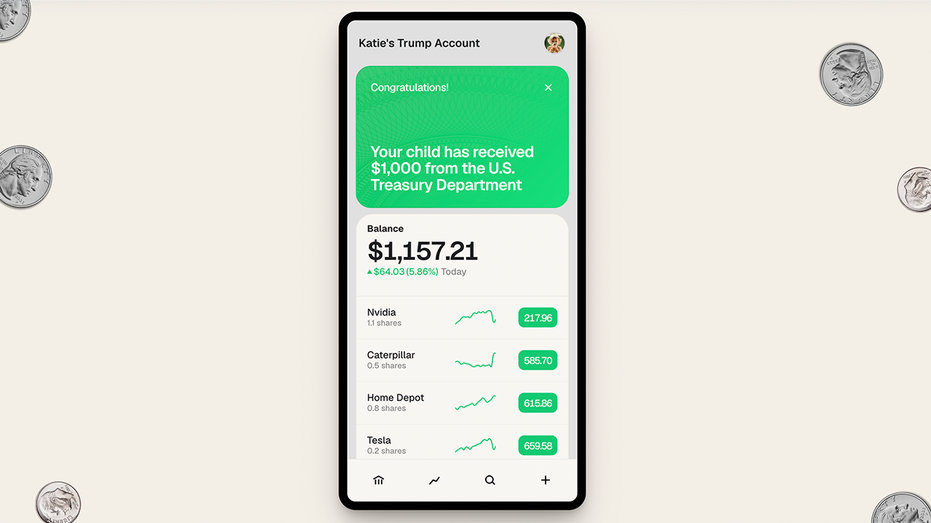
The White House announced on Wednesday Trump Accounts will drop a mobile app to track investments placed into children’s accounts as part of the administration’s new initiative.

“TOMORROW: Trump Accounts, on your phone,” the White House wrote in an X post. “Manage everything. Watch the growth. All in ONE place.”

Advertisement

The Wall Street Journal first reported account activation will begin for those who have already enrolled. 

The app, which was designed by Joe Gebbia and National Design Studio in partnership with BNY and Robinhood, can be downloaded through Apple or Google starting Thursday.

It will feature eight exclusive financial literacy modules that families can immediately access, an initiative that officials told FOX Business is a top priority for Treasury Secretary Scott Bessent.

Trump Accounts app

The Trump Accounts app will feature eight exclusive financial literacy modules that families can access before the July 4 rollout. (U.S. Department of the Treasury / Fox News)

HOW TO KNOW IF YOUR CHILD QUALIFIES FOR A TRUMP ACCOUNT: ‘A FINANCIAL STAKE IN THE FUTURE’

Advertisement

The initiative, which debuted in January, is a provision of the new tax legislation that will dole out $1,000 to every newborn U.S. citizen whose parents enroll them in the program.

No contributions are necessary, but parents can deposit up to $5,000 per year, which will be invested in American companies in the stock market.

At age 18, without any additional contributions, it is estimated a child’s account will be worth $5,800. By age 55, a child’s account without any additional contributions will reach roughly $200,000.

donald-trump

US President Donald Trump speaks during the Trump Accounts Launch Summit in Washington, DC, US, on Wednesday, Jan. 28, 2026. (Valerie Plesch/Bloomberg via Getty Images / Getty Images)

NEW TRUMP ACCOUNTS PITCHED AS TAX-SEASON GATEWAY TO BUILDING WEALTH

Advertisement

With a $5,000 contribution each year, an account will be worth nearly $304,000 by the time the child turns 18, or $2.7M by the time the child reaches 55.

For the first time ever, we’re going to give every newborn American child a financial stake in the future,” President Donald Trump said during an event announcing the program in January. “Head start life and a fair shot at the American dream, something people have talked about so much.”

“Over the next 15 years, we’re going to put $3 to $4 trillion of wealth into the hands of young Americans who otherwise would have really started out with nothing,” he added. “… Decades from now, I believe that Trump Accounts will be remembered as one of the most transformative policy innovations of all time.”

Trump Accounts app

The White House announced a new app for Trump Accounts will drop on Thursday. (Trump Accounts / Fox News)

GET FOX BUSINESS ON THE GO BY CLICKING HERE

Advertisement

Every American child born between Jan. 1, 2025, and Dec. 31, 2028, will be eligible. Children can be enrolled when parents file their taxes.

The account will be in the child’s name and parents will act as the sole custodian until they turn 18.

The program will launch July 4, coinciding with America’s 250th anniversary.

Advertisement
Continue Reading

Business

Private-Credit Risks Look Manageable, Says ECB

Published

on

David Uberti hedcut

That’s almost as big as America’s subprime-mortgage market in 2006, just before it took down the world economy. The difference, the ECB said: Private credit represents 4.7% of U.S. GDP today, whereas $1.5 trillion in subprime mortgages represented nearly 11% of the economy back then.

The ECB, which looks after financial stability in the eurozone, said banks in the single-currency area have much less exposure to private credit than they did to U.S. subprime mortgages before the global financial crisis. That could change if private credit balloons as a source of funding for the artificial-intelligence industry, it said.

European insurers stand to lose much more than banks in a private-credit downturn, the ECB found, mostly from associated losses in public markets.

Continue Reading

Business

Trinity Capital Could Move Higher As It Expands Dividend Coverage (NASDAQ:TRIN)

Published

on

Trinity Capital Could Move Higher As It Expands Dividend Coverage (NASDAQ:TRIN)

This article was written by

The equity market is a powerful mechanism as daily fluctuations in price get aggregated to incredible wealth creation or destruction over the long term. Pacifica Yield aims to pursue long-term wealth creation with a focus on undervalued yet high-growth companies, high-dividend tickers, REITs, and green energy firms.

Analyst’s Disclosure: I/we have a beneficial long position in the shares of TRIN either through stock ownership, options, or other derivatives. I wrote this article myself, and it expresses my own opinions. I am not receiving compensation for it (other than from Seeking Alpha). I have no business relationship with any company whose stock is mentioned in this article.

Seeking Alpha’s Disclosure: Past performance is no guarantee of future results. No recommendation or advice is being given as to whether any investment is suitable for a particular investor. Any views or opinions expressed above may not reflect those of Seeking Alpha as a whole. Seeking Alpha is not a licensed securities dealer, broker or US investment adviser or investment bank. Our analysts are third party authors that include both professional investors and individual investors who may not be licensed or certified by any institute or regulatory body.

Advertisement
Continue Reading

Business

Buy or Sell Oracle Stock in 2026? Analysts Weigh AI Cloud Surge Against High Valuation Risks

Published

on

Oracle is the latest global tech titan to announce major digital investments in Southeast Asia

NEW YORK — Oracle Corp. shares have delivered strong gains in 2026, driven by accelerating demand for its cloud infrastructure and artificial intelligence services, leaving investors to debate whether the current premium valuation still justifies buying more shares or if it is time to take profits amid growing competition and elevated expectations.

The database and enterprise software giant has emerged as a major beneficiary of the global AI boom, with its Oracle Cloud Infrastructure (OCI) experiencing rapid adoption by companies seeking high-performance computing resources for large language models and data analytics. As of late May 2026, Oracle stock has risen substantially year-to-date, outperforming broader market indices and reflecting investor confidence in the company’s transformation from a traditional software firm to a leading cloud and AI infrastructure provider.

Oracle reported robust fiscal third-quarter 2026 results in March, with cloud revenue growing more than 50 percent year-over-year. Total revenue reached $14.3 billion, while remaining performance obligations — a key indicator of future revenue — hit record levels. The company raised its full-year guidance, citing strong enterprise demand for its multicloud and AI offerings.

Bull Case: AI and Cloud Leadership

Supporters of buying Oracle stock point to its strategic positioning in the AI infrastructure market. The company has formed significant partnerships with major technology players, including a landmark collaboration with OpenAI to provide dedicated cloud capacity for training and inference workloads. Oracle’s focus on high-performance, cost-efficient cloud solutions has attracted large enterprises seeking alternatives to dominant hyperscalers.

Advertisement

Analysts highlight Oracle’s database dominance as a key competitive advantage. Its Autonomous Database and Exadata Cloud@Customer offerings allow seamless migration of mission-critical workloads to the cloud while maintaining strict security and compliance standards. This “bring your own license” model has proven particularly appealing to large organizations with substantial existing Oracle investments.

Chief Executive Safra Catz has emphasized the company’s ability to deliver both growth and profitability. During recent earnings calls, Oracle executives noted strong backlog growth and improving margins in its cloud segment, suggesting the business is reaching an inflection point where investments begin translating into sustained free cash flow expansion.

Valuation Concerns and Bear Case

Critics argue that Oracle’s rapid stock appreciation has pushed valuations to levels that leave little margin for error. The stock trades at a forward price-to-earnings multiple significantly above its historical average, reflecting high expectations for continued cloud acceleration. Some analysts caution that any slowdown in AI capital spending or delays in customer migrations could trigger a sharp correction.

Competition remains intense. Microsoft Azure, Amazon Web Services and Google Cloud continue to invest heavily in AI infrastructure, while specialized providers challenge Oracle in specific workloads. The company must also navigate complex geopolitical dynamics, particularly around data sovereignty and export restrictions affecting its international growth.

Advertisement

Oracle’s heavy capital expenditure commitments for data center expansion represent another risk factor. While these investments support future growth, they pressure near-term free cash flow and could limit flexibility if economic conditions deteriorate.

Analyst Perspectives

Wall Street remains generally bullish on Oracle, with the majority of covering firms maintaining Buy or Outperform ratings. Average price targets suggest moderate upside from current levels, though some firms have recently trimmed targets citing valuation concerns.

Analysts at firms such as Morgan Stanley and Goldman Sachs have highlighted Oracle’s improving competitive position in cloud infrastructure and its ability to win large enterprise deals. However, others recommend a more cautious approach, suggesting investors wait for pullbacks before adding to positions.

The stock offers a modest dividend yield, providing some income support for long-term holders. Oracle has also maintained an active share repurchase program, demonstrating confidence in its intrinsic value.

Advertisement

Strategic Initiatives and Outlook

Oracle continues expanding its cloud regions globally while investing in sovereign cloud solutions to address data residency requirements. The company’s acquisition strategy, including key deals in cybersecurity and application software, aims to create a more comprehensive enterprise technology stack.

Looking ahead to the remainder of 2026, investors will watch Oracle’s ability to convert strong backlog into recognized revenue and its progress in expanding margins. The company’s fiscal fourth-quarter results, expected in June, will provide important signals about the sustainability of its growth trajectory.

Broader industry trends remain supportive. Global enterprise spending on cloud and AI infrastructure is projected to grow significantly through the end of the decade, driven by digital transformation initiatives and generative AI adoption across sectors.

Investment Considerations

For investors considering Oracle stock in 2026, the decision largely depends on time horizon and risk tolerance. Long-term believers in the company’s cloud and AI strategy may view current levels as reasonable given growth prospects. Shorter-term traders might prefer waiting for a more attractive entry point following any market volatility.

Advertisement

Diversification remains important. Many portfolio managers recommend pairing Oracle with other technology and software names to balance exposure across the sector. Regular monitoring of quarterly results, customer win announcements and competitive developments is essential.

Oracle’s transformation story demonstrates the potential for established technology companies to successfully pivot toward high-growth areas. Its combination of legacy strength in databases and new momentum in cloud and AI creates a compelling long-term narrative, though the stock’s elevated valuation requires careful consideration of execution risks.

As the year progresses, Oracle’s performance will likely continue reflecting broader sentiment toward artificial intelligence infrastructure spending and enterprise technology investment. Whether the stock represents a buy or sell opportunity ultimately depends on individual assessment of the company’s ability to sustain its recent momentum while delivering on ambitious growth targets.

Advertisement
Continue Reading

Business

Micron’s AI Bottleneck Trade Just Started (NASDAQ:MU)

Published

on

Micron’s AI Bottleneck Trade Just Started (NASDAQ:MU)

This article was written by

My investing journey began at 15, sparked by a deep curiosity for markets and shaped by my father’s career in finance. What started as a fascination with Warren Buffett’s annual letters quickly evolved into a full-time passion for value investing, mental models, and understanding how great businesses create long-term value. I’ve spent years independently studying financial statements, building DCF models, and analyzing companies through both fundamental and behavioral lenses. While I’m still early in my professional path, I’ve been immersed in the world of investing for nearly a decade. From dissecting shareholder letters to reverse-engineering business strategies, I’ve developed a disciplined, fundamentals-first approach grounded in long-term thinking. I focus on identifying mispriced quality companies and understanding what makes certain business models resilient across cycles. I write on Seeking Alpha to share insights, test ideas in public, and contribute to a community of investors who value clear thinking over hype. My goal is to provide thoughtful, research-backed commentary, whether on under-the-radar compounders, Growth/GARP stocks, or misunderstood tech platforms. Above all, I invest with conviction, patience, and a relentless drive to keep learning.

Analyst’s Disclosure: I/we have a beneficial long position in the shares of MU either through stock ownership, options, or other derivatives. I wrote this article myself, and it expresses my own opinions. I am not receiving compensation for it (other than from Seeking Alpha). I have no business relationship with any company whose stock is mentioned in this article.

Seeking Alpha’s Disclosure: Past performance is no guarantee of future results. No recommendation or advice is being given as to whether any investment is suitable for a particular investor. Any views or opinions expressed above may not reflect those of Seeking Alpha as a whole. Seeking Alpha is not a licensed securities dealer, broker or US investment adviser or investment bank. Our analysts are third party authors that include both professional investors and individual investors who may not be licensed or certified by any institute or regulatory body.

Advertisement
Continue Reading

Trending

Copyright © 2025